Tuesday, May 24, 2022

NTIA selects 5G Challenge vendors

The National Telecommunications and Information Administration’s (NTIA) Institute for Telecommunication Sciences (ITS), in Boulder, Colo., in collaboration with the Department of Defense (DoD), announced 5G Challenge contestants selected from final white paper entries. This prize competition aims to accelerate the adoption of open interfaces, interoperable components, and multi-vendor solutions toward the development of an open 5G ecosystem.

Contestants selected from final white paper entries are:

Distributed Unit (DU)

  • Radisys Corp.
  • Signal System Management

Centralized Unit (CU)

  • Capgemini Engineering
  • Mavenir Systems, Inc.
  • Signal System Management

Radio Unit (RU)

  • Fujitsu Network Communications
  • Mavenir Systems, Inc.

In this 2022 first-year 5G Challenge Preliminary Event, ITS will award part of the total $3 million prize purse to contestants who submit winning hardware and/or software solutions for one or more of these 5G network subsystems: Distributed Unit (DU); Centralized Unit (CU); Radio Unit (RU). 

https://www.ntia.doc.gov/press-release/2022/ntia-s-institute-telecommunication-sciences-and-department-defense-select-5g-0


NTIA: ORAN will reinforce 5G vendor diversity 

Limited competition in the telecommunications infrastructure market can reduce supply chain resilience and security and contribute to higher prices for operators and consumers in the long run, according to a paper released by NTIA on behalf of the executive branch of the U.S. government.The 26-page paper explores the potential benefits of Open RAN in expanding the vendor ecosystem."The Executive Branch fully supports industry’s development of Open...


Samsung and Red Hat collaborate on next-gen memory software

Samsung Electronics and Red Hat are collaborating on software for next-generation memory solutions. 

The newly announced partnership will focus on the development and validation of open source software for existing and emerging memory and storage products, including NVMe SSDs; CXL memory; computational memory/storage (HBM-PIM, Smart SSDs) and fabrics — in building an expansive ecosystem for closely integrated memory hardware and software.

"Samsung and Red Hat will make a concerted effort to define and standardize memory software solutions that embrace evolving server and memory hardware, while building a more robust memory ecosystem," said Yongcheol Bae, Executive Vice President and Head of the Memory Application Engineering Team at Samsung Electronics. "We will invite partners from across the IT industry to join us in expanding the software-hardware memory ecosystem to create greater customer value."

"In the upcoming data-centric era, the integration of memory-centric hardware and software architectures will become increasingly essential, and for this purpose, Red Hat is happy to participate in the joint undertaking with Samsung," added Marjet Andriesse, Senior Vice President and Head of Red Hat Asia Pacific.

https://news.samsung.com/global/

NTT inaugurates data center in Madrid

NTT Ltd. opened its first data center in Spain. 

The high-availability, Tier 3-compliant colocation data center is located on NTT's Európolis Business and Technology Park site 20km northwest of Madrid. It provides hyperscalers as well as enterprise clients with 3,600m2 of IT space and a maximum IT capacity of 6.3MW when fully built out.

The cooling concept of the data center was adapted to the warm climate of central Spain: air-cooled chillers and higher cooling water temperatures reduce power consumption and ensure efficient operation of the facility. NTT’s first major client installation in the facility is powered entirely by renewable energy.

NTT's proprietary Global Data Center Interconnect (GDCI) offers private connections to internet nodes such as ESpanix, NetIX and DE-CIX, as well as cloud providers such as AWS, Google, Microsoft and others. Through Lyntia's fiber network, connections exist to 2,694 cities in Spain, to interconnects in France and Portugal, and to major submarine cables. In addition, fiber links exist to NTT's Global IP Network (GIN) as well as Colt IQ, euNetworks, GTT and other international and regional providers.

"The demand for data center capacity in Spain has grown strongly in recent years. Madrid is the largest data center hub in Spain and a European gateway to the world, and our investment in the region is another milestone on our global roadmap as we continue to expand our presence across the continent to meet the coverage, capacity and connectivity needs of our clients", said Florian Winkler, Chief Executive Officer of NTT Ltd.’s Global Data Centers division in EMEA.

https://services.global.ntt/en-us/newsroom/ntt-opens-its-first-data-center-in-spain

Nokia milestone: 1.5 millionth Quillion-powered PON port shipments

Nokia has reached the 1.5 million port milestone for its Quillion chipset-based broadband solutions, potentially reaching 50 million subscribers.500K of the ports are 25G PON-ready.

The Quillion chipset now has more than160 operator customers around the world. Designed to offer multi-PON capabilities with GPON, XGS-PON and 25G PON all running on the same fiber, Quillion also reduces energy consumption, with 50% less power needed in fiber installations than previous generations which comfortably beats EU Codes of Conduct for Broadband Communication Equipment targets and helps operators to meet their emissions goals.

Sandy Motley, President, Fixed Networks Division at Nokia, said “I am delighted we have reached this milestone. Quillion’s multi-PON design and low power requirements have been instrumental in our ability to accelerate XGS-PON, especially with customers looking to reduce greenhouse gas emissions and future proof their networks.”  

https://www.nokia.com/about-us/news/releases/2022/05/24/nokia-announces-shipment-of-15-millionth-quillion-powered-pon-port-for-broadband-fiber-nodes/

Frontier tests Nokia’s 25G PON 

Frontier Communications  completed the U.S.’ first trial of Nokia’s 25G PON. The two companies will continue trials on Frontier’s network while planning for commercial deployment in the second half of 2022.Veronica Bloodworth, Frontier’s Chief Network Officer, said, “Successfully completing the first U.S. trial of the country’s fastest fiber broadband is a critical step in offering a competitive advantage for Frontier and our customers. We already...

Nokia builds mini-OLT with its Quillion chipset

Nokia introduced what it is calling the world's smallest Optical Line Terminal (OLT) based on its Quillion chipset. The Lightspan DF-16GM OLT, which can simultaneously provide services from 1 to 25 Gbps, is designed for deployment in street cabinets in low-density areas.The mini-OLT supports GPON, XGS-PON and 25G PON. These enables the unit to cover all service types (residential, business and anyhaul) from a single solution. Nokia says the...


Ribbon supplies optical transport for Blueline Madagascar

Blueline, a provider of internet, voice and television services throughout Madagascar, has selected Ribbon's Apollo Optical Networking solution to upgrade the bandwidth capacity of its communications network.

The Apollo 9600 Dense Wavelength Division Multiplexing (DWDM) and Optical Transport solution provides Blueline multi-service transport capabilities on an energy-efficient multi-wavelength 100 Gigabit (100G) backbone that can be seamlessly upgraded to 200G as capacity needs increase.

"We are pleased to deliver a state-of-the-art end-to-end Optical solution to Blueline, enabling them to offer their customers highly desired high-speed broadband and connectivity communications services," said Lior Tourgeman, Ribbon's VP Sales, Africa. "Our Apollo solution provides Blueline with up to multi-terabit capacity in a very small form-factor, while offering carrier-grade reliability. We are also extremely proud of the fact that we could design a special solution that enables Blueline to protect its network equipment."


https://ribboncommunications.com

Colt teams with Nour Global for Middle East coverage

Colt Technology Services is working with Nour Global to provide global MPLS and Internet services across the Middle East.

The partnership expands Colt’s presence in key markets like Saudi Arabia, UAE, Bahrain, and Egypt with the option to grow with seamless access to the rest of the GCC and North Africa. Nour Global'sGMPLS solution includes Layer-2 last mile and Layer-3 for full any-to-any connectivity that can be tailored to fit a variety of enterprise demands.

“We are proud to being working with Colt and enabling more of its European enterprise customers to land and expand across the Middle East. Nour Global provides a secure and trusted foundation for growing in the region and we look forward to supporting Colt’s success across the Middle East,” said Ghaith Al Khalaileh, Country Manager at Nour Global. “Nour Global combines local knowledge, world-class partners, simple processes, and powerful solutions to enable customers to win and serve customers across the MENA region. Our partnership with Colt is a great milestone for our business as we help more players grow across MENA.” 

Nour Global’s services offer global delivery via provider edge routers in three continents as well as globally trusted peering relationships.

https://nourglobal.com

Renesas demos Arm Cortex-M85 processor prototype

Renesas Electronics will demonstrated a microcontroller (MCU) based on the recently announced Arm Cortex-M85 processor at the Embedded World 2022 Exhibition and Conference in Nuremburg Germany from June 21-24.

Renesas introduced the RA (Renesas Advanced) Family of Arm Cortex-M based MCUs in October of 2019, entering the general-purpose Arm-Cortex-M market with a robust and feature rich family of flash-based MCUs. In roughly 30 months, Renesas has introduced 17 MCU groups encompassing well over 200 individual parts. In addition, Renesas has developed a robust ecosystem of partners providing customers with comprehensive solutions for IoT, AI/ML, industrial automation, medical, building automation, home appliance and multiple other applications.

The Arm Cortex-M85 processor features Helium technology, Arm’s M-Profile Vector Extension that enables advanced DSP/ML capabilities and helps accelerate compute intensive applications such as endpoint AI. Delivering over 6 CoreMark/MHz, Cortex-M85 enables demanding IoT use cases that require the highest compute performance and DSP or ML capability, realized on a single, simple-to-program, Cortex-M processor.

"As a lead partner with Arm, we are proud to be the first to demonstrate an MCU based on the high-performance Cortex-M85 processor, a clear example of the momentum that we have built in the Arm ecosystem,” said Roger Wendelken, Senior Vice President in Renesas’ IoT and Infrastructure Business Unit. “The RA family has enjoyed tremendous success in a very short time, demonstrating the core strengths that make Renesas an MCU powerhouse, including design expertise, legendary quality, and close collaboration with customers and partners in all markets and all geographies.”

“To continue to scale and grow, the next generation of IoT solutions demand ever-improving levels of performance, security and simplified development, and we have delivered this with the new Arm Cortex-M85,” said Dipti Vachani, senior vice president and general manager, Automotive and IoT Line of Business at Arm. “This demonstration of the first silicon based on our most secure and highest performance Cortex-M processor will showcase the new and exciting applications it will enable and further cements our ongoing close collaboration with Renesas.”

www.renesas.com/ra

Monday, May 23, 2022

AWS launches instances powered by Graviton3 processors

AWS announced the general availability of Amazon Elastic Compute Cloud (Amazon EC2) C7g instances, the next generation of compute-optimized instances powered by AWS-designed Graviton3 processors.

AWS says its AWS Graviton3 processors running C7g instances provide up to 25% better compute performance for compute-intensive applications than current generation C6g instances powered by AWS Graviton2 processors. The higher performance of C7g instances makes it possible for customers to run more efficiently a wide range of compute-intensive workloads—from web servers, load balancers, and batch processing to electronic design automation (EDA), high performance computing (HPC), gaming, video encoding, scientific modeling, distributed analytics, machine learning inference, and ad serving. 

“Customers of all sizes are seeing significant performance gains and cost savings using AWS Graviton-based instances,” said David Brown, Vice President of Amazon EC2 at AWS. “Since we own the end-to-end chip development process, we’re able to innovate and deliver new instances to customers faster. With up to 25% better performance than current generation Graviton instances, new C7g instances powered by AWS Graviton3 processors make it easy for organizations to get the most value from running their infrastructure on AWS.”

New C7g instances are built on the AWS Nitro System, a collection of AWS-designed hardware and software  that streamline the delivery of isolated multi-tenancy, private networking, and fast local storage. The AWS Nitro System offloads the CPU virtualization, storage, and networking functions to dedicated hardware and software, delivering performance that is nearly indistinguishable from bare metal. 

AWS also promises that C7g instances in the coming weeks will include support for Elastic Fabric Adapter (EFA), which allows applications to communicate directly with network interface cards, providing lower and more consistent latency. C7g instances are available for purchase as On-Demand Instances, with Savings Plans, as Reserved Instances, or as Spot Instances. C7g instances are available today in US East (N. Virginia) and US West (Oregon), with availability in additional AWS Regions coming later this year.

http://www.aws.amazon.com/ec2/instance-types/c7g

AWS launches EC2 instances powered by its own Graviton2 processor

Amazon Web Services announced the general availability of its sixth generation of Amazon Elastic Compute Cloud (Amazon EC2) instances with three new instances powered by AWS-designed, Arm-based Graviton2 processors. Graviton2 is a custom AWS design that is built using a 7nm manufacturing process and based on 64-bit Arm Neoverse cores. AWS says it can deliver up to 7x the performance of the A1 instances, including twice the floating point performance....

Reports: AWS May Buy Israeli Start-up

Amazon is looking to acquire Annapurna Labs, a start-up based in Israel believed to be developing data center switching chipsets.  According to various media sources, the deal could excedd US$350 million. The company was founded in 2011 by Avigdor Willenz, who previously founded Galileo Technology. The companies have not yet commented on the reports. http://www.annapurnalabs.com/ https://aws.amazon.com/blogs/a...


Broadcom delivers 50G automotive Ethernet switch

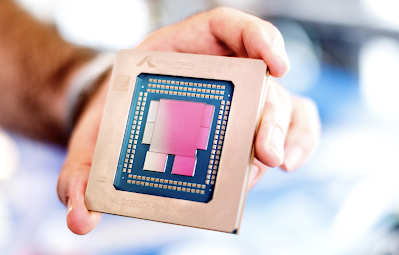
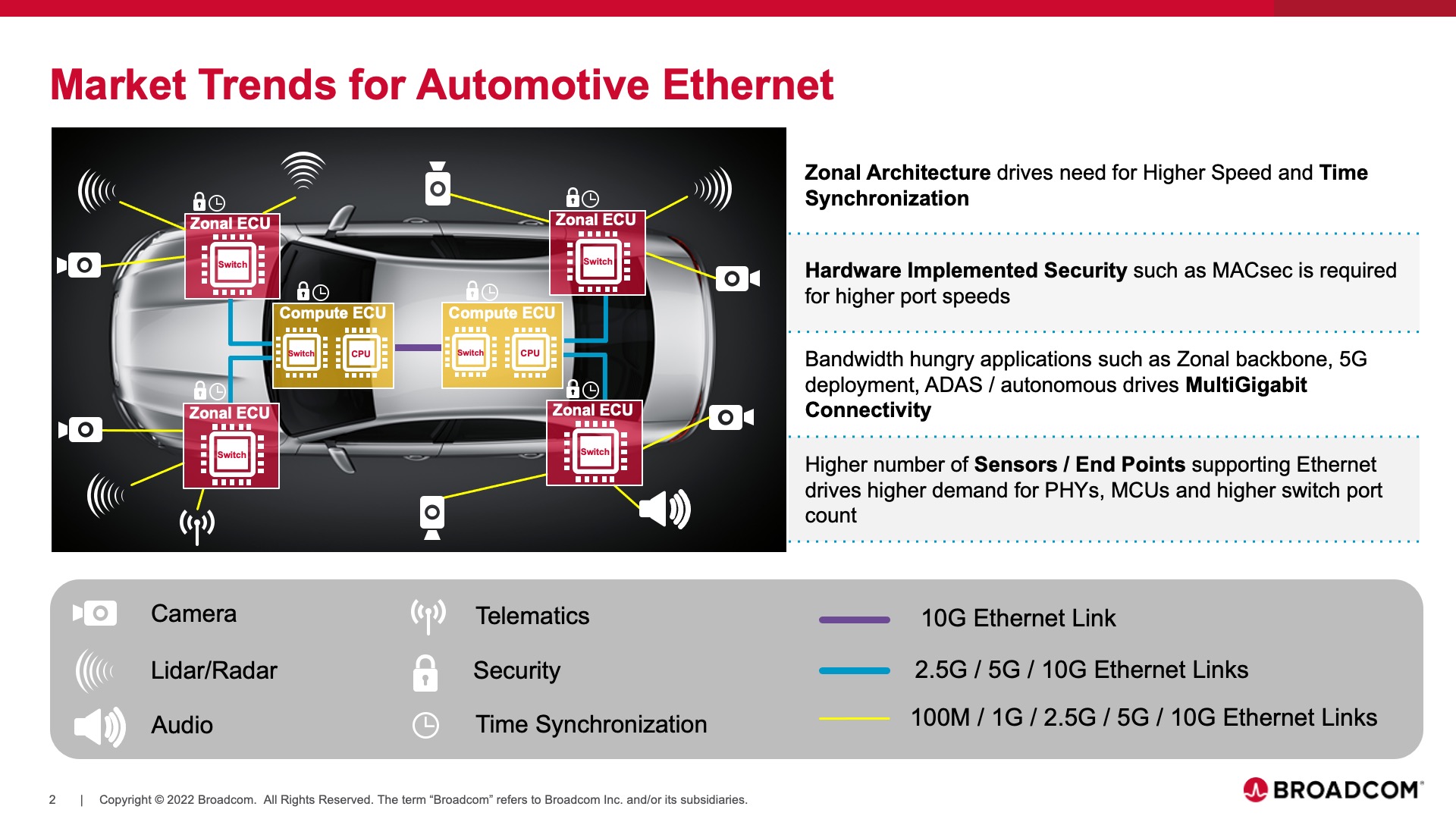
Broadcom  introduced its latest Scorpio Ethernet switch for building next-generation in-vehicle networks based on zonal architecture and capable of supporting large numbers of high-performance sensors and displays.

Broadcom's BCM8958X, which represents the company's 6th generation of automotive Ethernet switch and third generation in its Scorpio family, features 16 Ethernet ports of which up to six are 10 Gbps capable, as well as integrated 1000BASE-T1 and 100BASE-T1 PHYs, providing greater flexibility and switching capacity needed to support automotive zonal electronic control unit (ECU) and central compute ECU architectures. Additionally, this switch is equipped with an advanced rule-based packet filter engine that can adapt to different vehicle operation modes to enhance driving safety.

The company says that as automotive networking becomes more complex and software-defined, many OEMs are adopting a zonal in-vehicle network architecture to connect sensors, high-resolution cameras and displays. The zonal ECUs need to aggregate the data from these connected devices in real time and securely share them across central compute ECUs. The BCM8958X is optimized for use in both zonal ECUs and central compute ECUs that can switch and route large volumes of data for real time decision making. 


BCM8958X highlights:

• 6th generation automotive switch chip with 55 Gb/s switching capacity

• 16-port monolithic die switch

• Six 10G ports: XFI or PCIe x1 4.0 with SRIOV

• Integrated 100BASE-T1 and 1000BASE-T1 PHYs

• ARM subsystem with integrated TCM

• Hardware security and MACsec support

• AVB & TSN (802.1AS-2020, 802.1Qci, 802.1CB, 802.1Qbv)

• Software development kit including drivers, a gPTP protocol stack, and host APIs and providing portability from previous generation products

“Broadcom continues to lead with a comprehensive Ethernet solution for new automotive architectures,” said Vijay Janapaty, vice president and general manager of the Physical Layer

https://www.broadcom.com/company/news/product-releases/60241

T-Mobile advances 5G Private Mobile Network

T-Mobile US announced a 5G Private Mobile Network solution set for enterprise customers. The new 5G Advanced Network Solutions has three options: 5G connectivity with a Public Mobile Network, a Hybrid Mobile Network, and a Private Mobile Network. Customers have the option to add compute to each option or use their own compute provider. And each solution is fully managed. 

  • Customers who need more reliability and faster download speeds than legacy networks provide can use the T-Mobile Public Network for a wide variety of applications from smart meter applications to tracking optimization and more. T-Mobile’s public network is architected so that data travels less distance from the device to the compute resource and back. That’s a big reason T-Mobile 5G is faster with lower latency.
  • Customers who need even faster speeds, lower latency and/or dedicated reliability can use the Hybrid Mobile Network. This is ideal for things like immersive VR training, computer vision and inspections and other demanding applications, without the expense of a fully private solution.
  • Customers who need the highest speeds, reliability and ultra-low latency can use the Private Mobile Network. A private solution is needed for only the most demanding applications, like industrial automation in a factory or fully autonomous robots. 

T-Mobile also announced the following partnerships:

  • T-Mobile and Dell Technologies are developing solutions for enterprise and government customers to embrace the 5G era. T-Mobile’s 5G Private Mobile Network will pair a private 5G network with Dell edge computing technologies, including Dell VxRail hyperconverged infrastructure, so data can be processed, stored and acted upon locally at locations like large business campuses, factories, or universities. It will be available on-premises and be fully managed by T-Mobile.
  • Nokia and T-Mobile are developing 5G Private Mobile Networks and Hybrid Mobile Networks. Nokia’s equipment will be used for T-Mobile’s Hybrid Mobile Network; and for T-Mobile’s Private Mobile Network solution, the Nokia Digital Automation Cloud Private Network solution.
  • Ericsson’s RAN and Core equipment will power T-Mobile’s 5G Advanced Network Solutions.

“As we launch more 5G products and services this year, we’re always thinking about what our customers are telling us they need,” said Mishka Dehghan, Senior Vice President, Strategy, Product, and Solutions Engineering, T-Mobile Business Group. “And, customers are telling us that navigating the complex infrastructure around private networks to produce tangible results is a major pain point. We’re ready to help with partners like Dell Technologies so our customers can stay focused on their business and leave the next-gen connectivity solutions to us.”

http://t-mobile.com/business/solutions/networking/5G-advanced-solutions


UK's Netomnia tests STL's programmable FTTx

STL will test its programmable FTTx (pFTTx) software solution with Netomnia for their live networks in the UK.

STL recently announced general availability for pFTTx, a software-defined, open, and disaggregated Passive Optical Network  solution that is intended to make fibre networks intelligent and agile. 

The company cites core benefits like scalability, enhanced and detailed Telemetry reports, open community alignment (ONF/BBF/ITU-T), onboarding of third party Quality of Experience (QoE) applications, providing a better customer experience along with faster time-to-market and reduced total cost of ownership. This software stack, being cloud-native (Kubernetes microservices-based), can run on any Cloud-native Computing Foundation (CNCF)-based telco Edge Cloud platform. The solution currently supports both XGS-PON and GPON technologies and is upgradeable to 25G. Also, STL's pFTTx solution is certified and listed on the VMware Marketplace.

STL and Netomnia have recently partnered for Optical Fibre deployment and are now collaborating to incorporate programmability into large-scale FTTx networks. Once concluded, this trial will pave the way for the adoption of advanced software-defined architectures for FTTx in the UK.

Commenting on this collaboration, Jeremy Chelot, CEO, Netomnia, said, "The promise of full-fibre broadband will be realised when service providers implement advanced architectures that software-ise the fibre networks. We are excited about the possibilities that STL's pFTTx solution presents. This trial with STL will be significant as we will jointly demonstrate pFTTx in a live scenario."

Commenting on the announcement, Chris Rice, CEO, Access Solutions, STL, said, "pFTTx is a cloud-based access network solution that elevates the network service providers' business model. We are excited to collaborate with Netomnia for their Ultrafast full-fibre broadband program. Our solution is intended to help them achieve accelerated network rollout with faster deployment, provisioning and enhanced network performance."

https://www.stl.tech/press_release/Netomnia-and-STL-to-collaborate-for-testing-of-programmable-FTTx-in-live-networks/

STL launches VMWare-powered programmable FTTx

STL introduced its Programmable FTTx (pFTTX), a software-defined, open, and disaggregated solution that is now now listed on VMware Telco Cloud Infrastructure 2.0 OpenStack Edition Platform. STL said its pFTTx solution enables cloud- native networks with open interfaces by disaggregating the software from the hardware layer.Speaking at the launch, Gaurav Agarwal, Sr. Director - Enterprise & Government Sales from VMware India, said: “We...


First systems powered by NVIDIA's Grace and Grace Hopper Superchips

Leading Taiwanese computer makers are introducing the firstsystems powered by the NVIDIA's new Grace CPU Superchip and Grace Hopper Superchip.

Dozens of server models from ASUS, Foxconn Industrial Internet, GIGABYTE, QCT, Supermicro and Wiwynn are expected starting in the first half of 2023. The Grace-powered systems will join x86 and other Arm-based servers to offer customers a broad range of choice for achieving high performance and efficiency in their data centers.

The coming servers are based on four new system designs featuring the Grace CPU Superchip and Grace Hopper Superchip, which NVIDIA announced at its two most recent GTC conferences. 

“A new type of data center is emerging — AI factories that process and refine mountains of data to produce intelligence — and NVIDIA is working closely with our Taiwan partners to build the systems that enable this transformation,” said Ian Buck, vice president of Hyperscale and HPC at NVIDIA. “These new systems from our partners, powered by our Grace Superchips, will bring the power of accelerated computing to new markets and industries globally.”

The Grace CPU Superchip features two CPU chips, connected coherently through an NVIDIA NVLink-C2C interconnect, with up to 144 high-performance Arm V9 cores with scalable vector extensions and a 1 terabyte-per-second memory subsystem. The design provides the highest performance and twice the memory bandwidth and energy efficiency of today’s leading server processors to address the most demanding HPC, data analytics, digital twin, cloud gaming and hyperscale computing applications.

The Grace Hopper Superchip pairs an NVIDIA Hopper GPU with a Grace CPU over NVLink-C2C in an integrated module designed to address HPC and giant-scale AI applications. Using the NVLink-C2C interconnect, the Grace CPU transfers data to the Hopper GPU 15x faster than traditional CPUs.

The Grace CPU Superchip and Grace Hopper Superchip server design portfolio includes systems available in single baseboards with one-, two- and four-way configurations available across four workload-specific designs that can be customized by server manufacturers according to customer needs:

  • NVIDIA HGX Grace Hopper systems for AI training, inference and HPC are available with the Grace Hopper Superchip and NVIDIA BlueField-3 DPUs.
  • NVIDIA HGX Grace systems for HPC and supercomputing feature the CPU-only design with Grace CPU Superchip and BlueField-3.
  • NVIDIA OVX systems for digital twins and collaboration workloads feature the Grace CPU Superchip, BlueField-3 and NVIDIA GPUs.
  • NVIDIA CGX systems for cloud graphics and gaming feature the Grace CPU Superchip, BlueField-3 and NVIDIA A16 GPUs.

OneWeb signs Gogo Business Aviation

OneWeb confirmed a long-term distribution partnership agreement with Gogo Business Aviation, whereby the inflight connectivity solutions provider will market and sell OneWeb’s high-speed, low latency inflight broadband services to business aviation users globally.  

The agreement, OneWeb’s first announced distribution partner for the business aviation market, was signed at EBACE between Ben Griffin Vice President Mobility at OneWeb and, Jim MacDougall Vice President, Product Management for Gogo.

Gogo Business Aviation has more than 4,500 narrowband satcom systems installed and flying worldwide, and is a factory option at every major business aircraft manufacturer. 

MacDougall commented: “For more than 30 years, Gogo Business Aviation has been a driving force behind the technological innovations that have connected the skies. “This agreement with OneWeb enables Gogo to continue to disrupt and innovate to bring our customers superior connectivity solutions while expanding our service to a global audience.”  

https://oneweb.net/resources/oneweb-partners-gogo-business-aviation-revolutionise-flight-connectivity-business-jet

GSMA: Mobile operators commit to greenhouse gas reductions

The number of mobile operators committed to rapid emissions cuts has increased by more than 50% over the last year, according to GSMA's new 2022 Mobile Net Zero Report.

GSMA finds 49 operators representing 62% of the industry by revenue have now committed to rapidly cutting emissions over the next decade. This represents an increase of 18 operators since 2020, despite the challenges of Covid-19. In addition, 50% of mobile network operators by revenue have now committed to net-zero targets by 2050 or earlier.

Despite double-digit growth in data traffic and the global expansion of 5G networks, the report shows that operators successfully limited increases in carbon emissions to 2% on average in 2021. Investment in more energy-efficient network equipment and lower-carbon energy sources helped industry players limit their carbon impact, even as networks grew significantly to meet consumer demand.

GSMA’s Director General Mats Granryd said, “We are proud that the mobile industry continues to align around the 1.5C decarbonization pathway, even in the face of double-digit growth in demand for mobile services. We have far more to do to achieve our net zero ambitions, but mobile will undeniably play an essential role in helping industries and individuals across the globe reduce their carbon impact. The connected solutions we underpin, such as remote working, IoT and automation, are key enablers in reducing travel, cutting emissions in other industries and transitioning to a lower carbon future. We also take our responsibilities seriously, with greater disclosure and strict targets to reduce our own emissions, as we show in our annual Mobile Net Zero report.”

https://www.gsma.com/betterfuture/resources/mobile-net-zero-state-of-the-industry-on-climate-action-2022-report

Sunday, May 22, 2022

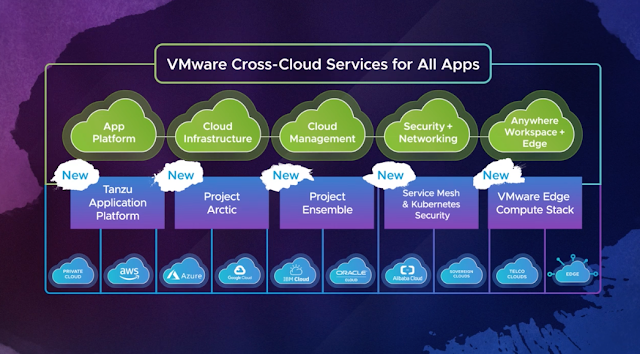
Reports: Broadcom in talks to acquire VMware

Multiple U.S. media sources, including the Wall Street Journal and The New York Times, reported that Broadcom is in advanced talks to acquire VMware. 

Neither company has commented on the reports, which cite anonymous sources. 


VMware completes spin-Off from Dell Technologies

VMware completed its spin-off from Dell Technologies. The move provides VMware increased freedom to execute its multi-cloud strategy, a simplified capital structure and governance model, and additional operational and financial flexibility. VMware and Dell said they will continue to partner with each other and to continue support/services to mutual customers.“VMware’s mission is to deliver the trusted software foundation that accelerates our customers’...


Trump blocks Broadcom's proposed takeover of Qualcomm

President Trump signed an executive order prohibiting Broadcom from acquiring Qualcomm or proceeding with any substantially equivalent merger, acquisition, or takeover of the firm whether effected directly or indirectly. The order cited "credible evidence" that Broadcom, along with its partners, subsidiaries, or affiliates, impairs the national security of the United States. Trump said he was taking this action upon review of a recommendation...


BT trials new hyper-sensitive quantum radio receiver

BT is testing a new hyper-sensitive quantum antenna technology uses ‘excited atoms’ to deliver over 100x greater sensitivity than traditional receivers.

BT says Atomic Radio Frequency (RF) receiver technology represents a revolutionary new way of detecting radio waves that could find much weaker signals than conventional receivers. The receiver works by using a quantum effect called “electromagnetically induced transparency” to form a highly sensitive electric field detector. BT’s trial represents the first time a digitally-encoded message has been received on a 3.6GHz (5G) carrier frequency. Previously, simple audio has been received using much higher frequencies but this trial is the first industrial demonstration using digital modulation within one of EE’s main commercial 5G frequency ranges.

Researchers at BT Labs in Martlesham are now working to miniaturise the equipment and find the optimum RF modulation and signal processing for potential use in future generations of radio networks. BT has secured a number of patents related to the implementation of the atomic RF receiver and is the first company to make use of the technology to send a message at 3.6GHz. Earlier this year, BT also had its first external publication on its atomic RF Receivers accepted for publication in the prestigious Journal of Lightwave Technology. 

Howard Watson, Chief Technology Officer of BT said: “BT’s investment in cutting edge R&D plays a central role in ensuring the UK remains a network technology leader. Our programme has huge potential to boost the performance of our next generation EE network and deliver an even better service to our customers. Although it’s early days for the technology, we’re proud to be playing an instrumental role in developing cutting edge science”.

BT tests Quantum Key Distribution over hollow core fibre 

 BT has conducted a trial of Quantum Key Distribution (QKD) over hollow core fibre cable developed by Lumenisity, a spin out from Southampton University.Testing of Nested Anti-Resonant Nodeless Fibre (NANF) hollow core fibre kicked off this summer at the BT Labs in Ipswich.BT researchers operated a state-of-the-art QKD system using commercial equipment over a 6-kilometre-long Lumenisity CoreSmart cable with a hollow, air-filled centre, revealing...


Canada bans Huawei and ZTE for 5G

Citing security concerns, the Government of Canada banned Huawei and ZTE from participating in the nation's 5G rollout.  Specifically:

  • The use of new 5G equipment and managed services from Huawei and ZTE will be prohibited and existing 5G equipment and managed services must be removed or terminated by June 28, 2024.
  • Any use of new 4G equipment and managed services from Huawei and ZTE will be prohibited and any existing 4G equipment and managed services must be removed or terminated by December 31, 2027.
  •  The Government expects that telecommunications service providers will cease procurement of new 4G or 5G equipment and associated services by September 1, 2022.
  • The government further intends to impose restrictions on Gigabit Passive Optical Network (GPON) equipment used in fibre-optic networks.
  • During these transition periods, telecommunications service providers that use this equipment and managed services would be required to comply with any assurance requirements prescribed by the government, building from the Communications Security Establishment’s Security Review Program.

https://www.canada.ca/en/innovation-science-economic-development/news/2022/05/policy-statement--securing-canadas-telecommunications-system.html

Huawei's Meng Wanzhou resolves legal case brought by U.S.

Wanzhou Meng, Chief Financial Officer of Huawei Technologies, reached an agreement with the United States Attorney’s Office for the Eastern District of New York, the Counterintelligence and Export Control Section of the Justice Department’s National Security Division (CES), and the Money Laundering and Asset Recovery Section of the Justice Department’s Criminal Division (MLARS). As a result, the U.S. Department of Justice withdrew its request to...


FCC eyes higher speed goals for small rural broadband

The Federal Communications Commission is seeking comment on a proposal to provide additional universal service support to certain rural carriers in exchange for increasing deployment to more locations at higher speeds.  

The proposal would make changes to the Alternative Connect America Cost Model (A-CAM) program, with the goal of achieving widespread deployment of faster 100/20 Mbps broadband service throughout the rural areas served by rural carriers currently receiving A-CAM support.  

The ACAM Broadband Coalition submitted a proposal to create an Enhanced A-CAM program, which is the impetus for the Notice of Proposed Rulemaking adopted today.  Enhanced A-CAM, as proposed, would raise the broadband speeds required by the A-CAM programs to those generally required by the Infrastructure Investment and Jobs Act, while minimizing duplicative support across different federal broadband programs.  

https://www.fcc.gov/document/fcc-proposes-higher-speed-goals-small-rural-broadband-providers-0

AMD and Qualcomm optimize Wi-Fi 6 and 6E on laptops

AMD and Qualcomm Technologies are working to optimize the Qualcomm FastConnect connectivity system for AMD Ryzen processor-based computing platforms, starting with AMD Ryzen PRO 6000 Series processors and the Qualcomm FastConnect 6900. This will enable optimized Wi-Fi 6 and 6E connectivity on business laptops powered by AMD Ryzen processors.

In collaboration with Microsoft, next-generation Windows 11 PCs, such as the Lenovo ThinkPad Z Series and HP EliteBook 805 Series, can harness the full potential of Windows 11 Wi-Fi Dual Station through Qualcomm 4-Stream Dual Band Simultaneous. Multiple Wi-Fi bands outperform traditional single band connections for improved video conferencing experiences, reduced latency, and enhanced connection robustness. Leveraging the 6 GHz band, next-gen laptop users can take full advantage of its bandwidth and speed improvements without competing with any non-6E devices.

Out-of-band Wi-Fi remote management is an important tool for enterprise IT managers to diagnose and fix issues, even when the operating system is not running,” said Jason Banta, CVP and General Manager, OEM Client Computing, AMD.  “AMD Ryzen™ PRO 6000 Series processors with Qualcomm FastConnect 6900 enable next generation business laptops to have the processing and connectivity tools needed to perform in modern environments, offering professional-strength remote manageability for users in the new, hybrid workplace.”

“Our collaboration with AMD reflects Qualcomm Technologies’ commitment to the mobile computing space. By optimizing FastConnect 6900 for platforms powered by AMD Ryzen 6000 Series processors, we’re bringing secure Wi-Fi remote management to AMD enterprise customers,” said Dino Bekis, vice president and general manager, Mobile Compute and Connectivity, Qualcomm Technologies, Inc. “This represents the first step in our relationship to bring superior wireless connectivity to the AMD mobile computing roadmap.” 

https://www.amd.com/en/press-releases/2022-05-17-amd-and-qualcomm-collaborate-to-optimize-fastconnect-connectivity


Cato opens SASE PoP in Marseilles

Cato Networks inaugurated its Marseilles point of presence (PoP), its twentieth PoP in EMEA. 

With the new PoP, Cato extends enterprise-grade threat prevention, data protection, and global traffic optimization to the sites and users in Southern France. Cato already operates a PoP in Paris. The Cato SASE Cloud delivers a full suite of converged security capabilities -- Zero Trust Network Access (ZTNA), Secure Web Gateway (SWG), Cloud Access Security Broker (CASB), Firewall as a Service (FWaaS), IPS as a Service, and Next Generation Anti-malware (NGAM). All available from 70+ PoPs worldwide, servicing 150+ countries, and interconnected by Cato's global private backbone that uses built-in WAN optimization to far outperform legacy MPLS services.

"With the rise of ransomware, cyberthreats, and the need for secure and optimized, global application access, Cato has seen strong demand for our cloud-native SASE platform," says Luca Simonelli, vice president of EMEA sales, "The Marseilles PoP helps meet that demand extending the reach of the Cato SASE Cloud while extending the cloud platform's resiliency within France. The expansion is just part of our strategic plan to continue investing in the EMEA region."

https://www.catonetworks.com/