Showing posts with label FCC. Show all posts

Monday, November 13, 2023

U.S. outlines National Spectrum Strategy

 The White House published a National Spectrum Strategy that aims to expand access to advanced wireless broadband networks and technologies, whether terrestrial-, airspace-, satellite- or space-based, for all Americans. 

The 23-page paper was developed by the National Telecommunications and Information Administration (NTIA), in collaboration with the FCC and in coordination with other Federal agencies.

The Strategy has four pillars

  • Pillar One: A Spectrum Pipeline to Ensure U.S. Leadership in Advanced and Emerging Technologies
  • Pillar Two: Collaborative Long-Term Planning to Support the Nation’s Evolving Spectrum Needs
  • Pillar Three: Unprecedented Spectrum Innovation, Access, and Management through Technology Development
  • Pillar Four: Expanded Spectrum Expertise and Elevated National Awareness

Significantly this Strategy identifies five spectrum bands in government hands totaling 2,786 megahertz of mostly mid-band spectrum for in-depth, near-term study to determine suitability for potential repurposing to address evolving needs,, including terrestrial wireless broadband, innovative space services, and unmanned aviation and other autonomous vehicle operations. This includes the following:

Lower 3 GHz (3.1-3.45 GHz)

  • The Department of Defense (DoD) has studied the potential for sharing 350 megahertz of spectrum with the private sector, determining that sharing is feasible with advanced interference-mitigation features and a coordination framework.
  • The Departments of Commerce and Defense will co-lead follow-on studies focusing on future use of the 3.1-3.45 GHz band, exploring dynamic spectrum sharing and private-sector access while preserving Federal mission capabilities
5030-5091 MHz
  •  The FCC, in coordination with NTIA and the Federal Aviation Administration, will facilitate limited deployment of UAS in this band, followed by studies to optimize UAS spectrum access while avoiding harmful interference to other operations.
7125-8400 MHz
  •  This 1,275 megahertz of spectrum will be studied for wireless broadband use, with some sub-bands potentially studied for other uses, while protecting incumbent users from harmful interference.
18.1-18.6 GHz
  • This 500 megahertz of spectrum will be studied for expanded Federal and non-Federal satellite operations, consistent with the U.S. position at the 2023 World Radiocommunication Conference.
37.0-37.6 GHz
  • This 600 megahertz of spectrum will be further studied to implement a co-equal, shared-use framework allowing Federal and non-Federal users to deploy operations in the band.
Thursday, June 8, 2023

FCC considers spectrum sharing for 42 GHz band

The FCC opened a proceeding to consider innovative sharing models in 500 megahertz of spectrum in the 42 GHz band. 

As the spectrum between 42-42.5 GHz is largely unused, the FCC proposes exploring an innovative, non-exclusive spectrum access model in this greenfield spectrum, which is ideal for experimentation due to the lack of incumbent licensees.

The FCC proceeding build a record on the benefits and drawbacks of implementing a shared licensing approach in this band.  It will seek comment on three specific shared licensing approaches: 1) a nationwide non-exclusive licensing approach, in which licensees coordinate specific deployment sites with a third-party database; 2) a site-based licensing approach, in which licensees would apply for each deployment site directly with the FCC; and 3) a technology-based sensing approach, in which operators would employ such technologies to avoid harmful interference from one another.

The NPRM proposes licensing the 42 GHz band as five 100 megahertz channels, and seeks comment on other aspects of implementing a shared licensing approach, including coordination mechanisms, first-in-time protections, buildout requirements, technical rules, and potential synergies with the sharing approaches being considered for the Lower 37 GHz (37-37.6 GHz) band.  It also proposes measures to protect radioastronomy services in the adjacent 42.5-43.5 GHz band.

FCC Chairwoman Jessica Rosenworcel states: So much of what is creative in wireless happened here first, on our shores.  And this agency played no small part in making this true.  We were the first to borrow the academic ideas of Ronald Coase and reimagine the distribution of airwaves with auctions.  More than three decades later we have raised $233 billion using this tool—one we need Congress to continue.  We were also the first to take a handful of underused frequencies known as “garbage bands” in the 900 MHz, 2.4 GHz, and 5.8 GHz range and do something radical—give the public access to these airwaves.  It worked because this is the unlicensed spectrum where Wi-Fi was born.  More recently, we blazed a trail for incentive auctions—again, the first to do this in the world.  We also created an innovative structure with a hierarchy of rights in the 3.5 GHz band combined with new systems to support dynamic spectrum access.  

Our goal today is to continue that creative streak.  This time we are going to do it with a millimeter wave band.  When I took over at the Federal Communications Commission, I believed the agency had overinvested in millimeter wave auctions at the expense of moving to market the mid-band spectrum essential for nationwide 5G service.  So we pivoted—fast.  With the help of my colleagues, we quickly launched auctions in the 3.45 GHz band and 2.5 GHz band.  With those successful mid-band efforts in the rear-view mirror, we are now turning back to millimeter wave.  But this time we want to consider something different.  

In the 42 GHz band we have 500 megahertz of greenfield airwaves with no federal or commercial incumbencies.  So we are putting out ideas.  We are exploring non-exclusive access models.  This could entail using a technology-based sensingmechanism to help operators actively detect and avoid one another.  It could involve non-exclusive nationwide licenses that leverage a database to facilitate co-existence.  It could also entail site-based licensing.  To get even more out of this effort we ask if our approaches could be combined with shared-used models in other spectrum bands, like the lower 37 GHz band."  

https://www.fcc.gov/document/fcc-explores-spectrum-sharing-approaches-42-ghz-spectrum-band

Sunday, April 9, 2023

FCC opens Space Bureau and Office of International Affairs

The FCC is opening a new Space Bureau and Office of International Affairs on April 11.

Once the reorganization is complete, the agency’s International Bureau will become two separate, cooperative units within the agency:

  •  The Space Bureau (SB) will promote a competitive and innovative global communications marketplace by leading policy and licensing matters related to satellite and space-based communications and activities. Among its responsibilities, the Bureau will lead complex policy analysis and rulemakings; authorize satellite and earth station systems used for space-based services; streamline regulatory processes to provide maximum flexibility for operators to meet customer needs; and foster the efficient use of scarce spectrum and orbital resources.  The Bureau will also serve as a focal point for coordination with other U.S. government agencies on matters of space policy and governance, and collaborate with the Office of International Affairs for consultations with other countries, international and multi-lateral organizations, and foreign government officials that involve satellite and space policy matters.
  •  The Office of International Affairs (OIA) will be responsible for the Commission's engagement of foreign and international regulatory authorities, including multilateral and regional organizations.  OIA will also facilitate through rulemaking and licensing the Commission’s development of policies regarding international telecommunications facilities and services as well as submarine cables, and advise the Commission on foreign ownership issues.   In undertaking these functions, OIA will implement Commission policies to facilitate competition and foreign investment in U.S. international telecommunications markets while ensuring, in consultation with relevant federal partners, that national security, law enforcement, foreign policy, and trade policy concerns are addressed.  OIA also will be responsible for intergovernmental leadership, negotiation, and international and inter-agency representational functions.  OIA will oversee and coordinate the FCC’s global participation in international and multilateral conferences, regional organizations, cross-border negotiations and international standard setting efforts.  OIA will also oversee bilateral meetings with other countries and foreign government officials.   

“Our country’s economic success today and in the future relies on space-based connections,” said Chairwoman Rosenworcel.  “Whether it’s bringing broadband to hard-to-connect rural communities, closing mobile dead zones, or linking freedom-seeking people across the globe, satellite connectivity is fundamental to improving our quality of life and maintaining our economic success.  That is why the FCC has made important structural changes to meet the needs of space innovation.”

https://www.fcc.gov

Tuesday, March 7, 2023

Gigi Sohn drops bid for FCC commissioner seat

Over one year after being nominated by President Biden, Gigi Sohn formally withdrew from consideration as an FCC commissioner. 

The position requires U.S. Senate consent and despite three confirmation hearings, it did not appear likely that she could gain  approval. 

For now, the fifth seat at the FCC remains vacant.


Biden nominates Jessica Rosenworcel and Gigi Sohn to FCC

President Biden nominated Jessica Rosenworcel to serve as Chair of the Federal Communications Commission and Gigi Sohn as Commissioner of the FCC.Jessica Rosenworcel presently serves as acting chair of the FCC. She has served as a Commissioner since 2012. Prior to joining the agency, she served as Senior Communications Counsel for the United States Senate Committee on Commerce, Science, and Transportation, under the leadership of Senator John D....


Sunday, January 22, 2023

FCC publishes rules for 4.9 GHz band

The FCC published a 166-page report and order that establishes a coordinated nationwide approach to managing the 4.9 GHz (4940-4990 MHz) band. The new rules introduce a nationwide Band Manager, which will be selected based on its expertise and connections to the public safety community and will coordinate all operations in the band to ensure that any non-public safety use remains fully secondary to, and preemptible by, public safety operations.  This nationwide framework will optimize public safety use and enable the integration of the latest commercially available technologies, such as 5G. The FCC is seeking comment on details of implementing this model.

The new rules allow for the collection of granular data on public safety operations in the 4.9 GHz band in order to improve interference mitigation efforts and bolster public safety confidence in the band. 

https://www.fcc.gov/document/fcc-updates-49-ghz-band-rules-seeks-further-comment

Monday, January 9, 2023

FCC to establish Space Bureau

 The FCC voted to establish a Space Bureau and Office of International Affairs in order to better support the needs of the growing satellite industry, promote long-term technical capacity at the FCC, and help the agency navigate 21st century global communications policy.  As part of this plan, the agency will be eliminating the current International Bureau and incorporating that team into the new bureau and office.  

"The satellite industry is growing at a record pace, but here on the ground our regulatory frameworks for licensing have not kept up.  We’re working to change that.  Today, we are moving forward with our plan to prepare for what comes next,” said Chairwoman Rosenworcel.  “A new Space Bureau at the FCC will ensure that the agency's resources are appropriately aligned to fulfill its statutory obligations, improve its coordination across the federal government, and support the 21st century satellite industry.  I also thank my fellow Commissioners for their support.

http://www.fcc.gov

FCC clears Starlink for up to 7,500 satellites

The FCC granted SpaceX authority to construct, deploy, and operate up to 7,500 satellites operating at altitudes of 525, 530, and 535 km and inclinations of 53, 43, and 33 degrees, respectively, using frequencies in the Ku- and Ka-band. The FCC defered a decision on the full SpaceX Gen2 Starlink application, which envisions up to 29,988 LEO satellites in its constellation,The FCC also granted SpaceX’s request for authority to conduct launch and early...

FCC grants first Satellite-to-Mobile license to Lynk Global

The FCC granted the first-ever commercial license for a satellite-direct-to-standard-mobile-phone service to Lynk Global. The license enables Lynk to launch commercial services for its global constellation of satellites later this year.Lynk launched Lynk Tower 1, the first satellite covered by the FCC license, on April 1. Lynk is scheduled to launch three more satellites — also known as Lynk Towers 2, 3 and 4 and Lynk’s 7th, 8th, and 9th cell-towers-in-space...


Monday, December 5, 2022

FCC issues 2.5 GHz licenses from Auction 108

The FCC’s Wireless Telecommunications Bureau  granted the first batch of new, flexible-use, county-based overlay wireless licenses made available in the 2.5 GHz auction, Auction 108.  With most of the available spectrum in the 2.5 GHz band located in rural areas, this auction provides vital spectrum resources to support wireless services in rural communities.  

In total, the FCC granted 51 of the 68 total long-form applications received from winning bidders in Auction 108, following a thorough review of the applications and a period of public comment.  Of the 51 applications granted, 15 applicants obtained small business bidding credits and 23 obtained rural service provider bidding credits.  Staff review of the remaining Auction 108 long-form applications remains ongoing.  

“This is important spectrum, especially for rural America.  I am grateful to our team for moving forward quickly but carefully in processing these applications,” said FCC Chairwoman Jessica Rosenworcel.  “We continue to focus on ensuring that mid-band spectrum is available for 5G and other next-generation wireless services.”

http://www.fcc.gov

FCC incentivizes to open underutilized spectrum for rural carriers

The FCC voted to create an Enhanced Competition Incentive Program (ECIP) to establish incentives for wireless licensees to make underutilized spectrum available to small carriers, Tribal Nations, and entities serving rural areas. The new program encourages licensees to partition, disaggregate, or lease spectrum to better match available spectrum resources with entities that seek to provide needed services to under-connected communities.  Under...


Sunday, December 4, 2022

FCC clears Starlink for up to 7,500 satellites

The FCC granted SpaceX authority to construct, deploy, and operate up to 7,500 satellites operating at altitudes of 525, 530, and 535 km and inclinations of 53, 43, and 33 degrees, respectively, using frequencies in the Ku- and Ka-band. The FCC defered a decision on the full SpaceX Gen2 Starlink application, which envisions up to 29,988 LEO satellites in its constellation,

The FCC also granted SpaceX’s request for authority to conduct launch and early orbit phase (LEOP) operations and testing during orbit-raising, as well as tracking, telemetry and command (TT&C) during the process of removing its satellites from orbit, consistent with the parameters described in the application and related materials.

In addition, the FCC ruling deferred consideration of SpaceX’s proposed use of E-band frequencies and tracking beacons. 

https://www.fcc.gov/document/fcc-partially-grants-spacex-gen2-broadband-satellite-application

  • In a January 2022 filing with the FCC, SpaceX proposed to operate 29,988 satellites at altitudes ranging from 340 km to 614 km.39 Approximately two thirds of the satellites (19,440) would be deployed in shells centered at altitudes from 340 km to 360 km (below the International Space Station (ISS)), approximately one third (10,080) would be deployed in shells centered at altitudes from 525 km to 535 km (above ISS and below SpaceX’s Gen1 Starlink constellation), and 468 satellites would be deployed into retrograde inclinations in shells centered at altitudes of 604 km and 614 km (above Gen1).


Sunday, November 27, 2022

FCC issues new ban covering Chinese video surveillance equipment

The FCC issued new rules prohibiting the importation or use of communications equipment and video surveillance systems produced by Huawei Technologies, ZTE Corporation, Hytera Communications, Hangzhou Hikvision Digital Technology, and Dahua Technology (and their subsidiaries and affiliates). 

The FCC said such equipment is deemed to pose an unacceptable risk to national security. 

“The FCC is committed to protecting our national security by ensuring that untrustworthy communications equipment is not authorized for use within our borders, and we are continuing that work here,” said Chairwoman Jessica Rosenworcel. “These new rules are an important part of our ongoing actions to protect the American people from national security threats involving telecommunications.”

The new rules prohibit the authorization of equipment through the FCC’s Certification process, and makes clear that such equipment cannot be authorized under the Supplier’s Declaration of Conformity process or be imported or marketed under rules that allow exemption from an equipment authorization. 

https://www.fcc.gov/document/fcc-bans-authorizations-devices-pose-national-security-threat

Sunday, November 20, 2022

FCC releases National Broadband Maps

The FCC published a pre-production draft of its new National Broadband Map, displaying specific location-level information about broadband services available throughout the country. By entering a U.S. address, it is possible to see which providers are offering broadband services at that premise. 

  • The Fixed Broadband Map shows the fiber, cable, DSL, satellite, or fixed wireless internet services available at each home or small business on the map. When you select a location, you can see which providers report making broadband service available at that location and the types of service or technologies and the maximum advertised download and upload speeds they each offer. 
  • The Mobile Broadband Map shows 3G, 4G, and 5G coverage of each mobile provider in the area displayed. The coverage areas reflect where consumers should be able to connect to the mobile network when outdoors or in a moving vehicle; the map does not show indoor coverage. The map also allows users to compare mobile wireless coverage reported by different mobile service providers.

The FCC will conduct a public challenge processes that will play a critical role in improving the accuracy of the map. An accurate map is an important resource for targeting funding and other efforts to bring broadband to unserved and underserved communities.

“Today is an important milestone in our effort to help everyone, everywhere get specific information about what broadband options are available for their homes, and pinpointing places in the country where communities do not have the service they need,” said Chairwoman Rosenworcel. “Our pre-production draft maps are a first step in a long-term effort to continuously improve our data as consumers, providers and others share information with us. By painting a more accurate picture of where broadband is and is not, local, state, and federal partners can better work together to ensure no one is left on the wrong side of the digital divide.”

The FCC also announced the launch of an updated version of the FCC Speed Test App that will enable users to quickly compare the performance and coverage of their mobile networks to that reported by their provider. 

https://broadbandmap.fcc.gov/home#/

Thursday, November 17, 2022

FCC updates 911 rules

The FCC updated its rules to promote public safety by ensuring that 911 call centers receive timely and useful notifications of network disruptions that affect 911 service. 

These notifications will help 911 call centers maintain emergency services and inform the public when to use alternatives to call 911.

One of the ways the Commission oversees the integrity of 911 communications infrastructure is by requiring service providers to report network outages to both the Commission and 911 call centers. At present, the Commission has different outage notification rules for providers that serve 911 call centers (covered 911 service providers) and the wireless, wireline, and VoIP providers that individuals use to call 911 (originating service providers). The Commission today improved the framework for reporting network outages that potentially affect 911 service and harmonized requirements, including the means, timing, and frequency of providing notification. The updated rules will standardize the type of information conveyed in the notifications and ensure that it is clear and actionable, regardless of where in the call processing network an outage occurs.

The updated rules also require service providers to maintain up-to-date contact information for the 911 call centers they serve. In addition, the Commission retained its current requirement that covered 911 service providers file annual 911 reliability certifications, which will help the Commission promote the continuity of 911 service during the transition to Next Generation 911.

https://www.fcc.gov/document/fcc-updates-rules-improve-911-reliability

Sunday, November 6, 2022

FCC Chairwoman Rosenworcel proposes Space Bureau

FCC Chairwoman Jessica Rosenworcel announced a plan to reorganize the FCC’s International Bureau into a new Space Bureau and a standalone Office of International Affairs. 

"The satellite industry is growing at a record pace, but here on the ground our regulatory frameworks for licensing them have not kept up. Over the past two years the agency has received applications for 64,000 new satellites. In addition, we are seeing new commercial models, new players, and new technologies coming together to pioneer a wide-range of new satellite services and space-based activities that need access to wireless airwaves,” said Chairwoman Rosenworcel. “Today, I announced a plan to build on this success and prepare for what comes next. A new Space Bureau at the FCC will ensure that the agency's resources are appropriately aligned to fulfill its statutory obligations, improve its coordination across the federal government, and support the 21st century satellite industry."

The Commission licenses radio frequency uses by satellites and ensures that space systems reviewed by the agency have sufficient plans to mitigate orbital debris under the authority of the Communications Act of 1934, as amended. By establishing a stand-alone Space Bureau the agency aims to better fulfill its statutory obligations and elevate the significance of satellite programs and policy within the agency to a level that reflects the importance of the emerging space economy. By separating satellite policy from the “International Bureau,” the agency acknowledges the role of satellite communications in advancing domestic communications policy and achieving U.S. broadband goals.

https://www.fcc.gov/document/chairwoman-rosenworcel-proposes-space-bureau

Tuesday, November 1, 2022

FCC considers opening 12.7 GHz band for next-gen wireless

The FCC will launch a proceeding to explore repurposing up to 550 megahertz in the 12.7 to 13.25 GHz band (12.7 GHz band) for next-generation wireless services.  

The FCC expects that this inquiry is the first step in providing for more intensive use of the 12.7 GHz band, unlocking a significant expanse of valuable mid-band frequencies that may play a key role in delivering on the promise of next-generation wireless services, including 5G, 6G, and beyond.  

The 12.7 GHz band is believed to be ideally suited for mobile broadband use as it is already allocated for terrestrial mobile services on a primary basis domestically.

The Notice of Inquiry seeks information on how the Commission could encourage more efficient and intensive use of the 12.7 GHz band.  

Given existing incumbent operations in the band, the FCC is also seeking comment on whether and how to provide opportunities for new uses while protecting the investments made by incumbents and avoiding disruption to their operations.  

FCC adds $791 million in RDOF funding for broadband

The FCC is ready to authorize $791,604,299 through the Rural Digital Opportunity Fund to six providers to fund new broadband deployments to over 350,000 estimated locations in 19 states.  The top three states receiving funding include Illinois, $212 million, Arizona, $140 million, and Iowa, $113 million. “This funding will connect more households throughout the country with high-speed broadband as part of our ongoing work to close the digital...

FCC Auction 108 concludes - 2.5 GHz Spectrum

Bidding has concluded in the FCC Auction 108.  Gross proceeds from the bid are expected to amount to $427,789,670.The FCC said it will post full results in the next few days. https://auctiondata.fcc.gov/public/projects/auction108FCC commences 5G mid-band spectrum auctionSunday, July 31, 2022  Auctions, FCC  The FCC opened bidding in its latest mid-band spectrum auction at 10am on Friday, July 29.Auction 108 makes...


Sunday, October 2, 2022

FCC: Florida cell sites recover from Hurricane Ian

A total of 444 cell sites remained out-of-service in Florida as of 02-October-2022, representing 5.5% of the state's cell sites. The down significantly from the peak of 1,552 cell sites out of commission on Thursday.

Cable and wireline companies reported the following number of subscribers out of service by state in the disaster area; this may include the loss of telephone, television, and/or Internet services:

Florida: 606,553 

South Carolina: 9,845

https://www.fcc.gov

Thursday, September 29, 2022

Hurricane Ian knocks out 1,552 cell sites in Florida

As of 29-September-2022, the FCC reports that 1,552 cell sites were out of service in Florida, approximately 11% of the 14,188 cell sites in the state. 

Of these, the FCC lists 180 cell sites as damaged/destroyed by the storm, while 795 cell sites are offline due to power issues, while 527 are on backup power.


The number of cell site outages in a specific area does not necessarily correspond to the availability of wireless service to consumers in that area. 

Cable and wireline companies reported 525,966 subscribers out of service in the disaster area for Hurricane Ian; this includes the loss of telephone, television, and/or Internet services. 

https://www.fcc.gov/document/hurricane-ian-communications-status-report-september-29-2022

Friday, September 9, 2022

FCC Chair proposes 5-year rule to de-orbit nonfunctioning LEO sats

FCC Chairwoman Jessica Rosenworcel put forward new rules that would require satellite operators in low-Earth orbit to dispose of their satellites within 5 years of completing their missions. If adopted by a vote of the full Commission at its September monthly meeting, the new rules will shorten the existing 25-year guideline for deorbiting satellites after they cease to function.

“Since 1957 humanity has put thousands of satellites into the sky, often with the understanding that they were cheaper to abandon than take out of orbit. These satellites can stay in orbit for decades, careening around our increasingly crowded skies as space junk and raising the risk of collisions that can ruin satellites we count on,” said Chairwoman Rosenworcel.

“Today it is the recommended practice for satellite operators to deorbit their spacecraft within 25 years of completing their missions. But there is no reason to wait that long anymore. Our space economy is moving fast. For it to continue to grow, we need to do more to clean up after ourselves so space innovation can continue to expand. That is why I am proposing to shorten the 25-year guideline to no more than 5 years. It will mean more accountability and less risk of collisions that increase debris. I hope my colleagues will join me in supporting this effort.”

https://www.fcc.gov/news-events/events/2022/09/september-2022-open-commission-meeting

Wednesday, August 31, 2022

FCC adds $791 million in RDOF funding for broadband

The FCC is ready to authorize $791,604,299 through the Rural Digital Opportunity Fund to six providers to fund new broadband deployments to over 350,000 estimated locations in 19 states.  

The top three states receiving funding include Illinois, $212 million, Arizona, $140 million, and Iowa, $113 million. 

“This funding will connect more households throughout the country with high-speed broadband as part of our ongoing work to close the digital divide,” said Chairwoman Rosenworcel.  “We are confident these projects can bring quality service to currently unserved areas.” 

This round of funding supports projects using a range of network technologies, including gigabit service hybrid fiber/fixed wireless deployments that will provide end-user locations with either fiber or fixed wireless network service using licensed spectrum.  

To date, the program has provided more than $6 billion in broadband deployment to 47 states. 

https://www.fcc.gov/auction/904/round-results  

FCC rejects Starlink for RDOF funding

The FCC rejected the long-form applications of Starlink and of LTD Broadband to receive support through the Rural Digital Opportunity Fund program. Starlink is delivering broadband access via thousands of LEO satellites. LTD Broadband offers a fixed wireless access service and has built over 2500 tower sites covering over 50,000 square miles of Iowa, Minnesota, Missouri, Nebraska, North Dakota, South Dakota, Tennessee, and Wisconsin. The...

FCC's RDOF program has committed over $5.2 billion to date

In its 9th round of program funding, the FCC is authorizing $199,336,695 through the Rural Digital Opportunity Fund (RDOF) for new broadband deployments in 26 states and the Northern Mariana Islands bringing service to over 230,000 locations.  To date, the RDOF program has committed over $5.2 billion for broadband deployment to 3 million locations in 47 states and the Northern Mariana Islands.“We need to connect everyone, everywhere, and today’s...


Monday, August 29, 2022

FCC Auction 108 concludes - 2.5 GHz Spectrum

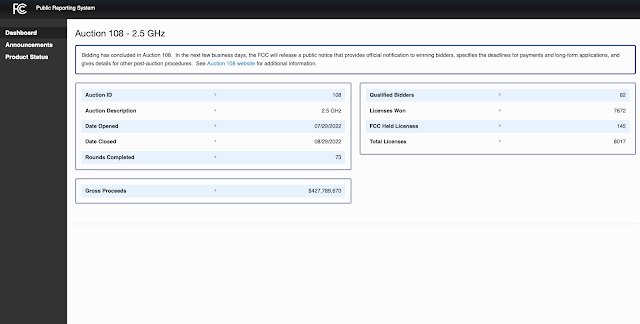
Bidding has concluded in the FCC Auction 108.  Gross proceeds from the bid are expected to amount to $427,789,670.

The FCC said it will post full results in the next few days. 

https://auctiondata.fcc.gov/public/projects/auction108

FCC commences 5G mid-band spectrum auction

The FCC opened bidding in its latest mid-band spectrum auction at 10am on Friday, July 29.

Auction 108 makes available 8,017 new flexible-use, county-based overlay licenses in the 2.5 GHz band. These licenses are in areas with unassigned 2.5 GHz spectrum— mostly rural parts of the country—following disposition of applications filed in the Rural Tribal Priority Window, which has to date resulted in the grant of 335 licenses to serve Tribal communities.

“We all know there are gaps in 5G coverage, especially in rural America, and this auction is a unique opportunity to fill them in,” said FCC Chairwoman Jessica Rosenworcel. “I am grateful to the teams that have worked so hard to both stand up this auction and ensure the success of our efforts to make these airwaves available to Tribes to support wireless service in their communities”

Auction 108 utilizes a “clock-1” auction format similar to the clock phase of past FCC auctions, but rather than offering multiple generic spectrum blocks in a category in a geographic area, it will offer only a single frequency-specific license in a category in a county. The new flexible-use geographic overlay licenses in the 2.5 GHz band (2496-2690 MHz) must protect the operations of incumbent licensees within the auctioned areas, including any licensees that receive their licenses through applications filed in the Rural Tribal Priority Window.

http://www.fcc.gov/auction/108

FCC incentivizes to open underutilized spectrum for rural carriers

The FCC voted to create an Enhanced Competition Incentive Program (ECIP) to establish incentives for wireless licensees to make underutilized spectrum available to small carriers, Tribal Nations, and entities serving rural areas. The new program encourages licensees to partition, disaggregate, or lease spectrum to better match available spectrum resources with entities that seek to provide needed services to under-connected communities.  Under...


Sunday, July 31, 2022

FCC commences 5G mid-band spectrum auction

The FCC opened bidding in its latest mid-band spectrum auction at 10am on Friday, July 29.

Auction 108 makes available 8,017 new flexible-use, county-based overlay licenses in the 2.5 GHz band. These licenses are in areas with unassigned 2.5 GHz spectrum— mostly rural parts of the country—following disposition of applications filed in the Rural Tribal Priority Window, which has to date resulted in the grant of 335 licenses to serve Tribal communities.

“We all know there are gaps in 5G coverage, especially in rural America, and this auction is a unique opportunity to fill them in,” said FCC Chairwoman Jessica Rosenworcel. “I am grateful to the teams that have worked so hard to both stand up this auction and ensure the success of our efforts to make these airwaves available to Tribes to support wireless service in their communities”

Auction 108 utilizes a “clock-1” auction format similar to the clock phase of past FCC auctions, but rather than offering multiple generic spectrum blocks in a category in a geographic area, it will offer only a single frequency-specific license in a category in a county. The new flexible-use geographic overlay licenses in the 2.5 GHz band (2496-2690 MHz) must protect the operations of incumbent licensees within the auctioned areas, including any licensees that receive their licenses through applications filed in the Rural Tribal Priority Window.

http://www.fcc.gov/auction/108

FCC incentivizes to open underutilized spectrum for rural carriers

The FCC voted to create an Enhanced Competition Incentive Program (ECIP) to establish incentives for wireless licensees to make underutilized spectrum available to small carriers, Tribal Nations, and entities serving rural areas. The new program encourages licensees to partition, disaggregate, or lease spectrum to better match available spectrum resources with entities that seek to provide needed services to under-connected communities.  Under...

Rosenworcel proposes minimum of 100/20 and goal of 1,000/500

FCC Chairwoman Jessica Rosenworcel is proposing a new the national standard for minimum broadband speed of 100 Mbps for download and 20 Mbps for upload. She is also proposing for the FCC to set a separate national goal of 1 Gbps/500 Mbps for the future. “The needs of internet users long ago surpassed the FCC’s 25/3 speed metric, especially during a global health pandemic that moved so much of life online,” said Chairwoman Rosenworcel.  “The...

FCC begins Mandatory Disaster Response Initiative for mobile operators

The FCC launched a Mandatory Disaster Response Initiative (MDRI) aimed at ensuring that the nation’s communications networks are more available in the midst of disasters and other emergencies. MDRI will leverage the industry-developed Wireless Network Resiliency Cooperative Framework, which is a voluntary agreement among a limited group of facilities-based mobile wireless service providers.   This agreement, which the Commission endorsed...