Showing posts with label Automotive. Show all posts

Tuesday, November 29, 2022

5G SA network slicing for Advanced Driver Assistance Systems

Ericsson, Deutsche Telekom, BMW, Valeo and Qualcomm are collaborating on a proof-of-concept (PoC) with 5G Standalone (SA) network slicing supporting Advanced Driver Assistance Systems (ADAS). 

The trial successfully used Ericsson's User Equipment Route Selection Policy (URSP) network slicing feature, which dynamically selects and connects to multiple slices simultaneously, together with a Quality of Demand (QoD) Network API. The QoD was used to request a defined QoS level from the network. When combined, these features meet the demands of mission-critical applications under various load conditions. 

Nicolai Martin, SVP BMW Group Driving Experience says: “The BMW Group sees the activities in the telecommunications industry with 5G as a central enabler for many innovative automotive features and also for Automated Valet Parking. It is crucial for such a new solution that several industries work closely together to offer the customer a valuable benefit. The aim is to build a standardized and interoperable AVP ecosystem. The BMW Group welcomes activities in the telecommunications industry especially the CAMARA project. This is an important enabler for future services.”

Claudia Nemat, Board member Technology and Innovation, Deutsche Telekom says: “Deutsche Telekom is excited to be part of this activity to demonstrate the capabilities of advanced network features like 5G network slicing with integrated APIs to meet the Quality of Service demands of automotive use cases. The close cross industry collaboration is essential to co-innovate and develop new solutions that bring customer benefits. This is an enabler for future services.”

https://www.ericsson.com/en/news/3/2022/breakthrough-proof-of-concept-for-automated-driving-applications


Tuesday, November 22, 2022

AirGain to supply wireless modems for EV charging network

Airgain announced a multi-million dollar contract to supply its NimbeLink embedded modems to a leading manufacturer of electric vehicle (EV) charging stations to its expanding nationwide network. 

Airgain’s line of NimbeLink embedded modems are end-device certified, bypassing what is often months of delay and tens of thousands of dollars in cost required to certify a device through cellular carriers. In addition, all RF components are included in the modem’s electronics, eliminating the need for RF design on the motherboard. The only requirement is a standard 20-pin connector, which allows for interchangeable modems and wireless modules. 

The company says this new contract is the latest for Airgain in a growing niche that includes several top manufacturers who require reliable connectivity for maintenance, status tracking, usage monitoring, payment processing, geolocation, etc.

“Connectivity is a catalyst to growth in EV charging,” says Brian Critchfield, Vice President of Marketing at Airgain. “Whether it is the customer who uses an EV charging station or the operator who manages it, connectivity is the backbone. With such rapid market growth upon us, manufacturers do not have time to wait for cellular carrier certification and often don’t have the RF engineers on staff to address the growing complexity in wireless. Airgain’s line of NimbeLink embedded modems simplify wireless connectivity by offering an elegant solution that shortens time-to-market and eliminates the need for in-house RF expertise.”

https://www.airgain.com

Wednesday, August 31, 2022

Renesas to acquire Bengaluru-based Steradian for 4D radar chips

Renesas Electronics agreed to acquire Steradian Semiconductors Private Limited, a fabless semiconductor company based in Bengaluru, India, that provides 4D imaging radar solutions. Financial terms were not disclosed of the an all-cash transaction. 

Founded in 2016 as a start-up company, Steradian has extensive expertise in radar technology. Operating in the 76-81 GHz band, Steradian’s powerful 4D radar transceivers offer a high level of integration in a small form factor and high power efficiency. Renesas will leverage Steradian's design assets and expertise to develop automotive radar products, with plans to start sample shipments by the end of 2022. The company aims to develop complete automotive radar solutions that combine ADAS SoCs (System-on-Chips) for processing radar signals, power management ICs (PMICs), and timing products together with software for object recognition. 

“Radar is an indispensable technology for ADAS, which uses a complex combination of various sensors,” said Hidetoshi Shibata, President and CEO of Renesas. “The addition of Steradian's superb radar technology and engineering talent will allow us to extend our leadership in the automotive segments. We will also leverage their technology for industrial applications to drive our mid- to long-term business growth in both segments.”

"Renesas' industry-leading portfolio of embedded solutions and broad customer base serve as an ideal foundation to maximize Steradian’s radar technology worldwide,” said Gireesh Rajendran, CEO of Steradian. “By working together with the Renesas team, we will continue to develop innovative radar solutions that deliver the high performance, small footprint and low power consumption that our customers desire.”


Tuesday, May 31, 2022

Marvell samples Ethernet switch for next gen automobiles

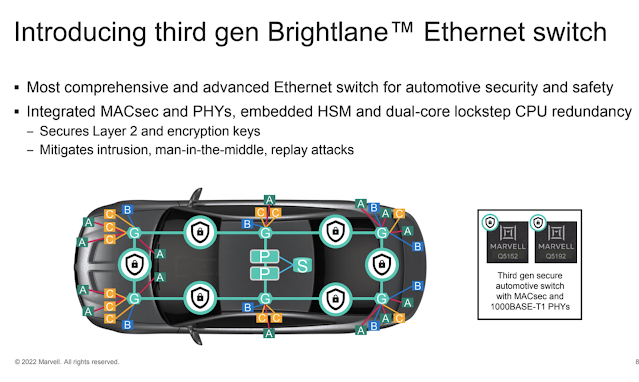
Marvell is sampling its third generation Brightlane Ethernet Switch for automobiles.

The latest Marvell Brightlane family, which includes 9-port and 16-port versions, is designed for Ethernet-based zonal architectures in next generation car designs. 

The new switch features IEEE 802.1AE-2018-compliant Media Access Control security (MACsec) protocols and an embedded Hardware Security Module (eHSM) for software authentication and data encryption. It also integrates 10Base-T1S capabilities, along with 100/1000Base-T1 PHYs, 2.5G/10G SerDes and PCIe Gen3 ports.


In addition, the Brightlane Ethernet Switch supports the latest Time-Sensitive Networking (TSN) standards to reduce latency and ensure quality of service (QoS) for essential vehicular connectivity, including the IEEE 802.1CB standard for data redundancy.

“The move to software-defined vehicles (SDVs) is a rapidly emerging megatrend in the automotive industry because software-centric architectures not only will enable over-the-air software updates for existing in-vehicle systems, but they will make possible entirely new aftermarket services and applications to continuously improve safety and driving experiences over time,” said Ian Riches, vice president for the Global Automotive Practice, Strategy Analytics. “As a result, security and safety is foundational to these networks, and Marvell’s new secure managed Ethernet switch integrates all the essential elements to drive the SDV revolution forward.”

“As the newest Brightlane Ethernet switch in our portfolio, this innovative design is targeted at the core need to ensure the security of next-generation in-vehicle networks and the data they carry,” said Mike Yeager, vice president and general manager, Automotive Business Unit, Marvell. “Our end-to-end optimization for software-defined, zonal architectures, advanced security, increased bandwidth and PHY integration is driving design win momentum for Marvell’s Ethernet products among top auto manufacturers and OEM partners.”

https://www.marvell.com/company/newsroom/marvell-introduces-industry-first-automotive-ethernet-switch-with-wockstep-dual-core-reliability-for-safer-vehicles.html

Monday, May 23, 2022

Broadcom delivers 50G automotive Ethernet switch

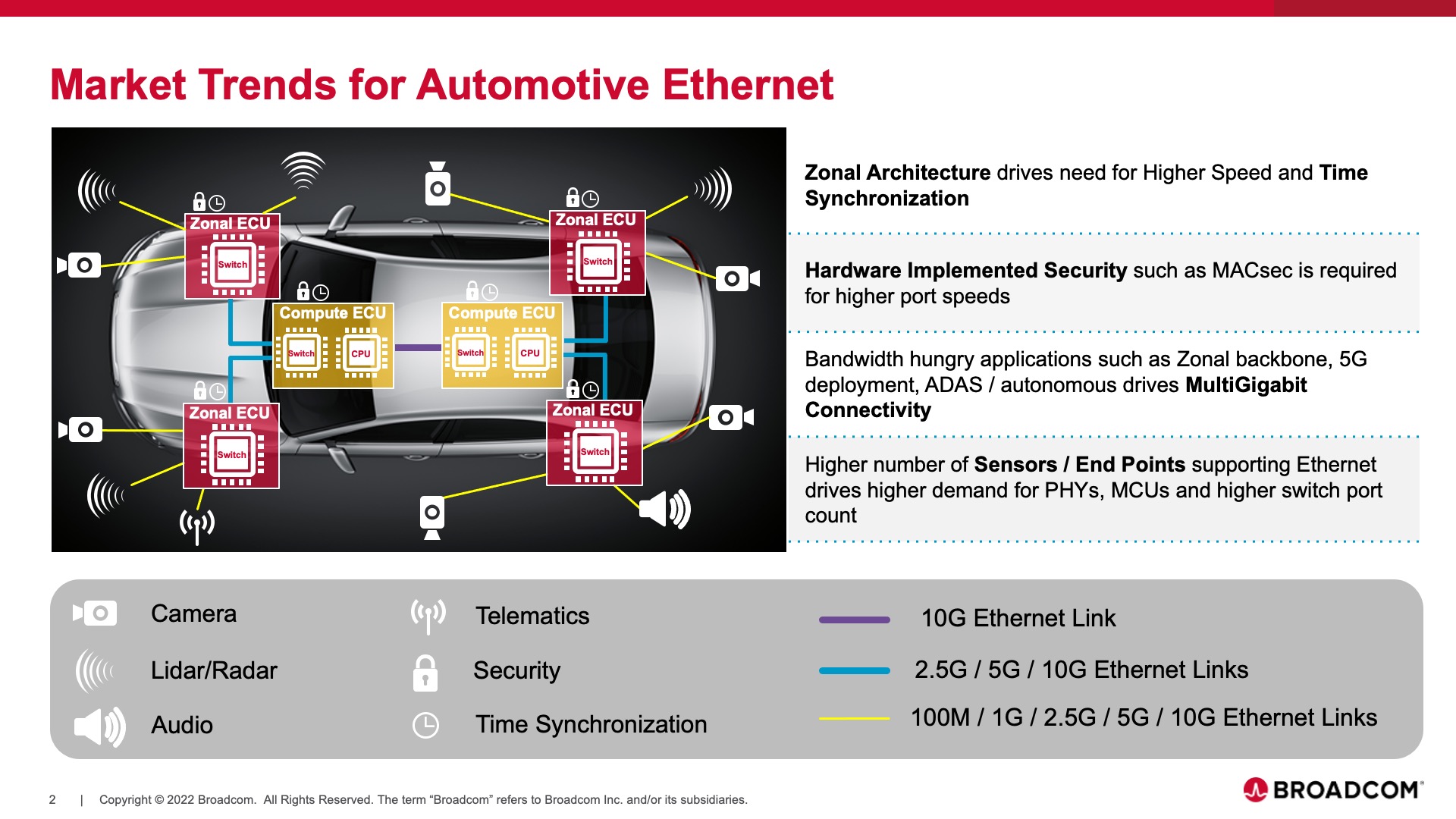
Broadcom  introduced its latest Scorpio Ethernet switch for building next-generation in-vehicle networks based on zonal architecture and capable of supporting large numbers of high-performance sensors and displays.

Broadcom's BCM8958X, which represents the company's 6th generation of automotive Ethernet switch and third generation in its Scorpio family, features 16 Ethernet ports of which up to six are 10 Gbps capable, as well as integrated 1000BASE-T1 and 100BASE-T1 PHYs, providing greater flexibility and switching capacity needed to support automotive zonal electronic control unit (ECU) and central compute ECU architectures. Additionally, this switch is equipped with an advanced rule-based packet filter engine that can adapt to different vehicle operation modes to enhance driving safety.

The company says that as automotive networking becomes more complex and software-defined, many OEMs are adopting a zonal in-vehicle network architecture to connect sensors, high-resolution cameras and displays. The zonal ECUs need to aggregate the data from these connected devices in real time and securely share them across central compute ECUs. The BCM8958X is optimized for use in both zonal ECUs and central compute ECUs that can switch and route large volumes of data for real time decision making. 


BCM8958X highlights:

• 6th generation automotive switch chip with 55 Gb/s switching capacity

• 16-port monolithic die switch

• Six 10G ports: XFI or PCIe x1 4.0 with SRIOV

• Integrated 100BASE-T1 and 1000BASE-T1 PHYs

• ARM subsystem with integrated TCM

• Hardware security and MACsec support

• AVB & TSN (802.1AS-2020, 802.1Qci, 802.1CB, 802.1Qbv)

• Software development kit including drivers, a gPTP protocol stack, and host APIs and providing portability from previous generation products

“Broadcom continues to lead with a comprehensive Ethernet solution for new automotive architectures,” said Vijay Janapaty, vice president and general manager of the Physical Layer

https://www.broadcom.com/company/news/product-releases/60241

Thursday, April 7, 2022

Lumentum ships first multi-junction VCSEL arrays for LiDARs

Lumentum introduced its M Series multi-junction VCSEL arrays for next-generation automotive, industrial LiDAR, and 3D sensing applications..

Lumentum's automotive qualified, high-performance M Series features peak powers suited for short- and long-range advanced mobility and industrial LiDAR applications. In addition to higher available power densities, extensive accelerated life testing of the multi-junction M Series has shown the same high reliability as single junction VCSEL devices already in volume production. 

The first M Series product is a 905 nm 70 W multi-junction VCSEL array.

"The Lumentum M Series enable automotive and industrial customers to accelerate the development of next-generation LiDAR systems," said Alex Ju, Product Line Manager for 3D Sensing at Lumentum. "The M51-100, with its extremely small size, is a versatile solution applicable to a wide range of customer systems. We are excited to deliver industry-leading VCSEL technology with proven quality and volume manufacturing capability into the advanced mobility space and enable a greater range of industrial applications."

https://www.lumentum.com

Lumentum to acquire NeoPhotonics for $918M amidst strong demand

Lumentum agreed to acquire NeoPhotonics for $16.00 per share in cash, representing a total equity value of approximately $918 million and a premium of approximately 39% to NeoPhotonics' closing stock price on November 3, 2021.The companies cited significant next-gen 400G+ opportunities as a leading driver for the merger.NeoPhotonics, which was founded in 1996 and is based in San Jose, is a leading supplier of tunable lasers and optoelectronic components,...


Tuesday, January 11, 2022

Toshiba adds to its line-up of Ethernet Bridge ICs for automotive

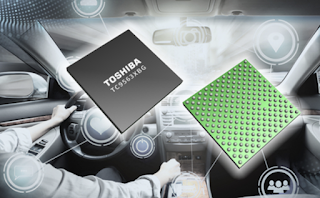
Toshiba Electronic Devices & Storage Corporation introduced a new device in its line-up of Ethernet bridge ICs to provide support for 10Gbps communications in automotive information communications systems and industrial equipment. Sample shipments have started and volume production will start in August 2022.

The new bridge IC has Toshiba’s first 2-port 10Gbps Ethernet, and the interface can be selected from USXGMII, XFI, SGMII, and RGMII. The two ports support Ethernet AVB and TSN, which facilitate real-time processing and synchronous processing, respectively. They also support “simplified” SR-IOV (virtual functions). 

Toshiba said its new IC can be used not only for zone architecture but also for various automotive applications such as IVI and telematics, and also in industrial equipment. It is also postioned to be a successor to current TC9560 and TC9562 series products supporting 1Gbps Ethernet.

The new device offers three PCIe Gen 3 switch ports for communications with the host SoC and connection to devices equipped with PCIe interfaces. The PCIe switch part is configured with one 4-lane upstream port for connection with the host SoC and two 1-lane downstream ports for connection to devices with a PCIe interface. Using the 3-port PCIe switch function for connections to such devices can help mitigate PCIe interface shortages.

Wednesday, December 15, 2021

Samsung ramps up automotive memory chips for EVs

Samsung Electronics unveiled a portfolio of automotive memory solutions designed for next-generation autonomous electric vehicles. The new lineup includes a 256-gigabyte (GB) PCIe Gen3 NVMe ball grid array (BGA) SSD, 2GB GDDR6 DRAM and 2GB DDR4 DRAM for high-performance infotainment systems, as well as 2GB GDDR6 DRAM and 128GB Universal Flash Storage (UFS) for autonomous driving systems.

The need for high-capacity, high-performance SSDs and graphics DRAM is driven by advanced features in infotainment systems such as high-definition maps, video streaming and 3D gaming, together with the growing use of autonomous driving systems.

Samsung's 256GB BGA SSD controller and firmware are developed in-house for optimized performance, offering a sequential read speed of 2,100 megabytes per second (MB/s) and a sequential write speed of 300MB/s, which are seven and two times faster than today's eMMC, respectively. Furthermore, the 2GB GDDR6 DRAM features up to a 14 gigabit-per-second (Gbps) data rate per pin. Such exceptional speeds and bandwidth will support complex processing of various multimedia applications as well as large amounts of autonomous driving data, contributing to a safer, more dynamic and more convenient driving experience.

"With the recent proliferation of electric vehicles and the rapid advancement of infotainment and autonomous driving systems, the semiconductor automotive platform is facing a paradigm shift. What used to be a seven to eight-year replacement cycle is now being compressed into a three to four-year cycle, and at the same time, performance and capacity requirements are advancing to levels commonly found in servers," said Jinman Han, executive vice president and head of Memory Global Sales & Marketing at Samsung Electronics. "Samsung's reinforced lineup of memory solutions will act as a major catalyst in further accelerating the shift toward the ‘Server on Wheels’ era."


Monday, December 6, 2021

Intel plans IPO for Mobileye

Intel plans to take Mobileye public in the United States in mid-2022 via an initial public offering (IPO) of newly issued Mobileye stock.

Intel will remain the majority owner of Mobileye, and the two companies will continue as strategic partners, collaborating on projects as they pursue the growth of computing in the automotive sector.

Mobileye focuses on advanced driver-assistance systems (ADAS) and self-driving solutions. In 2021, Mobileye shipped its 100 millionth EyeQ system-on-chip (SoC), scaled autonomous vehicle (AV) test programs across multiple cities around the world covering the U.S., Europe and Asia, unveiled its production robotaxi, and secured 41 new ADAS program wins across more than 30 automakers globally. New program wins range from core driver-assistance technology through next-generation driver-assistance and full self-driving systems. The company has also secured multiple deals for mobility-as-a-service (MaaS) programs starting in 2023, as well as consumer and business-to-business vehicle production designs for Mobileye’s self-driving system starting in 2024.

Intel said the  move will unlock the value of Mobileye for Intel shareholders.

“Intel’s acquisition of Mobileye has been a great success. Mobileye has achieved record revenue year-over-year with 2021 gains expected to be more than 40 percent higher than 2020, highlighting the powerful benefits to both companies of our ongoing partnership,” Intel CEO Pat Gelsinger said. “Amnon and I determined that an IPO provides the best opportunity to build on Mobileye’s track record for innovation and unlock value for shareholders.”

Mobileye went public in 2014; it was acquired by Intel in 2017. Intel currently owns 100% of Mobileye shares and is expected to retain majority ownership following the completion of the IPO.

Intel eyes automotive silicon expansion

Intel CEO Pat Gelsinger predicts the “digitization of everything” will push the share of semiconductors in the total new premium vehicle bill of materials (BOM) to more than 20% by 2030 – up more than 5X from 4% in 2019. The company forecasts the total addressable market (TAM) for automotive silicon will more than double by the end of the decade to $115 billion – approximately 11% of the entire silicon market.2

In pursuit of this opportunity, Intel announced plans to build new chip manufacturing facilities in Europe, establish committed foundry capacity at its Ireland site, and launch the Intel Foundry Services Accelerator to help foundry customers move automotive designs to advanced nodes.

In addition, Intel's Mobileye division unveiled the first production AV equipped with the Mobileye Drive self-driving system and bearing the MoovitAV services branding. Mobileye is working with Sixt to bring autonomous ride-hailing into operation with Munich-based Sixt SE starting in 2022. 


https://www.intel.com/

Intel leverages silicon photonics for Mobileye's lidar system-on-chip

Mobileye, a division of Intel, unveiled a new silicon photonics processor for frequency-modulated continuous wave (FMCW) lidar. The new device, which was engineered at Intel’s silicon photonics fab in New Mexico, is expected to be in production by 2025. 

Mobileye envisions that AVs will use both radio- and light-based detection-and-ranging sensing.

The new software-defined imaging radar technology with 2304 channels, 100DB dynamic range and 40 DBc side lobe level that together enable the radar to build a sensing state good enough for driving policy supporting autonomous driving. 

“This is really game-changing. And we call this a photonic integrated circuit, PIC. It has 184 vertical lines, and then those vertical lines are moved through optics. Having fabs that are able to do that, that’s very, very rare. So this gives Intel a significant advantage in building these lidars,” stated Mobileye president and chief executive officer Amnon Shashua.


Monday, November 29, 2021

Samsung intros three automotive chips

 Samsung Electronics Co. introduced three of its latest automotive chip solutions: the Exynos Auto T5123 for 5G connectivity, the Exynos Auto V7 for in-vehicle infotainment systems, and the ASIL-B certified S2VPS01 power management IC (PMIC) for the Auto V series.

  • Exynos Auto T5123: a 3GPP Release 15 telematics control unit specifically designed to bring 5G in both standalone (SA) and non-standalone (NSA) mode to the next generation of connected cars. It supports downloads of up to 5.1 Gbps, and supports a high speed PCIe (PCI Express) interface and a low-power high-performance LPDDR4x mobile DRAM. In addition, the unit comes with two Cortex-A55 CPU cores and a built-in Global Navigation Satellite System (GNSS) to minimize the use of external ICs and help reduce product development time. 
  • Exynos Auto V7: an automotive-brand processor for in-vehicle infotainment systems. The V7 integrates eight 1.5-gigahertz (GHz) Arm Cortex-A76 CPU cores and 11 Arm Mali G76 GPU cores. The GPU comes in two separate groups, with three cores in the ‘small’ domain for cluster display and AR-HUD, and eight in the ‘big’ domain for central information display (CID) and others. Such physical separation allows the GPU to support multiple systems simultaneously and brings safer operation as it keeps one domain from interfering with another. In addition to its powerful CPU and GPU, the V7 is equipped with an NPU for convenient services such as virtual assistance that can process visual and audio data for face, speech or gesture recognition features. It also offers strong data protection through an isolated security processor for crypto operation and provides a hardware key using a one-time programmable (OTP) or physical unclonable function (PUF). Furthermore, for critical functional safety, the Exynos Auto V7 complies with ASIL-B requirements of safety support for a digital cluster and an embedded safety island that detects and manages faults to maintain a safe state with a fault management unit (FMU). The Exynos Auto V7 is currently in mass production and is being used in Volkswagen’s latest In-Car Application-Server (ICAS) 3.1, developed by LG Electronics’ VS (Vehicle component Solutions) division.
  • S2VPS01 – An ASIL-B Certified Power Management IC for the Exynos Auto V Series

“Smarter and more connected automotive technologies for enriched in-vehicle experiences including entertainment, safety and comfort are becoming critical features on the road,” said Jaehong Park, Executive Vice President of System LSI Custom SOC Business at Samsung Electronics. “With an advanced 5G modem, an AI-enhanced multi-core processor, and a market-proven PMIC solution, Samsung is transfusing its expertise in mobile solutions into its automotive lineup and is positioned to expand its presence within the field.”

http://www.samsung.com/exynos


Tuesday, October 26, 2021

AT&T delivers Private 5G/Edge for Ford's Rouge electric vehicle factory

Ford Motor Company has deployed a private 5G network based on AT&T 5G with AT&T’s Multi-Access Edge Computing (MEC) technology at the  Rouge Electric Vehicle Center in Dearborn, Michigan.

The network will support advanced applications used in the production of the 2022 Ford F-150 Lightning.

“With this collaboration, we’ll help Ford unlock the potential of 5G helping to build the truck of the future,” said Rasesh Patel, Chief Product & Platform Officer, AT&T Business. “It’s 5G connectivity coming to life! And it’s all thanks to the transformative ultra-fast speeds, incredibly low latency, and massive connectivity that is 5G in action.

“The Rouge Electric Vehicle Center was built with a clean-slate design and features the latest in advanced manufacturing technology,” said Adrian Price, executive director, Global Manufacturing Engineering, Ford Motor Company. “We are deploying 5G technology at this facility as a platform to enable us to use significant additional advanced manufacturing technologies in the future.”

https://about.att.com/story/2021/ford-manufacturing-facility.html

Tuesday, September 7, 2021

Intel eyes automotive silicon expansion

Intel CEO Pat Gelsinger predicts the “digitization of everything” will push the share of semiconductors in the total new premium vehicle bill of materials (BOM) to more than 20% by 2030 – up more than 5X from 4% in 2019. The company forecasts the total addressable market (TAM) for automotive silicon will more than double by the end of the decade to $115 billion – approximately 11% of the entire silicon market.2

In pursuit of this opportunity, Intel announced plans to build new chip manufacturing facilities in Europe, establish committed foundry capacity at its Ireland site, and launch the Intel Foundry Services Accelerator to help foundry customers move automotive designs to advanced nodes.

In addition, Intel's Mobileye division unveiled the first production AV equipped with the Mobileye Drive self-driving system and bearing the MoovitAV services branding. Mobileye is working with Sixt to bring autonomous ride-hailing into operation with Munich-based Sixt SE starting in 2022. 


https://www.intel.com/

Thursday, August 19, 2021

AT&T to provide 5G for millions on new GM vehicles

General Motors has selected AT&T to provide 5G to millions of new vehicles over the next decade in the United States. 

GM said 5G connectivity will first be available in select model year 2024 vehicles. Additionally, through GM’s fifth-generation network, current 4G LTE-equipped model year 2019 and newer vehicles will experience faster connectivity speeds and many of the same performance benefits of future 5G-equipped vehicles. Current Chevrolet, Buick, GMC and Cadillac owners in the U.S. with 4G LTE-capable model year 2019 and newer vehicles will migrate to the new network infrastructure once available. 

To support GM’s next generation connected vehicles , AT&T is working with Microsoft to integrate secure cloud services.

“Together with AT&T, we’ve brought unprecedented experiences to the daily commute, family road trips and everything in between,” said Santiago Chamorro, GM vice president of Global Connected Services. “As an in-vehicle connectivity leader, this rollout demonstrates our commitment to growth through software-enabled services and reimagining every customer touchpoint by enabling faster connectivity speeds to power in-vehicle voice-enabled services, navigation, and apps that our customers have grown to love.”

“By connecting millions of GM vehicles to our nationwide 5G network, we will improve the customer experience for existing services while laying the groundwork for the next wave of innovation including autonomous driving,” said Gregory Wieboldt, senior vice president, Global Business, Industry Solutions, AT&T. “We now connect more vehicles than any other carrier and GM has played a critical role in our success. We’re honored to work alongside GM to usher the next chapter of connected driving.”


Thursday, August 5, 2021

Qualcomm launches $4.6 billion bid for Veoneer

Qualcomm launched a bid to acquire Veoneer for $37 per share, in an all-cash transaction valued at approximately $4.6 billion

Qualcomm said the proposal reflects its commitment to bring advanced technologies to the automotive industry and represents a natural extension of Qualcomm's digital chassis solutions. The company continues to see traction in automotive, with a revenue-design win pipeline of approximately $10 billion.

"As the automotive industry continues to transform, it is becoming increasingly important for automakers to have a partner who develops horizontal platforms that drive innovation and enable competition. The proposed acquisition will bring together our industry-leading automotive solutions with Veoneer's assisted driving assets to deliver a competitive and open ADAS platform to automakers and Tier 1 suppliers at scale," said Cristiano Amon, president and CEO of Qualcomm Incorporated.

Qualcomm's offer exceeds the acquisition proposal announced by Magna on July 29th for $ 31.25  per share in cash, representing a total value of  $ 3.8 billion, and an enterprise value of $ 3.3 billion, inclusive of Veoneer’s cash, net of debt and other debt-like items as of March 31, 2021.

Veoneer said its board of directors will evaluate the proposal from Qualcomm consistent with its legal duties and the terms of the Magna merger agreement. On July 22, 2021, Veoneer announced that it entered into a definitive merger agreement, approved by Veoneer's board of directors, with Magna International Inc. The merger agreement remains in place.

https://www.veoneer.com/en/home


Monday, May 24, 2021

Ericsson and Volvo test 5G network vehicular handover

 As part of the EU-funded 5GCroCo project, Ericsson and Volvo Cars have carried out the first successful test handover of connected cars between two national mobile 5G networks. The test occurred at the AstaZero test track in Sweden.

As part of the test, Ericsson deployed a 5G mobile radio network while two Volvo cars received an HD map of the route ahead. By updating the maps with information from sensor readings, connected cars can detect and distinguish between driving lanes ahead.

Mikael Prytz, Research Director, Ericsson Area Networks, says: “Sharing an updated map with other cars is a latency-sensitive task and requires high network performance within and across multiple networks. During the test at the AstaZero track, we could tackle this challenge with promising results. We are excited to continue our cooperation with Volvo Cars to expand the network mobility of autonomous and connected cars.”

https://www.ericsson.com/en/news/2021/5/volvo-cars-and-ericsson-in-connected-car-milestone

Tuesday, May 18, 2021

Intel's Mobileye wins ADAS design contract with Toyota

Toyota Motor Corp. selected Intel and ZF to develop advanced driver-assistance systems (ADAS) for use in multiple vehicle platforms starting in the next few years. 

As part of the agreement, ZF, one of the world’s largest producers of automotive cameras driven by Mobileye technology, will also supply its Gen 21 mid-range radar and be responsible for the integration of camera and radar in Toyota vehicles.

ZF and Mobileye will collaborate closely to produce advanced camera technology integrated with ZF radar technology to power key advanced driver-assistance platforms in Toyota vehicles. 

ZF’s Gen21 mid-range radar is a high-performance 77 GHz front radar designed to meet 2022+ Euro NCAP 5-Star Safety Ratings and enable L2/L2+ Automated Driving functions.

Wednesday, April 28, 2021

Factorial Energy emerges from stealth with solid-state battery for EVs

Factorial Energy, a start-up based in Woburn, Massachusetts, emerged from stealth to announce its plans for a 40 Amp-hour solid-state battery cell for electric vehicles (EVs) and other applications. 

The Factorial Electrolyte System Technology (FEST™) is a proprietary solid electrolyte material said to be safer than conventional lithium-ion technology, replacing the combustible liquid electrolyte with a safer, more stable solid-state electrolyte that suppresses lithium dendrite formation on lithium-metal anodes. Product specifics and timelines were not disclosed.

Factorial Energy is naming Joe Taylor as Executive Chairman. Taylor, the former Chairman and CEO of Panasonic Corporation of North America, played a key role in the development of the Tesla-Panasonic relationship, which resulted in Panasonic investing in the Tesla Gigafactory in Reno, Nevada. In addition, the former Chairman of the Board of Management of Daimler AG and Head of Mercedes-Benz, Dieter Zetsche, is also joining the company's advisory board.

https://factorialenergy.com/


Thursday, April 8, 2021

Verizon & Honda test 5G for connected and autonomous vehicles

Honda and Verizon, in partnership with the University of Michigan’s Mcity, a test bed for connected and autonomous vehicles, are testing how new connected safety technology using 5G and mobile edge computing (MEC) could ensure fast, reliable communication between road infrastructure, vehicles and pedestrians sharing the road thus reducing collisions and saving lives. 

Since 2017, Honda has been developing a technology to realize a collision-free society called SAFE SWARM. Using Cellular Vehicle-to-Everything (C-V2X) communication, Honda SAFE SWARM enables vehicles to communicate with other road users and share key information such as location, speed, and vehicle sensor data. One limitation of this approach is the need to outfit each vehicle with onboard artificial intelligence (AI) capabilities. The use of 5G helps move the AI capabilities from the vehicle to the MEC, reducing the need for AI onboard each vehicle.

The partners highlighted three safety scenarios:

  • Pedestrian Scenario: A pedestrian is crossing a street at an intersection. An approaching driver cannot see the pedestrian due to a building obstructing the view. Smart cameras mounted in the intersection relay information to MEC using the 5G network. Verizon’s MEC and V2X software platforms detect the pedestrian and vehicle and determine the precise location of road users assisted by Verizon’s Hyper Precise Location services. A visual warning message is then sent alerting the driver of the potential danger.
  • Emergency Vehicle Warning Scenario: A driver cannot see an approaching emergency vehicle and cannot hear its siren due to the high volume of in-vehicle audio. Verizon’s MEC and V2X software receive a safety message from the emergency vehicle and send a warning message to nearby vehicles. The driver receives a visual warning.
  • Red Light Runner Scenario: A vehicle fails to stop at a red light. Using data from the smart cameras, MEC and V2X software detect the vehicle and send a red-light-runner visual warning message to other vehicles approaching the intersection.

“Honda’s research collaboration with Verizon is an important step in our multi-year effort to develop connected vehicle safety technology to realize our vision for a collision-free society,” said Ehsan Moradi Pari, Ph.D, research group lead at Honda’s Advanced Technology Research Division. “While the research is preliminary and not intended as a product feature at this time, 5G-enabled vehicle communication and MEC have the potential to advance safety for everyone sharing the road.”

“The ability to move computing power to the edge of our 5G network is an essential building block for autonomous and connected vehicles, helping cars to communicate with each other in near real-time and with sensors and cameras installed in streets and traffic lights,” said Sanyogita Shamsunder, vice president of Technology Development and 5G Labs at Verizon. “When you consider that roughly 42,000 people were killed in car accidents last year and 94% of accidents are caused by human error, our new technologies including 5G and MEC can help drivers ‘see’ things before the human eye can register and react helping to prevent collisions and save lives.”


Thursday, March 18, 2021

II-VI opens industrial laser lab in Suzhou, China

II-VI opened a new applications laboratory in Suzhou, China, to support the growing industrial laser market in the region. 

II-VI said its new applications laboratory provides close customer support on state-of-the-art laser materials processing with practical hands-on training, in-depth applications consulting, and detailed feasibility studies based on the expertise of II-VI’s applications engineers and the advanced capabilities of II-VI’s laser processing heads.

The company highlighted new opportunities for industrial lasers in the automotive sector as as manufacturers retool their production lines for the unique welding requirements of electric vehicles and their batteries. 

“In our new applications laboratory in Suzhou, customers can directly experience our high-performing and intelligent laser processing heads,” said Dr. Karlheinz Gulden, Senior Vice President, Laser Devices and Systems Business Unit. “This product application facility, together with our labs in Berlin, Germany, and Detroit, U.S., enhances our global ability to demonstrate manufacturing feasibility and develop optimized processes for our customers.”


Monday, February 1, 2021

Ford's connected vehicles to run Google's Android

Ford and Google announce a strategic partnership to accelerate "to reinvent the connected vehicle experience" Under a six-year agreement beginning in 2023, millions of Ford and Lincoln vehicles will run Android, with Google apps and services built-in. This includes Google Maps as the vehicles’ primary navigation with information on real-time traffic, automatic rerouting, lane guidance, etc.

Ford also named Google Cloud its preferred cloud provider to leverage Google’s world-class expertise in data, artificial intelligence (AI), and machine learning (ML). 

In addition, the companies are forming a collaborative group, called Team Upshift, to develop new personalized consumer experiences and data-driven opportunities. 

“As Ford continues the most profound transformation in our history with electrification, connectivity and self-driving, Google and Ford coming together establishes an innovation powerhouse truly able to deliver a superior experience for our customers and modernize our business,” said Jim Farley, President and CEO of Ford.

“From the first moving assembly line to the latest driver-assist technology, Ford has set the pace of innovation for the automotive industry for nearly 120 years,” said Sundar Pichai, CEO of Google and Alphabet. “We’re proud to partner to apply the best of Google’s AI, data analytics, compute and cloud platforms to help transform Ford's business and build automotive technologies that keep people safe and connected on the road.”