Showing posts with label IOT. Show all posts

Wednesday, December 7, 2022

Ericsson to divest IoT Accelerator and Connected Vehicle Cloud to Aeris

Ericsson will divest its IoT Accelerator and Connected Vehicle Cloud businesses to Aeris,

The IoT business, with 2022 full year forecasted net sales of SEK 0.8 billion, has been the key driver of the losses in Business Area Technologies and New Businesses in the Enterprise segment. The transaction will eliminate quarterly losses of SEK 0.25 billion. The divestment, related cost and other portfolio optimizations will lead to a negative one-time EBIT impact of SEK 1.1 billion in Q4 2022, of which 80 percent being cash and the majority occurring in Q1 2023. The IoT business will be transferred to Segment Other in Q1 2023 in anticipation of closing of the transaction, with an expected EBIT loss of SEK 0.25 billion during the first quarter.

Aeris’ Intelligent IoT Network, targeting industry verticals such as transportation, energy, automotive and healthcare, gives communications service providers the opportunity to monetize new services on top of connectivity enabled by the IoT Accelerator.  The company, which is based in San Jose, California, has already teamed up with several leading communication service providers including Softbank, AT&T, T-Mobile, and Vodafone, and is also working with leading automotive original equipment manufacturers. 

Ericsson IoT Accelerator is used by over 9,000 enterprises to manage more than 95 million connected devices with 22 million eSIM connections globally. These enterprises and connections leverage Ericsson's growing ecosystem of over 35 communications service provider partners for global IoT cellular connectivity. Ericsson Connected Vehicle Cloud is currently being used to connect six million vehicles and counting across 180 countries.

Together, Aeris’ and Ericsson’s IoT platforms will connect over 100 million IoT devices worldwide, covering 190 countries. 

Ã…sa Tamsons, Head of Business Area Technologies & New Businesses at Ericsson, says: “Aeris has been successful in extending its IoT solution offering beyond connectivity and has the right focus, assets, and capabilities to realize the full value creation potential of Ericsson’s IoT business and its strong market presence. Despite significant investments to address the fragmentation of the IoT market, Ericsson has only tapped into a limited part of the value chain, limiting the returns of such investments. The combined business will offer an unparalleled IoT platform for enterprises and new revenue streams for communication service providers, ultimately benefiting Ericsson’s customers. Aeris is a good home for our IoT business.” 

Marc Jones, President and CEO of Aeris, says: “Building the best technology to support the success of our customers and drive innovation in the IoT space have always been at the forefront for Aeris.  Our intelligent, software defined IoT network and Ericsson’s leading connectivity management platform will provide the leading IoT technology stack in the industry. We look forward to bringing these new, transformational IoT solutions and Ericsson’s IoT Accelerator and Connected Vehicle Cloud products to our customers.”

https://www.ericsson.com/en/press-releases/2022/12/aeris-to-acquire-iot-business-from-ericsson

Tuesday, August 2, 2022

Semtech to acquire Sierra Wireless, bringing together LoRa + Cellular IoT

Semtech agreed to acquire Sierra Wireless, a leading supplier of Internet of Things (IoT) solutions, for US$31 per share in an all-cash transaction representing a total enterprise value of approximately US$1.2 billion.

Semtech said the deal will significantly expand its addressable market and is expected to approximately double Semtech’s annual revenue and create a strong and diverse portfolio of connectivity solutions for the growing IoT market. 


Significantly, the merger brings together Semtech's LoRa with Sierra Wireless' cellular IoT to enable the digitization of the industrial world with a comprehensive chip-to-Cloud platform.

Semtech expects the combination of Sierra Wireless’ cellular capabilities across its modules, gateways and managed connectivity together with Semtech’s LoRa-enabled end nodes to create a uniquely differentiated IoT portfolio which will enable a plethora of new IoT use cases to be conceived.

“We believe the next era of technology growth is the full digitization of our industrial world – the Internet of Everything. Our vision is to build a simple, horizontal platform with the goal of accelerating this transformation and to bring about a smarter and more sustainable planet,” said Semtech president and chief executive officer, Mohan Maheswaran. “This exciting strategic acquisition of Sierra Wireless is a critical part of bringing this vision to life through the combination of cellular, LoRa and Cloud services. Together, with the world-class Sierra Wireless engineering team, we will be positioned to advance the market with multi-radio solutions that bring new chip-to-Cloud services to support customers and grow our business.”

“Over the last year, Sierra Wireless has taken decisive steps to profitably grow the business, and I am proud that the progress we have made has culminated in this exciting transaction. Together with Semtech, we will be able to extend the reach of IoT solutions by scaling, optimizing and ultimately delivering an even stronger product portfolio and service model to customers,” said Phil Brace, president and chief executive officer of Sierra Wireless. 

https://www.semtech.com

Sunday, July 31, 2022

Telit to acquire Thales' cellular IoT business

 Telit agreed to acquire Thales' cellular IoT products division, which offers a portfolio of cellular wireless communication modules, gateways, and data (modem) cards, ranging from 4G LTE, LPWAN to 5G. 

Thales' cellular IoT module business, with approximately 550 employees across 23 countries, services many of the world's top brands. It generated sales of more than €300 million in 2021.

The combined company will be called Telit-Cinterion and based in California. To sharpen focus on Industrial IoT, Telit Cinterion plans to spin off and manage separately the automotive IoT unit after closing.

Paolo Dal Pino, Telit's CEO, remarked: "Innovation, scale and efficient IoT solutions are key for success. This transaction with Thales is arguably the most impactful one for Telit competitiveness. While it will boost our ability to address customer needs more precisely from a richer portfolio, it will also enable us to deliver all new offerings derived from the experience, expertise, and the DNA of two companies that have made security and quality part of their brand promise from the very beginning."

Philippe Vallée, Thales's EVP Digital Identity and Security, added: "The Thales and Telit combination brings together complementary strengths. The business will provide a unique value proposition in a highly competitive global IoT market and will allow Thales to focus its investments on its three core activities in aerospace, defence and security and digital identity and security. The new combination will rely on a unique set of expertise brought by Thales and Telit employees. It will also benefit from leveraging both companies' strong and complementary product portfolio and Thales's experience in cellular connectivity."

Tuesday, May 24, 2022

Renesas demos Arm Cortex-M85 processor prototype

Renesas Electronics will demonstrated a microcontroller (MCU) based on the recently announced Arm Cortex-M85 processor at the Embedded World 2022 Exhibition and Conference in Nuremburg Germany from June 21-24.

Renesas introduced the RA (Renesas Advanced) Family of Arm Cortex-M based MCUs in October of 2019, entering the general-purpose Arm-Cortex-M market with a robust and feature rich family of flash-based MCUs. In roughly 30 months, Renesas has introduced 17 MCU groups encompassing well over 200 individual parts. In addition, Renesas has developed a robust ecosystem of partners providing customers with comprehensive solutions for IoT, AI/ML, industrial automation, medical, building automation, home appliance and multiple other applications.

The Arm Cortex-M85 processor features Helium technology, Arm’s M-Profile Vector Extension that enables advanced DSP/ML capabilities and helps accelerate compute intensive applications such as endpoint AI. Delivering over 6 CoreMark/MHz, Cortex-M85 enables demanding IoT use cases that require the highest compute performance and DSP or ML capability, realized on a single, simple-to-program, Cortex-M processor.

"As a lead partner with Arm, we are proud to be the first to demonstrate an MCU based on the high-performance Cortex-M85 processor, a clear example of the momentum that we have built in the Arm ecosystem,” said Roger Wendelken, Senior Vice President in Renesas’ IoT and Infrastructure Business Unit. “The RA family has enjoyed tremendous success in a very short time, demonstrating the core strengths that make Renesas an MCU powerhouse, including design expertise, legendary quality, and close collaboration with customers and partners in all markets and all geographies.”

“To continue to scale and grow, the next generation of IoT solutions demand ever-improving levels of performance, security and simplified development, and we have delivered this with the new Arm Cortex-M85,” said Dipti Vachani, senior vice president and general manager, Automotive and IoT Line of Business at Arm. “This demonstration of the first silicon based on our most secure and highest performance Cortex-M processor will showcase the new and exciting applications it will enable and further cements our ongoing close collaboration with Renesas.”

www.renesas.com/ra

Tuesday, February 15, 2022

Aeris enhances its Intelligent IoT network

Aeris, a global IoT solutions provider currently connecting some 15 million devices, unveiled the the next generation of its Intelligent IoT Network featuring Machine Learning and AI-based capabilities that extends shared intelligence across infrastructure, applications, and services.

New capabilities include an Intelligent Security Center that provides built-in visibility and analytics to help clients accurately prevent, detect, and respond to potential malicious activities. Aeris said its Intelligent Security Center enables cellular IoT solution providers to transition from a reactive security approach to a proactive security plan. Its solution provides tools to detect and prevent potential security breaches and reduce the corresponding response time from months to minutes.

“Today, our company is leveraging decades of vision and experience to help customers realize the remarkable potential of their connected IoT devices by providing access to the most intelligent and secure IoT Network in the market,” said Marc Jones, Chairman and CEO of Aeris. “The Aeris Intelligent IoT Network is the only dynamic cellular IoT network designed from the ground up with intelligence at its core, offering unmatched network security, operational efficiencies and the flexibility to build, launch, and scale complex IoT deployments across the world.”

http://www.aeris.com/IntelligentIoT

Thursday, August 26, 2021

AT&T's 5G network now support IoT powered by Cisco

AT&T and Cisco have introduced 5G network capabilities to boost performance for Internet of Things (IoT) applications across the US.

The AT&T 5G network is now ready to deliver lower latency and faster speeds for enterprise customer IoT deployments using 5G certified devices. The service is powered by Cisco.


AT&T and Cisco currently manage millions of connected devices spanning manufacturing, utilities, transportation, public sector, retail, and healthcare industries as well as public safety on FirstNet, built with AT&T, through AT&T’s 4G LTE and low-power IoT cellular networks.

AT&T Control Center powered by Cisco gives businesses near real-time visibility of all the IoT devices on their network and helps mitigate security risks, identifies anomalies in data usage and optimizes traffic classification reporting.

https://about.att.com/story/2021/att_cisco_launch_5g.html

Thursday, March 25, 2021

NXP debuts Microsoft Azure Sphere-certified processor for IoT

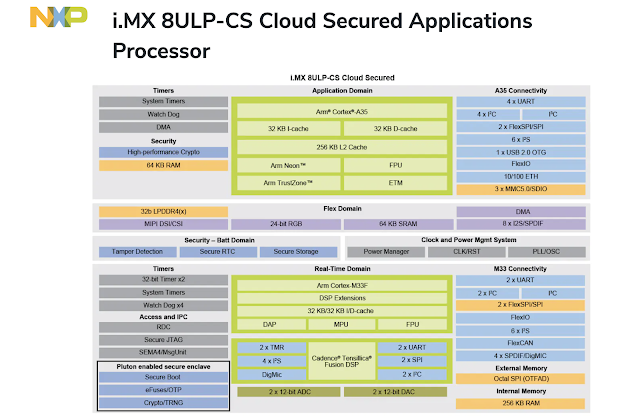
 NXP introduced its first cloud-secured crossover applications processor, the i.MX 8ULP-CS with Azure Sphere. The processor is based on the ARM Cortex A35 is aimed at IoT applications requiring continuous security updates in the field.

Together, NXP and Microsoft are delivering a new class of secured SoCs for the IoT market. Azure Sphere provides ongoing protection, responding to emerging threats and providing continual updates to help keep devices secured. 

NXP's new i.MX 8ULP-CS processor, is cloud secured by Azure Sphere, including: the Microsoft Pluton hardware root of trust enabled on NXP EdgeLock™ secure enclave, the secured Azure Sphere OS, the cloud-based Azure Sphere Security Service and ongoing on-chip OS and security improvements from Microsoft for each device, for more than ten years. 

https://www.nxp.com/company/blog/nxp-introduces-its-first-cloud-secured-microsoft-azure-sphere-certified-processor-family:BL-I-MX-8ULP-CS

Sunday, October 25, 2020

AT&T and Cisco team on IoT

AT&T and Cisco are expanding their collaboration to manage Internet of Things (IoT) devices for enterprises. Specifically, AT&T and Cisco are working together to bring new IoT solutions in Low Power Wide Area Networking and 5G. 

AT&T Control Center powered by Cisco gives businesses near real-time visibility of all the devices on their network and enhances their ability to gather and use device data to drive business outcomes. Together, the companies manage millions of connected devices spanning manufacturing, utilities, transportation, public sector, retail and  healthcare industries as well as public safety on FirstNet, built with AT&T. 


For more than a decade, the companies have worked together to manage services for U.S. enterprises and support through the AT&T Global SIM for international roaming that provides IoT connectivity in more than 200 countries and territories. 

“We look forward to continuing our collaboration with Cisco with a new multi-year agreement,” said Robert Boyanovksy, vice president, Internet of Things and Mobility, AT&T Business. “Together we can help businesses deploy IoT devices and applications faster and more securely and get more value out of devices they use.”

“Through our work with AT&T, we are helping enterprise customers accelerate their digitization initiatives and drive business outcomes with simplicity, scale and faster time to market," said Dave Wilson, Managing Director, Global IoT Sales, Cisco. 

Tuesday, July 7, 2020

Synaptics to acquire Broadcom’s IoT assets for $250 million

Synaptics agreed to acquire certain assets and manufacturing rights associated with the wireless IoT business of Broadcom for approximately $250 million in cash.

Specifically, Synaptics will acquire certain rights to Broadcom’s existing Wi-Fi, Bluetooth and GPS/GNSS products and business in the IoT market as well as future roadmap devices designed in advanced process nodes.

Synaptics expects the transaction to add approximately $65 million in current annualized sales and provide significant revenue growth potential. The transaction is expected to be immediately accretive to Synaptics’ non-GAAP gross margins and non-GAAP earnings post-close.

“Expanding our offering in the high growth IoT market has been one of the major focus areas for Synaptics and the addition of best-in-class wireless connectivity technology to our portfolio significantly enhances our overall position,” said Michael Hurlston, president and CEO, Synaptics. “This acquisition complements Synaptics’ ability to sell into a broad range of devices such as IP cameras, smart displays, speakers, home automation, and gaming consoles – all of which require cutting-edge technologies including Wi-Fi 6 and 6E, Bluetooth 5.2 and GPS L5.”

Monday, April 6, 2020

Myriota raises $19M for satellite IoT

Myriota, a start-up based in Adelaide, Australia, announced  US$19.3 million in Series B funding for its low-cost and low-power satellite connectivity for the Internet of Things (IoT).

Myriota has pioneered a new way to retrieve data from anywhere on Earth through the connectivity between its constellation of satellites and low-power IoT modules. The company said its technology will revolutionize the way companies share information across multiple industries, such as agriculture, defense, mining, transport & logistics, and more.

The new funding round was led by Hostplus and Main Sequence Ventures. Additional investors include In-Q-Tel, Inc., Right Click Capital, Singtel Innov8, Boeing HorizonX, South Australian Venture Capital Fund, and Malcolm Turnbull – the former Australian Prime Minister who led the government that established the Australian space agency in 2017. This latest round of funding brings Myriota’s total funding to more than US$37 million.

“This is a critical time for IoT. Presently, 90 percent of the earth’s surface lacks connectivity. At Myriota, we’ve been focused on filling that gap and overcoming constraints in existing infrastructure. With this new round of funding, we’ll continue to grow our network of satellites to deliver on an affordable, environmentally friendly, and powerful solution to make data accessible for our global customer base,” said Alex Grant, Co-founder and CEO, Myriota.

"Myriota is a leader and innovator in low cost, low power IoT. They have paved the way in bringing products to market for global and local applications, both here in Australia's flourishing space sector and across the world. Myriota’s growth plans will only strengthen its ability to provide industry-leading connectivity across its network of international partners,” said Malcolm Turnbull, 29th Prime Minister of Australia.

https://myriota.com

Sunday, February 9, 2020

U.S. Cellular launches LTE-M

U.S. Cellular launched its LTE-M network on more than 90% of its cell sites nationwide. The carrier aims to have LTE-M running on 100% of its cell sites in the second quarter of 2020.

U.S. Cellular’s said its LTE-M network is ideal for IoT solutions such as fleet and asset management, tank monitoring, smart meters and other applications because of its low power wide area technology (LPWAN) that provides extended coverage at a lower cost. Low power or battery-limited LTE-M devices can be less complex, lower cost and built for mass adoption of IoT applications and deployment.

“Our LTE-M network brings our business and government customers capabilities and features that will enable an entirely new set of use cases to help them improve their operations and grow their business,” said Jim Anetsberger, vice president of business sales at U.S. Cellular. “We want to set our IoT customers up for future success with solutions that are designed to meet their specific needs. Working together with our vendors and customers, we can unleash the potential of our LTE-M network.”

U.S. Cellular currently supports several LTE-M modules, including the Telit ME910C1-WW and ME910C1-NA, Quectel BG96 and u-blox SARA-R410M, with additional vendors coming soon. As the company continues to build out and evolve its LTE-M network, new features and capabilities will be added.

https://business.uscellular.com

Tuesday, January 28, 2020

Semtech debuts LoRa transceiver for Smart Home IoT sensors

Semtech introduced a transceiver designed for battery-powered LPWAN based smart home, community and consumer applications. The new Semtech LoRa Smart Home transceiver provides low power, broad coverage for indoor and neighborhood area IoT devices connecting to sensors and actuators for safety, environmental and convenience use cases. The company said its design will power sensors with multi-year operation. It features 600nA of sleep current and 4.6 mA of active receive current consumption.

Key Product Features of LoRa Smart Home (LLCC68)

  • High sensitivity to -126 dBm
  • +22 dBm output power with high efficiency PA
  • System works well even when the signal is 10dB below noise
  • Minimal external BOM/matching
  • Small size foot print, 24-pin 4x4
  • Works with existing LoRaWAN-based gateways
  • <5 consumption="" current="" li="" ma="" rx="">
  • 25 mA TX @ +14dBm
  • Integrated DC-DC and LDO
  • Supports LoRaWAN and other protocols

“With its simple and flexible network architecture, Semtech’s new LoRa® Smart Home device offers a unique opportunity to accelerate the consumer adoption of smart home connected solutions. As an end-to-end solution, or as a complement to Wi-Fi, LoRa Smart Home broadens smart home solutions by enabling connectivity for low cost and battery powered end points both indoors and outdoors,” said Pedro Pachuca, Director of IoT Wireless in Semtech’s Wireless and Sensing Products Group. “The new LoRa Smart Home device provides a flexible and cost effective solution for low latency smart home applications, including smart key locks and lighting, enabling low cost network extension and providing a bridge to the many LoRaWAN®-based B2B and B2C solutions available in the IoT market today.”

Tuesday, January 21, 2020

Skylo raises $103M for IoT over existing geostationary satellites

Skylo, a start-up based in San Mateo, California, emerged from stealth to unveil its plans to create "the world’s most affordable and ubiquitous network that connects any machine or sensor.

Skylo will leverage the cellular Narrowband Internet of Things (NB-IoT) protocol via satellite, making it possible to instantly connect billions of sensors on objects and machines in remote areas. Skylo’s new satellite connectivity will use existing geostationary satellites without the need to add new infrastructure in space. The company says it has proven its end-to-end technology and completed successful commercial field trials with major enterprise and government customers. The company’s customers already include enterprise and government entities in a range of industries including automotive, railways, agriculture and maritime.

Skylo recently completed a Series B round of funding which raised $103 million, led by SoftBank Group and joined by all existing investors. The company previously raised $13 million in a Series A round that was co-led by DCM and Innovation Endeavors, and joined by Moore Strategic Ventures. The new

“Skylo envisions a world where connectivity for machines, sensors and devices is as ubiquitous as the sky,” said Skylo co-founder and CEO Parthsarathi “Parth” Trivedi. “This low-cost, global fabric of connectivity for machine data will be transformative for entire industries.”

Skylo’s end-to-end solution encompasses the Skylo Hub, the Skylo Network, the Skylo Data Platform and Skylo API. Mass manufacturing of the Skylo Hub is underway and the Skylo Network is already live with early customers.

  • Skylo Hub — The Skylo Hub is a self-installed, easy-to-use satellite terminal that connects to the Skylo Network. It has a suite of onboard sensors to sense geolocation and acceleration, and operates like a wireless “hot spot” for a variety of external sensors such as vehicle on-board diagnostics (OBD2), temperature sensors, and standard mobile or tablet devices. The Hub uses off-the-shelf components from the cellular world, which drastically reduces the cost of the Hub and increases sensor and device compatibility. Skylo’s digitally-steered antenna technology makes the device so compact that the Hub itself is 8” x 8”, and the antenna can even be OEM-installed onto most vehicles, utilities infrastructure, and other industrial equipment. The Skylo Hub has a built-in battery, or can connect directly to external power sources, including solar.
  • Skylo Network — Skylo has also developed a proprietary method of efficiently transmitting data; this technology minimizes satellite usage costs, a cost savings that is passed onto Skylo customers.
  • Skylo Data Platform and Skylo API — The Skylo Data Platform and API helps customers to manage their Skylo Hubs remotely and visualize, analyze and act on the data that is generated, sent, and received via connected devices.

Skylo was founded in 2017 by CEO Parth Trivedi, Chief Technology Officer Dr. Andrew Nuttall and Chief Hub Architect Dr. Andrew Kalman. The company’s current Board of Directors includes Board Chairman former U.S. Ambassador Terry Kramer, David Chao of DCM, Scott Brady of Innovation Endeavors, Harpinder “Harpi” Singh of Innovation Endeavors, and Skylo CEO Trivedi. Following the receipt of required regulatory approvals, SoftBank Group will also have a representative on the Board of Directors, who will be Yoshi Segawa. Skylo has offices in San Mateo, Calif., Bangalore, India, and Tel Aviv, Israel, and is growing the team globally to support its fast-growing customer base.

Wednesday, November 6, 2019

Vodafone Business and América Móvil interconnect IoT services

Vodafone Business and América Móvil announced a partnership that makes it easier for IoT customers of both companies to deploy international IoT solutions by combining their respective IoT platforms and their expertise in IoT connectivity and services.

Vodafone Business customers will be able to connect IoT devices across Latin America; and América Móvil IoT clients will have access to one of the largest global networks via Vodafone.

“We are proud to be partnering with América Móvil” said Vinod Kumar, CEO, Vodafone Business. “With this agreement we further extend our IoT global footprint by partnering with one of Latin America’s strongest players. América Móvil´s coverage and expertise across Latin America will help us support our global customers in a part of the world where we have seen a surge in IoT adoption.”

"In América Móvil we believe in win-win partnerships that benefit our customers. We are excited about the partnership with Vodafone Business that provides our joint customers with the best user experience of two leading technology providers", said Marco Quatorze, América Móvil Value Added Service's Director.

Thursday, July 11, 2019

Deutsche Telekom and Software AG to create global Cloud of Things

Deutsche Telekom and Software AG formed a strategic partnership to deliver IoT services on a global scale.

Specifically, Deutsche Telekom and its enterprise customer unit T-Systems will expand their Cloud of Things offering, using Software AG’s Cumulocity IoT platform.

The companies are targeting an “IoT made in Germany” with plans to provide coverage in Germany, other European markets, and the United States.

Adel Al-Saleh, CEO of T-Systems and Board Member of Deutsche Telekom, said: “We’re delighted to be extending the reach and capabilities of our Cloud of Things IoT platform alongside our partner. Software AG’s technology is critical in enabling us to scale an already successful service and introduce new functionality, giving us the confidence to move into new sectors. Our strategic partnership will help us continue to drive innovation and provide the best possible platform and services for clients, both from the enterprise sector and Germany’s world-leading Mittelstand.”

Wednesday, June 19, 2019

Everactive raises $30M for industrial IoT sensors without batteries

Everactive (formerly PsiKick), a start-up based in Santa Clara, California, announced $30 million in new funding for its development of wireless, batteryless Internet of Things (IoT) systems.

Everactive said its initial products target the industrial sector, where collecting and analyzing data on physical equipment and infrastructure can have a profound and measurable impact—serving to reduce downtime, cut maintenance costs, improve safety and environmental impact, as well as boost overall efficiency. In late 2018, Everactive launched Steam Trap Monitor (STM), which is designed to continuously monitor the pervasive industrial and district energy steam trap in order to determine whether or not the trap has failed so that maintenance personnel can act to minimize costly energy waste and safety concerns. Currently in small-scale deployments, the company’s latest products include a Machine Health Monitor that analyzes vibration on rotating equipment, such as industrial motors, pumps, and fans. Everactive also offers a Flare System Monitor that mitigates the length and costs of flaring events in refineries.

Everactive eliminates batteries due to its underlying integrated circuit and wireless networking expertise. The company’s co-founders, Drs. Benton Calhoun and David Wentzloff, have been working on ultra-low-power electronics since their days together at MIT’s Electrical Engineering & Computer Science program. On top of that core chip technology, Everactive has not only built its own self-powered sensor devices, but also all the networking, software, and cloud analytics to be able to deliver insights to customers.

The funding round was led by Future Fund and joined by new investors Blue Bear Capital and ABB Technology Ventures, alongside existing investors New Enterprise Associates (NEA) and Osage University Partners. The company has raised $63 million to date.

“Removing the need for batteries solves one of the key limitations of the IoT and represents a fundamental paradigm shift, allowing our customers to deploy wireless sensors at scale and gain access to new, high-value data-driven insights,” said Bob Nunn, CEO of Everactive. “Over the last 18 months, Everactive has productized our ultra-low-power silicon technology and developed a compelling go-to-market strategy that is now driving rapid customer adoption. Everactive will use the proceeds from the new round to meet the growing customer demand for our existing and future products.”

http://www.everactive.com

Thursday, June 13, 2019

IDC: Worldwide Spending on IoT to hit $1.1 trillion in 2023

IDC is predicting booming worldwide spending on the Internet of Things (IoT) with spending exceeding $1.0 trillion mark in 2022 and reaching $1.1 trillion in 2023.

A new update to the International Data Corporation (IDC) Worldwide Semiannual Internet of Things Spending Guide shows the compound annual growth rate (CAGR) for IoT spending over the 2019-2023 forecast period will be 12.6%.

"Spending on IoT deployments continues with good momentum and is expected to be $726 billion worldwide this year," said Carrie MacGillivray, group vice president, Internet of Things, 5G, and Mobility at IDC. "While organizations are investing in hardware, software, and services to support their IoT initiatives, their next challenge is finding solutions that help them to manage, process, and analyze the data being generated from all these connected things."

Highlights:

  • Discrete manufacturing, process manufacturing, and transportation will account for nearly a third of worldwide spend total in 2023. 
  • The consumer market will be the second largest source of IoT spending in 2019, led by smart home and connected vehicle use cases. With the fastest five-year growth rate across all industries (16.8% CAGR), the consumer market is forecast to overtake discrete manufacturing to become the largest source of IoT spending by 2023.
  • Hardware spending is dominated by module/sensor purchases. 
  • Software will be the fastest growing technology category with a five-year CAGR of 15.3% with a focus on application and analytics software purchases.
  • More than three quarters of all spending on IoT platform software – middleware that provides the device management, connectivity management, data management, visualization, and applications enablement for connecting IoT endpoints – will go toward software packages that integrate and support devices, applications, data schemas, and standards of a single industry. 
  • By the end of the forecast, nearly one-third of IoT software spending will go toward public cloud deployments, compared to less than 20% spent on cloud deployments in 2018.
  • The United States and China will account for roughly half of all IoT spending throughout the forecast, followed by Western Europe and Asia/Pacific (excluding Japan and China). 

Thursday, February 28, 2019

DOCOMO Ventures Invests in Shoof for IoT tracking

NTT DOCOMO Ventures has made an equity investment in Shoof Technologies, a start-up based in Sunnyvale, California that is developing advanced wireless technology designed for the Industrial IoT.

Shoof claims its technology for asset monitoring and tracking overcomes the unreliable nature of current wireless technology. It offers a cloud platform and equipment such as base stations and tags to track assets in motion in any location in real time. It is applicable to a wide range of industrial markets with unmatched advantages, including scalability, ability for both indoor and outdoor tracking, a long communication range, blockchain-capable security authentication, open-network infrastructure, and is free of maintenance.

Wednesday, February 6, 2019

DT targets integrated SIM for IoT

Deutsche Telekom, working in partnership with industry partners, has led the development of nuSIM, which moves the SIM functionality from the physical SIM card directly to the chipset.

nuSIM is specifically designed for low-cost devices used in mobile IoT applications with a long life-span, such as asset trackers or smart motion or temperature sensors. It will be commercially available in the second half of 2019.

The partners include:

  • for chipsets: Altair Semiconductor, Commsolid/Goodix, HiSilicon, Nordic Semiconductor, Qualcomm, Samsung Electronics, Sequans Communications, 
  • for modules: Quectel Wireless Solutions, Sierra Wireless, Telit, u-blox, Nordic Semiconductor.
  • for digital security: Giesecke+Devrient Mobile Security.

“Deutsche Telekom has built a solid track record in IoT technology innovation over the past years. The most important success driver for us is to anticipate customer needs to make sure we enable their business success,” says Ingo Hofacker, Senior Vice President, responsible for the IoT business at Deutsche Telekom. “nuSIM, our rigorously optimized SIM solution for the cost-sensitive mobile IoT market is our latest endeavor and an important building block for our offering moving forward.”

Wednesday, January 9, 2019

Gemalto integrates eSIM into LTE-M IoT module for AT&T

Gemalto has integrated its embedded SIM (eSIM) for AT&T into its Cinterion LTE-M IoT module;

The new solution streamlines development for OEMs and reduces the cost and complexity of IoT deployment by eliminating the need for SIM card integration after manufacturing.

eSIMs also help maintain the strongest security levels with continuous security updates for the long life of IoT solutions. Samples of the new module are available with volume shipping to follow shortly.

“The increasing adoption of eSIM technology marks a significant transformation in wireless technology that is driving innovation and improved security across the whole lifecycle of devices, said Andreas Haegele, SVP IoT Products, Gemalto. “The Cinterion LTE-M Module with embedded SIM technology benefits mobile operators and OEMs alike with enhanced flexibility and seamless connectivity for the IoT.”