Showing posts with label Nvidia. Show all posts

Monday, March 18, 2024

NVIDIA rolls out 800G Networking Switches

NVIDIA introduced its X800 series of 800G Infiniband and Ethernet networking switches designed to cater to massive-scale AI workloads, including those utilizing NVIDIA's newly unveiled Blackwell architecture-based products.

Quantum-X800 Platform: Features the NVIDIA Quantum Q3400 switch and the NVIDIA ConnectX-8 SuperNIC, delivering 5 times higher bandwidth and a 9 times increase in In-Network Computing capabilities compared to previous generations. Advanced features include:

  • The Q3400-RA 4U switch—the first to utilize 200 Gbps-per-lane serializer/deserializer (SerDes) technology. It offers 144 ports of 800 Gbps distributed over 72 OSFP cages and a dedicated management port for NVIDIA UFM (Unified Fabric Manager) connectivity
  • With this very high radix, a two-level fat tree topology can connect up to 10,368 network interface cards (NICs)
  • NVIDIA SHARP v4, Message Passing Interface (MPI) tag matching, MPI_Alltoall, and programmable cores boost NVIDIA In-Network Computing
  • Adaptive routing: The switch and ConnectX-8 SuperNIC, working together, maximize bandwidth and ensure network resilience for AI fabrics
  • Telemetry-based congestion control: These techniques provide noise isolation for multi-tenant AI workloads.
  • The Q3400 is air-cooled and compatible with standard 19-inch rack cabinets. A parallel liquid-cooled system, Q3400-LD, fitting an Open Compute Project (OCP) 21-inch rack, is offered as well.

The NVIDIA ConnectX-8 SuperNIC delivers 800 Gbps networking with performance isolation for multi-tenant generative AI clouds. It provides 800 Gbps data throughput with PCI Express (PCIe) Gen6, offering up to 48 lanes for various use cases such as PCIe switching inside NVIDIA GPU systems. It also supports advanced NVIDIA In-Network Computing, MPI_Alltoall, and MPI tag-matching hardware engines, as well as fabric enhancement features like quality ofservice and congestion control. The ConnectX-8 SuperNIC, featuring single-port OSFP224 and dual-port quad small form-factor pluggable (QSFP) 112 connectors for the adapters, is compatible with various form factors, including OCP 3.0 and Card Electromechanical (CEM) PCIe x16. ConnectX-8 SuperNIC also supports NVIDIA Socket Direct 16-lane auxiliary card expansion


Spectrum-X800 Platform: Tailored for AI cloud and enterprise infrastructure, offering optimized performance for faster processing and analysis of AI workloads. It includes the Spectrum SN5600 800 Gbps switch and the NVIDIA BlueField-3 SuperNIC. Highlights:

  • The Spectrum-X800 SN5600 ASIC boasts 64 ports of 800G OSFP and 51.2 terabits per second (Tbps) of switching capacity. 
  • Support Remote direct-memory access (RDMA) over converged Ethernet (RoCE) adaptive routing: Spectrum-X800 features adaptive routing for lossless networks, closely integrating the switch and SuperNIC to boost bandwidth and resilience in AI fabrics. 
  • Programmable congestion control: Spectrum-X800 uses advanced congestion control techniques to enhance noise isolation in multi-tenant AI environments
  • Software Support: NVIDIA provides a suite of network acceleration libraries and software to enhance the performance of trillion-parameter AI models, including the NVIDIA Collective Communications Library (NCCL) for extending GPU computing tasks to the Quantum-X800 network.

“NVIDIA Networking is central to the scalability of our AI supercomputing infrastructure,” said Gilad Shainer, senior vice president of Networking at NVIDIA. “NVIDIA X800 switches are end-to-end networking platforms that enable us to achieve trillion-parameter-scale generative AI essential for new AI infrastructures.”

Initial adopters of Quantum InfiniBand and Spectrum-X Ethernet include Microsoft Azure and Oracle Cloud Infrastructure.

“AI is a powerful tool to turn data into knowledge. Behind this transformation is the evolution of data centers into high-performance AI engines with increased demands for networking infrastructure,” said Nidhi Chappell, Vice President of AI Infrastructure at Microsoft Azure. “With new integrations of NVIDIA networking solutions, Microsoft Azure will continue to build the infrastructure that pushes the boundaries of cloud AI.

https://www.nvidia.com

Tuesday, March 21, 2023

NVIDIA accelerates its generative AI platforms

NVIDIA launched four inference platforms optimized for generative AI applications:

  • NVIDIA L4 for AI Video can deliver 120x more AI-powered video performance than CPUs, combined with 99% better energy efficiency. Serving as a universal GPU for virtually any workload, it offers enhanced video decoding and transcoding capabilities, video streaming, augmented reality, generative AI video and more.
  • NVIDIA L40 for Image Generation is optimized for graphics and AI-enabled 2D, video and 3D image generation. The L40 platform serves as the engine of NVIDIA Omniverse, a platform for building and operating metaverse applications in the data center, delivering 7x the inference performance for Stable Diffusion and 12x Omniverse performance over the previous generation.
  • NVIDIA H100 NVL for Large Language Model Deployment is ideal for deploying massive LLMs like ChatGPT at scale. The new H100 NVL with 94GB of memory with Transformer Engine acceleration delivers up to 12x faster inference performance at GPT-3 compared to the prior generation A100 at data center scale.
  • NVIDIA Grace Hopper for Recommendation Models is ideal for graph recommendation models, vector databases and graph neural networks. With the 900 GB/s NVLink-C2C connection between CPU and GPU, Grace Hopper can deliver 7x faster data transfers and queries compared to PCIe Gen 5.

“The rise of generative AI is requiring more powerful inference computing platforms,” said Jensen Huang, founder and CEO of NVIDIA. “The number of applications for generative AI is infinite, limited only by human imagination. Arming developers with the most powerful and flexible inference computing platform will accelerate the creation of new services that will improve our lives in ways not yet imaginable.”

https://nvidianews.nvidia.com/news/nvidia-launches-inference-platforms-for-large-language-models-and-generative-ai-workloads

Wednesday, November 16, 2022

NVIDIA's Q3 sales drop to $5.93 billion, down 17% yoy

NVIDIA reported Q3 2022 revenue of $5.93 billion, down 17% from a year ago and down 12% from the previous quarter. Net income was $1.456 billion, down 51% yoy. Non-GAAP earnings per diluted share were $0.58, down 50% from a year ago and up 14% from the previous quarter.

“We are quickly adapting to the macro environment, correcting inventory levels and paving the way for new products,” said Jensen Huang, founder and CEO of NVIDIA.

“The ramp of our new platforms ― Ada Lovelace RTX graphics, Hopper AI computing, BlueField and Quantum networking, Orin for autonomous vehicles and robotics, and Omniverse ― is off to a great start and forms the foundation of our next phase of growth.

Highlights:

  • Data Center - Q3 revenue was $3.83 billion, up 31% from a year ago and up 1% from the previous quarter. During the quarter, the company began shipping the NVIDIA H100 Tensor Core GPU based on the new NVIDIA Hopper architecture, with first systems available now.
  • Gaming - Q3 revenue was $1.57 billion, down 51% from a year ago and down 23% from the previous quarter.
  • Professional Visualization - Q3 revenue was $200 million, down 65% from a year ago and down 60% from the previous quarter.
  • Automotive and Embedded - Q3 revenue was $251 million, up 86% from a year ago and up 14% from the previous quarter.

https://nvidianews.nvidia.com/news/nvidia-announces-financial-results-for-third-quarter-fiscal-2023

Wednesday, August 31, 2022

U.S. blocks shipments of NVIDIA's A100 and H100 to China, Russia

The U.S. government has imposed an export restriction on NVIDIA's A100 and forthcoming H100 integrated circuits to China (including Hong Kong) and Russia. The license restriction also covers NVIDIA's DGX or any other systems which incorporate A100 or H100 integrated circuits, as well as any future NVIDIA integrated circuit achieving both peak performance and chip-to-chip I/O performance equal to or greater than thresholds that are roughly equivalent to the A100, as well as any system that includes those circuits. 

The new license requirement may require NVIDIA to transition certain operations out of China. 

NVIDIA said its financial outlook for its third fiscal quarter, provided on August 24, 2022, included approximately $400 million in potential sales to China which may be subject to the new license requirement if customers do not want to purchase the Ccmpany’s alternative product offerings or if the U.S. government does not grant licenses in a timely manner or denies licenses to significant customers.


https://investor.nvidia.com/financial-info/sec-filings/default.aspx

  • NVIDIA's A100, powered by itsAmpere Architecture, is the engine of the NVIDIA data center platform. A100 provides up to 20X higher performance over the prior generation and can be partitioned into seven GPU instances to dynamically adjust to shifting demands. It is available in 40GB and 80GB memory versions,the latter of which boasts the world’s fastest memory bandwidth at over 2 terabytes per second (TB/s).
  • NVIDIA's H100 features fourth-generation Tensor Cores and the Transformer Engine with FP8 precision. The company claims up to 9X faster training over the prior generation for mixture-of-experts (MoE) models. The design also leverages fourth-generation NVlink, which offers 900 GB/s of GPU-to-GPU interconnect and the NVLINK Switch System, which accelerates communication by every GPU across nodes.

NVIDIA posts revenue or $6.7B, decline in gaming revenue

In what it described as a "challenging quarter" driven primarily by weaker gaming revenue, NVIDIA reported revenue of $6.70 billion for the second quarter ended July 31, 2022, up 3% from a year ago and down 19% from the previous quarter.GAAP earnings per diluted share for the quarter were $0.26, down 72% from a year ago and down 59% from the previous quarter. Non-GAAP earnings per diluted share were $0.51, down 51% from a year ago and down 63% from...

NVIDIA trims outlook on lower gaming sales and supply disruptions

Citing macroeconomic headwins and lower gaming sales, NVIDIA trimmed its financial outlook for the second quarter ended July 31, 2022.Second quarter revenue is expected to be approximately $6.70 billion, down 19% sequentially and up 3% from the prior year, primarily reflecting weaker than forecasted Gaming revenue. Gaming revenue was $2.04 billion, down 44% sequentially and down 33% from the prior year. Data Center revenue was $3.81 billion, up 1%...

NVIDIA unveils Quantum Optimized Device Architecture

NVIDIA outlined a new Quantum Optimized Device Architecture (QODA) for creating a coherent hybrid quantum-classical programming model. QODA is an open, unified environment for quantum processors that aims to make it easier to add quantum computing to existing applications, leveraging both today’s quantum processors, as well as simulated future quantum machines using NVIDIA DGX systems and a large installed base of NVIDIA GPUs available in scientific...


Wednesday, August 24, 2022

NVIDIA posts revenue or $6.7B, decline in gaming revenue

In what it described as a "challenging quarter" driven primarily by weaker gaming revenue, NVIDIA reported revenue of $6.70 billion for the second quarter ended July 31, 2022, up 3% from a year ago and down 19% from the previous quarter.

GAAP earnings per diluted share for the quarter were $0.26, down 72% from a year ago and down 59% from the previous quarter. Non-GAAP earnings per diluted share were $0.51, down 51% from a year ago and down 63% from the previous quarter.

NVIDIA said there was a steeper than expected decline in gaming revenue, which amounted to $2.04 billion, down 33% from a year ago and down 44% from the previous quarter. The company did not quantify the negative impact from crypto mining.

Data center revenue was $3.81 billion, up 61% from a year ago and up 1% from the previous quarter. 

Automotive revenue was $220 million, up 45% from a year ago and up 59% from the previous quarter.

“We are navigating our supply chain transitions in a challenging macro environment and we will get through this,” said Jensen Huang, founder and CEO of NVIDIA.

“Accelerated computing and AI, the pioneering work of our company, are transforming industries. Automotive is becoming a tech industry and is on track to be our next billion-dollar business. Advances in AI are driving our Data Center business while accelerating breakthroughs in fields from drug discovery to climate science to robotics.

“I look forward to next month’s GTC conference, where we will share new advances in RTX, as well as breakthroughs in AI and the metaverse, the next evolution of the internet. Join us,” he said.

During the second quarter of fiscal 2023, NVIDIA returned to shareholders $3.44 billion in share repurchases and cash dividends, following a return of $2.10 billion in the first quarter. The company has $11.93 billion remaining under its share repurchase authorization through December 2023. NVIDIA plans to continue share repurchases this fiscal year.

https://investor.nvidia.com/events-and-presentations/events-and-presentations/event-details/2022/NVIDIA-2nd-Quarter-FY23-Financial-Results/default.aspx

Monday, August 8, 2022

NVIDIA trims outlook on lower gaming sales and supply disruptions

Citing macroeconomic headwins and lower gaming sales, NVIDIA trimmed its financial outlook for the second quarter ended July 31, 2022.

Second quarter revenue is expected to be approximately $6.70 billion, down 19% sequentially and up 3% from the prior year, primarily reflecting weaker than forecasted Gaming revenue. Gaming revenue was $2.04 billion, down 44% sequentially and down 33% from the prior year. Data Center revenue was $3.81 billion, up 1% sequentially and up 61% from the prior year.

The shortfall relative to the May revenue outlook of $8.10 billion was primarily attributable to lower sell-in of Gaming products reflecting a reduction in channel partner sales likely due to macdroeconomic headwinds. In addition to reducing sell-in, the company implemented pricing programs with channel partners to reflect challenging market conditions that are expected to persist into the third quarter.

Data Center revenue, though a record, was somewhat short of the company’s expectations, as it was impacted by supply chain disruptions.

Second quarter results are expected to include approximately $1.32 billion of charges, primarily for inventory and related reserves, based on revised expectations of future demand.

“Our gaming product sell-through projections declined significantly as the quarter progressed,” said Jensen Huang, founder and CEO of NVIDIA. “As we expect the macroeconomic conditions affecting sell-through to continue, we took actions with our Gaming partners to adjust channel prices and inventory.

https://nvidianews.nvidia.com/news/nvidia-announces-preliminary-financial-resultsfor-second-quarter-fiscal-2023

Tuesday, July 12, 2022

NVIDIA unveils Quantum Optimized Device Architecture

NVIDIA outlined a new Quantum Optimized Device Architecture (QODA) for creating a coherent hybrid quantum-classical programming model. 

QODA is an open, unified environment for quantum processors that aims to make it easier to add quantum computing to existing applications, leveraging both today’s quantum processors, as well as simulated future quantum machines using NVIDIA DGX systems and a large installed base of NVIDIA GPUs available in scientific supercomputing centers and public clouds.

Leading quantum organizations are already using NVIDIA GPUs and highly specialized NVIDIA software – NVIDIA cuQuantum – to develop individual quantum circuits. With QODA, developers can build complete quantum applications simulated with NVIDIA cuQuantum on GPU-accelerated supercomputers.

“Scientific breakthroughs can occur in the near term with hybrid solutions combining classical computing and quantum computing,” said Tim Costa, director of HPC and Quantum Computing Products at NVIDIA. “QODA will revolutionize quantum computing by giving developers a powerful and productive programming model.”

In addition, NVIDIA announced QODA collaborations with quantum hardware providers IQM Quantum Computers, Pasqal, Quantinuum, Quantum Brilliance and Xanadu; software providers QC Ware and Zapata Computing; and supercomputing centers Forschungszentrum Jülich, Lawrence Berkeley National Laboratory and Oak Ridge National Laboratory.

“Quantinuum is partnering with NVIDIA to enable users of Quantinuum’s H-series quantum processors, powered by Honeywell, to program and develop the next generation of hybrid quantum-classical applications with QODA,” said Alex Chernoguzov, chief engineer at Quantinuum. “This ties together the best performing classical computers with our world-class quantum processors.”

“The hybrid quantum-classical capabilities developed by NVIDIA will enable HPC developers to accelerate their existing applications by providing an efficient way to program quantum and classical resources in a consolidated environment,” said Yudong Cao, chief technology officer at Zapata. “Near-term applications in chemistry, drug discovery, materials science and more can now be seamlessly integrated with quantum computing, driving new discoveries in these fields as practical quantum advantage emerges.”

https://developer.nvidia.com/qoda

Wednesday, May 25, 2022

Ayar Labs teams with NVIDIA on Optical Interconnects

Ayar Labs is working with NVIDIA on artificial intelligence (AI) infrastructure based on optical I/O technology to meet future demands of AI and high performance computing (HPC) workloads. 

The collaboration will focus on integrating Ayar Labs’ technology to develop scale-out architectures enabled by high-bandwidth, low-latency and ultra-low-power optical-based interconnects for future NVIDIA products. Together, the companies plan to accelerate the development and adoption of optical I/O technology to support the explosive growth of AI and machine learning (ML) applications and data volumes.

“Today’s state-of-the-art AI/ML training architectures are limited by current copper-based compute-to-compute interconnects to build scale-out systems for tomorrow’s requirements,” said Charles Wuischpard, CEO of Ayar Labs. “Our work with NVIDIA to develop next-generation solutions based on optical I/O provides the foundation for the next leap in AI capabilities to address the world’s most sophisticated problems.”

“Over the past decade, NVIDIA-accelerated computing has delivered a million-X speedup in AI,” said Rob Ober, Chief Platform Architect for Data Center Products at NVIDIA. “The next million-X will require new, advanced technologies like optical I/O to support the bandwidth, power and scale requirements of future AI and ML workloads and system architectures.”

https://ayarlabs.com/

Ayar Labs lands $130m for In-Package Optical I/O

Ayar Labs, a start-up based in Santa Clara, California, secured $130 million in additional financing for its optical I/O solution. 

With the new investment, Ayar Labs said it is ramping production and securing supply chain partners, as signaled by previously announced multi-year strategic collaborations with Lumentum and Macom, both leaders in optical and photonic products, as well as GlobalFoundries on its new GF Fotonix platform. The company also confirmed that it made its first volume commercial shipments under contract and expects to ship thousands of units of its in-package optical interconnect by end of year.

The new funding was led by Boardman Bay Capital Management. Hewlett Packard Enterprise (HPE) and NVIDIA entered this investment round, joining existing strategic investors Applied Ventures LLC, GlobalFoundries, Intel Capital, and Lockheed Martin Ventures. Other new strategic and financial investors participating in the round include Agave SPV, Atreides Capital, Berkeley Frontier Fund, IAG Capital Partners, Infinitum Capital, Nautilus Venture Partners, and Tyche Partners. They join existing investors such as BlueSky Capital, Founders Fund, Playground Global, and TechU Venture Partners.
 
http://www.ayarlabs.com
 

What's hot at OFC22? Ayar Labs on Optical I/O

There is a lot of discussion about optical I/O and the challenge of getting photonics integrated much closer to compute units, says Mark Wade, co-founder and CTO, Ayar Labs.Last year, Ayar Labs demonstrated its end-to-end, DWDM micro-ring solution for optical I/O. This year, it's clear that big parts of the industry are heading in this direction.  Some highlights for the ecosystem include GlobalFoundries newly announced photonics platform, a...

NVIDIA reports strong data center sales, trims outlook

NVIDIA reported record revenue for the first quarter ended May 1, 2022, of $8.29 billion, up 46% from a year ago and up 8% from the previous quarter, with record revenue in Data Center and Gaming.

GAAP earnings per diluted share for the quarter were $0.64, down 16% from a year ago and down 46% from the previous quarter, and include an after-tax impact of $0.52 related to the $1.35 billion Arm acquisition termination charge. Non-GAAP earnings per diluted share were $1.36, up 49% from a year ago and up 3% from the previous quarter.

“We delivered record results in Data Center and Gaming against the backdrop of a challenging macro environment,” said Jensen Huang, founder and CEO of NVIDIA. “The effectiveness of deep learning to automate intelligence is driving companies across industries to adopt NVIDIA for AI computing. Data Center has become our largest platform, even as Gaming achieved a record quarter.

“We are gearing up for the largest wave of new products in our history with new GPU, CPU, DPU and robotics processors ramping in the second half. Our new chips and systems will greatly advance AI, graphics, Omniverse, self-driving cars and robotics, as well as the many industries these technologies impact,” he said.

However, NVIDIA trimmed its outlook for the second quarter of fiscal 2023 is as follows:

Revenue is expected to be $8.10 billion, plus or minus 2%. This includes an estimated reduction of approximately $500 million relating to Russia and the COVID lockdowns in China.

GAAP and non-GAAP gross margins are expected to be 65.1% and 67.1%, respectively, plus or minus 50 basis points.

Some highlights:

  • Data Center: First-quarter revenue was a record $3.75 billion, up 83% from a year ago and up 15% from the previous quarter.
  • Gaming: First-quarter revenue was a record $3.62 billion, up 31% from a year ago and up 6% from the previous quarter.
  • Professional Visualization: First-quarter revenue was $622 million, up 67% from a year ago and down 3% from the previous quarter.
  • Automotive and Robotics: First-quarter Automotive revenue was $138 million, down 10% from a year ago and up 10% from the previous quarter.


https://investor.nvidia.com/home/default.aspx

Monday, May 23, 2022

First systems powered by NVIDIA's Grace and Grace Hopper Superchips

Leading Taiwanese computer makers are introducing the firstsystems powered by the NVIDIA's new Grace CPU Superchip and Grace Hopper Superchip.

Dozens of server models from ASUS, Foxconn Industrial Internet, GIGABYTE, QCT, Supermicro and Wiwynn are expected starting in the first half of 2023. The Grace-powered systems will join x86 and other Arm-based servers to offer customers a broad range of choice for achieving high performance and efficiency in their data centers.

The coming servers are based on four new system designs featuring the Grace CPU Superchip and Grace Hopper Superchip, which NVIDIA announced at its two most recent GTC conferences. 

“A new type of data center is emerging — AI factories that process and refine mountains of data to produce intelligence — and NVIDIA is working closely with our Taiwan partners to build the systems that enable this transformation,” said Ian Buck, vice president of Hyperscale and HPC at NVIDIA. “These new systems from our partners, powered by our Grace Superchips, will bring the power of accelerated computing to new markets and industries globally.”

The Grace CPU Superchip features two CPU chips, connected coherently through an NVIDIA NVLink-C2C interconnect, with up to 144 high-performance Arm V9 cores with scalable vector extensions and a 1 terabyte-per-second memory subsystem. The design provides the highest performance and twice the memory bandwidth and energy efficiency of today’s leading server processors to address the most demanding HPC, data analytics, digital twin, cloud gaming and hyperscale computing applications.

The Grace Hopper Superchip pairs an NVIDIA Hopper GPU with a Grace CPU over NVLink-C2C in an integrated module designed to address HPC and giant-scale AI applications. Using the NVLink-C2C interconnect, the Grace CPU transfers data to the Hopper GPU 15x faster than traditional CPUs.

The Grace CPU Superchip and Grace Hopper Superchip server design portfolio includes systems available in single baseboards with one-, two- and four-way configurations available across four workload-specific designs that can be customized by server manufacturers according to customer needs:

  • NVIDIA HGX Grace Hopper systems for AI training, inference and HPC are available with the Grace Hopper Superchip and NVIDIA BlueField-3 DPUs.
  • NVIDIA HGX Grace systems for HPC and supercomputing feature the CPU-only design with Grace CPU Superchip and BlueField-3.
  • NVIDIA OVX systems for digital twins and collaboration workloads feature the Grace CPU Superchip, BlueField-3 and NVIDIA GPUs.
  • NVIDIA CGX systems for cloud graphics and gaming feature the Grace CPU Superchip, BlueField-3 and NVIDIA A16 GPUs.

Tuesday, March 22, 2022

NVIDIA unveils 51.2T Spectrum-4 switch ASIC

NVIDIA unveiled its next generation, 400 Gbps Spectrum-4 Ethernet switch with adaptive routing and enhanced congestion control mechanisms.

The NVIDIA Spectrum-4 uses a custom ASIC with a 51.2 terabits per second switching capacity, supporting up 128 ports of 400G or 64 ports of 800G, and based on 100 Gbps PAM4 SerDes technology. It integrates a 12.8 Tb/s crypto engine wtih support for MACsec and VXLANsec. It also support secure boot as default via hardware root of trust .

NVIDIA Spectrum-4 features a fully-shared and monolithic packet buffer that’s dynamically available to all ports. This provides  microburst absorption with true, port-to-port, cut-through latency. Spectrum-4 also supports programmability of the pipeline and packet modifier/parser without impact tolatency or packet rate, enabling flexibility without compromising performance.

NVIDIA also notes that its Spectrum-4 switch enables accelerated RoCE-based data transport and load balancing through adaptive routing (including adaptive routing notifications for dynamic flow rebalance), as well as high precision congestion control (HPCC) facilitated through in-band network telemetry.

The chip is based on a 4nm process and is expected to sample later this year.

"A new era of massive-scale cloud technologies, such as Omniverse, requires a transformation of data center architecture,” said Kevin Deierling, vice president of Networking at NVIDIA. “The Spectrum-4 platform’s extreme performance and robust security will equip data centers to power breakthrough discoveries that push the boundaries of what’s possible for the benefit of society.”

https://nvdam.widen.net/s/lxhqbqlbqh/ethernet-switches-product-brief-gtc22-spring-spectrum-4-2169045-r3

NVIDIA opens its NVLink die-to-die and chip-to-chip

NVIDIA will expand the use of its NVLink chip-to-chip and die-to-die interconnect technology in its GPUs, CPUs, DPUs, NICs and SOCs. The company also plans to open the technolgy to other for for custom chip and chiplet integrations. 

NVIDIA NVLink-C2C is built on top of NVIDIA’s world-class SERDES and LINK design technology, and it is extensible from PCB-level integrations and multichip modules to silicon interposer and wafer-level connections, delivering extremely high bandwidth while optimizing for energy and die area efficiency.

In addition to NVLink-C2C, NVIDIA will also support the developing Universal Chiplet Interconnect Express (UCIe) standard. Custom silicon integration with NVIDIA chips can either use the UCIe standard or NVLink-C2C, which is optimized for lower latency, higher bandwidth and greater power efficiency.

Some of NVLink-C2C’s key features include:

● High Bandwidth – supporting high-bandwidth coherent data transfers between processors and accelerators

● Low Latency – supporting atomics between processors and accelerators to perform fast synchronization and high-frequency updates to shared data

● Low Power and High Density – using advanced packaging, it is 25x more energy efficient and 90x more area-efficient than PCIe Gen 5 on NVIDIA chips

● Industry-Standard Support – works with Arm’s AMBA CHI or CXL industry-standard protocols for interoperability between devices

“Chiplets and heterogeneous computing are necessary to counter the slowing of Moore’s law,” said Ian Buck, vice president of Hyperscale Computing at NVIDIA. “We’ve used our world-class expertise in high-speed interconnects to build uniform, open technology that will help our GPUs, DPUs, NICs, CPUs and SoCs create a new class of integrated products 

NVIDIA estimates that its NVLink-C2C interconnect could deliver up to 25x more energy efficiency and be 90x more area-efficient than PCIe Gen 5 on NVIDIA chips and enable coherent interconnect bandwidth of 900 Gbps or higher.

“As the future of CPU design is increasingly accelerated and multichip, it is critical to support chiplet-based SoCs across the ecosystem,” said Chris Bergey, senior vice president and general manager of the Infrastructure Line of Business at Arm. “Arm is supporting a broad set of connectivity standards and designing our AMBA CHI protocol to support these future technologies, including collaborating with NVIDIA on NVLink-C2C to address use cases like coherent connectivity between CPUs, GPUs and DPUs.”

https://www.nvidia-press.com/f/preview/27653

Tuesday, February 8, 2022

NVIDIA and SoftBank terminate Arm acquisition

NVIDIA and SoftBank cancelled the acquisition of Arm Limited by NVIDIA. The companies cited significant regulatory challenges.

SoftBank said it now plans a public listing of Arm Limited within the fiscal year ending in March 2023.

“Arm is becoming a center of innovation not only in the mobile phone revolution, but also in cloud computing, automotive, the Internet of Things and the metaverse, and has entered its second growth phase,” said Masayoshi Son, Representative Director, Corporate Officer, Chairman & Chief Executive Officer of SoftBank Group Corp. “We will take this opportunity and start preparing to take Arm public, and to make even further progress.”

“Arm has a bright future, and we’ll continue to support them as a proud licensee for decades to come,” said Jensen Huang, founder and chief executive officer of NVIDIA. “Arm is at the center of the important dynamics in computing. Though we won’t be one company, we will partner closely with Arm. The significant investments that Masa has made have positioned Arm to expand the reach of the Arm CPU beyond client computing to supercomputing, cloud, AI and robotics. I expect Arm to be the most important CPU architecture of the next decade.”

Citing competition concerns, FTC moves to block NVIDIA + ARM

The U.S. Federal Trade Commission (FTC) sued to block the $40 billion proposed acquisition of Arm Ltd. by Nvidia Corp.The FTC vote was 4-0.The FTC complaint states that the acquisition will harm competition in three worldwide markets in which Nvidia competes using Arm-based products:High-Level Advanced Driver Assistance Systems for passenger cars. These systems offer computer-assisted driving functions, such as automated lane changing, lane keeping,...

NVIDIA to acquire ARM for $40 billion

 In a deal that will redefine the semiconductor market, NVIDIA agreed to acquire Arm Limited from Softbank for $40 billion. Under the deal, NVIDIA will pay to SoftBank a total of $21.5 billion in NVIDIA common stock and $12 billion in cash. NVIDIA will also issue $1.5 billion in equity to Arm employees. The deal does not include Arm’s IoT Services Group.NVIDIA vowed to retain Arm's open-licensing model while maintaining the global customer neutrality...

Monday, January 24, 2022

Meta's next AI supercomputer to use NVIDIA 200 Gb/s InfiniBand fabric

Meta is building an AI research supercomputer that will leverage NVIDIA systems, InfiniBand networking and AI software to enable optimization across thousands of GPUs.

The AI Research SuperCluster (RSC), which will be the largest NVIDIA DGX A100 customer system to date when fully deployed later this year, will deliver 5 exaflops of AI performance.

RSC is powered by 760 NVIDIA DGX A100 systems linked with NVIDIA Quantum 200 Gb/s InfiniBand fabric, delivering 1,896 petaflops of TF32 performance.

Penguin Computing provided managed services and AI-optimized infrastructure for Meta comprised of 46 petabytes of cache storage with its Altus systems. Pure Storage FlashBlade and FlashArray//C provide the highly performant and scalable all-flash storage capabilities needed to power RSC.

https://blogs.nvidia.com/blog/2022/01/24/meta-ai-supercomputer-dgx/


Tuesday, December 21, 2021

NVIDIA's BlueFiled DPU claims performance record: 41.5 million IOPS

NVIDIA is reporting a new performance benchmark for DPUs:  two BlueField-2 data processing units reached 41.5 million input/output operations per second (IOPS) — more than 4x more IOPS than any other DPU.

The BlueField-2 DPU delivered record-breaking performance using standard networking protocols and open-source software. It reached more than 5 million 4KB IOPS and from 7 million to over 20 million 512B IOPS for NVMe over Fabrics (NVMe-oF), a common method of accessing storage media, with TCP networking, one of the primary internet protocols.

To accelerate AI, big data and high performance computing applications, BlueField provides even higher storage performance using the popular RoCE network transport option.

In testing, BlueField supercharged performance as both an initiator and target, using different types of storage software libraries and different workloads to simulate real-world storage configurations. BlueField also supports fast storage connectivity over InfiniBand, the preferred networking architecture for many HPC and AI applications.

Testing Methodology

The 41.5 million IOPS reached by BlueField is more than 4x the previous world record of 10 million IOPS, set using proprietary storage offerings. This performance was achieved by connecting two fast Hewlett Packard Enterprise Proliant DL380 Gen 10 Plus servers, one as the application server (storage initiator) and one as the storage system (storage target).

Each server had two Intel “Ice Lake” Xeon Platinum 8380 CPUs clocked at 2.3GHz, giving 160 hyperthreaded cores per server, along with 512GB of DRAM, 120MB of L3 cache (60MB per socket) and a PCIe Gen4 bus.

To accelerate networking and NVMe-oF, each server was configured with two NVIDIA BlueField-2 P-series DPU cards, each with two 100Gb Ethernet network ports, resulting in four network ports and 400Gb/s wire bandwidth between initiator and target, connected back-to-back using NVIDIA LinkX 100GbE Direct-Attach Copper (DAC) passive cables. Both servers had Red Hat Enterprise Linux (RHEL) version 8.3.

https://blogs.nvidia.com/blog/2021/12/21/bluefield-dpu-world-record-performance/

Thursday, December 2, 2021

Citing competition concerns, FTC moves to block NVIDIA + ARM

The U.S. Federal Trade Commission (FTC) sued to block the $40 billion proposed acquisition of Arm Ltd. by Nvidia Corp.

The FTC vote was 4-0.

The FTC complaint states that the acquisition will harm competition in three worldwide markets in which Nvidia competes using Arm-based products:

  • High-Level Advanced Driver Assistance Systems for passenger cars. These systems offer computer-assisted driving functions, such as automated lane changing, lane keeping, highway entrance and exit, and collision prevention;
  • DPU SmartNICs, which are advanced networking products used to increase the security and efficiency of datacenter servers; and
  • Arm-Based CPUs for Cloud Computing Service Providers

The complaint also alleges that the acquisition will harm competition by giving Nvidia access to the competitively sensitive information of Arm’s licensees, some of whom are Nvidia’s rivals, and that it is likely to decrease the incentive for Arm to pursue innovations that are perceived to conflict with Nvidia’s business interests.

“The FTC is suing to block the largest semiconductor chip merger in history to prevent a chip conglomerate from stifling the innovation pipeline for next-generation technologies,” said FTC Bureau of Competition Director Holly Vedova. “Tomorrow’s technologies depend on preserving today’s competitive, cutting-edge chip markets. This proposed deal would distort Arm’s incentives in chip markets and allow the combined firm to unfairly undermine Nvidia’s rivals. The FTC’s lawsuit should send a strong signal that we will act aggressively to protect our critical infrastructure markets from illegal vertical mergers that have far-reaching and damaging effects on future innovations.”

https://www.ftc.gov/news-events/press-releases/2021/12/ftc-sues-block-40-billion-semiconductor-chip-merger

NVIDIA to acquire ARM for $40 billion

 In a deal that will redefine the semiconductor market, NVIDIA agreed to acquire Arm Limited from Softbank for $40 billion. Under the deal, NVIDIA will pay to SoftBank a total of $21.5 billion in NVIDIA common stock and $12 billion in cash. NVIDIA will also issue $1.5 billion in equity to Arm employees. The deal does not include Arm’s IoT Services Group.

NVIDIA vowed to retain Arm's open-licensing model while maintaining the global customer neutrality that has been foundational to its success. NVIDIA also committed to retaining Arm's headquarters in Cambridge, UK.

SoftBank will retain a minority stake in NVIDIA, which is expected to be under 10%.

“AI is the most powerful technology force of our time and has launched a new wave of computing,” said Jensen Huang, founder and CEO of NVIDIA. “In the years ahead, trillions of computers running AI will create a new internet-of-things that is thousands of times larger than today’s internet-of-people. Our combination will create a company fabulously positioned for the age of AI.

“Simon Segars and his team at Arm have built an extraordinary company that is contributing to nearly every technology market in the world. Uniting NVIDIA’s AI computing capabilities with the vast ecosystem of Arm’s CPU, we can advance computing from the cloud, smartphones, PCs, self-driving cars and robotics, to edge IoT, and expand AI computing to every corner of the globe.

“This combination has tremendous benefits for both companies, our customers, and the industry. For Arm’s ecosystem, the combination will turbocharge Arm’s R&D capacity and expand its IP portfolio with NVIDIA’s world-leading GPU and AI technology.

https://nvidianews.nvidia.com/news/nvidia-to-acquire-arm-for-40-billion-creating-worlds-premier-computing-company-for-the-age-of-ai

NVIDIA acquires Mellanox - focus on Next Gen Data Centers

NVIDIA completed its $7 billion acquisition of Mellanox Technologies. The deal was originally announced on March 11, 2019.

NVIDIA says that by combining its computing expertise with Mellanox’s high-performance networking technology, data center customers will achieve higher performance, greater utilization of computing resources and lower operating costs.

“The emergence of AI and data science, as well as billions of simultaneous computer users, is fueling skyrocketing demand on the world’s datacenters,” said Jensen Huang, founder and CEO of NVIDIA. “Addressing this demand will require holistic architectures that connect vast numbers of fast computing nodes over intelligent networking fabrics to form a giant datacenter-scale compute engine.

Wednesday, November 17, 2021

NVIDA hits record revenue on strong data center and gaming trends

Driven by strong data center and gaming sales, NVIDIA reported record revenue of $7.10 billion, up 50 percent from a year earlier.

GAAP earnings per diluted share for the quarter were $0.97, up 83 percent from a year ago and up 3 percent from the previous quarter. Non-GAAP earnings per diluted share were $1.17, up 60 percent from a year ago and up 13 percent from the previous quarter.

“The third quarter was outstanding, with record revenue,” said Jensen Huang, founder and CEO of NVIDIA. “Demand for NVIDIA AI is surging, driven by hyperscale and cloud scale-out, and broadening adoption by more than 25,000 companies. NVIDIA RTX has reinvented computer graphics with ray tracing and AI, and is the ideal upgrade for the large, growing market of gamers and creators, as well as designers and professionals building home workstations.

Some highlights:

  • Record Data Center revenue of $2.94 billion, up 55 percent from a year earlier and up 24 percent from the previous quarter.
  • Record Gaming revenue of $3.22 billion, up 42 percent from a year earlier and up 5 percent from the previous quarter.
  • Professional Visualization revenue was a record $577 million, up 144 percent from a year earlier and up 11 percent from the previous quarter.
  • Automotive revenue was $135 million, up 8 percent from a year earlier and down 11 percent from the previous quarter.
https://nvidianews.nvidia.com/news/nvidia-announces-financial-results-for-third-quarter-fiscal-2022

Tuesday, November 9, 2021

NVIDIA unveils Quantum-2 networking platform - a 400Gbps InfiniBand Switch

NVIDIA announced the next generation of its InfiniBand networking platform for cloud computing providers and supercomputing centers.

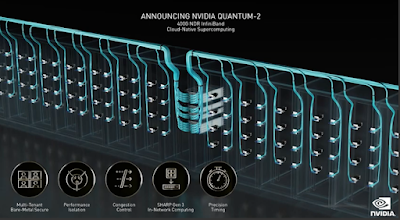
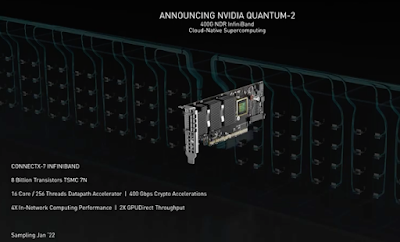
NVIDIA Quantum-2 is a 400Gbps InfiniBand networking platform that consists of the NVIDIA Quantum-2 switch, the ConnectX-7 network adapter, the BlueField-3 data processing unit (DPU) and all the software that supports the new architecture.

NVIDIA Quantum-2 includes key features required for demanding workloads running in either cloud enviroments or superomputing clusters. The multi-tenant performance isolation of NVIDIA Quantum-2 keeps the activity of one tenant from disturbing others, utilizing an advanced telemetry-based congestion control system with cloud-native capabilities that ensure reliable throughput, regardless of spikes in users or workload demands.

NVIDIA Quantum-2 SHARPv3 In-Network Computing technology provides 32x more acceleration engines for AI applications compared with the previous generation. Advanced InfiniBand fabric management for data centers, including predictive maintenance, is enabled with the NVIDIA UFM® Cyber-AI platform.

A nanosecond-precision timing system integrated into NVIDIA Quantum-2 can synchronize distributed applications, like database processing, helping to reduce the overhead of wait and idle times. This new capability allows cloud data centers to become part of the telecommunications network and host software-defined 5G radio services.

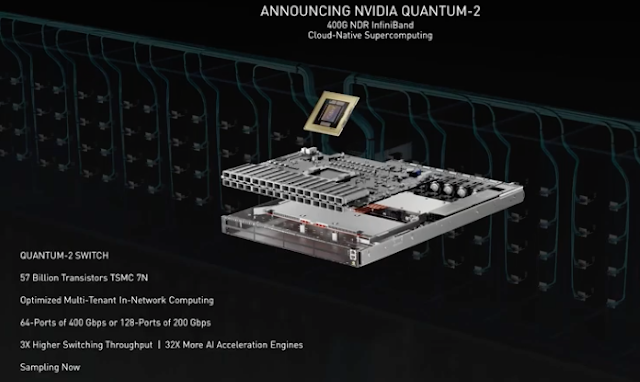
The Quantum-2 platform is powered by new Quantum-2 InfiniBand switching ASIC with 57 billion transistors implemented in 7-nanometer silicon. It features 64 ports at 400Gbps or 128 ports at 200Gbps and will be offered in a variety of switch systems up to 2,048 ports at 400Gbps or 4,096 ports at 200Gbps — more than 5x the switching capability over the previous generation, Quantum-1.

The NVIDIA Quantum-2 switch is now available from a wide range of leading infrastructure and system vendors around the world, including Atos, DataDirect Networks (DDN), Dell Technologies, Excelero, GIGABYTE, HPE, IBM, Inspur, Lenovo, NEC, Penguin Computing, QCT, Supermicro, VAST Data and WekaIO.

“The requirements of today’s supercomputing centers and public clouds are converging,” said Gilad Shainer, senior vice president of Networking at NVIDIA. “They must provide the greatest performance possible for next-generation HPC, AI and data analytics challenges, while also securely isolating workloads and responding to varying demands of user traffic. This vision of the modern data center is now real with NVIDIA Quantum-2 InfiniBand.”

https://nvidianews.nvidia.com/news/nvidia-quantum-2-takes-supercomputing-to-new-heights-into-the-cloud


Wednesday, August 18, 2021

Nvidia's quarterly sales hit $6.51 billion, up 68% yoy

Citing record revenue from its Gaming, Data Center and Professional Visualization platforms, NVIDIA reported record revenue for its second quarter ended August 1, 2021, of $6.51 billion, up 68 percent from a year earlier and up 15 percent from the previous quarter.

GAAP earnings per diluted share for the quarter were $0.94, up 276 percent from a year ago and up 24 percent from the previous quarter. Non-GAAP earnings per diluted share were $1.04, up 89 percent from a year ago and up 14 percent from the previous quarter.

“NVIDIA’s pioneering work in accelerated computing continues to advance graphics, scientific computing and AI,” said Jensen Huang, founder and CEO of NVIDIA. “This quarter, we launched NVIDIA Base Command and Fleet Command to develop, deploy, scale and orchestrate the AI workloads that run on the NVIDIA AI Enterprise software suite. With our new enterprise software, wide range of NVIDIA-powered systems and global network of system and integration partners, we can accelerate the world’s largest industries racing to benefit from the transformative power of AI."

https://investor.nvidia.com/home/default.aspx

Monday, April 19, 2021

UK to examine NVIDIA’s takeover of ARM


The U.K.'s Digital Secretary, Oliver Dowden, instructed the Competition and Markets Authority (CMA) to begin an investigation into the proposed sale of ARM to NVIDIA.

ARM, which is headquartered in Cambridge, is a major global player in the semiconductor industry. 

Digital Secretary Oliver Dowden states: “Following careful consideration of the proposed takeover of ARM, I have today issued an intervention notice on national security grounds.

“As a next step and to help me gather the relevant information, the UK’s independent competition authority will now prepare a report on the implications of the transaction, which will help inform any further decisions.

“We want to support our thriving UK tech industry and welcome foreign investment, but it is appropriate that we properly consider the national security implications of a transaction like this.”