Thursday, December 9, 2021

Verizon tops 14,000 5G Ultra Wideband cells sites

Verizon exceeded its 2021 year-end target of 14,000 new 5G Ultra Wideband cells sites, providing phone service to parts of 87 U.S. cities, 5G Home to parts of 65 cities and 5G Business Internet to parts of 62 cities.

Verizon said its aggressive expansion has supported an increase in 5G Ultra Wideband data use of more than 750% year to date.

“We’re continuing to see 5G usage accelerate, as our customers experience benefits, like incredible boosts in speed, the ability to stream video and audio in HD and the ability to get console-quality gaming on the go,” said Kyle Malady, CTO of Verizon. “This year our team has nearly doubled its 5G deployment versus the past two years and exceeded the aggressive targets we set at the beginning of the year, even in the face of global supply chain issues, and we’re not stopping. We are on track to deliver our 5G Ultra Wideband service using C-Band spectrum to more than 100 million people in the first quarter of 2022.”

Some additional notes:

  • Verizon now has 5G Home available in five times the number of markets compared to 2020, and 5G Business Internet in nearly three times the number of cities originally projected for 2021. 
  • Verizon’s network team has already deployed 5G Ultra Wideband equipment to thousands of cell sites and will continue aggressive expansion into the new year to meet its market promise of providing 5G Ultra Wideband service to 100 million people by the end of the first quarter of 2022 using C-Band spectrum.
  • The massive 5G Ultra Wideband expansion will initially involve deploying new C-Band equipment on macro cell towers, leveraging Verizon’s LTE network infrastructure. This rapid expansion will also involve deploying the new 5G Ultra Wideband service using small cells, enhancing both access to and the capacity of 5G using C-band spectrum. Just this week, Verizon engineers completed and approved plans for small cell equipment which will be deployed in the network in 2022 after the initial expansion.
  • In addition to rapid expansion using C-Band spectrum, Verizon will continue to expand its 5G Ultra Wideband service with the addition of a significant number of mmWave sites and private network solutions in the coming months.
  • In recent field tests, using 100MHz and 200Mhz of C-band spectrum, the company has seen speeds of 1.5 Gbps and 3 Gbps, respectively. And in a recent lab test using carrier aggregation (800 MHz of mmWave and 100 MHz of C-band) and a test device powered by Snapdragon  X65 5G Modem-RF System, Verizon and Qualcomm reached download speeds of 7.92 Gbps.

https://www.verizon.com/about/news/verizon-5g-ultra-wideband-rapid-c-band-expansion

Video: How TIP's Private Mobile Framework can Transform 5G Use Cases

https://youtu.be/BNNCm7gQaug

In this engineering discussion, David Martín Lambás, Senior Manager – Connectivity Innovation at Telefónica & Chair of TIP’s 5G Private Networks Solution Group and Sriram Subramanian, Global System Integrator Ecosystem Manager at Facebook & Technical Lead of TIP’s 5G Private Networks Solution Group, discuss how TIP’s diverse set of ecosystem partners provide an immersive end-to-end user experience for private network deployments.

ADVA-led 5G DU-Volution project wins funding from UK government

ADVA's UK 5G DU-Volution consortium has won British government funding to promote integration of new technology suppliers for open RAN solutions and develop innovation that enhances spectral efficiency and reduces power, footprint and latency in mobile networks. The ADVA-led consortium includes BT, the University of York, the Scotland 5G Centre and UK-based software companies AccelerComm and CommAgility.

ADVA and its partners were awarded the funding as one of the winning teams in the UK’s Future Radio Access Network Competition (FRANC), which is focused on supporting rapid nationwide rollout of 5G and attracting new home-grown telecommunication vendors to the mobile network supply chain. As well as promoting diversification and interoperability in 5G architectures, the project offers a boost to the UK government’s “levelling up” agenda. Significant investment in the north of England will include ADVA’s new open RAN systems integration center.

“This project will help the UK unlock the true potential of 5G. Together with our partners, we’re solving key challenges for disaggregated, vendor-neutral RAN infrastructure and enabling a new generation of mobile services,” said Christoph Glingener, CTO at ADVA. “As well as supporting interoperability and bolstering supply chains, 5G DU-Volution will create a springboard for British software innovation. By spearheading this project, we’re developing relationships between education institutions and employers and helping to transform the UK into a center of open RAN excellence.”

“We’re proud to be playing a leading role in this project. 5G DU-Volution will provide a platform for a new wave of open RAN software innovators as well as introducing UK-based technology and talent to the global telecoms market,” commented Anthony Magee, senior director of global business development at ADVA. “By working closely together, our consortium will overcome key hurdles to develop and integrate open RAN software and hardware that meet the needs of 5G. We’ll also be testing our early-stage solutions in real-world mobile network settings, including BT’s Adastral Park. What’s more, alongside our research and education partners, we’ll be working towards the next generation of mobile connectivity by evolving the test facilities towards a 6G future.”

https://www.adva.com/en/newsroom/press-releases/20211209-uk-government-awards-future-ran-competition-funding-to-adva-led-consortium

https://ktn-uk.org/news/5g-futureran-competition/

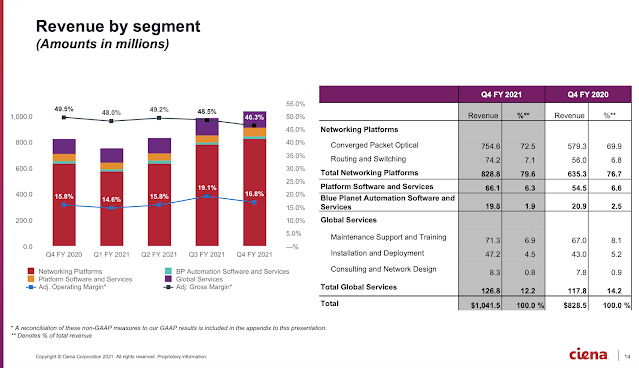
Ciena reports quarterly revenue of $1.04 billion, up 25.7% yoy

Ciena reported revenue of $1.04 billion for its fiscal fourth quarter ended October 30, 2021, an increase of 25.7% year over year. Q4 net income per share was $0.66 GAAP; $0.85 adjusted (non-GAAP), increasing 41.7% year over year.

“Our strong financial results exceeded our expectations in the fourth quarter and for the full fiscal year, driven by continued execution of our strategy and our demonstrated ability to manage supply chain challenges,” said Gary Smith, President and CEO, Ciena. “Looking ahead, we intend to continue driving growth in our business by leveraging our market leadership and investing to capitalize on robust demand dynamics. In addition, our strong balance sheet and cash generation expectations allow us to increase return of capital to our shareholders.”

For fiscal year 2021, Ciena reported revenue of $3.62 billion, as compared to $3.53 billion for fiscal year 2020.

On December 1, 2021, Ciena's Board of Directors authorized the repurchase of up to $1.0 billion of the company's stock, replacing the previous share repurchase authorization. In connection with this new authorization, the company intends to enter into an accelerated share repurchase (ASR) arrangement under which it will repurchase $250 million of its common stock. 

Some highlights:

  • WL5 Extreme (WL5e) total number of customers has reached 140 including 75 in 2021
  • 43 wins in the Routing and Switching portfolio
  • Blue Planet revenue grew 23% YoY
  • Commercially shipped its first 400 ZR pluggables, WL5 Nano
  • Non-telco represented 39% of total revenue
  • Direct web-scale contributed 18% of total revenue
  • APAC contributed 12% of total revenue


https://investor.ciena.com/overview/default.aspx?src=nav

HyperLight demos Hybrid Transmitter with DFB Laser on Thin-Film Lithium Niobate

HyperLight, in collaboration with Harvard University and Freedom Photonics, has demonstrated a breakthrough process of integrating high-power lasers on thin-film lithium niobate platform. 

The hybrid platform enabled the first high optical power transmitter chip consisting of an electrically pumped DFB laser integrated with HyperLight’s high-speed thin-film lithium niobate intensity modulator capable of operating at 60 mW output power and beyond 50 GHz electro-optic bandwidth.

The demonstration used DFB lasers for integration with thin-film lithium niobate because of their low cost, small footprint, and large output powers exceeding 100 mW. Using only passive-alignment and flip-chip thermo-compressive bonding, the DFB lasers emitted approximately 60 mW (17.8 dBm) of optical power into the thin-film lithium niobate waveguides. This will enable new architecture such as large arrays of high-power transmitters as well as unprecedented performance in optical links.

“We are very excited to be a part of this remarkable demonstration of the hybrid integration capability of the thin-film lithium niobate platform with other critical optical components,” said Mian Zhang, co-author, CEO of HyperLight. “The traditional bulk lithium niobate solutions are widely deployed but are limited in performance and applications due to the lack of integration. Our miniaturized thin film integrated solution combines the superior proven material property of lithium niobate with scalable silicon semiconductor processes at low cost. Hybrid integration of key active high-performance components such as DFB lasers with thin film lithium niobate results in best in class performance combined with low cost which opens up a lot of possibilities for those innovators who are looking into lower power consumption and lower cost solutions for optical networks beyond 800G and 1.6Tb/s.”

The results of the above demonstration are described in a manuscript by Amirhassan Shams-Ansari, et. al. entitled, “Electrically pumped high power laser transmitter integrated on thin-film lithium niobate,” (https://arxiv.org/abs/2111.08473). This effort is part of a DARPA funded program Lasers for Universal Microscale Optical Systems (LUMOS) which aims to bring high performance lasers and amplifiers to manufacturable photonics platforms through heterogeneous integration of diverse materials. 

http://www.hyperlightcorp.com

HyperLight and Nokia Bell Labs demonstrate 300 GBd for PAM-4 


HyperLight, a start-up based in Cambridge, MA developing thin-film lithium niobate (LN) photonic integrated circuits (PICs), and Nokia Bell Labs demonstrated a new record-breaking high-speed data transmission using its ultrahigh bandwidth, linear, and low noise thin-film lithium niobate Mach Zehnder (MZM) modulator.Using a HyperLight photonic chip, Nokia Bell Labs demonstrated a low complexity faster than Nyquist scheme without transmitter pre-processing...

HyperLight advances its thin-film lithium niobate PICs

HyperLight, a start-up based in Cambridge, Mass., cited progress in its development of thin-film lithium niobate photonic integrated circuits for next-generation 800 Gbps and beyond 1.6 Tbps optical networking systems.HyperLight claims its thin-film lithium niobate integrated photonics solution combines the proven superior material property of lithium niobate with an established and scalable integration process. The company has developed a thin-film...

HyperLight claims breakthrough with its lithium niobate optical modulator 

HyperLight, a start-up based in Cambridge, MA developing thin-film lithium niobate (LN) photonic integrated circuits (PICs), announced breakthrough voltage-bandwidth performances in integrated electro-optic modulators. HyperLight says its electro-optic PIC could lead to orders of magnitude energy consumption reduction for next generation optical networking.Current electro-optic modulators require extremely high radio-frequency (RF) driving voltages...


Analog Devices intros RadioVerse chip for 5G RUs

Analog Devices introduced its RadioVerse System-on-Chip (SoC) series for energy efficient 5G RUs.

The ADRV9040 is the first in the new RadioVerse SoC series. It offers eight transmit and receive channels of 400MHz bandwidth and integrates advanced digital signal processing functions, including carrier digital up-converters (CDUC), carrier digital down-converters (CDDC), crest factor reduction (CFR) and digital pre-distortion (DPD). This expanded signal processing can eliminate the need for a field-programmable gate array (FPGA), thereby reducing thermal footprint, and total system size, weight, power, and cost. The SoC’s DPD algorithms were developed using advanced machine learning techniques and are optimized in close collaboration with major power amplifier (PA) vendors to ease the design burden and deliver best-in-class wide bandwidth performance. The algorithms are fully tested and validated across 4G and 5G use cases, including various PA technology types such as gallium nitride (GaN). In addition, the ZiF radio architecture simplifies RF filtering and signal chain components, reducing RU cost and development time for band and power variants designs.

ADI said its new SoC series provides advanced RF signal processing with expanded digital functionality and RF capacity that greatly improves 5G RU performance and energy efficiency. 

“Samsung and ADI have long worked together to support the swift deployment of 5G in the global market,” said Dong Geun Lee, Vice President and Head of Hardware R&D Group, Network Business at Samsung Electronics. “We are excited for the successful launch of ADI’s new SoC, as we expect this cutting-edge technology will bring better 5G experience to consumers. We look forward to expanding our engagement with ADI.”

“RadioVerse SoCs are designed to optimize the full radio solution rather than just a single component or interface,” said Joe Barry, Vice President of Wireless Communications at Analog Devices. “Each successive generation has provided expanded capabilities, bandwidth and performance, while improving overall RU efficiency. This new RadioVerse SoC series takes a big step forward by delivering multiple advancements in signal processing to meet the demanding needs of 5G.”

http://www.analog.com/ADRV9040

Aruba debuts EdgeConnect Microbranch for home/small offices

Aruba introduced its new EdgeConnect Microbranch solution for providing remote personnel with all of the traditional services they receive in-office via a single Wi-Fi access point (AP) – with no gateway, agent or additional hardware required at the remote site. 

Aruba's EdgeConnect Microbranch, which essentially extends on-campus Zero Trust and Secure Access Services Edge (SASE) security frameworks to the home office/small office, comprises APs and a new suite of SD-WAN services and builds upon the company’s Remote Access Points (RAPs).

Aruba said its EdgeConnect Microbranch helps IT teams ensure that remote employee experience is consistent by optimizing the performance of latency-sensitive applications like unified communication and collaboration while ensuring proper security and contending with a higher density of bandwidth-hungry devices that may be on the network. New EdgeConnect Microbranch services such as policy-based routing, which enables IT to optimize how application traffic is routed to a destination, complement existing services such as Air Slice, which dynamically allocates AP radio resources to specific applications. 

“EdgeConnect Microbranch gives organizations a modern, scalable approach for enabling remote work and making the home office experience equivalent to being in-office,” said Larry Lunetta, VP of Solutions Portfolio Marketing at Aruba, a Hewlett Packard Enterprise company. “While some may believe that the only network service that can be extended to the home office AP/router is security – and even that requires an extra box, EdgeConnect Microbranch demonstrates that, with a cloud-based approach, all critical network services can be extended to the home office solely through an access point.”

Key features:

  • Policy-based routing: Allows IT to deliver application performance and security based on automated rules to meet service-level agreements (SLAs) for specific applications, websites or types of users
  • Tunnel and route orchestration: Optimizes network performance by orchestrating VPN tunnels on demand and automatically rerouting traffic to the network path that will provide the best performance
  • SASE integration: Provides secure connectivity to cloud security services such as Zscaler directly via the AP and with Aruba Central providing orchestration of tunnels and unified configuration management
  • Enhanced WAN visibility: Accelerates troubleshooting and improves the user experience by providing near real-time updates on WAN availability, utilization, and throughput by detecting latency, jitter, and other connectivity issues impacting the ISP that have traditionally been hidden from IT teams
  • Traffic prioritization: Assigns radio resources to an application and dynamically changes assignments as application sessions begin or end
  • Massive scalability: Supports zero touch deployment and consolidated management for tens of thousands of remote workers via Aruba Central’s cloud-based services and AOS 10
  • Improved uptime and reliability: Provides for LTE backup via a USB interface should the home or small office lose ISP connectivity

The Aruba EdgeConnect Microbranch solution is available in Early Access and will be generally available in March 2022 for any AP running ArubaOS 10 with a Foundation AP License (including qualified APs customers already own and manage in Central.) Aruba Central Foundation Licenses are available for $145 per AP. AP pricing varies per model and starts at $575.00 US for the Aruba 303H Series.

https://news.arubanetworks.com/news-release-details/2021/New-Aruba-EdgeConnect-Microbranch-Solution-Modernizes-the-HomeSmall-Office-Experience-for-Hybrid-Workplaces/default.aspx

Dell'Oro: SD-WAN market surges ahead 45% in Q3

The worldwide SD-WAN market grew 45 percent in the third quarter of 2021 compared to the prior year, according to a new report from Dell'Oro Group. Cisco maintained the top position for the revenue share for the quarter and was followed by Fortinet and VMware in the second and third spots.

“Enterprises are upgrading network infrastructures at accelerated rates compared to pre-pandemic times, and our research finds that the SD-WAN market is growing at strong double-digit rates in all regions of the world,” said Shin Umeda, Vice President at Dell’Oro Group. “Because SD-WAN is software-based technology, the global supply chain disruptions have had less of an effect compared to hardware-based networking products,” added Umeda.

Additional highlights from the 3Q 2021 SD-WAN Report:

  • The SD-WAN market continues to consolidate around a small number of vendors with the top six vendors accounting for 69 percent market share in 3Q 2021.
  • Cisco’s quarterly SD-WAN revenue nearly doubled in 3Q 2021 with especially strong growth in the North America region.
  • The market for hardware-based Access Routers grew quarterly revenues for the first time in almost two years.

https://www.delloro.com/news/sd-wan-market-surged-45-percent-to-a-record-level-in-3q-2021/

Expedera raises $18M for deep learning accelerator from founders of Marvell

Expedera, a start-up based in Santa Clara, California announced a $18 million Series A funding round led by Dr. Sehat Sutardja and Weili Dai (founders of Marvell Technology Group) and other prominent semiconductor industry investors. 

Expedera is developing a deep learning accelerator IP that is scalable up to 128 TOPS with a single core and to PetaOps with multi-core. The company says it will achieve the highest performance per watt. The solution is aimed at a wide range of AI inference applications, particularly at the edge. Expedera’s Origin IP and software platform supports popular AI frontends including TensorFlow, ONNX, Keras, Mxnet, Darknet, CoreML and Caffe2 through Apache TVM. By licensing its technology as a semiconductor IP, Expedera enables any chip designer to add state-of-the-art AI functionality to their product.

The latest funding brings the total amount raised to over $27 million.

“This financing underscores the success that Expedera has had so far and will enable us to expand our portfolio and team to meet the market needs,” said Da Chuang, CEO of Expedera. “We are incredibly happy to have Weili Dai and Sehat Sutardja lead this round. As highly respected veterans of the semiconductor industry, they have a unique understanding of the market and customer needs. I look forward to a long partnership.”

“Device makers have typically needed to build their own chips and usually, only the largest companies could afford to do so,” said Mr. Gwennap. “Expedera’s IP model provides a more cost effective way to address the sprawling edge AI market. A single IP supplier can license to any or all of the numerous chip vendors that supply a multitude of device makers in the edge market.”

http://www.expedera.com


Wednesday, December 8, 2021

Intel establishes Integrated Photonics Research Center

Intel Labs has established an academically-oriented Integrated Photonics Research Center with a mission to accelerate optical input/output (I/O) technology innovation in performance scaling and integration with a specific focus on photonics technology and devices, CMOS circuits and link architecture, and package integration and fiber coupling.

The Intel Research Center for Integrated Photonics for Data Center Interconnects will bring together leading university researchers to accelerate optical I/O technology innovation in performance scaling and integration. The research vision is to explore a technology scaling path that satisfies energy efficiency and bandwidth performance requirements for the next decade and beyond. 

"At Intel Labs, we’re strong believers that no one organization can successfully turn all the requisite innovations into research reality. By collaborating with some of the top scientific minds from across the United States, Intel is opening the doors for the advancement of integrated photonics for the next generation of compute interconnect. We look forward to working closely with these researchers to explore how we can overcome impending performance barriers,” stated James Jaussi, senior principal engineer and director of the PHY Research Lab in Intel Labs.

The researchers participating in the Research Center include:

  • John Bowers, University of California, Santa Barbara
    Project: Heterogeneously Integrated Quantum Dot Lasers on Silicon.
    Description: The UCSB team will investigate issues with integrating indium arsenide (InAs) quantum dot lasers with conventional silicon photonics. The goal of this project is to characterize expected performance and design parameters of single frequency and multiwavelength sources.
  • Pavan Kumar Hanumolu, University of Illinois, Urbana-Champaign
    Project: Low-power optical transceivers enabled by duo-binary signaling and baud-rate clock recovery.
    Description: This project will develop ultra-low-power, high-sensitivity optical receivers using novel trans-impedance amplifiers and baud-rate clock and data recovery architectures. The prototype optical transceivers will be implemented in a 22 nm CMOS process to demonstrate very high jitter tolerance and excellent energy efficiency.
  • Arka Majumdar, University of Washington
    Project:
    Nonvolatile reconfigurable optical switching network for high-bandwidth data communication.
    Description: The UW team will work on low-loss, nonvolatile electrically reconfigurable silicon photonic switches using emerging chalcogenide phase change materials. Unlike existing tunable mechanisms, the developed switch will hold its state, allowing zero static power consumption.
  • Samuel Palermo, Texas A&M University
    Project:
    Sub-150fJ/b optical transceivers for data center interconnects.
    Description: This project will develop energy-efficient optical transceiver circuits for a massively parallel, high-density and high-capacity photonic interconnect system. The goal is to improve energy efficiency by employing dynamic voltage frequency scaling in the transceivers, low-swing voltage-mode drivers, ultra-sensitive optical receivers with tight photodetector integration, and low-power optical device tuning loops.
  • Alan Wang, Oregon State University
    Project:
    0.5V silicon microring modulators driven by high-mobility transparent conductive oxide.
    Description: This project seeks to develop a low driving voltage, high bandwidth silicon microring resonator modulator (MRM) through heterogeneous integration between the silicon MOS capacitor with high-mobility Ti:In2O3 The device promises to overcome the energy efficiency bottleneck of the optical transmitter and can be co-packaged in future optical I/O systems.
  • Ming Wu, University of California, Berkeley
    Project:
    Wafer-scale optical packaging of silicon photonics.
    Description: The UC Berkeley team will develop integrated waveguide lenses that have potential to enable non-contact optical packaging of fiber arrays with low loss and high tolerances.
  • S.J. Ben Yoo, University of California, Davis
    Project:
    Athermal and power-efficient scalable high-capacity silicon-photonic transceivers.
    Description: The UC Davis team will develop extremely power-efficient athermal silicon-photonic modulator and resonant photodetector photonic integrated circuits scaling to 40 Tb/s capacity at 150 fJ/b energy efficiency and 16 Tb/s/mm I/O density. To achieve this, the team will also develop a new 3D packaging technology for vertical integration of photonic and electronic integrated circuits with 10,000 pad-per-square-mm interconnect-pad-density.

https://www.intel.com/content/www/us/en/newsroom/news/intel-launches-integrated-photonics-research-center.html

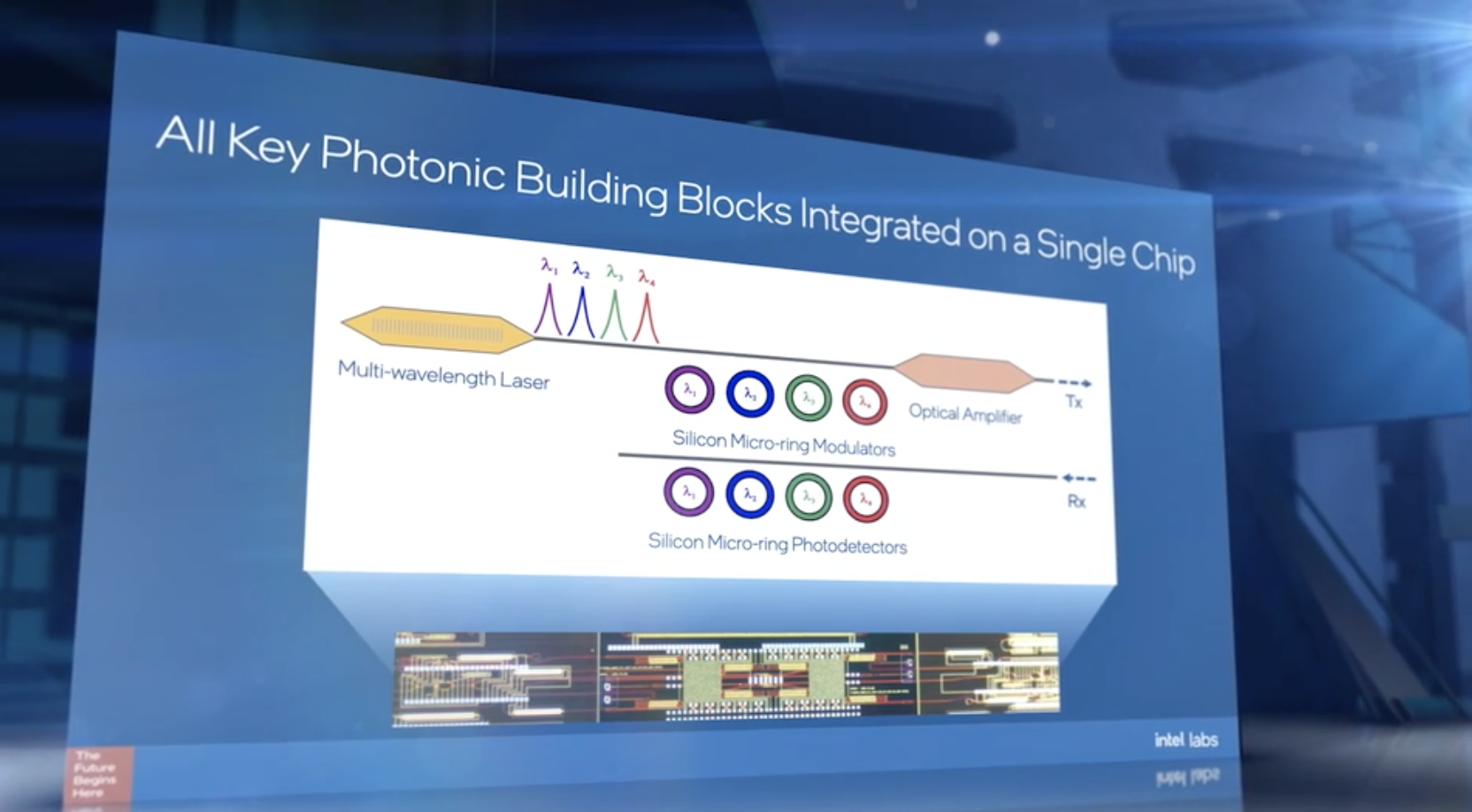
Intel shows micro-ring modulators, all-silicon photodetectors, multi-lambda lasers

Intel showcased a number of advancements in the field of optical interconnects, advancing its long-term ambition to bring optical I/O directly into silicon packages. During a virtual Intel Labs day presentatio, the company demonstrated advances in key technology building blocks, including with light generation, amplification, detection, modulation, complementary metal-oxide semiconductor (CMOS) interface circuits and package integration. 

Key technology building blocks showcased:

  • Micro-ring modulators: Conventional silicon modulators take up too much area and are costly to place on IC packages. By developing micro-ring modulators, Intel has miniaturized the modulator by a factor of more than 1,000, thereby eliminating a key barrier to integrating silicon photonics onto a compute package.
  • All-silicon photodetector: For decades, the industry has believed silicon has virtually no light detection capability in the 1.3-1.6um wavelength range. Intel showcased research that proves otherwise. Lower cost is one of the main benefits of this breakthrough.
  • Integrated semiconductor optical amplifier: As the focus turns to reducing total power consumption, integrated semiconductor optical amplifiers are an indispensable technology, made possible with the same material used for the integrated laser.
  • Integrated multi-wavelength lasers: Using a technique called wavelength division multiplexing, separate wavelengths can be used from the same laser to convey more data in the same beam of light. This enables additional data to be transmitted over a single fiber, increasing bandwidth density.
  • Integration: By tightly integrating silicon photonics and CMOS silicon through advanced packaging techniques, we can gain three benefits: lower power, higher bandwidth and reduced pin count. Intel is the only company that has demonstrated integrated multi-wavelength lasers and semiconductor optical amplifiers, all-silicon photodetectors, and micro-ring modulators on a single technology platform tightly integrated with CMOS silicon. This research breakthrough paves the path for scaling integrated photonics.

Intel said these advancements will enable future architectures that are more disaggregated, with multiple functional blocks such as compute, memory, accelerators and peripherals spread throughout the entire network and interconnected via optical and software in high-speed and low-latency links.

“We are approaching an I/O power wall and an I/O bandwidth gap that will dramatically hinder performance scaling. The rapid progress Intel is making in integrated photonics will enable the industry to fully re-imagine data center networks and architectures that are connected by light. We have now demonstrated all of the critical optical technology building blocks on one silicon platform, tightly integrated with CMOS silicon. Our research on tightly integrating photonics with CMOS silicon can systematically eliminate barriers across cost, power and size constraints to bring the transformative power of optical interconnects to server packages,” stated James Jaussi, senior principal engineer and director of PHY Lab, Intel Labs.

Without such advancements, Intel warns the industry will soon reach the practical limits of electrical I/O performance - what it calls an "I/O power wall".


https://www.intel.com/content/www/us/en/newsroom/news/progress-integrated-photonics-data-centers.html#gs.ibzo2u

Crosslake's CrossChannel cable goes live with 96 fibre pairs

Crosslake Fibre announced Ready For Service (RFS) status for its CrossChannel submarine cable, which is the first subsea cable system to be installed between the United Kingdom and France in over 20 years.

CrossChannel is a  96 fibre pair system that is capable of supporting over 2,400 Tbps of capacity.  The 550km system has a 149km submarine segment and is designed to be physically diverse of existing fibre infrastructure.  CrossChannel directly connects Equinix LD4 in Slough, to Interxion PAR3 and Equinix PA7 in Paris with extensions to various points-of-presence in both cities.

Crosslake notes its new system now provides the lowest latency fibre connectivity between these two vital financial and data centre hubs delivering connectivity in less than 5.5 milliseconds round trip delay (RTD).  The shorter length of the system also serves to reduce the risk of outages and provides users with lower operating costs given fewer amplification sites.

Crosslake is providing a Dark Fibre service and also deploying Ciena’s 6500 packet-optical platform powered by WaveLogic 5 Extreme. Additionally, Crosslake is using Ciena’s Manage, Control and Plan (MCP) with Liquid Spectrum’s Channel Margin Gauge app to allocate and scale capacity in real time, from 600Gbps to 800Gbps and quickly adapt to changing customer requirements and maximize the value of the deployed system.

“The CrossChannel system will provide critical Internet backbone infrastructure across the English Channel for decades to come,” states Mike Cunningham, Chief Executive Officer of Crosslake Fibre. “We are excited to launch the CrossChannel system which is the culmination of years of development and incredible effort by the Crosslake Fibre team and its many suppliers.”

https://crosslakefibre.ca/vital-new-infrastructure-uk-western-europe

Crosslake Fibre picks Ciena for cable across the English Channel

Crosslake Fibre has selected Ciena for a new submarine cable and terrestrial network between Slough, UK, and Paris, France.  The network, called ‘CrossChannel Fibre,’ is the first fibre cable project of its kind to be built across the busy shipping lanes of the English Channel since 2001. Crosslake is deploying Ciena’s 6500 packet-optical platform powered by WaveLogic 5 Extreme. Crosslake is also using Ciena’s Manage, Control and Plan (MCP)...

Crosslake Fibre plans high-capacity cable across English Channel

Crosslake Fibre an international network provider and developer of unique subsea and terrestrial fibre networks, announced plans for a high-fibre count cable across the English Channel. The non-repeatered, CrossChannel Fibre cable, which will connect Slough, United Kingdom and Paris, will contain 96 fibre pairs, each providing over 20 Tbps.  The system is expected be ready for service in the fall of 2021. Crosslake Fibre has engaged EGS, a...

Crosslake Fibre selects Equinix to terminate its Digital Gateway

Crosslake Fibre selected Equinix to extend its backhaul capacity into Equinix TR2 International Business Exchange (IBX®) data center in Toronto and Equinix NY4 IBX in Secaucus, New Jersey. The Crosslake cable traverses Lake Ontario from Toronto to New York State utilizing a specialized 192-fiber strand submarine cable that is 36 miles (58 km) in length. For the first time, this new network route delivers sub-9 ms round trip delay (RTD) performance...

Crosslake Fibre activates Toronto – New York network

Crosslake Fibre activated commercial services on the first submarine cable across Lake Ontario from Toronto, Canada to Buffalo, New York. The diverse, ultra-low latency route connects Toronto’s largest carrier hotels, Equinix TR2 at 45 Parliament Street and 151 Front Street West, to Equinix NY4 in Secaucus, New Jersey with multiple extensions to various points-of-presence in both cities. Crosslake Fibre provides lit and dark fiber services interconnecting...


Dell'Oro: Ethernet adapter shipments stalled by supply constraints

Ethernet adapter shipments were stalled by supply constraints in 3Q, according to a new report by Dell'Oro Group, however shipments are forecast to return to double-digit growth in 2022, as supply restrictions ease, and as Smart NICs create growth opportunities.

“Ethernet adapter port shipments declined seven percent year-over-year in 3Q 2021, as vendors faced various component sourcing challenges, with lead-times extending beyond 52 weeks in some extreme cases,” said Baron Fung, Research Director at Dell’Oro Group. “In contrast, Ethernet controller shipments have approached record levels, as we believe server vendors are increasing their inventories of controllers in anticipation of stronger cloud and enterprise demand ahead,” added Fung.

Additional highlights from the 3Q 2021 Ethernet Controller and Adapter report include:

  • Total Ethernet controller and adapter revenue forecast to grow 27 percent in 2021.
  • Major cloud service providers are upgrading server connectivity to 100 and 200 Gbps port speeds in conjunction with network upgrades.
  • Smart NICs developed internally by cloud service providers, such as Amazon and Microsoft, for their data centers have accounted for the majority of the shipments. Vendors such as Marvell and Nvidia, are expected to increase their share in 2022 as customer qualifications make progress.

https://www.delloro.com/news/ethernet-adapter-shipments-stalled-by-supply-constraints-in-3q-2021/

Nokia to supply O-RAN frontal to NTT Docomo

Nokia is ready to supply its O-RAN fronthaul multi-vendor solution to NTT DOCOMO's 5G network following successful testing. 

During the trial at DOCOMO’s Lab in Yokosuka, Nokia’s 5G O-RAN AirScale baseband was successfully integrated and tested with third-party O-RUs (radio units). Nokia’s O-RAN capabilities are built on top of its AirScale software and provide the same high level of performance, functionality, and security as Nokia's radio products. Nokia is helping to prepare for the network architecture of the future by building open interfaces on top of its existing solutions, offering CSPs a choice to pursue O-RAN. Nokia has already made significant investments in O-RAN by leading the early deployment of the RAN Intelligent Controller (RIC) and the open fronthaul.

Sadayuki Abeta, General Manager of Radio Access Network Development Department, NTT DOCOMO, commented: “NTT DOCOMO has been actively driving open RAN standardization and commercialization, being the world’s first operator to deploy multi-vendor O-RAN solutions for the 5G network. Successful testing with Nokia is an important step in further accelerating open RAN commercialization and its global expansion.”

Tommi Uitto, President of Mobile Networks at Nokia, said: “This project with NTT DOCOMO is further evidence of our commitment to leading the open mobile future by investing in Open RAN solutions. Open RAN technology will enrich the mobile ecosystem with new solutions and business models and support an expanded multi-vendor ecosystem. We have ​the scale and capabilities to address the increased customer demand for this technology, underpinned by the world-class network performance and security that only Nokia can deliver."

Video: Telecom Argentina looks to O-RAN


https://youtu.be/O-10wcUyUio

O-RAN has the potential to democratize mobile networks, allowing operators to deploy infrastructure much more cost-effectively. In this video, Marisa Viveros, VP Strategy and Solutions, Global Telecommunications, Media and Entertainment, IBM talks about key system integration capabilities across the O-RAN ecosystem. She discusses Telecom Argentina's proof-of-concept O-RAN project with IBM.

Download the 2021 Open RAN Report here: https://ngi.how/o-ran-2021

Nokia to supply 5G to Bangladesh's Teletalk

Nokia has been selected by Teletalk Bangladesh Ltd (Teletalk) to deploy a 5G network in the country for the first time. Financial terms were not disclosed.

In the initial phase of deployment, Nokia will provide equipment from its latest ReefShark System on Chip-powered AirScale equipment portfolio including its 5G AirScale Digital Baseband Unit with a plugin capability to add capacity where it is needed. It will also supply its high-performance 64TRX AirScale massive MIMO Adaptive Antennas to cover all deployment scenarios including dense-urban environments and wide-area coverage.  

Teletalk is launching its 5G network to coincide with Bangladesh's Golden Jubilee of Independence celebrations. Teletalk is upgrading its network including support for rural areas as well as the introduction of 5G networks to the main city areas.

Nokia and Teletalk have been partners since 2004 with the joint deployment of 2G, 3G, and 4G networks. Nokia also supplies transport and core solutions and signed a network expansion and modernization deal.


Zayo to build more fiber routes in Toronto

Zayo announced plans to build more than 140 kilometers of new fiber routes in the Greater Toronto Area by the end of 2022. Additional network expansion projects are expected in Toronto in the coming years.

Zayo’s dense fiber footprint in the Toronto area currently connects more than 100 data centers and 1,400 buildings. With over 14,000 Toronto buildings near its network, Zayo expects to connect many more buildings in the coming quarters.

Zayo is also now rolling out a new product offer to new and existing customers in the Toronto region. The offer, called Shielded Internet Access, includes Dedicated Internet Access, DDoS Protection and CloudLink, all within a single offer that will be competitively positioned against current market benchmarks.

“Toronto continues to lead and support key business sectors both nationally and globally, accelerating the need for reliable connectivity solutions,” said Roger Brulotte, Principal, Senior Sales Manager at Zayo Group. “Zayo is committed to supporting the fast-paced growth of Toronto’s diverse industries and the connectivity essential to our clients’ growth and success.”

“Zayo is helping usher in a new era for Canada’s fastest growing business and technology community,” said Toronto Mayor, John Tory. “The Toronto Region relies on accessible, high-quality connectivity infrastructure to support our key sector needs. We appreciate our partnership with Zayo and look forward to the opportunities that these network expansion projects will bring to the Greater Toronto Area.”


Red Hat brings Ansible Automation to Microsoft Azure

Red Hat is bringing its Ansible Automation Platform to Microsoft Azure. It builds on Red Hat’s standard for hybrid cloud automation that has been refined for the evolving realities of computing at hybrid cloud scale. 

Red Hat said Ansible Automation Platform on Azure enables enterprise IT teams to achieve greater scale, speed and standardization with automation practices for their hybrid cloud. This helps to remove the infrastructure maintenance and operational burden from IT teams, enabling them to focus purely on delivering automation strategies for a more efficient, flexible and scalable business.

The latest version of Ansible Automation Platform added self-contained automation capabilities to deploy at massive scale across hybrid clouds and edge environments, while shifting automation more deeply into the application development lifecycle. Its flexible foundation, tools, services and capabilities offer a whole new level of customization and control that expands the boundaries of what is possible for enterprises.

https://www.redhat.com/en/technologies/management/ansible

Toshiba launches 18TB NAS hard disk drive

Toshiba Electronic Devices & Storage Corporation began shipping a massive capacity 18TB NAS hard disk drive for home offices and small businesses.

MN09 is a 9-disk helium-sealed conventional magnetic recording (CMR) drive that leverages Toshiba’s new innovative Flux Control Microwave-Assisted Magnetic Recording (FC-MAMR) technology. FC-MAMR™ advances CMR capacity to 18TB and delivers increased density per platter over previous designs. The MN09 is the 3rd generation to use Toshiba’s pioneering 9-disk helium-sealed mechanical design. MN09 is engineered for 24/7 operation and has a workload rating of 180TB/year.

The 7200RPM 18TB NAS drive is designed with a 512MB buffer and delivers a consistent high level of performance with a sustained transfer rate of 268 MiB/s.

MAMR technology is one solution that extends HDD data capacities. The ability of HDD using a new MAMR head to significantly improve the write ability of the Microwave Assisted Switching (MAS) effect has been developed recently. Toshiba will continue to satisfy market demand and to advance CMR drive data densities with MAMR technology.


Molex acquires Keyssa wireless connector tech and IP

Molex has acquired core technology and intellectual property (IP) from Keyssa Inc. regarding wireless chip-to-chip technology. The deal encompasses over 350 filed patent applications. Financial terms were not disclosed.

The acquired technology operates at data rates up to 6 Gbps on the 60 GHz band with no WiFi or Bluetooth interference. 

Molex says the tiny, low-power, low-latency, solid-state contactless connectors can solve critical data transmission needs with minimal overhead. Molex plans to advance these current capabilities by supporting exponentially higher data rates and full-duplex communications. Additionally, Molex will leverage its longstanding signal integrity expertise and mmWave antenna capabilities to speed the commercialization of new contactless connectors while complementing its existing portfolio of products.

Molex also will take advantage of the Virtual Pipe I/O (VPIO) technology Keyssa developed to resolve protocol inefficiencies. By aggregating low- and high-speed protocols for simultaneous transmission over one or more links, VPIO can help compensate for real-time events that impact link performance integrity. Used in combination, VPIO and contactless connectors can create extensible and efficient I/O that is free from the limitations of mechanical connectors while being capable of adapting and scaling as dictated by application demands.

“Keyssa’s wireless chip-to-chip technology complements Molex’s developments in mmWave antenna connectivity to meet the growing demands for high data rate transmissions,” said Justin Kerr, vice president and general manager, Micro Solutions Business Unit, Molex. “We constantly push the technology envelope for our mobile and consumer device customers, offering greater product design freedom while supporting next-generation wireless connectivity needs.”

http://www.molex.com

Tuesday, December 7, 2021

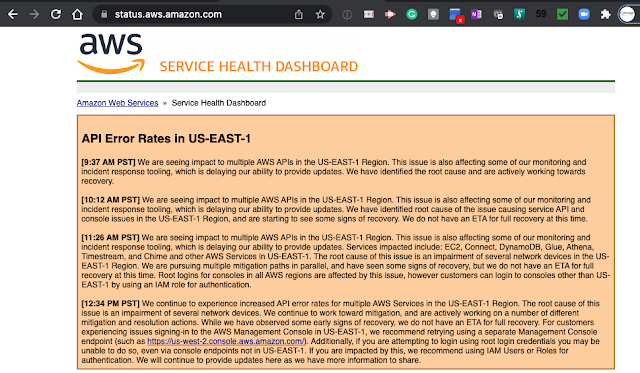
AWS hit by outage in US-EAST-1 region


Amazon Web Services (AWS) experienced an outage started on Dec 7, 2021 at approximately 15:40 UTC impacting various regions worldwide.

The AWS status page reported API and console issues in the US-EAST-1 Region, which is used to host the AWS global console landing page. The trouble included elevated error rates for EC2 APIs in the US-EAST-1 region. 

At 12:34 EST, the company said the root cause was "impairment of several network devices," confirmed that recovery was underway, but could not provide an ETA for full recovery.


https://status.aws.amazon.com