Showing posts with label Japan. Show all posts

Wednesday, December 14, 2022

NTT to test Open All Photonics Network wavelength interconnects

NTT, in collaboration with Ciena, Fujitsu, and NEC Corporation (NEC), will conduct Open All Photonics Network (APN) proof-of-concept (PoC) trial of on-demand wavelength technologies.

NTT said the work is based on the Open All Photonics Network (APN) Functional Architecture document published by the IOWN GF earlier this year.

The network nodes defined in the Open APN Functional Architecture can be constructed from the Open ROADM MSA’s standard components, which are available from global optical product vendors such as Ciena, Fujitsu, and NEC. To prove the viability and operability of Open APN, NTT will conduct a PoC jointly with Ciena, Fujitsu, NEC, and other companies in the fourth quarter of fiscal 2022. The PoC will validate wavelength connection creation/deletion functions and evaluate the performance of optical communications in terms of throughput, delay, and jitter.

The PoC should prove that Open APN is implementable and operable with products already available in the global market and encourage many organizations in the world to build and implement Open APN.

While conventional ROADM products are designed to create optical connections between telecommunication carriers’ sites, an Open APN creates connections between all endpoints, including customer sites. This difference leads to the need for new functions as listed below:

  • A function for automatically designing and provisioning wavelength connections that satisfy service requirements by cooperation and coordination of terminals deployed in user sites and carrier equipment, and functions for selecting the best transmission mode, etc.
  • A function for configuring and managing optical wavelength end points of terminals deployed in user sites and a function for passing and blocking optical signals in carrier equipment based on the authentication status of each terminal
  • A function for adapting different types of optical fibers to be connected in the same optical wavelength

NTT has developed the above functions and started a field test in the Tokyo metropolitan area. The test should validate their operability under various conditions, such as fiber length and loss levels in a real environment. As the test will also utilize the outcome from Open ROADM MSA and Telecom Infra Project Open Optical & Packet Transport6, it should demonstrate how the results from the three organizations can be combined to build open and disaggregated infrastructures.

Monday, December 5, 2022

STACK and ESR to develop data center in Osaka

 STACK Infrastructure and ESR Group announced a joint venture to develop a 72MW data center campus in Osaka, Japan.

STACK and ESR will jointly develop and deliver 72MW of data center capacity in Osaka’s eastern suburb of Keihanna. Construction of the first of three buildings will commence in Q4 2023 and will be ready for service in Q2 2025.

The deal further expands STACK and ESR’s APAC partnership, which currently includes a 48MW data center development in Incheon, Korea.

“Osaka is STACK’s sixth APAC market in 12 months since our entrance into the region, including the expansion of our footprint in both Japan and Australia to over 100MW each,” said Pithambar (Preet) Gona, Chief Executive Officer of STACK APAC. "This campus further deepens our partnership with ESR, allowing us to combine our capabilities to meet our clients’ strategic requirements in existing and emerging Tier 1 data center markets.” 

“ESR’s strong regional development capability in Tier 1 data center markets ensures we are well-positioned to continue to aggressively develop data center facilities across Asia Pacific,” said Diarmid Massey, CEO of ESR Data Centres. “Our partnership with STACK enables us to leverage our respective strengths to target hyperscale customer growth in key markets.”

https://www.stackinfra.com/about/news-events/press-releases/stack-infrastructure-and-esr-expand-their-apac-partnership-into-japan-with-a-72mw-data-center-development-in-osaka/

Sunday, December 4, 2022

KDDI connects mobile tower to Starlink for backhaul

KDDI has deployed the first mobile tower in Japan to use Starlink for backhaul. 

The tower is located in Hatsushima, a remote island in Sagami Bay. The service is now in commercial operation, following a series of tests beginning in 2021.

KDDI said that in order to ensure sufficient quality for cellular service with voice and data, Starlink  met its technical guidelines in latency, jitter and uplink/downlink bandwidth. KDDI has completed its evaluation of Starlink and confirmed the conformance in customer experience that could be comparable to that of optical fiber, which it uses for urban towers.

Starting with this location, KDDI will expand its coverage to 1,200 remote towers in order to pursue its vision to bring an urban mobile experience to its rural customers.

https://news.kddi.com/kddi/corporate/english/newsrelease/2022/12/01/6415.html

Monday, November 21, 2022

Rakuten Mobile to test BlueWalker 3 LEO satellite for Direct-to-Mobile

Rakuten Mobile obtained preliminary experimental test station licenses in Japan to conduct mobile communication tests and preliminary verification using AST SpaceMobile’s low earth orbit satellite, BlueWalker 3.

AST SpaceMobile is building a space-based cellular broadband network accessible directly by standard unmodified mobile phones. The company's BlueWalker 3 test satellite launched from the USA on September 11, 2022. On November 14, AST SpaceMobile also announced the successful deployment of the communications array for its test satellite, BlueWalker 3, in orbit.

In order to conduct communication tests between the test satellite launched by AST SpaceMobile and gateway earth stations in Japan and to perform preliminary verification with smartphones, Rakuten Mobile made applications to the Tohoku Telecommunications Bureau for a Gateway Experimental Test Station license (equivalent to a mobile base station) and to the Kanto Telecommunications Bureau for a Mobile Terminal Experimental Test Station license (equivalent to a portable mobile base station), and both applications have now been approved.

Rakuten Mobile plans to build a gateway earth station (equivalent to a mobile base station) in Fukushima Prefecture to test and verify direct communication between BlueWalker 3 and mobile devices in mountainous areas in Hokkaido.

To enable testing with Rakuten Mobile and other carriers, Rakuten Symphony will provide a variety of software from its Symworld product portfolio to AST SpaceMobile to be integrated into the company’s satellite system and enable the company’s space-based cellular broadband network. The software to be integrated includes Rakuten Symphony’s vRAN (virtualized Radio Access Network) software, OSS (Operations Support Systems) and BSS (Business Support Systems) software.

https://corp.mobile.rakuten.co.jp/english/news/press/2022/1118_01/

Sunday, November 6, 2022

NTT achieves 1 Mbps with underwater acoustic transmission

Researchers from NTT DOCOMO and NTT Communications achieved 1 Mbps in a joint experiment of underwater acoustic data transmission over a distance of 300m in a shallow sea area (water depth of about 30m).

The experiment used spatio-temporal equalization technology for broadband transmission and improved resistance technology for environmental noise. In addition, the researchers developed a wireless remotely operated vehicle (ROV) using these technologies.

NTT and DOCOMO said that extending data coverage to underwater areas could prove useful for ROVs used for underwater construction and fisheries.

https://www.ntt.com/en/about-us/press-releases/news/article/2022/1101.html


Wednesday, September 28, 2022

NTT to build 30 MW data center in Kyoto prefecture

NTT is to invest approximately 40 billion yen to to build a new "Keihanna Data Center" in Kyoto Prefecture.

NTT Communications plans to start providing services in the second half of fiscal year 2025.

The building will be a four-story, seismic-isolated structure that will stably supply a total of 30 MW for IT load (starting at 6 MW and gradually expanding) to a server room space of 10,900 sqm (equivalent to 4,800 racks). In addition to providing a redundant power supply, air conditioning, and communication equipment meeting the international Tier III standards for data centers, disaster countermeasures, and enhanced security, sustainable and safe services through enhancing energy-saving equipment.

https://group.ntt/en/newsrelease/2022/09/29/220929a.html

Monday, September 26, 2022

NTT develops graphene as a high-speed photodetector material

NTT and Japan's National Institute for Materials Science (NIMS) achieved the world's fastest zero-bias operation1(220 GHz) of a graphene photodetector (PD). 

The research clarifies the optical-to-electrical (O-E) conversion process in graphene for the first time. Graphene has high sensitivity and high-speed electrical response to a wide range of electromagnetic waves, from terahertz (THz) to ultraviolet (UV). Thus, it is a promising photodetection material for enabling high-speed O-E conversion at wavelength ranges where existing semiconductor devices cannot operate. However, until now, the demonstrated zero-bias operating speed has been limited to 70 GHz due to conventional device structure and measurement equipment. For this reason, the challenge for graphene PDs is to demonstrate 200-GHz operation speeds and clarify graphene's inherent properties, such the process of optical-to-electrical conversion.

In this study, NTT and NIMS demonstrated high-speed operation with a 3dB bandwidth of 220 GHz by removing the current delay caused by the device structure by using zinc oxide (ZnO) thin film as the gate material and by using on-chip THz spectroscopy technology to read out the current at high speed. The research also found a trade-off between operating speed and sensitivity by comparing the characteristics of PDs fabricated with graphene of different qualities. The findings will enable graphene PDs to be optimized according to their intended use, such as in optical sensors prioritizing sensitivity or O-E signal converters prioritizing speed. 

The research was published online in the British scientific journal Nature Photonics on August 25th, 2022.

https://group.ntt/en/newsrelease/2022/09/12/220912a.html

Thursday, September 15, 2022

NEC debuts SpectralWave for disaggregated optical transport

NEC introduced its "SpectralWave WX Series" a lineup of open specifications-compliant, open optical transport products. 

The products, which were developed in collaboration with NTT, are based on standards defined by Open ROADM and Telecom Infra Project's (TIP) Phoenix initiative. 

NEC sees the push for All Optical Networks as a marked shift in transport networks, which have conventionally required both optical and electrical technologies, but will be simplified to only optical transmission technology from end-to-end in the future. Initially, four products will be released on October 1, 2022. 

The compliance with open specifications such as Open ROADM and TIP's Phoenix enable these devices to support configurations that connect to the function blocks of APN-T, APN-G and APN-I as defined by Open APN, and under examination by the IOWN Global Forum (*1). 


"NEC aims to market these products to telecommunications carriers, electric power companies and data center operators throughout the world," said Sou Satou, Senior Director, Network Solutions Business Division, NEC Corporation. "Going forward, NEC will continue to contribute to the creation and expansion of open optical networks, aiming to acquire 25% of the future optical transport market by providing products that have grown in capacity from the current 400G to 800G and equipment that supports longer distances." 

https://www.nec.com/en/press/202209/global_20220915_01.html

Tuesday, September 13, 2022

NTT DOCOMO runs Nokia's AI radio frequency capacity planning

NTT DOCOMO is using Nokia's Artificial Intelligence (AI) Radio Frequency (RF) capacity planning software.

The AI RF capacity planning solution is part of Nokia’s Automation Visualization Analytics software offering that delivers “intelligence everywhere.” It was customized based on DOCOMO’s requirements and can predict RF capacity of 4G cells from BTS performance data; and simulate the best candidate locations of 5G cell and RAN hardware to meet required area capacity.

The software supports DOCOMO’s ongoing work to achieve a clearer understanding of where its network is starting to get congested and where to plan network upgrades to prevent capacity bottlenecks.

Yoshitaka Hiramoto, Director of RAN department at NTT DOCOMO, said: “We are striving to create new values and contribute to the resolution of social issues through communication technology to make our customers' lives more convenient and prosperous. To achieve this, efficient network construction is essential, and we expect incorporating Nokia's AI driven RF capacity planning software into our network capacity design work will help us to realize the construction of efficient networks.”

John Lancaster-Lennox, Head of Market Unit Japan at Nokia, said: “Placing a 5G cell in the best location can be just as important as the technology itself. AVA’s AI driven capacity planning software gives DOCOMO a critical tool for better understanding network capacity levels in order to give its customers an even better 5G experience.”

https://www.nokia.com/about-us/news/releases/2022/09/13/nokia-deploys-ava-ai-software-to-help-ntt-docomo-enhance-5g-network-planning/


Monday, September 5, 2022

NTT announces 1.2 Tbps coherent DSP

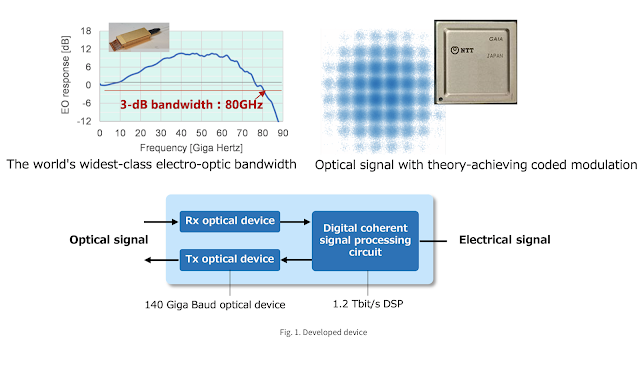
NTT announced a digital coherent signal processing circuit and optical device that achieves 1.2 Tbps optical transmission at 140 Giga baud.

NTT says its proprietary device utilizes a digital coherent detection scheme in which the polarization, amplitude, and phase of light are captured as digital data. The signal distortion that occurs in the optical fiber transmission channel and optoelectronic devices are compensated and equalized through advanced signal processing. 

Figure 1  (below) shows the configuration of an optical signal transceiver with a maximum transmission capacity of 1.2 Tbit/s. The transceiver consists of a cutting-edge digital coherent signal processing circuit (Fig. 1 upper right photo) and a 140-Giga baud class optical device with the world's widest-class opto-electrical response bandwidth (Fig. 1 upper left photo).


https://group.ntt/en/newsrelease/2022/09/05/220905a.html

Monday, August 22, 2022

NTT Data launches Innovation Centers in 6 countries

In a bid to generate new business through joint R&D with key customers NTT DATA is launching Innovation Center in six locations worldwide. Each location will focus on a unique topic wit the potential to become mainstream within five to ten years.

  • Japan (NTT research lab technologies): Genomes, metaverse, quantum computing
  • United States (customer contract-related technologies): Digital humans, smart city planning
  • Italy/Germany (data processing, simulation technologies): Quantum computing, metaverse
  • China (hardware-related technologies): Remote sensing technology (LiDAR), metaverse
  • India (a framework for prototype development)

https://www.nttdata.com/global/en/media/press-release/2022/august/ntt-data-launches-innovation-center-in-six-countries


Monday, August 15, 2022

Japan's Astellas Pharma picks Verizon Business to upgrade global net

Astellas Pharma, a global pharmaceutical company headquartered in Tokyo, selected Verizon Business to upgrade its global network infrastructure. 

The network transformation will enable Astellas to harness advanced technologies to help reduce drug development timelines, healthcare costs and drive new revenue opportunities for the Japanese pharmaceutical multinational.

Verizon’s relationship with Astellas stretches back more than a decade. In 2016, Astellas successfully deployed Verizon’s Secure Cloud Interconnect (SCI) solution to provide a high-bandwidth secure connection to its Amazon Web Services (AWS) and Microsoft Azure cloud services. Verizon’s current remit includes the build and deployment of Astellas’ global integrated network with a full suite of managed services, including Managed Wide Area Network, Local Area Network, Managed Security Services(MSS), Secure Gateway, Zero Trust Network Access and Unified Communications and Collaboration as a Service. 

Shinya Suda, Senior Vice President, Information Systems, Astellas commented, “From R&D to sales, we are seeing enormous amounts of data and intelligence flow through our business, across our 70 locations around the world. We want to ensure that we have a future-proof network in order to utilize cutting-edge technologies such as Artificial Intelligence, machine learning and robotics to make data-driven decisions to deliver better value for our patients. Our network transformation will underpin the next phase of our growth.”

“The network is transformative in its ability to enable innovation and growth and Astellas is changing the way they are using the tools at their disposal to completely revolutionize their business. This is truly a watershed moment for the pharmaceutical industry as companies grapple with the pressures of reducing time and costs for the development of drugs while improving patient care and value. We’re proud to have been a part of Astellas’ growth journey for more than a decade,” said Robert Le Busque, Regional Vice-President, Verizon Business Group, Asia Pacific.

Wednesday, July 20, 2022

NEC selected for Juno transpacific cable

NEC has been contracted to build the JUNO Cable System, which is slated to be the highest capacity transpacific cable when it comes online by the end of 2024.

The project is led by Seren Juno Network Co., Ltd., a company established by NTT Ltd Japan Corporation, PC Landing Corp. Mitsui & Co. and JA Mitsui Leasing.

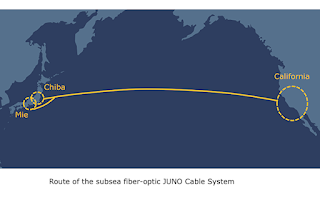
The JUNO cable will span 10,000 km between Chiba prefecture and Mie prefecture in Japan to California.

NEC plans to deploy its newly developed energy efficient repeaters and leading-edge SDM (Space Division Multiplexing) technology. This system will be able to adapt as many as 20 fiber pairs for the first time in a trans-Pacific subsea fiber-optic cable. The cable is expected to provide a maximum capacity of 350 Tbps.

NEC notes that it has been a leading supplier of submarine cable systems for more than 50 years, and has built more than 300,000 km of cable, spanning the earth nearly 8 times. As a system integrator, it  provides all aspects of submarine cable operations, including the manufacture and installation of optical submarine cables and repeaters, provision of ocean surveys and route designs, training and delivery testing. NEC's subsidiary OCC Corporation manufactures subsea optical cables capable of withstanding water pressures at ocean depths beyond 8,000 meters.

https://www.nec.com/en/press/202207/global_20220721_01.html

Sunday, July 10, 2022

Farice plans fiber route linking Iceland, Ireland and Japan

Farice reached a sales agrement with Far North Digital (FND) for fiber connectivity between Japan and Iceland via Farice’s new IRIS submarine cable and FND’s planned Arctic cable.

Construction is currently underway for Farice's IRIS Subsea Telecoms Cable System from Iceland to Galway, Ireland. The system is planned for service early 2023.

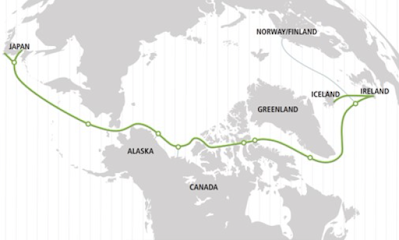
The FND fiber cable will be the first Arctic route connecting Asia with Europe via the Northwest Passage, greatly reducing the optical distance between Asia and Europe, thus minimizing latency.  FND is aiming for commercial launch by the end of 2026.

Farice and FND have agreed to develop a connectivity exchange at their shared landing site in Galway, Ireland.  Through the exchange, customers will be able to buy direct connectivity between Japan and Iceland, linking the third largest economy in the world and Iceland, which has 100% green and sustainable electricity.

“We are very excited about the development of the new Arctic fibre cable that will bring the continents of Asia, Northern America and Europe closer together.  The landing of the cable in Galway next to our IRIS cable will drive the development of a new submarine network exchange, connecting Iceland to Asia, North America and Northern Scandinavia”, says Thorvardur Sveinsson, CEO of Farice.

“Farice is a terrific partner, and Iceland has the renewable resources to make the Internet greener”, says Guy Houser, FND’s Chief Technical Officer.  “Our combined system offers faster and more secure connectivity for the world and the North.  It is critical infrastructure in the information age.”

https://www.fn-digital.com/news

https://farice.is/connectivity-between-iceland-and-japan-through-new-pan-arctic-fibre-cable/


IRIS cable to link Iceland to Ireland with up to 108 Tbps

IRIS, a new six-fiber pair undersea cable system, will connect Iceland and Ireland with up to 108 Tbps of system capacity.

Farice, the international connectivity provider fully owned by the Icelandic Government, has selected Subcom as the primary contractor.

Currently, there are two other submarine cable systems that connect Iceland to Europe – FARICE-1 (2003) and DANICE (2009). 

IRIS will be approximately 1,700 km in length and connect south west of Iceland to Ballyloughane Strand in Galway, Ireland. Farice has already finalized the DTS and marine survey work on Ireland’s continental shelf and will complete the remaining survey works to Iceland in 2021. Manufacture of the cable and equipment will take place at SubCom’s manufacturing headquarters in Newington, NH, USA during 2021 and early 2022, with main lay installation operations scheduled for summer 2022. The system is expected to be ready for service by the end of 2022.

Farice opted to land the IRIS cable in Ireland, a nexus of trans-Atlantic connections and a center of European operations for many international businesses. IRIS will directly connect to a new high-speed undersea cable system that will enable more diverse, secure, high-speed connectivity between Iceland and mainland Europe.

Saturday, July 2, 2022

KDDI hit by two day outage across Japan

KDDI, which serves over 31 million users across Japan, was hit by a widespread outage beginning on Saturday, July 2 at 01:35am local time.


KDDI attributed the initial fault to regular maintenance procedures involving the replacement of a router. Cascading errors led to disruption of other core elements, including its VoLTE platform. 

Rakuten Mobile users were also hit by the outage due to carriage agreements between the firms

As of Monday, July 4, the network had not yet fully recovered.

httpxs://news.kddi.com/important/news/important_202207051020.html


KDDI picks Ericsson, Nokia and Samsung for 5G

KDDI named Ericsson, Nokia and Samsung as its primary 5G vendors for next-generation network deployment in Japan. KDDI expects the first commercial live 5G services to be available from March 2020, with more than 93 percent coverage of 5G base station areas specified by Japan’s telecom regulation body by the end of March 2025. Ericsson confirmed that it will supply KDDI with Radio Access Network equipment, including products and solutions from...


Wednesday, June 22, 2022

SoftBank tests Altaeros' autonomous aerostat for base station

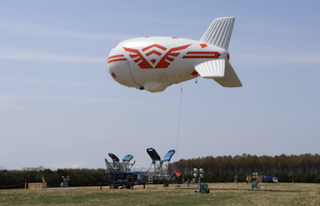
SoftBank has completed initial testing of Altaeros' ST-Flex autonomous aerostat with a base station as the payload. 

Operational and telecom tests were performed at Hokkaido Spaceport, Taiki Town, Hokkaido, Japan. Learn more about ST-Flex: 

SoftBank and Altaeros first launched the ST-Flex on May 2, 2022 and performed evaluation tests through May. ST-Flex carried SoftBank's base station system, which was equipped with its proprietary cylindrical antenna that realizes communication area footprint fixation, to a height of 816 feet (249m), where it was connected to their ground equipment via optical fiber and power conductors embedded in the tethers. F

"We are incredibly excited to have completed the first international launch of the ST-Flex," said Altaeros CEO, Ben Glass. "Successful testing of SoftBank's Footprint Fixation Technology on the ST-Flex is a huge milestone which will further the development and effectiveness of many aerial telecommunications platforms to help bring critical services around the world." 

https://www.softbank.jp/en/corp/news/press/sbkk/2022/20220622_01/ 

http://www.altaeros.com 


Monday, June 6, 2022

NTT DOCOMO announces 6G partnerships

NTT DOCOMO and Nippon Telegraph and Telephone Corporation (NTT) announced partnerships with Fujitsu, NEC, and Nokia to conduct experimental trials of new mobile communications technologies for the targeted commercial launch of 6G services by around 2030.

Launching the envisioned 6G services will require verification of numerous new mobile technologies, including those needed to newly use frequencies in the millimeter and sub-terahertz (above 6 GHz) bands, in addition to bands for existing 5G services. The trials are also expected to verify AI-based wireless transmission methods. DOCOMO and NTT will jointly conduct experimental trials with the three vendors, focusing on mobile technologies using new 6G frequency bands and AI-based wireless technology among these various mobile technologies.

The new 6G system will greatly exceed the performance of 5G and simultaneously provide high-speed, large capacity, and low latency capabilities, use new high-frequency bands such as sub-terahertz bands above 100 GHz, expand communication coverage in the sky, at sea and in space, and enable both ultra-low-power consumption and low-cost communications.

Naoki Tani, Executive Vice President and Chief Technology Officer at DOCOMO, said: "6G studies are progressing two or three years ahead of that of 5G. From this early stage, we would like to collaborate with world-leading global vendors to proactively demonstrate breakthrough concepts and technologies and promote them to the world."

DOCOMO and NTT will begin conducting indoor trials within the fiscal year ending in March 2023, and outdoor trials will begin in the following fiscal year. The trials are expected to verify concepts proposed so far by DOCOMO and NTT and will be reported in global research groups, international conferences and standardization activities related to 6G, and will serve as a foundation for more advanced technologies.

https://www.docomo.ne.jp/english/info/media_center/pr/2022/0606_00.html

Friday, June 3, 2022

Japan's Nara Institute of Science and Techn deploys Nokia's private 5G

Japan's Nara Institute of Science and Technology (NAIST) has deployed Nokia Digital Automation Cloud (DAC) and 5G Fixed Wireless Access (FWA) technology as part of a Local 5G network.  NS Solutions served as integrator for the project.

Nokia Digital Automation Cloud (DAC), an end-to-end private wireless networking and edge computing platform, is designed to empower enterprises from different industry verticals to leverage 5G-powered automation for greater efficiencies. The Nokia solution also includes the Japanese model of FastMile 5G Gateway, which was developed especially for local 5G use cases in Japan.

Takashi Oshiro, Executive Director and Senior Vice President, at NS Solutions, said: "Our expertise coupled with field-proven Nokia solutions allow us to deploy best-in-class Local 5G networks for enterprises from different industry verticals. Nokia DAC will enable us to quickly deploy Local 5G for NAIST to help them gain new research capabilities and allow them to use the network to conduct research for upcoming technologies. In addition, Nokia Fastmile CPEs allow the users to deploy 5G Fixed Wireless Access (FWA) quickly and easily."

Donny Janssens, Head of Customer Team Enterprise Japan, at Nokia, said: “Nokia Digital Automation Cloud will allow NAIST to benefit from a highly reliable local 5G network to better manage its data assets and provide a superior learning experience. In addition, our FastMile 5G Gateway allows NS Solutions to offer high-speed, reliable wireless connectivity for the local 5G network at NAIST. These solutions enable enterprises to leverage 5G technology in order to acquire new capabilities and gain a business edge. We are pleased to work with NS Solutions on this project and look forward to helping other enterprises benefit from innovative 5G use cases."


Nokia says it has deployed mission-critical networks to more than 2,200 leading enterprise customers in the transport, energy, large enterprise, manufacturing, webscale, and public sector segments around the globe.

https://www.nokia.com/about-us/news/releases/2022/06/03/nokia-ns-solutions-to-deploy-5g-sa-private-wireless-network-at-nara-institute-of-science-and-technology-to-advance-research-capabilities/

Tuesday, May 31, 2022

Mitsubishi Electric develops optical receiver for space laser

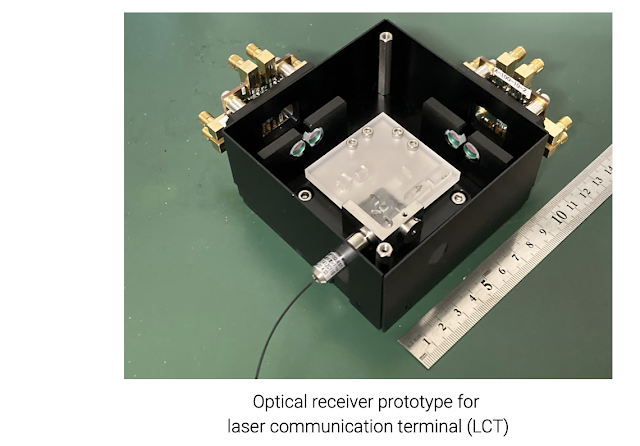
Mitsubishi Electric Corporation has developed an optical receiver for use in laser communication terminals (LCTs). The prototype combines laser beams with a function to detect the direction of received beams in the 1.5-μm band, a general-purpose band used for terrestrial optical fiber communications and other applications. 

Mitsubishi Electric said its optical receiver integrates functions to detect both four phase changes of laser light and beam direction. The result is a downsized optical receiver that enables space optical communication with 10 times the speed, capacity and distance of radio-wave communication. Since the wavelength is much shorter, smaller antennas can be used in compact communication units.

A newly developed optical circuit for coherent space optical communication detects four phase changes (0, 90, 180, and 270 degrees) in contrast to conventional two-phase (0 and 180 degrees) detection. As a result, communication capacity and speed are double those of two-phase optical communication schemes in the same bandwidth and some 10 times those of radio-wave communication systems.

https://www.mitsubishielectric.com/news/2022/0531-a.html

Monday, May 30, 2022

Yokogawa tests 5G industrial control with DOCOMO

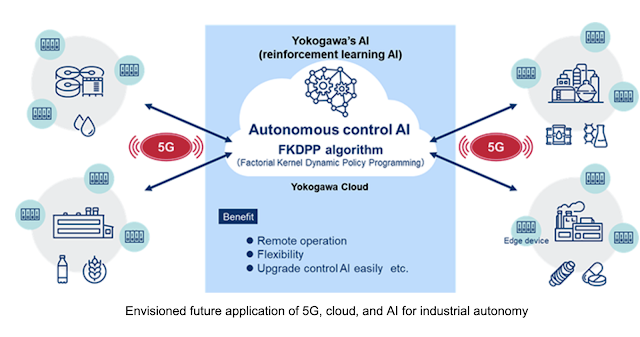
Yokogawa Electric Corporation has conducted a proof-of-concept test (PoC) of an autonomous AI controlling an industrial process and connected over DOCOMO's 5G network.

The fiel test, which successfully controlled a simulated plant processing operation over a period of 35 days, demonstrated that 5G is suitable for the remote control of actual plant processes.

Both Yokogawa and DOCOMO, as members of the 5G Alliance for Connected Industries and Automation (5G-ACIA), which is pursuing industrial applications for 5G, will continue to evaluate the use of 5G for remote, autonomous plant operations. 

The 5G-ACIA will present the results of this demonstration test at Hannover Messe 2022*6, between May 30 and June 2.

https://www.docomo.ne.jp/english/info/media_center/pr/2022/0530_00.html