Showing posts with label 5G. Show all posts

Tuesday, February 14, 2023

EE targets 5G expansion in rural areas

EE announced plans to extend 5G coverage to rural communities across the UK for the first time. Nearly 500 smaller communities, including Church Stretton and Birkenshaw in England, Llandeilo and Pen-y-banc (Carmarthenshire) in Wales and Tayport and Ratho in Scotland, now have their first 5G signal from EE, bringing the total number of UK cities, towns and villages where customers can access EE 5G to over 1,000. 

As part of the rollout, EE’s 5G is also reaching National Parks and popular rural tourist destinations.

In addition, EE is testing a range of  technologies to boost the range, reliability and energy efficiency of its networks. These include:

  • UK’s first 4G sent over low earth orbit satellite: BT Group has partnered with OneWeb to achieve the first transmission of 4G data using a low Earth orbit (LEO) satellite link to connect an EE mast to the mobile core network, instead of a traditional line of sight microwave or fibre connection. This paves the way for connecting small ultra-remote communities, emergency responders and disaster recovery units and other temporary deployments like festivals, events or construction sites.
  • Mobile coverage in harder to reach areas: In collaboration with Stratospheric Platforms Ltd (SPL), BT Group is running a trial that aims to deliver mobile coverage from the air using a ‘High Altitude Platform’ (HAPS) system being tested at BT’s Global innovation centre (Adastral Park). This has the potential to unlock connectivity for the most remote areas.
  • Self-powering sites: EE is weeks away from launching its first self-powering mast using sustainable energy, in Wales’ Elan Valley. Initial assessments demonstrate that local sourced renewable energy (wind and solar) can contribute up to 90% of the site’s requirements.
  • Biofuels phase-in: Trials are commencing to test the use of biofuels like Hydrotreated Vegetable Oil (HVO), Biogas and Hydrogen in network generators to support wider resilience. EE will initially implement the solutions as a trial across 20 physical sites.


Thursday, December 15, 2022

End-to-End network slicing with Ericsson, KDDI

Ericsson, Japanese operator KDDI, and Sony carried out a proof-of-concept (POC) showing end-to-end network across two simultaneous slices for the same user equipment and the same end-user service. 

In this PoC, Ericsson's 5G Core equipment and Sony's 5G SA mobile devices applied User Equipment Route Selection Policies (URSP) standards and Priority Scheduling to enable a gaming app to use two different network slices – one for video and one for mobile operation signals. This showed that dedicated network slices can be used for different processes on a mobile device by changing the terminal’s route selection policies in response to a request from 5G core equipment.

Chris Houghton, Senior Vice President and Head of Market Area Northeast Asia, Ericsson, says: “This significant achievement with KDDI, an important customer of ours, and Sony, a key partner, paves the way for all sorts of applications in network slicing. We will continue to support our customers and partners in Japan to monetize their networks by delivering new value and services for end users.”

The PoC showed that in a highly loaded mobile network, Radio Access Network (RAN) Slicing functions such as Quality of Service and Radio Resource Partitioning (RRP) can provide the required service isolation and differentiated priorities to protect the mobile broadband user performance. In addition, end-to-end network slices were deployed by the Service Orchestration, with the profiles for the RAN and 5G core and cell-level radio resources partitioned using RRP

Mr. Toshikazu Yokai, Managing Executive Officer, General Manager of Mobile Network Technical Development Division, KDDI, stated. “KDDI is constantly working on technology validation with the aim to create new use cases and services utilizing 5G standalone. KDDI will continue to develop and verify technologies to create new value.”

https://www.ericsson.com/en/press-releases/2/2022/12/ericsson-kddi-sony-successfully-achieve-simultaneous-communication-of-multiple-network-slices

Wednesday, December 7, 2022

New download peak speed benchmark: 7.3Gbps

Telstra, Ericsson claimed a new 5G download peak speed benchmark of 7.3Gbps for a single user.

The result was achieved at a Telstra live mobile site located at the Gold Coast, Queensland Australia. 

This new global 5G benchmark of 7.3Gbps for a single user was demonstrated using a smartphone form factor mobile test device, powered by Snapdragon X70 5G Modem-RF System. The mobile device connected to a live commercial Telstra mobile site equipped with an Ericsson Radio System base-station supporting New Radio Dual Connectivity (NR-DC) between 800MHz of n258 (26GHz) mmWave spectrum and 100MHz of mid-band n78 (3.6GHz) Time Division Duplex (TDD) spectrum.

The Ericsson base station used in this milestone has two Ericsson’s Baseband 6648, AIR5322 n258 26GHz mmWave radios, AIR6488 n78 3.6GHz radios and commercial Ericsson RAN software running 5G NR DC (new radio dual connectivity) capability. The high peak speed is achieved by aggregating eight 100MHz mmWave carriers (800MHz total bandwidth) running peak modulation of 256QAM and combining with 100MHz of mid-band TDD using NR dual connectivity.

The peak speed to 7.3Gbps surpassed  the previous 5G downlink benchmark also set by Telstra in February 2022 of 5.9Gbps (peak modulation of 64QAM on mmWave).

https://www.ericsson.com/en/press-releases/7/2022/telstra-ericsson-and-qualcomm-achieve-new-download-speed-benchmark

Sunday, November 20, 2022

TIM picks Ericsson for 5G standalone network

TIM has selected Ericsson to provide its 5G Core, enabling the Italian carrier to modernize its current "Evolved Packet Core" and introduce the new 5G Standalone in a single cloud-native solution.

The agreement also includes network orchestration and automation services, which underpin the introduction of ultra-reliable, low-latency network slicing and communications (URLLC) solutions. A key step that will enable the rapid introduction of new services for consumers and businesses.

Andrea Missori, President of Ericsson Italy, says: "This new partnership with TIM will allow to take full advantage of 5G, benefitting both consumers and businesses, and will contribute to accelerate the country's digital transformation. With 5G standalone it will be possible to activate a series of innovative services that require high performance, low latency and maximum security, as well as the network slicing functionality that will allow mobile operators to monetize network quality."

https://www.ericsson.com/en/press-releases/3/2022/ericssons-core-technology-for-tims-5g-standalone-network

Sunday, October 30, 2022

Ericsson Network Slicing runs during Singapore F1 Grand Prix

During the recent Grand Prix Season Singapore 2022 (GPSS 2022) in October, Singtel employed Ericsson’s Dynamic Radio Resource Partitioning feature to deliver end-to-end network slicing in a live 5G Standalone network to power 5G experiences and festivities along the Marina Bay Street Circuit.

Network slicing creates a logically separated, self-contained slice of the network, offering differentiated service performance with prioritised assurance on speed, latency and reliability. Dynamic Radio Resource Partitioning is a software solution that allocates spectrum resources at millisecond level scheduling.

Ericsson’s end-to-end network slicing solution also included cloud-native capabilities to create a dedicated slice of its network that was reserved for subscribers of Sports Plus on Singtel’s app marketplace, CAST. This meant subscribers could enjoy seamless video streaming of the action of the high-velocity race from wherever they were. The network delivered the live content even in congested areas along the Marina Bay Street Circuit due to the dedicated capacity being allocated to the service.

Singtel announced in July that it had achieved over 95 percent 5G Standalone nationwide coverage – three years ahead of the regulator’s deadline.

Mark Chong, Group Chief Technology Officer, Singtel, said, ”We’re proud to have been the official network partner of the GPSS, providing race spectators and attendees of the various GPSS related events with the superior features of Singapore’s most powerful 5G network. With the world’s first application of end-to-end network slicing technology to our CAST app, we were able to provide F1 fans a superior viewing experience of the action on the track and enhance the experience of 5G race-related activations held across the island.”

Martin Wiktorin, Head of Ericsson Singapore states:” The fast and efficient delivery of services as well as high-quality user experience provided by Singtel CAST was enabled by a range of Ericsson technologies working together to deliver a full end-to-end network slice on 5G sites surrounding the F1 race. With Singtel CAST subscribers being assigned the premium slice, they were able to enjoy the full race via seamless video streaming even in congested areas along the F1 race.” Around 302,000 fans turned up for the Singapore Grand Prix this year.

Tuesday, October 18, 2022

Ericsson confirms 5G contract with Reliance Jio

Ericsson signed a long-term strategic 5G contract with Indian communications service provider (CSP) Reliance Jio to roll out 5G Standalone (SA) in the country.

Ericsson’s energy-efficient 5G Radio Access Network (RAN) products and solutions (from the Ericsson Radio System portfolio) and E-band microwave mobile transport solutions will be deployed in the 5G network for Jio.All products and solutions are deployed on new-build 5G SA networks, designed to maximize the benefits of 5G to CSPs and their customers – whether individual subscribers or enterprise and industry customers.

Ericsson notes that it has played a pivotal role in powering virtually every facet of telecommunications in India, from setting up the first switch in India in 1903 to providing connectivity across 2G, 3G, 4G and now 5G.

Börje Ekholm, President and CEO, Ericsson, says: “India is building world-class digital infrastructure that will drive innovation, job creation and entrepreneurship across the country. We are happy to partner with Jio in those ambitions, through Ericsson 5G Standalone connectivity, which will be a major catalyst in meeting those digital transformation goals across society, enterprise and industry.”

https://www.ericsson.com/en/press-releases/2022/10/ericsson-partners-with-jio-to-build-indias-first-5g-standalone-network-to-achieve-indias-digital-leadership

Thursday, October 13, 2022

Blueprint: The Automation Imperative in 5G Transport Deployments

 by Sally Bament, Vice President, Cloud & Service Provider Marketing, Juniper Networks

5G is poised to make an enormous impact on the global economy, and organizations that can successfully exploit its speed, bandwidth and ultra-low latency have an opportunity to lead their market by delivering new and innovative services. In addition to the highly advertised enhancements of mobile telecommunications for consumers, 5G will be an important play in numerous other vertical markets, all of which represent attractive business opportunities.

For example, handling the volume of data generated by IoT sensors in logistics applications – transportation, warehousing, retail distribution and the like – will require bandwidth that only 5G can provide. 5G speed and low latency will take robotics (and productivity) to new levels on the factory floor. In homes, 5G will elevate immersive gaming and enable virtual reality. These are just a few examples of a market that is projected to reach $1,271 billion by 2025.

To participate in this growth, companies will need to evolve the way they plan, deploy, architect and optimize their transport networks, and this will involve a much higher degree of automation than now exists. Currently, 75% of networking activities[i] are manual, and 85% of CSPs[ii] still use manual or semi-manual processes to manage their network service lifecycle. Handling the increased scale and complexity of a 5G network with this level of manual intervention will not be sustainable. Fortunately, sophisticated, field-proven automation solutions are available to support the transition to 5G from initial deployment to long-term operation.

Eliminate Manual Tasks

Both the familiar mobile consumer services and emerging enterprises rely on edge computing to process the massive amounts of data more efficiently and cost-effectively. Such architectures can involve onboarding hundreds or even thousands of geographically dispersed mini data centers, including those incorporated within cell sites.

It’s hard to imagine deploying those modern distributed architectures manually with onsite engineers, but it’s viable with automation. The process begins with a template that can easily be replicated wherever a new point of presence is required. Templates enable a much faster turn-up process, plus a level of consistency throughout the network that translates into higher reliability and speed. One Tier 1 network provider’s manual cell-site activation process had more than 50 manual steps that took a minimum of 26 hours to set up. By switching to an automated process, the company reduced the activation time to two hours.

While reducing or eliminating manual tasks is often cited as the primary benefit of automation, it is by no means the only one. Automation also plays a vital role in onboarding devices and customers quickly, maintaining optimal network performance, maximizing utilization, accelerating problem identification, automation remediation, improving security and meeting service-level agreements (SLAs).

Measure what matters

Making automation work demands first and foremost a new attitude towards network quality data. In simple terms, instead of focusing on the health of the various elements involved in the end-to-end service delivery chain, operators need to measure what matters most: service quality and end user experience. This can now be achieved easily with active assurance which leverage virtual agents sending synthetic transactions directly on the data plane. Am I delivering the service quality characteristics purchased by my customers? If not, where are the performance degradations in the service delivery chain and what should I do to fix the problem? In a 5G network these are very complex questions, as different slices may need to support diverse services, each with specific requirements, such as an IoT application with a large number of low-throughput devices vs. an MBB where there are fewer devices, but each is transmitting or receiving high bandwidth content. With active assurance continually measuring real service quality, automated systems can make adjustments to routing and bandwidth requirements to optimize performance in real time with no need for human intervention. 

The ultimate goal of any network is to deliver the best possible experience for the user. To do so in a highly complex 5G deployment, automation is no longer a “nice to have” capability. It’s a “must have.” For example, automation can play an important role in the identification and remediation of incidents that affect the user experience. Currently, 60% of network problems are not discovered by NetOps, but by others, notably the users themselves. This is not acceptable, and underlines the fact that manually responding to every incident is no longer a viable option.

Deploy automation one use case at a time 

Although the need for automation is well understood, implementing it is still seen as a daunting task by many organizations. According to a survey conducted by Heavy Reading, 40% of CSPs believe that using a generic automation framework is the first barrier to adopting automation in their transport networks. This is not a necessary first step. The best approach to automation is to apply it to one business problem at a time. Working through a single implementation to a successful conclusion will provide lessons that will help future implementations go smoothly, and will also generate enthusiasm and build momentum for automation within the organization. SaaS-based automation for device onboarding is one good place to start.

Intent-Based Networking

Ultimately, the value of automation is that it enables operators to build intent-based networks. By shifting the focus towards “what to do” as opposed to “how to do it,” intent-based networking increases agility and lets operators respond more rapidly to business needs.

In summary, the arrival of 5G opens up a whole new realm of business opportunities, but success demands new ways of looking at network management.

[i] Gartner®, Market Guide for Network Automation Tools, Andrew Lerner, Ted Corbet, February 22, 2022

[ii] Omdia, Survey of 92 Communication Service Providers, September 2020


Verizon moves commercial traffic onto its 5G core

Verizon has begun moving customer traffic onto its new cloud-native, containerized 5G core.

The Verizon Cloud Platform (VCP), on which the 5G core is built, is based on a Webscale software architecture with advanced technologies designed specifically for telco workloads. VCP is a distributed platform that supports edge services, private cloud services, Network Function Virtualization tools, Cloud Native Functions, Web applications, mapping and spatial analysis tools, orchestration tools, service assurance tools, auto-remediation, and compute offerings. 

In addition to network slicing and dynamic resource allocation, Verizon cites the following benefits for its new 5G core:

  • Real-time resource management of Radio Access Network and core virtual container-based network functions
  • Advanced analytics of network data to improve network performance
  • Optimized services between Verizon's fixed and mobile networks
  • Scalable, more cost-efficient architecture
  • Ability to move workloads to fit use case requirements

Veizon said this architecture will enable it to achieve new levels of operational automation and adaptability to create differentiated customer experiences. This directional technology platform that enables MEC will support stand alone, non-stand alone, and VoNR services.

“Our mission has always been to build and operate the best, most reliable, highest performing, and secure networks in the world,” said Adam Koeppe, Senior Vice President of Network Technology, Strategy, and Planning at Verizon. “The 5G Core is a critical step in achieving our goal. From the densification and virtualization work in the Radio Access Network, to the architectural design changes in the core of the network developed specifically for telco workloads, we are working to ensure customers not only have access to 5G, but have the most advanced, secure, and robust network to support the remarkable new solutions being developed on 5G technology.”

“Bringing traffic onto the newly designed core coincides with the ecosystem development around us. With a critical number of customers now having devices that can access the advanced features of the 5G core and the solutions and applications development – especially for enterprise customers – really taking off, now is the ideal time to move traffic onto the new core,” said Koeppe.

https://www.verizon.com/about/news/verizon-moves-commercial-traffic-5g-core

Verizon has deployed 8,000 virtualized cell sites 

Verizon has now deployed over 8,000 virtualized cell sites with a goal of deploying over 20,000 by the end of 2025. “We are building the network with the most advanced technology available, because we know people rely on our network and we are committed to delivering the variety and quality of services our customers need,” said Adam Koeppe, Senior Vice President of Planning and Technology at Verizon. “Even while driving the most aggressive network...

Verizon upgrades its core network for 400G with Juniper's PTX series

Verizon is refreshing its core network with Juniper Networks' PTX series routers supporting 400G interfaces. Verizon said the new equipment is half the size of the existing equipment, reducing space requirements in core facilities and driving down both power usage per GB and cost per GB to operate. In addition, the new equipment offers an advanced level of automation, allowing for automated interfaces with other network systems.Verizon also...


Tuesday, September 13, 2022

Viettel picks Infinera Synchronization for 5G rollout across Vietnam

Viettel has selected Infinera’s Optical Timing Channel 2.0 (OTC2.0) solution to prepare its synchronization network for Viettel’s 5G pilot rollout. 

Infinera’s OTC2.0 is a standalone synchronization technology that can be deployed across virtually all DWDM networks from any vendor to ensure timing and synchronization of cell towers is seamless and meets the demanding performance criteria required by 5G applications even in challenging fiber environments. Viettel selected Infinera’s OTC2.0 solution for its superior performance and leading resiliency capabilities.

“Resilient and accurate synchronization performance enables us to fully utilize our most valuable asset, our spectrum,” said Mr. Dao Xuan Tung, Project Leader of Research and Implementation of Time/Phase Synchronization System for 5G Network at Viettel. “Infinera’s OTC2.0 solution will enable us to deploy a comprehensive 5G network and deliver superior solutions to our customers.”

“Synchronization requirements have become more stringent and more important for mobile operators like Viettel as they modernize their networks for 5G transport,” said Nick Walden, Senior Vice President of Worldwide Sales at Infinera. “Infinera’s synchronization capabilities enable both mobile network operators and wholesale carriers to deliver network-based synchronization with industry-leading high performance and resiliency.”

https://www.infinera.com/press-release/viettel-selects-infinera-synchronization-solution-to-support-5g-rollout-across-vietnam

Vietnam's Viettel deploys 5G with Nokia

Viettel and Nokia have broadcasted the first end-to-end 5G network in Ho Chi Minh City. Specifically, Viettel and Nokia have set up 10 5G base stations in the area of Ward 12, District 10, Ho Chi Minh City, Vietnam's biggest city with more than 2,000 km2 area and a population of 13 million. The project sets the basis for a comprehensive evaluation of the band, coverage and application of 5G before commercialization in 2020. Nokia said it deployed...


Monday, September 12, 2022

Black Hawk flight data transferred via AT&T 5G

In a test conducted last month at Lockheed Martin's Sikorsky headquarters in Stratford, Connecticut, AT&T securely and rapidly transferred UH-60M Black Hawk health and usage data through an AT&T 5G private cellular network and Lockheed Martin's 5G.MIL multi-site pilot network.

The AT&T 5G millimeter wave private cellular network wirelessly transferred data to the 5G.MIL network through ground support equipment from the Black Hawk's Integrated Vehicle Health Management System (IVHMS). The data was then routed to local Sikorsky networks for processing and distribution through the secure Lockheed Martin 5G.MIL pilot network to the Waterton, Colorado, 5G test range site.

Currently, it takes Black Hawk crews about 30 minutes to remove the IVHMS data cartridge from the helicopter, transport it to an operations center and extract the data for analysis. Lockheed Martin used AT&T 5G private cellular technologies to reduce the time required to less than 5 minutes including cartridge removal, demonstrating the potential benefits in time and cost for military and commercial helicopter operations. 

The companies said the test demonstrated that 5G  on the flight line can support accelerated maintenance operations and improved aircraft readiness. It also proved highly secure interoperability between the AT&T millimeter wave 5G private cellular network and the 5G.MIL pilot network.

"These 5G capabilities deployed at scale are expected to enable high-speed, secure-data transfer on virtually any flight line, providing another example of how we're advancing our 21st Century Security vision by improving customer readiness and operations," said Dan Rice, vice president of 5G.MIL Programs at Lockheed Martin. "In collaboration with commercial 5G leaders, an interoperable 5G.MIL multi-site, multi-vendor network is another step closer to reality." 

https://www.lockheedmartin.com/en-us/products/5G.html


Sunday, August 28, 2022

stc implements 5G carrier aggregation

Saudi Arabia's stc is activating 5G Carrier Aggregation to boost capacity by up to 60% and improving download speeds for its subscribers.

This development plan utilizes 2.3GHz band for 5G on more than 1,000 sites as an initial phase, through reuse of the spectrum resources initially used for 4G which affirms stc’s strategic commitment to adopt cutting edge technologies and services. 

The use of 5G Carrier Aggregation technology is expected to aggregate the new 2.3GHz carrier to the main 5G carrier on 3.5GHz, to augment the overall 5G network capacity and elevate speeds into global-ranking levels.

Eng. Bader Alluhaib - stc Infrastructure VP has stated: “In stc – as per our leading position in strengthening the Kingdom’s status in the global Telecom sector – we are restlessly working – with the support of our partners – to develop our infrastructure capabilities, and introducing the latest solutions and technologies to enrich our subscribers experience and improve the Kingdom’s global ranking. As the leading Operator in the Kingdom, we are planning to adopt these advanced solutions in a larger scale throughout the upcoming years as an integral part of the 2030 Vision”.

Eva Andrin – Deputy VP for Saudi and Egypt in Ericsson, stc’s Technology Partner has stated: “Ericsson’s 5G Carrier Aggregation solution - which employs Advanced Radio Coordination technologies – provides a breakthrough change in enhancing 5G coverage, boosting capacity and improving 5G users experience. Ericsson is devoted to provide stc with such innovative solutions to uplift its network capabilities, to outreach new horizons towards the Kingdom Vision”

stc expects to conclude this development within this year.

https://www.stc.com.sa/content/stcgroupwebsite/sa/en/media-center/press-release/press-release-detail.html?id=stc-boosts-5g-network

Friday, August 19, 2022

Dell'Oro: RAN Disappoints in 2Q 2022

The positive momentum that has characterized the Radio Access Network (RAN) market over the past four years is losing some steam, according to a new report from Dell'Oro Group. The overall 2G-5G RAN infrastructure equipment market – including hardware and software – declined in the second quarter, recording the first year-over-year contraction in more than two years and the third consecutive quarter of RAN coming in below expectations. Although the RAN market is not immune to external risks, initial readings suggest that the RAN impact from deteriorating macro conditions, high levels of inflation, and supply chain disruptions were limited in the quarter.

"The shift in the pendulum is not a surprise, but admittedly it has swung a bit faster toward the negative than initially expected", said Stefan Pongratz, Vice President at Dell'Oro Group. "Slower momentum is not a sign that the 5G deployment phase is over. The message we have communicated for some time now, namely that the 5G cycle will be longer than previous technology cycles, still holds. At the same time, market conditions in the quarter were impacted by APAC, excluding China, Russia, and foreign exchange," continued Pongratz.

Additional highlights from the 2Q 2022 RAN report:

  • Top 5 global suppliers in the quarter include Huawei, Ericsson, Nokia, ZTE, and Samsung.
  • Top 4 suppliers outside of China in the quarter include Ericsson, Nokia, Huawei, and Samsung.
  • Huawei and ZTE continued to dominate in China, together accounting for 90 to 95 percent of 1H 2022 revenues.
  • Ericsson maintained its grip on the RAN market outside of China, accounting for 39 percent of the revenues for the 1H 2022.
  • Nokia's RAN position outside of China improved between 1Q and 2Q 2022.
  • Samsung's 1H 2022 RAN share improved both in North America and globally.
  • Even though RAN results disappointed in the quarter and first half revenues are tracking below expectations, RAN is still projected to record a fifth consecutive year of growth in 2022.

https://www.delloro.com


Tuesday, August 2, 2022

Reliance Jio becomes India's biggest spectrum holder

Reliance Jio was the largest purchaser in the auction of 5G spectrum conducted by the Department of Telecommunications, Government of India, over the past week.

Jio confirmed that it acquired spectrum in the 700MHz, 800MHz, 1800MHz, 3300MHz and 26GHz bands. The company said it will use equipment made in India for its 5G rollout.

Jio's total cost of acquiring the technology agnostic spectrum for a period of 20 years is Rs. 88,078 crore. As per terms of the spectrum auction, the spectrum payments have to be made over 20 equated annual instalments, with interest computed at 7.2% per annum. 

Through this acquisition, Jio’s total owned spectrum footprint has increased significantly to 26,772 MHz (uplink + downlink), which is the highest in India:

  • Sub-GHz: Jio has the highest amount of sub-GHz spectrum with at least 2X10 MHz contiguous spectrum in both 700 MHz and 800 MHz bands across each of the 22 circles.
  • Mid-band: Jio is the only operator which has at least 2X10 MHz in 1800 MHz band (with 2X20 MHz in six key circles), 40 MHz in 2300 MHz band and 100 MHz in 3300 MHz band across all the 22 circles.
  • mmWave: In addition, Jio also has right to use 1,000 MHz in the millimetre wave band (26 GHz) in each of the 22 circles which will be crucial to enable enterprise use cases as well as provide high-quality streaming services.

Shri Akash M Ambani, Chairman, Reliance Jio Infocomm issued the following statement:

“We have always believed that India will become a leading economic power in the world by adopting the power of breakthrough technologies. This was the vision and conviction that gave birth to Jio. The speed, scale and societal impact of Jio’s 4G rollout is unmatched anywhere in the world. Now, with a bigger ambition and stronger resolve, Jio is set to lead India’s march into the 5G era. We will celebrate ‘Azadi ka Amrit Mahotsav’ with a pan India 5G rollout. Jio is committed to offering world-class, affordable 5G and 5G-enabled services. We will provide services, platforms and solutions that will accelerate India’s digital revolution, especially in crucial sectors like Education, Healthcare, Agriculture, Manufacturing and e-Governance and make another proud contribution to Honourable Prime Minister’s DIGITAL INDIA MISSION.”


Sunday, July 31, 2022

Bell Canada expands 5G+ across Ontario

Bell Canada is now deploying 3500 MHz wireless spectrum in the next phase of its 5G rollout.

Bell 5G+ service is now available in southern Ontario, including Toronto, Guelph, Kitchener-Waterloo, London, Barrie and select areas of Mississauga, Bell 5G+ is expected to be faster and more responsive, allowing for a superior mobile experience. In Toronto, speeds with 5G+ are now over 50% faster than before.

"Bell is taking its most-awarded 5G network and making it even better with 5G+, offering customers access to even faster mobile speeds than before. Ontario is just the beginning, and we look forward to rolling it out to more Canadians, and delivering on our promise to provide the latest technology and best experience for our customers," states Stephen Howe, Chief Technology and Information Officer, Bell.

https://www.bce.ca/news-and-media/releases/show/Bell-5G-expands-across-Ontario-offering-Canadians-its-fastest-mobile-speeds-ever?page=1&month=&year=&perpage=25

Wednesday, July 27, 2022

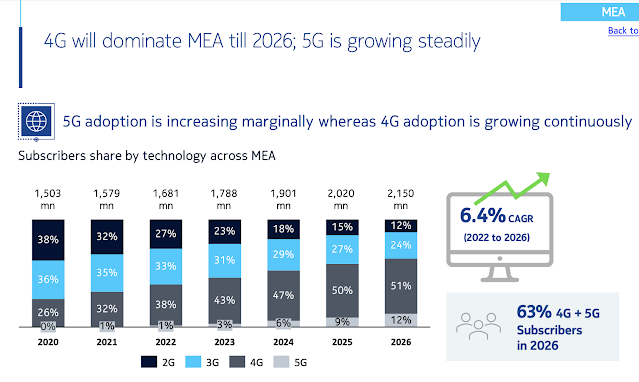
Nokia expects 5G subs to hit 263 million in the Middle East and Africa

Nokia is predicting that 5G subscriptions will reach 263 million in the Middle East and Africa (MEA) region by 2026. 

The 5G subscription growth will primarily be in Gulf Cooperation Council (GCC) countries, including Saudi Arabia, the UAE, Qatar, Oman, Kuwait and Bahrain. 

Additionally, subscribers in South Africa, Nigeria and North African countries will increase adoption following the release of new spectrum. This trend is triggered by the increasing use of high-bandwidth consumer applications and industrial use cases.

Mikko Lavanti, Head of Mobile Networks, Nokia MEA, said, “Globally, the pace of 5G network rollouts has surpassed 4G/LTE networks. Two years after the first LTE launch there were only 25 million subscriptions across 60 networks, while two years after the first 5G launch, 340 million subscriptions were registered across 155 networks. Similarly, in MEA, our MEA Broadband Index Report finds 40 percent year-on-year growth in 4G data traffic but a huge 350 percent year-on-year growth in 5G data traffic in 2021 alone. This trend in the region clearly indicates that there is a pressing need for the adoption and expansion of 5G networks across the region.”

https://www.nokia.com/sites/default/files/2022-07/mea-broadband-index-report-07-2022.pdf


Tuesday, July 26, 2022

Dell'Oro: 5G rollouts to drive demand for microwave transmission

Demand for Microwave Transmission equipment is set to increase for the next few years due to future 5G deployments, according to a recent forecast report by Dell’Oro Group. This growth will be driven by new 5G markets that rely more on wireless backhaul.

“Microwave Transmission equipment demand is on the rise,” said Jimmy Yu, Vice President of Dell’Oro Group. “Demand for Microwave Transmission equipment for mobile backhaul is already off to a good start, growing 11 percent in 2021. We expect future 5G installations will drive this market’s growth for a few more years.

“Although 5G deployments started a few years ago, most of those were rolled out in areas with high fiber availability. We are now seeing the 5G spectrum auctions and new roll outs in markets that rely more on wireless backhaul. This bodes well for point-to-point Microwave Transmission equipment,” added Yu.

Additional highlights from the Microwave Transmission & Mobile Backhaul 5-Year Forecast Report:

  • For the cumulative period that includes the years 2022 through 2026, Microwave Transmission equipment revenue is projected to approach $18 billion.
  • Approximately 70 percent of the Microwave Transmission market will be driven by mobile backhaul. The remainder will be from sales into vertical markets such as enterprises and government.
  • The technology segment with the highest five year growth will be E-band. The E/V Band market is forecast to grow at a 25 percent compounded annual growth rate.

https://www.delloro.com/news/future-5g-roll-outs-to-drive-demand-for-microwave-transmission-equipment/

Sunday, July 24, 2022

Gogo Business Aviation hits midpoint on 5G air-to-ground rollout

Gogo Business Aviation activated the 75th site on its nationwide 5G network, marking the halfway point in the construction of its air-to-ground infrastructure.  The company said it remains on budget and on schedule to launch in the second half of 2022.

Gogo 5G is expected to deliver ~25 Mbps on average with peak speeds in the 75-80 Mbps range with coverage over the entire continental United States. The service is designed to deliver high throughput with very low latency. It will use both licensed and unlicensed spectrum. The base station communicates with aircraft passing overhead using 16-antenna digital port beamforming antennas using massive MIMO technology.

Gogo says its AVANCE platform, with its multi-bearer capability and software-centric design, allows customers to future-proof their inflight connectivity investments, with  upgrade paths to both Gogo 5G and to Gogo's global Low-Earth Orbit (LEO) satellite-based product in the future.

Gogo is working with Duncan Aviation to complete the first-article Supplemental Type Certification (STC) for the onboard 5G system hardware along with STCs that will cover more than 30 aircraft models. Additional STCs are being developed by several other Gogo authorized dealers, and at the factory by business aviation aircraft manufacturers.

"Getting to the 50% mark for our 150-tower 5G nationwide network in a matter of months is an incredible accomplishment by our team," said Mike Rupert, vice president of network operations for Gogo Business Aviation. "We have a team of network experts that has been working hard to bring the 5G network to life, building sites across the country, and that work will continue into the fall."

"We've been testing our network and we're pleased with the results we're seeing," said Dave Glenn, senior vice president of customer operations. "Gogo 5G is going to deliver on everything we've promised to the market."

https://business.gogoair.com/gogo-5g/


Thursday, July 21, 2022

SK Telecom activates bare-metal 5G Core with Ericsson

SK Telecom has activated a bare-metal cloud-native 5G core network, using Ericsson 5G Core and Cloud Native Infrastructure (CNIS).

SKT's cloud-native 5G core is expected to improve traffic processing significantly compared to existing physical-based cores by applying packet acceleration processing, route optimization, and multi-flow control for ultra-high-speed and large-capacity 5G services.

The companies have been developing and verifying the cloud-native solution in stages since 2019, and since November of last year, they have been testing a full-scale 5G network for commercial service, where the Ericsson’s dual-mode 5G Core is deployed on the Kubernetes over bare metal infrastructure solution Ericsson Cloud Native Infrastructure (CNIS).

Park Jong-kwan, VP, Head of  Infra Tech, says, "Based on the commercialization of the cloud-native-based 5G core, we have laid the foundation to provide cutting-edge ICT services more efficiently and stably. We will continue to develop and apply the next-generation network technology that will become this”.

Monica Zethzon, Head of Solution Area Packet Core at Ericsson says, “With the bare-metal cloud-native 5G Core solution, SKT is reconfirming its ambitions to lead the way in creating a future-focused, versatile 5G network. The efficiency and performance gains to the 5G Core network that comes from this new Cloud Native Infrastructure will be a strong foundation for innovative use cases and new services for enterprises and consumers.  We are proud to continue our long-standing partnership with SKT, together supporting the innovative ecosystem of technology-driven businesses.” 

https://www.ericsson.com/en/press-releases/2/2022/7/skt-live-5g-core


Monday, July 18, 2022

Ericsson partners with Thai university on 5G education

Ericsson announced a partnership with King Mongkut University of Technology Thonburi (KMUTT) on a 5G ICT skills program.

The partnership will provide KMUTT students with access to ‘Ericsson Educate’, Ericsson’s online education initiative that supplements the students’ ongoing technical studies with courses that aim to strengthen their ICT skills and increase their job readiness. Around 2,000 students are expected to benefit from this program in the first year alone.

http://www.ericsson.com

Monday, July 11, 2022

AT&T Mexico looks to Nokia for 5G

AT&T Mexico is collaborating with Nokia on 5G and has selected the company as a strategic partner for AT&T Mexico’s 5G Innovation Lab. 

Under the deal, Nokia will provide equipment from its 5G AirScale RAN portfolio, powered by its latest ReefShark System-on-Chip chipset.

Nicole Rodriguez, CTO at AT&T Mexico, said: “We are committed to providing our customers with the best experience possible. As we move forward with the deployment of our 5G network, we need the latest technology and the most reliable support services."

Tommi Uitto, President of Mobile Networks at Nokia, said: “We are excited to be part of this important milestone as a strategic partner for AT&T Mexico. Our latest AirScale portfolio creates a strong foundation for the operator's 5G evolution, enabling super-fast mobile connectivity and innovative use cases for its customers.”