Showing posts with label #5G. Show all posts

Sunday, February 12, 2023

Ericsson intros precise-location software for indoor 5G

Ericsson introduced new precise-location software for indoor 5G that enables new enterprise use cases such as asset tracking and tool positioning. The softare is called Ericsson 5G Precise Positioning and could be used in environments such as factories, mines, hospitals, warehouses, and other industrial private network applications, as well as in emergency response scenarios.
The company is also making two additions to its Ericsson Radio Dot System portfolio:

  • IRU 8850 -- an indoor radio unit suited for medium-to-large venue coverage. Designed for simple and speedy deployment, it delivers up to four times the capacity of its predecessors, enhancing network performance and user experience in medium to large venues. It is also up to 70 percent more energy-efficient compared to active DAS technology.
  • Ericsson Indoor Fusion Unit, a compact, all-in-one indoor 5G solution that combines radio and baseband functionalities into one unit. This radio provides small- to medium-sized building coverage.

David Hammarwall, Head of Product Area Networks, Ericsson, says: “The new Radio Dot System equipment and location services software further increase the flexibility of Ericsson’s indoor portfolio. Scalable and cost-efficient, the expanded portfolio offers a one-stop-shop to accelerate indoor 5G rollouts globally, spreading the benefits of premium indoor connectivity. It will also enable a variety of use cases for service providers and enterprises that will boost operational efficiency, safety, and user experience.”
https://www.ericsson.com/en/press-releases/2023/2/new-ericsson-solutions-boost-indoor-5g-capacity-and-precise-location-services

Thursday, October 20, 2022

AT&T midband 5G deployment on or ahead of schedule

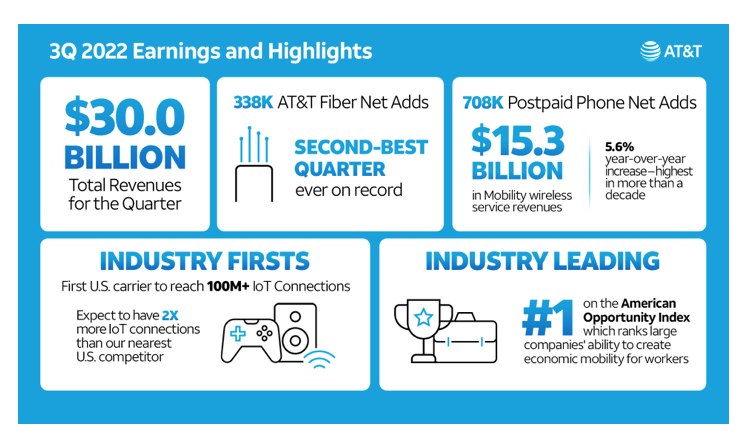
Citing strong, sustained momentum in customer additions across its growing 5G wireless and fiber networks, AT&T reported Q3 2022 revenue of $30.0 billion versus $31.3 billion in the year-ago quarter, down 4.1% reflecting the impact of the U.S. Video separation in July 2021. Excluding the impact of U.S. Video, operating revenues for standalone AT&T were up 3.1%, from $29.1 billion in the year-ago quarter. This increase primarily reflects higher Mobility revenues, and to a lesser extent Consumer Wireline and Mexico, partly offset by lower Business Wireline revenues.

“We’re investing at record levels to enhance our 5G and fiber connectivity and to deliver the best experience available in the market,” said John Stankey, AT&T CEO. “Our results show our strategy is resonating with customers as we continue to see robust levels of postpaid phone net adds and approach 1 million AT&T Fiber net adds for the year."

Some highlights:

  • Communications revenues were $29.1 billion, up 3.2% year over year primarily due to increases in Mobility and, to a lesser extent, Consumer Wireline, which more than offset a decline in Business Wireline.
  • Mobility revenues were up 6.0% year over year to $20.3 billion due to higher service and equipment revenues. Service revenues were $15.3 billion, up 5.6% year over year, primarily driven by subscriber and postpaid ARPU growth
  • Internet of Things (IoT) connections, including wholesale, have now reached more than 100 million.
  • FirstNet connections reached approximately 4 million across more than 23,000 agencies. 
  • Business Wireline revenues were $5.7 billion, down 4.5% year over year due to lower demand for legacy voice and data services and product simplification, partly offset by growth in connectivity services. 
  • 708,000 postpaid phone net adds; 2.2 million-plus through the third quarter, expected to be industry best
  • 338,000 AT&T Fiber net adds, second-best quarter ever; 11 straight quarters with more than 200,000 net adds.

https://about.att.com/story/2022/q3-earnings.html

Tuesday, October 18, 2022

Imagine 5G networks integrated with the Digital World


https://youtu.be/KYjL9fHvJ2Q

From Extended Reality (XR) and the Metaverse to the future of Enterprise connectivity, Jan Söderström walks us through the highlights of Ericsson's Imagine Possible event in Silicon Valley on October 18 and 19, 2022.


Wednesday, September 21, 2022

Napatech to showcase 5G UPF Offload with AMD and Advantech

Napatech will showcase its SmartNIC-based offload solution for 5G User Plane Function (UPF) in collaboration with AMD and Advantech at next week's MWC Americas in Las Vegas.

Unlike in most 4G networks based on purpose-built appliances, the 5G packet core is implemented as virtualized or cloud-native software running on servers located within edge and core data centers. As Communications Service Providers (CSPs) and enterprises scale up the deployments of their 5G networks, they face strong financial pressure to maximize the number of users that can be supported on each server, whether individual subscribers or IoT devices, thereby minimizing the net cost-per-user.

Within 5G packet core software, the subsystem that represents the highest compute workload is the User Plane Function (UPF), which performs critical packet inspection, routing and forwarding functions associated with connecting user and device traffic from the Radio Access Network (RAN) to the Data Network (DN). Since general-purpose server CPUs are not well suited to the performance and latency requirements of real-time packet processing, network operators and 5G core software vendors increasingly adopt solutions for offloading the UPF to accelerator cards which are optimized for executing such workloads.

Napatech addresses the key business challenges around packet core deployments through its new, integrated hardware/software solution that leverages an AMD Xilinx Virtex field programmable gate array (FPGA) to deliver industry-leading UPF performance. The solution comprises a fully-offloaded UPF fast path implemented within Napatech’s Link-Inline software stack, running on an NT200 programmable PCI-Express (PCIe) SmartNIC based on an AMD Virtex UltraScale+ VU9P FPGA. The UPF data path is implemented as a port-to-port inline or “hairpinned” architecture, which ensures that following initial setup all flows are processed on the SmartNIC with no need to pass traffic to and from the server CPU, maximizing the overall performance of the system.

Using a single 200Gbps NT200 SmartNIC to sustain 100Gbps of full duplex traffic, the Napatech UPF Offload solution processes up to 140 million concurrent flows, with a flow learning rate greater than 1.5 million flows per second, achieving a total throughput of up to 85 million packets per second on stateful connections and ensuring full wire speed operation for typical packet sizes. In a representative use case analyzed by the company, the Napatech UPF offload solution enables network operators to support 75x more users per server than with a software-based UPF and 7x more users per server than with a competing ASIC-based SmartNIC.

https://www.napatech.com/media/press-releases/napatech-collaborates-with-amd-and-advantech-to-showcase-5g-upf-offload-solution-at-mwc-americas/

SmartNIC Offload for 5G User Plane Function

 Optimizing the utilization of servers is important to carriers as they look to maximize the ROI for their network infrastructure. In this video, Charlie Ashton, Senior Director of Business Development at Napatech, discusses the business benefits of offloading the 5G user plane function (UPF) to dedicated accelerators like SmartNICs and details Napatech’s UPF offload solution.Download the 2022 SmartNICs and Infrastructure Acceleration Report:...


Wednesday, August 3, 2022

Dell'Oro: Rapid growth for 5G workloads on the public cloud

A new report by Dell'Oro Group predicts that 5G workloads on the public cloud will grow revenues at an 88 percent compounded annual growth rate (CAGR) and cumulative revenues are estimated at $4.6 billion over the 5-year forecast period 2022-2026. The report finds that the vast majority of 5G SA networks will be in the Telco Cloud, limiting the short-term opportunity for the Public Cloud to host 5G workloads.

“At first glance, this may appear to be a very conservative forecast. Especially in view of Hyperscale Cloud Providers’ (HCPs) plethora of press releases that suggest there is greater traction in the marketplace than previously identified. The new report discovers that the opportunity for HCPs to penetrate the Telco Cloud market is very limited in the short-term, with the momentum already established by Mobile Network Operators (MNOs) committing to the Telco Cloud,” stated Dave Bolan, Research Director at Dell’Oro Group. “Most of the HCP press releases are about HCPs adding network solutions for Enterprises that desire 5G device connectivity via a Hybrid Cloud at the edge location. Our projections are for Public Cloud revenues, not Hybrid Clouds at the edge of the networks.

“We found that 27 5G SA networks have been commercially deployed and only one MNO is running its 5G workloads in the Public Cloud. The balance chose to run their own Telco Clouds. Further findings show that another 130 MNOs have already cut contracts with 5G Core vendors to deploy their own Telco Clouds, and two MNOs have committed to run their networks in the Public Cloud.

“As a result, for the short-term, HCPs are focusing on the Enterprise opportunities extending their services to the network edge, either themselves or partnering with an MNO integrating their services inside the Telco Cloud. Longer term there is much more opportunity for the HCPs to host 5G workloads in their Public Clouds with 75 5G Non-Standalone (5G NSA) MNOs and another 600 LTE MNOs still to announce their 5G SA plans. The forecast exits 2026 with a higher year-over-year percentage growth rate for 5G workloads moving to the Public Cloud than for the growth rate of the Telco Cloud,” Bolan added.

https://www.delloro.com/news/public-cloud-5g-workloads-to-grow-at-88-percent-cagr-4-6-billion-over-five-years/

Tuesday, July 19, 2022

Verizon starts rollout of 100 MHz of C-band spectrum

Verizon has started deploying with 100 MHz of C-band spectrum in many markets across the US – a significant increase from the 60 MHz it has deployed in 5G markets to date.

In the recent trial, using 100 MHz of C-band spectrum, engineers were able to reach 1.4 Gbps peak download speeds near active cell sites and 500 Mbps further away from the towers.


Verizon said the rollout is occurring several months earlier than expected due to agreements with satellite providers to clear C-Band spectrum (which was originally scheduled to be cleared in December 2023).  As more spectrum is cleared in the coming months and years, Verizon customers ultimately will have access to between 140-200 MHz of C Band spectrum across the nation.

“This increase from using 60MHz to 100 MHz of C-band – which we will ultimately have available in many markets across the US  – allows us to support more network traffic, deliver even better performance to our customers and add new products and services on top of the mobile and fixed wireless access solutions we provide today,” said Kyle Malady, EVP and President, Global Networks and Technology.  “Reaching new levels of innovation and digital transformation in our society requires a fundamental transformation of the networks our world runs on. The continued evolution of our network is paving the way for this tremendous growth.”

https://www.verizon.com/about/news/verizon-adds-spectrum-faster-speeds-better-performance-greater-availability-5g-uw 

Tuesday, July 5, 2022

Ekinops' SixSq joins 5G-EMERGE

Ekinops has joined SixSq in the 5G-EMERGE project, which aims to develop solutions that leverage 5G technology and satellite broadcasting for media delivery. The project is part of the European Space Agency (ESA) programme of Advanced Research in Telecommunications Systems (ARTES) led by the European Broadcasting Union (EBU).

The 5G-EMERGE project aims at developing an integrated satellite and terrestrial system based on open standards to enable high-quality content distribution services over multi-layer IP infrastructures. Telecommunications satellites will efficiently deliver high-demand content, including streaming of live events, as close as possible to the end user – to the 'edge'. The project includes demonstrations in 5G base stations, users' homes and vehicles.

A consortium of 20 companies from six European countries will collaborate on developing the distributed edge technology and service-delivery features. SixSq's contribution includes leading the demonstration work package and providing the edge-to-cloud software infrastructure based on its Nuvla.io B2B SaaS platform and marketplace of containerised applications, as well as its open source NuvlaEdge software.

SixSq CEO Marc-Elian Bégin said, "leveraging satellite broadcast and 5G is a great opportunity to deliver the right high-density content at the right location with the right customization. However, this requires fine-tuned orchestration of the entire value chain and this is what SixSq edge-to-cloud software provides. We are no stranger to big challenges posed by ESA and EBU and are looking forward to pushing the boundaries of edge-to-cloud, bringing together the space sector, 5G and multi-media content delivery."

"The 5G-Emerge project is yet another example of Ekinops' long commitment towards software innovation as a mean to add value to the telecommunications sector," commented Vincent Munière, Group Chief Technology Officer & VP R&D at Ekinops. "We are looking forward to helping set the bar in 5G services and content delivery."

http://www.ekinops.com/ 

https://sixsq.com


Thursday, December 9, 2021

Video: How TIP's Private Mobile Framework can Transform 5G Use Cases

https://youtu.be/BNNCm7gQaug

In this engineering discussion, David Martín Lambás, Senior Manager – Connectivity Innovation at Telefónica & Chair of TIP’s 5G Private Networks Solution Group and Sriram Subramanian, Global System Integrator Ecosystem Manager at Facebook & Technical Lead of TIP’s 5G Private Networks Solution Group, discuss how TIP’s diverse set of ecosystem partners provide an immersive end-to-end user experience for private network deployments.

Tuesday, November 16, 2021

DISH Wireless and Cisco target 5G enterprise services

DISH Wireless and Cisco announced a strategic agreement focused on enterprise 5G services in the United States. Some highlights:

  • Go-to-market strategy: DISH will participate in Cisco’s Reseller and Managed Services Program
  • Deployment of an intelligent transport network: Cisco is helping to plan, design and deliver an open, cloud-based network that will predict, self-heal and self-optimize with closed-loop automation for transport network slicing. 
  • Co-innovation on virtual routing:  DISH’s 5G network will be powered with fully automated Cisco XRv9K virtualized routers running on AWS, along with virtual Cell Site Routers (vCSR) at the tower. 
  • New operational models: Cisco is helping DISH build out a lean, world-class DevOps organization that drives automation and improves operational efficiency leading to faster time-to-market with new services, speed to revenue and return on investments. Key outcomes are CI/CD testing and zero-touch onboarding to enable DISH to quickly go from development to pre-production, as well as staging and testing directly to production. 
  • Technology:  Cisco will support DISH with the following: IOS-XR operating system for 5G, backhaul and fronthaul transport via Cisco NCS series routers, segment routing for automated traffic management and network slicing, Nexus 9000 series with an Application Centric Infrastructure (ACI) fabric for data center switching, and Cisco Crosswork Network Controller as the transport domain controller including automated service provisioning and assurance.  

“Cisco and DISH are disrupting the mobile and enterprise markets by launching cloud-powered 5G services in record time through innovative technologies, fostering new application development and improving the overall customer experience,” said Chuck Robbins, Chairman and CEO, Cisco. “Together, we look forward to helping businesses across industries transform their networks to support the evolution of hybrid work models, the transition to Network as a Service (NaaS) offers, and the expansion into new markets including IoT.”

“DISH has compiled an outstanding roster of partners in the wireless industry, and Cisco is a key player helping us launch a customizable, automated, 5G network optimized for enterprise performance,” said Charlie Ergen, Chairman, DISH. “Working with Cisco is central to achieving our goal of delivering a best-in-class experience for enterprises. Our ability to continually drive value and enhance capabilities for our customers is a key differentiator for DISH and positions us to disrupt the industry with more innovation, speed, agility and security.”


Monday, October 25, 2021

Ericsson releases Time-Critical Communication toolbox for 5G

Ericsson is releasing a new Time-Critical Communication software toolbox for resolving lags and interruptions in mobile networks. It combines the 3GPP-specified ultra-reliable, low latency communication (URLLC) standard with Ericsson innovations to mitigate major causes of latency. 

Ericsson said its new software product delivers consistent low latency (50ms to 1ms) end to-end at specified guarantee levels (99.9 percent to 99.999 percent) – enabling time-critical use cases at scale.

Per Narvinger, Head of Product Area Networks, says: “Ericsson continues to introduce innovative 5G solutions that fuel the global uptake of 5G. Now we are taking 5G to the next level with Time-Critical Communication, a solution that will give our customers the tools to expand their offerings for the consumer, enterprise, and public sectors and further monetize 5G effectively.”

Ericsson notes that it has been piloting 5G for time-critical use cases with customers and industry partners such as BT and Hyperbat, Einride and Telia, Boliden, ABB, Audi, Fraunhofer IPT, DT and Rockwell.


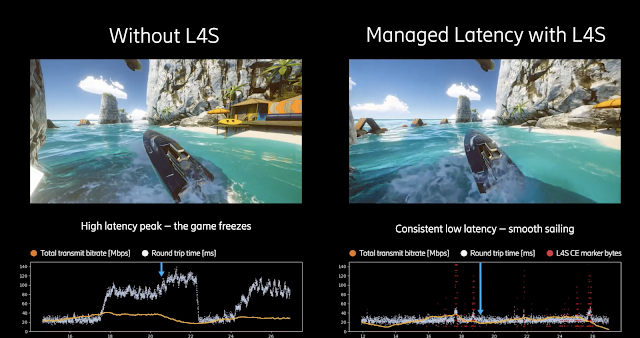
Ericsson recently partnered with Deutsche Telekom and Telstra to show the benefits of L4S (Low Latency Low Loss Scalable throughput) technology in reducing lag in an interactive cloud game. L4S is one of the new features in the Time-Critical Communication toolbox. Ericsson has also reached a new milestone with MediaTek by proving that 5G can deliver 1ms consistent low latency with 99.99 percent reliability in both uplink and downlink on mmWave band.

Tomohiro Sekiwa, Managing Executive Officer and Chief Network Officer, SoftBank, says: “We believe that Time-Critical Communication is key to realizing the full potential of 5G. One industry where this solution can play a transformative role is automotive and transportation. With reliable and consistent low latency connectivity, 5G can also vastly improve public health and safety, traffic efficiency, and make transportation more sustainable.”

https://www.ericsson.com/en/internet-of-things/iot-connectivity/cellular-iot/time-critical-communication

Monday, June 21, 2021

Intel cites continued momentum in 5G vRAN and edge

In a virtual event ahead of Mobile World Congress, Intel showcased a number of foundational technologies and products that position the company for continued leadership in 5G virtual radio access network (vRAN) and edge deployments. This includes the following product announcements:

  • Intel Agilex FPGA family is expanding, with a new FPGA with integrated cryptography acceleration that can support MACSec in 5G applications. This adds another layer of security to vRAN at the fronthaul, midhaul and backhaul levels.
  • Intel Ethernet 800 Series family is expanding, with Intel’s first SyncE capable Ethernet Adapter that is designed for space-constrained systems on the edge, and well-suited for both high-bandwidth 4G and 5G RAN as well as other time- and latency-sensitive applications in sectors such as industrial, financial and energy.

In addition, Intel Smart Edge, which consists of two software offerings for the multi-access edge computing layer, will now have a unified architecture and codebase to help customers onboard and manage edge applications and network functions.  Intel Smart Edge is commercial software focused on enterprise on-premise use cases, such as private networks and universal Customer Premise equipment. The evolved and enhanced Intel Smart Edge Open (formerly known as OpenNESS) is an open software toolkit that enables developers to build highly optimized and performant edge platforms.


The virtual event also highlighted key partnerships for Intel, including:

  • Reliance Jio announced it will do co-innovations with Intel in 5G radio and wireless core, and collaborate in other associate areas that include AI, cloud and edge computing, which will help it as they deploy 5G.
  • Deutsche Telekom is using Intel FlexRAN technology with accelerators in O-RAN Town, in the O-RAN network it is deploying in Neubrandenburg, Germany — a city of 65,000 people spread out over 33 square miles. The company is relying on Intel as a technology partner as it delivers high-performance RAN at scale.
  • DISH Wireless relies on Intel’s contributions to the 5G ecosystem as it builds out the first cloud-native 5G network in the United States. The launch in its first city, Las Vegas, as well as its nationwide network, will be deployed on infrastructure powered by Intel technology in the network core, access and edge.
  • Cohere is pioneering a new approach to improve spectrum utilization by leveraging capabilities in FlexRAN. It is integrating and optimizing spectrum multiplier software in the RAN intelligent controller. Cohere’s testing shows its Delay Doppler spatial multiplexing technology is improving channel estimation and delivering up to a two-times improvement in spectrum utilization for operators. That’s what Vodafone has seen in 700Mhz testing in its labs.

“Network transformation is critical to unleash the possibilities of 5G and maximize the rise of the edge to create new and better business outcomes for our customers across the globe. As the leading network silicon provider, we have been driving this shift to virtualizing the core to access to edge, and implementing edge computing capabilities with our decade of experience, to power our society’s digital revolution”, said Dan Rodriguez, Intel corporate vice president, Network Platforms Group.

Monday, May 31, 2021

Ericsson and DT propose a 5G rate adaptation mechanism

Ericsson and Deutsche Telekom published a joint whitepaper that describes a concept for rate adaptation in 5G networks based on Low Latency Low Loss Scalable throughput (L4S), a mechanism being standardized in IETF (Internet Engineering Task Force). 

The overall objective is to enable a large scale of time-critical high data rate applications over 5G mobile networks and the companies believe a common feedback loop mechanism is required for fast rate adaptation.


https://www.telekom.com/en/company/details/enabling-time-critical-applications-over-5g-with-rate-adaptation-628058

Sunday, May 16, 2021

DISH Wireless picks Oracle for 5G core

DISH Wireless has selected Oracle to enable a Service-Based Architecture (SBA) for its 5G core.

This will enable DISH Wireless to provide enterprise customers added control of the software and services they utilize, taking advantage of network slices.

“Oracle’s capabilities will essentially serve as the control tower of our network core, enabling our customers to consume software on demand and facilitating the advanced core functions required to power a truly automated network,” said Marc Rouanne, chief network officer, DISH Wireless. “While many carriers may claim to have 5G, there are certain attributes only possible with a cloud-based standalone network, and our working with Oracle will yield results that will unleash the power of true, fully-optimized 5G.”

Oracle’s 5G core control plane , which is aligned with the Cloud Native Computing Foundation (CNCF), includes network functions that will help operators automate and scale to meet the expected growth in 5G subscribers and connected devices. DISH Wireless will be using a number of network functions from Oracle including:

  • Policy Control Function (PCF): dynamically routes low-latency applications to edge data networks, while simultaneously considering network data analytics and slice information to provide optimized policies minimizing network resource utilization while maximizing quality of experience.
  • Network Repository Function (NRF): serves as a central repository for all of the network functions in DISH’s 5G network, along with the services provided by each of these elements.
  • Network Exposure Function (NEF): acts as a centralized point for service exposure and plays a key role in authorizing all access requests originating from outside the DISH network to enable Cellular IoT, non-IoT, edge computing and API gateway use cases for DISH and its enterprise customers.
  • Additionally, DISH will utilize Oracle for 5G Service Communications Proxy (SCP), Network Slice Selection Function (NSSF), Security Edge Protection Proxy (SEPP) and Binding Selection Function (BSF).

“DISH Wireless is completely disrupting the wireless industry,” said Andrew Morawski, senior vice president and general manager, Oracle Communications, Networks. “Using Oracle’s 5G cloud-native technology to automate their network, DISH will be one of the most agile operators in the world enabling enterprise digital transformation journeys across many diverse industries.”

https://www.oracle.com/news/announcement/dish-wireless-selects-oracle-for-5g-core-service-based-architecture-2021-05-14/

Monday, May 10, 2021

Verizon tests carrier aggregation of C-Band + mmWave

Verizon achieved speeds of 4.3 Gbps in a trial of carrier aggregation using its newly acquired national footprint of C-band spectrum and its existing mmWave spectrum. 

The lab trial aggregated 100 MHz of C-band spectrum together with 600 MHz of mmWave spectrum to provide greater efficiency for data sessions transmitting over the wireless network. The basebands and radios used were from Ericsson’s industry-leading Ericsson Radio System portfolio including the RAN Compute Baseband 6648, Antenna-Integrated Radio (AIR) 6449 for the C-band spectrum, and the Streetmacro 6701 for mmWave. The radios leverage massive Multiple Input Multiple Output (MIMO) architectures. The device used in this lab trial was a pre-market test device based on MediaTek’s M80 modem, which combines mmWave and sub-6 GHz 5G technologies onto a single chip.


“The depth of our spectrum portfolio, now the strongest in the industry, allows us to quickly expand access to a world-class 5G experience for our mobile and fixed broadband customers, providing high speeds, low latencies and enormous capacity,” said Adam Koeppe, Senior Vice President of Technology Planning at Verizon. “These lab trials demonstrate the exceptional network performance our customers will receive as we are able to integrate our newly acquired C-band spectrum with mmWave spectrum.” 

The trial follows the recent announcement of new agreements with Verizon’s tower partners, Crown and SBA Communications, which provide for process improvements including standardizing and reducing forms and minimizing legal reviews. Additionally, Verizon has already started installation of C-band equipment from Ericsson and Samsung Electronics Co., Ltd to speed deployment of its 5G Ultra Wideband and fixed wireless broadband service. These combined efforts, along with ongoing lab trials to optimize 5G technology on C-band spectrum will allow Verizon to offer expanded mobility and broadband services to millions more consumers and businesses as soon as the spectrum is cleared. 

In the first quarter of 2022, Verizon expects to put into service the new 5G C-band spectrum in the initial 46 markets and to provide 5G Ultra Wideband service to 100 million people. Over 2022 and 2023, coverage is expected to increase to more than 175 million people and by 2024 and beyond, when the remaining C-band spectrum is cleared, more than 250 million people are expected to have access to Verizon’s 5G Ultra Wideband service on C-band spectrum.


Wednesday, April 7, 2021

T-Mobile U.S. launches 4G/5G Home Internet service

T-Mobile U.S. officially launched its wireless Home Internet service with coverage to more than 30 million households, making T-Mobile one of the largest broadband providers in the entire country by service area — on its first day of service. 

Nearly 10 million of the households eligible for T-Mobile Home Internet are in rural areas where often there is only one other broadband provider or none at all.

T-Mobile Home Internet access runs over the carrier's 4G and 5G network. Monthly service is priced at $60 with no data cap. T-Mobile says most users should experience download speeds of 100 Mbps. Availability is based on network capacity, which is increasing all the time, as well as Wi-Fi Gateway inventory, which is limited by global supply chain constraints at launch. 

https://www.t-mobile.com/isp

DISH picks Allot to protect its OpenRAN-based 5G network

DISH Network has selected Allot Ltd. to provide end-to-end User Plane Protection (UPP) against DDoS and botnet attacks for its forthcoming cloud-native, OpenRAN-based 5G network. 

In addition, DISH will partner with Allot to provide cybersecurity threat protection services for its consumer, MVNO and SMB customers. This protection will cover DISH’s 5G network and off-network activities against cyberattacks such as malware, viruses, ransomware and phishing attacks.

“We are thrilled that DISH chose to partner with Allot to help secure its innovative 5G network,” said Erez Antebi, CEO, Allot. “With a distributed core architecture, DISH’s 5G network will be able to rapidly respond and adapt to ever-evolving cybersecurity threats. We look forward to supporting DISH’s deployment of the most secure, open 5G network.”

“DISH is deploying a first-of-its-kind, standalone 5G network that is free from the security limitations of traditional 2G, 3G and 4G technologies,” said Marc Rouanne, Chief Network Officer, DISH. “As we develop our 5G network from the ground up, we need security partners to become ingrained in our network and secure us against attack well before a threat occurs. Allot brings the capabilities we need with solutions designed to protect our network and its customers from a wide range of cyberattacks.”


Tuesday, April 6, 2021

T-Mobile and Lumen partner on 5G + Edge Computing

T-Mobile U.S. and Lumen Technologies agreed to expand their existing relationship to allow access to Lumen's Edge Computing platform over T-Mobile's 5G network, enabling enterprises to build, manage and scale applications across distributed environments. As part of this collaboration, T-Mobile will also become a preferred wireless connectivity partner for Lumen.

“By pairing America’s largest and fastest 5G network with Lumen’s enterprise solutions, we can break down industry barriers and deliver unparalleled network reach to enterprise and government organizations looking to optimize their applications across networks,” said Mike Katz, EVP of T-Mobile for Business. “With our leading 5G network, Lumen and T-Mobile have the opportunity to accelerate business innovation in an era where the network is more critical than ever.”


Thursday, March 18, 2021

AT&T awards 5-year contract to Nokia for 5G C-band rollout

AT&T has awarded a five-year contract to Nokia to deploy the mobile operator’s C-Band network in parts of the U.S. Financial terms were not disclosed.

Nokia’s C-Band portfolio includes support for both 5G standalone (SA) networks and non-standalone (NSA) networks, cloud-based implementations and Open RAN products, providing AT&T with flexibility for its 5G deployment. Nokia’s C-Band RAN technology will interwork with existing Nokia LTE RAN equipment deployed by AT&T for a powerful user experience. 

Igal Elbaz, Senior Vice President of Wireless and Access Technology AT&T said: “AT&T is committed to bringing the power of 5G to businesses and communities across the nation, and our C-Band deployments with Nokia will help add 5G capacity where it’s needed. Nokia has been our trusted collaborator for more than 20 years as we’ve rolled out each generation of wireless technology, and its C-Band portfolio brings the right capabilities to help enable AT&T to deliver an exciting and powerful 5G experience that our subscribers have come to expect from us.”

Ed Cholerton, President of Nokia North America, said: “Nokia is ready to support the launch of 5G services into this valuable new spectrum on our customers’ timelines by leveraging our powerful portfolio of C-Band solutions and by being the first to demonstrate a live C-Band network in the U.S. in 2020. Our flexible and comprehensive portfolio will enable AT&T to enhance its 5G services in areas across the nation.”

https://www.nokia.com/about-us/news/releases/2021/03/18/nokia-supports-5g-for-att-customers-with-five-year-c-band-deal/

Sunday, February 28, 2021

Europe's 5G Infrastructure Association opens memberships

The 5G Infrastructure Association, as the industrial partner of the 5G PPP, has extended an invitation to all organisations and enterprises to join the new "Smart Networks and Services" (SNS) European Partnership in the framework of the Horizon Europe programme.

Within the SNS, the 5G IA will be the private side representative, jointly managing the Partnership with the EU. The SNS Partnership aims to support European technological sovereignty on Smart Networks and Services. It will contribute to enable the digital and green transitions and will allow European players to develop the technology capacities for 6G systems as the basis for future digital services towards 2030. 

https://5g-ia.eu

Tuesday, February 9, 2021

Qualcomm's Snapdragon X65 modem boasts 10Gbps peak throughput

Qualcomm has begun sampling its fourth-generation, the Snapdragon X65 5G Modem-RF System, the first 5G modem-to-antenna solution to support 10 Gigabit 5G.  and the first modem-RF system, which is currently sampling to OEMs and targeting commercial device launches in 2021. 

The Snapdragon X65 supports 3GPP release 16. Commercial device launches are anticipated later this year.

Qualcomm describes the Snapdragon X65 as its biggest leap in 5G solutions since the commercialization of its first modem-RF system. In addition to the Snapdragon X65, Qualcomm Technologies also announced the Snapdragon X62 5G Modem-RF System, a modem-to-antenna solution optimized for mainstream adoption of mobile broadband applications. The modem offers spectrum aggregation across all key 5G bands and combinations, including mmWave and sub-6, using frequency division duplex (FDD) and time division duplex (TDD), providing operators ultimate flexibility in the use of fragmented 5G spectrum assets. It also features new power-saving technologies defined in 3GPP Release 16, such as Connected-Mode Wake-Up Signal.

Qualcomm is also introducing a modem-to-antenna system awareness capability to increase upload data speeds and enhance coverage for both mmWave and Sub-6 GHz bands while continuing to meet RF emissions requirements.

“The 5G transition presents the biggest opportunity for Qualcomm as mobile technology is poised to benefit virtually every industry,” said Cristiano Amon, president and CEO-elect, Qualcomm Incorporated. “We are reaching a significant milestone with the Snapdragon X65 5G Modem-RF System, unleashing connectivity up to 10 Gigabits per second and support for the latest 5G specifications that will play a critical role in enabling new 5G use cases not only for redefined premium smartphone experiences, but also opening a new realm of possibilities for 5G expansion across mobile broadband, compute, XR, industrial IoT, 5G private networks and fixed wireless access.”


https://www.qualcomm.com/news/releases/2021/02/09/qualcomm-announces-worlds-first-10-gigabit-5g-modem-rf-system