Showing posts with label Automation. Show all posts

Tuesday, November 29, 2022

Indonet deploys Juniper Apstra for network automation

PT IndoInternetTbk (Indonet), an Indonesian digital infrastructure provider, has selected Juniper Apstra to help automate, modernize and facilitate an experience-first expansion of its network infrastructure. Through managed automated network provisioning and monitoring, Apstra has already delivered Indonet an estimated 20% in cost-savings efficiency.

Indonet utilized Apstra to validate the design, deployment and operation of the EVPN/VXLAN overlay and IP fabric underlay of its latest data center, both built on Juniper QFX Series Switches. The use of validated templates and zero-touch provisioning has resulted in reduced deployment times and reliable data center operations, allowing Indonet to significantly streamline the day-to-day management of its data center networks and unify them in a virtual environment seamlessly.

“Juniper Networks is excited to partner with and grow Indonet’s network as they build out a simplified, reliable and efficient infrastructure across Indonesia. Apstra has greatly facilitated the automation and expansion across their data center networks and we look forward to continuing our journey together as they transform into a modern digital infrastructure provider, further fueling Indonesia’s growth momentum," said Perry Sui, Senior Director, ASEAN & Taiwan, Juniper Networks.

https://newsroom.juniper.net/news/news-details/2022/Indonet-Partners-with-Juniper-Networks-for-Intent-Based-Networking-Software-to-Automate-and-Modernize-Network-Deployment/default.aspx

Juniper extends Apstra software to the edge

Juniper Networks is extending its Apstra software platform to edge data centers with collapsed fabric topologies. The latest release of Apstra software also enables tighter Zero Trust security with new policy assurance and Role-Based Access Control (RBAC) capabilities, as well as simplified migration from legacy data centers with new Apstra professional services.Specifically, the latest version of Apstra provides policy assurance to enable granular...


Thursday, October 13, 2022

Blueprint: The Automation Imperative in 5G Transport Deployments

 by Sally Bament, Vice President, Cloud & Service Provider Marketing, Juniper Networks

5G is poised to make an enormous impact on the global economy, and organizations that can successfully exploit its speed, bandwidth and ultra-low latency have an opportunity to lead their market by delivering new and innovative services. In addition to the highly advertised enhancements of mobile telecommunications for consumers, 5G will be an important play in numerous other vertical markets, all of which represent attractive business opportunities.

For example, handling the volume of data generated by IoT sensors in logistics applications – transportation, warehousing, retail distribution and the like – will require bandwidth that only 5G can provide. 5G speed and low latency will take robotics (and productivity) to new levels on the factory floor. In homes, 5G will elevate immersive gaming and enable virtual reality. These are just a few examples of a market that is projected to reach $1,271 billion by 2025.

To participate in this growth, companies will need to evolve the way they plan, deploy, architect and optimize their transport networks, and this will involve a much higher degree of automation than now exists. Currently, 75% of networking activities[i] are manual, and 85% of CSPs[ii] still use manual or semi-manual processes to manage their network service lifecycle. Handling the increased scale and complexity of a 5G network with this level of manual intervention will not be sustainable. Fortunately, sophisticated, field-proven automation solutions are available to support the transition to 5G from initial deployment to long-term operation.

Eliminate Manual Tasks

Both the familiar mobile consumer services and emerging enterprises rely on edge computing to process the massive amounts of data more efficiently and cost-effectively. Such architectures can involve onboarding hundreds or even thousands of geographically dispersed mini data centers, including those incorporated within cell sites.

It’s hard to imagine deploying those modern distributed architectures manually with onsite engineers, but it’s viable with automation. The process begins with a template that can easily be replicated wherever a new point of presence is required. Templates enable a much faster turn-up process, plus a level of consistency throughout the network that translates into higher reliability and speed. One Tier 1 network provider’s manual cell-site activation process had more than 50 manual steps that took a minimum of 26 hours to set up. By switching to an automated process, the company reduced the activation time to two hours.

While reducing or eliminating manual tasks is often cited as the primary benefit of automation, it is by no means the only one. Automation also plays a vital role in onboarding devices and customers quickly, maintaining optimal network performance, maximizing utilization, accelerating problem identification, automation remediation, improving security and meeting service-level agreements (SLAs).

Measure what matters

Making automation work demands first and foremost a new attitude towards network quality data. In simple terms, instead of focusing on the health of the various elements involved in the end-to-end service delivery chain, operators need to measure what matters most: service quality and end user experience. This can now be achieved easily with active assurance which leverage virtual agents sending synthetic transactions directly on the data plane. Am I delivering the service quality characteristics purchased by my customers? If not, where are the performance degradations in the service delivery chain and what should I do to fix the problem? In a 5G network these are very complex questions, as different slices may need to support diverse services, each with specific requirements, such as an IoT application with a large number of low-throughput devices vs. an MBB where there are fewer devices, but each is transmitting or receiving high bandwidth content. With active assurance continually measuring real service quality, automated systems can make adjustments to routing and bandwidth requirements to optimize performance in real time with no need for human intervention. 

The ultimate goal of any network is to deliver the best possible experience for the user. To do so in a highly complex 5G deployment, automation is no longer a “nice to have” capability. It’s a “must have.” For example, automation can play an important role in the identification and remediation of incidents that affect the user experience. Currently, 60% of network problems are not discovered by NetOps, but by others, notably the users themselves. This is not acceptable, and underlines the fact that manually responding to every incident is no longer a viable option.

Deploy automation one use case at a time 

Although the need for automation is well understood, implementing it is still seen as a daunting task by many organizations. According to a survey conducted by Heavy Reading, 40% of CSPs believe that using a generic automation framework is the first barrier to adopting automation in their transport networks. This is not a necessary first step. The best approach to automation is to apply it to one business problem at a time. Working through a single implementation to a successful conclusion will provide lessons that will help future implementations go smoothly, and will also generate enthusiasm and build momentum for automation within the organization. SaaS-based automation for device onboarding is one good place to start.

Intent-Based Networking

Ultimately, the value of automation is that it enables operators to build intent-based networks. By shifting the focus towards “what to do” as opposed to “how to do it,” intent-based networking increases agility and lets operators respond more rapidly to business needs.

In summary, the arrival of 5G opens up a whole new realm of business opportunities, but success demands new ways of looking at network management.

[i] Gartner®, Market Guide for Network Automation Tools, Andrew Lerner, Ted Corbet, February 22, 2022

[ii] Omdia, Survey of 92 Communication Service Providers, September 2020


Monday, August 1, 2022

Video: Automation is the path to cloud-native network solutions

https://youtu.be/fbtvmPvQO0Q

Automation is key to enabling services across a global ecosystem of Service Providers, says Franck Morales, Vice President, Evolution Platform, Orange Business Services, and Director of MEF.

Here is a perspective on how this automation is developing within MEF and across the industry.

Wednesday, July 6, 2022

Swimlane raises $70 million for security automation

Swimlane, a start-up based near Boulder, Colorado, announced $70 million in new funding for its low-code security automation solutions.

Swimlane unifies security operations in-and-beyond the SOC into a single system of record that helps overcome process and data fatigue, chronic staffing shortages, and quantifying business value. The Swimlane Turbine platform combines human and machine data into actionable intelligence for security leaders.

The recent funding round led by Activate Capital and joined by existing investors Energy Impact Partners (EIP) and 3Lines Venture Capital .

“We are very proud of the global traction and results we have achieved,” said James Brear, CEO of Swimlane. “Besides our hyper revenue growth, we have achieved over 120% of net retention and product expansion. Our cloud product has seen a 5X increase in adoption over 2021 and our growth over the last four years is over 700%. This is a testament to our customer-first mindset and meeting all the use case requirements our customers demand.”

http://www.swimlane.com

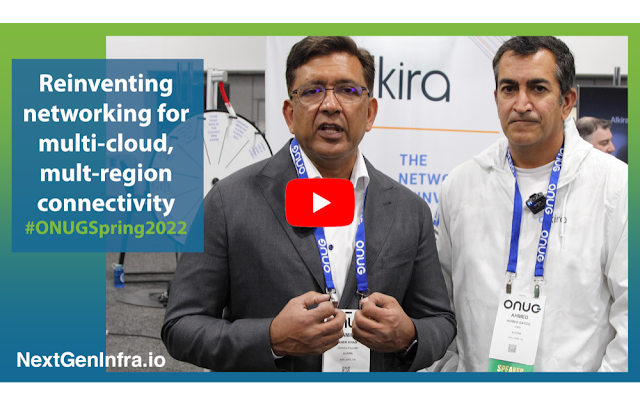
Reinventing networking for multi-cloud, multi-region connectivity

https://youtu.be/kX3L9hQ-ceUAlkira's Amir Khan and Ahmed Datoo discuss the need for better enterprise networking solutions in the era of distributed applications residing in multiple clouds and regions.Four areas of challenge: (1) Geographic expansion of the network footprint (2) Connecting applications to the cloud (3) for customers already in the cloud, there is the challenge of expanding into multiple regions in the same cloud (4) for customer...

Hyper Automation of Enterprise Networks

https://youtu.be/VtN0YiGuIcoEnterprises really must ask themselves whether they are up for the challenge of automating workloads across their hybrid cloud environments, or whether a purpose-built automation framework could more easily optimize their operations. Jeff Gray, Co-founder and CEO of Gluware, says that for most companies it makes more sense to bring in a vendor capable of abstracting all of the disparate platforms into a cohesive layer...

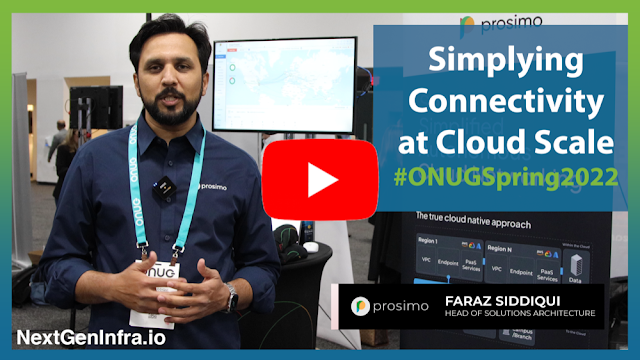
Video: Simplifying Connectivity at Cloud Scale - Prosimo

https://youtu.be/oT6fNlB1Kj4Enterprises, including major financial institutions, have been struggling to provide connectivity at cloud scale for all of their application workloads, says Faraz Siddiqui, Head of Solutions Architecture, Prosimo.Filmed at ONUG Spring 2022.https://prosimo.ioWho is Prosimo? CTO presentationTuesday, April 06, 2021  Prosimo, SD-WAN, Start-Ups  https://youtu.be/58YMebmBJwMProsimo, a start-up...


Saturday, June 11, 2022

Hyper Automation of Enterprise Networks


https://youtu.be/VtN0YiGuIco

Enterprises really must ask themselves whether they are up for the challenge of automating workloads across their hybrid cloud environments, or whether a purpose-built automation framework could more easily optimize their operations. Jeff Gray, Co-founder and CEO of Gluware, says that for most companies it makes more sense to bring in a vendor capable of abstracting all of the disparate platforms into a cohesive layer of automation.

Filmed at #ONUGSpring2022

Wednesday, December 8, 2021

Red Hat brings Ansible Automation to Microsoft Azure

Red Hat is bringing its Ansible Automation Platform to Microsoft Azure. It builds on Red Hat’s standard for hybrid cloud automation that has been refined for the evolving realities of computing at hybrid cloud scale. 

Red Hat said Ansible Automation Platform on Azure enables enterprise IT teams to achieve greater scale, speed and standardization with automation practices for their hybrid cloud. This helps to remove the infrastructure maintenance and operational burden from IT teams, enabling them to focus purely on delivering automation strategies for a more efficient, flexible and scalable business.

The latest version of Ansible Automation Platform added self-contained automation capabilities to deploy at massive scale across hybrid clouds and edge environments, while shifting automation more deeply into the application development lifecycle. Its flexible foundation, tools, services and capabilities offer a whole new level of customization and control that expands the boundaries of what is possible for enterprises.

https://www.redhat.com/en/technologies/management/ansible

Wednesday, October 6, 2021

Nokia: network automation delivers 65% OPEX cost avoidance

Operators can expect up to a 65% cost avoidance after implementing IP network automation according to Nokia based on a study performed by research firm Analysys Mason.

The study focused on network automation implemented for the operator’s service fulfilment, network lifecycle management, and network and service assurance processes with the Nokia NSP, a domain controller for multivendor IP, optical and microwave networks.

Analysys Mason interviewed a group of global operators on their network automation strategies and results, collecting more than 60 data points. Analysys Mason then extrapolated the quantified benefits that can be expected from automating IP networks.  Analysys Mason found cost avoidance at the domain controller is the result of multiple factors:

  • Process automation reduces the labor time requirement for manual workloads by up to 68%.
  • Consequently, the time needed to roll out new services is reduced by up to 88%.
  • Less manual tasks also means less human errors and higher predictability. The use of a standardized scenarios reduces the frequency of order fallout and issues that require manual correction. Overall, the time spent to process errors is reduced by up to 85%.
  • Automating alarm correlation and root cause analysis offers a significant improvement to the mean time to repair (MTTR) – up to 71%.

Larry Goldman, Chief Analyst and Project Director, Analysys Mason, said: “Our study shows clear benefits at the domain layer, and we highly recommend operators automate network management processes for their IP services. Network automation will be critical to enable future network slicing-based business models. Operators should also look for a network automation platform such as the Nokia NSP to reap the benefits of automation and ensure the efficient and automated management and control of network slice-based services.”

https://www.nokia.com/about-us/news/releases/2021/10/05/nokia-study-finds-operators-can-avoid-65-of-operational-costs-with-ip-network-automation/

Tuesday, July 13, 2021

Red Hat's Kubernetes integrates with Ansible automation

Red Hat announced a new version of its enterprise-grade Kubernetes management offering with new capabilities for managing and scaling hybrid and multicloud environments in a unified and automated way. 

Red Hat Advanced Cluster Management for Kubernetes 2.3 brings integration with the Red Hat Ansible Automation Platform and Red Hat Advanced Cluster Management for a more modern, hybrid cloud-ready environment.


Red Hat Advanced Cluster Management can now automatically trigger Ansible Playbooks before or after key lifecycle actions such as application and cluster creation, making it easier to automate tasks like configuring networking, connecting applications to databases, constructing load balancers and firewalls, and updating IT service management (ITSM) ticketing systems. With a Resource Operator for Red Hat Advanced Cluster Management, building on the Kubernetes Operator-based foundation of Red Hat OpenShift to encapsulate complex operational knowledge into code, Advanced Cluster Management can call on Ansible Automation Platform to execute tasks more efficiently outside of the Kubernetes cluster. The result is a single, automated workflow for customers to operationalize Red Hat OpenShift environments alongside traditional IT systems.

The Red Hat Advanced Cluster Management 2.3 also includes additional support for importing managed Kubernetes clusters for Red Hat OpenShift on AWS (ROSA), as well as OpenShift clusters on IBM Power Systems. This builds on supported managed Kubernetes clusters for Red Hat OpenShift on IBM Cloud (ROKS), Microsoft Azure Red Hat OpenShift (ARO), Red Hat OpenShift Dedicated (OSD) and IBM system Z. It also supports provisioning on-premises Red Hat OpenShift clusters on Red Hat OpenStack directly from Red Hat Advanced Cluster Management.

“Cloud-native applications and services are not an island. We need to meet organizations where they are to bridge the divide between traditional IT infrastructure and cloud-native development, so that IT teams can focus on innovation rather than trying to get disparate technologies to work together. Red Hat is uniquely positioned to bring these capabilities together through a GitOps-based approach, helping to accelerate and scale modernization. Now, customers can automate the full stack from start to finish, from the cluster to the policy and governance to the application deployment, helping to eliminate silos and further organization-wide hybrid cloud strategies,” states Dave Lindquist, general manager and vice president, Software Engineering, Advanced Kubernetes Management, Red Hat.


Wednesday, April 7, 2021

Arista enhances its CloudVision with automation

Arista introduced its CloudVision 2021 software platform with new automation capabilities designed to improve network agility and streamline enterprise business outcomes.

Arista describes CloudVision as a multi-domain management plane that brings cloud network operations to enterprise customers through a network-wide suite of automation, telemetry, and analytics, bringing consistency across data center, campus wired and wireless, and public cloud use cases. 


CloudVision’s existing network configuration management approach delivers streamlined network provisioning through a centralized ‘configlet’ model that leverages configuration inheritance and reuse principles. Building on this, Arista introduces CloudVision Studios: new capabilities for automating configuration workflows within CloudVision and providing a flexible abstraction between the business and the underlying network.

CloudVision 2021 cognitive capabilities include:

  • New network latency and path selection dashboards - CloudVision can now receive Inband Network Telemetry (INT) data, a standards-based capability for exporting latency and path telemetry and is now available across a suite of Arista’s latest switching platforms. CloudVision then provides the operator with views of network congestion hotspots with an unmatched level of granularity, providing visibility that helps to root-cause network performance problems across campus and data center networks.
  • Quality of Experience (QoE) Dashboard - In addition to video collaboration tools such as Zoom and Microsoft Teams, CloudVision now supports QoE monitoring for up to 25 applications, including Office 365, Google Workspace, Workday, Salesforce, and other enterprise application suites.
  • A Performance Dashboard utilizing a Root Cause Analysis (RCA) Engine to deliver client-specific views on the end user experience, including application, radio frequency interference, network, and client-specific analytics such as DNS and DHCP state to provide a unified view of the end user experience and automated remedial action recommendations.
  • CloudVision’s Radio Frequency (RF) Explorer delivers in-depth, live and historical views across the entire WiFi RF spectrum, delivering a comprehensive tool for monitoring, managing, and proactively troubleshooting RF-related issues.
  • A suite of additional enhancements, including new dashboards for customizable infrastructure views, an updated events app, additions to the continuous compliance app for expert insights and product lifecycle tracking, and integrations with the Arista TAC knowledge base.

The new CloudVision 2021 feature sets are in customer trials now and will be generally available in Q2 2021.

Wednesday, February 24, 2021

Juniper integrates Mist AI with SD-WAN and Secure Branch Gateway

Less than 2 months after completing its acquisition of 128 Technology, Juniper announced several new products integrate 128 Technology and further its vision of end-to-end AI-driven automation, insights and actions from client-to-cloud. The releases combine Mist AI with 128 Technology’s Session Smart SD-WAN technology to deliver integrated AIOps, security and troubleshooting across the WLAN, LAN and WAN. 

  • The latest additions to Juniper’s AI-driven enterprise include:

    • WAN Assurance and Marvis™ Virtual Network Assistant (VNA) for Session Smart SD-WAN. Ingesting telemetry data from Session Smart Routers into the Mist AI engine enables customers to set, monitor and enforce service levels across the WAN, proactively detect anomalies and gain enhanced insight into WAN conditions to assure optimal user experiences.

    • Enhanced SRX operations driven by Mist AI. The SRX Series of secure branch gateways can now be onboarded and configured using Mist AI and the cloud. With zero touch provisioning (ZTP) and automated workflows, Juniper simplifies deployment of these devices.
    • New EX4400 secure access switch. The latest addition to the EX Series portfolio is optimized for the cloud with best-in-class security and AIOps.

    “Juniper is consistently recognized for our experience-first approach to networking, where AI-driven automation, insight and actions simplify operator experiences and optimize end-user experiences from client-to-cloud,” said Jeff Aaron, VP Enterprise Product Marketing. “These latest product enhancements underscore our sustained commitment to executing on this vision, as well as our unique ability to rapidly deliver new solutions that drive real value to both customers and partners.”

    https://newsroom.juniper.net/news/news-details/2021/Juniper-Networks-Combines-Mist-AI-with-Session-Smart-SD-WAN-and-SRX-Secure-Branch-Gateway-for-Optimal-User-Experiences-from-Client-to-Cloud/default.asp

     Juniper to Acquire 128 Technology - focus on AI-driven WANs

    Juniper Networks agreed to acquire 128 Technology, a software-based networking company based in Burlington, Mass., for $450 million in cash and the assumption of outstanding equity awards. Juniper has also coordinated for 128 Technology to issue retention focused restricted stock units, which will be assumed by Juniper.

    128 Technology’s session-smart networking enables enterprise customers and service providers to create a user experience-centric fabric for WAN connectivity. Routing decisions are based on real-time user sessions and agile business policies instead of static network policies configured on a per tunnel basis. The company, which was founded in 2014 and launched in 2016,  is headed by Andy Orly, co-founder and CEO.

     Juniper said the deal will enhance its AI-driven enterprise network portfolio by uniting 128 Technology’s Session Smart networking with Juniper’s campus and branch solutions driven by Mist AI. 128 Technology will be integrated with Juniper’s AI-Driven Enterprise business unit, which includes wired and wireless access and SD-WAN, all driven by Mist AI. The combined portfolio will give customers a unified platform for optimized user experiences from client-to-cloud.

    “The acquisition of 128 Technology will enable Juniper to accelerate in a key area where we are seeing enormous success – the AI-driven enterprise,” said Rami Rahim, CEO of Juniper Networks. “Both companies share a common vision of putting user experiences above all else and leveraging automation with proactive actions to simplify IT operations. With 128 Technology, we are adding a highly differentiated technology into our award-winning arsenal of campus and branch solutions driven by Mist AI to deliver even more customer value while further accelerating Juniper’s continued growth in the enterprise.”

    “128 Technology has brought to market a groundbreaking session-based routing solution that gives rise to experience-based networking. This allows our customers to realign their network with the requirements of a digital future that includes cloud, mobility and virtualization,” said Andy Ory, Co-Founder and CEO of 128 Technology. “The combination of our Session Smart Router with Juniper’s AI-driven enterprise portfolio, expansive channel and world-class support will dramatically accelerate our vision to transform networking and make a big impact on a very large, yet still highly under-served, WAN-Edge market.”

    Wednesday, December 16, 2020

    Fujitsu intros Virtuora Analytics to automate network operations

    Fujitsu Network Communications introduced a set of cloud-native microapplications for transforming traditional network operations with the power of machine learning (ML) and artificial intelligence (AI). 

    Fujitsu said its Virtuora Analytics Transformation (AX) provides deep analysis and network intelligence for complex datasets, to automate correlation, prediction and anomaly detection for proactive and automated resolution. Network service delivery in today’s hyper-connected, digital age requires a more agile operations model enabled by virtualized and cloud-capable infrastructure. The Virtuora AX solution combines powerful network data analysis with intelligent automation to constantly evaluate and improve service performance, as well as the digital infrastructure that powers it. Virtuora AX applies vendor-neutral data extraction, analytics and ML to enable a wide range of network-centric AI applications, including:

    • Traffic prediction analysis
    • Network operations management
    • Optical line system fault predictions
    • Hardware and call log anomaly detection
    • OLS Design with real-time performance data.

    “The inherent complexity of next-generation networks has raised the stakes for service providers, taking analytics, machine learning and AI from concept to critical need,” said Francois Lafontaine, vice president and head of the software business at Fujitsu Network Communications, Inc. “With the new Fujitsu Virtuora AX network intelligence solution, AI is now within reach for network service providers, enabling them to increase operational efficiencies, reduce downtime and improve overall customer experience for significant competitive advantage.”

    https://marketing.us.fujitsu.com/rs/407-MTR-501/images/Virtuora%20AX%20Solution%20Brief.pdf

    Wednesday, December 9, 2020

    Gluware advances intent-based network automation with SaaS model

    Gluware announced major enhancements to its cloud-delivered intent-based network automation platform, including a new SaaS model with a free pricing tier for network discovery and inventory management.

    Gluware automates multi-vendor, multi-domain networks with an abstraction layer that provides device management, configuration audit/drift, policy management, etc.

    Gluware 4.0 introduces a number of new core capabilities and user benefits, including:


    • Expanded Network Vendor Support – Support for Aruba AOS-CX, AOS-Switch and ProVision; and Juniper Networks’ Junos OS for the EX, MX, QFX and SRX platforms help customers manage complex network configurations and deliver change at scale with the confidence of declarative automation.
    • Multi-Cloud Network Automation – Integration with Terraform enables users to automate the configuration of public cloud infrastructure including Amazon Web Services (AWS), Microsoft Azure and Google Cloud.
    • EVPN-VXLAN Multi-vendor Reference Design Package – Config modeling application enables simple automation of advanced architecture with standards-based leaf-routed/ERB and Juniper spine-routed/CRB support.
    • Gluware Dashboard – User-definable dashboards help customers quickly assimilate critical information in an actionable and fully integrated new design.
    • Config Search – Search functionality across any or all device configurations aids in troubleshooting, building audits and automating network features.
    • Ad-Hoc Query – The automated checking of each device configuration or state saves time when troubleshooting and performing assessments.
    • Syslog Integration – Real-time multi-vendor change notifications enhance the management of increasingly frequent network changes.
    • Enhanced OS Manager Engine – Expanded OS Manager capabilities improve the ability to successfully execute OS upgrades in complex deployments.
    • Cisco License Inventory Report – Automatic network audits for Cisco licensing and smart licensing enable customers to perform their own audits to save time and money.
    • Enhanced Audit Capabilities – Finer control of audit rules can help validate individual configurations independently, verify when order matters, and group commands into a single set, expanding audit use-cases and simplifying results.

    As for the new SaaS model, Gluware 4.0 introduces two offerings:

    • Gluware Pro is a cloud-delivered SaaS automation application suite powered by the Gluware Secure Gateway to achieve security and rapid onboarding in an easy to consume subscription model including a free-tier for network discovery and inventory. The Gluware Secure Gateway provides an onramp to Gluware running in AWS, encrypting the control messages from the cloud and performs multi-engine provisioning activities to each network device. Gluware Pro is packaged for up to 2,000 devices per customer.
    • Gluware Enterprise, a robust application suite, is optimized for the largest and most complex enterprises, automating global networks with distributed Gluware Zone Engines in geographic or logical groups for high scalability and security. Gluware Zone Engines enable customers to distribute multiple Gluware provisioning engines in strategic geographical locations to achieve the scale and performance required for tens of thousands of devices per enterprise. Gluware Enterprise is customizable with multiple deployment options including on-premises, customer cloud (AWS or Azure), Azure Marketplace delivered or Gluware hosted on AWS.

    “The networking demands of the enterprise are changing drastically as digital transformation and remote work adoption accelerate alongside the pandemic. Cloud-enabled network automation is a vital lifeline to those in I&O roles who need to mitigate the complexity of rapidly evolving enterprise networks,” said Jeff Gray, CEO and Co-founder, Gluware. “Gluware 4.0 is the industry’s first cloud-delivered intelligent automation platform for multi-domain, multi-vendor and multi-cloud networks that combines the intelligence, security and feature sets to transform enterprise networks from manually built and maintained, to fully automated and secure, so complexity is never an issue.”


    Monday, December 7, 2020

    Apstra's Mansour Karam on What is Intent-based Networking?


    Why would Juniper acquire Apstra? In this video from late 2019, Mansour Karam, Co-Founder and President of Apstra, provides a 3-minute overview of Intent-based Networking.

    Check out more Network Automation resources: https://nextgeninfra.io/network-automation/


    Monday, November 9, 2020

    Cellwize raises $32 million for its 5G automation and orchestration

    Cellwize, a start-up headquartered in Singapore with R&D in Israel, announced a $32 million Series B funding round for its mobile network automation and orchestration solution.

    The new funding round was led by Intel Capital and Qualcomm Ventures LLC with participation from Verizon Ventures, Samsung Next, and existing shareholders.

    Cellwize offers a RAN automation and orchestration platform for 5G rollouts. Cellwize CHIME enables operators to accelerate their 5G deployment by automating key business processes in the RAN domain. The company leverages artificial intelligence and machine learning for zero-touch 5G deployments, for automating 2G/3G/4G/5G network optimization, and for delivering mobile network assurance. 

    "We are delighted to have been selected by these leading VCs for their strategic investments to accelerate 5G in a way that is open and disaggregated," said Ofir Zemer, CEO of Cellwize. "This is a clear reflection of the trust they have in Cellwize and in the cutting-edge capabilities of CHIME for enabling the 5G revolution. "

    "Intel Capital is a lead investor in Cellwize because we're excited about the opportunity Cellwize has to help operators transform their networks to accelerate the 5G revolution," said David Flanagan, vice president and senior managing director at Intel Capital. "Cellwize and Intel Capital are aligned in their vision that Cellwize's cloud-native platform, which includes AI-based automation technology, will help customers deploy complex 5G networks in a more efficient, scalable, and flexible way. 

    "Qualcomm is at the forefront of 5G expansion, creating a robust ecosystem of technologies that will usher in the new era of connectivity," said Merav Weinryb, Senior Director of Qualcomm Israel Ltd. and Managing Director of Qualcomm Ventures Israel and Europe. "As a leader in RAN automation and orchestration, Cellwize plays an important role in 5G deployment. We are excited to support Cellwize through the Qualcomm Ventures' 5G global ecosystem fund as they scale and expedite 5G adoption worldwide." 

    https://www.cellwize.com/

    Thursday, September 24, 2020

    DISH selects Blue Planet automation software for its 5G network

     DISH selected inventory and service order management software from Ciena's Blue Planet division to automate its 5G network.

    Blue Planet's software automation delivers real-time management of all inventory, enabling on-demand provisioning and faster rollout of customer network slices. 

    “Blue Planet is a key component within our 5G platform, allowing us to dynamically manage all of our network inventory and service orders in real-time,” said Marc Rouanne, executive vice president and chief network officer, DISH. “With Blue Planet’s open, agile and programmable approach, DISH can rapidly deploy services and allocate resources to wholesale and enterprise customers, allowing them to provision network slices based on SLAs.”

    “Delivering 5G requires a network that can adapt, which is why gaining control over the operations environment is critical,” said Rick Hamilton, senior vice president, Blue Planet. “With closed-loop automation from Blue Planet, DISH will execute its innovative network strategy and usher in the 5G era.”

    http://www.blueplanet.com

    Wednesday, August 26, 2020

    Juniper and Netcracker team on enterprise service automation

    Juniper Networks and Netcracker Technology announced a joint solution that facilitates the end-to-end management of LAN/WLAN/WAN networks with automated service provisioning and workflows, AI-driven insight and full lifecycle management from client to cloud.

    The company said their joint Enterprise Service Automation solution will help service providers to unify LAN and WAN environments, providing additional value to their enterprise customers.

    The solution combines Juniper's Mist AI with Netcracker's Service Orchestration and 2020 Digital BSS/OSS portfolio.

    “For many enterprises, meeting the demands of an increasingly complex and dynamic network environment is an uphill battle. Through this expansion of our long-standing relationship with Netcracker, we can combine our industry-leading technology to offer a strategic value proposition to service providers and deliver end-to-end SLAs with fully managed enterprise networks. This approach can help increase revenues and profitability with existing customers as well as expand an SP’s managed services into new B2B vertical markets, leveraging new opportunities in the 5G era," states Raj Yavatkar, CTO, Juniper Networks.

    Thursday, June 25, 2020

    Keysight buys Eggplant for software test automation

    Keysight Technologies has acquired Eggplant, a developer of software test automation tools, from The Carlyle Group for US$330 million. Eggplant had 2019 revenue of US $38 million and its CEO, John Bates, will join the Keysight leadership team reporting to Soon-Chai Gooi, president of Keysight’s Electronic Industrial Solutions Group.

    Eggplant's software test automation platform uses artificial intelligence (AI) and analytics to automate test creation and test execution. Eggplant’s Digital Automation Intelligence platform can test any technology on any device, operating system or browser at any layer, from the user interface (UI) to application programming interfaces (APIs) to the database.

    “As a recognized leader and trusted advisor in layer 1-7 design and test, Keysight is excited to add Eggplant’s test capabilities for the software application layer, aligning with our strategy to grow our first-to-market software-centric solutions,” said Ron Nersesian, Keysight chairman and CEO. “We’re thrilled to welcome the Eggplant team to the Keysight family and look forward to working together in the fast-growing intelligent software test market with differentiated software-as-a-service technologies.”

    “Joining forces with Keysight gives Eggplant the ability to scale our intelligent automation platform and reach more organizations across the globe,” said Dr. John Bates, CEO of Eggplant. “We share a vision to accelerate innovation and together we will be able to help customers on their digital transformation journey. We’re proud of what we’ve accomplished through our employees and partners' contributions, and we’re excited about this next chapter.”

    http://www.eggplantsoftware.com

    Tuesday, June 23, 2020

    Anuta and Juniper partner on network automation

    Anuta Networks, a start-up based in Milpitas, California that specializes in network automation, announced a partnership with Juniper Networks.

    The Anuta ATOM platform will be integrated into Juniper’s existing network automation portfolio, including Junos Telemetry, Juniper HealthBot and Juniper NorthStar products. The resulting solutions will empower networking teams to rapidly design and provision network services, gain visibility into applications and services flowing through the network and ensure SLA compliance, as well as service assurance for multi-vendor infrastructure. The ATOM platform will be made available through Juniper.

    The addition of Anuta ATOM to the Juniper Networks automation portfolio will provide the following added capabilities and benefits:

    • Stateful service provisioning, enhancing Juniper’s focus on service assurance
    • Device lifecycle management, including configuration compliance
    • Stateless workflow-driven management and orchestration, powered by Anuta low-code technology

    “Traditionally, deploying network automation could be challenging due to siloed applications, heavy customization and monolithic products. However, Anuta’s integrative approach with a standards-based, microservices architecture has changed everything”, said Chandu Guntakala, Co-Founder & CEO of Anuta Networks. “Anuta ATOM accelerates stateful service orchestration, collects streaming telemetry and delivers closed-loop remediation. It has eliminated manual processes and accelerated digital transformation initiatives for global enterprises and service providers. We are thrilled to partner with Juniper Networks to extend the access of our platform to a wider customer set.”

    “Global operators are deploying automation to maximize the efficiency of their network infrastructure and improve customer experience, yet complexity remains a critical challenge. Automation solutions need to simplify network operations, not introduce greater complexity,” said Brendan Gibbs, VP Product Line Management, Automated WAN Solutions at Juniper Networks. “We are excited about our partnership with Anuta because ATOM delivers a powerful closed-loop automation solution - a perfect complement to Juniper’s NorthStar and HealthBot automation solutions. Together, we provide network operators with increased service assurance, operational efficiency and peace of mind.”

    Sunday, November 3, 2019

    Next Gen Network Automation: Reinventing Networking


    The future of networking is inside the application, says Galeal Zino, CEO of NetFoundry. There are four pillars to this reinvention of networking: (1) the application is the new edge (2) the Internet is the new business WAN (3) security needs to be zero-trust and (4) code needs to replace configuration.

    NetFoundry delivers its platform and Fabric in a Network-as-a-Service model in which customers control their private networks via API, SDK or web console, while NetFoundy manages the underlying network infrastructure. The company is based in Charlotte, North Carolina.

    Filmed at NetEvents 2019 in San Jose, California.

    https://nginfrastructure.com/network-automation/


    Wednesday, October 30, 2019

    Next-Gen Network Automation - ONAP advances with 5G blueprints


    Arpit Joshipura, GM Networking & Orchestration + Edge/IOT for The Linux Foundation, discusses ONAP's recent release, Dublin, and how the LF's new blueprints help operators deploy network automation at scale in production.

    https://nginfrastructure.com/network-automation/