Showing posts with label Routing. Show all posts

Wednesday, September 14, 2022

Arista delivers its next-gen Cloud Routing

Arista Networks is releasing the next iteration of its cloud-grade routing platform, which was first introduced six years ago. It is based on cloud principles of scale-out architectures, standards-based protocols, and software-driven control.

Highlights of the announcement:

For enterprises, Arista advances the enterprise edge by securing data-in-transit over high speed links with "TunnelSec" technology, providing in-line encryption at wire rate from 10G to 400G in its R3 Series platforms. Further, enterprise Data Center Interconnect (DCI) deployments are simplified with a unified solution connecting Ethernet VPN (EVPN) based data centers or across MPLS domains and leveraging 400GZR optics and integrated line systems.

In the cloud provider space, the expanded R3 series portfolio delivers increased route scale by 30% and provides a seamless transition to 100G and 400G and simplified connectivity options.

In mobile 5G networks, the R3 series also delivers precision timing solutions, achieved via Synchronous Ethernet (SyncE) and Precision Time Protocol (PTP), at the highest level of accuracy, to provide the best experience.

The R3 Series portfolio doubles by adding 26 new systems, including:

  • Expanded choice of 800G ready 7800R3 with 12 and 16 slot modular systems - 460Tbps and 576 ports of 400G
  • Flexible and efficient 7280R3A compact modular for metro, mobile, and DCI applications
  • 7280R3A Series with 50% performance increase scaling up to 54 ports of 400G with integrated Line System ports and SyncE for timing solutions
  • New R3A Series available with choice of route/policy scale and integrated TunnelSec.

https://www.arista.com/en/


Thursday, June 30, 2022

BT to test Nokia’s FP5 IP routing silicon and 800G interfaces

BT has agreed to test Nokia's next generation FP5 network processing silicon, including its 800G interfaces. 

FP5 is the new heart of Nokia’s IP service routing platforms capable of supporting high density 800G routing interfaces. FP5 will also enable flow-based encryption capabilities, while promising a 75% reduction in power consumption.

BT operates the largest IP network in the UK with peak rates above 25Tbps, powered by Nokia’s 77xx family of routers. With this trial, BT is the first in the UK to test the 800G interfaces on IP routers, helping to ensure the most cost-efficient scale and capacity where its future UK customer traffic demands.

Neil McRae, Managing Director and Chief Architect at BT, said: “With FP5, Nokia continues to innovate to ensure IP networks have the scale, flexibility and features to help us manage increasing demand from our residential, mobile and business customers. We’re eager to trial its capabilities as we grow our network capacity – part of our Best Network strategy for meeting our customers’ future needs.”

Rafa de Fermin, VP Network Infrastructure at Nokia, said: “This FP5 trial is an extension of the strong partnership and collaboration between BT and Nokia to build the multiservice network that runs the UK now and in the future. Key to this trial will be FP5’s capability to support high-density standards based QSFP-DD 800 ports, which are immediately available with the FP5 and a real differentiator for Nokia.”

https://www.nokia.com/networks/technologies/fp5/


Nokia launches its FP5 network processing silicon

Nokia unveiled its fifth-generation FP5 IP routing silicon capable of powering 800GE routing interfaces in service provider networks. Nokia promises a 75% reduction in power consumption and new embedded line rate, flow-based encryption capabilities.  FP5-based platforms will be available starting in the first half of 2022.

Nokia's FP5 is a fully programmable network processor (NPU) for Nokia’s IP service routing platforms. The company says the FP5 is the first ASIC on the market to deliver up to 48 ports of QSFP-DD 800 without further hardware or fabric upgrades. Some highlights:

Security: With the current generation FP4 silicon, Nokia transformed volumetric DDoS defense with router-based detection and mitigation. With FP5, Nokia brings an additional layer of network protection with the introduction of ‘ANYsec’ - a new line rate, flow-based encryption capability integrated directly into the chipset. ANYsec supports the delivery of secure IP services including MPLS and segment routing, on-demand and at scale without impacting performance or power efficiency. Service providers can now ensure the integrity and confidentiality of all data flowing through their networks.

Network Capacity. Nokia service router platforms are the first to support high-density 800GE and 1.6 Tbps clear channel routing interfaces for applications including mobile transport, IP core, peering, BNG and provider edge. New FP5-based line cards will support 14.4 Tbps (19.2 Tbps with Nokia’s intelligent aggregation capability.) A new series of fixed form factor 7750 Service Router-1 platforms enable the benefits of FP5 to also be realized in smaller network locations.

Energy Efficiency: Nokia’s FP5 network processors drive down power consumption per bit by 75%. As FP5 is backwards compatible with FP4 and fully integrated into the latest versions of Nokia’s Service Router Operating System (SR OS), all existing features are supported from day one on the new hardware. 

Some specs:

  • 4.8 Tbps
  • delivered with a 2.5D system-in-package (SiP) construct
  • First NPU to support 100G SERDES
  • Largest device in the industry using line rate memories everywhere, for both buffering and tables, in a completely deterministic configuration
  • First NPU with embedded line-rate network encryption for L2, L2.5 and L3
  • First to support multiple 1.6 Tbps clear channel flows
  • Support for 400G ZR/ZR+, 800G and 1.6 Tbps speeds
  • External MAC ASIC with QoS pre-processing, pre-classification, pre-buffering and first level DDoS protection and encryption

Federico Guillén, President of Network Infrastructure, Nokia, said: “Of all the things that are surprising about human beings, perhaps the most surprising is our ability to be surprised. Our customers require their networks to be robust, agile and adaptable enough to handle everything life throws at them – from disruptive security threats to a global pandemic. FP5 is a significant step forward in performance, security and efficiency and – in combination with our software excellence and investment in network automation and tools – it opens the next chapter in Nokia’s long-standing leadership in IP networking and IP silicon innovation.”

Tuesday, March 1, 2022

FCC seeks comment on BGP vulnerabilities

The FCC is seeking public comment on any steps that the Commission should consider taking to help protect and strengthen the nation’s communications network and other critical infrastructure from vulnerabilities posed by BGP.

The FCC observes that a bad network actor may deliberately falsify BGP reachability information to redirect traffic to itself or through a specific third-party network, and prevent that traffic from reaching its intended recipient. The FCC says Russian network operators have been suspected of exploiting BGP’s vulnerability to hijacking, including instances in which traffic has been redirected through Russia without explanation.

Specifically, the FCC is seeking comment on the extent to which Internet Service Providers, public Internet Exchange Providers, and providers of interconnected VoIP service have deployed BGP routers in their networks.  Do content delivery networks, and providers of cloud services operate BGP routers in their networks as well?  What other types of entities operate BGP routers?  

https://www.fcc.gov/document/fcc-launches-inquiry-internet-routing-vulnerabilities


Thursday, December 2, 2021

Italy's TOP-IX Internet Exchange deploys Nokia 400GE IP

Italian Internet Exchange provider TOP-IX will deploy the Nokia 7250 Interconnect Router (IXR)-X1 platforms with 400GE network interfaces to expand and upgrade its network to offer high speed IP routing for interconnection, peering and access to cloud services. The routers will be deployed in TOP-IX locations to increase the geographical scale, reach and capacity of its services.

Nokia 7250 IXR platforms running the Service Router Operating System (SR OS) are purpose-built to deliver multi-terabit-scale interconnectivity within data centers and across WANs. They offer exceptional networking performance and reliability and will enable TOP-IX to meet increasing traffic and service demands as its networking needs grow and change.

Davide Calonico, President of TOP-IX, said: “We chose to make a significant investment in Nokia technology because it perfectly meets the requirements of our interconnection services on a geographically distributed platform. The new platform will allow us to introduce automation for the deployment of current services and all future services that may be enabled. In addition, it will ensure that we grow in terms of capacity in order to meet the increases in traffic expected in the near future.”

Manuel Ortiz Fernandez, Senior Vice President of EMEA Webscale business at Nokia, said: “TOP-IX is a major regional Internet Exchange Provider and is expanding its regional interconnection capabilities to meet the needs of its customers as they embrace digital and cloud technologies. We are pleased that TOP-IX has chosen Nokia 400GE IP routing technology to enhance its infrastructure to support the needs of businesses and consumers in the region.”


Monday, October 25, 2021

Cisco's P100 routing silicon brings 112G SerDes and 19.2 Tbps capacity

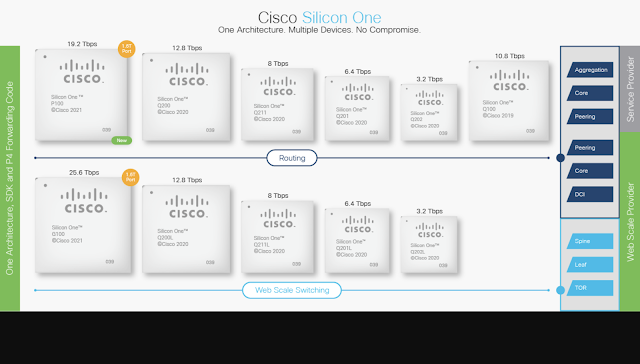
Cisco has begun sampling its latest P100 routing silicon, the 11th device in the Cisco Silicon One family which debuted in December 2019.

The 7nm Cisco Silicon One P100 boasts the industry’s first 112G Serializer/Deserializer (SerDes) high bandwidth routing silicon, achieving full-duplex 19.2 Tbps of capacity. It features Cisco's second-generation P4 run-to-completion engine coupled with large table scale and deep buffers.

Cisco says its P100 device enables a true single flow 1.6 Tbps port allowing for optimal link utilization for high bandwidth point-to-point connections. It can be used to create a 28.8 Tbps, 36 port QSFP-DD800 line card. It could also be used for a single rack unit 24 port QSFP-DD800 system or a two-rack unit 48 port QSFP-DD56 system. 

https://blogs.cisco.com/sp/ciscosilicononep100announcement

DT runs with Cisco 8000 Series routers

One year after introducing its 8000 Series routers, Cisco confirmed that Deutsche Telekom (DT) has now deployed the new platforms, which feature Cisco Silicon One Q200 series chips, to boost its network performance and reach – now supporting 246M mobile customers, more than 27 million fixed-network lines and 22 million broadband lines. Deutsche Telekom worked closely with Cisco to move from redesign to full provisioning in under four monthsThe...

Cisco unveils Routed Optical Networking

Cisco announced a number of  Internet infrastructure products and technologies including a new Routed Optical Networking solution featuring Acacia pluggable optics and Cisco’s full mass-scale routing portfolio. The company claims its integration of routing and optics will lead to savings of up to 46% over traditional, layered IP + optical product architecture.

At its virtual Cisco Live! event, the company said Acacia’s pluggable coherent optics, advancements in Segment Routing and Ethernet VPN, and new Cisco Crosswork Cloud capabilities will lead to greater efficiency for service providers and web scale companies such as Airtel, Altibox, Eolo, Facebook, Google Cloud, Rakuten Mobile, SFR, Telenor, Telia Carrier, Telstra, Websprix, etc.

Here are some highlights of the announcements

Cisco Silicon One - Cisco first introduced its programmable networking silicon architecture in 2019. The company has now expanded the Cisco Silicon One platform from a routing-focused solution to one which also addresses the web-scale switching market, offering ten networking chips (devices) ranging from 3.2 Tbps to 25.6 Tbps.

Subscriber Management - Cisco is introducing its new Cisco Cloud Native Broadband Network Gateway for telco customers (wireline), joining the Cisco family of existing cloud native broadband routers for cable and mobile. It paves the way for convergence to a unified subscriber management solution, bringing further simplification and efficiency while enabling service providers to offer truly access-agnostic services independent from where people use these services.  

Routing for the Access, Aggregation, Edge, and Core 

  • Cisco’s latest 8000 family of routers now features Cisco Silicon One Q200 series chips offering up to 14.4 Tbps total capacity, enabling 32 and 64 x 100G web-scale switches.
  • Introducing powerful new line cards and chassis for the Cisco Aggregated Service Router (ASR) 9000 series and Network Convergence System (NCS) 500 and 5500 series routers providing increased capacity with capital and operational cost savings
  • New Crosswork Network Controller (CNC) features help customers operate the Cisco Routed Optical Networking solution

Cisco Crosswork Cloud - new application called Traffic Analysis offers a comprehensive view across network peering points. With this insight

Cisco Business Critical Services - design and consulting services to help customers adopt Cisco's Routed Optical Networking and Cloud Native Broadband solutions. 

“Cisco has spent the last five years researching and investing in this portfolio of innovation, focusing on how to help our customers deliver the best internet while being able to grow revenue, reduce their costs and mitigate risk,” said Jonathan Davidson, Senior Vice President and General Manager, Mass-Scale Infrastructure Group, Cisco. “By helping our customers make the right decisions for their networks today, we are setting the world up for success, to connect more people, places and things than ever before. We can all look back on this point in time in the next ten years and celebrate how we rose to the challenge and did the right thing to take care of the internet.”

https://newsroom.cisco.com/press-release-content?type=webcontent&articleId=2150473

Wednesday, September 15, 2021

Leading vendors agree to tackle vulnerabilities in global routing

The Mutually Agreed Norms for Routing Security (MANRS) initiative, backed by Arista, Cisco, Huawei, Juniper, and Nokia and supported by the Internet Society, today announced an Equipment Vendor Program aimed at reducing the most common threats to the Internet’s routing system.

The MANRS Equipment Vendor Program provides best practices for all network equipment vendors. By joining MANRS, equipment vendors agree to the baseline of routing security defined by a set of two actions and a commitment:

  • Equipment vendors agree to provide security features network operators can use to implement MANRS recommendations such as preventing incorrect routing information and IP address spoofing.
  • Participants agree to promote MANRS through training and technical content.
  • They also agree to actively participate in the MANRS community to advise members, develop solutions, and contribute to routing security resources.

“Having five of the leading network equipment vendors in the world working together with the MANRS community to launch the new Equipment Vendor Program demonstrates the importance of routing security in making the Internet safe for business and consumers alike,” said Andrei Robachevsky, Senior Director, Technology Programs for the Internet Society. “These founding participants are leading by example to improve routing security and hopefully will motivate the entire Internet infrastructure community to make the Internet more secure for everyone.”

“With a greater reliance on the Internet now more than ever, it’s crucial that the Internet is stable and offers secure and trusted methods to connect users. It is the responsibility of the global community to work together to ensure that the ecosystem forming the Internet works well and is protected against threat actors. Juniper Networks is a proud supporter of the MANRS program and will continue to strive for a better internet in today’s connected world,” says Melchior Aelmans, Consulting Engineer, Juniper Networks.

Sunday, September 12, 2021

IDC: Switching revenues rise 11% while routing dip 0.5% in Q2

The worldwide Ethernet switch market recorded revenues of $7.4 billion in the second quarter of 2021 (2Q21), an increase of 10.8% year over year, while worldwide enterprise and service provider (SP) router market revenues declined 0.5% year over year in 2Q21 to $3.9 billion, according to IDC's Worldwide Quarterly Ethernet Switch Tracker and Worldwide Quarterly Router Tracker.

"IDC witnessed a strong start to 2021 for the global Ethernet switch market, as macroeconomic conditions improved and a growing number of organizations worldwide demonstrated perseverance and digital resilience in the face of the rolling challenges presented by the COVID-19 pandemic," said Brad Casemore, research vice president, Datacenter and Multicloud Networks at IDC. "Enterprises made notable investments in their campus networks, while hyperscalers and other providers of cloud services continue to drive growth in high-bandwidth datacenter switching."

Highlights from IDC

Switching

The Ethernet switch market's annualized growth of 10.8% builds upon the 7.6% growth in the first quarter of 2021. For the first half of the year, Ethernet switch revenues are up 9.3% over 2020. Compared to the second quarter of 2019 – before the COVID-19 pandemic – revenues increased 3.8%.

From a geographic perspective, the 2Q21 Ethernet switch market had strong results across most parts the world. In Asia/Pacific, the People's Republic of China revenues grew 11.6% year over year while Japan's market increased 8.3%. More broadly in the Asia/Pacific region, excluding China and Japan, the market rose 20.5% year over year in the quarter, buoyed by the market in Singapore growing 58.2% annually. In Europe, results were mixed: Western Europe's market rose 23.1% year over year with strength from France, which grew 39.3%. Central and Eastern Europe's market was essentially flat at 0.5% growth with Russia declining 4.8%. In the Middle East & Africa, the market increased 2.6% year over year. Across the Americas, revenues in the United States rose 6.2%, Canada's market fell 1.0%, and Latin America's market increased 8.1% year over year with Mexico rising 15.8% compared to a year earlier.

Overall port shipments increased 28.4%, driven by strength in the non-datacenter portion of the Ethernet switch market. Non-datacenter Ethernet switch revenues grew 17.7% in 2Q21 with port shipments increasing 36.1%. The non-datacenter ethernet switch portion of the market makes up 88.6% of port shipments and 58.5% of total market revenues with the balance of revenues and port shipments in the datacenter portion of the market. In the datacenter segment, revenues rose 2.4% year over year, while port shipments declined 10.6%.

The higher-speed segments of the Ethernet switch market continue to see significant growth, driven by hyperscalers and cloud providers. Market revenues for 200/400 GbE switches grew 132.5% from the first quarter to the second quarter of 2021, with port shipments more than tripling (+206.0%) on a sequential basis. 100GbE revenues increased 15.4% on an annualized basis, while port shipments rose 11.4% year over year. 25/50 GbE revenues increased 25.6% year over year while port shipments rose 1.3%.

Lower-speed switches, a more mature part of the market, saw mixed results. 10GbE port shipments rose 3.1% year over year, but revenue declined 8.4%. 10Gb switches make up 23.4% of the market's total revenue. 1GbE switches increased 33.2% annually in port shipments and 14.4% in revenue. 1GbE accounts for 35.9% of the total Ethernet switch market's revenue. 2.5/5GbE revenue increased 25.3% sequentially from 1Q21 to 2Q21, while port shipments rose 26.6% quarter over quarter.

Router Market

The worldwide enterprise and service provider router market declined 0.5% year over year in 2Q20 with the major service provider segment, which accounts for 76.7% of revenues, falling 0.8% and the enterprise segment increasing 0.4%. From a regional perspective, the combined service provider and enterprise router market increased 15.7% in Asia/Pacific (excluding Japan & China). Japan's market increased 4.9% while the People's Republic of China market was down 14.4% year over year. Revenues in Western Europe grew 3.3% year over year, while in Central and Eastern Europe the combined enterprise and service provider market was flat. The Middle East & Africa region grew 4.3%. In the U.S., the enterprise segment was down 4.8%, while service provider revenues increased 7.8%, giving the combined markets a 4.6% increase on an annualized basis. The Latin America market grew 1.0% on an annualized basis and Canada's market increased 2.2% year over year.

Company highlights

  • Cisco finished 2Q21 with a 4.5% increase in overall Ethernet switch revenues and market share of 44.1%. Cisco's combined service provider and enterprise router revenue grew 2.4% year over year with enterprise router revenue decreasing 9.8% and SP revenues increasing 10.1%. Cisco's combined SP and enterprise router market share stands at 34.2% in the quarter.
  • Huawei's Ethernet switch revenue increased 3.5% on an annualized basis, giving the company market share of 11.1%. The company's combined SP and enterprise router revenue declined 8.5% year over year, giving the company a market share of 33.4%.
  • Arista Networks saw Ethernet switch revenues increase 31.6% in 2Q21, bringing its share of the total market to 7.5%.
  • H3C's Ethernet switch revenue increased 10.6% year over year, giving the company market share of 7.0% in the quarter. In the combined service provider and enterprise routing market, H3C's revenues increased 32.6%, giving the company 2.5% market share.
  • HPE's Ethernet switch revenue increased 46.4% year over year, giving the company a market share of 6.7%.
  • Juniper's Ethernet switch revenue increased 23.3% year over year in 2Q21, bringing its Ethernet switch market share to 3.1%. Juniper saw a 3.9% decline in combined enterprise and SP router sales, bringing its market share in the router market to 9.8%.

https://www.idc.com/getdoc.jsp?containerId=prUS48222221

Monday, November 16, 2020

AT&T deploys dis-aggregated IP edge routing platform

AT&T deployed a next-gen open disaggregated IP edge routing platform into its production environment with support from Broadcom, Cisco, and UfiSpace. 

The hardware platform being used for this edge application is identical to that previously announced for AT&T’s IP/MPLS core, demonstrating the true openness of the hardware. AT&T said common hardware enables consistent maintenance processes and sparing. The Broadcom Jericho2-based hardware designs have been accepted by OCP, and compatible products are available from other ODMs. The UfiSpace portfolio consists of three components: a 40x100G line card system, 10x400G line card system, and a 48x400G fabric system. These building blocks are deployed using the highly flexible Distributed Dis-Aggregated Chassis (DDC) design in various configurations to build routers with capacity anywhere between 4 Tbps to 192 Tbps. 

Cisco’s IOS-XR Network Operating System provides the management and control functions for the solution. Some of the key features for the peering use case are BGP Flowspec, unicast Reverse Path Forwarding (uRPF), and port mirroring which collectively will allow AT&T fine granular monitoring and mitigation actions for security threats such as Directed Denial of Service (DDoS) attacks. 

“The first IP edge use case is peering – the system that connects AT&T’s IP network with that of other Internet Service Providers (ISPs)”, said Andre Fuetsch, AT&T’s CTO for Network Services. “But this is just the tip of the iceberg; we are working with Cisco on developing additional edge use cases that will include broadband, IP content, Ethernet, mobility, and VPN services. We have started the journey to converge the disparate edge implementations we have today onto common software and hardware driving uniformity, simplification, and agility.” 

“Jericho2's scalability allows the hardware platform to be used from the core to the edge of the AT&T network, while enabling a thriving ecosystem that supports their vision of a disaggregated, flexible, and simplified network infrastructure, said Ram Velaga, senior vice president and general manager, Core Switching Group, Broadcom. “Broadcom is pleased to work with AT&T to enable merchant silicon solutions for end-to-end deployments,”   

“The internet of the future is supported by an automated, software-defined network that can easily support the cloud-and-app-powered world we live in,” said Jonathan Davidson, SVP and GM , Mass Scale Infrastructure Group, Cisco. “Cisco’s broad portfolio of industry -leading silicon, systems and software disaggregation is making the internet better and stronger. Together with AT&T we are marking a milestone in the industry with the convergence of the IP edge using open, dis-aggregated hardware and software-only models designed to fit a broad spectrum of commercial arrangements.” 

“This is a really big development in the networking eco-system,” Fuetsch said. “This model gives us options and flexibility in our supply chain and enables us to use best-in-breed products whether they come from established or disruptive suppliers. And this is well past lab experiments; the technologies and eco-system have matured, and we are now into the production deployment phase.”

AT&T deploys open disaggregated core router

AT&T has deployed its open disaggregated core routing platform on its 400G transport network. The router leverages technology from Broadcom, DriveNets, and UfiSpace. 

The white box hardware, which was designed and manufactured by UfiSpace, is based on Broadcom’s Jericho2 switching silicon and Distributed, Dis-aggregated Chassis (DDC) design. It consists of three components: a 40x100G line card system, 10x400G line card system, and a 48x400G fabric system. These building blocks can be deployed in various configurations to build routers with capacity anywhere between 4 Tbps to 192 Tbps.

DriveNets Network Cloud solution and its  Network Operating System (NOS) software provides the management and control of the white box hardware. This enables MPLS transport across AT&T's global, multi-service core backbone. The software then connects into AT&T’s centralized SDN controller that optimizes the routing of traffic across the core.

AT&T notes that the deployment of this dis-aggregated core routing platform is coupled with the deployment of the company’s next gen long haul 400G optical transport platform.

“I’m proud to announce today that we have now deployed a next gen IP/MPLS core routing platform into our production network based on the open hardware designs we submitted to OCP last fall,” said Andre Fuetsch, AT&T’s CTO of Network Services, in his keynote speech at the Open Networking and Edge Summit (ONES). “We chose DriveNets, a disruptive supplier, to provide the Network Operating System (NOS) software for this core use case.”

“We are thrilled about this opportunity to work with AT&T on the development of their next gen, software-based core network,” said Ido Susan, CEO of DriveNets. “AT&T has a rigorous certification process that challenged my engineers to their limits, and we are delighted to take the project to the next level with deployment into the production network.”

AT&T contributes Distributed Disaggregated Chassis white box to OCP

AT&T has contributed its specifications for a Distributed Disaggregated Chassis (DDC) white box architecture to the Open Compute Project (OCP). The contributed design aims to define a standard set of configurable building blocks to construct service provider-class routers, ranging from single line card systems, a.k.a. “pizza boxes,” to large, disaggregated chassis clusters.  AT&T said it plans to apply the design to the provider edge (PE) and core routers that comprise its global IP Common Backbone (CBB).

“The release of our DDC specifications to the OCP takes our white box strategy to the next level,” said Chris Rice, SVP of Network Infrastructure and Cloud at AT&T. “We’re entering an era where 100G simply can’t handle all of the new demands on our network. Designing a class of routers that can operate at 400G is critical to supporting the massive bandwidth demands that will come with 5G and fiber-based broadband services. We’re confident these specifications will set an industry standard for DDC white box architecture that other service providers will adopt and embrace.”

AT&T’s DDC white box design, which is based on Broadcom’s Jericho2 chipset, calls for three key building blocks:

  • A line card system that supports 40 x 100G client ports, plus 13 400G fabric-facing ports.
  • A line card system that support 10 x 400G client ports, plus 13 400G fabric-facing ports.
  • A fabric system that supports 48 x 400G ports. A smaller, 24 x 400G fabric systems is also included.

Thursday, November 12, 2020

Deutsche Telekom will deploy Nokia 7750 Service Router for 5G

Deutsche Telekom has selected Nokia's 7750 Service Router (SR-7s) platform to significantly expand capacity across its edge/core routing network as it prepares for next-generation broadband and 5G services. 

The Nokia 7750 SR-7s routers are powered by the programmable FP4 network processing silicon. The 7750 SR-s is managed by the Nokia Network Services Platform (NSP). NSP supports 5G IP transport with automated slicing across IP and optical transport layers with end-to-end orchestration of network resource provisioning and assurance operations. 


Deployment has already started in Greece, where Nokia is replacing and modernizing the operator’s existing IP network. Rollout in Hungary is expected in Q4 2020.

Bernhard Scholl, Technology Europe VP Access Core & Transport at Deutsche Telekom, said: “Deutsche Telekom Group affiliates need to expand and modernize their IP networks to address stringent 5G IP transport requirements. We continue to see tremendous growth in network traffic and the need to deliver more throughput and higher capacity with strict QoS to our customers is critical. This is particlarly the case as bandwidth intensive applications are shifting to on demand video along with the growing usage of cloud-based services. Building out this backbone with Nokia's IP edge routers will allow us to stay ahead of our customers’ network needs.”

Tuesday, February 25, 2020

NTT DOCOMO picks Cisco's segment routing to optimize 5G backhaul

NTT DOCOMO has selected Cisco's Network Convergence System routers and segment routing for network slicing to help optimize its 5G mobile backhaul.

Cisco said its converged SDN transport, with segment routing, and Network Convergence System routers can provide massive scale, full programmability, simpler cloud integration and service level agreements.

“The IP network plays a more important role with 5G than ever before,” said Jonathan Davidson, Senior Vice President and General Manager, Cisco Service Provider Business. “Networks have to be automated, programmable and capable of massive scale. Together, DOCOMO and Cisco mapped out the right path for its 5G transformation with a new intelligent, software-defined network. Converging services over a common, trustworthy architecture will reduce costs, deliver new services that span multiple domains, and prepare them for a profitable 5G future.”


S

Tuesday, October 29, 2019

France-IX updates its IP backbone with Nokia

France-IX, the premier Internet Peering Service Provider in France, has selected Nokia to upgrade its IP backbone.

The update will use the Nokia 7750-SR-s IP router to provide a higher port density to accommodate anticipated growth and the evolution of France-IX’ service offerings. Deployment of the new platform is due to start in Paris and Marseille this year with upgrades to all PoPs to be completed progressively from 2020.

These will also allow a smooth upgrade path from VPLS to EVPN (Ethernet VPN), as well as the ability to offer network automation and Telemetry. The new backbone will enable France-IX to be more flexible, allowing it to automate the provisioning of new services and cutting the time to their activation to less than a day from receiving a request from resellers and France-IX Marketplace sellers.

"We are very pleased to partner with France-IX as it takes another leap forward in renewing its infrastructure by selecting Nokia’s latest generation of powerful IP routers,” says Rafael De Fermin, Senior Vice President Europe and MEA for Nokia’s IP and Optical business. “Among the most innovative IXPs, France-IX is keen to scale 100G capacity and deliver 400G interconnection on a stable, programmable platform that leverages automation and reduces time to market for new services."

“We chose Nokia as our long-term partner because it offers the most advanced technology to homogenise the whole foundation for our IXP platform infrastructure starting with the renewal of our backbone and working towards a broader objective of achieving a long-term homogenous platform for all our PoPS,” says Simon Muyal, Chief Technical Officer at France-IX. “This major investment – the highest made by France-IX since its creation – will give us outstanding stability and the ability to meet our anticipated growth in terms of increased demand for capacity. We look forward to being able to scale valuable new service offerings, automate network operations, or rapidly deploy new services without constraints.”

http://www.franceix.net

Tuesday, April 24, 2018

Orange deploys Cisco NCS 5500 for its Open Transit Internet backbone

Orange is using the Cisco Network Convergence System (NCS 5500) to modernize and expand the Orange Open Transit Internet (OTI) service, which is a Tier 1 international Internet connectivity service offering direct access to the Internet networks in more than 100 countries through more than 50 points of presence (POPs). Orange's OTI targets both Internet service providers and content providers. Financial terms were not disclosed.

The companies said this initiative expands Orange's OTI network in Europe, Africa, and the Middle East, with reduced operational complexity and increased capacity using the new generation of routers on its OTI service.

“Our work with Cisco on OTI supports the further evolution of our network, allowing us to cope with huge traffic growth and improving the reach of our network,” said Jean-Luc Vuillemin, senior vice president, Orange International Networks Infrastructures and Services.


Cisco adds to its Service Provider routing portfolio

Cisco announced the addition of hardware, software and security options to its Service Provider routing portfolio. Highlights include:

Routing hardware 

Cisco NCS 500 Series: addressing converged wireline and wireless 5G-ready requirements for mobile x-haul and future evolutions of Carrier Ethernet networks, and various bandwidth needs ranging from 1 to 100 Gbps interfaces in small form factors.

Cisco ASR 9901: it supports applications such as distributed provider edge, Internet peering, metro aggregation and broadband network gateway (BNG) in a space-optimized platform; It delivers 456 Gbps of port capacity while also providing flexibility in terms of port speeds ranging from 1 to 100 Gbps with industry-leading MACsec encryption support across all ports.

Cisco NCS 5500 Series:

  • Two fixed chassis supporting 24 and 36 100GE ports 
  • A 36 100GE ports line card targeted at high-density core, mobile backhaul and data center interconnect use cases; Offers flexible port configuration supporting 10G/25G/40G and 100G per port with enhanced scale capabilities (external TCAM) 
  • A compact 2RU router targeted at high-density metro aggregation, mobile backhaul networks and long-haul connectivity use cases; Delivers maximum flexibility with the support of Modular Port Adapters (MPA) with options of different port types and MACsec encryption support.

Routing software additions

Segment Routing: Offers service providers more control over Internet traffic by delivering a unified transport fabric across aggregation, edge, core and data center network domains with unmatched simplicity, resiliency and scalability; With Segment Routing Flexible Algorithm, a new addition to the Cisco Segment Routing Traffic Engineering toolkit, service providers can:

  • Optimize the same physical network infrastructure along various dimensions such as low-latency, bandwidth or path disjointness. 
  • Custom fit 5G network slices to specific applications

Ethernet VPN (EVPN): Cisco is now offering seamless integration with Virtual Private LAN Service (VPLS), helping service providers speed up migration from VPLS to EVPN as another method to provide Ethernet-based multipoint to multipoint communication over IP or MPLS networks; EVPN offers improved scalability, optimal forwarding and helps prevent traffic floods.

"Cisco continues to drive innovation in service provider routing to help our customers uplevel their architectures and be one step ahead in managing their network traffic demands,” said Jonathan Davidson, senior vice president and general manager, Service Provider Networking, Cisco.

Monday, April 9, 2018

Cisco adds to its Service Provider routing portfolio

Cisco announced the addition of hardware, software and security options to its Service Provider routing portfolio. Highlights include:

Routing hardware 

Cisco NCS 500 Series: addressing converged wireline and wireless 5G-ready requirements for mobile x-haul and future evolutions of Carrier Ethernet networks, and various bandwidth needs ranging from 1 to 100 Gbps interfaces in small form factors.

Cisco ASR 9901: it supports applications such as distributed provider edge, Internet peering, metro aggregation and broadband network gateway (BNG) in a space-optimized platform; It delivers 456 Gbps of port capacity while also providing flexibility in terms of port speeds ranging from 1 to 100 Gbps with industry-leading MACsec encryption support across all ports.

Cisco NCS 5500 Series:

  • Two fixed chassis supporting 24 and 36 100GE ports 
  • A 36 100GE ports line card targeted at high-density core, mobile backhaul and data center interconnect use cases; Offers flexible port configuration supporting 10G/25G/40G and 100G per port with enhanced scale capabilities (external TCAM) 
  • A compact 2RU router targeted at high-density metro aggregation, mobile backhaul networks and long-haul connectivity use cases; Delivers maximum flexibility with the support of Modular Port Adapters (MPA) with options of different port types and MACsec encryption support.

Routing software additions

Segment Routing: Offers service providers more control over Internet traffic by delivering a unified transport fabric across aggregation, edge, core and data center network domains with unmatched simplicity, resiliency and scalability; With Segment Routing Flexible Algorithm, a new addition to the Cisco Segment Routing Traffic Engineering toolkit, service providers can:

  • Optimize the same physical network infrastructure along various dimensions such as low-latency, bandwidth or path disjointness. 
  • Custom fit 5G network slices to specific applications

Ethernet VPN (EVPN): Cisco is now offering seamless integration with Virtual Private LAN Service (VPLS), helping service providers speed up migration from VPLS to EVPN as another method to provide Ethernet-based multipoint to multipoint communication over IP or MPLS networks; EVPN offers improved scalability, optimal forwarding and helps prevent traffic floods.

"Cisco continues to drive innovation in service provider routing to help our customers uplevel their architectures and be one step ahead in managing their network traffic demands,” said Jonathan Davidson, senior vice president and general manager, Service Provider Networking, Cisco.

The news was announced at this week's MPLS+SDN+NFV World Congress in Paris.

Wednesday, March 28, 2018

Metaswitch positions Composable Network Protocols for disaggregated networking

Metaswitch introduced a portfolio of Composable Network Protocols (CNP) for powering next-generation white box routing platforms with fully-decoupled control plane components and open management interfaces.

The suite of Composable Network Protocols is based on Metaswitch's more than 35 years of protocol development. Its proven and stable IP routing and MPLS networking stacks and layer 2 and 3 protocols are deployed in the products of more than 250 network OEMs, which the company says distinguishes its code from open source alternatives, enabling true software disaggregation while lowering capex, opex and operational risks. Metaswitch's CNP routing and control plane protocols install and operate as binary applications on top of any open network operating system, running stand-alone or combined with any third-party commercial or open source stack.

“Our new white box and open network operating system solution introduces groundbreaking capabilities and flexible purchasing options, while reducing the risk of moving to a fully-disaggregated architecture,” said Martin Lund, CEO of Metaswitch. “Metaswitch has a very strong track record in the development and deployment of hardened protocol stacks for the most demanding applications and OEMs and we look forward to working with an expanded range of customers to help them realize the future of composable networking.”

In addition, Dell EMC has agreed to resell Metaswitch Composable Network Protocols (CNP). Specifically, Dell EMC will combine Metaswitch’s CNP IP routing and MPLS networking stacks with its own EMC OS10 Open Edition on ONIE-enabled platforms. The companies said this joint solution embodies the evolution of networking software as it introduces new levels of software flexibility and programmability in large-scale data center environments for cloud and communications services providers (CSPs).

“The combination of Metaswitch CNP and Dell EMC OS10 Open Edition significantly raises the viability of software disaggregation in production deployments,” said Drew Schulke, VP of networking at Dell EMC. “With this comprehensive portfolio of hardened network protocol stacks, we’ll work closely on addressing the complexities of data center interconnect and wide-area IP/MPLS routing at scale. We’re pleased to be working closely with Metaswitch with its long and successful track record of development and deployment of protocol stacks.”

Sunday, March 11, 2018

ZTE enhances core router with Bit Indexed Explicit Replication

ZTE has enhanced its ZXR10 T8000 core router with the addition of Bit Indexed Explicit Replication (BIER) technology -- an industry first according to the company, and useful for balancing SDN backbone network traffic.

ZTE describes BIER as a simplified multicast packet forwarding technology that does not require complex multicast protocols and multicast forwarding tables. It can efficiently distribute multicast packets only by switching the messages of the multicast senders and receivers instead of maintaining multicast flow status, which perfectly fits the philosophy of SDN centralized control.

The ZXR10 T8000 router supports multiple northbound interfaces. The company's software enables traffic optimization and scheduling based on policies, which can help achieve load balancing, reduce the link congestion ratio, delay network expansion, and improve user experiences.

Wednesday, June 14, 2017

Nokia Unveils its Next Gen IP Routing Engine

Nokia unveils its fourth generation network processing silicon for powering the first petabit-class core IP routers.

The new FP4 silicon, which comes six years after the preceding FP3 chipset was announced, offers 2.4 Tb/s half-duplex capacity, or 6X more capacity than the current generation 400 Gb/s FP3 chipset. The FP4 will support full terabit IP flows. All conventional routing capabilities are included. Deep classification capabilities include enhanced packet intelligence and control, policy controls, telemetry, and security.


The FP4 could be used to provide an in-field upgrade to Nokia’s current line of core routers and carrier switches. It will also be used to power a new family of 7750 SR-s series routers designed for single-node, cloud scale density. In terms of specs, the SR-s boasts a 144 Tb/s configuration supporting port densities of up to 144 future Terabit links, 288 400G ports, or 1,440 100GE ports. Absolute capacity could be double for a maximum of 288 Tb/s configuration. It runs the same software as the company’s widely-deployed systems.  The first 7750 SR-s boxes are already running in Nokia’s labs. First commercial shipments are expected in Q4.

Nokia is also introducing a chassis extension option to push its router into petabit territory. Without using the switching shelf concept employed in the multi-chassis designs of its competitors, Nokia is offering the means to integrate up to six of its 7750 SRS-s routers into a single system. This results in 576 Tb/s of capacity, enough for densities of up to 2,880 100GE ports or 720 400G ports.

https://networks.nokia.com/ip-networks-reimagined

Tuesday, May 23, 2017

Coloclue deploys Juniper vMX virtual router for next-generation network

Juniper Networks announced that Netherlands-based Coloclue, a non-profit, independent association of network specialists, has selected the Juniper Networks vMX Virtual Router for its next-generation production network.

Juniper's vMX, a virtualised MX Series 3D universal edge router, offers a full-featured, carrier-grade virtual router that will enable Coloclue to upgrade its network environment. For the project, Coloclue will deploy the vMX on the NFX250 Network Services Platform and leverage the automation features of Junos OS as part of an effort to create a Self-Driving Network, designed to reduce time required for testing, as well as reduce costs, and allow its staff to focus on higher-value activities.

Deployment of Juniper's vMX on the NFX250 network services platform is intended to enable a high-performance, automated and operationally-efficient network that will deliver an advanced production environment for Coloclue members. Members will also be able to leverage the production network to test and troubleshoot new applications before they are rolled out.

The vMX solution offers a suite of advanced routing functions on an open platform and is designed to support network automation to allow engineers to create a real-world network environment while gaining experience with a variety of automation tools that help to reduce the resources needed to operate the network. This can allow engineers to focus on higher value testing and troubleshooting activities.


Juniper noted that partner Infradata BV, a network integrator focused on designing, implementing and managing next-generation networks, is carrying out the deployment with Coloclue.


  • Juniper recently announced that Dutch Internet connectivity provider A2B Internet had selected its vMX Virtual Routers as the first virtual network function (VNF) for its next-generation network platform. A2B Internet selected the vMX to enable improved service agility for its customers and reduced costs through simplifying its network.

Tuesday, March 29, 2016

Arista Unveils 100+ Terabit Switching/Routing Platform

Arista Networks introduced a 100+ Terabit switching and routing platform for cloud service provider and next generation enterprise data centers. The new Arista 7500R is being positioned as the industry's highest performance universal spine switch for data centers.

Arista believes that shifting traffic patterns inside the data center are best served with scalable two-tier active Leaf-Spine and single tier Spline architecture. The traditional core routing layer can be replaced with an Arista 7500R series-based spine for rapid re-convergence and network-wide resilience between data centers and to the Internet. The Arista 7500R Series supports familiar MPLS functions allowing up to 13-labels deep packet lookup for programmatic control across the largest networks. Along with the state oriented architecture of Arista’s Network–wide Database NetDB and SDK, Arista EOS (Extensible Operating System) users can customize their own preferred path across the largest networks in the world, instead of relying on best-effort forwarding on the Internet.

The new Arista 7500R Series, which begin shipping in Q2, provides industry-leading 100GbE density and large table sizes in a single chassis. Key attributes:

  • Chassis Fabric capacity of up to 115 Tbps
  • Up to 432 wirespeed 100GbE ports in a choice of three form factors
  • 288 Gigabytes of deep and smart packet memory for reliable packet transfers
  • Virtual Output Queues (VoQ) for lossless forwarding
  • Agile port speeds of 1/10/25/40/50/100GbE
  • FlexRoute technology delivers up to 1 Million wire speed routes with MPLS, Segment Routing and EVPN (Ethernet Virtual Private Network) protocol support
  • Programmable traffic engineering with up to 128,000 MPLS, GRE (Generic Routing Encapsulation), VXLAN (Virtual Extensible Local Area Network) and IP-in-IP tunnels
  • Support for NEBS (Network Equipment Building System) compliance for Service Provider deployments
  • Mix and Match across the wide selection of 7500E and 7500R series line-card options
Arista is also introducing three new wire speed 7500R Series line cards:

  • 36 x 100GbE QSFP - choice of 10/25/40/50/100GbE
  • 36 x 40GbE with flexible combinations of 10GbE and up to 6 ports of 100GbE
  • 48 x 10GbE SFP+ and 2 x 100G QSFP

“The 7500R is the highest performance switching and routing platform that supports the full Internet routing table, enabling a Universal Spine in cloud-scale networks,” said Andreas Bechtolsheim, Arista’s Chairman and Chief Development Officer.

https://www.arista.com/en/company/news/press-release/1283-pr-20160329

Friday, January 29, 2016

Bell Canada Deploys Nokia 7950 XRS Core Router

Bell Canada is deploying Nokia's 7950 XRS core router to support its wireless, residential and business customers. Specifically, Nokia is providing Bell Canada with the 7950 XRS - to be managed by Nokia's 5620 Service Aware Manager (SAM) - to create a single, end-to-end managed IP platform streamlining day-to-day network operations and enhancing operational efficiency, including a reduced energy footprint. The 7950 XRS scales from 6.4 to 32 terabits per second in a single system. 

The deal was won by Alcatel-Lucent, a subsidiary of Nokia.

http://nokia.com

Wednesday, January 6, 2016

NTT DOCOMO to Deploy ALU's 7950 IP Core/Edge Routers

NTT DOCOMO will deploy Alcatel-Lucent's 7950 Extensible Routing System for supporting its 68 million mobile subscribers in Japan. Financial terms were not disclosed.

Alcatel-Lucent said the deployment of its 7950 XRS core/edge router strengthens a long-standing relationship with NTT DOCOMO, particularly in the supply of IP technology. Alcatel-Lucent previously supplied its 7750 Service Router series and 7450 Ethernet Service Switch for DOCOMO's Border GateWay Router and Radio Access Network Switch projects.

"NTT DOCOMO is a company that is well-known for its emphasis on quality and reliability to offer the most innovative services to customers. As such, we are very pleased to be able to deliver our powerful IP core/edge router to help NTT DOCOMO support the increasing mobile traffic and the introduction of 5G," stated Nicolas Bouverot, President of Alcatel-Lucent Japan.

http://www.alcatel-lucent.com

DOCOMO Expands 5G Collaboration Program

NTT DOCOMO is expanding its industry collaboration program for 5G.  The company announced individual collaborations with five additional vendors: Intel, Keysight Technologies, Panasonic Corporation, Qualcomm Technologies, and Rohde & Schwarz GmbH & Co.

DOCOMO and its vendor-partners expect to begin technical discussions and various indoor trials at the DOCOMO R&D Center in Yokosuka, Kanagawa Prefecture within the current fiscal year ending in March 2016. The trials will expand to outdoor settings thereafter. Key findings and achievements will be shared with global research bodies and at international conferences. Through the collaborations, DOCOMO expects to evaluate and verify its proprietary 5G technologies and thereby accelerate 5G standardization.

Since May 2014, DOCOMO has been working with a number of other vendors, including Alcatel-Lucent, Ericsson, Fujitsu, Huawei, Mitsubishi Electric, NEC, Nokia and Samsung.

DOCOMO said it aims to introduce 5G on a commercial basis in 2020. 5G is being developed for ultra-high-speed data transmissions of over 10Gbps and 1,000 times the capacity of LTE, which will help address the proliferation of connected items in the emerging Internet of Things (IoT), as well as to support the increasingly diverse range of mobile services.

"Global expectations for 5G are growing as we approach the start of the standardization phase," said Seizo Onoe, Executive Vice President and Chief Technology Officer at DOCOMO. "We are delighted to form these new collaborations on 5G experimental trials for wider technical areas to establish the 5G ecosystem with additional world-leading global vendors to promote R&D targeted at 5G deployment in 2020."

https://www.nttdocomo.co.jp/english/info/media_center/pr/2015/0722_00.html