Showing posts with label Alcatel-Lucent. Show all posts

Wednesday, January 6, 2016

NTT DOCOMO to Deploy ALU's 7950 IP Core/Edge Routers

NTT DOCOMO will deploy Alcatel-Lucent's 7950 Extensible Routing System for supporting its 68 million mobile subscribers in Japan. Financial terms were not disclosed.

Alcatel-Lucent said the deployment of its 7950 XRS core/edge router strengthens a long-standing relationship with NTT DOCOMO, particularly in the supply of IP technology. Alcatel-Lucent previously supplied its 7750 Service Router series and 7450 Ethernet Service Switch for DOCOMO's Border GateWay Router and Radio Access Network Switch projects.

"NTT DOCOMO is a company that is well-known for its emphasis on quality and reliability to offer the most innovative services to customers. As such, we are very pleased to be able to deliver our powerful IP core/edge router to help NTT DOCOMO support the increasing mobile traffic and the introduction of 5G," stated Nicolas Bouverot, President of Alcatel-Lucent Japan.

http://www.alcatel-lucent.com

DOCOMO Expands 5G Collaboration Program

NTT DOCOMO is expanding its industry collaboration program for 5G.  The company announced individual collaborations with five additional vendors: Intel, Keysight Technologies, Panasonic Corporation, Qualcomm Technologies, and Rohde & Schwarz GmbH & Co.

DOCOMO and its vendor-partners expect to begin technical discussions and various indoor trials at the DOCOMO R&D Center in Yokosuka, Kanagawa Prefecture within the current fiscal year ending in March 2016. The trials will expand to outdoor settings thereafter. Key findings and achievements will be shared with global research bodies and at international conferences. Through the collaborations, DOCOMO expects to evaluate and verify its proprietary 5G technologies and thereby accelerate 5G standardization.

Since May 2014, DOCOMO has been working with a number of other vendors, including Alcatel-Lucent, Ericsson, Fujitsu, Huawei, Mitsubishi Electric, NEC, Nokia and Samsung.

DOCOMO said it aims to introduce 5G on a commercial basis in 2020. 5G is being developed for ultra-high-speed data transmissions of over 10Gbps and 1,000 times the capacity of LTE, which will help address the proliferation of connected items in the emerging Internet of Things (IoT), as well as to support the increasingly diverse range of mobile services.

"Global expectations for 5G are growing as we approach the start of the standardization phase," said Seizo Onoe, Executive Vice President and Chief Technology Officer at DOCOMO. "We are delighted to form these new collaborations on 5G experimental trials for wider technical areas to establish the 5G ecosystem with additional world-leading global vendors to promote R&D targeted at 5G deployment in 2020."

https://www.nttdocomo.co.jp/english/info/media_center/pr/2015/0722_00.html

Monday, January 4, 2016

Nokia Obtains Majority Share in Alcatel-Lucent

The French financial regulator, the Autorité des marchés financiers, confirmed that as a result of its ongoing public exchange offer, Nokia has now obtained over 71% over the share capital of Alcatel-Lucent, including over 76% of American depositary shares an over 89% of OCEANE convertible bonds issued by the company.

Philippe Camus, Chairman and interim CEO of Alcatel-Lucent stated: “With the Board of directors of Alcatel-Lucent, we are pleased that the combination of Nokia and Alcatel-Lucent has reached a decisive step, since Nokia obtained a large majority of the share capital on a fully diluted basis. We reaffirm our unanimous support to this industrial project which, by creating a global powerhouse in next-generation communications technologies and services, creates value for our shareholders, as well as for all our stakeholders. On behalf of the Board, I strongly encourage the investors in Alcatel-Lucent that have retained their securities to tender them into the re-opened offer in order to benefit from this creation of value and to fully participate in a major project for our industry.”

http://www.alcatel-lucent.com

Tuesday, December 15, 2015

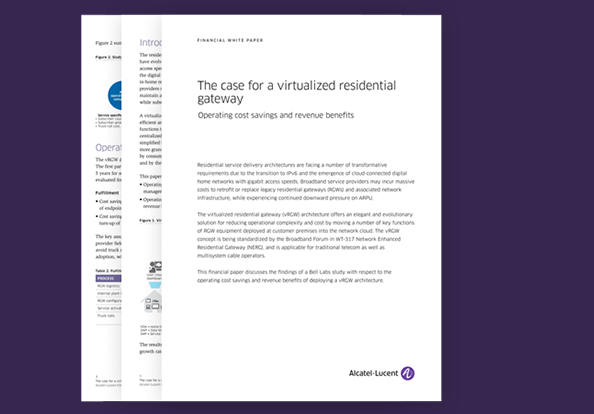
Bell Labs Study Quantifies Residential vCPE Gains

A new study from Bell Labs claims that communications service providers can dramatically reduce their operating costs by up to 40% by ‘virtualizing’ complex functions currently deployed on residential gateways into the network cloud.

A virtualized residential gateway (vRGW) moves functions like IP routing and Network Address Translation (NAT) into the cloud, along with centralized management and control. This lets service providers introduce a more simplified, bridged gateway model making it easier for the user to successfully install, operate and maintain their home network, without having to make service calls or home visits.

Bell Labs estimates that a vRGW can reduce the costs of service fulfilment, assurance and lifecycle management up to 40%. In addition to reducing operating cost and improving the customer experience, a virtualized gateway model allows new services to be introduced more rapidly and consistently across the installed base of residential gateway devices.

Key Facts:

  • The Bell Labs study reveals cost savings in the following categories:
  • Service fulfillment: 7-12% cost reduction - a simpler residential gateway, extended auto-installation capabilities and network-based service capabilities lead to faster turning up of upgrades or new services and fewer home visits  by technicians to address service activation or upgrade issues. Home visits can easily represent over 80% of service fulfillment cost.
  • Service assurance: 63-67% cost reduction - service provider data shows that 30-40% of trouble tickets are related to issues deeper in the network. These can be resolved better by virtualizing and centralizing these deeper functions in combination with home device management capabilities.
  • Life-cycle management: approximate 66% cost reduction - although life-cycle management costs are relatively small compared to fulfillment and assurance costs, enhanced service velocity and agility improve service innovation, time to market, and revenue.

In addition to boosting profitability, a virtualized residential gateway delivers structural improvements in customer experience, service velocity and operational agility.

Alcatel-Lucent’s virtualized residential gateway solution is supported by both the 7750 SR and the Virtualized Service Router product line, and complemented by the Motive vRGW Controller  and the 7368 ISAM CPE and ONT product lines. The company’s vRGW solution is available now, with more capabilities being introduced in first half 2016.

"While the operating cost savings are essential to sustain profitable growth, having a well thought out  VRGW architecture is a pre-requisite to enable service providers to seamlessly extend the home network into the Cloud,” said. “This is critical to operationalize the rapid introduction of new features and automate the delivery of new value added services for the home network, without having the necessity to upgrade the customer premises equipment," stated Enrique Hernandez-Valencia, Consulting Director, Bell Labs.

https://www.alcatel-lucent.com/

ALU Builds Out vRAN portfolio with Red Hat, Advantech, 6Wind

Alcatel-Lucent announced collaboration agreements with Red Hat, Advantech and 6WIND. The partnerships are aimed at accelerating the delivery of commercial virtualized radio access network (vRAN) products.

Alcatel-Lucent is trialling its near-commercial vRAN with leading service providers in North America, Asia and Europe using a platform that consists of 6WIND, Advantech and Red Hat hardware and software. In 2016 Alcatel-Lucent will expand these trials using the CloudBand NFV™ platform to onboard and manage applications.

Some key points:

  • Alcatel-Lucent and Red Hat are expanding their existing collaboration on CloudBand and Red Hat Enterprise Linux OpenStack Platform to jointly enhance NFV-based features and better address the needs of the telecommunications market with open source. This includes the integration of Red Hat Enterprise Linux OpenStack Platform,  and Red Hat Ceph Storage within Alcatel-Lucent’s vRAN offering.
  • Advantech is supplying its Packetarium XLc PAC-6009, a high-density carrier-grade blade server with switching infrastructure that supports all processing, storage and switching elements in a compact size.  Advantech’s PAC-6009 server is ‘NEBS compliant’ for the North American market and fits in a standard rack to simplify network introduction.
  • 6WIND will supply its 6WINDGate product offering a variety of networking and security protocols and features to allow Alcatel-Lucent to optimize the performance of its vRAN technology.
  • Alcatel-Lucent is also working with a number of service providers to develop innovative NFV-based radio access network technologies. Additionally the company demonstrated its progress with China Mobile, Telefónica and Intel at Mobile World Congress in 2015 and announced the industry’s first live field trial of vRAN technology with China Mobile in July. 

"We are leaders in vRAN technology and use a strategy of collaboration to integrate leading third-party technologies and deliver world-class products that meet the unique needs of our service provider customers. Working with Red Hat, Advantech and 6WIND we are accelerating the availability of our vRAN, giving operators the flexibility and efficiency they require on a large-scale to meet subscriber data demand into the future,” said Glenn Booth, vice-president of Wireless Portfolio Management and Strategy at Alcatel-Lucent.

https://www.alcatel-lucent.com

Advantech Launches Packetarium XLc Carrier Grade Blade Server

Advantech launched its Packetarium XLc carrier-grade blade server designed for mobile edge computing, where greater scalability and elasticity are needed to respond to fluctuations in subscriber demand and the introduction of additional new services.

Advantech said its Packetarium XLc is the first commercial-off-the-shelf (COTS) telco-grade server of its class to extend Network Function Virtualization (NFV) beyond the core network to both edge and access equipment. The system scales compute performance over nine Intel Xeon processor blades. Higher processing densities and lower power footprints are achieved through dual Intel Xeon processor blades that provide up to 144 powerful Intel Xeon processor cores in a compact 6U platform with a reduced depth of 400mm. The system routes traffic through two redundant switches that connect to the dual-star backplane creating an internal network with no single point of failure. It integrates Advantech’s Advanced Platform Management and is designed to meet demanding industry standards requiring five 9’s availability and NEBS Level 3 compliance.

Dan Rodriguez, General Manager, Intel Communications Infrastructure Division, said “Advantech’s Packetarium XLc is a good example of how members of the Intel Network Builders ecosystem play a key role in providing operators with the tools they need to actually go out and deploy a scalable and flexible NFV infrastructure built on Intel Xeon processors”.

“The Packetarium XLc enabled by a rich middleware partner ecosystem provides a solid NFV Infrastructure (NFVI) to application developers and content providers enabling them with the cloud-computing capabilities and IT-style service environment they need at the edge of the mobile network so they can drive new revenue streams for operators.” said Peter Marek, Senior Director x86 Solutions, Advantech Networks and Communications Group. “In addition, the system addresses real network deployment needs in locations with high mobile subscriber density and where greenfield installations are not possible.”

http://www2.advantech.com/networks-telecom/News.aspx?doc_id=32F7F005-9765-459F-B8B9-ECAF13A5B1C5


Monday, December 7, 2015

Alcatel-Lucent Lands Two More Big Routing Contracts in China

Alcatel-Lucent confirmed that China Unicom and China Mobile are both significantly expanding their deployment of the company’s core router. Financial terms were not disclosed.

China Mobile’s CMNET, its national IP backbone network, is to deploy Alcatel-Lucent's 7950 XRS IP Core Router. China Mobile will also use the 7950 XRS in its metro networks. The agreement expands on terms announced in October 2014 of Alcatel-Lucent’s selection as the sole supplier for the China Mobile 2014 high-performance Ethernet router central bid. In July, Alcatel-Lucent announced it would advance China Mobile’s move to the cloud using ultra-broadband access, IP networking and NFV technology. With 820 million subscribers, China Mobile is the world’s largest mobile operator.

China Unicom will expand the deployment of the Alcatel-Lucent 7950 XRS IP Core Router to meet high-traffic demand in nine Chinese cities within the Jiangsu, Shandong, Jiangxi, Qinghai and Inner Mongolia provinces. Specifically, Alcatel-Lucent is deploying its 7950 XRS IP Core Router within the 14 metro network nodes of nine cities in China. Deployment will be completed toward the end of 2016. China Unicom is aiming to ensure its metro networks can meet the surging capacity demands of a growing base of more than 400 million fixed and mobile broadband subscribers into the future. This agreement expands on Alcatel-Lucent’s 2014 announcement of its selection as the supplier for the China Unicom 2014 IP metro network core router central bid.

http://www.alcatel-lucent.com


Wednesday, December 2, 2015

Nokia Shareholders Approve all Resolutions for ALU Deal

Shareholders in Nokia Corporation approved all resolutions concerning the proposed acquisition of Alcatel-Lucent.

This follows the earlier-than-expected receipt of all regulatory approvals required to proceed with the proposed transaction and the launch of the French and U.S. public exchange offers for Alcatel-Lucent securities. The planned transaction is expected to close in the first quarter of 2016.

"We are delighted that the vast majority of Nokia’s shareholders recognize the long-term value creation opportunity that this proposed combination represents. We now encourage Alcatel-Lucent shareholders and convertible bondholders to help realize this potential by tendering their securities into the public exchange offer. By doing so, they would play an important role in helping to create a new leader in next generation technology and services for an IP connected world," stated Rajeev Suri, President and CEO of Nokia Corporation.

https://www.newconnectivity.com/wp-content/uploads/2015/10/final-egm-release-en.pdf

Bluesky Pacific Picks ALU for NZ-to-Hawaii Cable

Bluesky Pacific Group has selected Alcatel-Lucent Submarine Networks to build a new submarine cable system spanning more than 9,700 km across the Pacific.

The Moana Cable will link New Zealand and Hawaii.  The system will have two main segments: the first segment, based on two fiber pairs, will connect New Zealand to Hawaii over 8,000 km, serving Samoa and American Samoa and significantly enhancing route diversity for New Zealand; the second segment, based on one fiber pair, will link the Cook Islands to the Samoa hub over 1,700 km. 

The Moana Cable is also designed to accommodate the connection of additional Pacific island nations such as Niue, Tokelau and Tonga, which lie in close proximity to the New Zealand-to-Hawaii trunk, as well as French Polynesia on the East near the Cook Islands. It will be the first long-haul submarine cable in the Pacific islands region relying on the latest 200Gbpstechnology, with ultimate capacity between Hawaii and New Zealand of 20 Tbps.  Project completion is slated for 2018.
Bluesky Pacific Group owns and operates the ASH Cable connecting American Samoa to Hawaii and SAS Cable connecting Samoa to American Samoa. Anchor customers of the Moana Cable include Bluesky Pacific Group companies and existing ASH Cable customers. Bluesky has also signed a memorandum of understanding with RAM Telecom International, Inc, for collaboration and interconnection with its SEA-US submarine cable linking Asia to Hawaii and the West Coast of the United States.

https://www.alcatel-lucent.com/

Monday, November 30, 2015

Orange Romania Updates Microwave Transport Network with ALU

Alcatel-Lucent is upgrading Orange Romania’s existing long-haul microwave transport network, allowing Orange to enhance its 4G network capacity and performance. Orange Romania’s 4G network covers 70 percent of the population and 96 percent of those in urban locations, with higher speeds of up to 300 Mbps now available in six major cities as well as throughout Bucharest’s metro rail network.

Under the project, which will be completed in 2016, Alcatel-Lucent will migrate its own microwave links to the 9500 Microwave Packet Radio technology across Romania, replacing existing Alcatel-Lucent microwave transport links. Network management will be provided by the 5620 Service Aware Manager. The 9500 MPR offers superior capacity for legacy TDM and new Ethernet traffic.

https://www.alcatel-lucent.com/

Monday, November 23, 2015

China Telecom Expands Rollout of ALU's 7950 XRS IP Core Router

China Telecom is deploying Alcatel-Lucent's IP routing technology, including the 7950 XRS IP Core Router and 7750 Service Router, to expand its 4G LTE network.  Financial terms were not disclosed.

Alcatel-Lucent said its 7950 XRS, which is already in use in Jiangsu province and Shanghai, will manage the increasing traffic in the urban data centers of Beijing  as the financial hub of Guangzhou. Alcatel-Lucent’s 7750 Service Router will be deployed across seven major provinces.

All deployments will be completed in preparation for service in China Telecom’s network in December.

Alcatel-Lucent is also providing 15 percent of China Telecom’s new-build edge routing capabilities under this contract, including the deployment of its 7750 SR portfolio across seven major provinces to aggregate traffic at the metro network edge.

Alcatel-Lucent now providing 25 percent of China Telecom’s new build core routing network capabilities under this contract, including support for all data center interconnections in Beijing and Guangzhou.

https://www.alcatel-lucent.com]

Thursday, November 19, 2015

Rollout Continues on Africa Coast to Europe (ACE) Cable

Phase II of the Africa Coast to Europe (ACE) submarine cable system, a 5,000km extension from the Gulf of Guinea island of Sao Tomé-et-Principe to South Africa, is set to begin. Phase II will link Namibia, Angola, the Democratic Republic of Congo, Congo-Brazzaville and South Africa, including an extension to Cameroon. On completion of the Phase II extension, the ACE system will deliver an overall design capacity of 12.8 Tbps.

Alcatel-Lucent is supplying 100G submarine technology,

“The extension of the ACE system to South Africa is a significant milestone that confirms our commitment to address the connectivity challenges facing Africa. ASN’s know-how and technological innovations, which we have recently tested on our existing network, will support us in further developing direct connectivity within Africa and to the overall objective of ACE to reduce communication costs and drive social and economic growth in the continent,” stated Yves Ruggeri, Chairman of the ACE Management Committee/

https://www.alcatel-lucent.com


  • ACE consortium, led by Orange, is composed of 19 operators, namely: Benin ACE GIE, Cable Consortium of Liberia, Canalink, Côte d’Ivoire Telecom, Dolphin Telecom, Guineenne de la Large Bande, Gambia Submarine Cable Company, International Mauritania Telecom, Orange Cameroun, Orange France, Orange Mali, Orange Niger, MEO, Republic of Cameroon, Republic of Equatorial Guinea, Sierra Leone Cable Limited (SALCAB), Sonatel, SPIN (Gabon) and STP Cabo.. Phase I covered 11,500 km linking Sao Tomé and Principe to France - via Gabon, Equatorial Guinea, Nigeria, Benin, Ghana, Côte d’Ivoire, Liberia, Sierra Leone, Guinea, The Gambia, Senegal, Mauritania, Tenerife (Spain) and Portugal. Phase II will span more than 5,000 km, for an overall system distance of 17,000 km.  

Tuesday, November 17, 2015

ALU Lands 5-Year Deal with Ooredoo

Ooredoo Group awarded a 5-year frame supply deal to Alcatel-Lucent, extending and reinforcing the existing long-term collaboration between both companies. The agreement covers the technology evolution and latest innovations relating to ultra-broadband IP and transport networks. This contract will extend for five years and will benefit operations across the Ooredoo footprint in Middle East, Africa and Asia Pacific and Southeast Asia. Financial terms were not disclosed.

Alcatel-Lucent will supply state-of-the-art, full packet microwave, high bandwidth optical networking & IP routing platforms which will enhance Ooredoo’s customers’ experience, whether it is for rich communications, watching video entertainment from fixed/mobile devices or accessing cloud-based business applications. Alcatel-Lucent is also providing its professional services expertise including network management services.

http://www.alcatel-lucent.com

Monday, November 16, 2015

Alcatel-Lucent Intros Radio Interface for DAS

Alcatel-Lucent introduced a radio frequency module for distributed antenna systems (DAS) for connecting subscribers at large public venues.

The Distributed Antenna System Radio Frequency Module is a wideband low-power LTE interface card which removes the need for bulky radio technology in a public installation. It connects to Alcatel-Lucent's 9926 digital baseband unit, working directly with the analog DAS through RF signals that consume just one-eighth of the power and heat dissipation of an average remote radio head, reducing space requirements and optimizing costs. The 9926 digital baseband unit, connecting into a number of distributed radios, can divert capacity where needed when there are spikes in traffic, redistributing capacity to other radios when no longer required.

Up to 40 radio sectors with the associated baseband processing, can be fitted into a standard 19 inch indoor cabinet. The Alcatel-Lucent DAS RFM is offered in two wideband hardware versions, one for low band and one for high band radios. Each radio covers between 6 and 10 bands. Based on the latest Alcatel-Lucent RF platform it leverages common hardware and software and can quickly be adapted to various market frequency demands using pluggable cards.

Based on a study from Bell Labs, the company calculates its new DAS RFM offers up to 30 percent cost savings in terms of the wireless and DAS equipment required, up to 81 percent cost savings in terms of power and cooling, up to 91 percent cost savings in terms of construction,  and up to 78 percent cost savings in terms of energy.

"Alcatel-Lucent has been working closely with operators on how to improve LTE deployment in dense urban environments by leveraging their DAS infrastructure. This product was developed on the latest leading edge RF Platform that operators use for their Macro today allowing them full benefit and feature parity with their Macro sites. It is designed for use with any vendors' analog DAS," said Glenn Booth, Senior Vice President and General Manger of Alcatel-Lucent's LTE Business Unit said: .

Tuesday, November 10, 2015

CenturyLink Picks Nuage for Programmable Services Backbone

CenturyLink has selected Nuage Networks to provide networking functionality for its Programmable Services Backbone (PSB) network architecture.

PSB is an open, software-enabled platform for delivering dedicated services based on NFV technology to CenturyLink's enterprise and small and mid-sized business (SMB) customers at any time regardless of their location. It places applications and services close to the network edge so they can be deployed, modified and scaled rapidly as business demands change.

Nuage said its Virtualized Services Platform (VSP) overlay enables CenturyLink to deliver:
  • Cloud control – VSP unifies or "federates" new virtualized services with VPN, co-location and existing cloud services into a single entity that makes the services available wherever the user is. This foundation provides CenturyLink full control of the unified cloud as well as the ability to program its global network from the customer premises to the public cloud.             
  • Efficient operations – VSP integrates and interoperates with Open Source cloud platforms to coordinate compute, storage and networking needs. It also automates network provisioning across the entire federated cloud. Additionally, Nuage Networks Virtualized Services Assurance Platform (VSAP) provides CenturyLink the capability to detect, debug and resolve problems quickly through a real-time inventory of virtual services, physical connectivity and the correlation between them.
  • Comprehensive, consistent security – VSP's micro-segmentation capabilities protect against internal and external security breaches. VSP also addresses key security gaps in virtual machine and Docker container environments. 

"By moving virtualized network functions from a hardware appliance to a pure software environment coordinated by OpenStack and Nuage Networks, CenturyLink will be able to automate provisioning with a policy-based approach," Nuage Networks Chief Executive Officer Sunil Khandekar said. "It allows CenturyLink to develop, launch and perfect virtualized network services rapidly."

http://www.nuagenetworks.net/

CenturyLink Hits its Stride with NFV/SDN

CenturyLink is on track virtualize 40 percent of its global IP core network locations by end of 2015 with plans to have full global virtualization coverage in its IP core network and data centers by 2018.

The company said it has already built its NFV platform in 36 network and data center locations in seven countries, with plans to expand into a total of 44 locations by the end of the year.

CenturyLink also was one of the first providers to use NFV technology to virtualize security features such as firewalls and a content delivery network (CDN) to distribute video through its Prism® TV service, providing quicker delivery of these services. In the coming months, CenturyLink will begin deploying a range of virtualized data and voice infrastructure services, including virtualized Multi Protocol Label Switching (MPLS) routers and Customer Premises Equipment (CPE) to enable dynamic delivery of scalable services for customers.

"CenturyLink is taking its network assets and combining them with our expanded NFV platform and cloud services to create a customizable and dynamic applications marketplace infrastructure that will give businesses near real-time provisioning and more control over their service experience," said Aamir Hussain, CenturyLink executive vice president and chief technology officer. "The customer experience is a top priority for CenturyLink. Integrating virtualized services into our network and developing an interactive marketplace and portal for our customers allows us to be more responsive to market opportunities and meet changing customer demands. We are pleased that our efforts position CenturyLink as an industry leader in virtualization."

CenturyLink began implementing network virtualization and automation in 2013 when it partnered with five vendors to develop an open environment through common API structures, creating interoperability and enhancing the creation of applications. In February 2014, CenturyLink announced its agreement with Ericsson to deliver a next-generation Operations Support Systems (OSS) and Business Support Systems (BSS) solution through a single, reliable transport infrastructure which can rapidly fulfill customer demands and create the support needed for implementing NFV and SDN services.

In addition to Ciena, CenturyLink is working with several vendors, including Arista Networks, Nuage Networks, Red Hat and Supermicro to implement virtualization functions in its network and to deliver NFV-based versions of the vendors' current product lines.

http://news.centurylink.com/news/centurylink-announces-virtualization-plans-as-it-continues-integrating-its-network-into-the-cloud

CenturyLink Readies NFV-Enhanced Service Launch with Cyan

CenturyLink is preparing to launch NFV-enhanced services to enterprise and small and midsized business (SMB) customers based on Cyan’s Blue Planet NFV Orchestrator.

Specifically, CenturyLink will use Cyan’s Blue Planet orchestration for their Programmable Services Backbone (PSB), its platform that for next-generation virtualized services to its customers.  Blue Planet NFV Orchestrator bridges multiple technologies to instantiate virtual network functions (VNF) from multiple vendors. Blue Planet will add these virtual network functions to CenturyLink’s network for quickly providing software-enabled services and ubiquitous service coverage to CenturyLink’s broad set of customers.

Cyan said its Blue Planet software can instantiate and control virtual functions, coordinate with physical and virtual network resources, and interconnect virtual functions (i.e., vFirewall, vDPI, vEncryption, vRouter, vDNS, etc.) to achieve service chaining. The programmability of the Blue Planet NFV Orchestrator allows carriers like CenturyLink to onboard and define new services through a flexible template-based architecture. The open architecture of Blue Planet’s NFV Orchestrator enables rich, multi-vendor environments within the NFV Infrastructure (NFVI), including support for different cloud management software and physical servers.

“CenturyLink has taken a leadership position in driving the changes required to build a more service- centric network that derives maximum value from network assets while addressing evolving customer requirements,” said Aamir Hussain, CTO, CenturyLink. “The Programmable Services Backbone delivers an open, software-enabled architecture based on Cyan’s NFV orchestration technology that will allow us to rapidly deploy new services to enterprise and SMB customers across our footprint.”

“CenturyLink is leading the network transformation movement that is so critical to the future of our industry,” said Mike Hatfield, president, Cyan. “We’re proud that Cyan’s Blue Planet is playing a critical role in how they deploy multi-vendor VNFs as services to end customers. Together, CenturyLink and Cyan are unifying the data center, virtual resources, WAN, and managed services to create a new way of doing business for network operators.”

http://www.centurylink.com
http://www.cyaninc.com/company/news-room/press-releases/2015/centurylink-to-offer-nfv-enhanced-services-to-enterprise-and-smb-customers-with-cyans-blue-planet-#.VQGtyPm-2-1

Thursday, November 5, 2015

Alcatel-Lucent Announces Commercial Shipment of New Small Cell

Alcatel-Lucent confirmed that its residential multi-standard small cell devices have commenced commercial deployment.

The units, which were developed in collaboration with Qualcomm Technologies and use a single chipset to support both 3G and LTE, will allow operators to extend superior 3G and 4G LTE connectivity and coverage into homes, substantially enhancing the in-home voice and data wireless experience via mobile devices.

The Alcatel-Lucent 9961 Multi-Standard Home Cell (MSHC) voice (VoLTE) and LTE data services while also providing support for 3G-based devices.

https://www.alcatel-lucent.com/press/2015/alcatel-lucents-new-small-cells-designed-and-shipping-record-time-bring-superior-coverage-homes

T-Mobile Launches 4G LTE CellSpot

T-Mobile is introducing a residential small cell for providing LTE coverage inside a home.

The T-Mobile 4G LTE CellSpot delivers a 4G LTE signal for customers with or without an indoor cellular signal on compatible 3G, 4G and LTE handsets for up to 16 callers at one time anywhere a customer has broadband Internet and T-Mobile wireless spectrum. The customer must provide the location address and acknowledge 9-1-1 limitations. The device is free for customers on T-Mobile's Simple Choice plan.

“Where the T-Mobile Wi-Fi CellSpot’s like a T-Mobile tower, this new 4G LTE CellSpot is a T-Mobile mini-tower—and it’s a huge feat of engineering,” said John Legere, president and CEO of T-Mobile. “The big difference between us and the carriers is that they’ll do absolutely everything they can to bleed you dry. We’ll do absolutely everything we can and use every proven technology available to give you the best coverage possible.”

https://newsroom.t-mobile.com/media-kits/4g-lte-cellspot.htm

Thursday, October 29, 2015

ALU Posts Q3 Revenues

Alcatel-Lucent reported group revenues, excluding Managed Services and at constant perimeter, of Euro 3,429 million, up 7% year-on-year, with notable strength in next-generation revenues, which grew 23%. At constant exchange rates, group revenues were down 5%, while next-generation revenues were up 11%. The weight of next-generation revenues continued to progress, representing 77% of revenues compared to 66% in the year-ago quarter.

Gross margin reached 34.5% of revenues, expanding 50 bps year-on-year, driven by a higher proportion of software sales, notably in IP Platforms, and improved profitability in certain businesses.


Some highlights:

  • Core Networking segment revenues were Euro 1,608 million in Q3 2015, an increase of 11% year-over-year at actual rates and 2% at constant rates. Adjusted operating income totalled Euro 151 million, or 9.4% of segment revenues in Q3 2015, up from Euro 123 million and 8.5% respectively in Q3 2014, essentially driven by improved profitability in IP Platforms.
  • IP Routing revenues were Euro 649 million in Q3 2015, an increase of 9% at actual rates and flat at constant rates, when compared to Q3 2014. The business witnessed contrasting trends, with continued strong performance in EMEA and CALA almost entirely offset by softness in other geographies, notably in Japan. Revenues from non-telco customers grew at a double-digit pace year-over-year, at constant exchange rates, and now represented more than 15% of total IP Routing sales.
  • The 7950 XRS IP Core router now has a total of 50 wins to-date, with 6 new wins in Q3 2015, including Telefonica.
  • Virtualized routing momentum continues, with 15 new customers for the VSR in Q3 2015, bringing the total to 31 deployments and over 80 trials.
  • Nuage added 5 new customers, bringing the total to 30 wins, including being recently named in an ecosystem of partners that will develop an NFV proof of concept for Telstra in Australia.
  • IP Transport revenues were Euro 556 million in Q3 2015, up 6% at actual rates and 1% at constant rates, compared to the year-ago quarter.
  • IP Platforms revenues were Euro 403 million in Q3 2015, a year-on-year increase of 25% at actual rates and 11% at constant rates. Revenue growth in IP Platforms was driven by continued strength in IMS for VoLTE, notably in North America, where sales almost doubled year-over-year.
  • Access segment revenues were Euro 1,811 million in Q3 2015, flat year-over-year at actual rates and a decrease of 11% at constant rates.
  • North America revenues increased 4% at actual rates year-over-year and declined by 13% at constant rates, as growth in IP Platforms and resilience in IP Routing was not enough to offset weakness in other businesses. Revenues in Europe increased 12% year-over-year (10% at constant rates), driven notably by strength in IP Routing and IP Transport. Asia Pacific posted an 8% year-over-year increase in revenues at actual rates and a 2% decrease at constant rates, reflecting slight growth in China that was more than offset by weakness in other countries, notably Japan. In Rest of World, revenues decreased 5% year-over-year (down 7% at constant rates), as flattish revenue performance in CALA was not enough to compensate declines in MEA.


https://www.alcatel-lucent.com/press/2015/alcatel-lucent-reports-q3-2015-results

Friday, October 23, 2015

Australia's nbn Tests Alcatel-Lucent's G.fast

Australia’s nbn national broadband network completed a trial of Alcatel-Lucent's G.fast technology, which uses copper infrastructure that extends the last few hundred meters into the premises to achieve speeds of close to 1 Gbps.

nbn's stated goal is to provide affordable ultra-broadband download speeds of at least 25 Mbps to eight million premises and at least 50 Mbps to 90 percent of premises with fixed-line access by 2020. nbn is using a mix of technologies to meet specific deployment needs, including a significant fiber-to-the-node (FTTN) and fiber-to-the-building (FTTB) component using VDSL Vectoring, as well as fiber-to-the-premises (FTTP), hybrid fiber coaxial (HFC), fixed, wireless and satellite technologies.

The trial – conducted over the past month – demonstrated how G.fast can complement nbn’s existing multi-technology deployment toolkit, offering a range of opportunities to evolve its capabilities. Alcatel-Lucent’s G.fast technology uses the 7368 Intelligent Service Access Manager (ISAM) Optical Network Terminals (ONTs), 7368 Intelligent Services Access Manager (ISAM) CPE with integrated reverse power and 5520 Access Management System  to accelerate last mile fiber-to-the-home ultra-broadband connectivity.

https://www.alcatel-lucent.com/

Sunday, October 18, 2015

Chattanooga Offers 10G Residential Service for $299 a Month

EPB, the municipal utility of the City of Chattanooga, Tennessee, has launched the first 10G residential Internet service across a large community-wide territory.

EPB’s 10 Gig service, which is now available for access by every home and business in a 600 square mile area, uses Alcatel-Lucent’s TWDM-PON broadband technology. The service is priced at $299 per month. EPB is also launching 5 Gig and 10 Gig Internet products for small businesses as well as a 3 Gig, 5 Gig and 10 Gig “Professional” products for larger enterprises. These Internet services are available at varying price points.

“Five years ago, Chattanooga and Hamilton County became the first in the United States to offer up to 1 Gig Internet speeds,” said Harold DePriest, president and CEO of EPB. “Today, we become the first community in the world capable of delivering up to 10 Gigs to all 170,000 households and businesses in our service area.”

“Alcatel-Lucent is a strong proponent of the benefits of ultra-broadband technology for economic development,” said Danny Rollins, Vice President, Alcatel-Lucent Global Enterprise & Public Sector Sales for North America. “As a long-term supplier for EPB’s gigabit networks, we’re proud to be helping EPB and the city of Chattanooga be at the forefront of the ultra broadband movement and provide the industry’s leading fiber technology to help deliver on many services and innovation it brings to the community residents and businesses.”

http://www.epb.net


  • EPB is one of the largest publicly-owned electric power distributors in the U.S., serving more than 170,000 homes and businesses in an area that includes greater Chattanooga and Hamilton County, as well as portions of surrounding Tennessee counties and areas of North Georgia.
  • In September 2010, EPB became the first company in the United States to offer community-wide one gigabit-per-second Internet speed, a critical component of next generation technology innovation and economic development, to every home and business in its 600-square mile service territory. 

Friday, September 25, 2015

Eurotunnel Installs ALU's 1830 Photonic Service Switch

Eurotunnel will converge all of its operational communications services and applications onto a single data network powered by Alcatel-Lucent's optical transport technology.

Alcatel-Lucent will deploy a new optical network in the 50km North and South tunnels of the Channel Tunnel using its 1830 Photonic Service Switch (1830 PSS) platform with network management provided by the 5620 Service Aware Manger.  The new network will connect the existing synchronous digital hierarchy (SDH) optical network across both sides of the Channel Tunnel as well as new ‘mission-critical’ operational services. Communications traffic will include CCTV, Voice over IP (VoIP), back-office applications, billing, reporting, scheduling, traffic management and signalling functions.  Alcatel-Lucent has previously worked with Eurotunnel, including the deployment of mobile technology allowing passengers to connect to the Internet over their mobile devices while travelling through the tunnel beneath the English Channel.

https://www.alcatel-lucent.com


  • The Channel Tunnel has the longest undersea portion of any tunnel in the world, which is used by Eurostar passenger train services and the Le Shuttle car and freight trains which transport nearly 2.6 million cars and 1.5 million trucks between the UK and France each year. In 2014 more than 21 million passengers, on all services, traveled through the Channel Tunnel.

Optus Extends 100G from Cairns to Perth

Alcatel-Lucent has upgraded Optus’ Australian optical network between Cairns and Perth using its 1830 Photonic Service Switch and Photonic Service Engine (PSE)-based coherent technology with soft-decision forward error correction (SD-FEC). The network now delivers 100G wavelengths, ten times the previous capacity.

"Optus is committed to building reliable network capacity for retail, government and enterprise customers based on the world’s best long-haul transmission technology. This upgrade supports the changing needs of our customers including increasing capacity demands across Optus’ Wholesale and branded business lines alike," said Rob Parcell, Managing Director Optus Wholesale, Satellite and SMB.

https://media.optus.com.au

Tuesday, September 22, 2015

Alcatel-Lucent Debuts 7750 SR-e Service Routers

Alcatel-Lucent introduced a new series of IP routers designed for smaller locations in large-scale IP networks, or to serve as a full-service router for smaller networks.

The new 7750 SR-e service router, which is based on the company's 7750 Service Router (SR) family, FP3 silicon and Service Router Operating System (SR OS) software , delivers full IP edge routing capability in a mid-size form factor. The new 7750 SR-e platform is also cloud-ready and a key element in Alcatel-Lucent’s portfolio supporting the evolution of networking to NFV and SDN.

Some highlights:

  • Three form factors are being introduced: SR-1e (400 Gbps), SR-2e (800 Gbps) and SR-3e (1.2 Tbps). Supports GE, 10GE and 100GE interfaces. 
  • The routers sit between the 7750 SR and 7750 SR-a. The SR-e series fills the demand for a lower end 100G-capable box but offers more capability than the SR-a variant.
  • The 7750 SR-e is cloud-ready and a key element supporting the evolution of networking to NFV and SDN
  • Has a unique chassis air flow design for efficient cooling and reduced fan noise while paving the way for future capacity growth. Higher capacity systems run hotter, so a future-proof thermal design is critical for continued investment protection. With these advances, the SR-e platforms have a fully NEBS-compliant design purpose-built for the most stringent central office and co-location facilities.
  • Enables a converged IP-optical network with GMPLS UNI

“We continue to evolve our IP hardware and NFV portfolio in anticipation of our customers’ requirements. Our ‘Network Function Optimization’ approach recognizes that virtualized and integrated routing solutions will be required for different applications, and that choice will be dictated by the economics and architectural preference of each network operator. The success of our 7750 SR-a series affirms that we are on the right track and that customers will require even higher-performance, high-function, QoS-intensive IP services on specialized hardware routing platforms. With our cloud-ready 7750 SR-e series, customers have even more flexibility to strike the right balance for their network,” stated Basil Alwan, president of Alcatel-Lucent’s IP Routing and Transport business.

https://www.alcatel-lucent.com/