Showing posts with label Cloud. Show all posts

Thursday, December 8, 2022

Joint Warfighting Cloud contracts for AWS, Google, Azure, Oracle

The U.S. Department of Defense awarded Joint Warfighting Cloud Capability (JWCC) contracts to Amazon Web Services (AWS), Google Support Services, Microsoft, and Oracle. 

JWCC is a multiple-award contract vehicle that will provide the DoD the opportunity to acquire commercial cloud capabilities and services directly from the commercial Cloud Service Providers (CSPs) at the speed of mission, at all classification levels, from headquarters to the tactical edge. 

This Indefinite-Delivery, Indefinite-Quantity (IDIQ) contract vehicle offers commercial pricing, or better, and streamlined provisioning of cloud services. With JWCC, warfighters will now have the opportunity to acquire the following capabilities under one contract:

  • global accessibility
  • available and resilient services
  • centralized management and distributed control
  • ease of use
  • commercial parity
  • elastic computing, storage, and network infrastructure
  • advanced data analytics
  • fortified security 
  • tactical edge devices 

https://www.hacc.mil/Blogs/Blog-Display/Article/3240370/joint-warfighting-cloud-capability-jwcc-contract-awarded/

Wednesday, December 7, 2022

Apples boosts its cloud security

Apple introduced three advanced security features to protect user data in the cloud:

  • iMessage Contact Key Verification, allows users to verify they are communicating only with whom they intend. 
  • Security Keys for Apple ID - users have the choice to require a physical security key to sign in to their Apple ID account. 
  • Advanced Data Protection for iCloud -  uses end-to-end encryption to provide Apple’s highest level of cloud data security, users have the choice to further protect important iCloud data, including iCloud Backup, Photos, Notes, etc.

“At Apple, we are unwavering in our commitment to provide our users with the best data security in the world. We constantly identify and mitigate emerging threats to their personal data on device and in the cloud,” said Craig Federighi, Apple’s senior vice president of Software Engineering. 

https://www.apple.com/newsroom/2022/12/apple-advances-user-security-with-powerful-new-data-protections/

Lumen partners with Genesys on cloud-based contact centers

Lumen Technologies has partnered with Genesys to launch a cloud-based Contact Center as a Service (CCaaS).

Lumen Solutions for Contact Center – Genesys Cloud is an all-in-one contact center solution for enterprise-grade and Public Sector-grade communications, collaboration, and customer experience management. The API-first, experience-orchestration platform enables organizations to coordinate every customer interaction and touchpoint with frictionless and connected experiences for customers and employees.

"Moving from older contact center infrastructure to the latest technologies is a major change for companies, but the massive improvements to efficiency and effectiveness make it worth the effort," said Craig Richter, senior director of UC&C product management for Lumen. "Legacy platforms are capital intensive, while newer cloud-based or hybrid solutions are much more flexible and cost effective."

https://lumen.com/en-us/communications/genesys-cloud

Tuesday, November 22, 2022

AWS region opens in Hyderabad, India

Amazon Web Services officially opened Asia Pacific (Hyderabad) Region, its second region in India.  The new Hyderabad facility offers three Availability Zones. 

Hyderabad, an important talent hub for IT and entrepreneus, is the capital and largest city in the state of Telangana. 

AWS noted its ongoing expansion in India. The company first established a presence in the country in 2011, with the opening of an office in Delhi.

In 2016, AWS launched the Asia Pacific (Mumbai) Region giving enterprises, public sector organizations, startups, and SMBs access to state-of-the-art public cloud infrastructure. In May 2019, AWS expanded the Region to include a third Availability Zone to support rapid customer growth and provide more choice, flexibility, the ability to replicate workloads across more Availability Zones, and even higher availability.

There are currently 33 Amazon CloudFront edge locations in India: Mumbai, India (10), New Delhi (7), Chennai (7), Bangalore (4), Hyderabad (3), and Kolkata (2) in India. The edge locations work in concert with a CloudFront Regional edge cache in Mumbai to speed delivery of content. There are six AWS Direct Connect locations, all of which connect to the Asia Pacific (Mumbai) Region: two in Mumbai, one in Chennai, one in Hyderabad, one in Delhi, and one in Bangalore.

Finally, the first AWS Local Zones launched in Delhi, India for bringing selected AWS services very close to a particular geographic area. AWS has also announced plans to launch three more AWS Local Zones in India, in the cities of Chennai, Bengaluru, and Kolkata.

https://aws.amazon.com/blogs/aws/now-open-the-30th-aws-region-asia-pacific-hyderabad-region-in-india/

AWS Region opens in Spain

Amazon announced the opening on AWS Region in Aragón, Spain. The regions is officially named Europe (Spain) and the API name is eu-south-2. The AWS Europe (Spain) Region has three Availability Zones (AZ), enabling the deployment of applications across multiple data centers. Each Availability Zone is a fully isolated partition of AWS infrastructure that contains one or more data centers.Availability Zones are separate and distinct geographic...

AWS opens in Zurich

Amazon Web Services officially opened AWS Europe (Zurich) Region.With the launch of the AWS Europe (Zurich) Region, AWS has 90 Availability Zones across 28 geographic regions, with announced plans to launch 21 more Availability Zones and seven more AWS Regions in Australia, Canada, India, Israel, New Zealand, Spain, and Thailand. AWS Regions are composed of Availability Zones that place infrastructure in separate and distinct geographic locations....


Thursday, November 17, 2022

Lockheed Martin and Microsoft expand classified cloud work

Lockheed Martin and Microsoft have expanded their strategic relationship to help power the next generation of technology for the Department of Defense (DOD) in four critical areas:

  • Classified Cloud Innovations: Microsoft’s latest secure framework will make Lockheed Martin the first non-government entity to independently operate inside the Microsoft Azure Government Secret cloud ushering in a new era of cloud opportunities for industry.
  • Artificial Intelligence/Machine Learning (AI/ML), Modeling and Simulation Capabilities: Lockheed Martin and Microsoft have entered a two-year collaborative research and development (R&D) program that will advance AI/ML and modeling and simulation capabilities for the DOD.
  • 5G.MIL Programs: The R&D agreement also expands the companies’ existing collaboration to deliver advanced networking and secure 5G capabilities at the tactical edge.
  • Digital Transformation: Microsoft Azure will power Lockheed Martin’s digital transformation journey, accelerating enterprise-wide productivity gains to deliver innovation at scale, enhance choice and flexibility, and create the next generation of defense technologies.

Yvonne Hodge, senior vice president, Enterprise Business and Digital Transformation, and chief information officer, Lockheed Martin: “Through this historic agreement, Lockheed Martin and Microsoft are blazing a new path in classified cloud, artificial intelligence, and 5G.MIL capabilities for the Department of Defense. We are creating faster, safer, and more affordable 21st Century Security solutions that infuse immersive experiences and other advanced commercial technologies into the most capable defense systems. We are confident this unrivaled combination of capabilities will help keep our customers ahead of new threats and challenges.”

Lockheed Martin is the first defense industrial base member to use Microsoft’s newest National Industrial Security Program (NISP) framework for air-gapped clouds after a year-long pilot. 

https://news.microsoft.com/2022/11/16/lockheed-martin-microsoft-announce-landmark-agreement-on-classified-cloud-advanced-technologies-for-department-of-defense/


Lockheed Martin integrates Ayar Labs' optical I/O chipsets

Lockheed Martin is partnering with Ayar Labs in developing multi-chip package (MCP) solutions which place high-density, high-efficiency optical I/O chiplets in the same microelectronics package as the RF processing devices. The collaboration will integrate the Ayar Labs TeraPHY optical I/O chiplets and SuperNova light source in new sensory platforms that could be used across Department of Defense (DoD) applications to capture, digitize, transport,...

Lockheed Martin and Verizon demo 5G.MIL drones

Lockheed Martin and Verizon demonstrated 5G-enabled drones for capturing and securely transfering real-time intelligence, surveillance and reconnaissance (ISR) data from aircraft in flight. The demonstration, which occurred at Lockheed Martin’s 5G test range in Waterton, Colorado, used mmWave 5G to move data from aircraft in flight over Lockheed Martin’s multi-site, multi-vendor 5G.MIL pilot network.Lockheed Martin flew four rotary wing drones...

Black Hawk flight data transferred via AT&T 5G

In a test conducted last month at Lockheed Martin's Sikorsky headquarters in Stratford, Connecticut, AT&T securely and rapidly transferred UH-60M Black Hawk health and usage data through an AT&T 5G private cellular network and Lockheed Martin's 5G.MIL multi-site pilot network.The AT&T 5G millimeter wave private cellular network wirelessly transferred data to the 5G.MIL network through ground support equipment from the Black Hawk's Integrated...


Sunday, October 16, 2022

Kyndryl, Microsoft and Dell partner on a hybrid cloud solution

Kyndryl, Microsoft and Dell Technologies introduced a hybrid cloud solution that combines elements of Microsoft Azure, Kyndryl managed services and Dell Technologies infrastructure.

The new Kyndryl Distributed Cloud for Microsoft Azure Stack hyperconverged infrastructure (HCI) with Azure Arc consists of Dell Integrated System for Azure Stack HCI, based on Dell PowerEdge servers and Microsoft Azure Stack HCI software. Businesses will be able to transform their on-premises and remote workloads through fully managed distributed cloud services, high-performance operations and full-stack lifecycle management.

Customers can deploy Kyndryl Distributed Cloud for Microsoft Azure Stack HCI with Azure Arc in a data center, remote office and branch office (ROBO) locations or even next to an assembly line in a factory to run augmented reality maintenance and repair (ARMAR) in real-time and collect IoT data to derive insights for predictive maintenance and manage operations.

“We are glad to collaborate with Microsoft and Dell Technologies to help customers benefit from cloud automation and centralized management of their IT and operational environments, all while supporting performance and compliance requirements,” said Stephen Leonard, Kyndryl’s Strategic Global Alliances Leader. “Our new HCI offering provides flexibility of data deployments and access with advanced security capabilities, whether workloads are in the cloud, on-premises, or remote locations.”

https://www.kyndryl.com/us/en/about-us/news/2022/10/kyndryl-microsoft-and-dell-technologies-unveil-solution

Wednesday, October 12, 2022

Nutanix extends its hybrid cloud environment to Microsoft Azure

Nutanix Cloud Clusters (NC2) are now available on Microsoft Azure, extending the Nutanix hybrid cloud environment to Microsoft Azure dedicated bare metal nodes in North America.

Customers can now run workloads on NC2 on Azure and manage Azure instances from Nutanix's management interface. Nutanix says this enables customers to run hybrid workloads seamlessly across private clouds and Microsoft Azure without needing to re-architect their applications.

“Organizations are embracing hybrid multicloud to easily scale from on-prem to the public cloud, optimize costs for performant and secure workloads, and tap into a flexible subscription model,” said Rajiv Ramaswami, President and CEO of Nutanix. “NC2 on Azure gives our customers a frictionless on-ramp to Azure with consistent management of apps and data across their hybrid multicloud environment.”

“While public cloud has solidified as a crucial investment for businesses, many customers need to run and manage workloads across public and private cloud environments,” said Scott Guthrie, Executive Vice President, Cloud + AI Group, Microsoft. “NC2 on Azure provides consistent management for businesses’ infrastructure across on-premises and cloud, reduces network latency, and increases cost efficiency.”

https://nutanix.com/azure

Thursday, October 6, 2022

AWS Local Zones open in Taipei and Delhi

AWS announced the opening of Local Zones in Taipei (Taiwan) and Delhi (India)

Applications hosted in a Local Zone benefit from very low (single-digit millisecond) latency access to EC2 instances and other AWS services. Local Zones also give AWS customers additional choices regarding data residency, giving them the ability to store and process sensitive data (often financial or personal in nature) in-country. However, Local Zones offer a subset of the services offered at AWS Regions and Availability Zones.

AWS said it is working to bring Local Zones to 33 cities in 27 countries including 6 in Latin America.

https://aws.amazon.com/blogs/aws/aws-local-zones-expansion-taipei-and-delhi/

AWS pursues Local Zones strategy to cut latency

 AWS announced the availability of Local Zones in Boston, Houston, and Miami to serve latency-sensitive and throughput-sensitive workloads. The first AWS Local Zone was previously opened in Los Angeles. AWS has now announced plans to open an additional 12 Local Zones in 2021 in Atlanta, Chicago, Dallas, Denver, Kansas City, Las Vegas, Minneapolis, New York, Philadelphia, Phoenix, Portland, and Seattle.Currently, AWS spans 77 Availability Zones...


Wednesday, September 14, 2022

Arista delivers its next-gen Cloud Routing

Arista Networks is releasing the next iteration of its cloud-grade routing platform, which was first introduced six years ago. It is based on cloud principles of scale-out architectures, standards-based protocols, and software-driven control.

Highlights of the announcement:

For enterprises, Arista advances the enterprise edge by securing data-in-transit over high speed links with "TunnelSec" technology, providing in-line encryption at wire rate from 10G to 400G in its R3 Series platforms. Further, enterprise Data Center Interconnect (DCI) deployments are simplified with a unified solution connecting Ethernet VPN (EVPN) based data centers or across MPLS domains and leveraging 400GZR optics and integrated line systems.

In the cloud provider space, the expanded R3 series portfolio delivers increased route scale by 30% and provides a seamless transition to 100G and 400G and simplified connectivity options.

In mobile 5G networks, the R3 series also delivers precision timing solutions, achieved via Synchronous Ethernet (SyncE) and Precision Time Protocol (PTP), at the highest level of accuracy, to provide the best experience.

The R3 Series portfolio doubles by adding 26 new systems, including:

  • Expanded choice of 800G ready 7800R3 with 12 and 16 slot modular systems - 460Tbps and 576 ports of 400G
  • Flexible and efficient 7280R3A compact modular for metro, mobile, and DCI applications
  • 7280R3A Series with 50% performance increase scaling up to 54 ports of 400G with integrated Line System ports and SyncE for timing solutions
  • New R3A Series available with choice of route/policy scale and integrated TunnelSec.

https://www.arista.com/en/


Wednesday, August 3, 2022

Dell'Oro: Rapid growth for 5G workloads on the public cloud

A new report by Dell'Oro Group predicts that 5G workloads on the public cloud will grow revenues at an 88 percent compounded annual growth rate (CAGR) and cumulative revenues are estimated at $4.6 billion over the 5-year forecast period 2022-2026. The report finds that the vast majority of 5G SA networks will be in the Telco Cloud, limiting the short-term opportunity for the Public Cloud to host 5G workloads.

“At first glance, this may appear to be a very conservative forecast. Especially in view of Hyperscale Cloud Providers’ (HCPs) plethora of press releases that suggest there is greater traction in the marketplace than previously identified. The new report discovers that the opportunity for HCPs to penetrate the Telco Cloud market is very limited in the short-term, with the momentum already established by Mobile Network Operators (MNOs) committing to the Telco Cloud,” stated Dave Bolan, Research Director at Dell’Oro Group. “Most of the HCP press releases are about HCPs adding network solutions for Enterprises that desire 5G device connectivity via a Hybrid Cloud at the edge location. Our projections are for Public Cloud revenues, not Hybrid Clouds at the edge of the networks.

“We found that 27 5G SA networks have been commercially deployed and only one MNO is running its 5G workloads in the Public Cloud. The balance chose to run their own Telco Clouds. Further findings show that another 130 MNOs have already cut contracts with 5G Core vendors to deploy their own Telco Clouds, and two MNOs have committed to run their networks in the Public Cloud.

“As a result, for the short-term, HCPs are focusing on the Enterprise opportunities extending their services to the network edge, either themselves or partnering with an MNO integrating their services inside the Telco Cloud. Longer term there is much more opportunity for the HCPs to host 5G workloads in their Public Clouds with 75 5G Non-Standalone (5G NSA) MNOs and another 600 LTE MNOs still to announce their 5G SA plans. The forecast exits 2026 with a higher year-over-year percentage growth rate for 5G workloads moving to the Public Cloud than for the growth rate of the Telco Cloud,” Bolan added.

https://www.delloro.com/news/public-cloud-5g-workloads-to-grow-at-88-percent-cagr-4-6-billion-over-five-years/

Thursday, July 28, 2022

AWS sales in Q2 reached $19.7 billion, up 33% yoy

In its Q2 earnings report, Amazon reported quarterly sales for AWS of $19.739 billion, up 33% yoy. AWS operating income amounted to $5.715 billion. AWS operating expenses amounted to $14.024 billion.

  • Some customer wins for AWS in Q2
  • Delta Air Lines selected AWS as preferred cloud provider to accelerate its digital business transformation and reimagine the travel experience. 
  • Riot Games and AWS have teamed up to bring AWS’s data analytics integration to esports broadcasts for the first time, through Riot’s League of Legends, VALORANT, and League of Legends: Wild Rift esports leagues. AWS will also power Riot’s new cloud-first remote broadcast centers, which will support Riot’s current and future ambitions to reimagine entertainment experiences for billions of fans worldwide. 
  • BT selected AWS as preferred cloud provider to transform legacy infrastructure and internal applications to a new cloud-first architecture.
  • Investment banking firm Jefferies will migrate all its IT systems to AWS, including internal and customer-facing applications, IT resources, and companywide data.
  • Health and wellness organization Geisinger selected AWS as its strategic cloud provider. Geisinger will migrate its entire digital portfolio of more than 400 applications and numerous workflows to AWS, which will enable lifesaving technologies and save Geisinger several million dollars annually. 
  • Sweden-based SKF, the leading manufacturer of bearings, collaborated with AWS to launch a fully automated, condition-monitoring solution for industrial machine reliability and predictive maintenance. This helps manufacturers monitor equipment, detect anomalies, and avoid unexpected machine failures in their facilities. 
  • Italian multinational energy company Eni worked with AWS to integrate its proprietary data platform XWARE with the built-for-the-cloud Open Subsurface Data Universe on AWS.

https://ir.aboutamazon.com/news-release/news-release-details/2022/Amazon.com-Announces-Second-Quarter-Results-fe1df2b70/default.aspx

Tuesday, July 26, 2022

Microsoft misses some expectations but Azure revenue up 40%

Citing evolving macroeconomic conditions and other unforeseen items, Microsoft reported revenue and earnings below its previously-provided financial guidance.

Revenue was $51.9 billion, an increase of 12% (up 16% in constant currency). Operating income was $20.5 billion and increased 8% (up 14% in constant currency). Net income was $16.7 billion and increased 2% (up 7% in constant currency). Diluted earnings per share was $2.23 and increased 3% (up 8% in constant currency)

“We see real opportunity to help every customer in every industry use digital technology to overcome today’s challenges and emerge stronger,” said Satya Nadella, chairman and chief executive officer of Microsoft. “No company is better positioned than Microsoft to help organizations deliver on their digital imperative – so they can do more with less.”

 “In a dynamic environment we saw strong demand, took share, and increased customer commitment to our cloud platform. Commercial bookings grew 25% and Microsoft Cloud revenue was $25 billion, up 28% year over year,” said Amy Hood, executive vice president and chief financial officer of Microsoft. “As we begin a new fiscal year, we remain committed to balancing operational discipline with continued investments in key strategic areas to drive future growth.”

Unfavorable items included:

Unfavorable foreign exchange rate movement within the quarter negatively impacted revenue and diluted earnings per share $(595) million and $(0.04), respectively. 

Extended production shutdowns in China that continued through May and a deteriorating PC market in June contributed to a negative impact on Windows OEM revenue of over $(300) million

Reductions in advertising spend contributed to a negative impact on LinkedIn as well as Search and news advertising revenue of over $(100) million

Employee severance costs.

Some business highlights for the quarter:

Revenue in Productivity and Business Processes was $16.6 billion and increased 13% (up 17% in constant currency), with the following business highlights:

  • Office Commercial products and cloud services revenue increased 9% (up 13% in constant currency) driven by Office 365 Commercial revenue growth of 15% (up 19% in constant currency)
  • Office Consumer products and cloud services revenue increased 9% (up 12% in constant currency) and Microsoft 365 Consumer subscribers grew to 59.7 million
  • LinkedIn revenue increased 26% (up 29% in constant currency)
  • Dynamics products and cloud services revenue increased 19% (up 24% in constant currency) driven by Dynamics 365 revenue growth of 31% (up 36% in constant currency)

Revenue in Intelligent Cloud was $20.9 billion and increased 20% (up 25% in constant currency), with the following business highlights:

  • Server products and cloud services revenue increased 22% (up 26% in constant currency) driven by Azure and other cloud services revenue growth of 40% (up 46% in constant currency)


Revenue in More Personal Computing was $14.4 billion and increased 2% (up 5% in constant currency), with the following business highlights:

  • Windows OEM revenue decreased 2%
  • Windows Commercial products and cloud services revenue increased 6% (up 12% in constant currency)
  • Xbox content and services revenue decreased 6% (down 4% in constant currency)
  • Search and news advertising revenue excluding traffic acquisition costs increased 18% (up 21% in constant currency)
  • Surface revenue increased 10% (up 15% in constant currency)


https://www.microsoft.com/en-us/investor/earnings/fy-2022-q4/press-release-webcast

Thursday, July 14, 2022

Oracle partners with Claro on cloud services in Colombia

Oracle has formed a partnership with Claro to jointly offer Oracle Cloud Infrastructure (OCI) services to public and private sector organizations and enterprises in Colombia. 

Claro will become the host partner for an Oracle Cloud region in Colombia, which will enable Claro to offer OCI platform services along with professional and managed services to help customers adopt cloud solutions. In addition, to help improve its customer service and billings processes, Claro will migrate over 100 on-premises servers running mission-critical workloads to OCI.

“Partnering with Claro accelerates the technology modernization of businesses and consumers across Latin America. Our collaboration with Claro will also accelerate cloud adoption, stimulate economic recovery, and spur competitiveness in these countries,” said Germán Borromei, managing director, Oracle Colombia and Ecuador.

“We’ve reached another milestone in Colombia by hosting Oracle’s first public cloud region in the country. With this, we continue to support the modernization of organizations in the public and private sector with a comprehensive and differentiated portfolio. Oracle chose our Triara Data Center, certified with ICREA 5, that complies with the highest security standards so that local businesses have access to database services and middleware applications from one of the leading cloud providers in the market,” said Carlos Zenteno, CEO, Claro Colombia.

https://www.oracle.com/news/announcement/oracle-and-claro-partner-to-expand-global-cloud-services-in-colombia-2022-07-14/

Wednesday, June 29, 2022

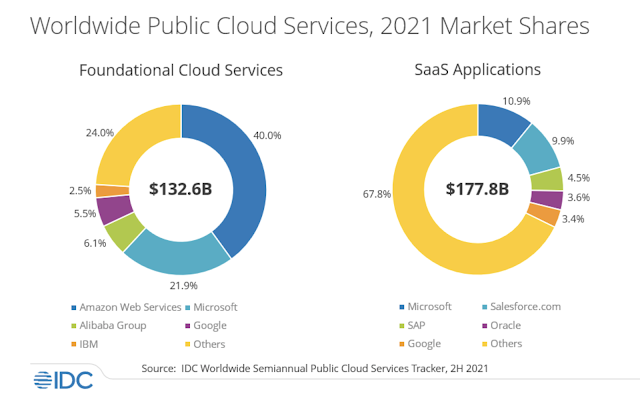
IDC: Worldwide public cloud revenues grew 29.0% in 2021

The worldwide public cloud services market, including Infrastructure as a Service (IaaS), Platform as a Service (PaaS), Software as a Service – System Infrastructure Software (SaaS – SIS), and Software as a Service – Applications, grew 29.0% year over year in 2021 with revenues totaling $408.6 billion, according to the International Data Corporation (IDC) Worldwide Semiannual Public Cloud Services Tracker.

"Organizations continued their strong adoption of shared public cloud services in 2021 to align IT investments more closely with business outcomes and ensure rapid access to the innovations required to be a digital-first business," said Rick Villars, group vice president, Worldwide Research at IDC. "For the next several years, leading cloud providers will play a critical role in helping enterprises navigate the current storms of disruption (inflation, supply chain, and geopolitical tensions), but IT teams will also focus more on bringing greater financial accountability to the variable spend models of public cloud services."

Some highlights:

  • The top 5 public cloud service providers (Microsoft, Amazon Web Services, Salesforce Inc., Google, and SAP) captured nearly 40% of the worldwide total and grew 36.6% year over year. 
  • With offerings in all four deployment categories, Microsoft captured the top position in the overall public cloud services market with 14.4% share in 2021, followed closely by Amazon Web Services with 13.7% share.
  • While the overall public cloud services market grew 29.0% in 2021, revenue for foundational cloud services* that support digital-first strategies saw revenue growth of 38.5%. 
  • IDC expects spending on foundational cloud services (especially IaaS and PaaS elements) to continue growing at a higher rate than the overall cloud market as enterprises leverage cloud to overcome the current disruptions and accelerate their shift toward digital business.

https://www.idc.com/getdoc.jsp?containerId=prUS49420022

Monday, June 27, 2022

Red Hat joins HPE GreenLake ecosystem

 Red Hat is joining the HPE GreenLake ecosystem. 

The partnership combines HPE GreenLake edge-to-cloud platform with Red Hat’s enterprise open source technologies will help address IT organizations’ need for agile technology solutions that can accelerate business outcomes and help fuel their digital transformations. 

“This extended partnership makes it easy for HPE GreenLake customers to consume and work with Red Hat’s highly regarded open source solutions. This enables our joint customers to focus on accelerating their business transformations, at a lower cost, while solving their most pressing challenges around performance, risk, and speed, without worries about integration, licenses, or product updates,” said Keith White, EVP & GM, HPE GreenLake Cloud Services Commercial Business, HPE. “We’re delivering the hybrid cloud ‘your way’ by partnering with trusted open source solutions from Red Hat.”

“Red Hat and HPE are committed to enabling greater customer choice and flexibility, as many organizations look to accelerate digital transformation efforts and expand their hybrid cloud footprints,” said Stefanie Chiras, senior vice president, Partner Ecosystem Success, Red Hat. “Red Hat’s open hybrid cloud portfolio offers a more consistent and scalable foundation for customers to optimize their cloud operations, from the datacenter to the edge. We are pleased to collaborate with HPE to integrate Red Hat technologies with HPE GreenLake platform, further supporting customer choice wherever needed.”

The HPE GreenLake edge-to-cloud platform enables customers to accelerate data-first modernization and provides over 50 cloud services that can run on-premises, at the edge, in a colocation facility, and in the public cloud. In Q2 2022, HPE reported Annualized Revenue Run-Rate (ARR) of $829 million and as-a-service orders growth of 107 percent year-over-year, the third consecutive quarter of triple digit orders growth. HPE GreenLake platform has over 1600 enterprise customers consuming cloud services today, and over 120,000 users of the platform. 

https://www.hpe.com/us/en/greenlake.html


Sunday, June 12, 2022

Reinventing networking for multi-cloud, multi-region connectivity

https://youtu.be/kX3L9hQ-ceU

Alkira's Amir Khan and Ahmed Datoo discuss the need for better enterprise networking solutions in the era of distributed applications residing in multiple clouds and regions.

Four areas of challenge: (1) Geographic expansion of the network footprint (2) Connecting applications to the cloud (3) for customers already in the cloud, there is the challenge of expanding into multiple regions in the same cloud (4) for customer who already are present in multiple regions within a single cloud, how do they expand to multiple clouds?

Here are some strategic insights from Alkira, which is a service built in the cloud to address each of these challenges. 


Wednesday, May 11, 2022

Intel's Project Amber promises to be a trust authority for edge and cloud

Intel introduced Project Amber, an independent trust authority in the form of an innovative service-based security implementation.

Intel said the foundational basis of trust in a confidential computing environment is established via a process called attestation. The verification of this trustworthiness is a critical requirement for customers to protect their data and intellectual property as they move sensitive workloads to the cloud. Project Amber is the first step in creating a new multi-cloud, multi-TEE service for third-party attestation:

  • Designed to be cloud-agnostic, this service will support confidential computing workloads in the public cloud, within private/hybrid cloud and at the edge. Interposing a third party to provide attestation helps provide objectivity and independence to enhance confidential computing assurance to users.
  • In its first version, Project Amber intends to support confidential compute workloads deployed as bare metal containers, virtual machines (VMs) and containers running in virtual machines using Intel TEEs. The initial release will support Intel TEEs, with plans to extend coverage to platforms, devices and other TEEs in the future.
  • Intel is also working with independent software vendors (ISVs) to enable trust services that include Project Amber. New software tools, such as published APIs that enable ISVs to incorporate Project Amber to augment software and services, will complement Intel’s platforms and technologies, and bring more value to customers and partners.

Intel plans to launch a customer pilot of Project Amber in the second half of 2022, followed by general availability in the first half of 2023.

“As organizations continue to capitalize on the value of the cloud, security has never been more top of mind. Trust goes hand in hand with security, and it is what our customers expect and require when delivering on Intel technology,” said Greg Lavender, chief technology officer, senior vice president and general manager of the Software and Advanced Technology Group at Intel. “With the introduction of Project Amber, Intel is taking confidential computing to the next level in our commitment to a zero-trust approach to attestation and the verification of compute assets at the network, edge and in the cloud.”

https://www.intel.com/content/www/us/en/newsroom/news/vision-2022-project-amber-security.html

Thursday, May 5, 2022

BT signs 5-year preferred cloud deal with AWS

BT’s Digital unit announced a five-year deal naming Amazon Web Services (AWS) as its preferred cloud as it transforms legacy infrastructure and internal applications to a new cloud-first architecture. 

Over the next five years, BT intends to continue to make significant investments and use of AWS technology to accelerate its digital transformation with a particular focus on application workloads via containers and serverless technologies.

“We have a big opportunity when it comes to modernising our infrastructure, and our collaboration with AWS is a key one for us as we deliver the transformation needed to accelerate BT,” comments Thomas Dücke, Chief Operating Officer, BT Digital.

Adolfo Hernandez, Vice President and General Manager, Telecom Global Industry Business Unit, AWS, says: “BT’s move to cloud-first applications can help reduce IT maintenance costs, streamline operations and help it better adapt to evolving customer needs. Plus, the AWS pay-as-you-go model offers flexibility so BT only pays for the IT needed.”

https://newsroom.bt.com/bt-signs-five-year-agreement-with-aws-as-preferred-cloud-provider-for-internal-applications-to-accelerate-its-digital-transformation/

BT and Google Cloud form strategic partnership

Google Cloud and BT announced a strategic, five-year partnership to accelerate BT’s company-wide digital transformation. The collaboration will involve BT using a suite of Google Cloud products and services—including cloud infrastructure, machine learning (ML) and artificial intelligence (AI), data analytics, security, and API management—to deliver superior customer experiences, reduce costs and risk, and build new revenue streams. The companies...

BT to implement Rackspace Fabric for multi-cloud services

BT and Rackspace Technology announced a partnership focused on multicloud management and optimization. Under the terms of the agreement, BT hybrid cloud services will be based on Rackspace Technology’s solutions, including its Rackspace Fabric management layer.Rackspace supports four primary technology stacks: AWS, Microsoft Azure, Google Cloud Platform and VMware. Rackspace Fabric is a single platform for consistent, automated cloud services,...

BT confirms Ericsson for 5G core

BT signed a deal to deploy Ericsson’s dual-mode 5G Core (Evolved Packet Core and 5G Core), a fully container-based, cloud native Mobile Packet Core for 4G, 5G Non-standalone and 5G Standalone services as a single fully integrated core. The solution, delivered on BT’s Network Cloud, will form a key component in BT’s move to a single converged IP network. It will incorporate network orchestration and automation, including continuous delivery and integration...


BT picks Juniper for virtualized telco cloud

BT has selected Juniper Networks to power its Network Cloud roll-out and enable a more flexible, virtualized network infrastructure. The Network Cloud will enable BT to combine a range of currently discrete network functions and deploy them on a cloud infrastructure that is built to a common framework and shared across the organization, throughout the UK and globally. These include services across BT’s voice, mobile core and radio/access, global...

BT picks Ciena's Blue Planet for automation software

 BT has selected Ciena's Blue Planet automation software as part of its drive to deliver market-leading user experience for its multinational enterprise customers. Blue Planet software automates the design and activation of end-to-end network connectivity, helping BT to offer superior digital experience for its customers. Deployed in BT’s cloud, Blue Planet eliminates the need for manual processes to help optimize operations, reduce costs and...


Thursday, March 31, 2022

IDC: Cloud infrastructure spending to grow 21.7% this year

Spending on compute and storage infrastructure products for cloud infrastructure, including dedicated and shared environments, increased 13.5% year over year in the fourth quarter of 2021 (4Q21) to $21.1 billion, according to the International Data Corporation (IDC) Worldwide Quarterly Enterprise Infrastructure Tracker: Buyer and Cloud Deployment. 

For the 2022, IDC is forecasting cloud infrastructure spending to grow 21.7% compared to 2021 to $90.0 billion, while non-cloud infrastructure is expected to decline slightly, down 0.3% to $59.4 billion. Shared cloud infrastructure spending is expected to grow 25.5% year over year to $64.5 billion for the full year. Spending on dedicated cloud infrastructure is expected to grow 13.1% to $25.4 billion in 2022.

Some highlights from IDC:

  • For the full year 2021, cloud infrastructure spending totaled $73.9 billion, up 8.8% over 2020.
  • Investments in non-cloud infrastructure increased 1.5% year over year in 4Q21 to $17.2 billion, marking the fourth consecutive quarter of growth. 
  • For the full year, non-cloud infrastructure spending increased 4.2% over 2020, reaching a total of $59.6 billion.
  • Spending on shared cloud infrastructure reached $14.4 billion in the fourth quarter, increasing 13.9% compared to a year ago, and grew to $51.4 billion for 2021, an increase of 7.5%. 
  • Spending on dedicated cloud infrastructure increased 12.5% year over year in 4Q21 to $6.7 billion and grew 11.8% to $22.5 billion for the full year 2021. Of the total dedicated cloud infrastructure, 47.5% in 4Q21 and 46.1% in 2021 were deployed on customer premises.
  • In 4Q21, service providers as a group spent $21.2 billion on compute and storage infrastructure, up 11.6% from 4Q20. This spending accounted for 55.4% of total compute and storage infrastructure spending. 
  • For 2021, spending by service providers reached $75.1 billion on 8.5% year over year growth, accounting for 56.2% of total compute and storage infrastructure spending. IDC expects compute and storage spending by service providers to reach $89.1 billion in 2022, growing at 18.7% year over year.

https://www.idc.com/getdoc.jsp?containerId=prUS48998722

Thursday, March 10, 2022

BT and Google Cloud form strategic partnership

Google Cloud and BT announced a strategic, five-year partnership to accelerate BT’s company-wide digital transformation. The collaboration will involve BT using a suite of Google Cloud products and services—including cloud infrastructure, machine learning (ML) and artificial intelligence (AI), data analytics, security, and API management—to deliver superior customer experiences, reduce costs and risk, and build new revenue streams. The companies plan to complete a core migration of data by 2023.

In addition, Google’s SRE team will partner with BT to foster a continuous delivery and “zero ops” autonomous operations culture to accelerate product development and continuous innovation as part of the new culture of working that BT calls “The Digital Way.”

“Our partnership with Google is one of a series of strategic moves that BT Digital is taking to help accelerate BT’s growth and digital transformation. This is a partnership that is deeper than just at the technology level. It will help Digital as a whole supercharge BT and drive its return to growth,” said Harmeen Mehta, Chief Digital and Innovation Officer, BT.

“We’re proud to collaborate with one of the world's leading providers of communications services and play an integral part in its digital transformation journey,” said Thomas Kurian, CEO at Google Cloud. “By deploying our full cloud capabilities, and support from our SRE organisation, our goal in this partnership is to set up BT with the tools it needs for future growth and innovation.” 

BT to implement Rackspace Fabric for multi-cloud services

BT and Rackspace Technology announced a partnership focused on multicloud management and optimization. Under the terms of the agreement, BT hybrid cloud services will be based on Rackspace Technology’s solutions, including its Rackspace Fabric management layer.Rackspace supports four primary technology stacks: AWS, Microsoft Azure, Google Cloud Platform and VMware. Rackspace Fabric is a single platform for consistent, automated cloud services,...

Why Service Assurance is Vital to our Multi-Cloud Future

https://youtu.be/MoglRmOW6m0Going forward, service assurance is vital for personal and business communications, says Chet Patel, BT's Chief Commercial Officer and President, BT Americas.  Continuous investment is needed, especially in AI, automation, and analytics, to ensure the best customer experience.  Here is a 1-minute perspective from San Francisco.Download the 2021 Service Assurance Report here: https://ngi.how/sa-2...