Wednesday, July 20, 2022

NEC selected for Juno transpacific cable

NEC has been contracted to build the JUNO Cable System, which is slated to be the highest capacity transpacific cable when it comes online by the end of 2024.

The project is led by Seren Juno Network Co., Ltd., a company established by NTT Ltd Japan Corporation, PC Landing Corp. Mitsui & Co. and JA Mitsui Leasing.

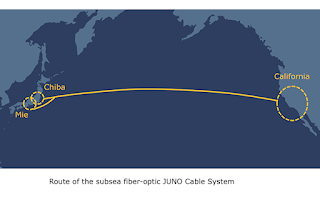
The JUNO cable will span 10,000 km between Chiba prefecture and Mie prefecture in Japan to California.

NEC plans to deploy its newly developed energy efficient repeaters and leading-edge SDM (Space Division Multiplexing) technology. This system will be able to adapt as many as 20 fiber pairs for the first time in a trans-Pacific subsea fiber-optic cable. The cable is expected to provide a maximum capacity of 350 Tbps.

NEC notes that it has been a leading supplier of submarine cable systems for more than 50 years, and has built more than 300,000 km of cable, spanning the earth nearly 8 times. As a system integrator, it  provides all aspects of submarine cable operations, including the manufacture and installation of optical submarine cables and repeaters, provision of ocean surveys and route designs, training and delivery testing. NEC's subsidiary OCC Corporation manufactures subsea optical cables capable of withstanding water pressures at ocean depths beyond 8,000 meters.

https://www.nec.com/en/press/202207/global_20220721_01.html

Sparkle activates capacity on the Monet subsea cable

Sparkle has activated spectrum capacity on the Monet submarine cable system connecting Brazil to the United States. 

The addition enhances Sparkle's regional backbone for the Americas, which now encompasses five diversified routes between North and South America. Sparkle is also present on the Seabras-1 cable system in the Atlantic and the Curie cable system in the Pacific.

Sparkle now counts 56 Points of Presence across the U.S., Argentina, Brazil, Chile, Colombia, Panama, Peru and Venezuela, a capillary presence in Brazil and a new open landing and connectivity hub in Panama.

https://www.tisparkle.com/PR-Sparkle-Adds-Monet

SkyWater Tech plans a $1.8 billion semiconductor fab at Purdue

SkyWater Technology announced its plans to build a $1.8 billion U.S. semiconductor R&D and production facility in Indiana through a public-private partnership with the state and Purdue University

The partners will pursue funding through the CHIPS (Creating Helpful Incentives to Produce Semiconductors) for America Act.

“This endeavor to bolster our chip fabrication facilities will rely on funding from the CHIPS Act. Federal investment will enable SkyWater to more quickly expand our efforts to address the need for strategic reshoring of semiconductor manufacturing,” said Thomas Sonderman, SkyWater president and CEO. “Through our alliance with the Indiana Economic Development Corporation and Purdue Research Foundation, we have a unique opportunity to increase domestic production, shore up our supply chains and lay the groundwork for manufacturing technologies that will support growing demand for microelectronics.”

“Today’s announcement marks a dramatic advance toward multiple strategic goals of Purdue’s last decade: enriched academic and career opportunities for our students; new research possibilities for our faculty; a transformed, more attractive environment on and adjacent to our campus; and the latest demonstration that Purdue and Greater Lafayette are now the hot new tech hub of a growing, diversifying Indiana economy,” said Purdue President Mitch Daniels. “Even for the place that specializes in them, this constitutes a genuine giant leap.”

https://www.purdue.edu/newsroom/releases/2022/Q3/skywater-technology-chooses-discovery-park-district-at-purdue-for-1.8b-semiconductor-fabrication-facility,-to-create-750-jobs-in-5-years.html


Quantum Loophole builds highest-density fiber route to Ashburn

Quantum Loophole broke ground on its massive QLoop network, a 43-mile fiber ring connecting the company’s 2,100+ acre Quantum Frederick data center development site in Maryland to the Ashburn, Virginia ecosystem. The network ring will offer capacity for more than 200,000 strands of fiber connecting to the Ashburn ecosystem in under one half millisecond Round Trip Time (RTT).

The QLoop fiber optic ring has received all governmental approvals for its two crossings of the Potomac River.

 Quantum Loophole will be constructing a network of conduits to connect Quantum Frederick’s two planned network centers on its Maryland data center campus where automatic, robotic cross connections powered by Telescent are planned to be installed.

 When complete, QLoop will contain in excess of thirty, 2-inch HDPE conduits placed at a depth designed to exceed security standards. When fully deployed, Telescent-enabled network centers will be capable of processing millions of cross connects from the QLoop to the on-campus conduits that deliver fiber to each data center site on the Quantum Frederick campus, thus expediting time-to-market for customers and creating a private metro system on the Quantum Frederick campus.

“We are building the largest medium haul fiber backbone that’s ever been created,” says Josh Snowhorn, Founder and CEO of Quantum Loophole. “And we are bolstering that with some pretty amazing cross-connect capabilities. Each property will have access to conduits and thousands of strands of fiber directly into the QLoop system to enable seamless, private and secure connectivity for all of our campus-wide customers.”

http://www.quantumloophole.com

Dell'Oro: Campus switch sales to exceed $95B over the next 5 years

More than $95 B will be spent on campus switches over the next five years, according to a new report from Dell'Oro Group. Multi-gigabit switches (2.5/5/10 Gbps) are expected to comprise 10 percent of the port shipments by 2026.

“Due to a number of unforeseen headwinds including lingering supply chain challenges, increased macro-economic uncertainties, higher inflation, and regional political conflict, we have lowered our forecast for 2022 and 2023 compared to our prior January report,” said Sameh Boujelbene, Senior Director at Dell’Oro Group. “At the same time, while we made this downward adjustment to our short-term forecast, we have raised the forecast figures for the outer years as we believe spending over the five-year forecast period will not decline compared to our prior forecast, but rather shift from one year to the next, depending on the supply situation and macro environment. Our interviews with system and component vendors, as well as with some of the Value-Added Resellers (VARs) and System Integrators (SIs), revealed that the fundamental growth drivers remain in place and that there is a substantial technology debt urging customers to upgrade their networks in order to support their digital transformation initiatives.

“Nevertheless, while we have maintained our forecast for revenue as well as port shipments, we have changed our port speed mix and shifted some of the volumes from 2.5/5.0 Gbps to the benefit of 1 Gbps. This adjustment is the result of a combination of supply-and-demand-related issues as explained in our report,” added Boujelbene.

Additional highlights from the Ethernet Switch – Campus 5-Year July 2022 Forecast Report:

  • Power-Over-Ethernet (PoE) ports are forecast to comprise nearly half of the total campus port shipments by 2026.
  • China is expected to recover very quickly from the recent lockdown and comprise 25 percent of campus switch sales by 2026.
  • The introduction of new software features and Artificial Intelligence capabilities are expected to increase over our forecast horizon.
  • Interest in Network-As-a-Service (NaaS) offerings is expected to rise but adoption may take time.

https://www.delloro.com/news/campus-switch-sales-to-exceed-95-b-over-the-next-five-years/

Sabey breaks ground on 40-acre data center campus near Austin

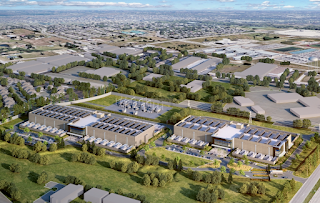
Sabey Data Centers has begun construction on a new, 40-acre data center campus in Round Rock, Texas. 

The new campus will provide up to 72-megawatt (MW) power capacity and will accommodate requirements of all sizes, including hyperscale deployments. When complete, the campus will offer 430,000 square feet of reliable colocation supported by high-density cooling, low cost of power, eight layers of security, carrier-neutral options, etc.

The target Ready for Service date is Q2 2023.

"This new market expansion reinforces the continued demand for digital capacity and is an exciting time for the Sabey organization," said Jeffrey Kanne, President and CEO of National Real Estate Advisors and Vice Chairman of Sabey Data Centers. "We look forward to deploying additional capital to support Sabey's efforts in the booming Austin tech hub."

"Sabey is dedicated to meeting our customers' increased demand for digital infrastructure and thrilled that this market expansion will pave the way for future technology developments in the region," comments Rob Rockwood, President of Sabey Data Centers. " Planning with the City of Round Rock, Round Rock Chamber, and other valued partners has been a welcoming experience. " 

http://www.sabeydatacenters.com

  • Sabey's data center portfolio includes data center campuses in Austin, Ashburn, New York City, Seattle, and Central Washington. 


T-Mobile extends 5G Home Internet across California

T-Mobile has expanded the footprint of its 5G Home Internet across California.

The fixed 5G service is now available to over six million homes throughout the state.

With the expansion, T-Mobile said more than 40 million households – a third of them in rural America – are eligible for 5G Home Internet. 

T-Mobile's 5G Home Internet is priced at $50 a month with AutoPay and no annual contract.

Availability is based on network capacity. 

https://www.t-mobile.com/isp


T-Mobile US pushes 5G Home Internet

One year after launching its fixed 5G Home Internet service, T-Mobile unveiled a number of incentives to accelerate the business under the slogan "Internet Freedom":Free Test Drive. Customers can try Home Internet for 15 days, worry-free. If they like it, great! If not, return the gateway and owe nothing. It’s 100% On Us. Because it’s wireless, they can keep their old provider while testing the T-Mobile service.T-Mobile will cover break-up fees with...

T-Mobile US expands its Fixed Wireless Access service

T-Mobile expanded the footprint of its Mobile Home Internet service to nearly 3 million more homes in 54 cities across four states: Alabama, Louisiana, Mississippi and Tennessee. “We launched T-Mobile Home Internet just a year ago, and already, we’ve disrupted the home broadband industry for good. We’re making fast, reliable, 5G Home Internet available to more than 30 million households across the country. And in Q4 of last year, we were the...


Keysight intros cloud-based Open RAN Architect Test

The Keysight Open Radio Access Network Architect (KORA) test solutions are moving to cloud-based deployment. In addition, the company’s LoadCore software for testing 5G Core (5GC), is now available as a metered, pay-as-you-go (PAYG) solution in AWS Marketplace to allow customers to scale costs with usage.

KORA is Keysight’s suite of test solutions that verify the functionality and performance of end-to-end O-RAN wireless infrastructure. A component of KORA, Keysight's LoadCore 5GC testing software enables customers to perform network capacity tests, measure device data throughput and model a wide variety of end-user behavior and mobility scenarios. A scalable 5GC network performance validation solution, LoadCore can verify that delivered connectivity service remains stable under various demanding conditions such as sudden spikes in network usage caused by disasters or other major events.

“As a cloud-based pay-as-you-go offering, users can purchase and provision KORA test solutions immediately to fit their testing needs,” said Kalyan Sundhar, vice president and general manager of 5G Edge to Core Solutions at Keysight. “This is an exciting new delivery model that offers customers the flexibility and scalability to use Keysight’s test solutions in the environment they want, in the cloud.”

https://www.keysight.com


Tuesday, July 19, 2022

OCP releases Bunch of Wires (BoW) spec for chiplet interconnect

The OCP Foundation released its Bunch of Wires (BoW) specification for Chiplet interconnect, representing a next step in the OCP Open Domain Specific Architecture (ODSA) Project's march towards establishing an open Chiplet ecosystem as a catalyst for a new silicon market place and integrated circuit supply chain model. 

BoW specifies a physical layer (PHY) optimized for System on a Chip (SoC) disaggregation, and complements OCP ODSA Open High Bandwidth Interconnect (OpenHBI) PHY specification targeting High Bandwidth Memory and other parallel bandwidth intensive use cases.

The ODSA BoW PHY specification is optimized for both commodity (organic laminate) and advanced packaging technologies, enabling cost and energy efficient, as well as high-performance designs across a wide range of process nodes. The specification was authored to allow many use cases driving significant economies of scale. Care was taken to impose as few constraints as possible and to avoid including required features in the specification that could increase design complexity when disaggregating an existing SoC.

The OCP Foundation notes that its BoW specification follow an open license model. It is already in use in at least 10 companies, including Samsung and NXP, over a dozen different use cases spanning 5, 6, 12, 16, 22 and 65nm process nodes, and covering Chiplet-based products for networking, specialized AI silicon, FPGAs, and processors. 

"The demand for specialized silicon has been increasing steadily due to workload diversity, such as with the adoption of AI and ML, and we expect this trend to continue for several years. In response to this demand the OCP recognizes that it must be a catalyst to establish open and standardized Chiplet ecosystems and new markets by investing in Chiplet interconnect technology that will enable composable silicon. The release of the BoW specification is an important step in this direction. We expect to increase our efforts on developing supply chain models for composable silicon," said Bill Carter, CTO, OCP Foundation.

"The semiconductor industry continues to innovate in new and exciting directions with multicore application specific SoCs, custom core architectures, deep learning, optical communications, analog processing techniques, RF interfaces, memory architectures and more. The new challenge is how to integrate all of these disparate innovations, several of which are not practical to produce at cutting- edge process nodes. Today's announcement from the OCP ODSA, releasing the Bunch of Wires open-source specification for Chiplet interconnect, supplies a new tool toward expanding innovation in the market. This opens the door to a more competitive landscape and diversity in innovation at varying cadences and is fuel or a healthy industry," said Tom Hackenberg, Principal Analyst, Computing & Software Semiconductor, Memory and Computing Division, Yole Intelligence.

http://www.opencompute.org

OCP 2019: New Open Domain-Specific Architecture sub-project 

The Open Compute Project is launching an Open Domain-Specific Architecture (ODSA) sub-project to define an open interface and architecture that enables the mixing and matching of available silicon die from different suppliers onto a single SoC for data center applications. The goal is to define a process to integrate best-of-breed chiplets onto a SoC. Netronome played a lead role initiating the new project. “The open architecture for domain-specific...

Dell'Oro: DWDM equipment market to surpass $17B by 2026

Demand for optical transport DWDM equipment is forecast to surpass $17 billion by 2026, according to a new report from Dell'Oro Group. Over the next five years, it is expected that DWDM long gaul system sales will grow at a faster pace than WDM Metro system sales. 

"Although there is a ton of market turbulence, we do not see demand for DWDM equipment letting up," said Jimmy Yu, Vice President at Dell'Oro Group. "In fact, the biggest issue is that demand seems to be growing faster than supply. Hence, even if a mild recession were to occur, we think the worst case scenario is that demand will align with supply sooner."

"Hence, we are projecting continuous growth for DWDM system revenues. The only difference over the next five years, compared to previous years, is that we are expecting more growth from DWDM Long Haul since IPoDWDM should lower the use of WDM Metro systems in data center interconnect," added Yu.

Additional highlights from the Optical Transport 5-Year July 2022 Forecast Report:

  • DWDM Long Haul revenue is forecast to grow at a five-year compounded annual growth rate (CAGR) of 5 percent.
  • WDM Metro revenue is forecast to grow at a five-year CAGR of 3 percent.
  • Capacity shipments each year are projected to grow at an average annual rate of 30+ percent.
  • Spectral efficiency is expected to improve at an average annual rate of 9 percent.

https://www.delloro.com/news/optical-transport-dwdm-equipment-market-to-surpass-17-billion-by-2026/

Verizon starts rollout of 100 MHz of C-band spectrum

Verizon has started deploying with 100 MHz of C-band spectrum in many markets across the US – a significant increase from the 60 MHz it has deployed in 5G markets to date.

In the recent trial, using 100 MHz of C-band spectrum, engineers were able to reach 1.4 Gbps peak download speeds near active cell sites and 500 Mbps further away from the towers.


Verizon said the rollout is occurring several months earlier than expected due to agreements with satellite providers to clear C-Band spectrum (which was originally scheduled to be cleared in December 2023).  As more spectrum is cleared in the coming months and years, Verizon customers ultimately will have access to between 140-200 MHz of C Band spectrum across the nation.

“This increase from using 60MHz to 100 MHz of C-band – which we will ultimately have available in many markets across the US  – allows us to support more network traffic, deliver even better performance to our customers and add new products and services on top of the mobile and fixed wireless access solutions we provide today,” said Kyle Malady, EVP and President, Global Networks and Technology.  “Reaching new levels of innovation and digital transformation in our society requires a fundamental transformation of the networks our world runs on. The continued evolution of our network is paving the way for this tremendous growth.”

https://www.verizon.com/about/news/verizon-adds-spectrum-faster-speeds-better-performance-greater-availability-5g-uw 

Openreach rolls out ADVA’s next-gen edge for Ethernet services

Openreach, has deployed ADVA's next generation of edge technology to support Ethernet Access Direct (EAD) services to customers throughout the UK. 

Openreach’s new infrastructure features the ADVA FSP 150-XG100Pro Series, a MEF 3.0-certified, 10Gbit/s programmable demarcation and aggregation platform. It enables Openreach to offer Carrier Ethernet and IP services with a range of bandwidth options from 100Mbit/s to 10Gbit/s. The new technology supports highly precise synchronization with hardware-based SyncE and PTP. It is managed by the Ensemble Controller suite, enabling integration into Openreach’s existing network. Openreach also offers optical spectrum services exceeding 10Gbit/s to allow movement of large amounts of data around the UK.

The rollout extends a longstanding relationship with ADVA. Over 250,000 Openreach circuits are deployed using the ADVA FSP 150.

“We’re continuing our close relationship with ADVA as we roll out the next generation of our Ethernet services. Over the past 10 years, ADVA’s technology has played a major part in the success of our EAD portfolio. It’s enabled service providers across the country to bring new offerings to the market while helping us establish the finest reputation for quality and reliability,” said Mark Logan, director of products at Openreach. “Through working with ADVA, we can enable our customers with flexible high-bandwidth point-to-point connectivity.”

“Openreach has gone from strength to strength in recent years, enabling many service providers to expand their UK networks and bring high-quality connectivity to millions of customers. We’re proud of our close connection with the Openreach team and are excited that they’ve chosen to continue our partnership,” commented Hartmut Müller-Leitloff, SVP of sales EMEA at ADVA. “Even in a time of global supply chain challenges and component shortages, our customers know that no one else does more than ADVA to make sure we deliver. We’ll carry on supporting Openreach every step of the way throughout its next decade of success.”

https://www.adva.com/en/newsroom/press-releases/20220719-openreach-rolls-out-adv-as-next-gen-edge-devices-as-part-of-its-ethernet-services

Augtera unveils its AI/ML-powered NetOps for data centers

 Augtera Networks, a start-up based in Palo Alto, California, unveiled its AI/ML-powered Network Operations platforms for data centers.

“Over the last three years we have partnered with some of the largest Data Center Network Operations teams to refine our solution,” said Rahul Aggarwal, Founder and CEO of Augtera Networks. “Our AI/ML algorithms have been specialized for Data Center networks and customers are seeing dramatic improvement in KPIs such as detection, mitigation, and repair. Most importantly, our technology reduces the total number of incidents that are actioned, resulting in operations teams not just running faster, but running smarter and more effectively.”

Augtera Networks Data Center Solution:

  • Proactive detection of environmental and optical degradation
  • Anomaly detection for aggregates such as a POD, fabric, or Data Center interconnects
  • Fabric, server, and Hybrid Cloud, latency, and loss anomaly detection
  • Flow analysis including Hybrid Cloud
  • Fabric congestion impact on application sessions
  • VXLAN and EVPN underlay / overlay insights including ECMP analysis
  • Firewall and Load Balancer anomalies
  • Multi-vendor support including Arista Networks, Cisco Systems, Juniper Networks, Dell Enterprise SONiC, F5, Palo Alto Networks, VMWare, and any equipment using industry-standard interfaces
  • Integrations including Amazon Web Services, Azure, Google Cloud Platform, ServiceNow, and Slack.

The solution includes capabilities that come standard with all Augtera Networks solutions including:

  • Holistic data ingestion
  • Automated creation of operationally relevant trouble tickets
  • Policy-driven auto-correlation and noise elimination
  • AI/ML-based anomaly & gray failure detection
  • Topology auto discovery
  • Multi-layer, topology-aware, auto-correlation
  • Topology-mapped “Time-machine” visualization of metrics, events, & anomalies
  • Real-Time Syslog anomaly detection including Zero-Day anomalies
  • DevOps friendly APIs

https://augtera.com/


At the ONUG Spring 2022 event, a key topic of discussion was the critical staff shortages faced by IT departments. Optimizing network operations has become a priority. John Heinz, Director of Sales Engineering at Augtera, discusses how machine learning and automation can reduce time to root cause detection and thus help alleviate the staffing shortage.


Rambus expands its line of DDR5 memory interface chips

Rambus has expanded its DDR5 memory interface chip portfolio with the addition of the Rambus SPD (Serial Presence Detect) Hub and Temperature Sensor, complementing its Registering Clock Driver (RCD), to deliver high-performance, high-capacity memory solutions for DDR5 computing systems. Both the SPD Hub and Temperature Sensor are critical components on a memory module that sense and report important data for system configuration and thermal management. The SPD Hub is used in both server and client modules, including RDIMMs, UDIMMS and SODIMMS, and the temperature sensor is designed for server RDIMMs.

“The new performance levels of DDR5 memory place an increased premium on signal integrity and thermal management for server and client DIMMs,” said Sean Fan, chief operating officer at Rambus. “With over 30 years of memory subsystem design experience, Rambus is ideally positioned to deliver DDR5 chipset solutions which enable breakthrough bandwidth and capacity for advanced computing systems.”

Key features of the SPD Hub (SPD5118) include:
  • I2C and I3C bus serial interface support Advanced reliability features 
  • Expanded NVM space for customer-specific applications 
  • Low latency for fastest I3C bus rates 
  • Integrated temperature sensor 
  • Meets or exceeds all JEDEC DDR5 SPD Hub operational requirements (JESD300-5A) 

Key features of the Temperature Sensor (TS5110) include:
  • Precision thermal sensing I2C and I3C bus serial interface support 
  • Low latency for fastest I3C bus rates 
  • Meets or exceeds all JEDEC DDR5 Temperature Sensor operational requirements (JESD302-1.01)

https://www.rambus.com/rambus-expands-portfolio-of-ddr5-memory-interface-chips-for-data-centers-and-pcs/

Rambus samples 5600 MT/s DDR5 registering clock driver

Rambus has begun sampling its 5600 MT/s 2nd-generation registering clock driver (RCD) chip to the major DDR5 memory module (RDIMM) suppliers. This new level of performance represents a 17% increase in data rate over the first-generation 4800 MT/s Rambus DDR5 RCD. Rambus said it is able to deliver 5600 MT/s performance at lower latency and power while optimizing timing parameters for improved RDIMM margins.“The RCD is a mission-critical...


Verizon lands $400M contract with FBI

The Federal Bureau of Investigation (FBI) has awarded a $400 million Enterprise Infrastructure Solutions (EIS) task order to Verizon Public Sector to help the agency meet increasing demands for data bandwidth around the globe.

Under the contract, Verizon will provide Ethernet access capabilities and a resilient global Virtual Private Network Services (VPNS) with a Verizon 4G LTE and 5G Nationwide cellular fixed wireless access arrangement, enabling the move to wireless connections provisioned on-demand for faster deployment at FBI locations, and support for high-speed connectivity for FBI agents working in the field.

Verizon’s EIS task order with the FBI includes 24/7 direct access to Verizon’s IT development team to address critical problems or discuss potential system enhancements, enabling the FBI to support a wide range of applications, such as cloud computing, video and imaging transmissions, and data applications that drive demand for dynamic bandwidth capacity.

“We understand the critical nature of the work we will do with the FBI to improve network availability, enhance operational efficiency, use tailored approaches to meet individual division needs, and help modernize technology,” said Maggie Hallbach, Senior Vice President, Public Sector at Verizon. “Building on nearly 20 years of partnership with the Bureau, this next phase will provide stable solutions and a modern network that is faster, more scalable and secure that will help the FBI achieve its mission.”

https://www.verizon.com/about/news/verizon-awarded-over-400m-modernization-contract-fbi

Liberty Global names CommScope as DOCSIS 4.0 partner

Liberty Global has selected CommScope to develop and deploy a Remote MACPHY Device (RMD) Node platform for DOCSIS 4.0 (D4.0), accelerating Liberty Global’s progress towards 10G capabilities.  

This project marks the industry’s first D4.0 initiative in Europe and leverages CommScope’s DOCSIS leadership and end-to-end portfolio of solutions to deliver a new custom node and RMD platform specifically for Liberty Global. The RMD Node platform for D4.0 will simplify Liberty Global’s hybrid fiber-coaxial (HFC) network transformation to deliver multi-gigabit services—in turn providing its subscribers with seamless access to new high-bandwidth, low-latency services and enabling Liberty Global to ultimately achieve 10G capabilities on the HFC network cost-effectively.


“Our groundbreaking D4.0 project is an important step forward in our 10G vision for the future,” stated Colin Buechner, Managing Director and Chief Network Officer, Liberty Global. “We selected CommScope to extend the capabilities of our HFC network into the next decade, because of their proven leadership and expertise in DOCSIS and next-generation networks. Together, we are laying the path to tomorrow’s multi-gigabit services and providing our subscribers across Europe with the world’s most advanced and reliable services.”

“We are excited to partner with Liberty Global once again as we demonstrate our worldwide leadership in DOCSIS,” said Guy Sucharczuk, SVP and President, Access Network Solutions, CommScope. “Our long-standing partnership with Liberty Global uniquely positions us to deliver end-to-end D4.0 solutions specific to its HFC network. This is a showcase for the global transformation of HFC into tomorrow’s 10G networks, and we’re excited to deploy this technology in Europe and beyond.”

https://www.commscope.com/press-releases/2022/liberty-global-selects-commscope-as-docsis-4.0-technology-partner/

AT&T announces $13m broadband fiber project in Indiana

AT&T has been selected for a $13 million project with the State of Indiana to bring fiber broadband to nine counties. 


The Next Level Connections Broadband project, which is contingent upon a final contract between the state of Indiana and AT&T, will connect nearly 6,100 homes, businesses and farm.

"It's tremendous seeing how our Next Level Connections efforts are helping Hoosier families and business owners obtain access to high-speed, quality broadband," said Indiana Lt. Gov. Suzanne Crouch, who also serves as Indiana's Secretary of Agriculture and Rural Affairs. "This project would bring fiber-based internet to thousands who couldn't get it before, and we're grateful for AT&T's plans for these communities."

AT&T looks to ramp investment in 5G and fiber

 AT&T is setting its sights on becoming "America's best broadband provider" based on a strategy of owning and operating both fiber and wireless. In light of closing its pending WarnerMedia transaction with Discovery, AT&T updated its financial expectations for 2022 and 2023, saying it will shift Capex to fiber and 5G.“Now that the close of the WarnerMedia deal is approaching, we are near the starting line of a new era for AT&T,”...

DigitalBridge appoints Tae Ahn as MD of Asia Capital Formation

DigitalBridge Group appointed Tae E. Ahn as Managing Director and Head of Asia Capital Formation at DigitalBridge Investment Management. Based in Singapore, he will work alongside DigitalBridge’s existing team with a focus on capital formation, coinvestment and client relationship management across Asia-Pacific.

Prior to joining DigitalBridge, he served as Senior Client Relationship Manager and Head of Korea at global private markets firm Partners Group. In that role, which he held for seven years, Mr. Ahn led fundraising, client relationship management and deal sourcing. Mr. Ahn holds a B.A. from the University of Michigan and a Masters in International Economic Policy from Columbia University.

www.digitalbridge.com

DT to sell 51% stake in towers business to Digital Bridge and Brookfield

Deutsche Telekom will sell 51 percent of GD Towers comprising its tower assets in Germany and Austria, to Digital Bridge and Brookfield at 17.5 billion euros enterprise value on a cash and debt free basis. With around 800 employees, GD Towers operates more than 40,000 sites in Germany and Austria and has a successful track record in delivering new sites for its anchor tenant Telekom Deutschland and securing revenues with third party customers....

Swiss Life-led Consortium to acquire 27% equity Interest in DataBank

DigitalBridge Group will sell an equity stake in its DataBank company to a consortium led by Swiss Life Asset Management AG and EDF Invest.DataBank’s portfolio consists of more than 65 data centers, 20 interconnection hubs in more than 27 markets, on-ramps to an ecosystem of cloud providers, and a modular edge data center platform.Under the terms of the agreement, SLAM and EDF will acquire 27% of the fully diluted equity interests in DataBank for...

DigitalBridge to acquire Switch for $11 billion for its data centers

DigitalBridge Group agreed to acquire Switch, a leading colocation data center operator, for $34.25 per share in an all-cash transaction valued at approximately $11 billion, including the assumption of debt.Switch, which was founded in 2000, operates SuperNAP data center campuses in Las Vegas, Reno, and Grand Rapids, Michigan. The company touts its high-resiliecy and high-security designs for mission critical workloads in its "Class 5" data centers....


Ethernet Alliance offers Power over Ethernet certification testing in Taipei

The Ethernet Alliance announced Power over Ethernet (PoE) Certification Gen 2 testing in Taipei, Taiwan, with UL Solutions. 

Manufacturers of PoE devices can now pursue Gen 1 and Gen 2 certification via third-party testing at labs in both Asia and North America, as well as testing at their own facilities with Ethernet Alliance-approved equipment.

https://ethernetalliance.org/blog/2022/07/19/ul-solutions-approved-for-gen2-poe-certification-testing/


Monday, July 18, 2022

FCC prorates grants under Rip-n-Replace at 39%

 The FCC has begun approving reimbursements for the removal and replacement of equipment from Huawei and ZTE under the Secure and Trusted Communications Networks Reimbursement Program (Reimbursement Program).

The Reimbursement Program is funded by a $1.9 billion congressional appropriation.

In February, FCC Chairwoman Jessica Rosenworcel first notified Congress that providers initially requested approximately $5.6 billion under the program.

Because demand for program support exceeds available funding, the FCC confirmed that it is implementing a prioritization scheme that requires funding to be allocated first to approved applicants that have 2,000,000 or fewer customers (Priority 1).

After review of the submitted applications, the FCC has determined that Priority 1 applicants have submitted approximately $4,640,284,672 in cost estimates that are reasonable and supported. 

Because available funding is substantially less than that amount, the Commission rules require that allocations to Priority 1 applicants be prorated on an equal basis. The pro-rata factor applied to those allocations is approximately 39%.

https://www.fcc.gov/document/fcc-announces-supply-chain-reimbursement-program-approved-applications

FCC sees strong demand for Rip-n-Replace as requests top $5.6 billion

 FCC Chairwoman Jessica Rosenworcel notified Congress that providers have initially requested approximately $5.6 billion from the Secure and Trusted Communications Networks Reimbursement Program to cover the costs of removing, replacing, and disposing of insecure equipment and services in U.S. networks.“Last year Congress created a first-of-its kind program for the FCC to reimburse service providers for their efforts to increase the security...

Biden signs Secure Equipment Act

President Biden signed into law the “Secure Equipment Act of 2021,” which requires the Federal Communications Commission to adopt rules clarifying that it will no longer review or approve any authorization application for equipment that poses an unacceptable risk to national security.The bill would prevent further integration and sales of Huawei, ZTE, Hytera, Hikvision, and Dahua – all Chinese state-backed or directed firms – in the U.S. regardless...