Showing posts with label Verizon. Show all posts

Sunday, December 11, 2022

Verizon deploys its first Ericsson VRAN cell site

Verizon activated its first Ericsson virtualized cell site (also referred to as Ericsson Cloud RAN), with support from Intel and RedHat providing the processing and cloud-native orchestration functions. 

Ericsson provided its commercial 5G Cloud RAN solution, consisting of a virtualized Central Unit (vCU), a virtualized Distributed Unit (vDU), and radio units. This software-based 5G Cloud RAN solution spans across all of Verizon’s frequency bands, utilizing both FDD and TDD 5G spectrum assets, including Massive MIMO support for C-band and interconnecting previously deployed equipment to enable Ericsson Spectrum Sharing between LTE and NR carriers. The Ericsson Cloud RAN solution offers Verizon efficiency and in network deployment and operational management transformation.

Intel provided its 3rd Gen Intel Xeon Scalable processor, Intel vRAN Dedicated Accelerator ACC100 and Intel Ethernet Network Adapter E810 to deliver the processing, acceleration and connectivity requirements.

Red Hat provided Red Hat OpenShift and Red Hat Advanced Cluster Management for Kubernetes to manage their fleet at scale in collaboration with Red Hat Consulting. As part of the solution, Red Hat Advanced Cluster Management delivers cloud-scale manageability by configuring the 5G RAN using a Distributed Unit (DU) profile, which deploys real-time OS kernel optimizations to run vRAN and other cloud-native application workloads from a single console. Red Hat OpenShift also incorporates zero-touch provisioning to enable distributed deployment at scale required to operate a large scale RAN.

Verizon said Radio Access Network virtualization enables it to rapidly respond to customers’ varied latency and computing needs. 

Virtualizing the far edge of the RAN – the cell sites closest to the customer - is a function of decoupling the hardware and software associated with a cell tower and transitioning the software so that it’s not just stored in the cloud, but is designed for a cloud-native architecture and operation.

Verizon recently confirmed that irecently it has 8,000 cell sites already virtualized in its network with an eye towards virtualizing 20,000 sites.

https://www.verizon.com/about/news/verizon-expands-vran-leadership-position

Verizon begins C-band rollout with Ericsson and Samsung

Verizon confirmed that the installation of C-band equipment from Ericsson and Samsung Electronics Co. is now underway. Ericsson is providing its Antenna-Integrated Radio (AIR) product, which features a massive Multiple Input Multiple Output (MIMO) architecture with Ericsson Uplink Booster and advanced beamforming technology.  Samsung is also supplying Massive MIMO radios and fully virtualized RAN (vRAN) solutions.Verizon secured an...

Verizon completes fully virtualized 5G data session
Verizon recently completed an end-to-end fully virtualized 5G data session in a live network. Verizon's demonstration of virtualization in the Radio Access Network tested technology from several partners, including: Samsung provided its commercial 5G virtualized RAN solution, consisting of a virtualized Central Unit (vCU), a virtualized Distributed Unit (vDU), and radio units. The solution can provide mobile operators with improved efficiency,...


Monday, December 5, 2022

Verizon's C-band rollout is ahead of schedule

Verizon now covers more than 175 million people with their ultra fast, ultra reliable 5G Ultra Wideband service, and will offer nationwide 5G Ultra Wideband in Q1 2023. 

Verizon confirmed that its ongoing C-Band rollout is a full 13 months ahead of the original schedule.

Less than 21 months after announcing the results of the FCC’s C-band auction and after securing early access to an additional 30 markets this year, Verizon accelerated its build plan and surpassed its goal of reaching 175 million people covered by the end of 2022, a month ahead of schedule.

“Our customers don’t stand still and neither does our network. Today, more than one out of every two Americans now have access to 5G Ultra Wideband. We know our customers rely on our service every day and we work for them – continuously enhancing, expanding and improving our wireless network,” said Hans Vestberg, Chairman and CEO of Verizon. “And as proud as I am to have crossed this milestone, I am equally proud of the way we are building our network – with the most advanced technologies, industry leading security, a robust fiber underpinning and a robust and varied spectrum portfolio. We are building this right. We are building this as a platform for innovation for years to come.”

Verizon’s 5G Ultra Wideband supports download speeds up to 1 Gbps.

In addition to providing greater coverage, especially in rural and suburban areas, Verizon will also enhance capacity by activating 100 MHz of C-Band spectrum in many markets, a significant step up from the 60 MHz of spectrum available when deployment first began. Once all of its licensed spectrum is made available, Verizon will have up to 200 MHz of C-Band spectrum deployed in many markets, which will provide exceptional speed and capacity.

Verizon is continuing to deploy 5G on mmWave spectrum in areas with significantly dense populations such as venues, stadiums, arenas, airports, major metro areas, office complexes, etc. mmWave will also continue to be used for private network deployments.

Verizon also highlighed progress in fully deploying the 5G core with its proprietary cloud platform built specifically for telco workloads, advancing the fiber network to handle exponential increases in data traffic, continuing massive virtualization of the network to add programmability and flexibility into the network, using artificial intelligence to drive reliability and performance, continuing to develop edge computing capabilities to drive down latency, and continuing to advance antenna configurations to drive speed and efficiency.

https://www.verizon.com/about/news/verizon-continues-deploy-5g-ultra-wideband-faster

Ericsson and Verizon sign multi-year $8.3 billion 5G deal

Ericsson confirmed a multi-year 5G supply agreement with Verizon valued at $8.3 billion.Under the agreement, Verizon will deploy Ericsson's 5G MIMO C-band, low-band and millimeter wave (mmWave) solutions to enhance and expand Verizon's 5G Ultra Wideband coverage, network performance and user experience. Ericsson's technology solutions, including Massive MIMO, Ericsson Spectrum Sharing and Ericsson Cloud RAN, complement the high-performing Ericsson...

Verizon begins C-band rollout with Ericsson and Samsung

Verizon confirmed that the installation of C-band equipment from Ericsson and Samsung Electronics Co. is now underway. Ericsson is providing its Antenna-Integrated Radio (AIR) product, which features a massive Multiple Input Multiple Output (MIMO) architecture with Ericsson Uplink Booster and advanced beamforming technology.  Samsung is also supplying Massive MIMO radios and fully virtualized RAN (vRAN) solutions.Verizon secured an...

Verizon activates C-band spectrum

Verizon activated C-band spectrum to boost its 5G Ultra Wideband network, which is now available to more than 100 million people in 1,700-plus cities around the nation.“This massive launch will put incredible speeds, reliability and security in the hands of our customers and amplifies our offering of reliable home and business broadband options to more places around the country, well ahead of the commitment we made last year,” said Hans Vestberg,...

Verizon serves nearly 48% of its cell sites with owned fiber

Verizon now connects nearly 48% of its cell sites with its own deployed fiber optic cables and is on track to reach about 50% by the end of this year.In June Verizon announced that data traffic on its 5G Ultra Wideband network had already increased 249%, and it expects continued increases as more customers adopt the new technology and begin to experience the robust capabilities and performance of 5G Ultra Wideband. Verizon has also announced...


Sunday, October 23, 2022

Verizon's 2022 CAPEX so far hits $15.8 billion

Verizon reported total revenue of $34.2 billion for Q3 2022, an increase of 4.0 percent from third-quarter 2021. Net income was $5.0 billion, a decrease of 23.3 percent from third-quarter 2021, and adjusted EBITDA1 of $12.2 billion, down 0.4 percent year over year.

"We took a number of actions in the third quarter that helped drive improved operational and financial performance, but we know there's still more work to be done," said Verizon Chairman and CEO Hans Vestberg. "The pricing actions we took earlier this year, as well as our new cost savings program, show that we are being deliberate and strategic in our decisions to strengthen our business. At the same time, we are focused on executing our 5G strategy, as we are covering every major market and accelerating our C-Band network build. We are on track to reach 200 million POPs within first-quarter 2023."

Highlights

Capital expenditures year-to-date were $15.8 billion, including C-Band spending of $4.5 billion.

Wireless: 

  • Total wireless service revenue of $18.8 billion, a 10.0 percent increase year over year.
  • Total retail postpaid churn of 1.17 percent, and retail postpaid phone churn of 0.92 percent.
  • Postpaid phone net additions of 8,000. 

Broadband:

  • Total broadband net additions of 377,000, including 342,000 fixed wireless net additions, reflecting a strong demand for reliable and high-value broadband offerings. Total broadband net additions increased 109,000 from second-quarter 2022, and fixed wireless net additions increased 86,000 from second-quarter 2022.
  • More than 40 million households covered by fixed wireless in third-quarter 2022, including over 30 million households covered by 5G Ultra Wideband. 
  • 61,000 Fios Internet net additions, an increase from 36,000 Fios Internet net additions in second-quarter 2022. 

Thursday, October 13, 2022

Verizon moves commercial traffic onto its 5G core

Verizon has begun moving customer traffic onto its new cloud-native, containerized 5G core.

The Verizon Cloud Platform (VCP), on which the 5G core is built, is based on a Webscale software architecture with advanced technologies designed specifically for telco workloads. VCP is a distributed platform that supports edge services, private cloud services, Network Function Virtualization tools, Cloud Native Functions, Web applications, mapping and spatial analysis tools, orchestration tools, service assurance tools, auto-remediation, and compute offerings. 

In addition to network slicing and dynamic resource allocation, Verizon cites the following benefits for its new 5G core:

  • Real-time resource management of Radio Access Network and core virtual container-based network functions
  • Advanced analytics of network data to improve network performance
  • Optimized services between Verizon's fixed and mobile networks
  • Scalable, more cost-efficient architecture
  • Ability to move workloads to fit use case requirements

Veizon said this architecture will enable it to achieve new levels of operational automation and adaptability to create differentiated customer experiences. This directional technology platform that enables MEC will support stand alone, non-stand alone, and VoNR services.

“Our mission has always been to build and operate the best, most reliable, highest performing, and secure networks in the world,” said Adam Koeppe, Senior Vice President of Network Technology, Strategy, and Planning at Verizon. “The 5G Core is a critical step in achieving our goal. From the densification and virtualization work in the Radio Access Network, to the architectural design changes in the core of the network developed specifically for telco workloads, we are working to ensure customers not only have access to 5G, but have the most advanced, secure, and robust network to support the remarkable new solutions being developed on 5G technology.”

“Bringing traffic onto the newly designed core coincides with the ecosystem development around us. With a critical number of customers now having devices that can access the advanced features of the 5G core and the solutions and applications development – especially for enterprise customers – really taking off, now is the ideal time to move traffic onto the new core,” said Koeppe.

https://www.verizon.com/about/news/verizon-moves-commercial-traffic-5g-core

Verizon has deployed 8,000 virtualized cell sites 

Verizon has now deployed over 8,000 virtualized cell sites with a goal of deploying over 20,000 by the end of 2025. “We are building the network with the most advanced technology available, because we know people rely on our network and we are committed to delivering the variety and quality of services our customers need,” said Adam Koeppe, Senior Vice President of Planning and Technology at Verizon. “Even while driving the most aggressive network...

Verizon upgrades its core network for 400G with Juniper's PTX series

Verizon is refreshing its core network with Juniper Networks' PTX series routers supporting 400G interfaces. Verizon said the new equipment is half the size of the existing equipment, reducing space requirements in core facilities and driving down both power usage per GB and cost per GB to operate. In addition, the new equipment offers an advanced level of automation, allowing for automated interfaces with other network systems.Verizon also...


Wednesday, October 5, 2022

Verizon lands $1.58B contract to update U.S. embassies

Verizon has been awarded a new Enterprise Infrastructure Solutions (EIS) contract to modernize the global communications infrastructure and provide IT services for each of the Department of State’s (DOS) U.S. embassies, consulars, and other key locations around the globe.

The contract, worth $1.58 billion over the next 10 years, includes implementation and management of network solutions for the Department’s non-domestic footprint, including Asia, Africa, the Middle East and South America. This includes technology and network infrastructure for embassies in nearly 260 locations across the globe.

“We are uniquely qualified to provide the Department of State with powerful solutions to their global network consolidation and management needs,” said Maggie Hallbach, Senior Vice President, Public Sector at Verizon. “We have supported the Department of Defense and other national security and civilian customers with global critical infrastructure and communications for more than three decades.”

The contract includes a proven management approach using experienced Verizon Public Sector teams, clear processes and technology-enabled tools to deliver all service on time and according to service performance standards.

https://www.verizon.com/about/news/verizon-lands-task-order-dept-of-state

Monday, October 3, 2022

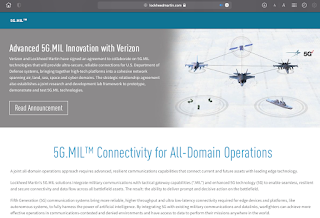
Lockheed Martin and Verizon demo 5G.MIL drones

Lockheed Martin and Verizon demonstrated 5G-enabled drones for capturing and securely transfering real-time intelligence, surveillance and reconnaissance (ISR) data from aircraft in flight. 

The demonstration, which occurred at Lockheed Martin’s 5G test range in Waterton, Colorado, used mmWave 5G to move data from aircraft in flight over Lockheed Martin’s multi-site, multi-vendor 5G.MIL pilot network.

Lockheed Martin flew four rotary wing drones on coordinated ISR missions while linked to two Verizon On Site Private Network nodes. The companies then seamlessly and securely moved the data captured by the drones between a 5G private network and a surrogate public network. 

The companies said the ability to use private and public 5G networks is key because it will extend the reach of 5G.MIL technology to a range of military environments where commercial networks may not be available or appropriate.

The drones then successfully located a target in the field that was transmitting a low power RF signal. The signal was detected because real-time drone sensing data was transmitted over the Verizon network and then processed by advanced signal processing algorithms running on edge compute resources, enabling geolocation of the signal source.

“To stay ahead of our adversaries, military decision-makers need the timely and accurate information that 5G.MIL delivered in this demonstration,” said Dan Rice, vice president of 5G.MIL Programs at Lockheed Martin. “By blending advanced commercial 5G capabilities with military capabilities using secure, open standards, we are helping to make the DOD’s vision for integrated deterrence a reality.”

“Verizon is the network America relies on, and our Private 5G Ultra Wideband networks provide the security, reliability, capacity and low latency that the defense sector depends on,” said Srini Kalapala, Senior Vice President for Technology and Product Development at Verizon. "By demonstrating the mission critical connectivity that our network provides, we are demonstrating how 5G and edge computing can help the DOD address their strategic priorities and continue to develop advanced solutions.”

https://www.verizon.com/about/news/lockheed-martin-verizon-demonstrate-5g-connected-isr

Black Hawk flight data transferred via AT&T 5G

In a test conducted last month at Lockheed Martin's Sikorsky headquarters in Stratford, Connecticut, AT&T securely and rapidly transferred UH-60M Black Hawk health and usage data through an AT&T 5G private cellular network and Lockheed Martin's 5G.MIL multi-site pilot network.The AT&T 5G millimeter wave private cellular network wirelessly transferred data to the 5G.MIL network through ground support equipment from the Black Hawk's Integrated...


Lockheed Martin and Keysight test 5G.MIL for aerospace/defense

Lockheed Martin and Keysight Technologies are actively collaborating on a 5G.MIL testbed that Lockheed Martin teams will use to advance 5G capabilities for multiple aerospace and defense applications. The testbed, which reached initial operational capability in July, will help Lockheed Martin’s 5G.MIL teams quickly verify interoperability and performance with a wide range of 5G assets and simulate reliable and secure communications. Since that...

Verizon and Lockheed Martin collaborate on 5G.MIL

Verizon (NYSE: VZ) and Lockheed Martin are collaborating on 5G.MIL technologies that will provide ultra-secure, reliable connections for U.S. Department of Defense systems , bringing together high-tech platforms into a cohesive network spanning air, land, sea, space and cyber domains. The companies highlighted a joint demonstration that used a Verizon private 5G network installed at Lockheed Martin Space’s 5G Test Range in Colorado, connected...


Monday, September 12, 2022

Verizon serves nearly 48% of its cell sites with owned fiber

Verizon now connects nearly 48% of its cell sites with its own deployed fiber optic cables and is on track to reach about 50% by the end of this year.

In June Verizon announced that data traffic on its 5G Ultra Wideband network had already increased 249%, and it expects continued increases as more customers adopt the new technology and begin to experience the robust capabilities and performance of 5G Ultra Wideband. 

Verizon has also announced plans to upgrading older router equipment with new equipment capable of 400 Gbps per port. 

https://www.verizon.com/about/news/owned-fiber-increases-reliability-improves-performance

Verizon upgrades its core network for 400G with Juniper's PTX series

Verizon is refreshing its core network with Juniper Networks' PTX series routers supporting 400G interfaces. Verizon said the new equipment is half the size of the existing equipment, reducing space requirements in core facilities and driving down both power usage per GB and cost per GB to operate. In addition, the new equipment offers an advanced level of automation, allowing for automated interfaces with other network systems.Verizon also...

Verizon activates C-band spectrum

Verizon activated C-band spectrum to boost its 5G Ultra Wideband network, which is now available to more than 100 million people in 1,700-plus cities around the nation.“This massive launch will put incredible speeds, reliability and security in the hands of our customers and amplifies our offering of reliable home and business broadband options to more places around the country, well ahead of the commitment we made last year,” said Hans Vestberg,...


American Tower and Verizon sign new lease agreement

American Tower and Verizon Communications signed a new overarching lease agreement, facilitating Verizon’s on-going 5G network deployment across American Tower’s extensive U.S. portfolio of communications sites. The companies said the deal provides a simplified and efficient leasing process through a contractual framework that will drive mutual growth and value over a multi-year period.“This agreement represents another key milestone and an...

Verizon starts rollout of 100 MHz of C-band spectrum

Verizon has started deploying with 100 MHz of C-band spectrum in many markets across the US – a significant increase from the 60 MHz it has deployed in 5G markets to date.In the recent trial, using 100 MHz of C-band spectrum, engineers were able to reach 1.4 Gbps peak download speeds near active cell sites and 500 Mbps further away from the towers.Verizon said the rollout is occurring several months earlier than expected due to agreements with satellite...

FAA reaches agreement with AT&T and Verizon

 The FAA reached an agreement with Verizon and AT&T on 5G in C-Band spectrum near airports. "The FAA appreciates the strong communication and collaborative approach with wireless companies, which have provided more precise data about the exact location of wireless transmitters and supported more thorough analysis of how 5G C-band signals interact with sensitive aircraft instruments. The FAA used this data to determine that it is possible...

Verizon has deployed 8,000 virtualized cell sites

Verizon has now deployed over 8,000 virtualized cell sites with a goal of deploying over 20,000 by the end of 2025. 

“We are building the network with the most advanced technology available, because we know people rely on our network and we are committed to delivering the variety and quality of services our customers need,” said Adam Koeppe, Senior Vice President of Planning and Technology at Verizon. “Even while driving the most aggressive network deployment in our company’s history, we know giving people access to 5G is only part of the winning equation.”

Verizon anticipates that key 5G use cases will heavily rely on the programmability of virtualized networks. The company also the following networking developmentsL

  • ORAN - Disaggregating the hardware and software functions on the network through widespread virtualization creates the foundation for ORAN. ORAN is an evolution of the virtual network architecture with the potential to bring many benefits in terms of deployment flexibility, faster innovation in an open environment, and greater service options by increasing the opportunity for new entrants to provide competitive and advanced solutions. More competition, more innovation, and increased supplier diversity will all be a net benefit to operators and consumers. 
  • Advanced antenna configurations - Verizon continues to drive antenna efficiency, including widespread use of Massive MIMO, which leads to greater speeds and less signal interference resulting in greater capacity and speed for customers.
  • MEC - Mobile EdgeComputing (MEC) moves the data processing done by the applications and services closer to the customer at the edge of the network. This shortens the roundtrip distance data travels from the device to servers that can process data. This helps critical, performance-impacting applications respond more quickly and efficiently. Verizon’s MEC is deployed in a rack next to our Core network gear which enables the lowest possible latency. We are partnering with the top cloud partners, driving tighter network integration/differentiation through API’s. Verizon recently expanded its MEC ecosystem by bringing AWS Wavelength zones to Nashville and Tampa and now reaches 19 metro areas. This means that 75% of the U.S. population is now within 150 miles of VZ 5G Edge.
  • Webscale platform - Using a Verizon-owned and operated webscale platform, Verizon engineers have created a cloud-native architecture. Verizon’s telco cloud has been optimized for telco workloads, unique telco regulatory and performance requirements, and tighter integration with other operations systems. This unique cloud architecture drives efficiency and allows functionality to be distributed throughout the network. Verizon’s native telco workloads (Core, RAN, signaling, and user plane) run more efficiently and with better performance and resiliency when deployed on this optimized cloud platform.

https://www.verizon.com/about/news/owned-fiber-increases-reliability-improves-performance

Verizon tests 200 MHz of C-band spectrum

Verizon completed lab trials using 200 MHz of C-band spectrum for 5G – a significant increase from the 60 MHz of spectrum it has deployed in 5G markets to date. 

Last month, Verizon announced it was beginning to deploy 5G over 100 MHz of the spectrum.

Verizon won C-Band licenses for between 140-200 MHz in all available markets, and began in the first 46 areas deploying up to 60 MHz. Over the next few years as additional spectrum is cleared by satellite companies, Verizon will be able to deploy 5G Ultra Wideband on all available bandwidth that it has licensed, up to 200 MHz. Every piece of equipment being deployed today is capable of the full 200MHz of bandwidth.

“Imagine adding several more lanes to a highway,” said Adam Koeppe, Senior Vice President of Technology and Planning at Verizon. “The more lanes, the more cars can get on and off the interstate and the faster they can drive. In the same way, the more spectrum we open up on our network, the more data can move across our network faster and more efficiently.”

“Spectral efficiency is critical as we scale our network and define new, automated, customized ways for customers to use our network” said Koeppe. “We have a long history of efficiently using the assets we have and we intend to continue to flex our engineering muscle as strong stewards of spectrum licenses. Using technologies like carrier aggregation, maximizing the build for long term access to spectrum and planning ahead for future spectrum needs has allowed us to engage a highly disciplined approach to efficiently and rapidly make these spectrum resources available to our customers.”

https://www.verizon.com/about/news/verizon-speed-performance-benefits-200-mhz-c-band-spectrum

Monday, August 15, 2022

Japan's Astellas Pharma picks Verizon Business to upgrade global net

Astellas Pharma, a global pharmaceutical company headquartered in Tokyo, selected Verizon Business to upgrade its global network infrastructure. 

The network transformation will enable Astellas to harness advanced technologies to help reduce drug development timelines, healthcare costs and drive new revenue opportunities for the Japanese pharmaceutical multinational.

Verizon’s relationship with Astellas stretches back more than a decade. In 2016, Astellas successfully deployed Verizon’s Secure Cloud Interconnect (SCI) solution to provide a high-bandwidth secure connection to its Amazon Web Services (AWS) and Microsoft Azure cloud services. Verizon’s current remit includes the build and deployment of Astellas’ global integrated network with a full suite of managed services, including Managed Wide Area Network, Local Area Network, Managed Security Services(MSS), Secure Gateway, Zero Trust Network Access and Unified Communications and Collaboration as a Service. 

Shinya Suda, Senior Vice President, Information Systems, Astellas commented, “From R&D to sales, we are seeing enormous amounts of data and intelligence flow through our business, across our 70 locations around the world. We want to ensure that we have a future-proof network in order to utilize cutting-edge technologies such as Artificial Intelligence, machine learning and robotics to make data-driven decisions to deliver better value for our patients. Our network transformation will underpin the next phase of our growth.”

“The network is transformative in its ability to enable innovation and growth and Astellas is changing the way they are using the tools at their disposal to completely revolutionize their business. This is truly a watershed moment for the pharmaceutical industry as companies grapple with the pressures of reducing time and costs for the development of drugs while improving patient care and value. We’re proud to have been a part of Astellas’ growth journey for more than a decade,” said Robert Le Busque, Regional Vice-President, Verizon Business Group, Asia Pacific.

Verizon targets enhanced mobile experience with 5G

Verizon will offer an enhanced mobile experience in Hi-Rez’s new game, Rogue Company Elite, via the Verizon 5G Ultra Wideband network.

Players on Verizon 5G Ultra Wideband will be able to download a high fidelity graphics package at super-fast speeds and with Verizon Up, Verizon’s customer loyalty program, they can receive a free weapon wrap for use in the game. 

“Verizon, the network America relies on, is built for gaming, with super-fast speeds, massive capacity and low lag on 5G Ultra Wideband, so you never miss a moment of the action when you’re on the go,” said Erin McPherson, Head of Consumer Content and Partnerships at Verizon. “With entertainment partners like Hi-Rez, we continue to bring the best experiences to our customers wherever they are - like games you can download in seconds and stream, and the ability to play data-intensive, multiplayer games typically reserved for consoles on your mobile phone.” 

The partnership will also give players rewards across Hi-Rez Studios’ games through the Verizon Up program. 

https://www.verizon.com/about/news/verizon-hi-rez-rogue-company-mobile-experience-5g