Friday, May 15, 2020

U.S. tightens semiconductor restrictions on Huawei

U.S. Department of Commerce Bureau of Industry and Security (BIS) issued new rules aimed at cutting off Huawei's access to advanced semiconductors designed or fabricated using U.S. technology or software in other countries.

Specifically, BIS is amending its longstanding foreign-produced direct product rule and the Entity List to narrowly and strategically target Huawei’s acquisition of semiconductors that are the direct product of certain U.S. software and technology.

The following foreign-produced items will now be subject to the Export Administration Regulations (EAR):

  • Items, such as semiconductor designs, when produced by Huawei and its affiliates on the Entity List (e.g., HiSilicon), that are the direct product of certain U.S. Commerce Control List (CCL) software and technology; and
  • Items, such as chipsets, when produced from the design specifications of Huawei or an affiliate on the Entity List (e.g., HiSilicon), that are the direct product of certain CCL semiconductor manufacturing equipment located outside the United States.  Such foreign-produced items will only require a license when there is knowledge that they are destined for reexport, export from abroad, or transfer (in-country) to Huawei or any of its affiliates on the Entity List.

To prevent immediate adverse economic impacts on foreign foundries utilizing U.S. semiconductor manufacturing equipment that have initiated any production step for items based on Huawei design specifications as of May 15, 2020, such foreign-produced items are not subject to these new licensing requirements so long as they are reexported, exported from abroad, or transferred (in-country) by 120 days from the effective date.

“Despite the Entity List actions the Department took last year, Huawei and its foreign affiliates have stepped-up efforts to undermine these national security-based restrictions through an indigenization effort.  However, that effort is still dependent on U.S. technologies,” said Secretary of Commerce Wilbur Ross.  “This is not how a responsible global corporate citizen behaves.  We must amend our rules exploited by Huawei and HiSilicon and prevent U.S. technologies from enabling malign activities contrary to U.S. national security and foreign policy interests.”

https://www.commerce.gov/news/press-releases/2020/05/commerce-addresses-huaweis-efforts-undermine-entity-list-restricts

TSMC to invest $12 billion in 5nm fab in Arizona

TSMC confirmed plans to build and operate an advanced semiconductor fab in Arizona -- its secend manufacturing site in the United States. The company already operates a fab in Camas, Washington and design centers in Austin and San Jose.

The new facility in Arizona represents a $12 billion investment. It will utilize TSMC’s 5-nanometer technology for semiconductor wafer fabrication, have a 20,000 semiconductor wafer per month capacity.

TSMC said the fabrication facility will create over 1,600 high-tech professional jobs directly, and thousands of indirect jobs in the semiconductor ecosystem. Construction is planned to start in 2021 with production targeted to begin in 2024.

TSMC cited a strong partnership with the U.S. administration and the State of Arizona on this project.

https://www.tsmc.com/tsmcdotcom/PRListingNewsAction.do?action=detail&newsid=THGOANPGTH


  • TSMC is expected to ramp 5nm production in Taiwan beginning in Q2

  • TSMC's 2020 current production capacity is approximately 12 million wafers

U.S. issues final 90-day extension of license authorizations for Huawei

The U.S. Department of Commerce extended the terms of the existing Temporary General License (TGL) authorizations for Huawei Technologies Co. Ltd. and its non-U.S. affiliates (Huawei) on the Entity List for 90 days.

The Department said its 90-day extension provides an opportunity for users of Huawei devices and telecommunication providers—particularly those in rural U.S. communities—to continue to temporarily operate such devices and existing networks while hastening the transition to alternative suppliers.

The Department is also notifying the public that activities authorized in the TGL may be revised and possibly eliminated after August 13, 2020.

https://www.commerce.gov/news/press-releases/2020/05/department-commerce-issues-expected-final-90-day-extension-temporary

China Mobile launches enterprise Private Line Service based on NG OTN

China Mobile Guangdong introduced an enterprise private line service based on Next-Generation Optical Transport Network (NG OTN) technology from Huawei.

The new service runs between Guangzhou’s Dongfengzhong and Liwan districts. The companies said their joint innovation in NG OTN technology defines a smaller-granularity and more flexible optical network that supports an expanded number of service connections, higher resource utilization, and lower transmission latency, further enhancing the capability of smart private networks.

Highlights:

  •  Minimum service granularity is 2 Mbit/s, and the number of network connections is increased 100 times. 100G can support 1000 service connections, providing massive premium private line services for industries.
  •  Reducing processing latency of devices by up to 90% assures ultra-low latency for financial and industrial manufacturing scenarios.
  •  2 Mbit/s to 100 Gbit/s stepless speed and hitless adjustment provides bandwidth on demand (BOD) without interrupting services.
  •  The integrated all-optical network is compatible with multiple technologies such as SDH, OTN, and NG OTN, supports flexible access of enterprise customers anywhere in the province, and ensures fast service provisioning within days.

China Mobile Guangdong has deployed Optical Cross-Connect (OXC) devices at more than 40 transmission nodes. The cloud-based OTN intelligent management and control system has managed over 55,000 NEs, facilitating China Mobile Guangdong's construction of an all-optical network.


Intel outlines 2030 sustainability goals

Intel outlined new 2030 goals for continued progress toward environmental and social sustainability, including net positive water use, 100% green power, zero waste to landfills across its global manufacturing operations, doubling the number of women and underrepresented minorities in senior leadership roles, and scaling the impact of its supply chain human rights programs.

In its newly released its annual Corporate Responsibility Report, Intel defines global challenges that expand its commitment in resources, expertise, global reach and influence beyond its own operations to address challenges that can only be solved by collaborating across major organizations, industries and countries.

“The world is facing challenges that we understand better each day as we collect and analyze more data, but they go unchecked without a collective response – from climate change to deep digital divides around the world to the current pandemic that has fundamentally changed all our lives,” said Intel CEO Bob Swan. “We can solve them, but only by working together.”

Intel committed to engage industries, governments and communities to tackle three specific global challenges over the next decade:


  • Intel will work with partners in healthcare, life sciences and government to apply technology in strategic manufacturing, transportation and healthcare initiatives, including accelerating cures for diseases and improving health. Its efforts will include the company’s recently announced Pandemic Response Technology Initiative, which applies cloud, artificial intelligence (AI) and high-performance technology solutions to better diagnose, treat and cure COVID-19 and to help prepare for future pandemics.
  • Intel will lead a global coalition of industry leaders toward a common objective: The safety of autonomous vehicles should not be a point of differentiation but a shared goal. Through collaboration with industry and governments and development of new safety technologies and standards – such as Responsibility-Sensitive Safety (RSS) and the forthcoming IEEE 2846 – that will provide clear guidance on what it means for an autonomous vehicle to drive safely, we have the potential to save more lives with autonomous vehicles when compared to human drivers.
  • Intel will work with other companies to accelerate adoption of inclusive business practices across industries by creating and implementing a Global Inclusion Index open standard. Using common metrics, it will allow the industry to track progress in area such as achieving greater levels of women and minorities in senior and technical positions, accessible technology and equal pay. Intel has already been collaborating with Lenovo to convene CDIOs and HR professionals to drive industry transformation and stay at the forefront of this work.
  • Intel will partner with governments and communities to address the digital divide and expand access to technology skills needed for current and future jobs. An example is the Intel® AI For Youth program, which provides AI curriculum and resources to over 100,000 high school and vocational students in 10 countries and will continue to scale globally. By 2030, Intel plans to partner with governments in 30 countries and 30,000 institutions worldwide and is committed to empower more than 30 million people with AI skills training.
  • Intel will work with PC manufacturers to create the most sustainable and energy-efficient PC in the world – one that eliminates carbon, water and waste in its design and use. Specifically, the company is exploring a sustainability roadmap that would include enabling sensor technology to reduce power usage, partnering with material vendors on recyclable packaging and developing longer-term, energy-efficient architectures.
  • Intel will collaborate with industry and policymakers to apply technology to reduce emissions across high-impact industries.
  • Technology is not just at the heart of breakthroughs. It plays a vital role in the global communities, governments and services that people depend on every day to solve current crises while proactively tackling future ones.

http://csrreportbuilder.intel.com/pdfbuilder/pdfs/CSR-2019-20-Full-Report.pdf

China Mobile deploys ZTE's 5G transport management system

The Guangdong Branch of China Mobile has completed the large-scale deployment of ZTE’s intelligent cloud-based 5G transport management and control system.

ZTE's ZENIC ONE (UME)is now providing unified management of 150,000 PTN network elements in Guangdong province.

ZENIC ONE adopts a new-generation B/S management and control system with the capability to manage up to 300,000+ network elements. It is based on a cloud-native, microservices technology. Moreover, the ZENIC ONE (UME) system supports the unified management of various types of transport networks, such as PTN/SPN, IPRAN, and OTN, providing high availability and elastic system scalability.

In order to improve the intelligent O&M efficiency and address the challenges of the SPN network management, the Guangdong Branch of China Mobile has gradually deployed ZTE’s ZENIC ONE (UME) in its existing networks since July 2019. To date, the ZENIC ONE system has been deployed in the cloud resource pool of the Guangdong Branch of China Mobile, realizing centralized management, control and analysis of the network.

SK Telecom shows 5G phone with quantum random number generator

SK Telecom, together with Samsung Electronics and ID Quantique, demonstrated the first 5G smartphone equipped with a quantum random number generator chipset.

The Samsung Galaxy A Quantum with integrated quantum-enhanced cryptography will allow customers to experience advanced security through two-factor authentication for T-ID, biometric authentication-based payment for SK Pay and mobile e-certification service.

“Securing mobiles phones has become a top priority for mobile operators, who are also looking to generate new revenues,” Says Grégoire Ribordy, co-founder and CEO of ID Quantique. “With its compact size and low power consumption, our latest Quantis QRNG chip can be embedded in any smartphone, to ensure trusted authentication and encryption of sensitive information. It will bring a new level of security to the mobile phone industry.”

  • Last year, SK Telecom and ID Quantique were awarded quantum communication network-building projects in the U.S. and Europe (EU), and applied QRNG to SK Telecom’s 5G authentication center (AuC) for the first time in the world. Going forward, SK Telecom will expand its footprint in the quantum security business by integrating QRNGs to more devices and networks.


Thursday, May 14, 2020

Microsoft to acquire Metaswitch, extending its reach into telco cloud

Microsoft agreed to acquire Metaswitch Networks, a long-time leader in providing high-performance software to the communications industry. Financial terms were not disclosed.

Metaswitch has been a pioneer in cloud-native solutions for telecom operators. Its range of solutions include:
  • VoIP softswitches and gateways
  • VoLTE/VoWiFi
  • Voice and VoLTE interconnect
  • IMS core deployments
  • Session Border Control
  • Robocall blocking
  • Converged voice and data messaging
  • Group Communications and Collaboration
  • Cloud contact centers
Metaswitch (formerly Data Connection Ltd) was founded in 1981 and is based in London. The company is privately held.

Yousef Khalidi,Corporate Vice President, Azure Networking, states: "This announcement builds on our recent acquisition of Affirmed Networks, which closed on April 23, 2020. Metaswitch’s complementary portfolio of ultra-high-performance, cloud-native communications software will expand our range of offerings available for the telecommunications industry. Microsoft intends to leverage the talent and technology of these two organizations, extending the Azure platform to both deploy and grow these capabilities at scale in a way that is secure, efficient and creates a sustainable ecosystem. As the industry moves to 5G, operators will have opportunities to advance the virtualization of their core networks and move forward on a path to an increasingly cloud-native future. Microsoft will continue to meet customers where they are, working together with the industry as operators and network equipment providers evolve their own operations."

https://blogs.microsoft.com/blog/2020/05/14/microsoft-announces-definitive-agreement-to-acquire-metaswitch-networks-expanding-approach-to-empower-operators-and-partner-with-network-equipment-providers-to-deliver-on-promise-of-5g/

Microsoft Azure Edge Zones previews with carriers

Microsoft has begun previewing Azure Edge Zones, which are 5G customer scenarios that can leverage its cloud capabilities.


Microsoft said Azure Edge Zones and Azure Private Edge Zones will enable:

  • Development of distributed applications across cloud, on-premises, and edge using the same Azure Portal, APIs, development, and security tools.
  • Local data processing for latency critical industrial IoT and media services workloads.
  • Acceleration of IoT, artificial intelligence (AI), and real-time analytics by optimizing, building, and innovating for robotics, automation, and mixed reality.
  • New frontiers for developers working with high-density graphics and real-time operations in industries such as gaming.
  • An evolving platform built with customers, carriers, and industry partners to allow seamless integration and operation of a wide selection of Virtual Network Functions, including 5G software and SD-WAN and firewalls from technology partners such as Affirmed, Mavenir, Nuage Networks from Nokia, Metaswitch, Palo Alto Networks, and VeloCloud By VMware.

Microsoft, which has already announced an Azure Edge Zone partnership with AT&T, is now expanding the program to the following carriers: Etisalat, NTT Communications, Proximus, Rogers, SK Telecom, Telefonica, Telstra, SK Telecom, and Vodafone Business.

By connecting Azure services directly to 5G networks inside the carrier's data centers, applications will benefit from significantly reduced latency,

“This is a uniquely challenging time across the globe as we rethink how to help organizations serve their customers and stakeholders,” said Anne Chow, chief executive officer, AT&T Business. “Fast and intelligent mobile networks will be increasingly central to all of our lives. Combining our network knowledge and experience with Microsoft’s cloud expertise will give businesses a critical head start.”

In addition, Microsoft announced the preview of Azure Private Edge Zones, a private 5G/LTE network combined with Azure Stack Edge on-premises delivering an ultra-low latency, secure, and high bandwidth solution for organizations to enable scenarios, like with Attabotics, accelerating e-commerce delivery times by using 3D robotic goods-to-person storage, retrieval, and real-time order fulfillment solutions. This solution leverages Azure Edge Zones and IoT technologies such as Azure IoT Central and Azure Sphere.

https://azure.microsoft.com/en-us/blog/microsoft-partners-with-the-industry-to-unlock-new-5g-scenarios-with-azure-edge-zones/


Metaswitch demos packet core for private LTE on Azure

Metaswitch demonstrated its microservices-based, high-performance Packet Core as part of Microsoft Azure capabilities for private LTE during Microsoft Ignite.

Metaswitch said its Fusion Core is tightly integrated with Microsoft’s networking and edge connectivity solutions for a seamless configuration and provisioning experience.  It can be integrated with the Ruckus CBRS-based RAN solution, and the Attabotics 3D robotic goods-to-person storage, retrieval and real-time order fulfillment system. It offers a programmable User Plane Function (UPF) that delivers very high bandwidth capacity in edge deployments while conserving space and power requirements.

“Cloud native and IoT applications are shaking the entirety of large and high-growth communications and data processing industries,” said Shriraj Gaglani, EVP of Business and Corporate Development at Metaswitch. “With deep integration of enhanced Fusion Core features with the Azure cloud and edge platforms, the combined Private LTEaaS solution hits a sweet spot in the heart of this megatrend.”

“The Microsoft Azure-based private LTE solution builds on decades of Microsoft enterprise success stories,” said Ross Ortega, Partner PM, Azure Networking. “In collaborating with Metaswitch and Ruckus, we see opportunity to enable IoT applications and take advantage of the security, latency and bitrates provided by private LTE networks for our mutual customers.”

http://www.metaswitch.com

Microsoft to acquire Affirmed Networks for telco cloud vEPC

Microsoft agreed to acquire Affirmed Networks. Financial terms were not disclosed.

Affirmed Networks, which is based in Acton, Massachusetts, supplies virtualized Evolved Packet Core (vEPC) solutions for mobile operators. Affirmed’s virtualized evolved packet solution capabilities include CUPS, 5G NSA, network slicing, integrated virtual probe, virtualized DPI, GiLAN, analytics and security services, virtualized Wi-Fi, and service automation platform. The company claims 76 deployments, including announced projects with AT&T, Etisalat, and Vodafone.

Microsoft said the acquisition will boost its efforts "to work with the telecommunications industry, building on our secure and trusted cloud platform for operators. With Affirmed Networks, we will be able to offer new and innovative solutions tailored to the unique needs of operators, including managing their network workloads in the cloud."

https://www.affirmednetworks.com/

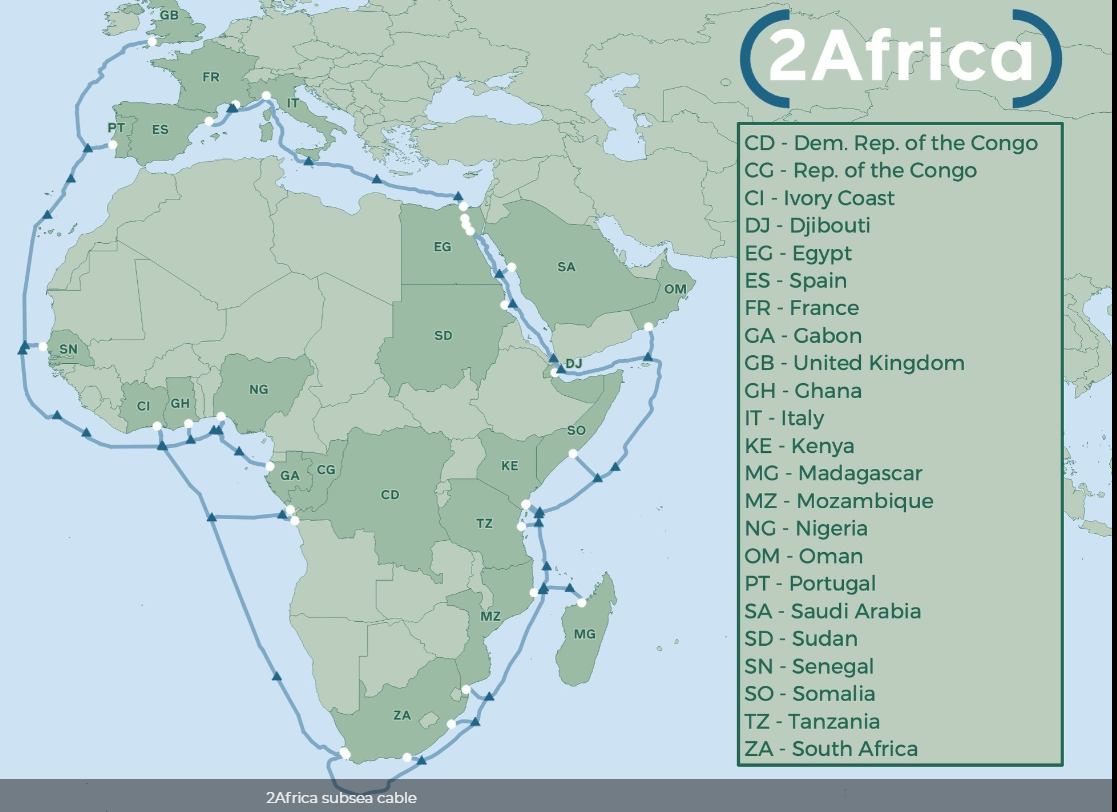
2Africa subsea cable boasts design capacity up to 180 Tbps

2Africa, a new subsea cable to serve the African continent and Middle East region, promises to deliver  more than the total combined capacity of all subsea cables serving Africa today, with a design capacity of up to 180Tbps on key parts of the system.

Consortium partners include China Mobile International, Facebook, MTN GlobalConnect, Orange, stc, Telecom Egypt, Vodafone and WIOCC.

Alcatel Submarine Networks (ASN) has been selected to build the fully-funded cable. The project will leverage SDM1 (space division multiplexing) technology from ASN, allowing deployment of up to 16 fiber pairs instead of the eight fiber pairs supported by older technologies. The cable will incorporate optical switching technology to enable flexible management of bandwidth. Cable burial depth has also been increased by 50% compared to older systems, and cable routing will avoid locations of known subsea disturbance, all helping to ensure the highest levels of availability.

The 2Africa subsea cable will span 37,000km long, interconnect Europe (eastward via Egypt), the Middle East (via Saudi Arabia), and 21 landings in 16 countries in Africa. The system is expected to go live in 2023/4. Each of the cable landing sites will offer carrier-neutral data centers or open-access cable landing stations on a fair and equitable basis.

In addition, the 2Africa parties and Airtel have signed an agreement with Telecom Egypt to provide a completely new crossing linking the Red Sea and the Mediterranean, the first in over a decade. This includes new cable landing stations and deployment of next-generation fiber on two new, diverse terrestrial routes parallel to the Suez Canal from Ras Ghareb to Port Said, and a new subsea link that will provide a third path between Ras Ghareb and Suez. 


"The launch of 2Africa enables us to offer our customers seamless connection between Africa and Europe, together with our SEA-ME-WE 5 and AAE-1 subsea cable resources to further extend to Asia, which is an important milestone of our global development strategy," said Jessica Gu, Director & Chief Technology Officer of China Mobile International. "The utmost capacity and faster transmission allows us to satisfy the needs of African nations today and in the future, reflecting our firm commitment to building a global digital life."

"We're excited to be collaborating with our 2Africa partners on the most comprehensive subsea cable that will serve the continent," said Najam Ahmad, Vice President, Network Infrastructure at Facebook. "2Africa is a major element of our ongoing investment in Africa to bring more people online to a faster internet.  We've seen first-hand the positive impact that increased connectivity has on communities, from education to healthcare. We know that economies flourish when there is widely accessible internet for businesses. 2Africa is a key pillar supporting this tremendous internet expansion as part of Africa's surging digital economy."

According to Frédéric Schepens, CEO of MTN Group's wholesale operation, MTN GlobalConnect, "MTN GlobalConnect is delighted to participate in this bold 2Africa subsea cable project. This initiative complements MTN GlobalConnect's terrestrial fibre strategy to connect African countries to each other and to the rest of the world. We are proud to be playing a key role in providing the benefits of a modern connected life – a core MTN belief."

Alioune Ndiaye, CEO of Orange Middle East and Africa, said, "As one of the world's leading multi-service telecommunications operators and present in 18 countries in Africa and the Middle East, it was natural for Orange to be part of the 2Africa project. This major investment will complete our existing submarine and pan-African terrestrial infrastructures to provide access to international connectivity in a redundant fashion throughout the west coast of Africa. It will enable Orange to securely meet the demand for increased bandwidth necessary for the continued digital development of regions throughout the 2Africa system."

Mohammed A. Alabbadi, Wholesale VP in stc commented, "stc is delighted to be a Partner in 2Africa. The 2Africa cable will be integrated into stc's MENA Gateway (MG1) datacentre in Jeddah, enabling customers to access our extensive international content and extend their regional connectivity through stc terrestrial geo-mesh network that extends to all neighboring countries. This will undoubtedly play a significant role in enhancing stc's international network capabilities, whilst also positioning stc as a leading regional digital player in the MENA region. The partnership demonstrates stc's commitment, in line with Saudi Vision 2030, to deliver meaningful digital transformation and build a digital society for all."

Adel Hamed, Telecom Egypt's Managing Director and Chief Executive Officer, commented, "Telecom Egypt's contribution to 2Africa marks an important milestone in our endeavor to contribute to digital transformation in Africa. Egypt's relationship with African states has and will always be one of Egypt's top priorities, it extends here to align with Egypt's strategy to contribute in the current development in Africa. We are honored to be part of such a revolutionary project alongside renowned global and African partners. For years, we have accomplished tangible steps in revamping our international infrastructure and increasing our assets' geodiversity in order to keep pace with the rising global demand for large bandwidth and global reach. We trust that 2Africa will be a rich addition to our diversified investments in the subsea cable industry." 

http://www.2AfricaCable.com

Alcatel Submarine Networks develops 3D WSS ROADM

Alcatel Submarine Networks introduced a new 3 Degree WSS ROADM unit designed to reduce the number of fiber pairs in the branch, leading to significant cost savings in subsea networks. The new ASN 3D WSS ROADM provides full WSS device flexibility maintaining East+West connectivity between trunk and branch. This simplifies the topology of complex networks and facilitates the implementation of branches on branches.

Key features:

  • Full flexibility in traffic routing thanks to WSS component
  • Submarine grade reliability thanks to WSS redundancy
  • Fully configurable through active supervisory commands
  • Embedded management of noise loading and traffic confidentiality
  • Fully managed by ASN SN10 Network Management


Alain Biston, President and CEO of Alcatel Submarine Networks said: “The introduction of innovation 3D design as part of ASN WSS ROADM product family addresses the market demand for more connectivity and flexibility at a reasonable cost, keeping the same level of quality and reliability. It effectively complements the SDM1 by ASN product portfolio to support all traffic demands and decrease cost per bit. ASN is strongly supporting its customer initiatives to provide a reliable internet infrastructure to all communities around the world and will continue to innovate to support this common goal.”

ASN confirmed that its new 3D WSS ROADM has already been selected for a major submarine cable system project.

https://web.asn.com/en/press-room/alcatel-submarine-networks-to-launch-a-new-wss-roadm-unit.html


Openreach picks ADTRAN's OLTs and Cloud Platform

Openreach, the wholesale infrastructure arm of BT, has selected ADTRAN’s SDX Series of OLTs and Mosaic Cloud Platform to help it achieve its ambition of making gigabit and multi-gigabit services available to 20 million homes across the UK by the mid-to-late 2020s with its Full Fibre network.

ADTRAN said its SDX platform will enable Openreach to economically scale its GPON and XGS-PON network with a level of flexibility that could not be realized with traditional access solutions.

Peter Bell, Network Technologies Director, Openreach said: “We’re already making our new ultrafast, ultra-reliable broadband network available to around 32,000 UK homes and businesses every week – and we’re on track to reach our target of reaching four and a half million premises with ‘Full Fibre’ by the end of March 2021.”

“But we don’t want to stop there. Our new network will support the UK’s economy for decades to come and help it bounce back from the COVID-19 pandemic, so we’ll be accelerating our Full Fibre build throughout the year. ADTRAN’s solutions will play a key role in helping us achieve that as we’re continually searching for innovative technologies that can help us build the network better, broader and faster for our customers.”

More than 600 retail carriers across the United Kingdom rely on Openreach to deliver the wholesale capacity to support a broad portfolio of services to enterprise, small-to-medium businesses and residential customers.

“ADTRAN is thrilled to be part of Openreach’s plan to upgrade the UK’s broadband infrastructure and the selection is a proof point that ADTRAN’s open, disaggregated approach to service creation and delivery is a blueprint for the telecommunications industry,” said Dan Whalen, ADTRAN’s Chief Product Officer. “Given the breadth of Openreach’s Full Fibre network, having the ability to deliver GPON and XGS-PON services from the same OLT port streamlines service delivery and reduces the complexity of network design. We make it possible for any service provider, based anywhere in the country, to have the service options they require to fit their customer’s needs.”

Deutsche Telekom Global Carrier activates 800G with Ciena

Deutsche Telekom Global Carrier has activated the first European 800G network connecting its data centers in Vienna, Austria.

The 800Gbps transmission has been validated for stability and error rates in a live environment.

The deployment will allow Deutsche Telekom to transport eight 100G of data traffic in less than 100Ghz of spectrum and is optimized for high-capacity 100GE and 400GE customer interface connectivity. Ciena said its solution is the first to transport 2x400GE across a single 800G wavelength.

In the next phase, Deutsche Telekom intends to implement Ciena’s WL5e with its 6500 and Waveserver 5 platforms, managed by Ciena’s Manage, Control and Plan (MCP)  domain controller, in Public Telehouse Exchange points.

“We pride ourselves on always being a step ahead and this move will push us over the threshold. It will help us achieve a significant industry milestone by delivering the first 800G network in Europe. With it, we will increase network capacity and efficiency, and create a more adaptive network that can meet our customer’s needs now and into the future,” said Rolf Nafziger, Senior Vice President, Deutsche Telekom Global Carrier.

https://www.ciena.com/about/newsroom/press-releases/deutsche-telekom-global-carrier--first-800g-network-in-europe.html

NVIDIA unveils 8th-gen Ampere GPU architecture

NVIDIA unveiled its Ampere architecture, described as the "greatest generational performance leap of NVIDIA’s eight generations of GPUs."

In a keynote recorded at hi home kitchen, NVIDIA's CEO Jensen Huang said the Ampere architecture will boost performance by up to 20x over its predecessors. More specifically, 6x higher performance than NVIDIA’s previous generation Volta architecture for training and 7x higher performance for inference.

Key features of A100:

  • More than 54 billion transistors, making it the world’s largest 7-nanometer processor.
  • Third-generation Tensor Cores with TF32, a new math format that accelerates single-precision AI training out of the box. NVIDIA’s widely used Tensor Cores are now more flexible, faster and easier to use, Huang explained.
  • Structural sparsity acceleration, a new efficiency technique harnessing the inherently sparse nature of AI math for higher performance.
  • Multi-instance GPU, or MIG, allowing a single A100 to be partitioned into as many as seven independent GPUs, each with its own resources.
  • Third-generation NVLink technology, doubling high-speed connectivity between GPUs, allowing A100 servers to act as one giant GPU.

The NVIDIA DGX A100 will power the third generation of the NVIDIA DGX AI server, boasting 5-petaflops of performance.

Deutsche Telekom: Limited impact from pandemic

Deutsche Telekom's revenue increased 2.3 percent year-on-year to 19.9 billion euros in the first quarter. Adjusted EBITDA AL rose by 10.2 percent, reaching 6.5 billion euros.

“Deutsche Telekom is an anchor of stability in a global crisis,” said CEO Tim Höttges. “Our networks are working reliably as digital lifelines for society.”

The company said its expects the pandemic to have limited impact on revenue, due to, for example, the closure of shops, lower roaming revenues, and companies postponing or canceling IT projects. On the other hand, voice telephony revenue is increasing, for instance, and the mobile churn rate is falling.

"Taking the offsetting effects and measures into account, the impact on adjusted EBITDA AL is likely to be comparatively low. As such, taking into account all foreseeable consequences of the pandemic, the Group confirms its guidance for the current financial year."

Free cash flow AL decreased by around 0.7 billion euros due to the reduction in factoring. This decision accounted for the decline to 1.3 billion euros. Adjusted net profit increased by 8.5 percent to 1.3 billion euros, unadjusted it increased by 1.8 percent to 916 million euros.

Some highlights

Germany – strong performance in fixed-line and mobile communications

  • 83,000 new broadband customers - the best result in two years in Germany. 
  • The number of TV customers increased significantly, with 60,000 new users of MagentaTV. 
  • The number of fiber-optic lines (VDSL/vectoring, FTTH) grew by 389,000 between January and March, bringing the total to around 14.8 million at the end of the first quarter, 1.9 million more than a year earlier.
  • Mobile service revenues increased 1.7 percent YoY. 
  • Mobile branded contract customer additions amounted to 141,000 in the first quarter.
  • The Germany segment also posted positive trends in its financials. 

United States – continued growth in financial figures

  • T-Mobile US completed its business combination with Sprint on April 1, 2020.
  • Adjusted EBITDA AL grew by 14.5 percent to 3.5 billion U.S. dollars, while revenue grew 0.7 percent against the prior-year level to 11.2 billion U.S. dollars, with mobile service revenues increasing by 5.5 percent. 
  • The number of branded postpaid customers increased by 777,000 in the first three months to 47.8 million. T-Mobile US now has a total of 68.5 million branded customers. In line with other companies in the industry in the United States, the company no longer reports any wholesale customers as of this quarter.

Europe – still on course

  • Driven primarily by growing fixed-network and mobile service revenues, revenue in the Europe operating segment grew by 2.0 percent in organic terms year-on-year in the first quarter to 2.9 billion euros. 
  • Adjusted EBITDA AL rose by 3.4 percent in organic terms to 1.0 billion euros. 
  • Between January and March, the European national companies acquired 110,000 new mobile contract customers, 65,000 new broadband customers, and 238,000 new users of product packages combining fixed network and mobile communications. More than half of all broadband households now use these convergent offers.

Systems Solutions – earnings up thanks to growth areas

  • T-Systems managed to offset the expected fall in revenue from traditional IT business with gains in growth areas. 
  • The areas of public cloud and security performed particularly well. 
  • At 1.6 billion euros, revenue across the whole segment remained at the prior-year level.
  • The positive trend in the growth areas and the ongoing transformation strengthened profitability. 
  • Adjusted EBITDA AL increased by 8.7 percent compared with the first quarter of 2019 to 100 million euros. Order entry declined by 13.4 percent against the strong prior-year quarter to 1.4 billion euros.


Türk Telekom deploys ADVA's Oscilloquartz network timing

Türk Telekom has deployed ADVA's Oscilloquartz network timing technology, bringing accurate, robust frequency synchronization to its national transport network.

The compact and flexible OSA 3230B Series cesium clocks enable high levels of frequency stability across Türk Telekom’s timing and sync network and their extended holdover performance protects against GNSS outages. The solution was implemented by ADVA and Türk Telekom’s partner NetaÅŸ, which will also provide continuous maintenance and support.

“The ADVA OSA 3230B Series maximizes the synchronization performance and continuity of our transmission network. It empowers us to optimize availability and deliver even more value to our customers,” said Yusuf Kıraç, CTO, Türk Telekom. “Accurate frequency and stable timing have become essential. Our residential and mobile customers will be demanding more access to streaming and gaming applications and enterprises across Turkey and will be looking to leverage long-distance collaborative tools. That will require precise and stable frequency and timing information at all times. With the OSA 3230B Series delivering vital immunity against loss of satellite signal, we can meet strict accuracy and stability needs.”

“With intentional GNSS impairments such as spoofing and jamming on the increase, as well as the threat of unintentional disturbances, it’s vital for decision-makers of mission-critical infrastructure to mitigate against GNSS vulnerabilities. Our OSA 3230B Series provides Türk Telekom with a primary reference clock that enables it to operate a highly accurate and stable time and frequency sync network resistant to GNSS outages,” commented Jörg Urban, senior director, business development, Oscilloquartz, ADVA. “Together with our business partner NetaÅŸ, we’ve worked closely to achieve true synergy with Türk Telekom. Our teams share a drive to continuously meet and exceed customer expectations. With the support of our engineers and our comprehensive technology portfolio, we’ll be able to meet their frequency and timing requirements for many years to come.”

Wednesday, May 13, 2020

FCC opens some 900 MHz spectrum

The FCC will make six megahertz of 900 MHz band spectrum available for wireless broadband technologies and services.  The 900 MHz band is currently designated for narrowband land mobile radio communications and primarily used by land transportation, utility, manufacturing, and petrochemical companies. 

The six megahertz will be available for broadband licenses on a county-by-county basis while reserving the remaining four megahertz of spectrum for continued narrowband operations.
provide crucial services to the American public.

Specifically, the Commission approved a Report and Order, an Order of Proposed Modification, and two Orders that realign the band and establish a transition mechanism based primarily on negotiations between prospective broadband licensees and existing narrowband incumbent licensees.  The item also establishes rules to prevent broadband applicants from receiving windfalls and includes application requirements and operating and technical rules applicable to the new 900 MHz broadband licenses.

In addition, the item would modify the Association of American Railroads’ existing nationwide ribbon license in the 900 MHz band to facilitate the transition of the band without disruptions to railroads’ operations, and to enable significant railroad safety upgrades.

As part of today’s action, the Commission also announces a partial lifting of the 900 MHz application freeze to permit existing licensees to file applications to relocate their narrowband operations as part of a transition plan.

FCC Chairman Ajit Pai writes: "900 MHz users are enthusiastic about the possibilities that reliable broadband will open for them.  Broadband access will enable industries to leverage technologies for applications like private LTE networks—next-generation networks that can enable Voice over LTE, grid resiliency and monitoring, wildfire mitigation, enhanced cybersecurity, and more.  Utilities are eager to use broadband to modernize the electric grid.  Southern California Edison, a utility in a state hard-hit by fires in recent years, predicts that broadband will enable innovative monitoring technologies that will help utilities detect and extinguish fires caused by downed power lines." 

Trump extends export restrictions on Huawei

President Trump extended for 1 year the national emergency declared in May 2019 (Executive Order 13873) with respect to securing the information and communications technology and services supply chain.

The order pertains to the export of U.S. technology to Huawei.

The White House statement reads: "The unrestricted acquisition or use in the United States of information and communications technology or services designed, developed, manufactured, or supplied by persons owned by, controlled by, or subject to the jurisdiction or direction of foreign adversaries augments the ability of these foreign adversaries to create and exploit vulnerabilities in information and communications technology or services, with potentially catastrophic effects. This threat continues to pose an unusual and extraordinary threat to the national security, foreign policy, and economy of the United States."

https://www.whitehouse.gov/

Department of Commerce extends export license to Huawei

The U.S. Department of Commerce has extended export licenses to Huawei Technologies Co. Ltd. and its non-United States affiliates (Huawei) for U.S. suppliers through May 15, 2020.

At the same time, the Bureau of Industry and Security (BIS) announced it is seeking public comments on the continuing need for, and scope of, possible future extensions of the Temporary General License (TGL) for Huawei.  The Department notes that its initial TGL from May 2019 and the three extensions that followed were intended to allow time for companies and persons to shift to alternative sources of equipment, software, and technology (e.g. those not produced by Huawei or one of its listed affiliates).


U.S. Dept of Commerce: Huawei restrictions 

Wilbur Ross, U.S. Secretary of Commerce, announced that restrictions on the export of U.S. technology to Huawei begin on Friday.

Earlier, the Bureau of Industry and Security (BIS) of the U.S. Department of Commerce, confirmed that Huawei and its affiliates have been added to the Bureau’s Entity List. The reason given is that "Huawei is engaged in activities that are contrary to U.S. national security or foreign policy interest."

For companies on the Entity List, a license must be issued by BIS for the sale or transfer of U.S. technology. A license may be denied if the sale or transfer would harm U.S. national security or foreign policy interests.

“This action by the Commerce Department’s Bureau of Industry and Security, with the support of the President of the United States, places Huawei, a Chinese owned company that is the largest telecommunications equipment producer in the world, on the Entity List. This will prevent American technology from being used by foreign owned entities in ways that potentially undermine U.S. national security or foreign policy interests,” said Secretary of Commerce Wilbur Ross. “President Trump has directed the Commerce Department to be vigilant in its protection of national security activities. Since the beginning of the Administration, the Department has added 190 persons or organizations to the Entity List, as well as instituted five investigations of the effect of imports on national security under Section 232 of the Trade Act of 1962.”

Cisco posts revenue of $12.0 billion, down 8% YoY

Cisco reported revenue of $12.0 billion for its third fiscal quarter ended April 25, 2020, down 8% compared to a year earlier.  Net income (GAAP) was $2.8 billion or $0.65 per share, down 9% compared to a year earlier, and non-GAAP net income was $3.4 billion or $0.79 per share.

"During this extraordinary time, our priority has been supporting our employees, customers, partners and communities, while positioning Cisco for the future," said Chuck Robbins, chairman and CEO of Cisco.  "The pandemic has driven organizations across the globe to digitize their operations and support remote workforces at a faster speed and greater scale than ever before.  We remain focused on providing the technology and solutions our customers need to accelerate their digital organizations."

"We executed well in Q3 in a very challenging environment, delivering strong margins and non-GAAP EPS growth," said Kelly Kramer, CFO of Cisco.  "The resiliency that we have been building into our business model is paying off, with software subscriptions now at 74% of our software revenue, up 9 points year over year.  We are focused on driving long-term profitable growth while delivering shareholder value."

Highlights:

  • Product revenue down 12% and service revenue up 5%, compared to a year earlier.
  • Revenue by geographic segment was: Americas down 8%, EMEA down 7%, and APJC down 9%. 
  • Product revenue was led by growth in Security, up 6%.  Infrastructure Platforms was down 15% and Applications was down 5%.
  • On a GAAP basis, total gross margin, product gross margin, and service gross margin were 64.9%, 63.7%, and 67.7%, respectively, as compared with 63.1%, 62.0%, and 66.3%, respectively, in the third quarter of fiscal 2019.


Colt trims latencies on key financial routes with Arista switches

Colt Technology Services has reduced latency on critical routes of its PrizmNet infrastructure in Europe. PrizmNet serves the high-frequency trading (HFT) sector and the Capital Markets community, including financial brokers, investment funds and banks, and FX-related applications.

Colt PrizmNet is underpinned by the Colt IQ Network, a 100Gbps optimised intelligent network that’s distributed to more than 29,000 on net buildings, 900 data centres and hundreds of data network connection points around the world.

Following recent investment in its ultra-low latency PrizmNet infrastructure in Asia, Colt has now implemented next-generation Arista 7130 Layer 1 switches (also known as Metamako Metamux) within the PrizmNet European core to provide even lower latency connectivity between the following key liquidity hubs and exchanges:

Equinix London (LD4) and London Stock Exchange (LSE)
Equinix London (LD4) and Interxion London (IXL)
Equinix London (LD4) and Equinix Frankfurt (FR2)
Interxion London (IXL) and Equinix Frankfurt (FR2)
Interxion London (IXL) and Equinix Zurich (ZH4)
Interxion London (IXL) and Bolsa de Madrid Colocation (BME)

Colt said customers connected to these hubs and exchanges via PrizmNet, and service providers using PrizmNet to connect to away markets or to execute to brokers or market data services, will automatically benefit from the latency reductions and performance enhancements on these routes.

“We know that every microsecond counts for Capital Markets participants. The latency reductions on these important European routes will help our PrizmNet customers improve their trading performance and execution success rates,” says Matthew Reinholds, Colt’s Head of Capital Markets for the US and Europe. “Colt will continue to monitor the market and make infrastructure investments to ensure we keep delivering the best possible latencies and performance for the Capital Markets community.”

Ekinops confirms major OTN switch customer

EKINOPS announced its first OTN switch customer, finalizing a deal with a major provider of telecommunication and digital solutions in EMEA. The customer was not disclosed.

Specifically, the EKINOPS Transport Switch (ETS) is being used to upgrade an existing optical transport network from 10G to 100G using a two-phase approach by first optimizing and simplifying the operations of existing 10G services before migrating the network to 100G. EKINOPS said its customer’s existing fiber optic network is used to transport sub-1Gbps to 10Gbps services between Europe and Asia primarily connecting global financial centers.  Extending from the Chinese border to Russia and Europe and using diverse routes across its service territory, the network provides highly reliable and resilient connectivity between the two continents.  High demand across this network has made the providers current operational model, largely dependent on manual reconfiguration of circuits and fiber connections, obsolete and has resulted in large amounts of stranded capacity. During the first phase of the project, the service provider will create a mesh architecture that will interconnect all of its 10G interfaces to support traffic without any physical change in the core network.  Phase two will entail deploying the 100G interfaces already available on the same line cards giving the service provider the control to upgrade on an as-needed basis and avoid having to make a full capital commitment upfront.

“This is a significant win and represents a major milestone in the evolution of EKINOPS as a company,” said Francois Xavier Ollivier, Ekinops’ co-founder and Chief Operating Officer for optical transport. “It demonstrates our ability to bring new technologies to market quickly as well as the value we add for our customers through acquisitions.”

https://www.ekinops.com/products/ekinops360-portfolio/otn-line-of-products/ets-chassis-products

Ekinops acquires OTN tech fom Padtec

Ekinops agreed to acquire an OTN switching platform developed by Padtec, an optical communications system manufacturer based in Brazil, for €10 million in cash. The deal brings an experienced R&D team comprised of 25 engineers based in Campinas, near Sao Paulo (Brazil). Brazilian operations will be overseen by Jean-Luc Pamart, co-founder of Ekinops and VP of R&D for optical transport.

With this acquisition, Ekinops expects to be able to offer a complete OTN/DWDM solution for optical networks from early 2020, enabling flexible data traffic and support for the evolution of data speeds and protocols transmitted over 200-400G modulated optical wavelengths, eventually reaching 1 Tbps.

Ekinops plans to carry out a capital increase by private placement over the coming weeks, for an amount capped at 10% of the capital stock.

Padtec CEO Manuel Andrade said:

"The acquisition of the OTN-Switch Platform by a globally recognized company such as Ekinops is a validation of the capability of Padtec's engineers to develop state-of-the-art technologies deployable worldwide. Additionally, we are happy to enter into commercial agreements with Ekinops that will enable Padtec to offer the OTN-Switch on an OEM basis to our customer base in Latin America. This is a clear win-win agreement for both companies."

Didier Brédy, Chairman & CEO of Ekinops, made the following comments:

"The OTN technology developed by Padtec is particularly innovative and will enable Ekinops to take a major technological and commercial leap forward in order to advance its position with leading telecom operators. The agreements with Padtec, the leading Latin American manufacturer and supplier of optical networking equipment, will also allow Padtec to source the OTN products it needs from Ekinops. This major strategic acquisition means that Ekinops can target to triple its sales of optical transport products within 5 years."

http://www.padtec.com.br/en/
https://www.ekinops.com/

Rakuten to acquire Innoeye for cloud-native expertise

Rakuten Mobile agreed to acquire Innoeye, a privately-held company specializing in cloud technologies. The company has offices in Herndon, Virginia and Indore (MP), India. Financial terms were not disclosed.

Rakuten Mobile has already deployed Innoeye’s converged OSS, an end-to-end platform process automation solution, to support the 4G/5G cloud platform for its network launch in Japan. Plans are also underway to rollout this technology and expertise as part of the new Rakuten Communications Platform (RCP) offering to be made available to telecom companies and other enterprise customers around the world.

Rakuten Mobile has pursued a cloud-native architecture. The Rakuten Communications Platform contains all the elements of the Rakuten Mobile network, including telco applications and software from multiple vendors, OSS and BSS systems handling customer billing and activation systems, in addition to edge computing and virtual network management functions. Rakuten Communications Platform will be made available with an app-store-like interface where customers can tailor the platform to their local requirements.

“Since we first envisioned the launch of Rakuten Mobile two years ago, we have also planned to bring to market our own expertise and technology stack as a unique service that will enable operators around the world to deploy fully cloud-native telco networks of the future,” said Tareq Amin, Representative Director, Executive Vice President and CTO of Rakuten Mobile. “With the planned acquisition of Innoeye, we are one step closer to closing the circle in bringing to market a carrier grade telco cloud product that is as simple as click, purchase and deploy.”

“Innoeye is delighted by the opportunity to become part of the Rakuten Mobile family,” said Rajeev Gupta, CEO of Innoeye. “Joining hands with Rakuten Mobile will provide us with unique ability to contribute towards this large industry movement and create a highly innovative cloud-based communication platform that is open, scalable and highly secure. Rakuten Communications Platform will disrupt the industry and pave the way for the next level of innovation. We look forward to being a part of this journey.”