Showing posts with label DOJ. Show all posts

Tuesday, February 8, 2022

U.S. charges Hyterra with stealing Motorola's digital mobile radio tech

The U.S. Department of Justice accused PRC-based Hytera Communications Corp. LTD with conspiracy to commit theft of trade secrets involving  Motorola Solutions' digital mobile radio (DMR) technology from 2007 to 2020.
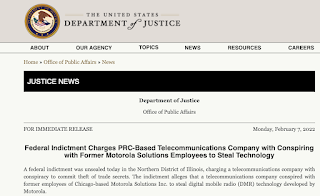
The 21-count indictment was partially unsealed today in U.S. District Court in Chicago says Hytera recruited and hired Motorola Solutions employees and directed them to take proprietary and trade secret information from Motorola without authorization. The charges allege that, while still employed at Motorola, some of the employees allegedly accessed the trade secret information from Motorola’s internal database and sent multiple emails describing their intentions to use the technology at Hytera. According to the indictment, Hytera paid the recruited employees higher salaries and benefits than what they received at Motorola.

https://www.justice.gov/opa/pr/federal-indictment-charges-prc-based-telecommunications-company-conspiring-former-motorola


Jury awards Motorola Solutions $764.6m in case against Hytera

A jury in the U.S. District Court for the Northern District of Illinois awarded $746.6 million to Motorola Solutions in its trade secret theft and copyright infringement case against Hytera Communications of Shenzhen, China and its U.S.-based subsidiaries.  Motorola is now seeking a worldwide injunction preventing Hytera from further misappropriating its stolen trade secrets and infringing its copyrights.

“Today’s verdict is a tremendous victory for our company,” said Greg Brown, chairman and CEO, Motorola Solutions. “Motorola Solutions has always invested significantly in research and development to bring pioneering and beneficial technology to our customers around the world. In contrast, Hytera was simply profiting off of the hard work and innovation of our world-class engineers. The jury’s verdict validates our global litigation against Hytera by definitively affirming that stealing trade secrets and source code will not be tolerated.”


Biden signs Secure Equipment Act

President Biden signed into law the “Secure Equipment Act of 2021,” which requires the Federal Communications Commission to adopt rules clarifying that it will no longer review or approve any authorization application for equipment that poses an unacceptable risk to national security.The bill would prevent further integration and sales of Huawei, ZTE, Hytera, Hikvision, and Dahua – all Chinese state-backed or directed firms – in the U.S. regardless...

FCC seeks to extend ban on equipment from Huawei, ZTE, Hikvision

 The Federal Communications Commission proposed rules that would prohibit all future authorizations for communications equipment deemed to pose an unacceptable risk to national security.  Specifically, the FCC is would prohibit the authorization of equipment through either the FCC’s Certification or Supplier’s Declaration of Conformity equipment authorization processes.  The proposal also seeks comment on whether to revise rules concerning...

Monday, July 12, 2021

U.S. charges fiber laser expert with espionage over DARPA project

A U.S. federal grand jury has indicted Mr. Ji Wang on charges of economic espionage, theft of trade secrets, and violating the International Emergency Economic Powers Act (IEEPA).

The case relates to Wang's work on a fiber laser research and development project initiated by the Defense Advanced Research Projects Agency (DARPA). 

On July 1, 2016, Wang is alleged to have downloaded and copied nonpublic and restricted DARPA project files onto a personal device with the intent to establish a fiber laser business known as QuantumWave. The U.S. Department of Justice alleges thataAt the time of the download, Wang and another person were in the midst of negotiations with various municipal and other governmental entities in the People’s Republic of China to establish the new company.

During trips to China, Wang is alleged to have illegally exported technical data regarding fiber laser manufacturing, in violation of IEEPA. 

https://www.bis.doc.gov/index.php/documents/about-bis/newsroom/press-releases/2775-wang-indictment-final/file

Friday, May 15, 2020

U.S. tightens semiconductor restrictions on Huawei

U.S. Department of Commerce Bureau of Industry and Security (BIS) issued new rules aimed at cutting off Huawei's access to advanced semiconductors designed or fabricated using U.S. technology or software in other countries.

Specifically, BIS is amending its longstanding foreign-produced direct product rule and the Entity List to narrowly and strategically target Huawei’s acquisition of semiconductors that are the direct product of certain U.S. software and technology.

The following foreign-produced items will now be subject to the Export Administration Regulations (EAR):

  • Items, such as semiconductor designs, when produced by Huawei and its affiliates on the Entity List (e.g., HiSilicon), that are the direct product of certain U.S. Commerce Control List (CCL) software and technology; and
  • Items, such as chipsets, when produced from the design specifications of Huawei or an affiliate on the Entity List (e.g., HiSilicon), that are the direct product of certain CCL semiconductor manufacturing equipment located outside the United States.  Such foreign-produced items will only require a license when there is knowledge that they are destined for reexport, export from abroad, or transfer (in-country) to Huawei or any of its affiliates on the Entity List.

To prevent immediate adverse economic impacts on foreign foundries utilizing U.S. semiconductor manufacturing equipment that have initiated any production step for items based on Huawei design specifications as of May 15, 2020, such foreign-produced items are not subject to these new licensing requirements so long as they are reexported, exported from abroad, or transferred (in-country) by 120 days from the effective date.

“Despite the Entity List actions the Department took last year, Huawei and its foreign affiliates have stepped-up efforts to undermine these national security-based restrictions through an indigenization effort.  However, that effort is still dependent on U.S. technologies,” said Secretary of Commerce Wilbur Ross.  “This is not how a responsible global corporate citizen behaves.  We must amend our rules exploited by Huawei and HiSilicon and prevent U.S. technologies from enabling malign activities contrary to U.S. national security and foreign policy interests.”

https://www.commerce.gov/news/press-releases/2020/05/commerce-addresses-huaweis-efforts-undermine-entity-list-restricts

U.S. issues final 90-day extension of license authorizations for Huawei

The U.S. Department of Commerce extended the terms of the existing Temporary General License (TGL) authorizations for Huawei Technologies Co. Ltd. and its non-U.S. affiliates (Huawei) on the Entity List for 90 days.

The Department said its 90-day extension provides an opportunity for users of Huawei devices and telecommunication providers—particularly those in rural U.S. communities—to continue to temporarily operate such devices and existing networks while hastening the transition to alternative suppliers.

The Department is also notifying the public that activities authorized in the TGL may be revised and possibly eliminated after August 13, 2020.

https://www.commerce.gov/news/press-releases/2020/05/department-commerce-issues-expected-final-90-day-extension-temporary

Thursday, February 13, 2020

U.S. Department of Justice charges Huawei under RICO act

The U.S. Department of Justice and the FBI are charging Huawei Technologies Co. Ltd. and two U.S. subsidiaries with conspiracy to violate the Racketeer Influenced and Corrupt Organizations Act (RICO).

A 16-count superseding indictment in federal court in Brooklyn, New York cites a long-running practice of using fraud and deception to misappropriate sophisticated technology from U.S. counterparts. The Department of Justice alleges that Huawei, and several of its subsidiaries, both in the U.S. and in the People’s Republic of China, misappropriated intellectual property, including from six U.S. technology companies, including intellectual property, trade secrets and copyrighted works, such as source code and user manuals for internet routers, antenna technology and robot testing technology.

The indictment states that as a result of this campaign to steal this technology and intellectual property, "Huawei was able to drastically cut its research and development costs and associated delays, giving the company a significant and unfair competitive advantage."

https://www.justice.gov/opa/pr/chinese-telecommunications-conglomerate-huawei-and-subsidiaries-charged-racketeering

Monday, January 28, 2019

U.S. Department of Justice issues multiple indictments against Huawei

The U.S. Department of Justice laid out its case against Huawei in a press conference in Washington, D.C. There are two cases where the DoJ is pursuing legal actions:
  • A grand jury in Seattle returned an indictment alledging 10 federal crimes by two affiliates of Huawei Technologies. The indictment alleges that in 2012 Huawei began a concerted effort to steal information about a robot that T-Mobile used to test mobile phones. Huawei engineers are alleged to have violated confidentiality and non-disclosure agreements with T-Mobile by secretly taking photos of the robot, measuring it, and stealing a piece of it.
  • A grand jury in New York returned an indictment alleging 13 additional crimes committed by Huawei, its CFO, its affiliate in Iran, and one of its subsidiaries in the United States. This criminal activity is said to go back ten years and to involve top officials of the company. The indictment alleges that beginning in 2007, Huawei began to misrepresent its relationship with its Skycom affiliate. By claiming Skycom was a separate company, Huawei represented that it was in compliance with U.S. sanctions against Iran. Furthermore, Huawei is alleged to have misrepresented financial transactions with multiple banks. 
  • Defendants from both cases are variously charged with conspiracy, bank fraud, wire fraud, violations of the Emergency Economic Powers Act,  money laundering, and obstruction of justice.
The DoJ is seeking the extradition of Huawei CFO, Meng Wanzhou, from Vancouver, Canada, where she was arrested in December.

The DoJ further alleges that Huawei lied to the U.S. government and attempted to obstruct justice by concealing and destroying evidence, as well as moving executives back to China.

https://www.justice.gov/


Thursday, July 12, 2018

DOJ to challenge AT&T's acquisition of Time Warner

The U.S. Department of Justice will appeal the decision by U.S. District Court in Washington, D.C. in the case involving the merger of AT&T and Time Warner.

On June 12th, U.S. federal judge Richard Leon ruled in favor of AT&T in the lawsuit brought by the Department of Justice to block its acquisition of Time Warner. Since then, AT&T has consummated its acquisition of Time Warner.

In response, David McAtee, AT&T General Counsel, issued the following statement: “The Court’s decision could hardly have been more thorough, fact-based, and well-reasoned.  While the losing party in litigation always has the right to appeal if it wishes, we are surprised that the DOJ has chosen to do so under these circumstances.  We are ready to defend the Court’s decision at the D.C. Circuit Court of Appeals.”

Tuesday, May 19, 2015

Dept of Justice Charges Chinese Professor with Espionage from Avago

The U.S. Department of Justice filed economic espionage charges against Tianjin University Professor Hao Zhang (36) and Wei Pang (35) in a case involving trade secrets and RF patents belonging to Avago Technologies.

The 32-count indictment alleges that Wei Pang and Hao Zhang conducted research and development on thin-film bulk acoustic resonator (FBAR) technology while students at the University of Southern California under  funding from U.S. Defense Advanced Research Projects Agency (DARPA).  After earning their doctorate in approximately 2005, Pang accepted employment as an FBAR engineer with Avago Technologies (Avago) in Colorado and Zhang accepted employment as an FBAR engineer with Skyworks Solutions Inc. (Skyworks) in Massachusetts. The indictments accuse the men of preparing a business plan to steal technology from Avago and Skyworks with the intent of establishing a new competitor, ROFS Microsystes, a joint venture with Tianjun University and located in PRC state-sponsored Tianjin Economic Development Area (TEDA).

Zhang was arrested on May 16, 2015, upon landing at the Los Angeles International Airport on a flight from the PRC.

http://www.justice.gov/opa/pr/chinese-professors-among-six-defendants-charged-economic-espionage-and-theft-trade-secrets