Sunday, September 17, 2017

CWDM8 MSA targets 400G data centre links at 2 km and 10 km

Leading vendors, including Accton, Barefoot Networks, Credo Semiconductor, Hisense, Innovium, Intel, MACOM, Mellanox, Neophotonics, and Rockley Photonics, have formed a new CWDM8 MSA (8-wavelength Coarse Wavelength Division Multiplexing Multi-Source Agreement) Group dedicated to defining optical specifications and promoting adoption of interoperable 2 km and 10 km 400 Gb/s interfaces over duplex single-mode fiber.

The goal is to develop optical link specifications that will enable cost-effective, low power consumption 400G duplex single-mode optics using 50G per wavelength optical NRZ modulation, all while maintaining full compatibility with standard 50G PAM4 electrical interfaces.

The group is targetting next-generation module form factors such as QSFP-DD, OSFP, and COBO, to handle the 400 Gb/s interface at distances of 2 km and 10km for intra data centre of campus data centre connectivity.

"There is currently no adequate solution in the market to meet our needs for cost effective and uncooled 400G optical interfaces for 2km and 10km reaches. We welcome the formation of the CWDM8 MSA, which offers proven 50G NRZ technology to enable compact and low power dissipation form factors for 400G," stated Yu Li, VP of Data Center Switching, Huawei.

NeoPhotonics shows 64 Gbaud Coherent, enabling systems at 600 Gbps +

At this week's European Conference on Optical Communications (ECOC) in Gothenburg, Sweden, NeoPhotonics is showcasing a suite of 64 Gbaud optical components for coherent systems operating at 600G and above, effectively doubling the symbol rate over standard 100G (32 Gbaud) coherent systems

NeoPhotonics has just announced sampling of a 64 Gbaud Micro Modulator (Micro-MOD) with integrated drivers.  The company has also begun shipping its 64 Gbaud Micro Coherent Receiver (Micro-ICR) and it low-profile ultra-narrow line width tunable laser for 400G and 600G applications.

“Our 64 Gbaud symbol rate optical components for coherent transport provide system designers with the optical tools that match increases in DSP capability to enable higher spectral densities and longer reaches,” said Tim Jenks, Chairman and CEO of NeoPhotonics. “Each of these products is based on our hybrid photonic integration technology and leverages our existing proven design platforms, which allows us to ramp production rapidly to match customer demands while maintaining high quality and reliability.”

Some highlights of the suite.

  • 64 Gbaud Micro-MOD (CDM): NeoPhotonics 64 GBaud, polarization multiplexed, quadrature micro-modulator is currently being sampled to major customers and features a co-packaged InP modulator with linear, high bandwidth, differential drivers in a compact package to operate in 400G and beyond pluggable modules that demand reduced size and power consumption.
  • 64 Gbaud Micro-ICR: NeoPhotonics Class 40 High Bandwidth Micro-Intradyne Coherent Receiver is in volume production and is designed for 64 Gbaud symbol rates, doubling the RF bandwidth of standard 100G ICRs. The 64 Gbaud Micro-ICR supports higher order modulation such as 64 QAM.
  • Low Profile Micro-TL: NeoPhotonics ultra-narrow linewidth external cavity tunable laser has been proven in volume production and is now configured in a smaller, lower profile package, which is designed to meet the stringent requirements for packaging density in pluggable modules, including at 400G and 600G data rates. The external cavity laser has a significantly narrower linewidth, which is advantageous for higher order modulation formats.

Source Photonics and Credo demo Single Lambda 100G at 20km

A new generation of single wavelength 100G trancseivers is a step closer.

Whereas currently deployed 100G optical transceivers rely on 4x25G WDM technology, the next generation of transceivers will use higher order modulation techniques, such as PAM4, and higher data rate operation at 53Gbaud. This means that that one laser and one receiver could do the job that currently requires four lasers and four receivers. In addition to 100G-DR/FR/LR, Source Photonics plans to leverage this technology for 400G-DR4/FR4.

At this week's ECOC 2017 in Sweden, Source Photonics will be hosting a private demonstration of its internally packaged TOSA and ROSA sub-assemblies in an optical loopback configuration through 20km of single-mode fiber using a single 100G channel of Credo’s low power PAM4 IC technology.

Source Photonics said its testing revealed that the bit-error-rate (BER) after 20km of fiber remains better than the KP4 FEC requirement and was around 5x10⁻⁵. The TOSA is based on Source Photonics’ EML laser technology which provides the necessary bandwidth to achieve a TDECQ value below 2.5dB. The room temperature link budget of 10dB provides considerable margin for the most significant link specifications under development in the industry, allowing production margin for performance variations.

“We are continuing to invest in next generation technology, such as Single Lambda 100G, as part of our commitment to providing leading edge solutions for data centers,” said Manish Mehta, EVP, PLM Source Photonics

Source Photonics ramps up 100G QSFP28 transceiver line

Source Photonics, which began sampling its first generation of 100GBASE-LR4 in QSFP28 form factor in 2014, and which began full-scale QSFP28 production in 2015, is now ramping up for increased production volumes. The company reports that continuous investment into its InP fab as well as in transceiver production infrastructure will enable it to produce greater than half a million modules annually by early 2018.

The ramp up in 100GBASE-LR4 QSFP28 modules comes in response to the rapid adoption of 100G in data centers.

Source Photonics reports an expansion of its product portfolio to include modules with an OTU4 data rate. extended temperature operation of up to 85°C for 100GBASE-LR4 and 100G CWDM4 (2 km), as well as 4WDM-10 (10 km) modules. In addition, longer reach

Source Photonics is also planning a 100G 4WDM-40 MSA compliant module for 100G applications with up to a 40km reach. The companay anticipates sampling in Q4 2017 and full production in Q1 2018.

NeoPhotonics presents data centre optoelectronics for CWDM4, CLR4, PSM-4 and PAM4

At this week's European Conference on Optical Communications (ECOC) in Gothenburg, Sweden, NeoPhotonics is presenting its portfolio of 100 Gbps to 400 Gbps optoelectronics for the data centre, including including CWDM4, CLR4, PSM-4 and PAM4.
The line-up includes NeoPhotonics'

  • High power 1310 nm lasers and laser arrays, which are qualified for use with low-cost, non-hermetic packages for 100G silicon photonics based QSFP28 modules.  
  • Low power consumption 28 GBaud externally modulated lasers (EML) with an integrated driver, which are designed for longer reach 4x25 NRZ 100G, 4x50 PAM4 200G, and 8x50 PAM4 400G data center applications.  
  • A 56 Gbaud EML with an integrated driver, which is designed for use in 4x100 PAM4 configurations for 400G data center application
  • A line of high power, uncooled 1310nm CW DFB lasers and laser arrays that are qualified to the Telcordia GR-468-CORE Issue 2 standard and which are designed for specific silicon-based high speed analog and digital electronic devices and related photonic components.
  • A new 28 GBaud EML for longer reaches that integrates a driver, which utilizes NeoPhotonics low power linear GaAs amplifier technology, with NeoPhotonics 28 GBaud EML at the chip-on-carrier, or CoC, level. This is designed for 100Gbps QSFP28 and CFP4 form factors and it fits into a four channel transmitter optical sub-assembly, or Quad TOSA, eliminating the need for a separate driver on the board. NeoPhotonics is also targetting PAM4 in 200 Gbps to 400 Gbps applications. The integrated linear driver of the new CMOS-drivable 28 GBaud EML enables a simple and direct connection to the PAM4/CDR IC.   

“Our laser components are key elements for optical modules used inside the datacenter suppling the light for short reach Silicon Photonics based 100G transceivers and the modulated light for longer reach PAM4 based 100G and 400G transceivers,” said Tim Jenks, Chairman and CEO of NeoPhotonics.  “While the laser architectures are different, both are designed by us, manufactured in our internal fabs and utlize our hybrid photonic integration technology for high performance and high reliability”.

Dr. Winston Way, NeoPhotonics CTO, Systems, is also presenting a paper at ECOC entitled “Applications of 64 Gbaud Optical Components and Modules”.

OE Solutions showcases its 25G SFP28 transceivers

OE Solutions, a global supplier of optical transceivers based in Gwangju, South Korea with R&D centres in the USA, the Netherlands as well as offices worldwide, has begun sampling a portfolio of 25G SFP28 optical transceivers for enterprise and access network applications.

The company will be demonstrating the portfolio at this week's ECOC 2017 in Gothenburg, Sweden.

The first two devices in OE Solutions's 25G SFP28 portfolio are multi-rate transceivers for next generation datacom applications and wireless infrastructure. Specifically, the new 25G transceivers are:

  • 25Gbps (25G Ethernet, 8G-FC, 16G-FC and 32G-FC) 1310nm Standard-Temperature SFP28 for distances up to 10km
  • 25Gbps (25G Ethernet, CPRI-10) 1310nm Industrial-Temperature SFP28 for distances up to 10km

OE Solutions said it sees an opportunity for 25G both in data centre applications as well as in access networks, where IEEE work is underway to develop 25G Ethernet with eCPRI support for optical connectivity to 5G infrastructure.


  • In March 2017, OE Solutions announced high-density transceivers, including 2x10Gbps Compact SFP+, 4x10Gbps QSFP+, and 25Gbps SFP28, for wireless fronthaul applications. The new industrial-temperature rated transceivers are designed for high port densities in radio access network equipment.
  • Also in March 2017, OE Solutions began shipping Extended Reach 10Gbps CWDM SFP+ transceivers supporting 1GE and 10GE for Ethernet applications as well as CPRI-2 to CPRI-8 for wireless network applications. 

NTT Com continues to develop its partnership strategy

NTT Communications continues to develop its partnership strategy by hosting its fourteenth "Arcstar Carrier Forum 2017" on September 13-14.

NTT Com's Arcstar enterprise VPN service reaches more than 190 countries. NTT Com partners participating in the Forum included:

Australia
Optus Pty Limited

Australia/Japan
Telstra Japan K.K.

Brazil
Neutrona Networks

China
China Telecommunications Corporation
China Unicom

France
Orange Business Services

Germany
Deutsche Telekom AG

Hong Kong
China Telecom Global Limited
Hutchison Global Communications Ltd.
PCCW Global Ltd.
WTT HK Limited

India
Tata Communications Ltd.

Indonesia
Biznet Networks
Indosat Ooredoo
PT. Telekomunikasi Indonesia International

Korea
KT Corporation

Malaysia
Telekom Malaysia Berhad
TIME dotCom Berhad

Philippines
PLDT Inc.

South Africa
Internet Solutions

Taiwan
Chunghwa Telecom International Business Group

Thailand
CAT Telecom Public Company Limited

UK
Colt Technology Services Co., Ltd.

Interoute Communications Limited

USA
Level 3 Communications

USA/Hong Kong/Japan
Verizon Hong Kong Limited/Verizon Japan Ltd.

Vietnam
VNPT International

MACOM 12G crosspoint powers 4K and 8K video routing switcher

MACOM Technology Solutions Inc. (MACOM) has developed a 160x160 M21605G-12 crosspoint switch that combines multi-rate broadcast video routing and switching in a single device, with each switching path operating independently at any data rate of up to 12.8 Gbps.

The technology has now been licensed by FOR-A, a leading manufacturer broadcast and production equipment, to power a new routing switcher to 4K and 8K production flows. MACOM’s crosspoint is being used in FOR-A platform to enable single cable transfer of 4K video over 12G-SDI without complex cabling and utilizing fewer channels than traditional 3G-SDI systems.

"By leveraging MACOM’s ability to support 12G-SDI, we are able to build a system that simplifies implementation and provides greater flexibility in handling different SDI rates," said Hidefumi Hamaguchi, General Manager of SDR Development Department, FOR-A.

"As broadcast transitions to 4K, the need for higher density switching fabrics becomes critical,” said Gary Shah, Vice President and Business Line Manager, High-Performance Analog, at MACOM. “Our 160x160 port device enables system manufacturers to lower their total cost over a quad-link 3G architecture while simplifying their infrastructure with single link 12G-SDI."

Toshiba's Cambridge Research Lab Sets Quantum Encryption record

Quantum cyptography is postulated to be unbreakable. However, the quantum key must be held by the receiving party for the encrypted message to be deciphered. Until now, the speed at which a quantum key can be distributed has been limited to 1.9 Mbps.

Toshiba Research Europe Limited’s Cambridge Research Laboratory in the UK has just announced a new data distribution speed record of 13.7 Mbps - seven times the previous record, which was also achieved by Toshiba last year. The transmission spanned 10km over an optical fiber.

The details of the new device will be announced at the QCrypt 2017 conference, which will be held at the University of Cambridge from September 18-22.

Toshiba says it is already applying quantum encrption to secure genomic data in Japan.

Thursday, September 14, 2017

Microsoft intros Azure confidential computing

Microsoft Azure is introducing a new data security capability called Azure confidential computing that provides encryption for data that is in use.

Microsoft said it has been working on this capability with Intel for over four years.

Confidential computing protects data in use from the following threats:

  • Malicious insiders with administrative privilege or direct access to hardware on which it is being processed
  • Hackers and malware that exploit bugs in the operating system, application, or hypervisor
  • Third parties accessing it without their consent

Microsoft said that when data is “in the clear” it is protected inside a Trusted Execution Environment (TEE - also known as an enclave), which ensures there is no way to view data or the operations inside from the outside, even with a debugger.

https://azure.microsoft.com/en-us/blog/introducing-azure-confidential-computing/

Vertical Systems: Mid-Year 2017 Global Provider Ethernet LEADERBOARD

Orange Business Services (France), Colt (U.K.), AT&T (U.S.), Level 3 (U.S.), BT Global Services (U.K.), Verizon (U.S.) and NTT (Japan) hold the top spots (in rank order based on retail port share) in Vertical Systems Group’s Mid-Year 2017 Global Provider Ethernet LEADERBOARD, which ranks companies that hold a 4% or higher share of billable retail ports at sites outside of their respective home countries.

Based on mid-year 2017 port share results, Orange, Colt and AT&T continue to rank as the top three companies on the Global Provider Ethernet LEADERBOARD, respectively. Level 3 moves up to fourth from fifth position, displacing BT Global Services.

The Challenge Tier of Global Providers includes companies with share between 2% and 4% of this defined market. Six companies qualify for the mid-2017 Challenge Tier (in alphabetical order): Cogent (U.S.), SingTel (Singapore), T-Systems (Germany), Tata Communications (India), Telefonica Worldwide (Spain) and Vodafone (U.K.).

“Demand for global Ethernet networking continues to expand. As retail Ethernet providers extend their network footprints through partners worldwide, the growth outlook for wholesale services is increasing,” said Rick Malone, principal at Vertical Systems Group. “Orchestration across multiple provider networks is the top challenge constraining new service deployments, according to our research. This obstacle is being addressed through collaboration among industry players and standards organizations, including efforts to standardize on open APIs and service specifications.”

https://www.verticalsystems.com/vsglb/mid-year-2017-global-provider-ethernet-leaderboard/

Mobile World Congress Americas attracts 21,000

The 2017 Mobile World Congress Americas, held September 12-14 in San Francisco, attracted more than 21,000 attendees, according to GSMA.

Over 55 percent of Mobile World Congress Americas attendees held senior-level positions, including more than 2,400 CEOs, and 20 per cent of all attendees were female. Over 300 members of the media and industry analysts attended to report on the event.

“We are very pleased with the success of our first Mobile World Congress Americas event,” said John Hoffman, CEO, GSMA Ltd. “The strong level of engagement at the show, particularly among senior-level attendees, underscores the integral role that mobile plays across the entire Americas region. I would like to thank our partner CTIA and also extend our gratitude to all attendees, exhibitors, sponsors and partners who were a part of the 2017 Mobile World Congress Americas.”

http://www.mwcamericas.com


VeriSign: Internet domain name registrations growing at 2.1% annually

Approximately 1.3 million domain name registrations were added to the Internet in the second quarter of 2017, bringing the total number of domain name registrations to approximately 331.9 million across all top-level domains (TLDs) as of June 30, 2017, according to the newly-updated Verisign Domain Name Industry Brief.

The increase of approximately 1.3 million domain name registrations globally equates to a growth rate of 0.4 percent over the first quarter of 2017.1

Compared to last year, domain name registrations increased by 6.7 million, or 2.1 percent.

As of June 30, 2017, the .com domain name base totaled 129.2 million domain name registrations, while the .net domain name base totaled 15.1 million domain name registrations.

http://www.Verisign.com/DNIB


DISH Network picks Amdocs CES 10 for business services

DISH Network has selected Amdocs CES 10 for its DISH Business customers, including private offices, hotels and apartments.

Under the contract, Amdocs will provide an advanced business and operational support system (BSS/OSS) that integrates all the elements that define the DISH Business experience. This includes delivering the best possible entertainment experience in a wide range of properties with innovative services powered by DISH’s SMARTBOX and EVOLVE set-back box for hotels, and supported by Amdocs CES 10.  

“With Amdocs CES 10 as our next generation platform for the business sector, we’ll be able to launch new services and further enhance the customer experience,” said John Swieringa, executive vice president of operations at DISH.

http://www.amdocs.com

Spirent launches Transport Layer Security (TLS 1.3) testing

Spirent Communications has updated its flagship security testing solution, CyberFlood, to support Transport Layer Security (TLS 1.3), a new encryption protocol.

Specifically, this newCyberFlood Advanced Fuzzing update provides support for TLS 1.3 draft-19, draft-20, and draft-21.

Transport Layer Security (TLS) is the underlying technology that enables secure communication between web browsers and servers on the Internet.

“As the first to market with fuzz testing for TLS 1.3, Spirent is extending its leadership in security testing and validating the way the world communicates,” said David DeSanto, director of products and threat research at Spirent Communications. “The industry is ripe for an encryption protocol update, and our customers are relying on Spirent to provide them with the realistic preemptive intelligence that ensures their TLS 1.3 implementations are stable, reliable and secure before they go to market.”

http://www.spirent.com/security

Wednesday, September 13, 2017

FCC: Cell sites being restored, wireline outages worsening

As of September 13, 2017 at 11:00 AM EDT, substantial numbers of cell sites remain out of services in areas impacted by Hurricane Irma, but the situation is improving, according to data from the FCC.

  • Alabama: Less than 1% of cell sites in the disaster area are out of service
  • Florida: 18.1% (down from 24.6% yesterday) of cell sites are out of service.
  • Georgia: Overall, 5.3% (down from 10.5% yesterday) of cell sites in the disaster area are out of
  • service.
  • Puerto Rico: 10.1% (down from 14.5% yesterday) of cell sites are out of service.
  • Virgin Islands: 54.7% (up from 53.8%) of cell sites are out of service.

However, the the outage is growing for cable and fixed wireline systems.  There are at least 8,190,407 (up from 7,184,909 yesterday) subscribers out of service in the affectedareas in Alabama, Florida, and Georgia.

There are a total of 1,040 (up from 819 yesterday) non-mobile switching centers out in Alabama, Florida, and Georgia.

http://transition.fcc.gov/Daily_Releases/Daily_Business/2017/db0913/DOC-346710A1.pdf

AT&T Extends its NetBond between clouds

AT&T NetBond is introducing a "cloud-to-cloud" feature that efficiently moves workloads across highly secure connections between public, private and hybrid cloud services in the NetBond for Cloud ecosystem.

AT&T NetBond for Cloud promises scalable network connectivity for efficient traffic flow between clouds. AT&T said that with this feature, each ecosystem cloud – private or public – can now be efficiently connected to another and remain off internet. Customers can easily manage connections between clouds by using the digital AT&T cloud portal. Network managers no longer have the time-consuming manual task of working with multiple cloud providers to build connection points individually – they can now create or change connectivity configurations within minutes.

“Many businesses use 3 or more clouds. And they’re often a mix of public, private or hybrid,” said Roman Pacewicz, Chief Product Officer, AT&T Business. “No matter the combination, it can be challenging if cloud environments have to mix. An important part is enabling efficient and highly secure network connections that help customers move their workflows between cloud endpoints. With NetBond for Cloud, it’s simple.”

Security options are available to manage the flow between end users and applications that can be used with the cloud to cloud feature. Our NetBond for Cloud service is fully off-internet, providing simple, highly secure access to industry-leading cloud services from virtually anywhere.

http://att.com/netbond


Qualcomm shows 5G NR mmWave prototype

Qualcomm unveiled a 5G NR mmWave prototype system based on the 5G New Radio (NR) Release-15 specifications.  Peak download speeds of up to 5 Gbps are possible.

The prototype system, which operates in millimeter wave (mmWave) spectrum bands above 24 GHz, demonstrates how advanced 5G NR mmWave technologies can be utilized to deliver robust mobile broadband communications at multi-gigabit-per-second data rates in real-world mobile environments.

Qualcomm's prototype leverages the company's optimized mmWave RF Front-end design in a smartphone form-factor to test and trial real-world mmWave challenges, such as device and hand-blocking. It employs Multiple-Input Multiple-Output (MIMO) antenna technology with adaptive analog beamforming and beam tracking/steering techniques, which is required for robust and sustained mobile broadband communications in non-line-of-sight (NLOS) environments and device mobility. It also supports 800 MHz bandwidth and advanced 5G NR technologies including LDPC channel coding for data channels.

"We are delivering on the promise of developing 5G NR mmWave technologies to enhance mobile broadband services,” said Cristiano Amon, executive vice president, Qualcomm Technologies, Inc., and president, Qualcomm CDMA Technologies. “Our 5G NR mmWave prototype system is proving that sustained mobile broadband communications and smartphone form-factor devices are progressing for 2019 launches — another powerful testament to Qualcomm Technologies’ continued leadership in developing next generation wireless technologies that push the boundaries of what is possible.”

https://www.qualcomm.com/news/releases/2017/09/11/qualcomm-announces-5g-nr-mmwave-prototype-accelerate-mobile-deployments

Sprint says Massive MIMO could increase network capacity by 10x

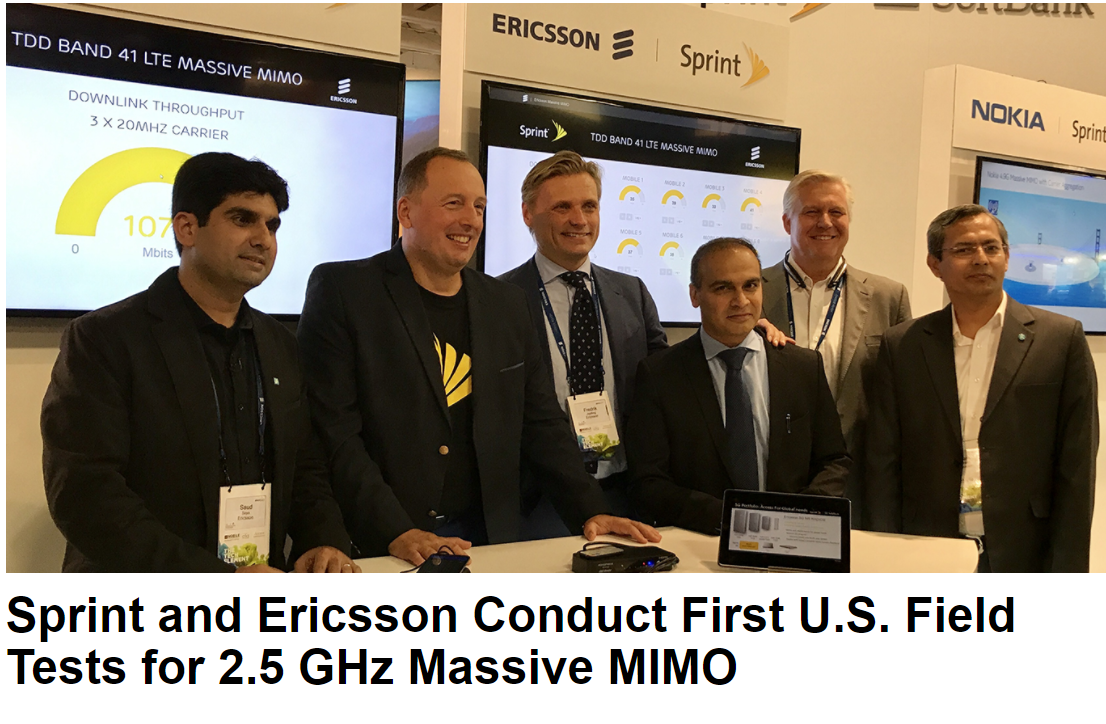
Sprint reported strong results of 2.5 GHz Massive MIMO (multiple input, multiple output) field tests conducted in Seattle, Washington and Plano, Texas in partnership with Ericsson, saying Massive MIMO radios could increase its network capacity up to ten times.

The Massive MIMO tests used Sprint’s 2.5 GHz spectrum and Ericsson’s next-generation 5G-ready AIR6468 (64 transmit, 64 receive) radio, and the backhaul equipment utilized the MINI-LINK 6352 R2 microwave radios which can provide up to 10 Gbps of backhaul.

The companies said Massive MIMO test showed a capacity increase of approximately four times compared to an 8T8R antenna. This was demonstrated by having 100 people with Samsung Galaxy S7 phones run simultaneous file downloads on a timed-test on all networks. The testing showed a 100 percent success rate on the Massive MIMO-powered Sprint network, which was a significantly higher result compared to the other networks.

In Plano, Texas, Sprint and Ericsson also recently tested Ericsson’s 64T64R Massive MIMO radios reaching peak speeds of more than 300 Mbps using a single 20 MHz channel of 2.5 GHz spectrum.

“Massive MIMO is a game changer for adding capacity to our network and taking LTE Plus to the next level,” said Dr. John Saw, Sprint CTO. “This technology is a tremendous competitive advantage for Sprint, enabling us to maximize our deep 2.5 GHz spectrum holdings. Massive MIMO will be key to meeting our customers’ growing demand for unlimited data, as well as offering Gigabit LTE and 5G services.”

Nishant Batra, Head of Network Infrastructure, Ericsson says: “Ericsson and Sprint have been collaborating on new technologies and continually evolving Sprint’s LTE network, laying the foundation for 5G. Our next-generation 5G-ready TDD 64T64R Massive MIMO radio (AIR6468) will help maximize spectral efficiency of Sprint’s 2.5 GHz network. It will also provide a cost-efficient way to support their customers’ growing appetite for increased capacity and high-speed data services. This will be the industry’s first live eCPRI installation, which allows for several deployment and performance advantages to operators in the 5G era.”

The two companies are preparing for commercial deployment next year.

http://www.sprint.com
http://www.ericsson.com


Verizon and Ericsson hit 953 Mbps with 4-carrier aggregation

Verizon achieved a top downlink rate of 953 Mbps is a real-world LTE-Advanced field test in Florida conducted in partnership with Ericsson and Qualcomm. The test combined licensed and unlicensed bands with 4-carrier aggregation, 4x4 MIMO and 256 QAM. The new Moto Z2 Force and Samsung Note 8 are capable of performing at this level.

Verizon announced several other milestones at MWC-A:

  • LTE on CBRS: Verizon, Ericsson, Qualcomm and Federated Wireless will demonstrate the first use of CBRS band 48 spectrum for LTE with carrier aggregation using a true band 48 radio in the Ericsson Radio Dot System, Qualcomm MTP, Federated Wireless Spectrum Access System (SAS) and domain proxy in the Ericsson Network Manager. This group was the first to use this newly authorized spectrum an innovative spectrum sharing scheme, and will allow cellular systems to tap into 150 MHz of new spectrum in buildings and small cell clusters. The demonstration will showcase the possibility of both operator mobile broadband and private LTE use cases on the same radio.
  • 5G enhanced intelligent video surveillance: Today, 4G LTE is used to connect surveillance cameras across cities in the US. With 5G, there will be significantly more capacity to stream the captured video back to the network and support large numbers of cameras, enabling new levels of intelligence. With all streams coming to a central, video optimized repository in the core of the 5G network, additional analysis can be applied, providing actionable intelligence for end users. This 5G enhancement to an existing 4G solution will provide benefits across smart cities, marketing insights for retail, and security.
  • Drone powered by edge compute: The Verizon and Ericsson Distributed Edge Cloud amplifies the power of simple drones to match or exceed the capabilities of complex drones, which are much more expensive. This proof of concept demonstration shows that as intelligence and processing are moved to the 5G core and the very edge of the network, existing device constraints will be lifted, enabling advanced applications with low cost devices. This new kind of architecture will provide benefits to augmented and virtual reality use cases as well as industrial control and intelligent transport systems.


http://www.verizon.com