Tuesday, July 5, 2022

LF Networking releases ONAP Jakarta

LF Networking released ONAP Jakarta -- the tenth version of its open-source, orchestration and automation framework for network operators, cloud providers, and enterprises. 

Release Highlights 

  • Security enhancements in the A&AI, DCAE, CCSDK, MSB, and MultiCloud projects, reducing log4j vulnerability and removing most GPLv3 dependencies.
  • Deepened O-RAN integration in the OOF Self Optimizing Network (SON) and CCSDK projects with O-RAN O1 models and the O-RAN AI Policy interface (consumed downstream by the O-RAN Software community).
  • Enablement of a richer set of day-2 configuration for Cloud-Native Network Functions (CNF) through CDS API extensions.
  • Intent-based networking (IBN) for closed loop for E2E Network Slicing
  • New functionality in the Configuration Persistence Service (CPS) that allows more granular control of configuration-heavy network services like RAN.
  • DCAE Transformation initiative was completed enabling huge resource savings and simplified deployment of collectors/event-processors/analytics microservices.
  • Simplification of control loop automation architecture, enabling easy deployment of new control modules. New Network Function lifecycle management features based on real-life use cases.
  • Modeling: Solidified the data model for CNFs using the novel ASD approach, while continuing alignment with data models produced by SDOs such as ETSI.
  • An overhaul of the policy framework allowing easy composition of control loop policies and better observability.

In addition, ONAP Jakarta brings a number of security enhancements as well as integration with the O-ORAN Software Community (O-RAN SC). 

"We are pleased to announce that the ONAP community has issued its tenth release, ! We’ve maintained our cadence of two major releases per year and the community has really hit its stride as we continue into our fifth year as a project! It’s the ongoing, collaborative spirit of the developers and contributors across our growing ecosystem that’s established ONAP as an open source, comprehensive platform for orchestration, management, and automation of network and edge computing services," states Catherine Lefèvre, ONAP TSC Chair. 

https://lfnetworking.org/onap-issues-jakarta-release-with-expanded-security-o-ran-alignment-5g-enhancements-and-more/

Ekinops' SixSq joins 5G-EMERGE

Ekinops has joined SixSq in the 5G-EMERGE project, which aims to develop solutions that leverage 5G technology and satellite broadcasting for media delivery. The project is part of the European Space Agency (ESA) programme of Advanced Research in Telecommunications Systems (ARTES) led by the European Broadcasting Union (EBU).

The 5G-EMERGE project aims at developing an integrated satellite and terrestrial system based on open standards to enable high-quality content distribution services over multi-layer IP infrastructures. Telecommunications satellites will efficiently deliver high-demand content, including streaming of live events, as close as possible to the end user – to the 'edge'. The project includes demonstrations in 5G base stations, users' homes and vehicles.

A consortium of 20 companies from six European countries will collaborate on developing the distributed edge technology and service-delivery features. SixSq's contribution includes leading the demonstration work package and providing the edge-to-cloud software infrastructure based on its Nuvla.io B2B SaaS platform and marketplace of containerised applications, as well as its open source NuvlaEdge software.

SixSq CEO Marc-Elian Bégin said, "leveraging satellite broadcast and 5G is a great opportunity to deliver the right high-density content at the right location with the right customization. However, this requires fine-tuned orchestration of the entire value chain and this is what SixSq edge-to-cloud software provides. We are no stranger to big challenges posed by ESA and EBU and are looking forward to pushing the boundaries of edge-to-cloud, bringing together the space sector, 5G and multi-media content delivery."

"The 5G-Emerge project is yet another example of Ekinops' long commitment towards software innovation as a mean to add value to the telecommunications sector," commented Vincent Munière, Group Chief Technology Officer & VP R&D at Ekinops. "We are looking forward to helping set the bar in 5G services and content delivery."

http://www.ekinops.com/ 

https://sixsq.com


CoreSite improves power utilization effectiveness to 1.39

CoreSite achieved a company-wide power utilization effectiveness of 1.39 in 2021, compared to 1.42 in 2020, according to its newly published its 2021 Sustainability Report.

CoreSite’s 2021 accomplishments include:

  • Entering into a 100% total renewable generation program at its Reston Colocation Data Center (VA3), located at 12369 Sunrise Valley Drive, Reston, VA 20191
  • Completing a highly energy-efficient cooling system at its Boston Data Center (BO1), located at 70 Inner Belt Rd, Somerville, MA 02143, that will save an estimated eight million kilowatt-hours each year
  • Decreasing its carbon intensity per million dollars of revenue and per net rentable square foot compared to 2020, while expanding its operational footprint

CoreSite also recently joined the Infrastructure Masons Climate Accord (ICA), a historic cooperative of more than 150 companies established in 2022 and committed to reducing carbon in digital infrastructure materials, products and power.

“CoreSite remains committed to being a reliable partner, people-centered and efficiency-focused company,” said Juan Font, President of CoreSite and SVP of U.S. Tower. “I am proud of what our team has been able to accomplish over the last year to further our sustainability journey. As members of the Infrastructure Masons Climate Accord, we look forward to collaborating with our industry peers to find ways to enhance our sustainability initiatives as well as improve the tracking and reporting of key sustainability markers.”

https://investors.coresite.com/news-releases/news-release-details/coresite-publishes-annual-sustainability-report-joins

Phoenix Tower to acquire 3,800 towers from WOM Chile

Phoenix Tower International has agreed to acquire up to 3,800 telecommunications sites in Chile from WOM SpA. The deal includes approximately 2,334 tower sites at the initial closing and 1,466 additional sites by 2024 for a total consideration of approximately $930 million, a portion of which will be paid upon transfer of the additional sites.

After accounting for this transaction, PTI will become the largest communications tower owner in Chile, expanding its global presence to over 22,000 towers in 19 countries.

“PTI is excited to enter the wireless infrastructure market in Chile. We have strong relationships with all four Mobile Network Operators in the country, each of which will be deploying 5G networks in the near term. We are proud of our partnership with WOM and the continued expansion of the relationship that this transaction represents,” said Dagan Kasavana, CEO of PTI.

“This transaction further solidifies PTI’s global footprint and is a fantastic next step for our customers, employees and investors at Blackstone,” said Tim Culver, Executive Chairman of PTI.

“This deal enables WOM to strengthen our focus to provide affordable, easy–to-access, world-class connectivity to all Chileans and will allow us to fulfill our promise to deliver the best service at fair prices. It also enables us to strengthen our investment in Chile, particularly expanding 5G coverage from Arica to Punta Arenas over the next several months, as well as expanding coverage into rural areas of the country by delivering upgraded connectivity and contributing to a reduction of the digital gap,” said WOM CEO, Sebastian Precht.

https://www.phoenixintnl.com/news/phoenix-tower-international-to-acquire-up-to-3800-towers-from-wom-in-chile

Altice to sell its towers in the Dominican Republic 

Altice Europe will sell off its communications tower business in the Dominican Republic to Phoenix Tower International, a portfolio company of Blackstone, for US$170 million. The deal covers 1,049 sites currently operated by Altice Dominicana. In addition, Altice Dominicana will enter into a 20-year master agreement to lease back the facilities. Altice forms tower infrastructure companies in France and Portugal Thursday, June 21, 2018  Altice   Altice...

Bouygues and Phoenix to operate 4,000 mobile towers in France

Blackstone-backed Phoenix Tower International and Bouygues Telecom will form a joint venture to develop approximately 4,000 newly constructed wireless towers over 12 years across France outside the Very Dense Area. The companies said some of the sites will be deployed as part of Bouygues Telecom’s “New Deal Mobile” regulatory obligations of targeted mobile radio coverage improvements, accelerated mobile radio rollouts alongside transportation routes....


AT&T to bring fiber to City of Amarillo, TX

The city of Amarillo in Texas has selected AT&T for a $24 million project to bring its fiber network to more than 22,000 customer locations throughout the city. The project proposes providing access to AT&T Fiber for homes, businesses and government agencies in the city center. The project is contingent upon funding approval by the city of Amarillo and a final contract between AT&T and the city.

In 2021, AT&T made fiber available in more than 300,000 new locations in Texas.  

"We appreciate the leadership and foresight of the city in planning to choose AT&T Fiber, which will provide a fast and reliable internet solution for today and tomorrow. This is an important milestone for the city of Amarillo and the state of Texas to show how public-private partnerships can help close the digital divide," said Fred Maldonado, Regional Vice President, AT&T Texas. "We have a long history of connecting businesses and residents in Amarillo, and we look forward to working with the city of Amarillo on making plans to bring high-speed internet to those who need it most."


Norway's ICE picks Nokia for 5G RAN

Ice, a Norwegian mobile operator, awarded a 5-year contract to Ice to expand its 5G radio network infrastructure nationwide. 

Under the contract, Nokia will supply equipment from its comprehensive, energy-efficient AirScale portfolio including Single RAN, AirScale base stations, and high-capacity 5G Massive MIMO antennas to support different spectrum bands. Approximately, 3200 base stations will be modernized and an additional 3900 new base stations will be deployed. 

Ice currently has around 700,000 subscribers.

Tommi Uitto, President of Mobile Networks at Nokia, said: “This is a particularly exciting phase for Ice as 5G is picking up pace in Norway and is establishing a competitive position in the market. We are proud to continue our journey as its long-term partner. We have already made great progress with the deployment of 5G services across the country and this new deal will extend coverage to new areas while improving the coverage and performance of the existing footprint. Our industry has a big role to play in the green transition of societies, and our energy-efficient AirScale portfolio supports Ice’s commitments to sustainability.”

https://www.nokia.com/about-us/news/releases/2022/07/05/nokia-wins-five-year-nationwide-5g-deal-with-ice-norway/

Sunday, July 3, 2022

Juniper advances its vision for the new Cloud Metro

Juniper Networks outlined its vision, strategy and products for the Cloud Metro – a new category of solutions optimized for metro transformation, sustainable business growth, and powered by AI-enabled, cloud-delivered automation. 

Cloud Metro is defined as the "new edge", where connectivity, edge cloud hosting, and service experience converge. Where as the traditional metro network was understood to be the aggregation layer, Juniper envisions that the new Cloud Metro will need extreme scale to handle gigabit residential broadband, 5G backhaul, and business cloud connectivity. Cloud Metro also needs agility and deep service assurance. To meet these needs, Juniper will deliver a series of high-performance networking systems, powered by AI-enabled, cloud-delivered automation, specifically designed to build next generation Cloud Metro infrastructure.


Juniper's Cloud Metro systems leverage adaptive power designs as their foundational principle, enabling unused features and Packet Forwarding Engines (PFEs) to be automatically switched off when not in use. A removable modular power shelf design reduces e-waste and extends system lifetimes by accommodating up to 48 times bandwidth growth within the same chassis. The goal is to replace the traditional 3-5 year ‘rip-and-replace’ network lifecycles with 7-12 year lifecycles.

The rollout includes a number of new platforms in the ACX7000 family , which features Broadcom's switching silicon and Juniper optics, including new, co-developed 400G ZR/ZR+ optics. The ACX7000 series scales from 1Gbps to 345Tbps of total capacity. The highest-end platform could support up to 54 400GE ports. Juniper says it is ready for 800G and 1.6T ports.


Some further highlights:

  • Juniper Paragon Automation as a Service provides AI-enabled, cloud-delivered automation, delivering immediate time-to-service value from months to minutes and reduced Mean Time to Know (MTTK) and Mean Time to Recovery (MTTR). Juniper AI-Enabled Device Onboarding-as-a-Service is the first-use case to be launched leveraging Juniper Paragon Automation as a Service, driving real business outcomes by significantly reducing device onboarding times.
  • The ACX7000 Family products promise up to 77 percent lower power consumption, up to 64 percent better space efficiencies and 4-7 years longer system lifetime than leading competitive products available today. The portfolio also delivers the industry’s fastest router line card, highest 400GE density and fabric capacity per slot, up to 21.6 Tbps with 54x400GE ports, ready for 800G and beyond.
  • Juniper Paragon Active Assurancetest agents are embeddedin JUNOS OS Evolved, available in all ACX7000 models. This turns the cloud metro network into a distributed sensor for assuring user experience proactively which removes the need for additional, standalone probe hardware to be deployed. Additionally, with the new capability of emulating 5G UE/gNB, service providers can now simulate traffic for both the control plane and user plane, ensuring each 5G network slice meets expected SLA.
  • Zero Trust Security ⁴ principles and the threat detection, analysis and prevention fundamentals of Juniper’s Connected Security portfolio have been applied throughout the Juniper Cloud Metro solution. Unique cryptographic digital identities are implemented with the Trusted Platform Module (TPM 2.0) across the Cloud Metro IP services fabric, enabling device attestation and RFC-compliant secure zero-touch provisioning (sZTP). In addition, file encryption and MACsec are implemented to protect data at rest and data in transit. This holistic approach to trust is further enhanced by Paragon’s ability to automatically validate the security deployment and operation across a network of ACX7000 devices.
  • Juniper Networks 400G ZR/ZR+ optics co-developed to reduce service provider costs by consolidating IP and optical layers with coherent pluggable optics, which eliminates an entire layer of DWDM transponder terminals by integrating 400G ZR/ZR+ Digital Coherent Optics (DCO). These optics fully comply with industry specifications from OpenZR+ and OIF.

“In a world of 'retro metros,' Juniper’s new Cloud Metro solution stands apart. Our cloud-delivered Paragon Automation-as-a-Service promises immediate productivity increases for service providers. Instead of building complex, time-consuming 'DIY' automation solutions, they are empowered tofocus on assuring service experiences for their customers," states Brendan Gibbs, Senior Vice President of Automated WAN Solutions, Juniper Networks. "By extending our proven AI solution to the service provider WAN, we can improve productivity for customer operations teams by dramatically reducing trouble tickets and increasing network availability. And our extended ACX7000 Family delivers the most secure, assured, scalable and intelligent Cloud Metro portfolio on the market. This is the answer to service provider needs for a sustainable future for their profits, their people and the planet.”

https://newsroom.juniper.net/news/news-details/2022/Juniper-Networks-Announces-Cloud-Metro-Innovation-to-Drive-Sustainable-Business-Growth-for-Service-Providers/default.aspx

Blueprint: Reimagining Metro Networks for Edge Computing and Beyond

by Julius Francis, Sr. Director, Product Marketing, Juniper NetworksAs new advancements are made in 5G, Internet of Things (IoT) and edge computing, doors are opening for network operators to play a more prominent role in the delivery of next generation consumer and enterprise services. However, these opportunities come paired with new challenges. Specifically, these new services and requirements drive increased traffic and diverse traffic patterns...

Video: Deliver End-to-end Network Quality with Active Assurance

The requirements around network quality are drastically increasing for both business and home use cases. SLAs are promising network quality with network KPIs, but how can we measure this? Meet active assurance. In this video, Stefan Vallin, Senior Product Manager at Juniper Networks, discusses how active assurance manages SLAs to ensure network quality.https://youtu.be/C0q9Gr-j...

Juniper intros cloud-native Paragon Automation for service assurance

Juniper Networks introduced a modular portfolio of cloud-native software applications that deliver closed-loop automation in 5G and multicloud environments.Juniper said its Paragon Automation suite is designed to translate business intent into real-world performance across the lifecycle of a network and services. The goal is to help operations teams to eliminate manual tasks and processes, assuring that users have a consistent, high-quality experience...


Saturday, July 2, 2022

KDDI hit by two day outage across Japan

KDDI, which serves over 31 million users across Japan, was hit by a widespread outage beginning on Saturday, July 2 at 01:35am local time.


KDDI attributed the initial fault to regular maintenance procedures involving the replacement of a router. Cascading errors led to disruption of other core elements, including its VoLTE platform. 

Rakuten Mobile users were also hit by the outage due to carriage agreements between the firms

As of Monday, July 4, the network had not yet fully recovered.

httpxs://news.kddi.com/important/news/important_202207051020.html


KDDI picks Ericsson, Nokia and Samsung for 5G

KDDI named Ericsson, Nokia and Samsung as its primary 5G vendors for next-generation network deployment in Japan. KDDI expects the first commercial live 5G services to be available from March 2020, with more than 93 percent coverage of 5G base station areas specified by Japan’s telecom regulation body by the end of March 2025. Ericsson confirmed that it will supply KDDI with Radio Access Network equipment, including products and solutions from...


Google Cloud region opens in Paris

A new Google Cloud region has opened in Paris, France.

The new France region (europe-west 9) launches with three cloud zones and Google Cloud's standard set of services including Compute Engine, Google Kubernetes Engine, Cloud Storage, Persistent Disk, CloudSQL, and Cloud Identity. In addition, it offers core controls to enable organizations to meet their unique compliance, privacy, and digital sovereignty needs.

https://cloud.google.com/blog/products/infrastructure/google-cloud-region-in-paris-france-now-open

Oracle inaugurates data center in Paris, now 38 cloud regionsworldwide

Oracle opened its second cloud region in France in La Courneuve, Paris.  All Oracle Cloud Infrastructure (OCI) services are available in the Oracle Cloud Paris region to support regulatory compliance requirements, which are especially critical in banking and the public sector. Available services include Oracle Autonomous Database, Oracle Container Engine for Kubernetes, and Oracle Cloud VMware Solution. The company already operates a data center...


Telstra upgrades optical network to 400 GE

Telstra is upgrading its optical network interface for its IP routers and switches from 100 GE to a 400 GE.

The deployment on Ciena’s 6500 Packet-Optical Platform  will initially be used for Telstra’s Internet traffic and broadband connectivity.

Iskra Nikolova, Telstra Executive for Network and Infrastructure, says: “We’re seeing traffic demands for mobile and fixed growing at over 40 percent and around 25 percent per annum respectively, driven by more people working from home and higher bandwidth requirements. This is due to the rising demands of video streaming and online gaming, as well as increased requirements for cloud and data center connectivity.

Emilio Romeo, Head of Ericsson Australia and New Zealand says: “This milestone achievement will ensure that Telstra’s Next Generation Optical Network has the capabilities to meet existing and future demands from its customers. Here at Ericsson, we are proud to work with Telstra and Ciena in providing network services that will benefit all Australians.”

Matthew Vesperman, Regional Managing Director for Ciena Australia and New Zealand says: “Innovative network providers like Telstra are constructing adaptive networks that can not only scale but also dynamically respond to unpredictable traffic requirements. Ciena’s 6500 platform powered by WaveLogic optics combines the required capabilities and software intelligence, providing optical network efficiencies while optimizing its footprint, power, and capacity.”

https://www.ericsson.com/en/press-releases/2/2022/6/telstra-ericsson-and-ciena-quadruple-service-capacity-for-telstras-optical-network

Telstra launches 400G service based on Ciena

 Telstra has launched commercial wavelength services based on 400G technology from Ciena. For the deployment, Ericsson delivered Ciena’s WaveLogic Ai and WaveLogic 5 Extreme solutions along with associated local professional services for optical transmission. The higher bandwidth services can now quickly be delivered with a single card, offering on-demand capacity, from 100G up to 400G. In a trial, Telstra also achieved 700G per wavelength...


Oxford Quantum Circuits raises £38 million

UK-based Oxford Quantum Circuits (OQC) announed £38 million (US $46.45 million) in Series A funding for its work in quantum computing.

The round was co-led by Lansdowne Partners, one of Europe’s leading investment firms, and The University of Tokyo Edge Capital Partners (UTEC), Japan’s largest deeptech VC fund. British Patient Capital and existing investors Oxford Science Enterprises (OSE) and Oxford Investment Consultants (OIC) also participated. This funding follows the February 2022 launch of OQC’s latest system, Lucy, on Amazon Braket - making it the first European quantum company on AWS. The company’s technology can be used by businesses in financial services, pharma and logistics to increase their competitive edge.

Ilana Wisby, CEO of OQC, said “This initial close is the UK’s largest ever Series A in quantum computing, demonstrating the confidence our investors have in our ability to lead the global quantum industry. It’s testament to the significant technological and commercial progress we have achieved in recent months, thanks to our world-class team. It is also the first step in our international expansion, bringing quantum to our customers’ fingertips – wherever they are in the world.”

https://oxfordquantumcircuits.com

Friday, July 1, 2022

Polaris Wireless enables E911 Z-Axis location on Schok feature phone

Polaris Wireless, which offers high accuracy software-based wireless location solutions, is now supporting Z-axis location capability on Schok's new feature phone.

Polaris Wireless' technology, which meets the FCC’s 3-meter vertical location accuracy requirement, is integrated into Schok’s newly released flip feature phones which are available for purchase in select stores, including Walmart, across the United States.

Feature phones are typically used by consumers looking for a simple, yet powerful flip phone, who all deserve to be accurately located in emergencies. Adding indoor and vertical location to these devices enables first responders to locate all wireless 911 callers with floor level accuracy in multi-story buildings.

“This is a major milestone for the 911 industry to deliver FCC-compliant Z-axis emergency location technology for users of feature phones,” said Manlio Allegra, CEO and Founder of Polaris Wireless. “Working with Schok and their partners has been straightforward and it’s exciting to see for the first time the complete Z-axis solution commercially available in a flip phone.”

“The Polaris Wireless location software was seamlessly integrated with our existing location and chipset vendors,” said Samuel Gutiérrez, Chairman and CEO of Schok, LLC. “Our Schok flip feature phone passed Tier I carrier acceptance testing, which for the first time included Z-axis location. Now our customers can be assured their accurate vertical location will enable first responders to find them faster in an emergency."

https://www.polariswireless.com/newsroom/press-releases/jun-21-2022/polaris-wireless-e911-z-axis-location-solution-is-deployed-in-schok-feature-phones-available-nationwide/

Thursday, June 30, 2022

BT to test Nokia’s FP5 IP routing silicon and 800G interfaces

BT has agreed to test Nokia's next generation FP5 network processing silicon, including its 800G interfaces. 

FP5 is the new heart of Nokia’s IP service routing platforms capable of supporting high density 800G routing interfaces. FP5 will also enable flow-based encryption capabilities, while promising a 75% reduction in power consumption.

BT operates the largest IP network in the UK with peak rates above 25Tbps, powered by Nokia’s 77xx family of routers. With this trial, BT is the first in the UK to test the 800G interfaces on IP routers, helping to ensure the most cost-efficient scale and capacity where its future UK customer traffic demands.

Neil McRae, Managing Director and Chief Architect at BT, said: “With FP5, Nokia continues to innovate to ensure IP networks have the scale, flexibility and features to help us manage increasing demand from our residential, mobile and business customers. We’re eager to trial its capabilities as we grow our network capacity – part of our Best Network strategy for meeting our customers’ future needs.”

Rafa de Fermin, VP Network Infrastructure at Nokia, said: “This FP5 trial is an extension of the strong partnership and collaboration between BT and Nokia to build the multiservice network that runs the UK now and in the future. Key to this trial will be FP5’s capability to support high-density standards based QSFP-DD 800 ports, which are immediately available with the FP5 and a real differentiator for Nokia.”

https://www.nokia.com/networks/technologies/fp5/


Nokia launches its FP5 network processing silicon

Nokia unveiled its fifth-generation FP5 IP routing silicon capable of powering 800GE routing interfaces in service provider networks. Nokia promises a 75% reduction in power consumption and new embedded line rate, flow-based encryption capabilities.  FP5-based platforms will be available starting in the first half of 2022.

Nokia's FP5 is a fully programmable network processor (NPU) for Nokia’s IP service routing platforms. The company says the FP5 is the first ASIC on the market to deliver up to 48 ports of QSFP-DD 800 without further hardware or fabric upgrades. Some highlights:

Security: With the current generation FP4 silicon, Nokia transformed volumetric DDoS defense with router-based detection and mitigation. With FP5, Nokia brings an additional layer of network protection with the introduction of ‘ANYsec’ - a new line rate, flow-based encryption capability integrated directly into the chipset. ANYsec supports the delivery of secure IP services including MPLS and segment routing, on-demand and at scale without impacting performance or power efficiency. Service providers can now ensure the integrity and confidentiality of all data flowing through their networks.

Network Capacity. Nokia service router platforms are the first to support high-density 800GE and 1.6 Tbps clear channel routing interfaces for applications including mobile transport, IP core, peering, BNG and provider edge. New FP5-based line cards will support 14.4 Tbps (19.2 Tbps with Nokia’s intelligent aggregation capability.) A new series of fixed form factor 7750 Service Router-1 platforms enable the benefits of FP5 to also be realized in smaller network locations.

Energy Efficiency: Nokia’s FP5 network processors drive down power consumption per bit by 75%. As FP5 is backwards compatible with FP4 and fully integrated into the latest versions of Nokia’s Service Router Operating System (SR OS), all existing features are supported from day one on the new hardware. 

Some specs:

  • 4.8 Tbps
  • delivered with a 2.5D system-in-package (SiP) construct
  • First NPU to support 100G SERDES
  • Largest device in the industry using line rate memories everywhere, for both buffering and tables, in a completely deterministic configuration
  • First NPU with embedded line-rate network encryption for L2, L2.5 and L3
  • First to support multiple 1.6 Tbps clear channel flows
  • Support for 400G ZR/ZR+, 800G and 1.6 Tbps speeds
  • External MAC ASIC with QoS pre-processing, pre-classification, pre-buffering and first level DDoS protection and encryption

Federico Guillén, President of Network Infrastructure, Nokia, said: “Of all the things that are surprising about human beings, perhaps the most surprising is our ability to be surprised. Our customers require their networks to be robust, agile and adaptable enough to handle everything life throws at them – from disruptive security threats to a global pandemic. FP5 is a significant step forward in performance, security and efficiency and – in combination with our software excellence and investment in network automation and tools – it opens the next chapter in Nokia’s long-standing leadership in IP networking and IP silicon innovation.”

O-RAN adds certification and badging program

The O-RAN Alliance, which has just wrapped up its industry summit in Germany, has launched its Certification and Badging program in collaboration with Open Test and Integration Centres (OTIC).  O-RAN certificates state that an equipment or function is conformant to O-RAN specifications, whereas the O-RAN badges confirm interoperability or end-to-end functionality of an O-RAN solution. O-RAN certificates and badges will be issued by the Open Testing and Integration Centers, or OTICs.

The OTICs provide collaborative, open, and impartial working environment to ensure consistency and quality of testing of O-RAN products and solutions. O-RAN ALLIANCE has just approved the 7th OTIC and first one in Americas: Kyrio O-RAN Test and Integration Lab hosted by CableLabs.

Some other highlights from the summit:

  • a next Generations Research Group (nGRG) has been formed to focus on open and intelligent RAN principles in 6G and future network standards. 
  • Open RAN Summit @will be held on 25-26 October 2022 in Madrid. The event will be held in collaboration with Telecom Infra Project.
  • The O-RAN Global PlugFest Spring 2022 concluded at 3 continents with 50 participants. Starting from this year, O-RAN ALLIANCE switches to hosting two global PlugFests per year, to accommodate for ever increasing interest of the diverse O-RAN community to efficiently test and integrate their O-RAN solutions.

https://www.o-ran.org/testing-integration#learn-otic

NEC. to acquire Ireland's Aspire Tech. for O-RAN expertise

NEC agreed to acquire Aspire Technology Unlimited Company, a system integration company headquartered in Dublin, Ireland. The company specializes in designing and integrating Open RAN solutions. It provides solutions and services across the full network lifecycle for legacy and open architectures, from 2G to 5G. Financial terms were not disclosed.

NEC is a global leader in Open RAN. NEC Open Networks is an industry-leading ecosystem consisting of an end-to-end suite of open products and solutions, including Open RAN components for disaggregated hardware and software, xHaul transport, converged core, automation/ orchestration software and SI services. 


Naohisa Matsuda, General Manager of NEC's 5G Strategy and Business said, "NEC has made a strong, public commitment to providing leadership in the rollout of Open RAN. Part of that commitment is building out our ability to serve as the prime system integrator for global operators as they adopt Open Networks at their own pace. The SI business is all about people and expertise. The strong capabilities and the deep pool of talented engineers at Aspire Technology, combined with their portfolio of technology solutions and applications, is a big step forward for our NEC Open Networks strategy. NEC is now better prepared than any supplier to integrate disaggregated network components into a well-tuned ecosystem."

Bill Walsh, Aspire Technology's Founder and CEO said, "We believe the combination of NEC and Aspire Technology will provide tremendous benefits to our customers, both legacy network-based and those evolving to the more Open environment, and also to the broader 5G and Open RAN marketplace, which is growing rapidly. We share a common vision of the 5G and Open RAN market, and a history of delivering complex integration projects with some of the largest carriers in the world. Together, we create a compelling and comprehensive 5G solutions portfolio."


ADVA intros high-performance optical cesium clock

ADVA introduced an industry first optical cesium atomic clock that delivers a major leap in the accuracy and stability of network timing while providing a substantially longer lifetime.

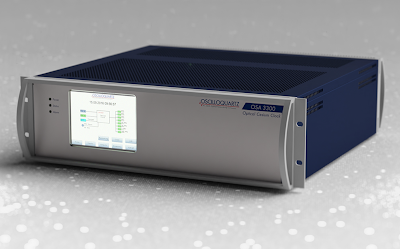
The ADVA coreSync OSA 3300-HP leverages optical-pumping techniques using laser diodes. This enables it to measure 100 times the number of atoms, making it radically more efficient compared to existing primary reference clock (PRC) technologies. Its product lifespan is 100% longer than competing high-performance magnetic cesium clocks; the OSA 3300-HP delivers optimum stability for over 10 years. What’s more, further to the launch of the OSA 3300-HP, ADVA is also announcing a dual-purpose enhancement of its OSA 3350 ePRC+. Now, as well as providing phase holdover as part of ePRTC systems, it can be utilized as a free-running frequency source with enhanced standard performance.

“What we’ve accomplished with our optical cesium atomic clock solutions is more than incremental innovation. Industrializing optical pumping techniques was widely considered to be impossible. But that’s what our team has achieved. Now, we’re taking precision timing to the next level, empowering networks with nanosecond accuracy and phenomenal stability,” commented Patrick Berthoud, time and frequency chief scientist at Oscilloquartz, ADVA. “As well as meeting new sync requirements, our OSA 3300-HP will help simplify operations with its easy-to-use GUI for intuitive configuration and operation. These devices will support advances in a host of different technology fields. Able to meet the most demanding applications in data centers, financial networks, smart grids, transportation, metrology, scientific research and more, they will also be a foundation for future innovation as we continue to expand the boundaries of possibility for accuracy and stability.”

“The launch of our coreSync OSA 3300-HP marks a key milestone in the design of atomic frequency and phase standards. After many years of extensive work in our Swiss laboratories supported by the European Space Agency, we now have a mature, state-of-the-art technology that enables a major leap in the accuracy and stability of network timing while providing a substantially longer lifetime,” said Gil Biran, GM of Oscilloquartz, ADVA. ”From 5G mobile services to mission-critical defense applications, our OSA 3300-HP will be a truly disruptive enhancement of our aPNT+™ technology. And what makes its arrival so significant is that it comes at a moment when existing synchronization solutions in fixed, wireless and cable networks are being stretched to the limit, while the threat of GNSS cyberattacks also continues to grow. Across a wide range of industries, our high-performance cesium atomic clock will meet new timing demands, create new value and open up new possibilities for PNT assurance in critical infrastructure.”

https://www.slideshare.net/ADVAOpticalNetworking/introducing-the-markets-first-high-performance-optical-cesium-clock

https://www.oscilloquartz.com

Japan's TOYO Corp to harness ADVA’s optical cesium atomic clock

TOYO Corporation has deployed ADVA's Oscilloquartz optical cesium atomic clock solution to enable R&D institutions to achieve new levels of accuracy in network synchronization. ADVA’s optical cesium atomic clock leverages advanced optical-pumping techniques. This enables the device to optimize both time delivery performance and product lifetime. ADVA says that by utilizing cesium atoms in a much more efficient way than legacy magnetic...


FCC authorizes Ku-band service in motion for SpaceX and Kepler

The FCC issued blanket authorizations to SpaceX to operate consumer and enterprise Ku-band Earth Stations in Motion (ESIM) and to Kepler Communications to operate unlimited Ku-band Earth Stations on Vessels (ESVs) in the territorial waters of the United States and aboard US-registered vessels throughout international waters worldwide.

Both SpaceX and Kepler propose to use the 14.0-14.5 GHz band to transmit (Earth-to-space), and the 10.7-12.7 GHz band, including 12.2-12.7 GHz (generally known as the 12 GHz band), to receive (space-to-Earth). 

The grants are subject to a number of conditions, some of which are related to the ongoing 12 GHz rulemaking proceeding.

https://www.fcc.gov

Dell'Oro: SASE’s Security Services Edge Market heats up

The Security Services Edge (SSE) market grew 40 percent year-over-year (Y/Y) and was over $800 M in 1Q 2022, according to a new report from Dell'Oro Group. SSE is a new market that combines cloud-delivered Secure Web Gateway (SWG), Cloud Access Security Broker (CASB), Zero Trust Network Architecture (ZTNA), and Firewall-as-a-Service (FWaaS) technologies.

“We have identified SSE as an initial basket of four cloud-delivered security technologies that underpin security in SASE,” said Mauricio Sanchez, Research Director, Network Security, and SASE & SD-WAN at Dell’Oro Group. “In the age of distributed apps and hybrid work, enterprises increasingly prefer cloud-delivered security over traditional on-premises solutions,” added Sanchez.

Additional highlights from the inaugural 1Q 2022 SASE & SD-WAN Quarterly Report:

  • Revenue associated with FWaaS and ZTNA cumulatively grew over 100 percent Y/Y.
  • Revenue associated with SWG and CASB cumulatively grew nearly 30 percent Y/Y.
  • Total SASE networking and security revenue approached $1.5 B and experienced over 30 percent Y/Y growth.
  • SD-WAN revenue grew more than 20 percent Y/Y even as supply chain headwinds persist.
  • Unified SASE–a subset of the total SASE market consisting of solutions that implement SASE networking and security as an integrated platform–achieved triple-digit Y/Y revenue growth.
  • The SASE market has over 35 vendors, with the top 11 representing 80 percent of the market by revenue.

https://www.delloro.com/news/sases-security-services-edge-market-heats-up-40-percent-in-1q-2022/

DISH Wireless employs Nokia 5G Standalone Core on AWS

Nokia confirmed that DISH Wireless is the Nokia 5G Standalone Core on Amazon Web Services (AWS) public cloud.

Nokia said its cloud-native software allows DISH to cost effectively manage its network and offer new enterprise and consumer 5G use cases in areas like Industry 4.0 and mission critical services quickly and securely, while fully adhering to Service Level Agreements.

Raghav Sahgal, President of Cloud and Network Services at Nokia, said: “This is a tremendous milestone after years of planning and perseverance, and we are pleased that Nokia’s leading 5G Core offering is serving as a backbone for delivering 5G services to DISH customers in the U.S.”

Nokia also notes that over 60 CSP customers around the world, including around 30 CSPs in Europe have committed to its 5G SA Core. In addition, 25 of the top 40 communication service providers globally by revenue rely on Nokia Core network products.

LightRiver appoints Scotty Benda as Chief Product Officer

LightRiver, an optical network integration solution provider, appointed Scotty Benda as Chief Product Officer. 

Benda previously has held senior systems, software and services leadership positions at Nortel, Lucent, ONI and Ciena where he successfully led innovative growth efforts and drove improvements in product, process and delivery performance within those companies.

“The shift to open optical networks represents an unprecedented opportunity for LightRiver with our comprehensive ‘design, deploy and automate’ approach to multivendor network solutions,” states Mike Jonas, President of Global Customer Operations for LightRiver. “I’m thrilled to welcome Scotty to our leadership team as we scale our platform, enhance our value proposition and accelerate toward the next phase of growth.”