Thursday, August 27, 2020

VMware posts Q2 revenue of $2.88 billion, up 9% yoy

VMware reported Q2 revenue of $2.88 billion, an increase of 9% from the second quarter of fiscal 2020. GAAP net income for the second quarter was $447 million, or $1.06 per diluted share, compared to $5.30 billion1, or $12.47 per diluted share, for the second quarter of fiscal 2020. Non-GAAP net income for the second quarter was $766 million, or $1.81 per diluted share, up 18% per diluted share compared to $650 million, or $1.53 per diluted share, for the second quarter of fiscal 2020.

“In light of these uncertain times, we delivered solid execution and financial performance in Q2 FY21,” said Pat Gelsinger, VMware CEO. “With our Any Cloud, Any Application, Any Device strategy, we are helping customers solve their hardest technology challenges and meet and exceed their business objectives.”

“Our performance in Q2 reflected strength in our Subscription and SaaS product offerings, which grew 44% year-over-year,” said Zane Rowe, executive vice president and CFO, VMware. “We plan to accelerate certain product initiatives through the remainder of the year, which will further support customers’ digital transformations and grow our Subscription and SaaS product offerings.”
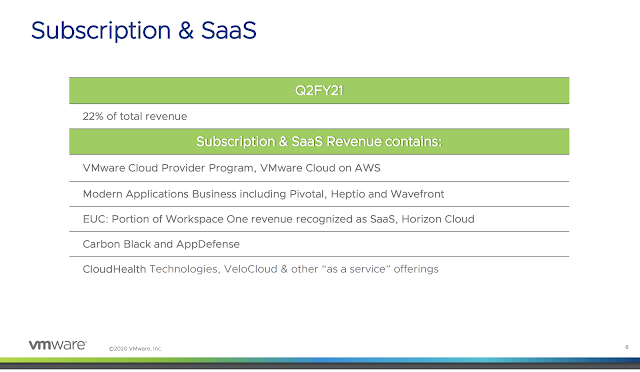


  • The combination of subscription and SaaS and license revenue was $1.35 billion, an increase of 11% from the second quarter of fiscal 2020.
  • Subscription and SaaS revenue for the second quarter was $631 million, an increase of 44% year-over-year, representing 22% of total revenue.
  • The combination of subscription and SaaS and license revenue plus sequential change in unearned subscription and SaaS and license revenue grew 12% year-over-year.
  • VMware made available the second generation of VMware Cloud on Dell EMC, a VMware service that delivers simple, more secure and scalable infrastructure as-a-service to customers’ on-premises data center and edge locations.
  • Google Cloud announced the general availability of Google Cloud VMware Engine, an integrated first-party offering with end-to-end support to migrate and run the VMware environment in Google Cloud.
  • Microsoft previewed the next generation of Azure VMware Solution, a first-party solution designed, built and supported by Microsoft and endorsed by VMware.
  • VMware announced new capabilities designed to further improve the economic value of VMware Cloud on AWS while meeting an evolving set of requirements for application modernization, business continuity and resiliency, and cloud migration.
  • Oracle unveiled worldwide availability of Oracle Cloud VMware Solution, a dedicated, cloud-native VMware-based environment that enables enterprises to easily move their production VMware workloads to Oracle Cloud Infrastructure.
  • DISH has chosen VMware Telco Cloud to help deploy the world’s first 5G, cloud-native Open Radio Access Network. The platform will help bring to life the first network in the U.S. to combine the efficiency of the distributed telco cloud, public cloud and private cloud environments while delivering consistent, low-latency edge computing.
  • Intel and VMware announced they are collaborating on an integrated software platform for virtualized Radio Access Networks to accelerate the rollout of both existing LTE and future 5G networks.

Dheeraj Pandey, co-founder and CEO of Nutanix, to step down

Dheeraj Pandey announced plans to retire as CEO of Nutanix upon the selection and appointment of the company’s next CEO.

“Co-founding and leading Nutanix for the last 11 years has been the single most rewarding experience of my professional career. Guided by a vision of making IT infrastructure so simple that it becomes invisible, our team has built Nutanix into a leader in cloud software and a pioneer in hybrid cloud infrastructure solutions,” said Pandey. “With our strong fourth quarter financial results, 29 percent growth in year-over-year run-rate ACV, a delightful software stack, and our recent launch of Nutanix Clusters on AWS bare metal, Nutanix is well positioned for the future. In addition, the $750 million investment from Bain Capital Private Equity announced today underscores the strength of our business and ensures a strong financial foundation to capitalize on the significant opportunities ahead. I am confident there is no better time for me to make this transition to a new leader who can guide Nutanix through its next decade of growth and success.”

“Silicon Valley’s history is filled with storied founders and legendary visionaries and Dheeraj Pandey has earned a place among them,” said Ravi Mhatre, Lead Independent Director. “On behalf of the entire Board, I thank Dheeraj for his vision and invaluable contributions, which have enabled Nutanix to grow from a simple idea to the market leader and successful company it is today. We support his decision to begin another chapter and deeply appreciate that he will continue to lead the management team until a successor has been appointed.”

Wednesday, August 26, 2020

OIF approves CEI-224G development project

OIF members have approved the CEI (Common Electrical I/O) 224G Development Project,  the next electrical data rate beyond 112 Gbps.

The expected result will be a technical white paper summarizing a consensus-based body of knowledge which will then enable several project starts for next generation CEI clauses addressing specific reaches and architectures.

OIF's recent quarterly virtual meeting also resulted in a wrap-up of the “Co-packaging of Optics with ASICs” members-only workshop and a readout of the results of the public Optical Module Management Interface Survey.

“OIF strives to challenge our member companies to achieve more in order to accelerate industry innovation and standards that maintain alignment with network operator trends and needs,” explained Nathan Tracy, TE Connectivity and OIF President. “We are continually advocating for increased interoperability and the OIF quarterly meetings provide the ideal forum for members to debate and discuss the interoperability challenges that the industry is trying to overcome. For example, getting electrical signals to travel at 224 Gbps over workable distances is a challenge we are looking forward to exploring.”

OIF held a “Co-packaging of Optics with ASICs” workshop on July 20th for OIF members. The workshop explored the various challenges of co-packaging of optics and identified opportunities for industry collaboration. Presenting companies included Applied Optoelectronics, Inc., Facebook, Inphi, Intel, Keysight Technologies, Microsoft, Ranovus, Senko Advanced Components, Inc. and TE Connectivity. Based on the success of the member workshop and increasing interest in the topic industry-wide, OIF is planning a public workshop on co-packaging of optics. Details and registration will be available soon.

OIF recently conducted a public industry survey designed to determine how the Coherent Common Management Interface Specification Implementation Agreement is viewed by the industry and the level of industry alignment and support for further standardization of optical module management. Results of the survey were presented on a public webinar on July 30 and recapped during the Q3 meeting. Click HERE to download the survey results.  Survey results are posted here: https://www.oiforum.com/wp-content/uploads/OIF_Management_Survey_results_V7.pdf

Turkcell tests OpenRAN and vRAN with Mavenir

Turkcell announced the world’s first OpenRAN vRAN call fully containerized with O-RAN Split 7.2 architecture.

Running on Turkcell’s Telco Cloud environment, Mavenir’s OpenRAN vRAN is integrated with Turkcell Core, and is the first workload that will be going live on Turkcell’s Edge Cloud.


Mavenir said its OpenRAN vRAN solution centralizes baseband processing in cloud-native virtualized and containerized baseband units (vBBU) and exploits fronthaul over ethernet between vBBU and multiple remote radio units (RRU). The Mavenir vRAN architecture and platform supports 4G as well as both 5G NR NSA and SA. The vBBU is split into Central Unit (CU) and Distributed Unit (DU) and it features O-RAN standard interfaces.

The split between the DU and the RRU gives flexibility to the RAN system by enabling an efficient interface which can be run over Ethernet and allows concentration of the processing power either into data centers or onto edge platforms. Mavenir’s OpenRAN vRAN allows a very secure and transparent interface which is based on a single architecture that can accommodate several deployment scenarios.

With these open interfaces, as well as virtualization and web scale containerization, the solution has the flexibility to support various deployment scenarios – including Public Cloud, Private Cloud and at the RRU site. It can also support massive MIMO, mmWave, edge micro services and network slicing for 5G NR.

“Mavenir is extremely proud to have supported Turkcell, which is a very innovative and advanced operator, in achieving this first call in a truly OpenRAN containerized implementation,” said Mikael Rylander, Mavenir’s SVP/GM Radio Access Products. “The standard O-RAN 7.2 interface will enable and boost the OpenRAN ecosystem significantly by allowing many RRU vendors to be deployed and to have very effective solutions in all possible frequency bands with great deployment flexibility and with automation and remote operations.”

“We strongly believe in Turkcell that innovation is the engine that allows us to be very close to our customers and meet their demands,” Gediz Sezgin, Turkcell CTO stated. “Now with OpenRAN, we are entering a new era that offers us new ways of deploying Radio Networks and create a real distributed 5G network to fulfill the expectations that the industry has. We are pleased to pioneer this technology with Mavenir by realizing world’s first containerized implementation with a truly open architecture using a mix and match of Open FH supported RRU and CU/DU which reflects the true sense of Open RAN.”

FCC raises $4.5 billion in first 5G mid-band spectrum auction

The FCC completed its auction of Priority Access Licenses in the 3550-3650 MHz band. Gross proceeds reached $4,585,663,345, and bidders won 20,625 of 22,631, or more than 91.1%, of available licenses.

“This is a banner day for American leadership in 5G and for American consumers.  The 3.5 GHz auction has concluded, and I can say unequivocally:  It was a resounding success,” said FCC Chairman Ajit Pai.  “The strong demand for licenses was the direct result of this Commission’s reforms to the rules for the 3.5 GHz band—reforms that would not have been possible without the leadership and hard work of my colleague, Commissioner Mike O’Rielly.  This auction has been a key part of our 5G FAST Plan and our ongoing push to make more mid-band spectrum available for 5G.  I look forward to this important spectrum being put to use quickly to provide service to the American people.  And I look forward to the Commission making available 280 more megahertz of mid-band spectrum for 5G in the C-band auction beginning on December 8.”

The FCC will release a public notice in a few days providing detailed auction results, including the names of Auction 105 winning bidders, and announcing deadlines for payments and the filing of long-form applications, as well as other post-auction procedures needed for the prompt issuance of licenses. 

https://www.fcc.gov/auction/105

Telia Carrier announces expansion and partnerships in Mexico

QuattroCom, a Mexican carrier-neutral service provider, has formed a partnership with Telia Carrier to provide dedicated Internet access to its enterprise businesses in the city of Querétaro, in central Mexico. The partnership gives QuattroCom access to Telia Carrier's AS1299 global network, supporting enterprise business demands for the increasing need for scalable, high-performance connectivity in the city's growing business market.

“Partnering with QuattroCom allows us to reach the burgeoning businesses in the city Querétaro,” said Luis Velasquez, Mexico business manager, Telia Carrier. “Aside from being recognized as being one of the best places to do business in the Americas, Querétaro is also considered to be Mexico's 'Silicon Valley.' This partnership allows us to strengthen our position to deliver connectivity and high-quality local access to these thriving businesses and enables the local infrastructure to grow.”

Telia Carrier also announced an expansion of its partnership with Neutral Networks in Mexico, adding a new point of presence (PoP) at the Pabellon M development in the city of Monterrey. The partnership will enhance Telia Carrier’s fiber backbone and connectivity in the city of Monterrey, with the possibility to connect with northern Mexico’s top markets and strategic business sectors including manufacturing, commerce and financial services.

“Our presence in Monterrey is part of Telia Carrier’s mission to extend our global network partnering with regional access providers to bring unique diversity and value to the market. Working with Neutral Networks, a division of Even Group which is one of the most active infrastructure builders in the Mexican telecoms landscape, we strengthen our position to deliver connectivity and high-quality local access for growing regional industries.” said Luis Velasquez, Mexico business manager, Telia Carrier.

http://www.Teliacarrier.com

Edgecore builds a cloud controller for wired and wireless devices

Taiwan-based Edgecore Networks introduced ecCLOUD, a cloud controller for unified visibility and control over Edgecore wired and wireless devices. Cloud controllers are lower cost and simpler than on-site management system installations.

TT Hsu, Vice President of Edgecore Networks said, “Edgecore’s ecCLOUD is a feature-rich, reliable, and scalable network management solution suited for networks of any size. With ecCLOUD, deployment, management, and monitoring of single-site or multi-site networks can be greatly simplified. ecCLOUD also supports management of a comprehensive product portfolio for service providers and organizations to enjoy the benefit of being able to choose from a wide array of Edgecore products for their deployments.”

ecCLOUD features

  • Multi-level Management: ecCLOUD is composed of three levels – Cloud, Site, and Device. This multi-level architecture facilitates tiered administrative privileges as well as bulk device management from the site level. With ecCLOUD, multi-site networks can be easily managed, and each site can have its own set of configuration settings that can be applied to devices registered under the site.
  • Quick Device Onboarding: Placing a device online is easy – simply register the device on ecCLOUD and connect the registered device to the Internet for auto-provisioning.
  • Auto-generated Network Topology Diagrams: Network topology diagrams are automatically generated at the site-level to help network administrators better assess and manage deployment architectures.
  • Network Security & Access Control: ecCLOUD ensures overall network security through encryption of device-to-cloud communication. Enhanced switch port security and AAA services for wireless users are also available.
  • Customizable Captive Portal: Network administrators can quickly create unique Wi-Fi login pages per SSID for brand promotion, marketing activities, or advertisements. The built-in captive portal editor provides drag-and-drop modules for adding text, links, and multimedia, allowing anyone to easily craft their own login pages even without extensive knowledge in web development.


Juniper and Netcracker team on enterprise service automation

Juniper Networks and Netcracker Technology announced a joint solution that facilitates the end-to-end management of LAN/WLAN/WAN networks with automated service provisioning and workflows, AI-driven insight and full lifecycle management from client to cloud.

The company said their joint Enterprise Service Automation solution will help service providers to unify LAN and WAN environments, providing additional value to their enterprise customers.

The solution combines Juniper's Mist AI with Netcracker's Service Orchestration and 2020 Digital BSS/OSS portfolio.

“For many enterprises, meeting the demands of an increasingly complex and dynamic network environment is an uphill battle. Through this expansion of our long-standing relationship with Netcracker, we can combine our industry-leading technology to offer a strategic value proposition to service providers and deliver end-to-end SLAs with fully managed enterprise networks. This approach can help increase revenues and profitability with existing customers as well as expand an SP’s managed services into new B2B vertical markets, leveraging new opportunities in the 5G era," states Raj Yavatkar, CTO, Juniper Networks.

Keysight powers Jabil’s 5G test bed

Jabil, which provides design, manufacturing, supply chain and product management services, has selected Keysight’s 5G device test solutions to address the demand for 5G product validation in design and manufacturing.

Jabil serves a broad range of industries, many of which are taking full advantage of a digital transformation towards realizing the future of the fourth industrial revolution (4IR). Keysight’s software-centric test, measurement, security and optimization solutions support this transformation across multiple technology domains, including 5G new radio (NR), high-speed digital and virtualized radio access networks (vRAN).

“As a solution partner to top brands and leading original equipment manufacturers (OEMs), we’re pleased that Jabil selected Keysight’s UXM 5G wireless test platform to help advance research activities,” said Cao Peng, senior director of Keysight’s communications solutions group. “Keysight is pleased to contribute to the wireless standards development organizations (SDOs) and industry consortia, as it enables us to deliver a comprehensive suite of certified test cases for conformance validation of 5G new radio devices.”

Tuesday, August 25, 2020

ONF launches 5G SD-RAN Project

The Open Networking Foundation (ONF) has launched an SD-RAN project with the aim of building an open source Near Real-Time RAN Intelligent Controller (nRT-RIC) compatible with the O-RAN architecture as well ONF’s existing base cloud-native solutions leveraging disaggregation and whitebox hardware.

ONF said its goal is to foster open source software platforms and multi-vendor solutions for mobile 4G and 5G RAN deployments.

Central to the project is the development of an open source near-real time RIC called µONOS-RIC (pronounced “micro-ONOS-RIC”).

µONOS is a microservices-based SDN controller created by the refactoring and enhancement of ONOS, the leading SDN controller for operators in production tier-1 networks worldwide.  µONOS-RIC is built on µONOS, and hence features a cloud-native design supporting active-active clustering for scalability, performance and high availability along with the real-time capabilities needed for intelligent RAN control. The O-RAN ALLIANCE E2 interface is used to interface between µONOS-RIC and vendor supplied RAN RU/DU/CU RAN components.

Carriers would be able to run new "xApps" on top of the µONOS-RIC.  These open xApps could provide functionality that traditionally has been implemented in vendor-proprietary implementations, including providing visibility and control over the RAN.

Significantly, the ONF's SD-RAN project is backed by AT&T, China Mobile, China Unicom, Deutsche Telekom, Facebook, Google, Intel, NTT, Radisys and Sercomm.

A working skeleton prototype of the µONOS-RIC controller is already running above a RAN emulation platform through the E2 interface.  ONF has demonstrated handover and load balancing at scale, supporting over 100 base stations and 100,000 user devices with less than 50ms handover latency (less than 10ms latency for 99% of all handovers). Field trials are expected by early 2021.

“AT&T strongly supports the development of specifications and components that can help drive openness and innovation in the RAN ecosystem. The O-RAN ALLIANCE’s specifications are enabling the ecosystem, with a range of companies and organizations creating both open source and proprietary implementations that are bringing the open specifications to life. The ONF SD-RAN project, along with the O-RAN OSC, will expand the ecosystem with an nRT-RIC that can support xApps and help demonstrate their interoperability. This project will help accelerate the transition to an open RAN future,” stated Andre Fuetsch, President and Chief Technology Officer, AT&T Labs.

“Google is an advocate for SDN, disaggregation and open source, and we are excited to see these principles now being applied to the RAN domain. ONF’s SD-RAN project’s ambition to create an open source RIC can help invigorate innovation across the mobile domain, said Ankur Jain, Distinguished Engineer, Google.

https://www.opennetworking.org/news-and-events/press-releases/onf-announces-new-5g-sd-ran-project/


https://youtu.be/1VbiRGBjqK8

ONF's Aether targets Enterprise 5G/LTE-Edge-Cloud-as-a-Service

The Open Networking Foundation (ONF) announced Aether – the first open-source platform for delivering Enterprise 5G/LTE-Edge-Cloud-as-a-Service.

Aether (pronounced ‘ee-ther’) provides mobile connectivity and edge cloud services for distributed enterprise networks, all provisioned and managed from a centralized cloud.


Aether leverages existing work from ONF including the CORD and ONOS platforms. It can be run in a Kubernetes environment, and it simultaneously supports deployment on licensed (4G/5G) and unlicensed (CBRS) spectrum.

“Aether opens the door for enterprises to rapidly deploy 5G and edge cloud services to help power their digital transformations. This can be done with a variety of flexible business models including in collaboration with telco operators, cloud operators, and third party providers. It offers the flexibility to utilize a wide range of bands including 5G, licensed bands, and CBRS. This cloud-enabled platform turns mobile connectivity and enterprise mobile edge cloud capabilities into a cloud-managed service, simplifying deployment and operations while delivering scalable and cost-effective services,” states Guru Parulkar, Executive Director, ONF & Executive Director, Stanford Platform Lab.

ONF already has a modest Aether pilot production network supporting edge cloud services running at two ONF offices, Intel Labs, and at other sites. This pilot is centrally managed and controlled from public cloud, with Aether Edge installations at each site. The entire deployment is maintained by ONF and ONF members using a distributed CI/CD DevOps development pipeline.

As with all ONF projects, Aether is backed by ONF’s operator partners AT&T, China Unicom, Comcast, Deutsche Telekom, Google, NTT Group and Turk Telekom. Additionally, ONF, Intel, GSLab, Infosys, and Accelleran are actively collaborating as a distributed DevOps team enhancing and maintaining Aether.

Verizon completes fully virtualized 5G data session

Verizon recently completed an end-to-end fully virtualized 5G data session in a live network.

Verizon's demonstration of virtualization in the Radio Access Network tested technology from several partners, including:

  • Samsung provided its commercial 5G virtualized RAN solution, consisting of a virtualized Central Unit (vCU), a virtualized Distributed Unit (vDU), and radio units. The solution can provide mobile operators with improved efficiency, flexibility, and management benefits through the deployment of a software-based 5G radio infrastructure. Samsung announced commercial availability of its fully-virtualized 5G RAN solution last month.
  • Intel provided its Intel Xeon Scalable processor, Intel FPGA Programmable Acceleration Card (Intel FPGA PAC) N3000, Intel Ethernet Network Adapter XXV710 to deliver the processing, acceleration and connectivity requirements, and its FlexRAN software reference architecture.
  • Wind River is providing Verizon with a cloud-native, Kubernetes- and container-based software infrastructure, which delivers ultra-low latency and high availability for national deployment of virtualized 5G RAN. Wind River’s solution is integrated with best-in-class vRAN applications, providing single-pane-of-glass and zero-touch automated management, and network analytics.

Verizon said this technology milestone provides the foundation for wide-scale mobile edge computing and network slicing.  Earlier this month, Verizon launched 5G mobile edge compute live for developers with AWS Wavelength at Verizon’s 5G Edge locations in Boston and the Bay Area.  As Verizon extends its MEC leadership, virtualization in the Radio Access Network (RAN) becomes even more important.

Virtualizing the RAN decouples software and hardware functionality enabling the network to be built on general purpose hardware. Using Common Off-The-Shelf (COTS) hardware leads to greater flexibility and agility in the introduction of new products and services. Instead of adding or upgrading single-purpose hardware, the move to a cloud native, container-based virtualized architecture with standardized interfaces leads to greater flexibility, faster delivery of services, greater scalability, and improved cost efficiency in networks.

“Virtualizing the entire network from the core to the edge has been a massive, multi-year redesign effort of our network architecture that simplifies and modernizes our entire network,” said Adam Koeppe, Senior Vice President of Technology and Planning for Verizon. “Verizon has been on the leading edge of virtualizing the core over the past few years and has been bullish in the design and development of open RAN technology, as well as in the testing of that technology with great success.”

“Massive scale IOT solutions, more robust consumer devices and solutions, AR/VR, remote healthcare, autonomous robotics in manufacturing environments, and ubiquitous smart city solutions are only some of the ways we will be able to deliver the promise of the digital world.  Advancements in virtualization technology are critical steps towards that realization,” said Koeppe.

Verizon to offer 5G network edge computing with AWS Wavelength

Verizon will be the first carrier to offer the new AWS Wavelength service to provide developers the ability to deploy applications that require ultra-low latency to mobile devices using 5G.  The service targets latency-sensitive use cases like machine learning inference at the edge, autonomous industrial equipment, smart cars and cities, Internet of Things (IoT), and augmented and virtual reality. The idea is to position AWS compute and storage services at the edge of Verizon’s 5G network.

The companies are currently piloting AWS Wavelength on Verizon’s edge compute platform, 5G Edge, in Chicago for a select group of customers, including video game publisher Bethesda Softworks and the National Football League (NFL). Additional deployments are planned in other locations across the U.S. in 2020.

Verizon 5G Edge provides mobile edge computing and an efficient high-volume connection between users, devices, and applications. AWS Wavelength lets customers deploy the parts of an application that require ultra-low latency to the edge of the network and then seamlessly connect back to the full range of cloud services running in AWS.

AWS also listed Vodafone Business, KDDI, and SK Telecom as partners.

Verizon tests Ericsson's cloud-native, containerized EPC

Verizon and Ericsson introduced a cloud-native, container-based technology on the core of Verizon’s active network.

The proof-of-concept trial deployment is described as the first container- based wireless EPC (Evolved Packet Core) technology deployment in a live network in the world.

The trial, which was conducted on Verizon's commercial network in Hillsboro, Oregon, used Ericsson Packet Core Controller deployed as a cloud-native and microservice-based Mobility Management Entity (MME) in an existing pool. The software used leverages docker images and helm charts, with expected updates on the software from Ericsson every two weeks.

Nils Viklund, Head of Solution Area Packet Core at Ericsson says: "The industry’s evolution to cloud native means big changes ahead. Ericsson is leading the industry when it comes to driving cloud-native design in order to bring the agility needed to manage workloads dynamically at the edge required for many new 5G use cases. Now together with Verizon, we are demonstrating how cloud native EPC can be an important step in increasing efficiency and utilization of the cloud infrastructure."

“The pace of technological advancement is rapid and is exponentially increasing. By evolving our core network past simply using virtualized machines and instead changing our underlying software architecture to run on cloud- native technology, we are able to achieve new levels of operational automation, flexibility and adaptability,” said Bill Stone, Vice President of Technology Development and Planning for Verizon.

Open Eye Consortium announces 53Gbps per lane Multi-Mode SR4

The Open Eye Consortium (Open Eye MSA) announced two new specifications targeted for 53Gbps per lane applications: SR4 for 100 meters reach over a multi-mode fiber and LR for 10 kilometers reach over a single-mode fiber. The new specs target 53Gbps SFP28 Long-Reach (LR) and 200Gbps QSFP Short-Reach (SR) optical module designs for next generation 5G wireless, enterprise and data center networking applications.

The Open Eye MSA said its new specifications will provide an alternative to higher power and higher cost DSP-based solutions.

The new specs complement the Open Eye MSA’s previously released 200Gbps FR4 specification.

In addition, the Open Eye MSA will be hosting two webinars aimed at introducing network planners and optical module developers to this new exciting technology:

Webinar 1

  • Topic: Reduce Cost, Power and Latency with Open Eye MSA based Optical Connectivity
  • Description: This webinar is targeted for Data Center, Enterprise and Telecom network architects. Presenters will overview the benefits of the Open Eye MSA approach enabling low cost, low power and low latency optical modules for 200Gbps and 400Gbps connectivity deployments.
Webinar 2
  • Topic: Reducing the Cost of 200Gbps and 400Gbps Optics using Open Eye MSA compliant Chipset Solutions
  • Description: This webinar is targeted for manufacturers of optical modules. The Open Eye MSA approach is a natural evolution relative to today’s high-volume optical nodes, enabling users to scale to next generation Baud rates. Presenters will overview chip-set and test solutions for implementation of modules based on Open Eye MSA specifications.

The Open Eye MSA is also excited to announce that its membership has grown to 37 members with the addition of Credo Semiconductor, Fuji Xerox and Lumentum to its list of members.

https://www.openeye-msa.org/

Open Eye Consortium specification defines 53Gbps per lane PAM-4

The Open Eye Consortium (Open Eye MSA) published its 53 Gbps single-mode specification defining the requirements for analog PAM-4 solutions for 50G SFP, 100G DSFP, 200G QSFP, and 400G QSFP-DD and OSFP single-mode modules.

The Open Eye MSA aims to accelerate the adoption of PAM-4 optical interconnects scaling to 50Gbps, 100Gbps, 200Gbps, and 400Gbps by expanding upon existing standards to enable optical module implementations using less complex, lower cost, lower power, and optimized analog clock and data recovery (CDR) based architectures in addition to existing digital signal processing (DSP) architectures.

A whitepaper is available to view and download.

In addition, the Open Eye MSA announced the draft of its multi-mode specification available to its members for comments, with general availability targeted for release in Fall 2020.

http://www.openeye-msa.org

Cisco to acquire BabbleLabs - AI-powered voice enhancement

Cisco agreed to acquire BabbleLabs, a start-up headquartered in Campbell, California that uses AI techniques to distinguish human speech from unwanted noise. Financial terms were not disclosed.

The BabbleLabs technology can be used to enhance the quality of communications and conferencing applications. BabbleLabs goes beyond existing noise suppression technology solutions by:

  • Distinguishing speech from background noise;
  • Removing background noise in real-time; and
  • Enhancing the voice to elevate communication, regardless of language.
BabbleLabs team will join the Cisco Collaboration Group, led by Javed Khan, senior vice president and general manager, which is part of the Cisco Security and Applications Business, led by Jeetu Patel.

Initially, Cisco will focus on integrating BabbleLabs to deliver a best-in-class audio experience to Webex Meetings users.  - wherever they are and however they connect via the Webex application (whether via a conference room or mobile device).

“A great meeting experience starts with great audio,” said Jeetu Patel, senior vice president and general manager, Cisco Security and Applications Business Unit. “We’re thrilled to welcome BabbleLabs’ team of highly skilled engineers. Their technology is going to provide our customers with yet another important innovation – automatically removing unwanted noise - to continue enabling exceptional Webex meeting experiences.”

Kymeta completes $85 milllion funding round led by Bill Gates

Kymeta, a developer of satellite antennas, completed an $85 million funding round led by Bill Gates with members of the leadership team personally investing approximately $1 million, including Kymeta Executive Chairman, Doug Hutcheson.

Kymeta offers an electronically steered flat panel antenna platform built specifically for mobility and designed for the needs of military, first responders and commercial customers. The advanced u8 antenna supports global land mobility, covering the full Ku-band with improved efficiency. The company also offers a hybrid satellite-cellular connectivity service.

“As a company, we’re just scratching the surface of how powerful hybrid satellite-cellular communications can be when combined with an affordable electronically steered flat panel antenna offered to the global land mobility ecosystem,” said Doug Hutcheson, Executive Chairman, Kymeta. “Having the continued support of Bill Gates will help us execute our vision even more rapidly and broadly – and with the benefit of experience, perspective and relationships of a leading and highly successful technology backer.”

http://www.kymetacorp.com


.

HPE reports growing "as-a-service" revenue

Hewlett Packard Enterprise reported revenue of $6.8 billion for its fiscal 2020 third quarter, ended July 31, 2020, down 6% from the prior-year period or 4% when adjusted for currency. Revenue grew 13% sequentially or 14% when adjusted for currency driven by solid execution in clearing historic backlog by approximately $500 million during the quarter. Gross profit was $2.1 billion, up 8% sequentially, which the company credits to strong operation execution.

“Our Q3 results are marked by strong execution and sequential growth,” said Antonio Neri, president and CEO of Hewlett Packard Enterprise. “We significantly improved operational and supply chain execution and advanced our innovation agenda with the introduction of HPE GreenLake cloud services solutions, our new HPE Ezmeral software portfolio, and our planned acquisition of SD-WAN leader Silver Peak.”

“We gained momentum in key areas of differentiation and accelerated our as-a-service pivot with strong ARR growth and a record number of HPE GreenLake services orders,” he continued. “Navigating through the pandemic and planning for a post-COVID world have increased customers’ needs for as-a-service offerings, secure connectivity, remote work capabilities and analytics to unlock insights from data that are aligned to our strategy. We see a tremendous opportunity to help our customers drive digital transformations as they continue to adapt to operate in a new world.”

Highlights

  • Intelligent Edge revenue was $684 million, down 12% year over year or 11% when adjusted for currency, with 8.6% operating profit margin, compared to 6.8% from the prior-year period. Revenue grew 3% sequentially demonstrating continued momentum.
  • Compute revenue was $3.4 billion, flat year over year or up 1% when adjusted for currency, with 8.5% operating profit margin, compared to 12.9% from the prior-year period. Revenue grew 28% sequentially or 29% when adjusted for currency as we executed against the backlog and improved supply chain execution.
  • High Performance Compute & Mission Critical Systems (HPC & MCS) revenue was $649 million, up 3% year over year, with 5.5% operating profit margin, compared to 8.1% from the prior-year period. Revenue grew 10% sequentially as installations and customer acceptance of systems improved.
  • Storage revenue was $1.1 billion, down 10% year over year or 9% when adjusted for currency, with 12.9% operating profit margin, compared to 16.5% from the prior-year period. Revenue grew 4% sequentially driven by improved operational execution and reduction of backlog.
  • Advisory & Professional Services (A&PS) revenue was $226 million, down 7% year over year or 5% when adjusted for currency, with (1.8%) operating profit margin, compared to (3.7%) from the prior-year period. Revenue was down 5% sequentially.
  • Financial Services revenue was $811 million, down 9% year over year or 6% when adjusted for currency and down 3% sequentially or 2% when adjusted for currency, with 8.0% operating profit margin, compared to 8.7% from the prior-year period. 

Monday, August 24, 2020

GSMA advances its Network Equipment Security Assurance Scheme

Ericsson, Huawei, Nokia and ZTE, have successfully completed an assessment of their product development and lifecycle management processes using the GSMA’s Network Equipment Security Assurance Scheme (NESAS), which provides a security assurance framework to improve security levels across the mobile industry.

The NESAS scheme is a collaboration and jointly led by 3GPP and the GSMA, and is open to all vendors of network equipment products that support 3GPP defined functions.

“The GSMA recognises the support and participation of Ericsson, Huawei, Nokia and ZTE who have satisfied the scheme’s security requirements via an independent security audit and we congratulate them on achieving this important first step,” said Alex Sinclair, Chief Technology Officer, GSMA. “By committing to NESAS, vendors are helping network operators, and other stakeholders make informed decisions about secure product development. We look forward to others participating in the scheme, evidencing their commitment to good security practice by promoting a security-by-design culture within the industry.”

During the second stage of NESAS, vendors will submit network equipment products to qualified test laboratories for evaluation. This stage involves laboratories running security tests, defined by 3GPP, and checking that the products undergoing evaluation have been developed under the assessed development and lifecycle management processes. The evaluation concludes with the production, by the test laboratory, of a valuation report that records the test results. The report is provided to the vendor who can make it available to its customers and other stakeholders at its discretion.

https://www.gsma.com/newsroom/press-release/gsma-announces-progress-on-network-equipment-security-assurance-scheme/

AWS launches next-gen SSDs for its Elastic Block Store

Amazon Web Services announced the general availability of io2, the next generation Provisioned IOPS SSD volumes for Amazon Elastic Block Store.

The new io2 volume is designed for 100x higher volume durability (99.999%) when compared to the 99.9% durability offered by io1 Amazon EBS volumes. Higher volume durability reduces the likelihood of storage failures and makes the primary copy of customers’ data more resilient, resulting in better application availability.

AWS said its new SSD volumes will enable customers todrive 10x higher input/output operations per second (IOPS) from their provisioned storage at the same price as io, so performance improves significantly without increasing storage cost. io2 is ideal for performance-intensive, business critical applications that need higher availability like ERP, CRM, and online transaction systems and the databases like SAP HANA, Oracle, Microsoft SQL Server, IBM DB2, Apache Cassandra, MySQL, and PostreSQL that back them.

“Customers rely on highly durable AWS block storage to keep their business-critical applications running at any scale,” said Mai-Lan Tomsen Bukovec, Vice President, Block and Object Storage, AWS. “Today, we are excited to announce new high durability io2 volumes, that provide existing customers 100x higher volume durability than io1 at no additional cost. For new customers where five nines of storage durability is critical to migrate on-premises business critical applications to AWS, io2 brings together performance, durability, and agility all in a single EBS volume.”

https://aws.amazon.com/ebs

Palo Alto Networks to acquire The Crypsis Group

Palo Alto Networks agreed to acquire The Crypsis Group, a leading incident response, risk management and digital forensics consulting firm, for $265 million in cash.

The Crypsis Group's more than 150 security consultants have handled some of the most complex and significant cybersecurity incidents, responding to more than 1,300 security engagements per year. The company was named one of the Top 10 Digital Forensics Services Companies of 2019 and 2020 by Enterprise Security magazine.

Palo Alto Networks already provides prevention, detection and response capabilities through its Cortex XDR. The addition of The Crypsis Group's security consulting and forensics capabilities will strengthen Cortex XDR's ability to collect rich security telemetry, manage breaches and initiate rapid response actions. The Crypsis Group's experts and insights will also fuel the Cortex XDR platform with a continuous feedback loop between incident response engagements and product research teams to prevent future cyberattacks. The company expects to integrate The Crypsis Group's processes and technology into Cortex XDR to further enhance its ability to safeguard organizations at every stage of the security lifecycle.

"The proposed acquisition of The Crypsis Group will significantly enhance our position as the cybersecurity partner of choice, while expanding our capabilities and strengthening our Cortex strategy. By joining forces, we will be able to help customers not only predict and prevent cyberattacks but also mitigate the impact of any breach they may face," said Nikesh Arora, chairman and CEO of Palo Alto Networks.

Palo Alto Networks' revenue grows 18% yoy to $950M

Palo Alto Networks reported revenue of $950.4 million for its fiscal fourth quarter 2020, ended July 31, 2020, up 18% year over year, compared with total revenue of $805.8 million for the fiscal fourth quarter 2019. GAAP net loss for the fiscal fourth quarter 2020 was $58.9 million, or $0.61 per diluted share, compared with GAAP net loss of $20.8 million, or $0.22 per diluted share, for the fiscal fourth quarter 2019. Non-GAAP net income for the fiscal fourth quarter 2020 was $144.9 million, or $1.48 per diluted share, compared with non-GAAP net income of $146.9 million, or $1.47 per diluted share, for the fiscal fourth quarter 2019. A reconciliation between GAAP and non-GAAP information is contained in the tables below.

"We had a strong finish to our fiscal year, with fourth quarter billings accelerating to 32% year-over-year growth, driven by strong execution, work-from-home tailwinds, and continued success in next-gen security," said Nikesh Arora, chairman and CEO of Palo Alto Networks. "Earlier today we announced the proposed acquisition of The Crypsis Group, a leading incident response firm. Once the transaction closes, The Crypsis Group will complement our Cortex XDR platform with best-in-class incident response, forensic, and consulting capabilities. In addition to being able to predict and prevent cyberattacks, Cortex will be able to mitigate the impact of any breach that our customers may face."


https://investors.paloaltonetworks.com/investor-relations/overview/default.aspx

Zoom suffers widespread outage

Zoom experienced a widespread outage on Monday, the first day of online classes for many schools and universities across the United States. Users in the UK also reported disruptions to the Zoom conferencing service.

The company said it began posting a software fix as of 8am PT.