Showing posts with label OIF. Show all posts

Wednesday, April 5, 2023

OIF announces 3.2T Co-Packaged Module Implementation Agreement

OIF announced its Co-Packaging-3.2T-Module-01.0 Implementation Agreement for Ethernet switching applications utilizing 100G electrical lanes while ensuring backward compatibility with 50G lanes. 

The module definition can be in the form of an optical module or a passive copper cable assembly and provides ~140G/mm of bandwidth edge-density. It can enable optical and/or electrical interfaces for a 51.2Tb/s aggregate bandwidth switch.

The new IA includes interoperability specifications for the 3.2 Tb/s CPO modules, including:

  • 8x400Gb/s optical interface options for FR4 and DR4 connectivity
  • 32 x CEI-112G-XSR host interface (or 32 x CEI-56G-XSR in “backwards compatible” mode)
  • Opto-mechanical module specifications
  • Electrical specifications
  • Control and management interface, enabled by enhancements to the existing OIF CMIS specification

“OIF’s members are committed to driving innovation and progress in co-packaging, continuously seeking ways to improve and innovate,” said Jeff Hutchins, OIF PLL Working Group Co-Packaging Vice Chair and Board Member, Ranovus. “This IA is part of a trio of projects which include the Framework project and the External Laser Small Form Factor Pluggable (ELSFP) project. Building on OIF’s successful track record of coherent and laser module IAs, it addresses the market need for interoperable integrated optics standardization identified by the CPO Framework IA.”

“Considerable progress has been made in co-packaging, and this new IA, along with a collaborative ecosystem, is a critical piece to propel the technology so that it meets industry needs, including that of Cloud service providers as they build their next-generation AI networks,” said Richard Ward, Technical Editor of the OIF 3.2T Co-Packaged Module IA, Astera Labs.

http://www.oiforum.com

Tuesday, November 22, 2022

OIF Update: External Light Source and CPO, 400ZR Survey, new WG chairs

The OIF provided the following updates following its  Q4 Technical and MA&E Committees Meeting, which were held in Hawaii and virtually November 1-3, 2022.

New White Paper – Management of External Light Sources and Co-packaged Optical Engines

  • Properly managing optical engines and external light sources requires an efficient system management architecture. A newly launched white paper from OIF outlines the recommended system management architecture that enables co-packaged optical transceivers to use lasers as external light sources. It also describes how OIF’s Common Management Interface Specification (CMIS) can manage transceivers and light sources. The key feature is placing the intelligence for controlling the continuous wave light sources in the host board controller, not in the optical engines.

400ZR Demonstrations and Plugfests Survey – Deadline December 7

OIF is launching a survey designed to gather feedback from network operators and stakeholders on OIF’s 400ZR demonstrations and plugfests. The survey also includes collecting input on the interest of an 800ZR and/or 800LR OIF demo and reaches of interest for 800G (800LR, 800ZR, > 800ZR).

The survey is available and open to all who can represent their company’s viewpoint – module vendors, system vendors and network operators. Multiple responses per company are also allowed. Responses will be collated anonymously and summarized for presentation to the public. Interested parties, please email survey@oiforum.com. The deadline for completing the survey is December 7.

Working Group Chairs Re-Election

OIF members re-elected Working Group Chairs (for two-year terms):

  • Mike Klempa, Alphawave IP Group – Physical & Link Layer (PLL) Interoperability Working Group Chair
  • Jeffery Maki, Juniper Networks – Physical Layer User Group Working Group Chair

Guest Speaker – Francis Alueta, Hawaiian Telecom

As Director, Network Reliability, Alueta, presented a high-level overview of Hawaiian Telcom’s investment in its next-generation network, the landmark Southeast Asia (SEA) US Trans-Pacific Cable System and backbone transport network. Next generation network plans include pushing a low-latency network edge closer to the customer and deploying a resilient, 400G backbone network. He also outlined some of the unique challenges they face as an island chain, geographic limits to route and path diversity options and climate change.

“Big Mahalo for OIF allowing me to present an overview of the architectural and operational challenges we have to overcome, as we transform our network,” said Alueta. “The work OIF continues to do will allow us to address those challenges and ensure a resilient network for our customers and the people of Hawaii.”

https://www.oiforum.com/


http://www.oiforum.com

Wednesday, October 26, 2022

OIF appoints Board of Directors

 OIF announced its newly elected Board of Directors and Officers. T

Board of Directors: 

  • Ian Betty, Ciena, was elected to the Board (two-year term)
  • Jeff Hutchins, Ranovus, was re-elected to the Board (one-year term) and continues as Physical & Link Layer Working Group – Co-Packaging Vice Chair
  • Mike Li, Intel, was elected to the Board (one-year term)
  • Cathy Liu, Broadcom Inc., was re-elected to the Board (two-year term) and continues as President
  • Gary Nicholl, Cisco, was re-elected to the Board (two-year term) and continues as Secretary/Treasurer; and as Physical & Link Layer Working Group – Management Co-Vice Chair

Continuing in their positions are:

  • Dave Brown, Nokia, continues to serve as Director of Communications
  • Mark Filer, Google, continues to serve on the Board as Vice President
  • Jeffery Maki, Juniper Networks, continues to serve as a board member; and as Physical Layer User Group Working Group Chair

Officers: 

  • Karl Bois, Nvidia, was re-elected as Technical Committee Vice Chair
  • Lyndon Ong, Ciena, was re-elected as Market Awareness & Education Committee Co-Chair, Networking
  • Klaus-Holger Otto, Nokia, was re-elected as Technical Committee Chair
  • Nathan Tracy, TE Connectivity, was elected Market Awareness & Education Committee Co-Chair, Physical & Link Layer Working Group

“As a member-driven organization, the Board and Officers are critical to furthering OIF’s mission to drive innovation and interoperability in today’s market,” said Cathy Liu, President of OIF. “We congratulate our new and returning members serving on the Board of Directors and Officers and thank them for their continued commitment to OIF.”

https://www.oiforum.com

Tuesday, September 20, 2022

ECOC22: OIF demonstrates 400ZR, Co-Packaging, CEI 112G, 224G, CMIS

At this week's ECOC 2022 exhibition in Basel, Switzerland, OIF is hosting nearly 30 member companies in demonstrations in four critical areas: 400ZR optics, Co-Packaging architectures, Common Electrical I/O (CEI) architectures and Common Management Interface Specification (CMIS) implementations.

400ZR Demo

OIF’s 400ZR project is proving successful in facilitating new and simplified architectures for high bandwidth inter-data center interconnects and promoting interoperability among coherent optical module manufacturers. This 400ZR interop demo shows a full implementation across an 80km DWDM ecosystem using multiple form-factor pluggable modules, 400GbE routers, a 75 GHz C-band open line system, and test equipment solutions from multiple vendors. The demo provides evidence of widescale 400ZR deployment readiness based on a broad ecosystem of interoperable solutions.

Co-Packaging Demo

While individual companies consider options to optimize power and density, OIF has seen the need to lead industry standardization discussions for co-packaging architectures that promise to reduce power consumption and increase bandwidth edge density. OIF is leading the industry’s interoperability discussions for co-packaging solutions and will showcase its progress with multi-party demonstrations of its 3.2T Module project and External Laser Small Form Factor Pluggable project (ELSFP). A variety of interoperable components that enable co-packaging will be shown, along with a system implementation.

Common Electrical I/O (CEI) Demo

OIF played a lead role in moving the industry to the next generation by developing electrical interface specifications for 112 Gbps per differential pair. Multiple live demonstrations featuring interoperability amongst 14 participating members prove the critical role OIF serves as well as the developing supplier ecosystem. The CEI-112G demonstrations in the OIF booth will feature multi-party silicon supplier interoperability over various channels, including mated compliance boards, PCB channels, direct attach copper cable channels, a cabled backplane and even fiber. Each configuration demonstrates the technical viability of 112 Gbps operation, along with multiple industry form factors, including OSFP and QSFP-DD. The demo also shows a measured far-end eye diagram on an oscilloscope with analysis to show an example of the silicon signal integrity that is typically required going through the large variety of channels on display.

As the industry looks forward to higher data rates and increased throughput for the next generation of systems based on 224 Gbps per lane, new specifications and technologies will be required. OIF, where the optical networking industry’s interoperability work gets done, is leading the charge on 224G hardware interconnection application spaces and definitions, unveiling publicly at ECOC the first live 224G demo.

Common Management Interface Specification (CMIS) Implementations Demo

CMIS is now established as the management interface of choice for next-generation pluggable modules, capable of managing both simple and advanced modules. CMIS provides a well-defined common mechanism to initialize and manage optical and copper modules while still providing the ability to support custom functionality. This commonality makes integration into different host platforms easier for both the host vendor and the module vendor. The CMIS demo consists of four separate demonstrations that show how modules can be managed and initialized, how modules can support multiple independent services (breakout) and how module firmware can be easily upgraded.

“The high level of participation in this year’s interoperability demonstration at ECOC demonstrates the global importance of OIF’s work and the collective efforts of its members to showcase how their solutions establish an ecosystem and work together to drive implementation of next-generation capabilities,” said Mike Klempa, Alphawave IP Group, and OIF Physical & Link Layer Interoperability Working Group Chair.


https://www.oiforum.com


Wednesday, June 8, 2022

OIF releases Common Electrical I/O 5.0 Implementation Agreement

OIF published a new Implementation Agreement (IA) for Common Electrical I/O (CEI) 5.0 specifying the next generation of 112 Gbps electrical interconnects. The IA specifies transmitter, receiver and channel requirements associated with Extra Short Reach (XSR), Medium Reach (MR) and Long Reach (LR) interfaces for multi-chip-module, chip-to-chip, and high-speed backplane applications.

“This IA marks a new generation of specifications for 112G interfaces,” said Klaus-Holger Otto, Nokia and OIF Technical Committee Chair. “It is a continuation of OIF’s proud history of adding next-generation data rates that enable broad interconnect solutions and are critical building blocks for several industry standards and platforms.”

“These new data rate specifications will enable applications including backplane, chip-to-chip, and die-to-die interfaces within a package,” said David Stauffer, Kandou Bus and Chair of OIF’s Physical and Link Layer (PLL) Working Group. “And, it enables multiple applications, such as co-packaged optics. Definitions of interfaces within co-packaged die are unique to this IA and OIF’s work.”

http://www.oiforum.com

OIF advances 224G CEI

OIF launched four new CEI projects during its recent Q122 Technical and MA&E Committees meeting, which was held virtually in mid-February. These include:CEI-224G-Extra Short Reach (XSR) Common Electrical On-Package Interface Project, CEI-224G-Very Short Reach (VSR) Common Electrical Chip-to-Module Interface Project, CEI-224G-Medium Reach (MR) Common Electrical Chip-to-Chip Interface Project, CEI-224G-Long Reach (LR) Common Electrical...

OIF demos at at #OFC22: 400ZR interoperability; CPO; CEI-112, CMIS

OIF will host the following demonstrations at this year’s OFC 2022 in San Diego, March 8-10, 2022. Industry experts will also present updates on OIF’s current work in many critical areas, including 400ZR/800ZR and electrical rates.400ZR Demo - the first-ever public multivendor 400ZR consists of a full implementation of 400GE across an 80km, DWDM ecosystem using multiple module, router, open line systems, and test equipment vendors, demonstrating...


Thursday, June 2, 2022

OIF advances Common Management Interface Spec (CMIS)

The OIF has released a Common Management Interface Specification (CMIS) Implementation Agreement (IA). 

CMIS provides a well-defined mechanism to initialize and manage optical and copper modules in a standard way, while still providing the capability to provide custom functionality. This commonality makes integration into different host platforms easier for both the host and module vendors.

IA—CMIS 5.2:The importance of CMIS continues to expand as higher-speed systems require more complex modules demanding more sophisticated management interfaces. This IA marks the first OIF-approved CMIS IA and the completion of the transition of the work to OIF.

“One of the reasons OIF adopted the CMIS work is its close coupling and application to ongoing OIF projects,” said Ian Alderdice, Ciena and OIF Physical & Link Layer Working Group – Management Co-Vice Chair. “This IA includes new features supporting a wide variety of form factors, most importantly fiber channel enhancements which expands the range of end-user applications.”

At its Q2 2022 Technical and MA&E Committees Meeting, which was held last month, a new CMIS project was also intiated. CMIS addresses commonality in managing pluggable modules and is a critical interface working hand-in-hand with other OIF areas, including co-packaging and electrical. The project work to create the next version of CMIS will add the necessary support for co-packaging/External Laser Small Form Factor Pluggable (ELSFP) projects and link training.

“This new project work represents the next steps in the evolution of CMIS and its alignment with other OIF PLL Working Groups tracks to enable an interoperable ecosystem,” said Gary Nicholl, Cisco and OIF PLL Working Group – Management Co-Vice Chair and Secretary/Treasurer. 

https://www.oiforum.com/oif-releases-new-common-management-interface-specification-cmis-implementation-agreement-and-launches-new-cmis-project-at-q2-technical-and-mae-committees-meeting/

OIF adopts Common Management Interface Specification (CMIS) 

OIF has adopted the Common Management Interface Specification (CMIS) work initiated by the Quad Small Form Factor Pluggable Double Density (QSFP-DD) Multi Source Agreement (MSA).  

CMIS may be used by pluggable or on-board modules, such as QSFP Double Density (QSFP-DD), OSFP, COBO, QSFP, and future module developments like co-packaged optics with host to module management communication based on a two-wire interface. This specification is targeted to systems manufacturers, system integrators and suppliers of CMIS compliant optical and copper modules. 

“The QSFP-DD MSA initiated the CMIS effort to address an industry need for commonality in managing pluggable modules, and it has been broadly and successfully adopted across the industry,” said Mark Nowell, Cisco, QSFP-DD MSA Group founding member and MSA co-chair. “OIF is very well suited to maintain and extend the development of this effort and I look forward to seeing their progress.”

“Adopting CMIS from the QSFP-DD MSA, with the goal to build on and extend the specification is an ideal expansion of OIF’s work,” said Nathan Tracy, OIF VP of Marketing and TE Connectivity. “OIF is where the cloud gets its work done and extending CMIS is a giant step forward and an integral linkage to the other work that OIF members are doing to enable an interoperable ecosystem.” 

In August, OIF announced the new Physical & Link Layer (PLL) Working Group Management track to include the transition of ownership and maintenance of CMIS from the QSFP-DD MSA to OIF and a project to focus on CMIS extensions for co-packaging implementations. OIF will take over the ongoing CMIS revisions and further enhancements and CMIS extensions under this track. This track is co-vice-chaired by Gary Nicholl, Cisco and Ian Alderdice, Ciena.

https://www.oiforum.com/

OIF's Coherent Common Management Interface Spec supports 400ZR

OIF has completed the Coherent Common Management Interface Specification (C-CMIS) Implementation Agreement (IA), which serves as an extension to the CMIS (QSFP-DD/OSFP/COBO) management specification, specifically targeting DCO modules. “The C-CMIS IA is an important part of the developing 400ZR ecosystem,” said Ian Betty, Ciena and OIF Board Member. “It defines additional management registers, and monitors, together with new functionality, mechanisms,...

OIF launches Optical Module Management Interface Survey

The OIF is conducting a survey to determine how the Common Management Interface Specification is viewed by the industry and the level of industry alignment on and support for further standardization of optical module management. The subject of module management encompasses physical interfaces, communication protocols and management applications layers. The survey is intended to gather industry opinion regarding evolution of optical module management...


Sunday, April 10, 2022

OIF's Multi-vendor demonstration of Co-Packaged Optics (CPO)

Nathan Tracy, Vice President of Marketing for the OIF, gives a multivendor demonstration of OIF's 3.2T Module project and external laser project (ELSFP). A variety of interoperable components that enable co-packaging are shown, along with a system implementation.

https://youtu.be/qUidEpTG_aw

Thursday, April 7, 2022

OIF Multivendor 400ZR Interoperability video


Karl Gass provides an overview of the OIF's 400ZR multivendor interoperability demonstration at OFC22 in San Diego, California.

Two set-ups are tested:

  • 400GE to Transport DWDM link - from an EXFO traffic generator/analyze via NeoPhotonics OSFP traversing a Cisco Open Line System to a Ciena Open Line system to a Cisco CFP-DCO in a Viavi traffic generator/analyzer
  • Round robin path consisting of 14 QSFP-DD modules, including modules from Cisco, Juniper, Ciena, Marvell, NeoPhotonics, and Fujitsu

Wednesday, March 16, 2022

OIF advances 224G CEI

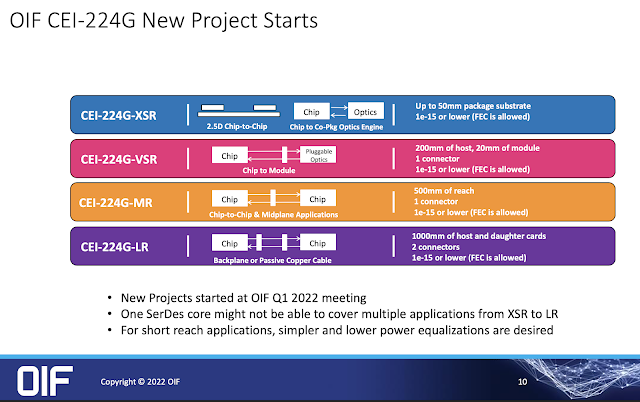
OIF launched four new CEI projects during its recent Q122 Technical and MA&E Committees meeting, which was held virtually in mid-February. These include:

  • CEI-224G-Extra Short Reach (XSR) Common Electrical On-Package Interface Project, 
  • CEI-224G-Very Short Reach (VSR) Common Electrical Chip-to-Module Interface Project, 
  • CEI-224G-Medium Reach (MR) Common Electrical Chip-to-Chip Interface Project, 
  • CEI-224G-Long Reach (LR) Common Electrical Backplane and Copper Cable Interface Project.

 These projects are the first set to target the 224G generation of electrical interfaces.

In addition to these 224G project launches, OIF membership approved publishing the 224G Framework Project white paper that was kicked off in August 2020. 

“OIF’s CEI-224G framework project white paper provides a roadmap for the applications, challenges and projects needed to support new specifications and technologies – these four new projects will develop the Implementation Agreements (IAs) to address that roadmap,” said Dave Stauffer, Kandou Bus and Chair, OIF Physical and Link Layer (PLL) Working Group.

The OIF also launched two new Common Management Interface Specification projects: 

  • CMIS: Form-Factor Specific Hardware Management -- OIF initiated a new project to create supplemental specifications to CMIS for Form-factor Specific Hardware Management (FSHM). CMIS has been adopted to manage future generation of small form-factor pluggable (SFP) 112, SFP-DD/SFP-DD112, and quad small form-factor pluggable (QSFP) 112. Currently, CMIS does not provide hardware management control for these form-factors. FSHM will define form-factor specific module hardware management registers in CMIS.
  • CMIS Support for Host-Module Link Training -- OIF started another new project that will add CMIS Support for Host-Module Link Training. This project will provide an optional out-of-band, protocol agnostic, management mechanism for optimizing link tuning and training.

 http://www.oiforum.com


Wednesday, February 23, 2022

OIF demos at at #OFC22: 400ZR interoperability; CPO; CEI-112, CMIS

OIF will host the following demonstrations at this year’s OFC 2022 in San Diego, March 8-10, 2022. Industry experts will also present updates on OIF’s current work in many critical areas, including 400ZR/800ZR and electrical rates.

400ZR Demo - the first-ever public multivendor 400ZR consists of a full implementation of 400GE across an 80km, DWDM ecosystem using multiple module, router, open line systems, and test equipment vendors, demonstrating the project achieved it’s interoperability goals.

Co-Packaging Architectures Demo - multi-party demonstrations of OIF's 3.2T Module project and external laser project (ELSFP). A variety of interoperable components that enable co-packaging will be shown, along with a system implementation.

CEI-112G Demo - multiple live demonstrations featuring interoperability amongst 12 participating members clearly prove the key role OIF provides as well as the developing supplier ecosystem. The CEI-112G demonstrations in the OIF booth will feature multi-party silicon supplier interoperability over various channels including mated compliance boards, PCB channels and direct attach copper cable channels, and even fiber. Each configuration demonstrates the technical viability of 112 Gbps operation, along with multiple industry form factors, including OSFP and QSFP-DD. The demo also shows a measured far-end eye diagram on an oscilloscope with analysis to show an example of the silicon signal integrity that is typically required going through the large variety of channels on display.

Common Management Interface Specification (CMIS) Implementations Demo - CMIS provides a well-defined mechanism to initialize and manage optical and copper modules in a standard way, while still providing the capability to provide custom functionality. This commonality makes integration into different host platforms easier for both the host vendor and the module vendor. The CMIS demo consists of four separate demonstrations that show how modules can be managed and initialized, how modules can support multiple independent services (breakout) and how module firmware can be easily upgraded.

FlexE Demo - showing FlexE’s channelization features, which allow standard Ethernet optics to be broken down into multiple clients of both standard and non-standard Ethernet rates with a granularity of 5Gb/s. Realistic multi-vendor deployment scenarios will show standard 100GbE interfaces channelized into clients of mixed rates, mapping of traffic from standard Ethernet ports, and end-to-end bit error rate tester (BERT) features demonstrating error and alarm monitoring.

Participating companies include Accton; Alphawave IP; Amphenol; Applied Optoelectonics, Inc.; Broadcom Inc., Ciena; Cisco; EXFO; Fujitsu Optical Components; Innolume GmbH; Intel; Juniper Networks; Keysight Technologies; Lumentum, MACOM Technology Solutions Inc.; Marvell; MaxLinear, Inc.; Molex; MultiLane, Inc.; NEC Corporation; NeoPhotonics; Nokia; O-Net Communications; Ragile Networks Inc.; Senko Advanced Components; Sumitomo Electric Industries, Ltd.; TE Connectivity; VIAVI Solutions and Wilder Technologies.

“With demonstrations in five critical technology areas enabling the networks of today and the future, the OIF booth at OFC will showcase the intersection of innovation, interoperability and implementations,” said Mike Klempa, Amphenol, and OIF Physical and Link Layer Interoperability Working Group Chair.

https://www.oiforum.com/oif-members-demonstrate-how-interoperability-accelerates-solutions-for-todays-and-future-global-networks-at-ofc-2022/


Tuesday, February 15, 2022

OIF publishes CEI-224G Framework Project white paper

OIF's CEI-224G framework project published a white paper summarizing the consensus findings and guidance for new OIF project starts for future CEI clauses addressing specific 224 Gbps reaches and architectures. 

The whitepaper identifies key technical challenges for next-generation systems, defines electrical interconnection applications, and discusses some of the interoperability test challenges.  This provides the OIF and other industry standards bodies with a common language and understanding of the development projects required for the next generation data rate systems. It also establishes baseline materials that will enable 1.6/3.2 Tbps rate architectures and lower cost, lower complexity 800 Gbps and 400 Gbps architectures.

“As demonstrated in the past, most recently at 112 Gbps, OIF plays a key role in driving industry activity to identify and develop critical technical solutions that will enable next-generation data rates to be cost-effectively deployed in future equipment and networks,” said Cathy Liu, Broadcom Inc., and OIF President.

“224 Gbps is going to bring many difficult challenges for the industry to address to achieve practical implementations in an interoperable way,” said Nathan Tracy, OIF VP of Marketing, TE Connectivity. “This Framework project and its resultant white paper align OIF members and industry on many of the key hurdles. Overcoming obstacles can be achieved by having consensus amongst a broad cross-section of component, subsystem and system suppliers to leverage new technologies that drive signaling, architecture and integration developments.” 

https://www.oiforum.com/oif-launches-cei-224g-framework-project-white-paper-for-next-generation-data-rate-systems/

OIF approves CEI-224G development project

OIF members have approved the CEI (Common Electrical I/O) 224G Development Project,  the next electrical data rate beyond 112 Gbps. The expected result will be a technical white paper summarizing a consensus-based body of knowledge which will then enable several project starts for next generation CEI clauses addressing specific reaches and architectures. OIF's recent quarterly virtual meeting also resulted in a wrap-up of the “Co-packaging...


Thursday, February 10, 2022

OIF releases Co-Packaging Framework IA

OIF published a framework Implementation Agreement (IA) for co-packaging of communication and computing interfaces with one or more ASICs. The document identifies critical co-packaged applications and their requirements and charting a path for interoperability standards.

The Co-Packaging track of OIF’s Physical & Link Layer (PLL) Working Group began by studying the application spaces contributed by the end-users. Then, it examined various related topics, including electrical and optical interfaces, thermal and mechanical considerations, reliability, safety, environmental and management interfaces. The findings of the work are summarized in the Framework Document IA.

OIF has initiated two follow-on co-packaging projects: External Laser Small Form Factor Pluggable (ELSFP) Project, announced in May 2021, and the 3.2T Module Project, announced in March 2021.

“OIF is leading industry discussion on this critical dense integration technology,” said Jeff Hutchins, Ranovus and OIF Board Member and PLL Working Group – Co-Packaging Vice Chair. “This framework IA provides the industry with a foundation for developing interoperable energy efficient co-packaged solutions.”

“Co-packaging represents a significant change to the way high-performance communications ASICs are packaged today,” said Technical Editor of the Co-Packaging Framework IA, Kenneth Jackson, Sumitomo Electric. 

https://www.oiforum.com/oif-releases-co-packaging-framework-implementation-agreement/

OIF initiates 3 projects, including co-packaged optics external laser module

OIF initiated three new projects, including a Co-Packaged Optics external laser module, Artificial Intelligence (AI) for Enhanced Network Operations and CEI-112G-Linear, in addition to announcing a network operator survey for the 2022 Networking Demo.External Laser Small Form Factor Pluggable (ELSFP) Module Project – companion project to support co-packaged optics applicationsThis project for a blind-mate pluggable external light source module will...


OIF begins 3.2T Co-Packaged Module Project for data center switching

OIF started a 3.2T Co-Packaged Module project for intra data center switching applications. The 3.2T Co-Packaged Optical Module Implementation Agreement (IA) is the first project initiated under the umbrella of the Co-Packaged Framework Project announced in November 2020. The IA will define a 3.2T co-packaged optical module that targets Ethernet switching applications utilizing 100G electrical lanes. It will include the following interoperability...

Thursday, January 6, 2022

OIF adopts Common Management Interface Specification (CMIS)

OIF has adopted the Common Management Interface Specification (CMIS) work initiated by the Quad Small Form Factor Pluggable Double Density (QSFP-DD) Multi Source Agreement (MSA).  

CMIS may be used by pluggable or on-board modules, such as QSFP Double Density (QSFP-DD), OSFP, COBO, QSFP, and future module developments like co-packaged optics with host to module management communication based on a two-wire interface. This specification is targeted to systems manufacturers, system integrators and suppliers of CMIS compliant optical and copper modules. 

“The QSFP-DD MSA initiated the CMIS effort to address an industry need for commonality in managing pluggable modules, and it has been broadly and successfully adopted across the industry,” said Mark Nowell, Cisco, QSFP-DD MSA Group founding member and MSA co-chair. “OIF is very well suited to maintain and extend the development of this effort and I look forward to seeing their progress.”

“Adopting CMIS from the QSFP-DD MSA, with the goal to build on and extend the specification is an ideal expansion of OIF’s work,” said Nathan Tracy, OIF VP of Marketing and TE Connectivity. “OIF is where the cloud gets its work done and extending CMIS is a giant step forward and an integral linkage to the other work that OIF members are doing to enable an interoperable ecosystem.” 

In August, OIF announced the new Physical & Link Layer (PLL) Working Group Management track to include the transition of ownership and maintenance of CMIS from the QSFP-DD MSA to OIF and a project to focus on CMIS extensions for co-packaging implementations. OIF will take over the ongoing CMIS revisions and further enhancements and CMIS extensions under this track. This track is co-vice-chaired by Gary Nicholl, Cisco and Ian Alderdice, Ciena.

https://www.oiforum.com/

Saturday, August 28, 2021

OIF begins work on 112G-Extra Short Reach (XSR)+ project

 OIF has initiated work on a new Common Electrical I/O (CEI) 112G Extra Short Reach (XSR)+ project that will allow lower power, multi-source 112Gbps (optimized for 106.25Gbps) electrical I/O interface to be developed with advanced PCB and substrate technology. The project will also support an open ecosystem based on Near Package Optics (NPO) architecture. OIF members are proposing that an “XSR+” type interface is used to add reach for NPO applications over the existing XSR interface to enable a multi-vendor open ecosystem without adding significant power.

During OIF’s Q3 2021 Technical and MA&E Committees Meeting, held virtually August 2-6, two projects under the Physical and Link Layer (PLL) newly formed Management track were also initiated. The first project will transition ownership and maintenance of the Common Management Interface Specification (CMIS) from the Quad Small Form Factor Pluggable Double Density (QSFP-DD) Multi-Source Agreement (MSA) to OIF. 

The second project will focus on CMIS extensions for co-packaging implementations.


“Our quarterly meetings provide a critical platform for our members to discuss and debate interoperability challenges and industry standards that help OIF continue its mission to accelerate industry innovation,” explained David Stauffer, OIF Physical & Link Layer WG Chair and Kandou. “The new CEI-112G-XSR+ project will help strengthen an open ecosystem for NPO demonstrating OIF’s leadership in next-generation channel definition. Another significant new activity that addresses industry interoperability and standards is OIF’s new Management track. Due to the complementary/synergistic nature of the work with the OIF co-packaged optics, NPO, CEI and coherent optics projects, OIF will take over the ongoing CMIS revisions as well as further enhancements and CMIS extensions under this track.”

In addition, Rob Stone of Facebook was appointed to the OIF Board of Directors, filling an open position. Stone will serve the term for this position that goes through September 2022.

https://www.oiforum.com/oif-reveals-new-common-electrical-i-o-project-to-strengthen-an-open-ecosystem-for-near-package-optics-architecture-launches-management-track-and-facebook-joins-board-of-directors-at-q3-2021-virtual-m/

Thursday, July 29, 2021

OIF's IA for High Bandwidth Coherent Driver Modulator -- 800G and up

OIF announced an Implementation Agreement (IA) for High Bandwidth Coherent Driver Modulator (HB-CDM) 2.0. This IA builds upon the HB-CDM 1.0 IA, released in November 2018, and leverages the same form factor.

The HB-CDM 2.0 follows the integrated laser and coherent receiver standards from OIF in enabling next-generation compact, high-performance coherent networking solutions. Since OIF’s HB-CDM 1.0 was released for 64 Gigabaud (GBd), enabling 400Gbps coherent systems, the market has seen a need for increased network capacity and higher performance. The HB-CDM 2.0 leverages the original Type 1 form factor for compatibility with existing systems and also includes a Flexible Printed Circuit (FPC) as an alternate interface and higher performance RF pitch options for extended rates for future systems.


“OIF’s HB-CDM 1.0 standard was a critical new component enabling optimized 400G+ metro and long-haul coherent networks, supporting the industry need for more capacity with a standardized footprint, interface and performance,” explained Technical Editor of the OIF HB-CDM 2.0 IA, Richard Ward, Intel. “The HB-CDM 2.0 is a natural extension covering 128GBd in coherent technology for 800G per wavelength and beyond coherent systems. The market demand reinforces OIF’s critical role in creating solutions to fulfill industry requirements and accelerating market adoption of optical networking technologies.”

http://www.oiforum.com


Thursday, June 24, 2021

OIF's 3.2T Co-packaged Optics Module Project

COBO/OIF Board Member Jeff Hutchins discusses the industry's Co-Packaged Optics (CPO) collaboration with regards to the OIF's recently launched 3.2T Co-packaged Optics Module Project.


https://youtu.be/nUp2Ytovlhk

OIF begins 3.2T Co-Packaged Module Project for data center switching

OIF started a 3.2T Co-Packaged Module project for intra data center switching applications. The 3.2T Co-Packaged Optical Module Implementation Agreement (IA) is the first project initiated under the umbrella of the Co-Packaged Framework Project announced in November 2020. The IA will define a 3.2T co-packaged optical module that targets Ethernet switching applications utilizing 100G electrical lanes. It will include the following interoperability specifications:

  • Optical interface options supporting 400GBASE-FR4 and 400GBASE-DR4 with backwards compatible to 200G interfaces
  • CEI-112G-XSR high speed electrical interfaces
  • Electrical, mechanical, and management interfaces

“This 3.2T Co-Packaging project builds on OIF’s 20+ year successful track record to anticipate and address the industry’s needs,” said Jeff Hutchins, Ranovus and OIF Physical and Link Layer Working Group, Co-Packaging Vice Chair. “With its broad membership from across the eco-system, OIF is well positioned to create unified host, module and control specifications.”

“The industry has clearly articulated the need for a standardized co-packaged solution to address data center power constraints, and further, to enable new network architectures and applications,” said Mark Filer, Microsoft Principal Hardware Engineer and OIF Board Member. “The 3.2T Co-Packaged Optical Module project is a concrete step toward that goal, and OIF is uniquely qualified to rapidly execute on the implementation agreement in order to meet the market needs.”

https://www.oiforum.com/

Wednesday, May 26, 2021

OIF initiates 3 projects, including co-packaged optics external laser module

OIF initiated three new projects, including a Co-Packaged Optics external laser module, Artificial Intelligence (AI) for Enhanced Network Operations and CEI-112G-Linear, in addition to announcing a network operator survey for the 2022 Networking Demo.


External Laser Small Form Factor Pluggable (ELSFP) Module Project – companion project to support co-packaged optics applications

This project for a blind-mate pluggable external light source module will define a new form factor optimized to package lasers to support co-packaged optical modules. It also includes provisions for the longevity of this form factor beyond the initial scope of the Co-Packaged Optics Module project (i.e., more fibers, thermal, and optical power classes).

“The ELSFP project is an important step for enabling co-packaged optics deployments,” according to Gary Nicholl, Cisco and OIF board member. “And, the project objectives include the necessary technical considerations to ensure this project will be relevant for multiple generations.”

Application of Artificial Intelligence to Enhanced Network Operations Project

A healthy and high-performance network serves as the foundation for all 5G application scenarios. Traditional approaches face significant difficulties in automatically and efficiently analyzing network data, solving network faults, and optimizing network performance. This new project will result in a white paper identifying a collection of use cases for applying AI to construct intelligent, resilient and high-performance optical and packet networks.

CEI-112G-Linear Project

A linear Chip-to-Optical Engine interface is needed to enable low power, low cost, small form factor 112G serial optical modules in Co-Packaged Optics, Near Package Optics (NPO) and server/GPU applications. This new project will facilitate increased bandwidth and reduced power of switch ports using co-packaged and closely packaged optical modules.

Network Operator Survey – 2022 Transport SDN Interoperability Demonstration

The OIF Networking Interoperability Working Group is surveying operators worldwide for their input and interest in participating in a 2022 Transport SDN Interoperability Demonstration. As with past surveys, responses will be anonymized, tabulated and summarized. The deadline to complete the survey is Tuesday, June 15, 2021.  Link to the survey: https://www.oiforum.com/technical-work/request-download-oif-network-operator-survey/

https://www.oiforum.com/oif-reveals-three-innovative-projects-external-laser-small-form-factor-pluggable-module-for-co-packaged-optics-artificial-intelligence-for-enhanced-network-operations-and-cei-112g-linear/

Thursday, March 11, 2021

OIF begins 3.2T Co-Packaged Module Project for data center switching

OIF started a 3.2T Co-Packaged Module project for intra data center switching applications. The 3.2T Co-Packaged Optical Module Implementation Agreement (IA) is the first project initiated under the umbrella of the Co-Packaged Framework Project announced in November 2020. The IA will define a 3.2T co-packaged optical module that targets Ethernet switching applications utilizing 100G electrical lanes. It will include the following interoperability specifications:

  • Optical interface options supporting 400GBASE-FR4 and 400GBASE-DR4 with backwards compatible to 200G interfaces
  • CEI-112G-XSR high speed electrical interfaces
  • Electrical, mechanical, and management interfaces

“This 3.2T Co-Packaging project builds on OIF’s 20+ year successful track record to anticipate and address the industry’s needs,” said Jeff Hutchins, Ranovus and OIF Physical and Link Layer Working Group, Co-Packaging Vice Chair. “With its broad membership from across the eco-system, OIF is well positioned to create unified host, module and control specifications.”

“The industry has clearly articulated the need for a standardized co-packaged solution to address data center power constraints, and further, to enable new network architectures and applications,” said Mark Filer, Microsoft Principal Hardware Engineer and OIF Board Member. “The 3.2T Co-Packaged Optical Module project is a concrete step toward that goal, and OIF is uniquely qualified to rapidly execute on the implementation agreement in order to meet the market needs.”

https://www.oiforum.com/


OIF begins co-packaging framework IA project

OIF has kicked off a Co-Packaging Framework Implementation Agreement (IA) umbrella project to study the application spaces and relevant technology considerations for co-packaging of communication interfaces with one or more ASICs. 


A primary objective of this specification is to identify new opportunities for interoperability standards for possible future work at the OIF or other standards organizations. Upon completion, the work will be summarized in a Framework IA.

“It is critical that the industry be aligned on the solutions needed to move co-packaged interoperability forward,” said Jeff Hutchins, Ranovus and OIF Physical and Link Layer (PLL) Working Group – Co-Packaging Vice Chair. “With its member-driven focus, OIF is the ideal forum to facilitate industry conversation and drive interoperability of co-packaging with ASICs.”

The scope of the Co-Packaging Framework project is to:

  • Identify the key co-packaged applications and their requirements
  • Study and identify key issues associated with co-packaged optics
  • Identify opportunities and develop industry consensus to pursue interoperability standards
  • Document the study in the Framework IA (a technical whitepaper)
  • Launch follow-on standardization activities at the OIF or other appropriate standard bodies

http://www.oiforum.com


Tuesday, February 2, 2021

OIF publishes results of Transport SDN API interoperability demo

OIF published the results of its 2020 Transport SDN Application Programming Interface (API) Interoperability Demonstration, which was a ten-week long interoperability testing exercise that was held in Telefonica’s lab in Madrid.

The interoperability testing involved three phases over ten weeks, Sept – Nov 2020:

  • Phase 1: Open Networking Foundation (ONF) T-API NBI testing, Scope: ONF T-API v2.1.3 reference implementation agreement TR-547
  • Phase 2: Open terminals testing including discovery, provisioning, service de-activation and streaming telemetry
  • Phase 3: End-to-end disaggregation demo, Scope: evaluation and demonstration of end-to-end use cases

Findings and results of the testing include:

  • Vendor products demonstrate a high level of maturity and support of operator-favored use cases, based on T-API version 2.1.3 and OpenConfig APIs. Vendors have adopted the ONF 2.1.3 Reference Implementation Agreement (ONF TR-547) rapidly and with few deviations.
  • Inconsistent interpretation of the Internet Engineering Task Force (IETF) RESTCONF standard was one interoperability issue identified, especially standard authentication. Clarification to RESTCONF provisioning behavior and implementation scalability were also identified as issues.  
  •  A particularly good level of compliance to the OpenConfig models was demonstrated by implementations, however, some areas such as key exchange algorithms for IETF NETCONF and complex use cases for device provisioning and commissioning did generate issues.


Participating vendors included ADVA, Ciena, Cisco Systems, Infinera and Nokia. Network operator Telefónica hosted the demo. China Telecom, Telia Company and TELUS participated as consulting network operators.

“Interoperable transport SDN APIs are essential capabilities to enable open optical networks,” said Mauro Costa, Head of planning, strategy & architecture, Telia Company, a consulting network operator for this year’s demo. “International co-operations, like this one with OIF, allow the industry to progress at a high pace and Telia Company welcomes the opportunity offered by this interoperability demo. It reinforces that we are advancing in the right direction and that the maturity of the APIs implementation for optical SDN architecture is improving.”

The whitepaper is posted here:

https://www.oiforum.com/documents/oif-2020-transport-sdn-api-interop-demo-white-paper/

Wednesday, December 2, 2020

OIF's 2020 Transport SDN API Interoperability Demo

OIF completed a multi-vendor 2020 Transport SDN Application Programming Interface (API) interoperability demonstration aimed at validating the benefits of transport SDN for the 5G era.

The ten-week long interoperability testing exercise, which was held in Telefonica’s Madrid lab, focused on SDN-based programmability, control and automation — testing Layer 1 and Layer 0 OTN control using ONF T-API 2.1.3, with additional testing of OpenConfig device APIs for transport equipment in network-operator-defined use cases.

Participating vendors included ADVA, Ciena, Cisco Systems, Infinera and Nokia. Network operator Telefonica hosted the demo. China Telecom, Telia and TELUS participated as consulting network operators.

“Operators have demanded more open optical networks to enable flexibility, lower costs, and best-of-breed options,” said Scott Wilkinson, Lead Analyst at Cignal AI. “Standard management interfaces and multi-vendor interoperability are critical to open optical networks. The interoperability demonstration recently performed under the guidance of the OIF is a major step towards achieving those operator goals.”

“The successful completion of the OIF 2020 Transport SDN API interoperability demonstration is a significant milestone toward widespread SDN deployment in production networks,” said Arturo Mayoral, Telefónica Transport Global CTIO Unit – Technology Expert and Lead of Optical SDN strategy. “By aligning vendors for a shared purpose – interoperability – and testing multiple use cases, we’re fostering manageability and flexibility in the network to allow deployment of cloud-based services, meet dynamic bandwidth demands and accelerate transport network transformation for the 5G era.”

The results of the multi-vendor demonstration will be revealed during a public read-out webinar event being held in partnership with Lightwave, Tuesday 12 January 2021, 6:00-7:30am PST. Register for free here

A private read-out event for demo participants and invited Network Operators is scheduled for Tuesday 19 January 2021.

OIF representatives will give presentations on the current status of the 2020 OIF Transport SDN API Interoperability Demonstration during the below events:

  • NGON & DCI World Digital Symposium – Friday 04 December 2020 – 20:00-20:15pm CET, OIF Speaker: Arturo Mayoral López de Lerma, Telefonica S.A
  • ECOC – Monday 07 December 2020 – 17:20-17:40pm CET, OIF Speaker: Arturo Mayoral López de Lerma, Telefonica S.A

https://www.oiforum.com/technical-work/2020-oif-transport-sdn-api-interoperability-demo/


2020 Transport SDN Application Programming Interface (API) Interoperability Demonstration PR Boilerplate: