Monday, November 16, 2015

Alcatel-Lucent Intros Radio Interface for DAS

Alcatel-Lucent introduced a radio frequency module for distributed antenna systems (DAS) for connecting subscribers at large public venues.

The Distributed Antenna System Radio Frequency Module is a wideband low-power LTE interface card which removes the need for bulky radio technology in a public installation. It connects to Alcatel-Lucent's 9926 digital baseband unit, working directly with the analog DAS through RF signals that consume just one-eighth of the power and heat dissipation of an average remote radio head, reducing space requirements and optimizing costs. The 9926 digital baseband unit, connecting into a number of distributed radios, can divert capacity where needed when there are spikes in traffic, redistributing capacity to other radios when no longer required.

Up to 40 radio sectors with the associated baseband processing, can be fitted into a standard 19 inch indoor cabinet. The Alcatel-Lucent DAS RFM is offered in two wideband hardware versions, one for low band and one for high band radios. Each radio covers between 6 and 10 bands. Based on the latest Alcatel-Lucent RF platform it leverages common hardware and software and can quickly be adapted to various market frequency demands using pluggable cards.

Based on a study from Bell Labs, the company calculates its new DAS RFM offers up to 30 percent cost savings in terms of the wireless and DAS equipment required, up to 81 percent cost savings in terms of power and cooling, up to 91 percent cost savings in terms of construction,  and up to 78 percent cost savings in terms of energy.

"Alcatel-Lucent has been working closely with operators on how to improve LTE deployment in dense urban environments by leveraging their DAS infrastructure. This product was developed on the latest leading edge RF Platform that operators use for their Macro today allowing them full benefit and feature parity with their Macro sites. It is designed for use with any vendors' analog DAS," said Glenn Booth, Senior Vice President and General Manger of Alcatel-Lucent's LTE Business Unit said: .

CableLabs Schedules Conference for April 2016

CableLabs will host a new Inform[ed]: conference series beginning on April 13, 2016 in New York City.

  • Phil McKinney, President and CEO, CableLabs
  • Prof. Theodore S. Rappaport, NYU (founding director of NYU WIRELESS)
  • Neville Meijers, VP of Small Cell, Qualcomm
  • Jeremy Bye, VP of Carrier and Wholesale, Cox Business
  • Paul de Sa, Bernstein Research
  • Rob Howald, VP of Network Architecture, Comcast

"As wireless technology continues to advance, it’s imperative that the wireless industry fully explores both the opportunities and challenges of developing innovative wireless technologies that benefit consumers and drive technology forward,” said Phil McKinney, president and chief executive officer of CableLabs. "CableLabs is continually expanding its testing and research in a variety of areas in the wireless space. This conference gives us the opportunity to bring together the industry’s top minds to tackle the most prominent issues in wireless in new and inventive ways.”

http://www.cablelabs.com
http://www.cablenet.org

PMC-Sierra Reiterates Commitment to Skyworks Deal

PMC-Sierra's board of directors unanimously determined that the proposal received on November 9, 2015 from Microsemi Corporation to acquire all of the outstanding shares of PMC common stock is not superior to PMC’s existing agreement with Skyworks Solutions, Inc..

The company's board said the Skyworks all cash proposal provides more value certainty to PMC stockholders than the stock and cash consideration provided in the Microsemi proposal.

http://www.pmc-sierra.com

Ericsson Wins 5-Year Deal with Ooredoo Group

Ooredoo Group awarded a five-year frame agreement to Ericsson for 2G, 3G and 4G radio, core and transmissions solutions. Financial terms were not disclosed.

The group frame agreement includes radio, core and transmission equipment as well as related services. The agreement also covers Ericsson's Software model with its predefined software value packages which ensures better performance and reduces time to market for new functionalities. Using these solutions, Ooredoo's network performance will improve to meet growing end-user expectations.

http://www.ericsson.com


Sunday, November 15, 2015

ZTE Makes Progess in D-MIMO Technology

ZTE announced a breakthrough in its development of D-MIMO (distributed multiple input and multiple output) technology, which promises up to a 9X increase in wireless network performance at the cell edge.

In mobile networks with many base stations, interference can cause degraded signaling at the cell edge, affecting user experience. D-MIMO technology can effectively improve the data rate at the cell edge through coordinated transmission among base stations, resolving a major challenge facing operators.

ZTE said a recent outdoor field test conducted jointly with a partner used D-MIMO technology based on ZTE’s proprietary Cloud Radio solution.  The testing covered single-user and multiple-user scenarios in an environment with multiple overlapping base stations, and used commercially-available mobile device terminals.

The Coherent-Joint Transmission technology used in ZTE’s new D-MIMO system ensures full phase synchronization among base stations, so that the jointly transmitted signal is amplified to the maximum level as it arrives at the antenna of a user terminal, minimizing interference with other terminals. Compared with the legacy Non-Coherent-JT technology, Coherent-JT provides 3 dB of additional gain at the antenna of a target user terminal and forms null steering at the antennas of other user terminals to minimize signal interference, achieving multi-user joint transmission (MU-JT).

The indoor D-MIMO test result shows that the MU-JT technology can form null steering toward multiple users to guarantee good multi-user joint transmission in an enclosed and small space. The service data rate of a single testing cell has been at least quadrupled in an ideal non-interference situation, and a number of testing cells have enhanced their resistance to interference by more than a hundred times.

http://wwwen.zte.com.cn/en/press_center/news/201511/t20151112_445840.html


IHS: Sales Increasing for SDN

Data center and enterprise LAN software-defined networking (SDN) deployments began to ramp in the first half of 2015 (1H15), according to a new report from IHS .

IHS forecasts the market for ‘in-use’ SDN Ethernet switches and controllers to top $1.4 billion this year, nearly doubling from last year.


Some highlights:

  • In the first half of 2015 (1H15), bare metal switches accounted for 45 percent of global in-use SDN-capable Ethernet switch revenue
  • White box switch vendors, as a group, are #1 in bare metal switch revenue
  • Dell owns 100 percent of branded bare metal switch revenue
  • HP has the largest share of SDN-capable (in-use and not-in-use) branded Ethernet switch ports
  • In-use virtual switch (vSwitch) ports are expected to make up 11 percent of SDN (in-use and not-in-use) ports shipped by the end of 2015
  • SDN in-use physical Ethernet switches are forecast by IHS to comprise 15 percent of Ethernet switch market revenue in 2017, up from 4 percent today

“New SDN use cases continue to emerge, and the first half of 2015 was no exception with the establishment of the software-defined enterprise WAN (SD-WAN) market. The SD-WAN market is still small, but many startups and traditional WAN optimization appliance vendors and network vendors have jumped in,” said Cliff Grossner, Ph.D., research director for data center, cloud and SDN at IHS.

http://www.infonetics.com/pr/2015/1H15-Data-Center-Enterprise-SDN-Market.asp

Friday, November 13, 2015

Huawei Develops Lithium-Ion Quick Charge

 Huawei Technology has developed a new quick charging capability for lithium-ion batteries.

The company said its new tech enables new batteries to achieve a charging speed 10 times faster than that of normal batteries, reaching about 50% capacity in mere minutes.

In a demo, Huawei showed how one battery with a 600 mAh capacity can be charged to 68% capacity in two minutes.  Another demo shows a 3000 mAh capacity and an energy density above 620 Wh/L, which can be charged to 48% capacity in five minutes to allow ten hours of phone call on Huawei mobile phones. These quick charging batteries underwent many rounds of testing, and have been certified by Huawei's terminal test department.

According to Huawei, the company bonded heteroatoms to the molecule of graphite in anode, which could be a catalyst for the capture and transmission of lithium through carbon bonds. Huawei stated that the heteroatoms increase the charging speed of batteries without decreasing energy density or battery life.

http://www.huawei.com/en/news/2015/11/Huawei%20reveals%20the%20next%20generation%20of%20quick%20charging%20technology

Brocade Appoints Security CTO

Brocade announced the appointment of Hadi Nahari as vice president and security chief technology officer (CTO) and the promotion of David Meyer to Brocade Fellow.

Nahari previously was chief security architect of mobile and software platforms at NVIDIA where he initiated Trusted Little Kernel, the foundation for Android Trusty. He has held principal security architect roles at PayPal, MontaVista Software, Motorola, NetScape and the U.S. Government. Nahari holds 13 patents -- 11 in the U.S. and two in the European Union. In his new role at Brocade, Nahari will be responsible for Brocade's product security strategy, architecture, and portfolio, as well as building the company's security ecosystem.

Since joining Brocade in 2012 as chief scientist and service provider CTO, Meyer has become the company authority on external technologies and industry direction. He is the co-inventor of the Locator/ID Separation Protocol (LISP) and a much sought-after advisor in the industry. In addition, he is the founding chair of the OpenDaylight Technical Steering Committee, the founding co-chair of the Open Networking Foundation Forward Abstractions Working Group, as well as the founding chair of the Internet Research Task Force's Software-Defined Networking Research Group. Prior to joining Brocade, Meyer spent 12 years at Cisco Systems as a distinguished engineer.

"Hadi Nahari and Dave Meyer are shining examples of Brocade attracting the best technologists in the industry," said Ken Cheng, CTO and senior vice president of Corporate Development and Emerging Business at Brocade. "Hadi and Dave each bring a wealth of knowledge and experience across many different technology sectors, including mobile, machine learning, massively scalable systems, and security. They have an intense passion to deliver innovative products that benefit our customers' businesses. Hadi will drive Brocade's product security strategy and innovation while Dave will focus on a wide variety of emerging technologies, including machine learning research and development."

http://www.brocade.com

ARM Tunes its 64-bit CPUs for HPC

ARM has developed new math libraries designed to enable the maximum performance of computational software running on ARM-based HPC (High-performance computing) servers and systems. ARM math libraries take advantage of each silicon partner’s specific microarchitecture innovations and features within their SoCs based on the ARMv8-A architecture to ensure peak system performance.

“ARM Performance Libraries are another key milestone in the advancement of the ARM server and HPC ecosystem,” said Hobson Bullman, general manager, developer systems group, ARM. “The HPC community are early adopters of ARM-based servers and the introduction of optimized math routines build a foundation for enabling scientific computing on 64-bit ARM based compute platforms. ARM Performance Libraries hit the mark for both software performance and a consistent library interface to enable ease of software development and portability to ARMv8-A server platforms.”

To accelerate porting of software to platforms based on the ARMv8-A architecture, including 64-bit ARM Cortex® processor-based servers, ARM Performance Libraries offer tested binary distributions of popular open source applications for HPC including ATLAS, OpenMPI, NumPy and TAU. All changes required to port these open source applications to ARM will be fed back to the open source repositories to enable HPC community development and collaboration.

http://www.arm.com

Gogo's 2Ku Delivers 70 Mbps In-Flight

Gogo said its 2Ku next generation satellite technology is capable of matching or exceeding the bandwidth of any other system currently offered.  The new technology will deliver peak speeds to the aircraft of more than 70 Mbps.

As part of the flight testing of 2Ku on its Boeing 737 aircraft, Gogo has simultaneously streamed videos on more than 40 devices while supporting browsing on additional devices. The technology also benefits from the global coverage and redundancy of the more than 180 satellites in the Ku-band.  In addition, the proprietary antenna design gives 2Ku a significant cost advantage over any other global solution.

Gogo's 2Ku is expected to be launched commercially in the coming months.

"This is a tremendous milestone for Gogo.  In about a year and a half, we've been able to fully develop and bring this new technology to market, a speed which is unprecedented in this industry.  The accomplishment really highlights Gogo's leadership in this space and the tremendously talented employees we have within our ranks," said Gogo's president and CEO Michael Small.  "Gogo created the in-flight connectivity market in the U.S. through its technological innovations, and we expect 2Ku to be the technology that kick-starts this industry for global aviation."


Nokia Delivers LTE for Smartone in Macau

Nokia Networks is providing an LTE upgrade for SmarTone's network in Macau.

Under the 5-year contract, Nokia Networks is planning and deploying the operator’s 4G LTE network in one of the world’s densest traffic areas. The project includes:

  • Single RAN Advanced solution, based on the energy-efficient, high-capacity Flexi Multiradio 10 Base Station
  • Evolved Packet Core (EPC) and Subscriber Data Management platform, a centralized database for all relevant subscriber information
  • Self Organizing Networks (SON) software features for more network efficiency
  • NetAct, a virtualized OSS, will be updated for effective and consolidated configuration, monitoring, management and optimization of SmarTone’s LTE network
  • Network planning and optimization, systems integration and network implementation services to ensure high network quality and a swift rollout   

Michael Shieh, Head of Taiwan, Hong Kong and Macau Sub-region, Nokia Networks, said: “We are proud to be working with SmarTone on its journey to ultra-fast LTE-based broadband connectivity, having already helped the operator build its 2G and 3G networks. Our services experts can meet the challenges of such a high-volume traffic area and are supporting this journey throughout, from the planning phase through system integration and implementation, and also with network maintenance and staff training.”

http://networks.nokia.com/


NTT Comm Signs with PLDT for Data Center Services in Philippines

NTT Communications and Philippine Long Distance Telephone Company (PLDT) signed a deal to provide Nexcenter solutions in the Philippines and promote cross-selling.

Under the agreement, Philippines corporations with international operations will be able to use NTT Com’s globally standardized high-quality Nexcenter services at some 140 locations in 84 cities of 19 countries, in addition to its Arcstar Universal One private-network service, which is already available in the Philippines.

PLDT, supported by NTT Com, expects to gain Nexcenter accreditation for its two main data centers and begin providing Nexcenter services by January 2016. In addition, PLDT will incorporate Nexcenter standards in a new data center now under construction, which also will be launched as a new Nexcenter™ facility. The additions will strengthen Nexcenter™ as No. 1 data center brand in the Asian region.

http://www.ntt.com/aboutus_e/news/data/20151111.html

Thursday, November 12, 2015

Cisco Posts Strong Growth in Income but Guidance Cites Macro Economic Uncertainty

Cisco reported first quarter revenue of $12.7 billion, net income on a generally accepted accounting principles (GAAP) basis of $2.4 billion or $0.48 per share, and non-GAAP net income of $3.0 billion or $0.59 per share. Revenue was up 3.6% compared to the same period last year, while net income rose by 33%.

"Q1 was a very strong quarter. We are accelerating our ability to deliver on growth opportunities, aggressively driving our cloud business, and delivering continued strength in our deferred product revenue, as we sell more of our portfolio in software and cloud models," said Chuck Robbins, Cisco chief executive officer. "We guided to solid growth in Q2. Our guidance reflects lower than expected order growth in Q1, driven largely by the uncertainty of the macro environment and currency impacts. Despite these headwinds, I believe we are executing very well. We are moving very fast to capture new opportunities and I feel good about how we are positioned for the second half of the year."

Some highlights:

  • Product revenue increased by 4% and service revenue increased by 1%. 
  • Total revenue by geographic segment was: Americas up 4%, and each of EMEA and APJC up 3%. 
  • Product revenue growth was led by Data Center and Collaboration at 24% and 17%, respectively. 
  • Wireless and Security each grew 7%, Switching grew 5%, NGN Routing decreased 8%, and Service Provider Video decreased 2%.
  • By product orders per customer segment, Enterprise (3%), Public Sector (0%), Commercial 7%, Service Provider 6%.  Overall 3%.
  • By product orders geographically, Americas 1%, EMEA 3%, APJC 9%. Cisco total 3%.
  • Cash and cash equivalents were $59.1 billion, up from $52.1 billion a year ago.
  • Cisco headcount was 72,063, which is about the same as a year ago.

http://investor.cisco.com/investor-relations/news-and-events/news/news-details/2015/Cisco-Reports-First-Quarter-Earnings/

Mellanox Intros 100Gbps InfiniBand Switch

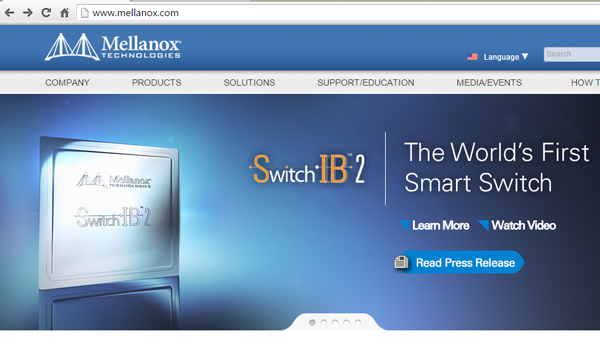
Mellanox Technologies introduced its next generation InfiniBand switch for High-Performance Computing, Web 2.0, database and cloud data centers.

The Mellanox Switch-IB 2 is capable of 100 Gbps per port speeds and is the world's first smart network switch that offloads MPI operations from the CPU to the network to deliver 10X performance improvements. It integrates 144 SerDes which can operate at 1Gbps to 25Gbps speeds per lane and delivers 7.02 billion messages-per-second, 90ns switch latency and low power consumption, making Switch-IB 2 the best solution for high-performance computing, cloud, Web 2.0, database and storage centers.

Mellanox said a major innovation is that the switch can manage collective communications (MPI and SHMEM) using embedded hardware, decreading the amount of data traversing the network, reducing application latency with additional benefit of freeing up CPU resources for computation rather than using them to process communication.

“Mellanox smart interconnect solutions will continue to bring not just the widest and fastest interconnect but also more hardware offloads to free the CPU to focus on the application,” said Gilad Shainer, vice president of marketing, Mellanox Technologies. “Mellanox’s smart interconnect technology is a full generation ahead of the competition in terms of performance and return-on-investment advantages it brings to IT and applications managers.”

http://www.mellanox.com/page/press_release_item?id=1627

Rancher Can Now Orchestrate Persistent Storage Services for Docker

Rancher Labs, a start-up based in Cupertino, California, now offers the ability to orchestrate Persistent Storage Services for Docker.  This makes its easier for developers to define and deploy the exact storage capabilities needed for their containerized applications.

Rancher, which is the company's flagship software tool for building a private container service, can be used with a Docker 1.9 volume plugin to:

  • Orchestrate the deployment and configuration of storage services directly on container hosts, utilizing any software defined storage platforms shipped as containers, including, for example, Gluster, Ceph and NexentaEdge.
  • Launch applications using Docker Compose that can leverage these storage services to automatically create and mount persistent Docker volumes to support stateful application services such as traditional databases.
  • Utilize any vendor-specific advanced storage features offered by storage services such as snapshot, backup, remote replication and data analytics.
  • Deploy an application with all of its necessary storage services on any virtual machine or bare metal server, running in any public cloud or private data center.

For example, a user deploying a web application running on Tomcat and MySQL can also use Rancher to deploy a Persistent Storage Service based on Gluster. The Gluster storage service can then be distributed across multiple disks running on different hosts within the Rancher cluster. When the MySQL service is launched, Rancher can orchestrate the deployment of a block storage volume from the Gluster service, which is then connected to the MySQL container as a Docker Volume. Users can leverage GlusterFS geo-replication to backup the application to a remote site.

Once the application is deployed, Rancher continues to manage both the application and storage services, monitoring hosts and disks for failures and responding whenever necessary to ensure the availability of the application.

“As developers begin to deploy more stateful applications using Docker, it is critical that storage services become as easy to deploy and migrate as regular Docker containers,” said Sheng Liang, co-founder and CEO of Rancher Labs. “We’re thrilled to announce this latest update to Rancher, as we believe persistent storage services will unleash a new wave of innovation for the Docker ecosystem, community and users.”

http://www.rancher.com

Rancher Labs Launches its Container Infrastructure Platform

Rancher Labs, a start-up based in Cupertino, California, announced the beta release of its platform for running Docker in production. It includes a fully-integrated set of infrastructure services purpose built for containers, including networking, storage management, load balancing, service discovery, monitoring, and resource management. Rancher connects these infrastructure services with standard Docker plugins and application management tools, such as Docker Compose, to make it simple for organizations to deploy and manage containerized workloads on any infrastructure.

Key Rancher features:

  • Cross-host networking: Rancher creates a private software defined network for each user, allowing secure communication between containers across hosts and even clouds.
  • Container load balancing: Rancher provides an integrated, elastic load balancing service to distribute traffic between containers or services.
  • Storage Management: Rancher supports live snapshot and backup of Docker volumes, enabling users to backup stateful containers and stateful services.
  • Service discovery: Rancher implements a distributed DNS-based service discovery function with integrated health checking that allows containers to automatically register themselves as services, as well as services to dynamically discover each other over the network.
  • Service upgrades: Rancher makes it easy for users to upgrade existing container services, by allowing service cloning and redirection of service requests. This makes it possible to ensure services can be validated against their dependencies before live traffic is directed to the newly upgraded services.
  • Resource management: Rancher supports Docker Machine, a powerful tool for provisioning hosts directly from cloud providers. Rancher then monitors host resources and manages container deployment.
  • Native Docker Support: Rancher supports native Docker management of containers. Users can directly provision containers using the Docker API or CLI, as well as using Docker Compose for more complex application management functions. Third-party tools that are built on Docker API, such as Kubernetes, work seamlessly on Rancher.
  • Multi-tenancy and user management: Rancher is designed for multiple users and allows organizations to collaborate throughout the application lifecycle. By connecting with existing directory services, Rancher allows users to create separate development, testing, and production environments and invite their peers to collaboratively manage resources and applications.

Microsoft to offer Cloud Services from UK Data Centers

Microsoft plans to offer commercial cloud services from the UK.

Specifically, Microsoft Azure and Office 365 will be generally available from local UK-based data centers in late 2016 with Microsoft Dynamics CRM Online following shortly thereafter.

In addition, Microsoft announced the completion of the most recent expansion of its Ireland site and that its data center facility in Middenmeer, the Netherlands, is now operational. Both locations serve as hubs for Microsoft cloud services, including Microsoft Azure, Office 365 and Dynamics CRM Online, and will provide additional capacity for customers across Europe, the Middle East and Africa.

https://news.microsoft.com/2015/11/10/microsoft-announces-plans-to-offer-cloud-services-from-the-uk/

Rocket Fiber Promises 10G Residential Internet in Detroit

Rocket Fiber, a Detroit-based optical fiber Internet service provider backed by Quicken Loans, announced plans to provide up to 10 Gbps Internet speeds for residential customers and up to 100G for businesses.

Rocket Fiber beta testing has already begun for residents connected to the service at The Albert and Malcomson Buildings in Detroit's Capitol Park neighborhood. In addition, 19 office buildings have been connected to the Rocket Fiber network including the First National Building and One Kennedy Square. The company said a large number of business and residential customers are scheduled to "go live" in early 2016.

Rocket Fiber has already laid 17 miles of fiber in the city and began activating clients earlier this month in downtown Detroit's Central Business District. The company is expected to expand to Midtown Detroit in 2016 and then continue to grow in other areas of the city and eventually beyond.

"Rocket Fiber's mission is to develop and implement critical technology infrastructure that will contribute to transforming Detroit into one of the most attractive cities for technology and other businesses to locate," says Rocket Fiber Chief Technology Officer and Co-founder Randy Foster. "Ten-gigabit Internet will put Detroit in an elite category in which technology start-ups and growth companies will naturally and quickly emerge inside its borders."

http://www.rocketfiber.com

EZChip Postpones Vote on Acquisition by Mellanox

At the request of Mellanox Technologies, EZChip is postponing the date for its shareholders to vote on the current acquisition agreement by Mellanox. The vote had be scheduled for November 12.

Mellanox has proposed a waiver of its merger termination fee and a 30-day go-shop period under which EZChip could solicit third party offers.

Mellanox also reaffirmed its "full, fair and firm" offer of $25.50 per EZchip share, which represents a premium of 16% over the closing price of EZchip shares on September 29, 2015 (the last trading day prior to the public announcement) and a 33% premium and 31% premium over the volume-weighted average closing prices of EZchip shares over the 12-month and 3-month period prior to the public announcement of the transaction.  

http://www.mellanox.com/page/press_release_item?id=1628

Mellanox to Acquire EZchip

Mellanox Technologies agreed to acquire EZchip, a supplier of network processors and embedded CPUs for carrier and data center networks, for a cash purchase price of $25.5 per share, implying a transaction value of approximately $811 million (approximately $620 million net of cash).

EZchip’s silicon portfolio of solutions includes network processors, multi-core processors, intelligent network adapters, and high-performance appliances with a comprehensive software ecosystem, that scale to terabit performance levels. The company has expertise in security, deep packet inspection, video, and storage processing. EZChip is based in Yokneam, Israel. Eli Fruchter has served as CEO since the company's inception in May 1999

Mellanox said the EZchip acquisition is a step in its strategy to become the leading broad-line supplier of intelligent interconnect solutions for the software-defined data centers.

“The synergies between EZchip and Mellanox create attractive opportunities. We expect our combined technologies, and product portfolios to deliver leading end-to-end intelligent interconnect and processing solutions to data centers and wide area networks,” said Eyal Waldman, president and CEO of Mellanox Technologies.

“Joining forces with Mellanox represents numerous synergies that create a true powerhouse for connectivity and processing. With Mellanox's leading layer 1 - 3 connectivity solutions for data centers and EZchip's leading layer 3 – 7 processing solutions for carrier networks, the two companies complement each other in technology, products, markets served and customers. Together, we enable a multitude of layer 1 through 7 solutions for data centers and carriers,” said Eli Fruchter, CEO of EZchip.

The combined businesses currently have approximately 2,400 employees, and have generated combined revenues of $668 million for the twelve months ended June 30, 2015.

http://ir.mellanox.com
http://www.ezchip.com

Zayo to Acquire Viatel for European Fiber Networks

Zayo agreed to acquire Viatel’s infrastructure and non-Irish enterprise businesses for approximately EUR 95 million. Viatel is a wholly owned subsidiary of the Digiweb Group, a full service telecommunications and managed services operator, based in Dublin, Ireland.

Zayo said the Viatel acquisition will bring an 8,400 kilometer fiber network across eight countries. The transaction will add 12 new metro networks, seven data centers and connectivity to 81 on-net buildings. Two wholly-owned subsea cable systems will provide connectivity on two of Europe’s busiest routes – London Amsterdam and London-Paris. The Viatel businesses to be acquired are highly aligned with Zayo’s existing product and customer set, including a higher proportion of dark fiber revenue.

 “Viatel’s long-haul fiber network and colo assets combined with Zayo’s existing national UK, France and U.S. networks provides truly international, seamless connectivity for Zayo’s existing and new customers,” said Dan Caruso, chairman and CEO of Zayo. “Our Pan-European infrastructure capability addresses new growth opportunities, including connectivity to key subsea cable systems delivering traffic to and from high-growth regions such as Asia and Africa.”

http://www.zayo.com

Juniper Appoints Security CTO

Juniper Networks announced the appointment of Kevin Walker as security chief technology officer (CTO). He joins the company with more than 25 years of experience in information security and technology, most recently serving as vice president and assistant chief information security officer at Walmart.com. He has also served in a variety of roles, including chief information security officer, chief security strategist and director of information security across technology, networking and security companies such as Intuit, Cisco Systems, Symantec Corporation and Veritas Software.

“For Juniper, ‘security’ and ‘networking’ are one and the same and we are committed to building the most secure networks for our customers. Kevin brings years of cybersecurity expertise across product development, research and engineering as well as front-line experience at some of the world’s largest companies. He understands the complex issues that our customers face and will help Juniper continue to innovate, challenge the status quo and deliver security solutions that meet our customers’ needs,” said Jonathan Davidson, executive vice president and general manager, JDI of Juniper Networks.

http://www.juniper.net