Tuesday, February 3, 2015

Cisco: 2019 Mobile Data Traffic Forecast

Global mobile data traffic will reach an annual run rate of 292 exabytes by 2019, up from 30 exabytes in 2014, according to the newly released Cisco Visual Networking Index (VNI) Global Mobile Data Traffic Forecast for 2014 to 2019.  Not surprisingly, the ongoing adoption of more powerful mobile devices and machine-to-machine (M2M) connections combined with broader access to faster cellular networks are key contributors to significant mobile traffic growth.

From 2014 to 2019, Cisco anticipates that global mobile traffic growth will outpace global fixed traffic growth by a factor of three.

Some highlights from the Cisco study:

  • More mobile users: By 2019, there will be 5.2 billion mobile users (up from 4.3 billion in 2014). In 2014, nearly 59 percent of the world's population (7.2 billion people) was comprised of mobile users; by 2019, more than 69 percent of the world's population (7.6 billion people) will be mobile users.
  • More mobile connections: By 2019, there will be approximately 11.5 billion mobile-ready devices/connections, including 8.3 billion personal mobile devices and 3.2 billion M2M connections (up from 7.4 billion total mobile-ready devices and M2M connections in 2014).
  • Faster mobile speeds: Average global mobile network speeds will increase 2.4 fold from 2014 (1.7 Mbps) to 2019 (4.0 Mbps).
  • More mobile video: By 2019, mobile video will represent 72 percent of global mobile data traffic (up from 55 percent in 2014).

Impact of Mobile M2M Connections (and Wearable Devices)


  • The number of wearable devices globally will grow five-fold, reaching 578 million by 2019, up from 109 million in 2014, with the majority of devices anticipated in North America and Asia Pacific.
  • This is expected to fuel 18-fold growth in mobile traffic from wearable devices between 2014 and 2019, with most of it channeled through smartphones.
  • In 2014, the average wearable device generated 6X more traffic per month than a basic handset (wearables = 141 MBs mobile traffic/month vs. basic handsets = 22 MBs mobile traffic/month).
  • As an example of a high-end wearables use case, livestreaming of a GoPro video camera on a cellular network would generate about 5 MB of mobile data traffic per minute.
  • In 2014, the average M2M module generated three-times more traffic per month than a basic handset (M2M = 70 MB of mobile traffic/month vs. basic handsets = 22 MB of mobile traffic/month).

Increase in 4G Connectivity


  • 26 percent of all global devices and connections will be 4G capable by 2019.
  • The number of 4G connections globally will grow 18-fold, from 459 million in 2019 to 3 billion by 2019.
  • By 2017, 3G will surpass 2G as the top cellular technology based on connection share.
  • In 2014, 4G connections accounted for 40 percent of total mobile data traffic; by 2019, 4G connections will account for 68 percent of total mobile data traffic.
  • In 2014, the average 4G connection generated 2.2 GB of mobile data traffic per month; by 2019, the average 4G connection will generate 5.5 GB of mobile data traffic per month, 5.3X higher than the 1.04 GB/month for the average non-4G connection.

Wi-Fi Offload Traffic Surpasses Cellular Traffic


  • In 2014, 46 percent of total mobile data traffic was offloaded; by 2019, 54 percent of total mobile data traffic will be offloaded.
  • Without offload, the 2014 - 2019 global mobile data traffic compound annual growth rate (CAGR) for global mobile data traffic would be significantly higher (65 percent instead of 57 percent).

Voice-over-Wi-Fi (VoWi-Fi) Surpasses Voice-over-LTE (VoLTE)


  • By 2017, VoWi-Fi traffic (10.8 PB/year) will exceed VoLTE traffic (10.7 PB/year).
  • By 2018, VoWi-Fi will exceed VoLTE in the number of minutes used per year.
  • By 2019, VoWi-Fi minutes of use will account for more than half – 53 percent – of all mobile IP voice traffic.
  • By 2019, the number of Wi-Fi-capable tablets and PCs (1.9 billion) will be nearly 3.5-times the number of cellular-capable tablets and PCs (542 million).

Growth of Mobile Cloud Traffic


  • Mobile cloud traffic will grow nearly 11-fold from 2014 (2 exabytes/month) to 2019 (21.8 exabytes/month).
  •  In 2014, cloud applications accounted for 81 percent of total mobile data traffic; by 2019, cloud applications will account for 90 percent of total mobile data traffic.

http://newsroom.cisco.com/press-release-content?type=webcontent&articleId=1578507

VMware NSX and vCloud Air to Bridge Public and Private Clouds

VMware introduced its unified compute/storage/networking platform for the hybrid cloud. The goal is to create one consistent environment across the private and public cloud to run, protect and manage any cloud-native or traditional application.

A key part of the announcement is the introduction of VMware vCloud Air Hybrid Networking Services powered by VMware NSX, which lets enterprise customers establish a single, secure network domain through a gateway appliance.  VMware NSX is a network virtualization platform that delivers the entire networking and security model from L2-L7 in software.

VMware is now deploying NSX as the networking foundation for VMware vCloud Air. The company said customers will be able to maintain hundreds of virtual networks spanning the private cloud and vCloud Air over a single WAN connection, and share the same fine-grained "zero trust" security policies and network isolation for applications, unchanged.  A phased release of these capabilities will begin in the first half of the year.

VMware also noted support for container-based distributed application technologies, including Kubernetes, the open-source container orchestration project initiated and managed by Google.

"Every traditional industry across the globe is being transformed by software," said Pat Gelsinger, chief executive officer, VMware, Inc. "To navigate and thrive in the face of this change, businesses must be decisive in the face of uncertainty. Today, we are taking another leap forward in helping our customers meet these demands through a unified platform, defined in software, which will offer unmatched choice and extends our innovations across compute, networking and storage to deliver the hybrid cloud."

VMware also announced:

VMware vSphere 6 - re-defines infrastructure and application service-levels and availability.  The latest release introduces 650 new features and capabilities.

VMware Integrated OpenStack - provides developers with open APIs to access VMware's enterprise-class infrastructure. VMware packages, tests and supports all components of the distribution, including the open source OpenStack code, and will provide the distribution free of charge to VMware vSphere customers.

VMware Virtual SAN 6 and vSphere Virtual Volumes - introduces significant scalability and performance enhancements to the company's hypervisor-converged storage solution. Additionally, VMware vSphere Virtual Volumes will offer a new level of storage integration to make external arrays natively aware of virtual machines.

http://www.vmware.com

Internap Takes its OpenStack-powered AgileCLOUD to NY

Internap announced the availability of its OpenStack-powered AgileCLOUD at its New York metro area data center in Secaucus, N.J. Opened in early 2014, Internap’s Secaucus facility is a true hybrid data center, offering Internap’s full range of infrastructure services. Customers can seamlessly link AgileCLOUD with bare-metal instances, as well as colocation and managed hosting environments, within the Secaucus facility and across other AgileCLOUD locations.

This is Internap’s fourth OpenStack public cloud location worldwide since its launch in 2014.  Other AgileCLOUD locations Other are Dallas, Montreal and Amsterdam.

“As enterprises increasingly adopt OpenStack for private clouds, they require public cloud platforms that provide the same level of interoperability as well as the performance and reliability needed to deploy their mission-critical applications at scale,” said Satish Hemachandran, senior vice president and general manager, cloud and hosting, at Internap. “Every aspect of Internap’s OpenStack-powered AgileCLOUD is optimized for performance – from dedicated compute CPU options to all-SSD storage, route-optimized networking and powerful management tools – and the continued expansion of our footprint means even better reach and faster application performance for customers.”

http://www.internap.com/press-release/internap-openstack-public-cloud-location-new-york-metro/


EMC'S Hyper-Converged Appliance for Compute/Storage/Networking

EMC Corp. introduced is "VSPEX BLUE" hyper-converged infrastructure appliance combining compute, storage, networking and management powered by VMware EVO:RAIL and EMC software.

The appliance is aimed at mid-market customers needing linear scalability from one to four 2U/4-nodes for infrastructure consolidations or virtual desktop deployments.

The VSPEX BLUE Manager extends the capabilities of the native EVO:RAIL Deployment, Configuration and Management (DCM) Engine, delivering a built-in support experience and an online Market of value-added software from EMC and EMC ecosystem partners.

http://www.emc.com/about/news/press/2015/20150203-01.htm

EMC to Take Controlling Stake in VCE as Cisco Sells

VCE will become an EMC business as Cisco agrees to sell all but 10% of its equity stake in the joint venture to EMC.

VCE is the joint venture formed in 2009 by Cisco and EMC with investments from VMware and Intel.  VMware is a subsidiary of EMC.

Going forward, VCE will be a subsidiary of EMC and will serve as  "an integration point for technologies from across the company."

VCE's flagship product is its Vblock Systems, a converged infrastructure offering that combines VMware vSphere software running on Cisco Unified Computing Systems (UCS) connected with Cisco Nexus switches, attached to EMC Symmetrix storage. More than 1,000 enterprises and service providers have deployed over 2,000 Vblock Systems worldwide.

Cloudera Acquires Xplain.io for Hadoop Analytics

Cloudera, which specializes in enterprise analytic data management powered by Apache Hadoop, has acquired Xplain.io, a start-up specializing in self-service analytics. Financial terms were not disclosed.

Xplain.io's product, "Big Data Integration Service" (BDIS), automates the design, integration, and optimization of data models that use SQL, NoSQL, and NewSQL technologies, enabling data architects to transform data models that dramatically accelerate Business Intelligence and applications.

Cloudera said the Xplain.io toolset will help its customers accelerate their enterprise data hub (EDH) deployments and make it easier for them to add more data and more complex workloads (automation, optimization, self-service) to their Cloudera environments.

"The business intelligence industry has demonstrated that analytics is moving to a self-service model," said Charles Zedlewski, vice president, Products, Cloudera. "The ability for end-users to find and analyze their own data makes teams more productive, companies more agile and frees BI experts for more value-added tasks. With the addition of Xplain.io technology and expertise, we have the opportunity to extend the self-service analytics revolution into the Hadoop platform itself."

http://www.cloudera.com
http://xplain.io/

China Unicom Employs Huawei's Atom Router for QoE

Guangdong Unicom has deployed Huawei's miniature Atom router in its commercial mobile network to support of quality of experience assessments of its customers.

Huawei's Atom Router plugs directly into a service port of a device on an existing network, such as a base station, router, or switch, and does not require external power. It provides real-time service level agreement (SLA) measurements and accurate SLA reporting, as well as quick fault location capabilities. The router supports seamless access to 3G/4G mobile bearer networks and smooth OAM capability expansion.

Huawei said its solution delivers super-high precision IP Flow Performance Measurement (FPM). It monitors network KPIs to illustrate service quality including measuring packet loss rate and delay of end-to-end service packets transmitted on an IP network to determine network performance.

http://pr.huawei.com/en/news/hw-413569-4g.htm#.VNGDmP6-2-0

ZTE Tests Massive MIMO Pre-5G Base Station

ZTE announced pre-commercial field testing of a next gen base station leveraging Massive MIMO (multiple input multiple output) that sets new records in single-carrier transmission capacity and spectral efficiency.

ZTE said its proprietary, pre-5G, multi-user/multi-stream spatial multiplexing technology has demonstrated peak data throughput that is more than three times that of traditional base stations, and average data throughput that exceeds conventional systems by at least five times. Testing is done with conventional 4G handsets.

Based on ZTE’s self-developed baseband processor chipset, the Massive MIMO base station uses a frontal area similar to existing 8-antennas. Integrating antennas, base station units and RFs in one module, ZTE’s Massive MIMO base station uses only one-third of the installation space of traditional systems, lowering operating costs and total cost ownership of operators.

“Being a pre-5G technology, ZTE’s Massive MIMO solution is delivering exponential advances to 4G networks without modifying existing air interfaces, making it possible for carriers to provide a 5G-like user experience on existing 4G handsets in an accelerated timeframe,” said Dr. Xiang Jiying, Chief Scientist of ZTE. “ZTE successfully overcame the challenge of doing multi-user and multi-stream spatial multiplexing in a scattered-signal environment, clearing the main hurdle in the development of Massive MIMO technology.”

http://wwwen.zte.com.cn/en/press_center/news/201501/t20150126_431213.html

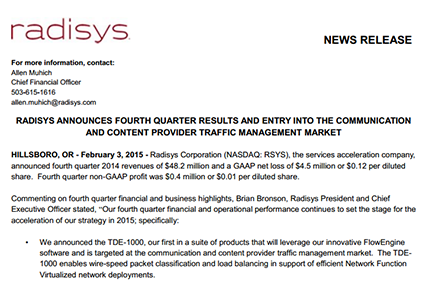
Radisys Posts Q4 Revenue of $48.2 Million

Radisys reported fourth quarter 2014 revenues of $48.2 million and a GAAP net loss of $4.5 million or $0.12 per diluted share. Fourth quarter non-GAAP profit was $0.4 million or $0.01 per diluted share.

Going forward, Radisys will report revenue and profitability in two segments: Software-Systems and Embedded Products and Hardware Services. The company's 2015 expectations for these two segments are:

  • Software-Systems: Revenue growth of 10% to 20%, Gross Margins of 55% to 65% and an operating loss of $2 to $8 million. Growth will be enabled by a focus on VoLTE market opportunities with the company's MediaEngine products, providing wire-speed packet classification and load balancing for NFV telecom architectures with FlowEngine products and royalty growth resulting from its CellEngine software suite of products moving into small cell commercial deployments.
  • Embedded Products and Hardware Services: Revenue decline of approximately 20%, gross margins of 25% to 30% and operating profit of $13 million to $17 million. 

“Over the last two years we have made incredible strategic progress in our core focus areas while simultaneously improving the operational execution of the company. This has positioned Radisys to enjoy meaningful growth opportunities in all of our Software-Systems product lines while at the same time benefiting from the stability and increasing levels of profitability within our Embedded Products business," stated Brian Bronson, Radisys President and Chief Executive Officer.

http://investor.radisys.com/phoenix.zhtml?c=90237&p=irol-irhome

RSA's Art Coviello to Retire

Art Coviello's is retiring from his post as Executive Chairman of RSA and Executive Vice President of EMC for health reasons.

Mr. Coviello was the Chief Executive Officer of RSA Security Inc. prior to its acquisition by EMC Corporation in 2006. He joined RSA in 1995 and has been a driving force in its strategic evolution and rapid growth over the past 20 years. In that time, RSA grew from being a leader in authentication to a multi-dimensional company with leadership positions in GRC, Security Analytics, and Identity Management and saw its annual revenue increase from $25 million in 1995 to $1 billion in 2014.

http://www.emc.com

Monday, February 2, 2015

Vitesse's 10/40G PHYs Enable Secure WAN with 256-bit MACsec and 1588

Vitesse Semiconductor introduced a new quad channel, 10/40G physical layer transceiver family featuring government-grade, FIPS-197-certified 256-bit MACsec encryption for securing WAN links for enterprise, cloud and mobile backhaul traffic.

Specifically, the new PHYs enable 40G connectivity with “secure 1588” by leveraging Vitesse’s FIPS-certified Intellisec IEEE 802.1AE MACsec security encryption technology and Vitesse’s VeriTime IEEE 1588 timing and synchronization.

Vitesse said the new quad channel 10G PHY family addresses several markets which are prime for MACsec encryption: enterprise and data center networking, where access lines with government-grade protection is required; and Service Provider access networking, where higher capacity, more intelligence and secured Ethernet transport is needed in aggregation service router, mobile backhaul, etc.

Vitesse notes that traditional MACsec implementations are not able to deliver IEEE 1588 timing accuracy, as required in TD-LTE and LTE-Advanced mobile networks.  Its Intellisec and VeriTime technologies deliver line-rate 256-bit encryption with the industry’s de facto highest accuracy IEEE 1588 timing. Intellisec’s “tag-in-the-clear” capability also provides the network transparency needed to enable use of third party networks for delivery of critical services to mobile, Enterprise and Industrial-IoT networks.

Key capabilities of Vitesse’s VSC8256, VSC8257 and VSC8258 include:
  • High capacity 40G connectivity;
  • Highly accurate VeriTime IEEE 1588 network timing; and
  • Flexible Layer 2 security (Intellisec IEEE 802.1AE MACsec) offload for companion network processors, I/O processors, MAC controllers and/or FPGA-based designs.
  • Accelerating Cloud Services to Users and Industry
“Addressing the ‘Snowden effect’ and growing security concerns in our increasingly connected world is critical in next-generation networking equipment,” said Uday Mudoi, vice president of product marketing at Vitesse. “Vitesse’s game-changing technologies readily enable the rigorous security needed to safeguard Enterprise, Cloud and mobile network infrastructures.”

The new 10GE PHY family includes:

  • VSC8256: Serial-quad channel 1G/10G Ethernet retimer and repeater
  • VSC8257: Serial quad channel 1G/10G Ethernet PHY with VeriTime IEEE 1588 timing and synchronization
  • VSC8258: Serial quad channel 1G/10G Ethernet PHY with VeriTime IEEE 1588 timing and synchronization and Intellisec IEEE 802.1AE MACsec
http://www.vitesse.com/products/physical-layer/10ge-phys

Brocade Adds Inline MACsec Encryption to Routers

Brocade introduced native port-based encryption functionality for its family of MLXe modular routers.

The new security functionality added to the Brocade MLXe routers includes both 256-bit IPsec encryption and 128-bit MACsec encryption for ensuring end-to-end data protection. Both of these security protocols can be enabled at wire speed for up to 44 Gbps (IPsec) or 200 Gbps (MACsec) throughput per module, meeting the highest levels of network performance requirements. The encryption is interoperable with third-party IPsec Suite B-capable platforms, and it complements MACsec functionality available in the Brocade ICX family of switches.

Brocade said this update eliminates the need for expensive specialized switch/router encryption services blades or third-party security appliances, while also eradicating performance-inhibiting latency and complex operations that are inherent with these types of add-on devices. Adding encryption and decryption natively to the I/O modules of the router enables the network to ensure the privacy of all data that moves across it, without compromise, for the first time. By bringing wire-speed encryption into the router, customers can enable pervasive data privacy across their New IP initiatives while offloading their appliances, improving performance, and increasing their overall IT security profile.

IPsec interoperability with the Brocade Vyatta vRouter is targeted for a future release.

"With data breaches making headlines around the world, securing confidential information is top of mind for every organization. As customers tackle the data privacy challenge, they need security everywhere in their infrastructure, but especially for data-in-flight over the WAN. Historically, performance and cost have been key barriers to broad adoption of network encryption technology," said Jason Nolet, senior vice president Switching, Routing, and Analytics Products, at Brocade. "By utilizing innovative, I/O-based encryption in Brocade MLXe routers, organizations can now deploy up to 44 Gbps of wire-speed IPsec encryption per trunk and over 1 Tbps per router, achieving five times the performance at a third of the cost -- and without the operational complexity -- of comparable solutions."

"In a recent survey of IT professionals across North America, respondents stated they experienced a 75 percent decline in network performance when security appliance capabilities are enabled such as firewall, anti-virus, deep packet inspection, and encryption," said Zeus Kerravala, founder, ZK Research. "Additionally, 44 percent cited trade-offs being required between network performance and security, with nearly 40 percent of respondents stating they either decline to enable, or completely turn off, functions in their security devices to avoid impacting networking performance."

Hardware modules that support up to 200 Gbps of wire-speed MACsec encryption are priced starting at $90,000. A module that supports both IPsec and MACsec at up to 44 Gbps wire-speed performance is priced at $120,000.

http://newsroom.brocade.com/press-releases/brocade-enables-pervasive-data-privacy-across-publ-nasdaq-brcd-1171720#.VNAp0f6-2-0

Apple to Build $2 Billion Data Center in Arizona

Apple plans invest $2 billion to convert a former factory in Mesa, Arizona, into a major data center.

The 1.3 million square foot facility was previously occupied by GT Advanced Technologies, a company that had sought to supply sapphire screens to Apple. The new data center will be 100 percent solar energy.

http://azgovernor.gov/governor/news/governor-doug-ducey-announces-major-apple-expansion-arizona

Verizon Customers at Super Bowl Generated 4 TB of Data

Verizon customers at the Super Bowl racked up more than 25 million wireless connections – nearly 25,000 per minute.

All of the tweets, texts, status updates, etc. sent by Verizon customers immediately before, during and after the game in Glendale added up to 4.1 terabytes of data, compared to 1.9 terabytes during the 2014 Super Bowl.

Verizon said its network engineers spent nearly two years preparing for the event, including quadrupling the 4G LTE data capacity at the stadium and at major venues throughout metro Phoenix, adding cell sites, small cell systems, indoor and outdoor Distributed Antenna Systems and rolling in mobile cell sites.

http://www.verizonwireless.com/news/article/2015/01/verizon-customers-at-super-bowl-xlix-rack-up-more-than-25-million-wireless-data-connections.html

SanDisk Show All-Flash VMware Virtual SAN

SanDisk is showcasing an all-flash VMware Virtual SAN 6 architecture that can perform more than two million transactions per minute (TPM) for database transaction processing and Virtual Desktop Infrastructure (VDI) applications.

The new Virtual SAN 6, which can be deployed at entry-level as a 4-node cluster that can scale up to a total of 64 nodes, leverages SanDisk Lightning Gen. II 12Gb/s Serial Attached SCSI (SAS) SSDs and CloudSpeed SATA SSDs to provide the cache and persistent storage tiers.

“This new all-flash VMware Virtual SAN design from SanDisk provides our mutual customers with increased levels of virtual machine (VM) performance density with scalability and the necessary price/performance SSD attributes,” said Charles Fan, senior vice president and general manager, Storage and Availability Business Unit, VMware.

http://www.sandisk.com/

IBM Softlayer to Host eBay Enterprise Commerce Ecosystem

eBay Enterprise has selected IBM's Softlayer hybrid cloud platform to enhance its Magento Hosting Partner ecosystem to further expand its global scope and reach.

Magento is an ecommerce platform used by more than 240,000 retailers worldwide.

The agreement is designed to introduce Magento's ecommerce clients to IBM's cloud platform while also expanding global infrastructure options for Magento's retailers and brands. Through this partnership, Magento will have additional means to support clients in every major global market.

"Magento's unique worldwide developer network enables retailers and brands to create customized, innovative, omnichannel commerce experiences to accelerate their growth. Our partnership with IBM, a proven leader in cloud, will provide Magento clients of all sizes another cost-effective, scalable and secure hosting infrastructure on a global scale," noted Craig Hayman, president, eBay Enterprise.

http://www.ibm.com

Intel to Acquire Lantiq for Home Gateway Silicon

Intel has agreed to acquire Lantiq, a supplier of broadband access and home networking technologies, for an undisclosed sum.

Lantiq, which is based in Munich, Germany, offers a portfolio of silicon devices including xDSL solutions with vectoring and G.Fast; fiber-based technologies such as Fiber to the Distribution Point (FTTdp) and GPON; gateway home networking and DSLTE systems; ultra-efficient network processors; and comprehensive Ethernet and voice solutions. The company holds over 2,000 patents.

Intel said the acquisition will expand its presence in the cable residential gateway market and broaden its offering to other gateway markets, including DSL, Fiber, LTE, retail and IoT smart routers.

"By 2018, we expect more than 800 million broadband connected households worldwide," said Kirk Skaugen, senior vice president and general manager of Intel’s Client Computing Group. "Intel has been a global leader in driving broadband into the home and to connected compute devices. The combination of our cable gateway business with Lantiq's technology and talent can allow global service providers to introduce new home computing experiences and enable consumers to take advantage of a more smart and connected home."

"Intel and Lantiq share a common vision about the evolution of the connected home and the intelligent network," said Dan Artusi, Lantiq CEO. "Together we can drive the transformation of the broadband customer premises equipment (CPE) as it becomes a smart gateway that connects an increasingly diverse roster of devices and services in the home."

http://www.intel.com
https://www.lantiq.com/media-center/news/press/380/


  • Lantiq was spun out of Infineon Technologies in 2009. It subsequently acquired the home networking and DSL-related assets of Aware.

Singapore Assigns 2.3GHz and 2.5 GHz TDD for HetNet Trials

The Infocomm Development Authority of Singapore (IDA) will assign some Time Division Duplex (“TDD”) spectrum in the 2.3 GHz and 2.5 GHz band in the short term to facilitate trials for Heterogeneous Network (HetNet) deployments.

IDA expects the HetNet trials in Singapore to last six to nine months.  IDA is currently studying the allocation of these TDD bands for the longer term, as part of its overall review of spectrum bands to be allocated for mobile broadband services.

https://www.ida.gov.sg/About-Us/Newsroom/Media-Releases/2015/Spectrum-in-TDD-bands-assigned-for-HetNet-trials

SanDisk Intros Automotive Grade Flash Storage

SanDisk introduced a suite of robust, automotive grade NAND flash solutions optimized for connected cars and automotive infotainment systems.

SanDisk anticipates a the need for high-performance storage in a range of in-vehicle applications, including 3D mapping and advanced augmented reality in navigation systems, entertainment systems, intuitive driver assist technology, data event recorders, etc.

The SanDisk Automotive portfolio of storage solutions includes an automotive grade SanDisk SD card and iNAND embedded flash drive (EFD), which are available to automotive manufacturers in capacities up to 64GB. The devices are designed to perform in temperatures from -40 degrees C to 85oC.

http://www.sandisk.com/

FCC Commissioner Questions DISH's AWS-3 Subsidy

FCC Commissioner Ajit Pai called for an investigation into how DISH Network Corp. qualified for a multi-billion discount in the recently completed AWS-3 spectrum auction.

By acting through two companies in which it holds an 85% stake, DISH was qualified as a small company in the auction, entitling it to a 25% discount on acquired spectrum.  Pai notes that DISH has annual revenues of almost $14 billion, a market capitalization of over $32 billion, and over 14 million customers.

http://www.fcc.gov/document/commissioner-pai-statement-abuse-designated-entity-program

Ericsson Announces 5G Partnership with SingTel

SingTel and Ericsson signed a Memorandum of Understanding (MOU) to explore future 5G networks and to address a wide range of use cases from consumers to industries.  The companies plan to evaluate and test technologies that are candidates for future 5G standardization. SingTel is seeking to explore how 5G technology can support Singapore’s vision of being a "Smart Nation."

Tay Soo Meng, Group Chief Technology Officer, SingTel, says: "We see 5G as a potential technology that will support very advanced communication needs in the future. We will endeavor to explore, study and possibly trial the 5G technologies to ensure SingTel continues its technology leadership in the mobile communications domain."

http://www.ericsson.com/
http://www.singtel.com