Thursday, May 22, 2014

T-Mobile Activates VoLTE in Seattle

T-Mobile activated Voice over LTE (VoLTE) in the Seattle area for customers using LG G Flex and Samsung Galaxy Note 3 and Galaxy Light devices.

In a blog post, Neville Ray, Chief Technology Officer at T-Mobile, said the rollout uses Enhanced Single Radio Voice Call Continuity (eSRVCC), a new LTE Advanced function.  T-Mobile is the first to deploy it in the U.S.

T-Mobile is working on rolling out VoLTE in other markets nationwide. It also plans to launch a host of rich communication services and additional innovations around Wi-Fi calling over the coming months.

He also noted that MetroPCS was the first to launch VoLTE in the U.S. back in 2012.

http://multimediacapsule.thomsonone.com/t-mobileusa/t-mobile-brings-voice-over-lte-to-seattle

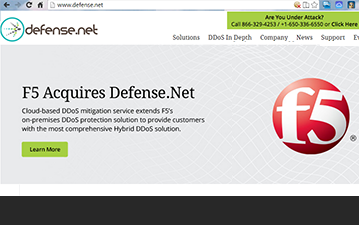
F5 Networks Acquires Defense.Net for DDos Mitigation Service

F5 Networks (has acquired Defense.Net, Inc., a privately-held provider of cloud-based security services for protecting data centers and Internet applications from distributed denial-of-service (DDoS) attacks. Financial terms were not disclosed.

Defense.Net was founded by Barrett Lyon, one of the pioneers of DDoS mitigation.  The company operates a massive, cloud-based service designed to absorb even the largest DDoS attacks. The Defense.Net network supports multiple protocols and provides features for remediation and control to safeguard customers from unforeseen threat vectors, while maintaining application performance.

F5 said Defense.Net’s high-capacity cloud service is complementary to its own on-premise DDoS Protection capabilities. The advanced technologies and operational experience shared between the two companies will expand F5’s portfolio of security solutions for defense against Internet-based DDoS attacks on networks, data centers, and applications.

“F5’s DDoS product engineering shows a comparable focus on scale and performance to how Defense.Net has built its mitigation capability in the cloud,” said Barrett Lyon, Founder and CTO of Defense.Net. “Customers of all sizes will be able to ensure that business-critical applications and networks are protected and available under the most demanding conditions regardless of the volume, type, or source of DDoS attack. Wherever it makes the most sense to stop an attack, F5 will provide the customer with the right defense.”

http://www.defense.net/
http://www.f5.com


  • Defense.Net is based in Belmont, California.  It has data centers in San Jose, California and Ashburn, Virginia.

AMD’s SeaMicro Server Sets OpenStack Record: 168,000 Virtual Machines​​

AMD has achieved record scalability of 168,000 virtual machines on 576 physical hosts, all provisioned on its SeaMicro SM15000 server. AMD said the first 75,000 virtual machines were deployed in six hours and thirty minutes.  The record demonstration was achieved in collaboration with Canonical using the Ubuntu OpenStack (Icehouse) distribution. MaaS (Metal as a Service), part of Ubuntu 14.04 LTS and Ubuntu OpenStack, was used to deliver the bare metal servers, storage and networking.

AMD’s SeaMicro SM15000 is a high-density, 10 rack unit system that links 512 compute cores, 160 gigabits of I/O networking and more than five petabytes of storage with a 1.28 terabyte high-performance supercompute fabric.  The SM15000 server design eliminates top-of-rack switches, terminal servers and hundreds of cables.  It currently supports the next-generation AMD Opteron (Piledriver core) processor, Intel Xeon E3-1260L (Sandy Bridge), E3-1265Lv2 (Ivy Bridge), E3-1265Lv3 (Haswell) and Intel Atom N570 processors.

“This record validates that the SeaMicro SM15000 is well suited for massive OpenStack deployments,” said Dhiraj Mallick, corporate vice president and general manager, AMD Data Center Server Solutions. “The combination of Ubuntu OpenStack and the SeaMicro SM15000 server provides the industry’s leading solution to build cloud infrastructure that is highly responsive and ideal for on-demand services.”

http://www.amd.com/en-us/press-releases/Pages/seamicro-sets-record-2014may13.aspx

Telstra Demos LTE Advanced Carrier Aggregation at 450 Mbps

Telstra has demonstrated downlink speeds of 450 Mbps using LTE Advanced Carrier Aggregation across a trial combination of 1800MHz and 2600MHz bands over its live network.

Telstra worked with Ericsson to install equipment for two new 4G Frequency Division Duplexing (FDD) channels of 20MHz bandwidth each on the 2600MHz spectrum band (40MHz FDD), aggregated with live 20MHz of 4G on the 1800MHz band. The result was three simultaneous side-by-side paths for the data to travel through to the operational core network. Telstra also used an advanced prototype Cat 9 engineering device that could combine the three channels to achieve these speeds.

"Conducting this type of test is a significant step in the network engineering and development process. It is essential for us to see how this type of technology works in the live network and understand what needs to be done to continue to absorb the exploding demand in mobile broadband and offer an exceptional customer experience,” Mike Wright, Group Managing Director Telstra Networks.

”Telstra has the largest holding of APT700MHz and 2600MHz spectrum in Australia and we expect we will eventually be able to offer this service across much if not most of our mobile network footprint, allowing more of our customers to benefit from improved capacity and faster speeds,” said Mr Wright.

http://www.telstra.com

In February 2014, Ericsson and Qualcomm Technologies conducted the first inter-vendor interoperability testing of LTE Category 6, which promises potential speeds of up to 300 Mbps.

The final stages of testing, which were completed in collaboration with Telstra, was based on ready-to-release versions of Ericsson's L14A software release. Ericsson said its L14A software leverages load balancing for better spectrum efficiency and improved user experience during high-load situations. It supports all bandwidth and frequency combinations for up to 40MHz Carrier Aggregation, providing users with speeds of up to 300 Mbps.  The test also used Qualcomm;s fourth-generation 3G/LTE multimode modem, the Qualcomm Gobi 9x35 chipset.

Absolute Software Delivers Persistent Client for BYOD Security

Absolute Software, which offers a persistent endpoint security and management module that can be embedded in the firmware of computers, laptops, tablets and smartphones, announced full BYOD support for Mac and Windows computers.

Absolute persistence technology is built into the BIOS or firmware of a device during the manufacturing process. Once activated, customers who purchase these devices benefit from an extra level of security.

The company said its latest Absolute Manage 6.5 will provide enrollment workflows as well as remote and automated security protocols for corporate and employee-owned devices, including smartphones, tablets and laptops. In addition, integration with Cisco’s Identity Service Engine (ISE) provides an increased level of network security. If a computer or mobile device attempts to access the network, its compliance status is automatically checked against company policy. This ensures all devices on the network are configured appropriately, including Absolute Manage enrollment. If a device is not already enrolled, ISE can redirect it to complete enrollment before allowing access.

“Many of our customers are receiving requests from employees to bring their personally-owned devices to work. But corporate IT doesn’t want to use multiple consoles and products to secure this range of form factors. With this release, Absolute Manage will be the only solution on the market to offer full BYOD capabilities for all devices. Our customers can count on us to provide them with the support they need to manage all the devices that enter their network,” said Errol Olsen, Interim CEO at Absolute Software. “The release of Absolute Manage 6.5 will support the Absolute Unified IT vision, allowing IT to manage all employee-owned devices from a single console.”

http://www.absolute.com

ADVA and HEAnet Demo SDN Controlled 4K Video Services

ADVA Optical Networking, in collaboration with HEAnet, i2CAT and Eurotek, showcased SDN-controlled distribution of 4K video content at this week's TNC2014 conference in Dublin, Ireland.

The demo features a software-defined networking (SDN) controller and ADVA's FSP 3000 colorless and directionless reconfigurable optical add drop multiplexers (ROADMs) transporting terabits of data to a multi-tenant cloud-based infrastructure.

“Flexibility is key for tomorrow's networks; it’s a fundamental building block that could prove to be the deciding factor between success and failure,” said Christoph Glingener, CTO, ADVA Optical Networking. “This is especially true for service providers that need to provision enormous amounts of streaming media. Being able to rapidly respond to fluctuating bandwidth demand is vital. That's why this demo is so important. We've harnessed OpenDaylight to build an SDN controller that is capable of orchestrating end-to-end 4K video services over an advanced ROADM network using OpenNaaS as a service orchestration platform. This is something that has never been done before.”

http://www.advaoptical.com/

Telstra Aims for 2 Million Crowd-Sourced Wi-Fi Hotspots in 5 Years

Telstra announced a strategy to offer all Australians, irrespective of whether they are a Telstra customer or not, access to two million Wi-Fi hotspots across the nation within five years.

Telstra is working with Fon, which provides users access to its global syndicate of over 12 million Wi-Fi hotspots.

Telstra aims to have its Wi-Fi sharing network launch in early 2015.

Australians already have access to one of the world’s leading mobile networks offering fast, unparalleled coverage on the move. Telstra’s new Wi-Fi network will broaden the choice of connection giving people a convenient way to get online using their portable devices when spending time at a hotspot. It will offer our customers the unique option to seamlessly use their home broadband allowance inside and outside the home,” stated David Thodey, Telstra CEO.

http://www.telstra.com.au/aboutus/media/media-releases/telstra-to-create-one-of-the-worlds-largest-wi-fi-networks.xml

Wednesday, May 21, 2014

Video: Radisys and Intel Small Cell Gateway Demo

In this video, Daniel Lynch, Senior Product Marketing Manager at Intel,  demonstrates a new way of rolling out a small cell site gateways.  Rather than a closed box in a fixed form factor, this demonstration shows a new, virtualized design based on Radisys technology.

Chandresh Ruparel, Director of x86 Platform at Radisys, explains how a small cell gateway integrated with a virtual EPC and IoT management can be scaled on the new Radisys T-series platforms.

See video: http://youtu.be/3nUBB1dyjQc


Intel Introduces Service Assurance from On-Chip Trusted Execution

Intel introduced a Service Assurance Administrator software solution to help the data center administrators improve the security and management of applications, including OpenStack deployments.

The Intel Datacenter Manager: Service Assurance Administrator (DCM: SAA) improves data center efficiency by ensuring workloads are running on a trusted infrastructure and meet performance expectations in multitenant environments. The idea is to leverage deep platform telemetry built in Xeon processors to gain service-level assurance.

Specifically, Intel said deep platform telemetry hardware in the processor and chipset allows its new software to offer reliable and efficient resource management across legacy devices in multitenant environments.

The Intel DCM: SAA telemetry capabilities also provide cloud service administrators with deeper insight into performance metrics between the infrastructure and application.

Key Features

  • Controller: Optimizes the allocation of data center resources by collecting deep platform telemetry data from compute node agents and using that information to place application on the best server for optimal performance and assigned trust.
  • Assured performance: As applications are provisioned in the OpenStack environment, a performance SLA is assigned to the application using an Intel DCM: SAA feature known as a Service Compute Unit (SCU). This SCU specifies the target performance for the application. Intel DCM: SAA then uses the hardware instrumentation to measure the delivered performance and adjust as needed.
  • Trust: Intel Trusted Execution Technology (Intel TXT) obtains a measurement of a server at the time it boots up. The measurement is then used to determine the types of applications that can run on that server, allowing applications to effectively specify the infrastructure trust requirements. 

http://download.intel.com/newsroom/kits/cloud/pdfs/DCM_SAA_Factsheet.pdf
http://www.intel.com

Cisco to Acquire ThreatGRID for Dynamic Malware Intelligence

Cisco  intent to acquire ThreatGRID, which offers a crowdsourced, unified malware analysis and threat intelligence solution.

ThreatGRID, which is based in New York City, securely crowdsources large volumes of malware and performs advanced analysis in the cloud, to identify key behavioral indicators enabling near real-time remediation. This allows customers to correlate a single malware sample’s characteristics against millions of other samples. The company delivers its dynamic malware analysis and threat intelligence technology both on-premise and in the cloud.

Cisco said the acquisition of ThreatGRID and its team strengthens its Advanced Malware Protection (AMP) portfolio, which was originally developed by Sourcefire and acquired in 2013. ThreatGRID’s on-premise products also expand Cisco's ability to help protect customers with in-house data retention requirements.

comprehensive malware-defeating capabilities, including detection and blocking, continuous analysis and retrospective remediation of advanced threats. The combination of Cisco and ThreatGRID will enhance our already strong capabilities to aggregate and correlate data to identify advanced and evasive cyber threats and provide intelligent cybersecurity solutions for the real world.

http://blogs.cisco.com/news/cisco-announces-intent-to-acquire-threatgrid/


  • ThreatGRID is headed by Dov Yoran (co-founder and CEO), who previously was a co-founder and partner at MetroSITE Group, an advisory services firm to both emerging security companies and large enterprises. Previously, he held several leadership roles at Solutionary (now NTT), Symantec, Riptech (acquired by Symantec) and Accenture. Dov is a Founding Member of the Cloud Security Alliance, serves on the Boards of the NY Metro ISSA and CSA chapters and frequently speaks at industry conferences.

Verizon Expands HIPAA-Compliant Data Centers

Verizon announced an expansion of its Healthcare Enabled Services to five additional data centers and featuring a broader range of cloud and data center infrastructure services.  The facilities help the healthcare industry to meet the federal Health Insurance Portability and Accountability Act (HIPAA) requirements for safeguarding electronic protected health information (ePHI).

In addition to Miami, Fla. and Culpeper, Va., healthcare organizations can now securely store their ePHI in Verizon's data centers located in Richardson, Texas; Santa Clara, Calif.; Englewood, Colo.; Carteret, N.J. and Elmsford, N.Y.

http://www.verizonenterprise.com/news/2014/05/healthcare-enabled-services-expanded-hipaa

VMware Previews Automated Log Analytics for Virtual and Hybrid Clouds

VMware introduced an automated log management and analytics product that uses machine-learning technology to help automate IT operations across physical, virtual and hybrid cloud environments.  VMware vCenter Log Insight 2.0 analyzes logs to help identify and resolve IT issues.

"IT organizations continue to be overwhelmed with massive amounts of unstructured log data generated by their virtual and hybrid cloud environments," said Ramin Sayar, senior vice president and general manager, Cloud Management Business Unit, VMware. "With VMware vCenter™ Log Insight™ 2.0, we're doubling-down on our unique predictive analytics-based approach to log management. VMware vSphere® customers, including general IT operations, security, applications and DevOps teams will be able leverage the power of VMware vCenter Log Insight 2.0 to analyze machine data for actionable insight to prevent system downtime."

New capabilities in VMware vCenter Log Insight 2.0:

  • Intelligent Grouping - A new machine learning-based technology that automatically groups related data to help administrators spot problems more rapidly and reduce time-to-resolution;
  • Query Performance - 6x faster query performance than the market leading solution will improve productivity levels of administrators and IT operations teams;(2)
  • Data Ingestion - 8x faster data collection over VMware vCenter Log Insight 1.5 can speed insight into more of customers' physical, virtual and cloud environments;(3)
  • Data Visualization - New data visualization capabilities in the form of tables and chart types will provide administrators with increased options for analyzing unstructured log data; and,
  • Extensibility - A new native Microsoft Windows agent will collect logs from Windows-based desktops and servers, enabling customers to now capture and analyze log data across all key environments.

In conjunction with VMware vCenter Log Insight 2.0, VMware is introducing four new content packs for Brocade Fibre Channel storage area networks (SANs) as well as for Microsoft Active Directory, Microsoft Exchange and Microsoft Windows.

http://www.vmware.com

Australia Japan Cable Completes Multi-Terabit Upgrade with Infinera

Australia Japan Cable (AJC) has completed a multi-terabit upgrade to its undersea network using equipment from Infinera. AJC offers connectivity and bandwidth to its customers across a 12,700 km submarine fiber optic cable network linking Australia, Guam and Japan. 

This second and final phase of deployment completes a multi-terabit, high-capacity ring providing diverse fiber paths into cable landing stations in Australia, Guam and Japan, where Infinera DTN-X packet optical transport networking platforms enable an Intelligent Transport Network for AJC.

"This network upgrade with Infinera's Intelligent Transport Network has enabled the retirement of AJC’s original 10G transport equipment and the transfer of traffic to the more capable Infinera DTN-X platform," said Philip Murphy, Head of Engineering at AJC. ”The original AJC 10G technology served us well but the efficiency, flexibility and speed of deploying the Infinera DTN-X to deliver 100G allows AJC to be more responsive to our customers in terms of client interfaces and traffic switching.”


  • Investors in AJC include Telstra, AT&T, NTT, Verizon and Softbank.

IBM Intros Trusteer Endpoint Protection Software

IBM introduced its new Trusteer Apex endpoint software aimed at stopping advanced malware at the weakest link, the endpoint, including laptops and desktops.

IBM's Trusteer Apex software, which is the newest offering in the company's Threat Protection System announced earlier this month, leverages security intelligence and behavioral analytics to go beyond traditional anti-virus approaches and firewalls to disrupt attacks across the entire attack chain - from break-in to exfiltrate.

IBM said its new Trusteer Apex software addresses strategic chokepoints where cybercriminals focus their attention, take hold of a user's endpoint and infect it with malware. For example, Java is the target of half of the application vulnerability attacks. Trusteer Apex can stop attacks that are embedded into Java applications and lock them from wreaking havoc on the enterprise.  Trusteer Apex prevents malicious Java applications through assessing application trust and activity risk, and blocking untrusted apps from doing high-risk activities.

"Through extensive research, IBM has identified specific stages of the attack chain where cyber criminals have relatively few options to execute their malicious content," said Yaron Dycian, Vice President of Marketing, Products & Services at Trusteer, an IBM company.  "Current point solutions in the market offer narrow protections against specific attack vectors and create significant workload on overstretched security teams, making it difficult to manage against cyber threats. Our strategic chokepoint technology introduces a fresh approach for breaking the threat lifecycle and preempting cyber attacks."

http://www.ibm.com

Mimosa Raises $20 Million for Massive MIMO Wi-Fi

Mimosa Networks, a start-up based in Campbell, California, $20 million investment in Series C funding for its work in last mile, gigabit wireless technology.

The latest funding was led by returning investor New Enterprise Associates (NEA). Oak Investment Partners also returned for its third round of investment in Mimosa, bringing the company’s total financing to $38 million.

The company plans to introduce a wireless product line for ISPs that leverages the most advanced Wi-Fi technology.  Mimosa has a partnership with Quantenna, which has previously disclosed plans for a 8x8 MU-MIMO chipset capable of 10Gbps speeds.

“The wireless industry is set to explode in the coming years, and Mimosa’s technology is unique in its ability to help networks scale to meet the needs of the global communications market,” said Greg Papadopoulos, venture partner, NEA. “We are excited to have the chance to ‘double down’ on a company so clearly poised to transform and revolutionize the wireless space.”

http://www.mimosa.co

Load DynamiX Raises $12 Million for Storage Performance Test

Load DynamiX, a start-up based in Santa Clara, California, announced a $12 million round of funding to support its storage performance validation solutions. The company develops tools to understand the performance of flash and hybrid storage systems under load.  The funding was led by HighBar Partners.

In 2013, Load DynamiX expanded its focus to enterprise IT and cloud service providers.  The company recently released the Load DynamiX Enterprise Series solutions that combine advanced storage workload modeling and extreme load generation into an integrated 2RU appliance.

The company’s enhanced product line now provides deep storage infrastructure insight that enables IT managers and architects to optimize the performance, availability and cost of their networked storage infrastructures.

“Storage architects and engineers are demanding a new level of insight into their infrastructure as they migrate to an Infrastructure as a Service (IaaS) model for their public and private clouds. In order to meet their performance, availability and cost objectives, new storage systems and technologies, including flash storage, must be tested, analyzed and validated before production deployment,” said Philippe Vincent, CEO of Load DynamiX. “Our storage workload modeling and performance validation appliances are the only way to properly plan and deploy these new storage technologies without the risk of unpredictable response times, unplanned outages and uncontrolled over-investment in equipment.”

http://www.loaddynamix.com

Huawei Appoints Ming He as General Manager of U.S. Operations

Huawei announced the appointment of Mr. Ming He as Country General Manager of its operations in the United States. In this role, Mr. He will be based in the company’s Plano, Texas, headquarters and have operational responsibility and provide strategic oversight for both the Carrier Network business group and the Enterprise business group within the United States.

Prior to this appointment, Mr. He led Huawei’s U.S. Carrier Network business group to provide continuous customer-centric innovation to U.S. operators.

http://www.huawei.com

Tuesday, May 20, 2014

Verizon Confirms VoLTE Coming Later this Year

Verizon confirmed plans to commercially launch its Voice over LTE service across its nationwide network later this year. A specific launch date was not specified.

From the beginning, Verizon’s VoLTE service will offer an HD Voice experience using the AMR-wideband standard.  The company said it will have a robust line-up of VoLTE-enabled smartphones available when the service launches. A software upgrade will also be available for certain other smartphones.

Verizon’s VoLTE will also offer video calling options, including making and receiving video calls directly from contact lists. As part of the VoLTE video calling experience, customers have the ability to change their calls instantly from voice-only to voice and video. The rollout also sets the stage for future enhancements through Rich Communications Services (RCS), which enable things like including large file transfer, more robust group messaging, and more location sharing.

http://newscenter.verizon.com/corporate/news-articles/2014/05-20-verizon-announces-volte/

Cisco Names Intercloud Partners: Dimension Data, Sungard, Telstra

Cisco announced partnerships with Dimension Data (part of NTT, Sungard Availability Services and Telstra to extend its vision of the Intercloud.  The partners will align their public cloud infrastructure to the Cisco Cloud architecture and deliver Cisco Cloud services to customers and resellers.

Cisco's open Intercloud allows local hosting and local provider options that enable data sovereignty. The hybrid cloud capabilities that differentiate the Cisco Cloud are built upon the Cisco Application Centric Infrastructure (ACI) and Cisco Intercloud Fabric technologies.

Some highlights of the partnerships

The deal with Dimension Data expands a 23-year relationship. Cisco will use Dimension Data's Managed Cloud Platform and SaaS solutions to deliver a suite of midmarket cloud services to its customers and resellers. Dimension Data and Cisco will partner to deliver an infrastructure-as-a-service (IaaS) solution that will be packaged with Cisco technology and software-as-a-service (SaaS) applications, including Microsoft SQL Server and SharePoint. The Cisco validated and co-branded solutions will be sold by Cisco through the Cisco channel partner community. Dimension Data's global cloud service is available via 10 data centers around the world, with plans to expand to 13 locations by September 2014. As a Cisco Intercloud partner, Dimension Data will evolve its Managed Cloud Platform to embrace Cisco ACI and Intercloud Fabric — the building blocks of the Cisco Cloud architecture

Sungard Availability Services is a Cisco Intercloud partner, utilizing its cloud infrastructure to deliver new Cisco Cloud services to customers and resellers. As a Cisco Intercloud partner, Sungard AS is expanding its cloud infrastructure utilizing the foundational elements of the Cisco Cloud architecture, including Cisco ACI. Sungard AS is poised to become the first cloud provider to market with a Cisco ACI-based public cloud offer built on an application-centric cloud architecture. Cisco will feature two cloud services from Sungard AS in its service catalog: an IaaS offering that enables customers to rapidly deploy hybrid clouds; and a disaster recovery-as-a-service offering to deliver business continuity.

Telstra said it will build a cloud infrastructure together with Cisco that provisions cloud and network services in real-time, providing greater speed, security and performance.   This includes investing in the Cisco Evolved Services Platform for its networking infrastructure, enabling seamless and highly secure delivery of cloud applications to customers, across the network and cloud, all the way to the branch and user desktop. Telstra’s cloud offerings based on Cisco’s global cloud platform will be available in Australia by the end of 2014.


In March, Cisco announced plans to build "the world’s largest global Intercloud" – a network of clouds – together with a set of partners.  The idea is to leverage a distributed network and security architecture designed for high-value application workloads, real-time analytics, “near infinite” scalability and full compliance with local data sovereignty laws. Cisco's open Intercloud promises APIs for rapid application development and a new enterprise-class portfolio of cloud IT services for businesses, service providers and resellers. It will support OpenStack and multiple hypervisors. It will also leverage Cisco's recently announced Application Centric Infrastructure.

Cisco plans to invest over $1 billion to build its expanded cloud business over the next two years following a "partner-centric" business model.  The Cisco Intercloud will be hosted across a global network of Cisco data centers and partner data centers. It will offer value-added application- and network-centric cloud services to accelerate the Internet of Everything.

Cisco's John Chambers and Rob Lloyd on Consolidation, Intercloud, ACI and NSA

On Industry consolidation

In your keynote, you predicted a "brutal consolidation" for the IT sector.  What do you foresee?

John Chambers:  I've seen this movie before.  All of our competitors from 15 years ago are gone.  They were good companies but they missed critical transitions. Now you are seeing this accelerate. The role of a pure hardware player will be challenged.  We are a software-hardware-ASIC-cloud company moving forward.  I do think that of the top 5 IT players today, only two or three will really be relevant five years from now. It isn't a given that Cisco will be one of those. We have to change to get ahead in the transition.

On Intercloud

What is the real value proposition for Intercloud? What's in it for other Service Providers?

Rob Lloyd:  The primary differentiators with current infrastructure-as-a-service offerings are (1) Intercloud partnerships will be based on ACI (Cisco's Application Centric Infrastructure) for handling profiles that can scale from private clouds to public clouds, (2) Intercloud partners will embrace the idea of workload mobility or hypervisor independent workloads, which is a recent innovation that allows the customer to have choice to move from a VSphere-application to AWS or Azure application via APIs. We've tested workload mobility already with Amazon, (3) Many of the services that we plan on bringing to the Intercloud partnerships will be networking services.  We will deliver an increasing number of cloud-based networking services.  Many of the Intercloud offers will be branded solely by the Service Providers.  That will be the case with Telstra, which was the first Intercloud partner that we announced.

John Chambers: To really know if an idea is going to be successful, I like to sit down with the customer.  If they get really excited about the new idea, then we move. This was the case with Telstra.  It's clear that they get how an Intercloud will transform their bottom line.

On a deal with Rackspace

To be successful in cloud services, is it vital for Cisco to acquire a leading player such as Rackspace?

John Chambers: The purpose of our network architecture is to help us to prioritize what we are going to do in each market.  We don't move into a new market unless there is a real chance of capturing 40% share with sustainable differentiation.  We try not to move into markets that don't have very strong gross margins -- unless they are very strategic for us.  In this case we are talking about a market that is very price sensitive that is taking on giants like Google, Facebook, AWS, Microsoft, etc.  In this type of scenario, we will look for partnership opportunities rather than acquisitions.

Rob Lloyd:  The concept of the Intercloud was announced at our Partner Conference.  That was not accidental.  Our desire is to build a Star Alliance of cloud providers.  Any company that is in that space today should be part of our roadmap to build the Intercloud.  Customers will choose to use its scale.  They will embrace the constructs describer earlier, namely, ACI architecture, OpenStack automation, movable workloads, etc. This ecosystem will expand and it could grow to include any of the companies that we think of today as major cloud providers.

On NSA

How did you feel about the most recent revelation that the NSA may have tampered with Cisco products prior to delivery to certain customers?  Did this prompt your recent letter to President Obama?

John Chambers:  I'm not going to dodge this question.  But first, let's take a step back to the days immediately after 9/11. I was asked by President Bush to be a co-chair for the National Infrastructure Advisory Council and so I understand what is possible. This country has been very fortunate that there have not been addition terrorist attacks.  Things change, however. When I saw the picture (of the Cisco box being tampered with), I did not know how to interpret it.  Is it true? Remember nothing has been proven at this point, and there isn't any indication that Cisco is involved.  The photo could very likely have been a training program.

The issue is really simple and too important to the global supply chain.  It is essential for our customers to trust us. This isn't just an issue for the U.S. high tech industry.  It is global. Customers have to be able to trust the supply chain or things will begin to break down.

My parents, who were doctors, taught me never to get too excited and I've never raised my voice as CEO.  I knew this could be a real issue for Cisco, even though there is no reason to think we were involved. Therefore, I made the decision to write the letter to President Obama.  This is so important to the future of our industry.  We have got to change.  I like our leader.  I know that the NSA has good people and they are a good customer for us, but the situation is different now than the days after 9/11 .  We have got to change. It isn't so important how we got to where we are now as to where we go from here.

On the issue of tampering, how are you planning to ensure that the customer gets the original product that you shipped?  

Distribution and shipment is just one part in the production cycle.  You also have to look at where the product is manufactured.  Securing hardware manufacturing is easier than software development. We believe that we have the most secure supply chain in the industry. You have to offer more than just a single step in security. We've been focused on securing the supply chain also because of the issue of counterfeiting. The are boxes out there that look identical to Cisco. It's really hard to tell the difference.  In some cases, it may be nation-states that have created the counterfeit. We have been cranking up security but at the same time we do not want to see a break-down of the global supply chain.  On an international level, we need rules of the road. Governments need to say 'we are not going to mess with the supply chain.'

On ACI

What is the No. 1 business case for Application Centric Infrastructure?  Why would customers want to buy it?

John Chambers:  The first reason is to have common policy for the data center, cloud, WAN and through the access network.  If you consider what application centric infrastructure does, it is remarkably simple -- it delivers applications, network, scale, and security. As basic as that sounds, that's how we charted the original cloud in the data center combining compute, storage and the network. The value is in bring applications to life to run wherever you want with common policy and management.

Rob Lloyd:  I think the No. 1 use case for ACI is security.  I think we are going to see security policies deployed from data centers to WANs to access.  I think we are going to see that the ability to react quickly to a threat or attack quickly will become automated and handled network policy. Once that threats are mitigated, the isolated node could be decommissioned and then the rest of the network will return to a normal state.  Many of the breaches in security often happen between the silos in network infrastructure and these can be avoided with end-to-end common policy.  This will be one of the strongest arguments for ACI.

John Chambers: If you want to track our progress in ACI, watch the shipment numbers for Nexus 9000 switches and the number of ACI customers that we announce each quarter. There were 25 Nexus 9000 customers a quarter ago and there are 175 customers today.  ACI is in a number of trials now and shipments are coming soon.  Watch how our customer count will go up. That will be the real measure of whether we hit a homerun with this one.

Transcribed and paraphrased from a press conference at Cisco Live! on 20-May-2014