Sunday, October 23, 2022

Progress with ODSA Chiplets and Bunch-of-Wires Interface

Bapi Vinnakota, project lead for the Open Compute Project's Open Domain-Specific Architecture (ODSA) initiative, provides an update on the chipset architecture following #OCPSummit2022 in San Jose, California. Two specs have been released this year. A mechanism to describe chiplets in XML was also discussed.

There was also a session on the Bunch-of-Wires interface.

https://youtu.be/6is_y09wSBc

Market drivers for Active Electrical Cables

Marvell has confirmed that  that leading cable manufacturers, including Amphenol, Molex, and TE Connectivity, are sampling to cloud data center operators their 100G/lane active electrical cables (AECs) powered by Marvell Alaska A PAM4 DSPs.

 At these speeds, the physical reach achievable with passive direct attach cables (DACs) falls short of the distance requirements for server-to-ToR (top of rack) and switch-to-switch interconnects. For cloud operators to continue their routine data center bandwidth doubling, most of these interconnects must transition from DAC to AEC. 

Marvell says the new AECs enable next-generation 400G, 800G and 1.6T server-to-switch and switch-to-switch interconnects that require 100G serial I/Os.

Marvell’s Alaska A family further applies advanced DSP equalization techniques and flexible firmware-based implementation to optimally compensate for the impairments introduced by the cable on the high-speed 100G PAM4 signal. This provides the ability to deploy thin cables that address the reach and flexibility needs of next-generation data center architectures.

Here is a over of the market from Venu Balasubramonian,  VP of product marketing, High Speed Connectivity and PHY Business Unit, Marvell.


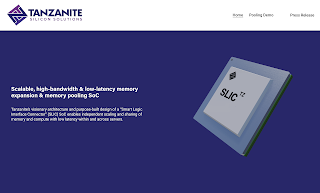
Marvell to acquire Tanzanite for Compute Express Link (CXL)

Marvell agreed to acquire privately-held Tanzanite Silicon Solutions, a start-up based in Milpitas, California that is developing advanced Compute Express Link (CXL) technologies. Terms of the all-cash transaction were not disclosed. Marvell said the future cloud data center will be built on fully disaggregated architecture utilizing CXL technology, requiring greater high-speed interconnectivity than ever combined with optimized compute, networking,...

Marvell intros 400G/800G PAM4 DSPs for Active Electrical Cables

Marvell introduced its Alaska A PAM4 DSP family for Active Electrical Cables (AECs) designed for data center interconnects by hyperscale customers.The new Alaska 400G/800G DSPs, fabricated in 6nm process, leverages Marvell’s PAM4 DSP technology to improve signal integrity in copper, short reach AECs to address emerging 100G/lane adoption in cloud data center interconnect architectures. The new Alaska 400G/800G DSPs add to Marvell’s comprehensive...


1.6Tbps OSFP-XD AECs for hyperscale spines

Credo unveiled its 1.6Tbps OSFP-XD HiWire CLOS Active Electrical Cable (AEC) supporting lengths up to 2.75m in a thin, compact, cable form factor to support the dense spine switching requirements for next generation hyperscale data centers. 

The 1.6Tbps OSFP-XD AEC supports 16 bi-directional lanes of 112Gbps communication with an industry standard Attachement Unit Interface (AUI) on each end.  It supports cable lengths up to 2.75m using a compact 32AWG cable connecting the two ends that is no larger than two Cat6e cables.  The OSFP-XD AEC consumes less than 20W of power per end and offers the most reliable, lowest power interconnect for in-rack applications such as Distributed, Disaggregated Chassis (DDCs).


Don Barnetson, Vice President of AEC Product at Credo, provides an overview.

https://youtu.be/1Lc85VCRhNs


IDC maintains +2% forecast for worldwide IT services

International Data Corporation (IDC) is maintaining its forecast for 2% growth in nominal dollar denominated revenue this year for worldwide IT and business services. This corresponds to a 5.7% growth rate if measures in constant currency.

IDC maitains the forecast even against the backdrop of a global recession. Worldwide GDP growth has worsened since March/April and is now expected to grow by only 2.7% this year and 2.4% in 2023, based on August's figures. 

"While economic conditions for major economies around the world worsened in the last few months, given the services vendors' strong revenues, bookings, and other leading indicators, the worldwide services market will likely continue on its current growth trajectory," said Xiao-Fei Zhang, program director, IDC Worldwide Services Tracker program. "Also, the real threat to vendors may be from the supply side: with book-to-bill ratios above 1.1 or 1.15, attrition 25% plus, and utilization rate pushing close to 90%, something has to give. A cooler economy may actually help vendors to convert bookings to revenue faster by easing the labor market."

The 2022 market growth represents a slight increase of 12 basis points from IDC's April 2022 forecast. The five-year compound annual growth rate (CAGR) is now projected to be 5.2%, compared to the previous forecast of 4.9%.

https://www.idc.com/getdoc.jsp?containerId=prUS49791022


D-Wave's Quantum Service now in AWS Marketplace

D-Wave Quantum is introducing four offerings in AWS Marketplace, including:

  • Leap Quantum Cloud Service: The Leap quantum cloud service provides real-time access to D-Wave’s  quantum computers and a quantum-classical hybrid solver service that can handle problems with up to one million variables and 100,000 constraints. Leap will be available in AWS Marketplace soon, and Amazon Braket customers will be directed to the AWS Marketplace to access the D-Wave system.
  • Quantum Proof of Concept: In a Quantum Proof of Concept, D-Wave helps customers validate a selected quantum use case through detailed problem discovery, problem definition, development of an initial prototype solution, and testing with representative application data.
  • Quantum Feature Selection for Machine Learning: With increasing data sets comes increasing complexity, especially when it comes to feature selection, a fundamental building block of machine learning. This program focuses on utilizing quantum hybrid approaches to optimize feature selection in model training and prediction.
  • Quantum Consulting Services: To help customers get started with quantum or implement a quantum solution, D-Wave’s Launch™ service combines technical enablement, products and services. Utilizing powerful quantum hybrid solutions and professional service consulting, the Launch service helps customers solve complex problems and deliver real business value.

“The era of commercial quantum computing is here. Forward-looking organizations are increasingly turning to quantum computing to find solutions for today’s complex and computationally intensive business problems, ultimately to reduce costs and increase revenue,” said Mark Snedeker, senior vice president of growth at D-Wave. “By launching in AWS Marketplace, we’re introducing our Leap quantum computing service to AWS customers, enabling them to quickly and easily start deriving business value from quantum computing, today.”

https://www.dwavesys.com/


Red Hat launches Enterprise Linux for Workstations on AWS

Red Hat Enterprise Linux for Workstations is now available on AWS, The service, which is accessible via an Amazon-provided NICE DCV client or standard web browsers, delivers a high-end Red Hat Enterprise Linux for Workstations environment for powering intensive workloads like animation rendering or data visualization. It supports a variety of GPU-accelerated hardware instances offered on AWS while still delivering a fully-featured Red Hat Enterprise Linux for Workstations environment, delivering a powerful set of capabilities, including:

  • Optimization for high-performance workloads with an emphasis on graphically-intensive processes, limiting the need to performance tune or configure the operating system to meet user needs.
  • Extensive software support with Red Hat Enterprise Linux for Workstations retaining the same certified ecosystem as Red Hat Enterprise Linux, with thousands of independent software vendor (ISV) applications ready for use.
  • Broad hardware support that works with a range of Amazon EC2 instances, including G-family accelerated instance types best suited for remote workstations.
  • Provides access everywhere by offering web client and Windows, Mac and Linux thin clients support.
  • An established software development stack with support for the latest stable languages, databases, and tools.
  • Consistency for the hybrid cloud, from platform to cloud service 

“Compute-intensive tasks like animation, data visualization or medical imaging require a powerful, scalable and stable operating system. Red Hat Enterprise Linux already delivers these capabilities for high-end workstations, and today’s launch of Red Hat Enterprise Linux for Workstations on AWS further expands this delivery, enabling artists, medical professionals, scientists and engineers to do their work anywhere in the world with the required features and in a low-latency environment."

Verizon's 2022 CAPEX so far hits $15.8 billion

Verizon reported total revenue of $34.2 billion for Q3 2022, an increase of 4.0 percent from third-quarter 2021. Net income was $5.0 billion, a decrease of 23.3 percent from third-quarter 2021, and adjusted EBITDA1 of $12.2 billion, down 0.4 percent year over year.

"We took a number of actions in the third quarter that helped drive improved operational and financial performance, but we know there's still more work to be done," said Verizon Chairman and CEO Hans Vestberg. "The pricing actions we took earlier this year, as well as our new cost savings program, show that we are being deliberate and strategic in our decisions to strengthen our business. At the same time, we are focused on executing our 5G strategy, as we are covering every major market and accelerating our C-Band network build. We are on track to reach 200 million POPs within first-quarter 2023."

Highlights

Capital expenditures year-to-date were $15.8 billion, including C-Band spending of $4.5 billion.

Wireless: 

  • Total wireless service revenue of $18.8 billion, a 10.0 percent increase year over year.
  • Total retail postpaid churn of 1.17 percent, and retail postpaid phone churn of 0.92 percent.
  • Postpaid phone net additions of 8,000. 

Broadband:

  • Total broadband net additions of 377,000, including 342,000 fixed wireless net additions, reflecting a strong demand for reliable and high-value broadband offerings. Total broadband net additions increased 109,000 from second-quarter 2022, and fixed wireless net additions increased 86,000 from second-quarter 2022.
  • More than 40 million households covered by fixed wireless in third-quarter 2022, including over 30 million households covered by 5G Ultra Wideband. 
  • 61,000 Fios Internet net additions, an increase from 36,000 Fios Internet net additions in second-quarter 2022. 

Thursday, October 20, 2022

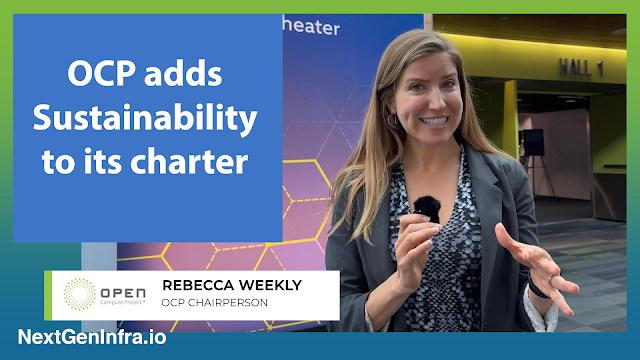
Video: OCP adds Sustainability to its Charter

"You can feel the energy". 

Rebecca Weekly, Chair of the Open Computer Project, provides a wrap-up of this year's #OCPSummit20222 in San Jose, California.

Sustainability has become a key tenet for everything at OCP. A new working group was established. Future technologies, including optical interconnects, are being explored. Innovation in data center infrastructure remains the focus.

https://youtu.be/hmfaci8MUBQ

Ericsson sees stock drop after Q3 report

Ericsson's shares experienced a sharp drop on Thursday after the company reported that Q3 Group Net Sales grew by 3% organically to SEK 68.0 billion (approx. US$6.031 billion), driven by strong performance from Networks. 

Börje Ekholm, President and CEO of Ericsson, stated: "We see robust underlying performance and strong momentum in the business as we continue to execute on our strategy. This includes leadership in mobile networks by growing market share. Since 2017 we have increased RAN market share, excluding Mainland China, from 33% to 39% and we have had multiple contract wins across geographies in this quarter. We continue to solidify our strong position in 5G to capture the considerable opportunities presented by the fastest scaling mobile generation. Our expansion into the exciting high-growth Enterprise space is gaining momentum with the acquisition of Vonage, providing us with access to a powerful range of cloud communication services."

Some highlights

  • EBITA of SEK 7.7 b. corresponded to a margin of 11.3%, where higher gross income from business growth was offset by increased technology investments and the consolidation of Vonage with acquisition accounting and one-time acquisition costs.
  • Group organic sales grew by 3% YoY driven primarily by Networks in North America. Reported sales were SEK 68.0 (56.3) b., of which Vonage contributed SEK 2.9 b. since July 21.
  • Gross income increased to SEK 28.1 (24.8) b. driven by higher sales primarily in Networks, and the consolidation of Vonage.
  • The Networks business saw strong organic sales growth of 7% excluding IPR (4% including IPR), with growth driven by North America where operators continue to forcefully drive 5G deployment. After expected record operator capex in 2022 in North America, Ericsson anticipatea RAN capex to hold up well in 2023, albeit at a lower level than this year. 
  • In the new Cloud Software & Services segment, revenues were impacted by lower managed services sales and IPR revenues. Gross income was stable after offsetting ongoing 5G Core deployment costs. 
  • In the current inflationary environment, Ericsson is making pricing adjustments as well as leveraging product substitution to manage margins.


https://www.ericsson.com/4904ed/assets/local/investors/documents/financial-reports-and-filings/interim-reports-archive/2022/9month22-ceo-slides.pdf

Marvell advances to 3nm with TSMC

Marvell's first 3nm silicon is now in fabrication with Taiwan Semiconductor Manufacturing Company (TSMC) on its 3nm shuttle. Marvell said this advancement will enable it to develop some of the most advanced multi-die, multi-chiplet systems-in-package (SiP) for its infrastructure products and co-development of custom ASIC solutions optimized for some of the most challenging infrastructure use cases, such as machine learning.

The 3nm platform includes foundational IP building blocks such as long reach SerDes, PCIe Gen6 PHY, and several standards-based die-to-die interconnect technologies for managing data flow across the data infrastructure. 

This 3nm development follows numerous 5nm solutions from Marvell – in production or development – that span electro-optics, switch, PHY, compute, 5G baseband, and storage products, as well as a wide range of custom ASIC programs.

Additionally, this IP portfolio is compatible with 2.5D packaging technologies such as TSMC’s leading-edge 2.5D Chip-on-Wafer-on-Substrate (CoWoS)

Hugh Durdan provides a perspective.

https://youtu.be/mUYoLecCWoI

AT&T to reach a dozen 5G Edge Zones by year's end

AT&T disclosed plans of getting to an even dozen 5G Edge Zones by the end of 2022, up from the current count of 10.

The Edge Zone facilities are standalone network cores with software defined network capabilities located in network data centers close to cross connect facilities that have fast connections to nearby cloud facilities run by the “hyperscaler” cloud providers.

AT&T says these edge zones powered by regional 5G standalone network cores will open a range of new capabilities that simply aren’t possible with 4G. 

https://about.att.com/blogs/2022/legg-5g-edge-zones.html


AT&T and Microsoft launch 5G Azure Edge Zones in Atlanta

AT&T and Microsoft are launching the “Private Preview” of Azure Edge Zone in Atlanta.The companies are pitching the power of AT&T Network Edge (ANE) capabilities combined with the Microsoft Azure cloud platform.The Azure Edge Zones collaboration enables customers to creaste services such as lightweight and rich virtual reality interfaces for everyone from gamers to first responders. Or hyper-precise location tools that will supercharge industrial...


Arelion's multi-vendor, multi-layer optical transport trial

Arelion completed a series of trials with Acacia and Cisco over multiple, third-party, open line systems. 

On a live fiber route with existing ROADM infrastructure between Hamburg and Copenhagen, Arelion successfully leveraged Acacia Bright 400ZR+ QSFP-DD coherent modules with greater than +1 dBm transmit power between Cisco 8000 and NCS 5700 router platforms. The trial demonstrated the seamless integration of Routed Optical Networking with DWDM transponders carrying wavelength services.

Acacia's Bright 400ZR+ pluggable coherent optical modules can plug into Cisco routers, enabling Arelion's further adoption of the simpler and more scalable architecture of Routed Optical Networking, combining innovations in silicon, optics and routing systems. 

Arelion also highlighted the interworking on brownfield long-haul applications built with third-party optical line systems

"Multi-layer architecture has always been challenging to scale and operate due to decades of accumulated complexity. With this latest trial, Arelion demonstrated the possibility to simplify conversion and interoperability, bringing us closer to Routed Optical Networking that evolves cost structures, scalability and efficiency," said Dariusz Solowiej, VP Network Technology & Customer Operations at Arelion. "400G coherent pluggables will help our customers secure high-performance connectivity at the lowest cost and help us grow our networks in scale as we continue to connect the world."

"As the latest entrant in our comprehensive family of 400G pluggables, the Bright 400ZR+ QSFP-DD is designed to expand optical transceiver applications by supporting higher transmit power and performance consistent with legacy coherent optics," Benny Mikkelsen, Vice President/Chief Technology Officer at Acacia, now part of Cisco. "The ability of these solutions to meet the varying needs of network operators, while driving economies of scale on a common technology platform, is a key advantage for providers such as Arelion to grow their networks."

https://www.arelion.com/about-us/press-releases/400G-field-trial.html

AT&T midband 5G deployment on or ahead of schedule

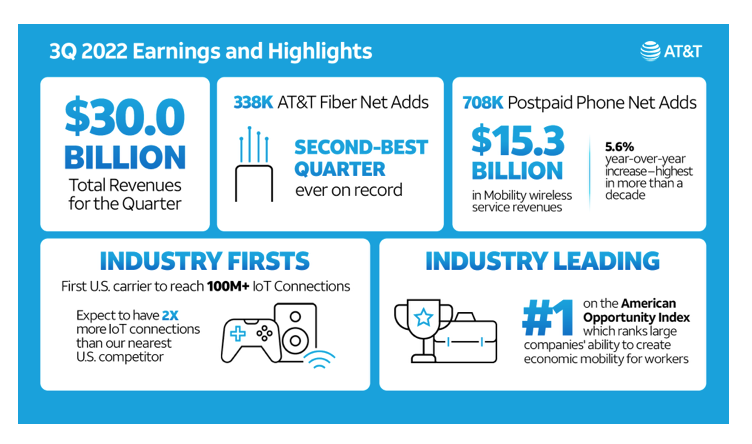
Citing strong, sustained momentum in customer additions across its growing 5G wireless and fiber networks, AT&T reported Q3 2022 revenue of $30.0 billion versus $31.3 billion in the year-ago quarter, down 4.1% reflecting the impact of the U.S. Video separation in July 2021. Excluding the impact of U.S. Video, operating revenues for standalone AT&T were up 3.1%, from $29.1 billion in the year-ago quarter. This increase primarily reflects higher Mobility revenues, and to a lesser extent Consumer Wireline and Mexico, partly offset by lower Business Wireline revenues.

“We’re investing at record levels to enhance our 5G and fiber connectivity and to deliver the best experience available in the market,” said John Stankey, AT&T CEO. “Our results show our strategy is resonating with customers as we continue to see robust levels of postpaid phone net adds and approach 1 million AT&T Fiber net adds for the year."

Some highlights:

  • Communications revenues were $29.1 billion, up 3.2% year over year primarily due to increases in Mobility and, to a lesser extent, Consumer Wireline, which more than offset a decline in Business Wireline.
  • Mobility revenues were up 6.0% year over year to $20.3 billion due to higher service and equipment revenues. Service revenues were $15.3 billion, up 5.6% year over year, primarily driven by subscriber and postpaid ARPU growth
  • Internet of Things (IoT) connections, including wholesale, have now reached more than 100 million.
  • FirstNet connections reached approximately 4 million across more than 23,000 agencies. 
  • Business Wireline revenues were $5.7 billion, down 4.5% year over year due to lower demand for legacy voice and data services and product simplification, partly offset by growth in connectivity services. 
  • 708,000 postpaid phone net adds; 2.2 million-plus through the third quarter, expected to be industry best
  • 338,000 AT&T Fiber net adds, second-best quarter ever; 11 straight quarters with more than 200,000 net adds.

https://about.att.com/story/2022/q3-earnings.html

Equinix invests $45million for 2nd data center in Bogota

Equinix announced a US$45 million investment for the construction of BG2, a new International Business Exchange (IBX) in Bogotá - its second data center in Colombia.

The new facility, which is scheduled to open in the first half of 2023, will offer around 32,000 square feet (approximately 2,900 square meters) of colocation space, making it one of the largest data centers in Colombia. 

The initial phase of BG2 will have a capacity for 550 cabinets, with space for additional cabinets in future phases. At full build, the facility will provide capacity for 1,100 cabinets.

https://www.equinix.com/newsroom/press-releases/2022/10/digital-transformation-growth-in-latam-underpins-equinix-us-45m-investment-in-its-second-data-center-in-colombia

Wednesday, October 19, 2022

Open Compute Project and LF target Silicon Root of Trust

The Open Compute Project Foundation (OCP) and the Linux Foundation (LF), which are now collaborating on hardware-software co-design strategy, announced "Caliptra", a new effort to standardize silicon embedded hardware root of trust (ROT) security.

Caliptra is supported by AMD, NVIDIA, Microsoft and Google. The hardware root of trust provides a set of security properties that anchor the security of a system-on-a-chip (SOC), including CPUs, GPUs and SSDs, into the hardware.

"An important part of the OCP mission, on top of serving our hyperscale operator community, is to make it easy for everyone to consume hyperscale innovations, which end up embedded in OCP recognized products. Understanding that deployable solutions need hardware and software that is integrated into a complete and validated solution, we are pleased to be able to bring together the strengths of the Linux Foundation for collaborative open source software development and the OCP for hardware specifications, and ability to develop supply chains for emerging markets. As part of the expanded collaboration with LF, we are pleased to have new security contributions from Google and Microsoft," said George Tchaparian, CEO Open Compute Project Foundation.

"The Linux Foundation is happy to collaborate with the OCP to create communities that participate on both LF and OCP projects with a common goal and harmonized process to deliver market ready solutions combining open hardware and software," said Arpit Joshipura, general manager, Networking, Edge, and IoT, the Linux Foundation. "We also look forward to partnering with the OCP on go-to-market initiatives developing emerging market supply chains in support of our vendor and system integrator members."

"Independent hardware and software initiatives by different communities and consortiums often require significant integration efforts by the industry. Vendors need to convert and integrate the initiative into solutions with the market need in mind. The net effect is that many innovations never see the light of the day or serve the needs of the broader market. The expanded collaboration between the Open Compute Project and Linux Foundation has the strong potential to accelerate the absorption of open innovations into meaningful products and services", said Ashish Nadkarni, Group Vice President and General Manager, Worldwide Infrastructure at IDC.

https://www.opencompute.org/blog/cloud-security-integrating-trust-into-every-chip

OCP launches Composable Memory Systems Project

The Open Compute Project Foundation (OCP) is pursuing a Composable Memory Systems (CMS) Project. Work started in February 2021 when the Future Technologies  Initiative - Software Defined Memory (SDM)  began studying the use cases, interconnect preferences and system characteristics of such memory systems.

CXL can enable memory expansion within a system locally, but also can enable more innovative solutions that allow pooling/sharing of memory across multiple hosts.

The Composable Memory Systems Project aims to follow a  a hardware-software  co-design strategy , developing a community to standardize and drive adoption of tiered and hybrid memory technologies and solutions that can benefit data center applications across industries such as AI-ML/HPC, Virtualized Servers and Cache/Databases.

OCP members who have joined this effort include Meta, Microsoft, Intel, Micron, Samsung, AMD, VMware, Uber, ARM, SMART Modular, Cisco and MemVerge. As the group becomes a formal sub-project under the OCP Server Project, the industry can join and drive the memory focused innovations to adoption.

As the CSM group formally launches as an OCP Project, we would like to invite all of you to participate and help us drive this next frontier of innovation for computational infrastructure  systems from the perspective of a hardware and  software and systems architecture.

https://www.opencompute.org/blog/ocp-launches-composable-memory-systems-subgroup

Video: Advancing Composable Memory Systems


Software-defined memory systems have tremendous potential to accelerate innovation in large data centers.  Manoj Wadekar, Hardware Systems Technologist, Meta, shares a perspective on discussions underway at OCP Summit 2022 in San Jose, California.

Telecom Infra Project tackles metaverse-ready networks

Telecom Infra Project is launching a new project group to address metaverse-ready networks. 

The TIP Metaverse-Ready Networks Project Group’s primary objective is to accelerate the development of solutions and architectures that enhance network readiness to support metaverse experiences. Meta Platforms, Microsoft, Sparkle, T-Mobile and Telefónica  will be the initial co-chairs of the Project Group. 

Working in close collaboration, the Project Group will aim to align on industry-wide network capabilities, specific APIs and mechanisms required to access end-to-end (E2E) network capabilities supporting immersive applications at scale. The group will define requirements and methods for measuring E2E Quality of Experience (QoE), and provide a prioritization of future network architectures needed to achieve metaverse readiness.

Alex Harmand, Head of Network Platforms at Telefónica and Co-Chair of the MRN Project Group said: “This new group will enable operators to address the exciting opportunities that the metaverse is creating in both the consumer and enterprise segments. Telefonica is looking forward to collaborating to define  the network capabilities and associated APIs  needed  to enhance metaverse services. The TIP community is the perfect environment for this initiative, as it will allow us to leverage multiple current project groups, such as OpenRAN, Open Optical and Packet Transport, to deliver end-to-end architectures and solutions that we will then test in Telefonica’s and other TIP Community Labs.”

https://telecominfraproject.com/tip-launches-metaverse-ready-networks-project-group/

EllaLink plans petabit cable along Portugal's coast

EllaLink, which operates a subsea cable directly connecting Europe to Latin America, plans to build a direct connection between Sines and the Lisbon Metro Area via a new subsea cable.

The multi-petabit capacity "Olisipo" system will connect all the international submarine landings in Portugal with the major data centers in the region, including the data centers of Start Campus NEST in Sines and Altice LDV in Lisbon. The cable will land in Carcavelos and Sines and will be ready to branch into Seixal & Sesimbra cable landing stations and connect the Setubal area.

The unrepeatered, 110km fully buried cable will incorporate 288 fibers, providing a design capacity of 4.3 Petabits. The cable robustness will be enforced by particular care given to route engineering with special attention to cable crossing, full subsea and terrestrial burial strategy, full cable armouring and extra shore-end protection with bore pipe in Sines.

The Olisipo system will provide direct POP to POP connectivity at fibre pair level between the main Data Centres located in Sines and Lisbon Metro Area, connecting at day one 

https://ella.link/2022/10/18/olisipo-the-new-ellalink-cable-petabits/

EllaLink opens PoP with Brazil's GlobeNet

EllaLink announced a new PoP with GlobeNet in Fortaleza, Brazil. Brazilian customers of GlobeNet will be able to use the EllaLink cable - which stretches 6,000 km between Fortaleza (Ceará) and Sines (Portugal) - to access service content providers and Internet Exchange Points (IXs) in Europe. Similarly, European companies will be able to use the EllaLink cable to access GlobeNet's network.GlobeNet offers direct low-latency routes and advanced...

EllaLink cites 30% less latency for gamers on transatlantic link

EllaLink said its new fiber optic submarine cable linking Europe with Latin America enables gamers on both continents to play online matches with 30% less latency. EllaLink has entered into a partnership with IP Telecom - which provides differentiated IP transit access to the main content servers spread across the European continent - and with NoPing, a high-performance solution for latency improvement focused on the online gaming segment.Inaugurated...


Cobalt Digital transports native SMPTE-2110 with ADVA Oscilloquartz

Cobalt Digital demonstrated high-speed transport of uncompressed audio and video signals in an SMPTE-2110 environment using ADVA’s Oscilloquartz timing technology. The trial network offers a simple, reliable and low-cost way to share broadcast streams in multiple digital formats at the highest quality. 

The demonstration featured OSA 5401 small form-factor pluggable (SFP) PTP grandmasters and Digital’s high-density audio and video processing technology with native SMPTE-2110 support and multiple 25 Gbps Ethernet interfaces.

“This demo verifies the viability of an incredibly flexible technology for transporting video, audio and broadcast data without the need for compression or reformatting. With Indigo, our next-generation platform, and ADVA’s unique timing plug, the trial solution delivers the highest levels of availability and quality and with an extremely small footprint,” said Suzana Brady, SVP of worldwide sales and marketing at Cobalt Digital. “ADVA’s pluggable Oscilloquartz timing device enables quick and simple deployment in a power-on and run environment. It removes the complexity of local network configurations and can support both GNSS-based and arbitrary time modes.”

“Leveraging our most compact Oscilloquartz PTP timing technology, this demo shows how broadcast and media production network operators can achieve higher speeds while significantly improving efficiency. By processing natively over IP, Cobalt Digital’s platform removes complexity and significantly reduces cost,” commented Gil Biran, GM of Oscilloquartz, ADVA. “High-quality video and audio transmission rely on accurate and stable timing and our pluggable device was crucial to the success of this trial. The flexibility and simplicity of our accessSync™ OSA 5401 SyncPlug™ were key as well as its ability to distribute timing to many devices from a single SFP.”

https://www.adva.com/en/newsroom/press-releases/20221019-cobalt-digital-demos-25g-uncompressed-video-transport-using-adva-timing-plug