Showing posts with label #OCPSummit. Show all posts

Wednesday, October 18, 2023

OCP launches Security Appraisal Framework and Enablement program

The Open Compute Project Foundation (OCP) has launched a new Security Appraisal Framework and Enablement (S.A.F.E.) program aimed at improving the trustworthiness of devices across all data center IT infrastructure. 

The OCP S.A.F.E. program is expected to reduce cost overhead and redundancy of device security audits with an OCP Community developed per device security checklist, and advance the security posture of device hardware and firmware components across the supply chain.

The OCP S.A.F.E. Program is designed to reduce cost overhead and redundancy of device security audits:

  1. provide security conformance assurance to device consumers 
  2. increase the number of devices whose firmware and associated updates are reviewed on a continuous basis, rather than only once when the device is 1st manufactured. 
  3. advance the security posture of device hardware and firmware components, through iterative refinement of review areas, testing scopes and reporting requirements.

"The OCP S.A.F.E. Program is designed to be a catalyst for upleveling the effort on security across the OCP Community and the industry. The OCP S.A.F.E. program is an OCP Community led effort to bring standardizations to device firmware security validation to help data center operators maintain a consistent security posture with reduced costs through removing duplication of efforts which can be replicated by other market segments. Security is the underlying foundation which makes OCP core tenets of efficiency, openness, scale, impact and sustainability possible," said Steve Helvie, VP Emerging Markets at the Open Compute Project Foundation.

"Creating a standardized approach for provenance, code quality and software supply chain for firmware releases and firmware patches that run on data center IT devices benefits the broader community; from democratizing the review process to streamlining efforts. Google is pleased to be a founding member of the OCP S.A.F.E. program and together, with the community, we will accomplish our mutual goal of increased security assurance for the industry," said Phil Venables, CISO, Google Cloud.

Independent third-party audits present significant challenges. These results are often available only to a certain set of customers, limiting their market impact. Also, these reviews are often commissioned by device consumers at the time of purchase, with device reviews are only performed once and subsequent security issues introduced by firmware upgrades and patches go undetected. The OCP driving a standardized approach, across all data center operators, will effectively and efficiently address these issues.


"We have partnered with OCP to create SAFE, a framework that promotes systematic security evaluations across the hardware ecosystem. This initiative provides enhanced levels of quality and security assurance to all hardware consumers," said Mark Russinovich, Azure CTO.


LITEON presents its Liquid Cooling at OCP Global Summit

LITEON Technology introduced new liquid cooling solutions under its new brand, COOLITE. 

The lineup includes intelligent Power Distribution Units (PDUs) equipped with real-time monitoring and control features, enabling data center operators to optimize power usage and ensure reliability. The ultra-efficient Uninterruptible Power Supplies (UPS) provide a resilient power backup system, while the intelligent power management software offers insights into energy consumption patterns for proactive decision-making.

https://liteon-cips.com/

Sunday, October 23, 2022

Progress with ODSA Chiplets and Bunch-of-Wires Interface

Bapi Vinnakota, project lead for the Open Compute Project's Open Domain-Specific Architecture (ODSA) initiative, provides an update on the chipset architecture following #OCPSummit2022 in San Jose, California. Two specs have been released this year. A mechanism to describe chiplets in XML was also discussed.

There was also a session on the Bunch-of-Wires interface.

https://youtu.be/6is_y09wSBc

Wednesday, October 19, 2022

Open Compute Project and LF target Silicon Root of Trust

The Open Compute Project Foundation (OCP) and the Linux Foundation (LF), which are now collaborating on hardware-software co-design strategy, announced "Caliptra", a new effort to standardize silicon embedded hardware root of trust (ROT) security.

Caliptra is supported by AMD, NVIDIA, Microsoft and Google. The hardware root of trust provides a set of security properties that anchor the security of a system-on-a-chip (SOC), including CPUs, GPUs and SSDs, into the hardware.

"An important part of the OCP mission, on top of serving our hyperscale operator community, is to make it easy for everyone to consume hyperscale innovations, which end up embedded in OCP recognized products. Understanding that deployable solutions need hardware and software that is integrated into a complete and validated solution, we are pleased to be able to bring together the strengths of the Linux Foundation for collaborative open source software development and the OCP for hardware specifications, and ability to develop supply chains for emerging markets. As part of the expanded collaboration with LF, we are pleased to have new security contributions from Google and Microsoft," said George Tchaparian, CEO Open Compute Project Foundation.

"The Linux Foundation is happy to collaborate with the OCP to create communities that participate on both LF and OCP projects with a common goal and harmonized process to deliver market ready solutions combining open hardware and software," said Arpit Joshipura, general manager, Networking, Edge, and IoT, the Linux Foundation. "We also look forward to partnering with the OCP on go-to-market initiatives developing emerging market supply chains in support of our vendor and system integrator members."

"Independent hardware and software initiatives by different communities and consortiums often require significant integration efforts by the industry. Vendors need to convert and integrate the initiative into solutions with the market need in mind. The net effect is that many innovations never see the light of the day or serve the needs of the broader market. The expanded collaboration between the Open Compute Project and Linux Foundation has the strong potential to accelerate the absorption of open innovations into meaningful products and services", said Ashish Nadkarni, Group Vice President and General Manager, Worldwide Infrastructure at IDC.

https://www.opencompute.org/blog/cloud-security-integrating-trust-into-every-chip

OCP launches Composable Memory Systems Project

The Open Compute Project Foundation (OCP) is pursuing a Composable Memory Systems (CMS) Project. Work started in February 2021 when the Future Technologies  Initiative - Software Defined Memory (SDM)  began studying the use cases, interconnect preferences and system characteristics of such memory systems.

CXL can enable memory expansion within a system locally, but also can enable more innovative solutions that allow pooling/sharing of memory across multiple hosts.

The Composable Memory Systems Project aims to follow a  a hardware-software  co-design strategy , developing a community to standardize and drive adoption of tiered and hybrid memory technologies and solutions that can benefit data center applications across industries such as AI-ML/HPC, Virtualized Servers and Cache/Databases.

OCP members who have joined this effort include Meta, Microsoft, Intel, Micron, Samsung, AMD, VMware, Uber, ARM, SMART Modular, Cisco and MemVerge. As the group becomes a formal sub-project under the OCP Server Project, the industry can join and drive the memory focused innovations to adoption.

As the CSM group formally launches as an OCP Project, we would like to invite all of you to participate and help us drive this next frontier of innovation for computational infrastructure  systems from the perspective of a hardware and  software and systems architecture.

https://www.opencompute.org/blog/ocp-launches-composable-memory-systems-subgroup

Wednesday, November 10, 2021

2021 OCP Global Summit - the next 10 years

This year is the tenth anniversary of the Open Compute Project, an organization that has advanced the cause of "vanity free" infrastructure for cloud providers. The mission is broadening and the next 10 years will see advances in additional domains. Here is a 2-minute perspective from Rebecca Weekly, Board Chair, Open Compute Project.

https://youtu.be/xeU8WsVscAs

For more video interviews with industry experts, visit: https://nextgeninfra.io/

Inspur and Samsung build open storage solution for OCP

Inspur Information, which ranks among the world’s top 3 server manufacturers, and Samsung announced a Poseidon V2 E3.x reference system for the Open Compute Project community.

This product adopted composable architecture to maximize the benefits of EDSFF E3.x form factor.  Poseidon V2 system can accommodate not only the PCIe Gen5 SSDs but also various devices like AI/ML accelerators or CXL Memory Expanders.  Data center users can configure the system according to application's needs.


“Following the development of the E1.S reference system, we expect that this type of storage solution will become one of the most sought-after and cost-effective storage solutions on the market for leading cloud data center servers and hyperscale companies that operate large data centers,” according to Jongyoul Lee, Executive Vice President of Samsung’s Memory Software Development Team. “We are eager to continue our collaborative work on the E3.S reference system with Inspur to drive further advancements in future server and storage systems.”

“Through our combined vision with Inspur's general purpose server design and Samsung's Poseidon, we believe E1.S and E3.x will bring a revolutionary use case that fulfills the need for an efficient high-performance and high-density storage system,” stated Alan Chang, VP of Technical Operation at Inspur Information. “Customers who use general purpose severs as their compute can smoothly transition to Poseidon whose modularized design will reduce redundant engineering and validation across the board. We anticipate even broader usage models and applications with the new Poseidon v2 specification.”

https://www.inspursystems.com

Sunday, March 1, 2020

OCP Summit in San Jose is cancelled

The Open Compute Project Foundation (OCP) has decided to cancel the OCP Global Summit due to the COVID-19 situation. The event was scheduled to take place March 3-5 at the San Jose Convention Center in California. Also canceled were associated events including the Future Technology Symposium, the OCP SONiC/SAI Pre-Summit Workshop, and the Open System Firmware Hack event.

The OCP Summit is an annual event with an active and broad community following.

https://www.opencompute.org/summit/global-summit

Friday, March 15, 2019

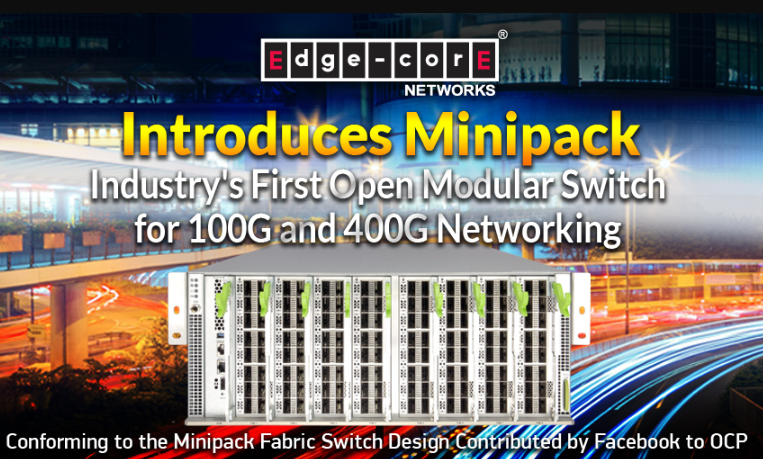
OCP 2019: Edgecore debuts "Minipack" Switch for 100G and 400G

At OCP Summit 2019, Edgecore Networks introduced an open modular switch for 100G and 400G networking that conforms to the Minipack Fabric Switch design contributed by Facebook to the Open Compute Project (OCP).

Minipack is a disaggregated whitebox system providing a flexible mix of 100GbE and 400GbE ports up to a system capacity of 12.8Tbps.

The Minipack switch can support a mix of 100G and 400G Ethernet interfaces up to a maximum of 128x100G or 32x400G ports. Minipack is based on Broadcom StrataXGS Tomahawk 3 Switch Series silicon capable of line rate 12.8Tbps Layer2 and Layer3 switching.

The Minipack front panel has eight slots for port interface modules (PIM). The first PIM options available for the Edgecore Minipack switch are the PIM-16Q with 16x100G QSFP28 ports, and the PIM-4DD with 4x400G QSFP-DD ports. The Minipack modular switch is a 4U form factor, power optimized for data center deployments, and includes hot-swappable redundant power supplies and fans for high availability.

Edgecore said its Minipack AS8000 Switch enables network operators to select disaggregated NOS and SDN software options from commercial partners and open source communities to address different use cases and operational requirements. Edgecore has ported and validated Software for Open Networking in the Cloud (SONiC), the OCP open source software platform, on the Minipack AS8000 Switch as an open source option for high capacity data center fabrics. In addition, Cumulus Networks announced the availability of its Cumulus Linux operating system for the Edgecore Minipack switch.

“Network operators are demanding open network solutions to increase their network capacities with 400G and higher density 100G switches based on open technology. The Edgecore Minipack switch broadens our full set of OCP Accepted open network switches, and enables data center operators to deploy higher capacity fabrics with flexible combinations of 100G and 400G interfaces and pay-as-you-grow expansion,” said George Tchaparian, CEO, Edgecore Networks. “The open and modular design of Minipack will enable Edgecore and partners to address more data center and service provider use cases in the future by developing innovative enhancements such as additional interface modules supporting encryption, multiple 400G port types, coherent optical ports and integrated optics, plus additional Minipack Switch family members utilizing deep-buffer or highly programmable or next-generation switching silicon in the same flexible modular form factor.”

“Facebook designed Minipack as a fabric switch with innovative performance, power optimization and modularity to enable our deployment of the next generation data center fabrics,” said Hans-Juergen Schmidtke, Director of Engineering, Facebook. “We have contributed the Minipack design to OCP in order to stimulate additional design innovation and to facilitate availability of the platform to network operators. We welcome Edgecore’s introduction of Minipack as a commercial whitebox product.”

The Minipack AS8000 Switch with PIM-16Q 100G QSFP28 interface modules will be available from Edgecore resellers and integrators worldwide in Q2. PIM-4DD 400G QSFP-DD interface modules will be available in Q3. SONiC open source software, including platform drivers for the Edgecore Minipack AS8000 Switch, are available from the SONiC GitHub.

OCP 2019: Netronome unveils 50GbE SmartNICs

Netronome unveiled its Agilio CX 50GbE SmartNICs in OCP Mezzanine 2.0 form factor with line-rate advanced cryptography and 2GB onboard DDR memory.

The Agilio CX SmartNIC platform fully and transparently offloads virtual switch, virtual router, eBPF and P4-based datapath processing for networking functions such as overlays, security, load balancing and telemetry, enabling cloud and SDN-enabled compute and storage servers to free up critical server CPU cores for application processing while delivering significantly higher performance.

Netronome said its new SmartNIC reduces tail latency significantly enabling high-performance Web 2.0 applications to be deployed in cost and energy-efficient servers. With advanced Transport Layer Security (TLS/SSL)-based cryptography support at line-rate and up to two million stateful sessions per SmartNIC, web and data storage servers in hyperscale environments can now be secured tighter than ever before, preventing hacking of networks and precious user data.

Deployable in OCP Yosemite servers, the Agilio CX 50GbE SmartNICs implement a standards-based and open advanced buffer management scheme enabled by the unique many-core multithreaded processing memory-based architecture of the Netronome Network Flow Processor (NFP) silicon. This improves application performance and enables hyperscale operators to maintain high levels of service level agreements (SLAs). Dynamic eBPF-based programming and hardware acceleration enables intelligent scaling of networking workloads across multiple host CPU cores, improving server efficiency. The solution also enhances security and data center efficiencies by offloading TLS, a widely deployed protocol used for encryption and authentication of applications that require data to be securely exchanged over a network.

“Securing user data in Web 2.0 applications and preventing malicious attacks such as BGP hijacking as experienced recently in hyperscale operator infrastructures are critical needs that have exacerbated significantly in recent years,” said Sujal Das, chief marketing and strategy officer at Netronome. “Netronome developed the Agilio CX 50GbE SmartNIC solution to address these vital industry requirements by meticulously optimizing the hardware with open source and hyperscale operator applications and infrastructures.”

Agilio CX 50GbE SmartNICs in OCP Mezzanine 2.0 form factor are sampling today and include the generally available NFP-5000 silicon. The production version of the board and software is expected in the second half of this year.

OCP 2019: Inspur and Intel contribute 4-socket Crane Mountain design

Inspur and Intel will contribute a jointly-developed, cloud-optimized platform code named "Crane Mountain" to the OCP community.

The four-socket platform is a high-density, flexible and powerful 2U server, validated for Intel Xeon (Cascade Lake) processors and optimized with Intel Optane DC persistent memory.

Inspur said its NF8260M5 system is being used by Intel as a lead platform for introducing the “high-density cloud-optimized” four-socket server solution to the cloud service provider (CSP) market.

At OCP Summit 2019, Inspur also showcased three new artificial intelligence (AI) computing solutions, and announced the world’s first NVSwitch-enabled 16-GPU fully connected GPU expansion box, the GX5, which is also part of an advanced new architecture that combines the 16-GPU box with an Inspur 4-socket Olympus server. This solution features 80 CPU cores, making it suitable for deep-learning applications that require maximum throughput across multiple workloads. The Inspur NF8360M5 4-socket Olympus server is going through the OCP Contribution and OCP Accepted recognition process.

Inspur also launched the 8-GPU box ON5388M5 with NVLink 2.0, as a new OCP contribution-in-process for 8-GPU box solutions. The Inspur solution offers two new topologies for different AI applications, such as autonomous driving and voice recognition.


Alan Chang discusses Inspur's contributions to the Open Compute Project, including a High-density Cloud-optimized platform code-named “Crane Mountain”.

This four-socket platform is a high-density, flexible and powerful 2U server, validated for Cascade Lake processors and optimized with Intel Optane DC persistent memory.  It is designed and optimized for cloud Infrastructure-aaS, Function-aaS, and Bare-Metal-aaS solutions.

https://youtu.be/JZj-arumtD0


OCP 2019: Toshiba tests NVM Express over Fabrics

At OCP Summit 2019, Toshiba Memory America demonstrated proof-of-concept native Ethernet NVMe-oF (NVM Express over Fabrics) SSDs.

Toshiba Memory also showed its KumoScale software, which is a key NVMe-oF enabler for disaggregated storage cloud deployments. First introduced last year, Toshiba Memory has recently enhanced KumoScale’s capabilities with support for TCP-based networks.

OCP 2019: Wiwynn intros Open19 server based on Project Olympus

At OCP 2019, Wiwynn introduced an Open19 server based on Microsoft’s Project Olympus server specification.

The SV6100G3 is a 1U double wide brick server that complies with the LinkedIn led Open19 Project standard, which defines a cross-industry common form factor applicable to EIA 19” racks. With the Open19 defined brick servers, cages and snap-on cables, operators can blind mate both data and power connections to speed up rack deployment and enhance serviceability.

Based on the open source cloud hardware specification of Microsoft’s Project Olympus, the SV6100G3 features two Intel Xeon Processor Scalable family processors, up to 1.5TB memory and one OCP Mezzanine NIC. The

“Wiwynn has extensive experience in open IT gears design to bring TCO improvement for hyperscale data centers,” said Steven Lu, Vice President of Product Management at Wiwynn. “We are excited to introduce the Open19 based SV6100G3 which assists data center operators of all sizes to benefit from the next generation high-efficiency open standards with lower entry barrier.”

Thursday, March 14, 2019

OCP 2019: New Open Domain-Specific Architecture sub-project

The Open Compute Project is launching an Open Domain-Specific Architecture (ODSA) sub-project to define an open interface and architecture that enables the mixing and matching of available silicon die from different suppliers onto a single SoC for data center applications. The goal is to define a process to integrate best-of-breed chiplets onto a SoC.

Netronome played a lead role initiating the new project.

“The open architecture for domain-specific accelerators being proposed by the ODSA Workgroup brings the benefits of disaggregation to the world of SoCs. The OCP Community led by hyperscale operators has been at the forefront driving disaggregation of server and networking systems. Joining forces with OCP, the ODSA Workgroup brings the next chapter of disaggregation for domain-specific accelerator SoCs as it looks toward enabling proof of concepts and deployable products leveraging OCP’s strong ecosystem of hardware and software developers,” said Sujal Das, chief marketing and strategy officer at Netronome.

"Coincident with the decline of Moore's law, the silicon industry is facing longer development times and significantly increased complexity. We are pleased to see the ODSA Workgroup become a part of the Open Compute Project. We hope workgroup members will help to drive development practices and adoption of best-of-breed chiplets and SoCs. Their collaboration has the potential to further democratize chip development, and ultimately reduce design overhead of domain-specific silicon in emerging use cases,” said Aaron Sullivan, Director Hardware Engineering at Facebook."

https://2019ocpglobalsummit.sched.com/event/JxrZ/open-domain-specific-architecture-odsa-sub-project-launch

Wiki page: https://www.opencompute.org/wiki/Server/ODSA

Mailing list: https://ocp-all.groups.io/g/OCP-ODSA

Netronome proposes open "chiplets" for domain specific workloads

Netronome unveiled its open architecture for domain-specific accelerators .

Netronome is collaborating with six leading silicon companies, Achronix, GLOBALFOUNDRIES, Kandou, NXP, Sarcina and SiFive, to develop this open architecture and related specifications for developing chiplets that promise to reduce silicon development and manufacturing costs.

The idea is fo chiplet-based silicon to be composed using best-of-breed components such as processors, accelerators, and memory and I/O peripherals using optimal process nodes. The open architecture will provide a complete stack of components (known good die, packaging, interconnect network, software integration stack) that lowers the hardware and software costs of developing and deploying domain-specific accelerator solutions. Implementing open specifications contributed by participating companies, any vendor’s silicon die can become a building block that can be utilized in a chiplet-based SoC design.

“Netronome’s domain-specific architecture as used in its Network Flow Processor (NFP) products has been designed from the ground up keeping modularity, and economies of silicon development and manufacturing costs as top of mind,” said Niel Viljoen, founder and CEO at Netronome. “We are extremely excited to collaborate with industry leaders and contribute significant intellectual property and related open specifications derived from the proven NFP products and apply that effectively to the open and composable chiplet-based architecture being developed in the ODSA Workgroup.”

Wednesday, March 21, 2018

Seagate shows 14TB helium-based Exos HDD

Seagate Technology introduced its 14TB helium-based Exos X14 enterprise drive at the OCP U.S. Summit 2018 in San Jose, California.

The Seagate Exos X14, which is aimed at hyperscale data centers, boasts enhanced areal density for higher capacity storage in a smaller package. It offers built-in encryption with the United States government’s Federal Information Processing Standard (FIPS) 140-2, Level 2 certification and the Common Criteria for Information Technology Security Evaluation (CC) - an international computer security certification standard (ISO/EIC 15408). Other key features include 40 percent more petabytes per rack versus Exos 10TB drives, a 10 percent weight reduction versus air nearline drives, and a flexible design that delivers wider integration options and support for a greater number of workloads.

The drive is currently sampling to select customers and will be followed by production availability this summer.

Tuesday, March 20, 2018

Toshiba intros NVM Express over Fabrics

Toshiba introduced its new NVMe-oF (NVM Express over Fabrics) shared accelerated storage software.

Toshiba, which is a leading provider of NVMe SSDs, said its KumoScale software enables the use of NVMe-oF to make flash storage accessible over a data center network, providing a simple and flexible abstraction of physical disks into a pool of block storage, all while preserving the high performance of direct-attached NVMe SSDs.

“The cloud was built on Direct Attached Storage (DAS) SSDs due to their low cost and ease of deployment,” noted Steve Fingerhut, senior vice president and general manager, SSD and Cloud Software business units for TMA. “However, customers are finding the fixed nature of DAS inhibits the flexibility promised by the adoption of containers and orchestration frameworks. With the availability of KumoScale software, these cloud data centers can scale and provision server and flash storage independently to accommodate unexpected and peak workloads. This increases data center efficiency and gives the agility needed to respond to new revenue opportunities.”

Friday, March 24, 2017

Microsoft's Project Olympus provides an opening for ARM

A key observation from this year's Open Compute Summit is that the hyper-scale cloud vendors are indeed calling the shots in terms of hardware design for their data centres. This extends all the way from the chassis configurations to storage, networking, protocol stacks and now customised silicon.

To recap, Facebook's newly refreshed server line-up now has 7 models, each optimised for different workloads: Type 1 (Web); Type 2 - Flash (database); Type 3 – HDD (database); Type 4 (Hadoop); Type 5 (photos); Type 6 (multi-service); and Type 7 (cold storage). Racks of these servers are populated with a ToR switch followed by sleds with either the compute or storage resources.

In comparison, Microsoft, which was also a keynote presenter at this year's OCP Summit, is taking a slightly different approach with its Project Olympus universal server. Here the idea is also to reduce the cost and complexity of its Azure rollout in hyper-scale date centres around the world, but to do so using a universal server platform design. Project Olympus uses either a 1 RU or 2 RU chassis and various modules for adapting the server for various workloads or electrical inputs. Significantly, it is the first OCP server to support both Intel and ARM-based CPUs. 

Not surprisingly, Intel is looking to continue its role as the mainstay CPU supplier for data centre servers. Project Olympus will use the next generation Intel Xeon processors, code-named Skylake, and with its new FPGA capability in-house, Intel is sure to supply more silicon accelerators for Azure data centres. Jason Waxman, GM of Intel's Data Center Group, showed off a prototype Project Olympus server integrating Arria 10 FPGAs. Meanwhile, in a keynote presentation, Microsoft Distinguished Engineer Leendert van Doorn confirmed that ARM processors are now part of Project Olympus.

Microsoft showed Olympus versions running Windows server on Cavium's ThunderX2 and Qualcomm's 10 nm Centriq 2400, which offers 48 cores. AMD is another CPU partner for Olympus with its ARM-based processor, code-named Naples.  In addition, there are other ARM licensees waiting in the wings with designs aimed at data centres, including MACOM (AppliedMicro's X-Gene 3 processor) and Nephos, a spin-out from MediaTek. For Cavium and Qualcomm, the case for ARM-powered servers comes down to optimised performance for certain workloads, and in OCP Summit presentations, both companies cited web indexing and search as one of the first applications that Microsoft is using to test their processors.

Project Olympus is also putting forward an OCP design aimed at accelerating AI in its next-gen cloud infrastructure. Microsoft, together with NVIDIA and Ingrasys, is proposing a hyper-scale GPU accelerator chassis for AI. The design, code named HGX-1, will package eight of NVIDIA's latest Pascal GPUs connected via NVIDIA’s NVLink technology. The NVLink technology can scale to provide extremely high connectivity between as many as 32 GPUs - conceivably 4 HGX-1 boxes linked as one. A standardised AI chassis would enable Microsoft to rapidly rollout the same technology to all of its Azure data centres worldwide.

In tests published a few months ago, NVIDIA said its earlier DGX-1 server, which uses Pascal-powered Tesla P100 GPUs and an NVLink implementation, were delivering 170x of the performance of standard Xeon E5 CPUs when running Microsoft’s Cognitive Toolkit.

Meanwhile, Intel has introduced the second generation of its Rack Scale Design for OCP. This brings improvements in the management software for integrating OCP systems in a hyper-scale data centre and also adds open APIs to the Snap open source telemetry framework so that other partners can contribute to the management of each rack as an integrated system. This concept of easier data centre management was illustrated in an OCP keynote by Yahoo Japan, which amazingly delivers 62 billion page views per day to its users and remains the most popular website in that nation. The Yahoo Japan presentation focused on an OCP-compliant data centre it operates in the state of Washington, its only overseas data centre. The remote data centre facility is manned by only a skeleton crew that through streamlined OCP designs is able to perform most hardware maintenance tasks, such as replacing a disk drive, memory module or CPU, in less than two minutes.

One further note on Intel’s OCP efforts relates to its 100 Gbit/s CWDM4 silicon photonics modules, which it states are ramping up in shipment volume. These are lower cost 100 Gbit/s optical interfaces that run over up to 2 km for cross data centre connectivity.

On the OCP-compliant storage front not everything is flash, with spinning HDDs still in play. Seagate has recently announced a 12 Tbytes 3.5 HDD engineered to accommodate 550 Tbyte workloads annually. The company claims MTBF (mean time between failure) of 2.5 million hours and the drive is designed to operate 24/7 for five years. These 12 Tbyte enable a single 42 U rack to deploy over 10 Pbytes of storage, quite an amazing density considering how much bandwidth would be required to move this volume of data.


Google did not make a keynote appearance at this year’s OCP Summit, but had its own event underway in nearby San Francisco. The Google Cloud Next event gave the company an even bigger stage to present its vision for cloud services and the infrastructure needed to support it.

Wednesday, March 22, 2017

Facebook shows its progress with Open Compute Project

The latest instalment of the annual Open Compute Project (OCP) Summit, which was held March 8-9 in Silicon Valley, brought new open source designs for next-generation data centres. It is six years since Facebook launched OCP and it has grown into quite an institution. Membership in the group has doubled over the past year to 195 companies and it is clear that OCP is having an impact in adjacent sectors such as enterprise storage and telecom infrastructure gear.

The OCP was never intended to be a traditional standards organisation, serving more as a public forum in which Facebook, Microsoft and potentially other big buyers of data centre equipment can share their engineering designs with the industry. The hyper-scale cloud market, which also includes Amazon Web Services, Google, Alibaba and potentially others such as IBM and Tencent, are where the growth is at. IDC, in its Worldwide Quarterly Cloud IT Infrastructure Tracker, estimates total spending on IT infrastructure products (server, enterprise storage and Ethernet switches) for deployment in cloud environments will increase by 18% in 2017 to reach $44.2 billion. Of this, IDC estimates that 61% of spending will be by public cloud data centres, while off-premises private cloud environments constitute 15% of spending.

It is clear from previous disclosures that all Facebook data centres have adopted the OCP architecture, including its primary facilities in Prineville (Oregon), Forest City (North Carolina), Altoona (Iowa) and Luleå (Sweden). Meanwhile, the newest Facebook data centres, under construction in Fort Worth (Texas) and Clonee, Ireland are pushing OCP boundaries even further in terms of energy efficiency.

Facebook's ambitions famously extend to connecting all people on the planet and it has already passed the billion monthly user milestone for both its mobile and web platforms. The latest metrics indicate that Facebook is delivering 100 million hours of video content every day to its users; 95+ million photos and videos are shared on Instagram on a daily basis; and 400 million people now use Messenger for voice and video chat on a routine basis.

At this year's OCP Summit, Facebook is rolling out refreshed designs for all of its 'vanity-free' servers, each optimised for a particular workload type, and Facebook engineers can choose to run their applications on any of the supported server types. Highlights of the new designs include:

·         Bryce Canyon, a very high-density storage server for photos and videos that features a 20% higher hard disk drive density and a 4x increase in compute capability over its predecessor, Honey Badger.

·         Yosemite v2, a compute server that features 'hot' service, meaning servers do not need to be powered down when the sled is pulled out of the chassis in order for components to be serviced.

·         Tioga Pass, a compute server with dual-socket motherboards and more IO bandwidth (i.e. more bandwidth to flash, network cards and GPUs) than its predecessor, Leopard, enabling larger memory configurations and faster compute time.

·         Big Basin, a server designed for artificial intelligence (AI) and machine learning, optimised for image processing and training neural networks. Compared to its predecessor, Big Basin can train machine learning models that are 30% larger due to greater arithmetical throughput and by implementing more memory (12 to 16 Gbytes).

Facebook currently has web server capacity to deliver 7.5 quadrillion instructions per second and its 10-year roadmap for data centre infrastructure, also highlighted at the OCP Summit, predicts that AI and machine learning will be applied to a wide range of applications hosted on the Facebook platform. Photos and videos uploaded to any of the Facebook services will routinely go through machine-based image recognition and to handle this load Facebook is pursuing additional OCP designs that bring fast storage capabilities closer to its compute resources. It will leverage silicon photonics to provide fast connectivity between resources inside its hyper-scale data centres and new open source models designed to speed innovation in both hardware and software.

Thursday, March 9, 2017

Edgecore Showcases 25/100 GBE switches, virtual OLT based on AT&T XGS-PON specification

Edgecore Networks, a provider of open networking solutions and a subsidiary of Accton Technology, has announced design contributions to the Open Compute Project (OCP) of a 25 Gigabit Ethernet top-of-rack switch and high-density 100 Gigabit Ethernet spine switch designed to lower the cost of high capacity data centre networks, as well as 802.1ac WiFi access point designs.

At the OCP Summit Edgecore is showcasing new open hardware platforms that extend open networking into telecom applications, including a modular packet optical switch integrating Ethernet networking at up to 100 Gigabit Ethernet and featuring analogue coherent optics (ACO) and digital coherent optics (DCO) technology from multiple partners.

The company is also displaying a disaggregated virtual OLT for PON deployment at up to 10 Gbit/ that is based on the AT&T Open XGS-PON 1RU OLT specification contributed to the OCP Telco working group.

Edgecore is contributing the specification and design package for the AS7800-64X, the first open network switch design to be based on the Broadcom StrataXGS Tomahawk II switch series, which provides 64 x QSFP28 ports in a 2U form factor and is designed to deliver a cost effective 100 Gigabit Ethernet networking alternative.

In addition, to meet demand for optimised 25 Gigabit Ethernet top-of-rack switching, Edgecore is contributing the specification and design for the AS7300-54X open network switch, based on Broadcom's StrataXGS Tomahawk switch series, providing 48 x SFP28 ports, each supporting 10 or 25 Gigabit Ethernet and 6 x QSFP28 100 Gigabit Ethernet uplink ports.

The AS7300-54X and AS7800-64X designs feature options for CPU modules incorporating Intel Atom, Xeon Processor D or NXP QorIQ T2080 processors. The switches also initially offer support for OCP-ACCEPTED networking software, including Open Network Install Environment (ONIE), Open Network Linux, Open Optical Monitoring (OOM) API and SnapRoute's FlexSwitch NOS.

At the OCP Summit, Edgecore is showcasing new open networking demonstrations and products including:

1. Its ASFvOLT16 disaggregated virtual OLT, an OCP-INSPIRED product conformant with AT&T Open XGS-PON 1RU OLT specification based on Broadcom StrataDNX switch and PON MAC SOC silicon and offering 16 ports of XGS-PON or NG-PON2 with 4 x QSFP28 ports for next generation PON deployments and R-CORD telecom infrastructure.

2. The AS7812-24S open packet optical switch, a 1.5U modular platform based on Broadcom StrataXGS Tomahawk switch silicon that provides 3.2 Tbit/s bandwidth over a mix of 10 to 100 Gigabit Ethernet ports and 100/200 Gbit/s CFP2 coherent optical ports, integrating optics and coherent DSP technology from partners Acacia Communications, Finisar and NTT Electronics.

3. The OCP-ACCEPTED AS7512-32X 100 Gigabit Ethernet open network switch based on Cavium XPliant switch silicon with Software for Open Networking in the Cloud (SONiC), the open source networking software contributed to OCP by Microsoft and co-contributors.

4. An Open Optical Monitoring (OOM) API demonstration based on Edgecore open switch hardware, Cumulus Linux NOS, and 25 and 100 Gbit/s optical transceivers from Finisar that shows the OCP-ACCEPTED OOM integrating asset management and health monitoring of optical transceivers and switches.

5 Its Wedge100BF-65X open network switch, offering 65 x 100 Gigabit Ethernet ports and based on Barefoot Networks programmable Tofino switch silicon, which is being contributed to OCP.

Wednesday, March 8, 2017

Facebook Refreshes its OCP Server Designs

At this year's Open Compute Summit in Santa Clara, California, Facebook unveiled a number of new server designs to power the wide variety of workloads it now handles.

Some updated Facebook metrics:

  • People watch 100 million hours of video every day on Facebook; 
  • 95M+ photos and videos are posted to Instagram every day; 
  • 400M people now use voice and video chat every month on Messenger. 

Highlights of the new servers:

  • Bryce Canyon is a storage server primarily used for high-density storage, including photos and videos. The server is designed with more powerful processors and increased memory, and provides increased efficiency and performance. Bryce Canyon has 20% higher hard disk drive density and a 4x increase in compute capability over its predecessor, Honey Badger.
  • Yosemite v2 is a compute server that provides the flexibility and power efficiency needed for scale-out data centers. The power design supports hot service, meaning servers don't need to be powered down when the sled is pulled out of the chassis in order for components to be serviced; these servers can continue to operate.
  • Tioga Pass is a compute server with dual-socket motherboards and more IO bandwidth (i.e. more bandwidth to flash, network cards, and GPUs) than its predecessor Leopard. This design enables larger memory configurations and speeds up compute time.
  • Big Basin is a server used to train neural networks, a technology that can do a number of research tasks including learning to identify images by examining enormous numbers of them. With Big Basin, Facebook can train machine learning models that are 30% larger (compared its predecessor Big Sur). They can do so due to greater arithmetic throughput now available and by implementing more memory (12GB to 16GB). In tests with image classification model Resnet-50, they reached almost 100% improvement in throughput compared to Big Sur.

http://www.opencompute.org/wiki/Files_and_Specs
https://www.facebook.com/Engineering/