Thursday, June 17, 2021

Keysight, Amphenol and Cisco validate 800G in QSFP-DD

Keysight Technologies, Amphenol and Cisco recently demonstrated a physical design validation solution featuring high speed Ethernet partners in the quad small form factor pluggable double density (QSFP-DD800) ecosystem.

The QSFP-DD Multisource Agreement (MSA) group recently announced a hardware revision 6.0 to introduce the QSFP-DD800 specification and Common Management interface Specification (CMIS) 5.0 in May 2021.

The multi-company demonstration is first to showcase this form factor running full line rate, Ethernet speeds based on the IEEE 802.3ck 100G Pulse Amplitude Modulation 4-level (PAM4) electrical lanes. Along with Keysight, the demonstration includes partners in the DD800 ecosystem including host board connectors from Amphenol and link partner from system company Cisco. These leading companies are active contributing members of the QSFP-DD MSA.

“The QSFP-DD form factor continues to evolve to support next generation data centers supporting signal integrity, thermal performance, and port density,” said Scott Sommers, co-chairman of the QSFP-DD MSA and Molex director of Industry Standards. “Keysight’s new G800 builds on the industry momentum supporting QSFP-DD infrastructure.”

“We are pleased to see the QSFP-DD800 ecosystem expanding with test solutions such as the G800 from Keysight,” said Mark Nowell, Cisco Fellow. “This capability is critical to Cisco when developing products with 800G QSFP-DD800 ports.”

Keysight said its new G800 advanced bit error ratio test (BERT) and forward error correction (FEC) error density and performance analysis system is the first test solution designed specifically for testing all Ethernet speeds based on 112G electrical lanes, including Ethernet Technology Consortium 800GE and IEEE 802.3 400GE, 200GE and 100GE. The G800 integrates with the Keysight M8040A bit error ratio tester (BERT) and the Keysight UXR-Series oscilloscope to provide insights into FEC constraints for physical design validation and compliance.

https://www.keysight.com/us/en/events/america/tradeshows/ofc/g800.html

Keysight’s latest test solution enables NEMs and hyperscale data center providers to evaluate interoperability and FEC performance with error analysis such as patented BERT inferred FEC. It features an easy-to-see system overview of FEC performance across all Ethernet speeds in real-time, in 112Gb/s electrical lanes.


“Higher-speed Ethernet is a complex multiple channel environment. NEMs need visibility into all Ethernet lanes to detect and correlate meaningful errors to achieve the best performance,” said Jerry Pepper, Keysight Fellow. “Keysight is first to deliver these test capabilities, integrated with our BERT and UXR real-time oscilloscope. Together, they enable NEMs to gain unprecedented insights into their higher data rate implementation challenges for the hyperscale data centers of the future.”


https://www.keysight.com/us/en/events/america/tradeshows/ofc/g800.html
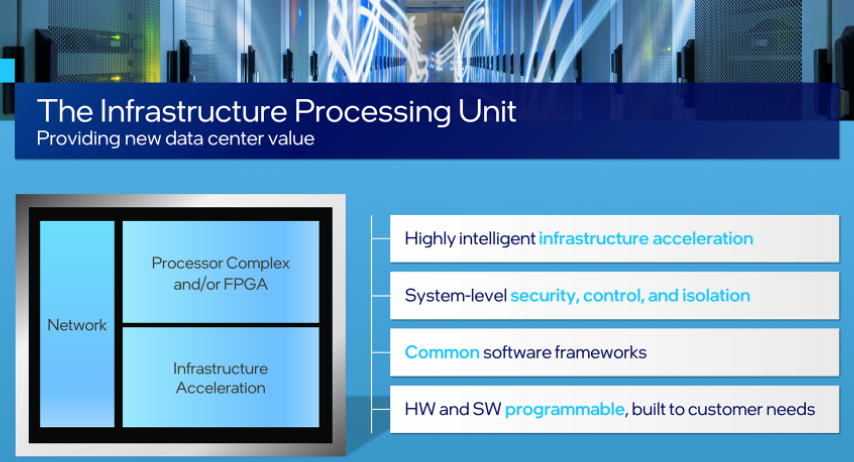
Intel rolls FPGA-based Infrastructure Processing Unit (IPU)

Intel outlined its vision for the infrastructure processing unit (IPU), a programmable network device that intelligently manages system-level infrastructure resources by securely accelerating those functions in a data center.

In a video, Guido Appenzeller, chief technology officer with Intel's Data Platforms Group says the idea is to cleanly separate the processing of client workloads from workloads of the cloud service provider.

Intel cites several advantages for an IPU architecture. First, cloud service providers will be able to process their workloads very efficiently on silicon designed for the tasks. The cloud service provider will be able to rent out 100% of available CPU resources to the clients. The clients are now able to fully control the CPUs including with their own hypervisors. In addition, local disk storage can be enhanced or replaced with virtual storage connected to the network. 

The first instances of Intel's FPGA-based IPU platforms are already shipping. Intel will be rolling out additional FPGA-based IPUs and integrated ASICs as well. "As a result of Intel’s collaboration with a majority of hyperscalers, Intel is already the volume leader in the IPU market with our Xeon-D, FPGA and Ethernet components,” said Patty Kummrow, vice president in the Data Platforms Group and general manager of Ethernet Products Group at Intel. “The first of Intel’s FPGA-based IPU platforms are deployed at multiple cloud service providers and our first ASIC IPU is under test.”

https://youtu.be/ahChxDyl8t4

https://www.intel.com/content/www/us/en/newsroom/news/infrastructure-processing-unit-data-center.html


FCC seeks to extend ban on equipment from Huawei, ZTE, Hikvision

 The Federal Communications Commission proposed rules that would prohibit all future authorizations for communications equipment deemed to pose an unacceptable risk to national security.  Specifically, the FCC is would prohibit the authorization of equipment through either the FCC’s Certification or Supplier’s Declaration of Conformity equipment authorization processes.  The proposal also seeks comment on whether to revise rules concerning equipment currently exempted from the equipment authorization requirements to no longer permit this exemption for equipment on the Covered List.


The rule would include communications equipment and services from Huawei, ZTE, Hytera, Hikvision, and Dahua.  

In addition, the FCC seeks comment on possible changes to the competitive bidding rules for auctions to protect national security.

"By reducing our dependence on network components developed by untrusted vendors, we send a strong signal that the United States is committed to developing a market for secure 5G equipment alternatives.  To this end, our ongoing work to foster the development of open radio access networks is important.  Because if we do this right we will have a renewed opportunity for American technology leadership, more competition, better economic security, more resiliency in our supply chains, and improved ability to protect the privacy and data of citizens," stated FCC Acting Chairwoman Jessical Rosenworcel.

https://www.fcc.gov/document/fcc-proposes-ban-devices-deemed-threat-national-security


EXFO will not pursue Viavi's acquisition bid

The Board of Directors of EXFO issued a statement confirming that, after careful consideration, it has decided not to pursue the unsolicited non-binding proposal made by Viavi Solutions Inc. as it is not capable of being completed.

Mr. Germain Lamonde, who founded the company and who controls, directly or indirectly, 61.46% of the issued and outstanding shares of EXFO and 93.53% of the voting rights attached to all the issued and outstanding shares of EXFO, indicated to EXFO's Board of Directors that he would not consider any alternative change of control transaction.

In a press release, Germain Lamonde states: "This is the third time that Viavi has made an offer to acquire EXFO, after its first and second attempts in November 2020 at a price of US$4.75 and in May 2021 at a price of US$5.25, respectively. On both occasions, I have indicated clearly to the board of directors of EXFO that, as the controlling shareholder of EXFO, I would not consider any transaction with Viavi and the board consequently concluded that there was no merit in pursuing any discussions with Viavi and did reiterate today to the board that, for the third time, Viavi's non-binding proposal would not obtain my support as the controlling shareholder."

DISH selects Dell for RAN and edge compute infrastructure

DISH Network has selected Dell Technologies to provide RAN and edge compute infrastructure for its cloud-native, open 5G network

Highlights:


  • Dell and DISH are creating private 5G wireless network solutions, SD-WAN, and multi-access edge cloud platforms. 
  • The companies will co-develop technology for Open RAN, SmartNICs, emerging micro-edge colocation, operational automation and other areas of R&D. Joint teams will pursue and create multi-access edge computing (MEC) solutions for enterprise and small business opportunities.
  • Dell and DISH will enable advanced machine learning capabilities to monitor the health of the system and to help proactively predict the anomalies that may impact performance or services. 
  • Dell and DISH will design the network infrastructure from cell sites to data centers to deliver better performance, power efficiency and automated operations.
  • DISH will deploy Dell EMC PowerEdge servers at cell tower sites and in centralized RAN locations to tackle the growing demands of edge-based, data-intensive workloads.
  • DISH will use Dell EMC PowerEdge XR11 ruggedized servers to support its private cloud and far edge applications. DISH will also use Dell EMC PowerEdge R740 and R750 servers to support virtualization and demanding cloud-native workloads. Dell platforms also futureproof DISH for next generation RAN compute requirements, allowing DISH to support additional accelerators cards.
  • With Dell Technologies APEX Flex On Demand, DISH can scale its server usage up and down while only paying for what they use.

"By collaborating with Dell Technologies, we will have the hardware and software infrastructure needed to harness the power and potential of 5G. Dell's open ecosystem approach will help us scale our RAN network with agility, speed and consistency, bringing about new business opportunities for both enterprise customers and consumers, completing our cloud strategy," said Marc Rouanne, DISH chief network officer. "We chose to leverage Dell's technology because they have a demonstrated track record of transforming networks and a willingness to work with us on designing and implementing Infrastructure as Code (IaC). With their help, we're another step closer to deploying the United States' first cloud-native, Open RAN 5G network."


Lightpath enters Boston market with acquisition of fiber routes

Lightpath, which operates over 18,000 route miles of fiber in the New York metropolitan region, announced its entrance into the Boston market via the acquisition of three fiber networks.

Cambridge Network Solutions (CNS), a second area connectivity provider, and the purchase of fiber network assets from Hub Fiber. The CNS and the second acquisitions have closed, while the Hub Fiber purchase is expected to close within 30 days. Financial terms were not disclosed.

Together, the three propertiews represent 80 route miles of in-place, high-count fiber network reaching over 100 locations, including 12 area data centers, throughout Boston, Cambridge, Somerville, Waltham, Burlington, Billerica, Bedford, and Lowell. Additionally, Lightpath's network in the region will be connected to its New York Metro network, expanding on the company's existing 18,000 route miles of fiber serving over 12,000 locations.

"Greater Boston is a perfect expansion area for Lightpath, with its robust technology and biotech industries, financial services sector, world leading universities and research institutes, tech-savvy governments, and other enterprise businesses," stated Chris Morley, Lightpath's CEO. "This is the first step for Lightpath expanding beyond the NY Metro region after reliably serving thousands of customers there for over 30 years. We are excited to bring our network, connectivity solutions, and innovative customer service approach to more organizations. These acquisitions will help us hit the ground running, and we will be able to start serving new customers right away."

Altice USA owns a 50.01% controlling interest in Lightpath and Morgan Stanley Infrastructure Partners (MSIP) owns 49.99% of the company.

https://lightpathfiber.com/

IBM completes Turbonomic acquisition

IBM completed its previously announced acquisition of Turbonomic, an Application Resource Management (ARM) and Network Performance Management (NPM) software provider based in Boston.

IBM said the deal complements its recent acquisition of Instana for application performance monitoring (APM) and observability, and the launch of IBM Cloud Pak for Watson AIOps to automate IT Operations using AI. IBM provides customers with AI-powered automation capabilities that span from AIOps (the use of AI to automate IT Operations) to application-centric performance and IT resources observability – all built on Red Hat OpenShift to run across any hybrid cloud environment.

"We believe that the move to AI-powered automation is essential to helping businesses succeed in a digital-first world," said Dinesh Nirmal, General Manager, IBM Automation. "IBM is already helping thousands of customers use automation to make IT and business processes more efficient and employees more effective. Now that Turbonomic is a part of our portfolio, IBM is the only company providing a one-stop shop of AI-powered automation capabilities, all built on Red Hat OpenShift to run anywhere."

"Today, applications run the business," said Ben Nye, CEO, Turbonomic. "Turbonomic's Application Resource Management assures application performance and governance so customers can focus on innovation. IBM's acquisition of Turbonomic now helps us reach and serve more customers globally – enabling successful application hosting operations across any cloud environment."


Wednesday, June 16, 2021

EdgeQ pursues a feature subscription model for 5G basestation chip

EdgeQ, a start-up offering a 5G systems-on-a-chip, introduced a 5G chipset-as-a-service model in which customers can scale 5G and AI features as a function of subscription payments.  The service-oriented model would enable customers to scale from nominal to advanced 5G features such as ultra-reliable low latency communications, geo-location services, massive MIMO, fine-grained network slicing, as well as extending compatibility to other legacy wireless protocols. 

The company says its new service model is the very first in the chip industry to scale price, performance, and features as a function of need and use.  The potential is to elevate 5G Open Radio Access network (O-RAN) to an even more configurable, elastic, open wireless infrastructure. Enterprise network, telco, and cloud providers might also use the EdgeQ model to virtualize network resources.

“Our vision at EdgeQ has always been about implementing 5G in a format that is accessible, consumable, and intuitive for our customers. EdgeQ is not only the first company to converge both 5G and AI on a single chip for wireless infrastructure, but we are also able to make those capabilities available in a SaaS model.  This fundamentally reduces the initial capex investment required for 5G, thereby removing both technical and economic barriers of 5G adaptation at greenfield enterprises,” said Vinay Ravuri, CEO and Founder, EdgeQ. “This pay-as-you-go model ensures that the evolving demands of the market can leverage the full fluidity and elasticity of EdgeQ’s 5G-as-a-Service product.”


https://edgeq.io/


Huawei cites 1.6 Tbps single wavelength field trial over 180km

Huawei has successfully tested a 1.6 Tbps, per single-wavelength optical transmission in a high-capacity data center interconnect (DCI) scenario. 

The field trial, which was conducted with an unnamed European tier 1 operator, was performed on 96.5km of field-deployed standard G.652 fiber using EDFA-only amplification. A total of 34 channels were transmitted with 150GHz spacing for a total fiber capacity of more than 56 Tbps and spectral efficiency of higher than 11 bit/s/Hz.

Additional demonstrations featured single-wavelength transmission of 1.77 Tbps over 60km, 1.65 Tbps over 120km and 1.6 Tbps over 180km. T

Huawei said the record performance was driven by its advanced channel-matched shaping (CMS) algorithms. It includes the advanced non-linear digital signal processing and advanced modulation based on 400QAM using enhanced probabilistic constellation shaping (ePCS).

The company also cited a demonstration of 1.28 Tbps net bitrate per single-wavelength in a ROADM-based metro network link of 452km G.652 fiber also employing EDFA-only amplification.

Dr. Maxim Kuschnerov, Director of Huawei's Optical and Quantum Communications Laboratory said: “We achieved an important milestone towards the era of 1.6 Terabit per second transmission in DCI and metro networks. Furthermore, deploying a Super-C+L band line system, the total fiber capacity could exceed 100Tb/s and provide sufficient room for future network growth driven by the rapid expansion of cloud services.”

https://www.huawei.com/en/news/2021/6/first-single-wavelength-european-operator-dci-dwdm-1dot6t

Huawei announces 220 GBaud symbol rate test

Huawei has successfully tested a 220 GBaud ultra-high-speed optical signal transmission, breaking the previous record of 192 GBaud. The highest symbol rate in a commercial product is around 95 GBaud for an 800G single wavelength transmission.The achievement, which was performed by Huawei's Munich optical network R&D team, is described in a post-deadline paper (PDP) by Huawei at last week's virtual European Conference on Optical Communications...


Samsung and UC Santa Barbara demo 6G Terahertz prototype

by Benedict Chua, Associate Editor

Samsung Electronics, in collaboration with the University of California, Santa Barbara (UCSB), demonstrated a 6G Terahertz (THz) wireless communication prototype which consists of a 16-channel phased-array transmitter and receiver modules. These were driven by CMOS RFICs (Radio Frequency Integrated Circuits), and a baseband unit to process signals with 2GHz bandwidth and fast adaptive beamforming. In the over-the-air test, the prototype system achieved real-time throughput of 6.2 Gbps over a 15-meter distance with adaptive beam steering capability at the Terahertz frequency.

Samsung says the THz band includes an enormous amount of available spectrum, which will enable wideband channels with tens of GHz-wide bandwidth. This could potentially provide a means to meet the 6G requirement of terabits per second data rate. 

Samsung and UCSB researchers have been working closely on the development of a THz phased array. The precise digital beamforming calibration algorithm, developed by Samsung, enables these modules to achieve high beamforming gain.


Nokia opens O-RAN collaboration center in Dallas

Nokia opened its first Open RAN (O-RAN) Collaboration and Testing Center at its offices in Dallas, Texas. 

Nokia will use the center to support the development of partnerships among O-RAN vendors that will help with the verification, introduction and launch of O-RAN compliant solutions to market. In particular, vendors will be able to execute Interoperability Tests (IOT) and end-to-end testing for O-RU/O-DU Open Fronthaul as well as xAPP testing for Nokia’s near-real-time RAN Intelligent Controller (RIC). The project is the latest in Nokia’s continued commitment to O-RAN, vRAN and Edge Cloud innovation. Nokia plans to open similar facilities at its other global offices around the world in the future.

Nokia also noted that its new center will place particular emphasis on the protection of participants’ intellectual property and confidential material. It provides work area isolation of vendor personnel, equipment and data through access controls, separate secure work areas, and network segregation.

Pasi Toivanen, Head of Edge Cloud at Nokia, commented: “Our new O-RAN Collaboration and Testing Center highlights our continued commitment towards O-RAN and the development of new solutions. At our Dallas offices we have created a collaborative and secure working environment that offers best-in-class facilities to help our partners achieve their goal.”

Nokia accelerates push into Open RAN

Nokia is ramping up the adoption of Open RAN (O-RAN) interfaces in its AirScale portfolio, saying it aims to enable an open ecosystem of innovation and a robust telecom supply chain, while ensuring world-class network performance and security. Nokia's new O-RAN capabilities, which include open interfaces, build on its existing AirScale software. The company says its O-RAN software delivers the same performance, functionalities and security standards...

AT&T tests Nokia's RAN Intelligent Controller over commercial 5G

Nokia and AT&T conducted a limited live trial of RAN Intelligent Controller (RIC) over the AT&T commercial 5G mmWave network in New York City. Last year, AT&T and Nokia announced their collaboration to co-develop the RIC software platform, in alignment with the O-RAN Alliance target architecture. The RIC software is available at the O-RAN Software Community. For the recent trial, AT&T and Nokia ran a series of external applications,...

AT&T and Nokia collaborate on open RAN platform

by James E. Carroll AT&T and Nokia are collaborating on an open software platform under the ORAN Alliance to open up access to 5G radio access networks (RANs). The goal is faster, more flexible service deployments and programmability within a rapidly-evolvable RAN.  The ORAN Alliance aims to enable a multi-vendor open ecosystem of interoperable components for the disaggregated RAN. AT&T said it is commencing development of a software...

Nokia joins the Open RAN Policy Coalition

Nokia has joined the Open RAN Policy Coalition, which was formed earlier this year to promote policies that will advance the adoption of open and interoperable solutions in the Radio Access Network (RAN) as a means to create innovation, spur competition and expand the supply chain for advanced wireless technologies including 5G. Brian Hendricks, Vice President of Government Relations Americas, Nokia said: “Nokia believes that policymakers, operators...


Viavi bids to acquire EXFO for US$7.50 per Share


Viavi Solutions announced a proposal to acquire EXFO at a price of US$7.50 in cash per share, representing an enterprise value of approximately US$430 million for EXFO. The offer represents a premium of 103% to the NASDAQ closing price on June 4, 2021, the trading day before the announcement of the going private transaction by EXFO's majority shareholder, Germain Lamonde; and 25% to the US$6.00 consideration offered under the Going Private Transaction.

Viavi cited clear strategic merits for combining VIAVI and EXFO to build the leader in communications test and measurement for the next decade. The strength of the combined teams and technology, combined with significantly greater scale and financial resources, would enable strong investment in growth while achieving greater operating leverage than either company could do alone. 


Ekinops selected by Telemach Hrvastska for optical upgrade in Croatia

United Group has chosen Ekinops' DWDM solution to build optical fiber networks for its Croatian subsidiary, Telemach Hrvastska.

Ekinops said its 200G and 400G FlexRate single carrier solutions are being combined with its Flex Grid ROADM architecture to enable the long-term flexibility needed across both the regional and core networks. With the proposed architecture, including the Ekinops advanced software control and creation mechanisms of Celestis NMS, United Group and Telemach Hrvatska can upgrade networks easily and quickly by simply adding new circuits to the main hub locations. A single WDM platform offers a coherent solution for urban and regional long-haul networks, accommodating unpredictable bandwidth demands in densely populated areas, as well as interconnecting with other United Group hubs. The compact and power-efficient solution gives a further boost to cost effectiveness.


Dutch-based United Group is the leading provider of telecommunications services and media in Southeast Europe. The company – whose telecommunications brands include Telemach, Vivacom, SBB, and Nova – expects to invest more than EUR 500 million over the next five years to extend its optical fibre networks into new areas and upgrade existing ones.

"United Group is committed to empower Croatia and Southeast Europe with innovative and futureproof connectivity solutions across mobile and fixed services," says Željko Batistić, Vice President Technology, United Group. "Central to this is a fiber optic network that's both robust and flexible enough to meet the needs of subscribers today and as demands evolve. Having worked with Ekinops previously across other affiliates, we're delighted that its strong technical expertise and collaborative approach have once again delivered a solution that strikes a compelling balance between cost, quality of service and speed."

https://www.ekinops.com/solutions/optical-transport 

Viavi offers streamlined 5G Network Tester

Viavi Solutions introduced a streamlined version of its flagship TM500 Network Tester in use with virtually every wireless base station manufacturer around the globe. 

The new TMLite is an extension of the TM500, providing test capabilities trusted by leading manufacturers. It enables functional, system and performance testing for the latest 5G Standalone (SA) features, including FR1, FR2, FDD, TDD, and up to 4x4 MIMO, and delivers the RF, baseband and higher layer processing for one 5G NR carrier – on a single COTS server. With TM500 family application programming interfaces (APIs) optimized for automation environments, TMLite tests can be compared with TM500 insights for efficient parallel testing and high-quality product development. Customers also have access to the unmatched VIAVI support model, providing access to engineering expertise in every region of the globe.

“In order to prove the quality of their products in an ever-widening competitive field, small cell manufacturers and new market entrants need early access to the same 3GPP feature set as established vendors,” said Ian Langley, Vice President and General Manager, Wireless Business Unit, VIAVI. “We have harnessed our decades of experience in lab test tools for both cellular and virtualized networks to develop a test environment tailored to their technical requirements and budgets.”


Tuesday, June 15, 2021

Dell'Oro: Total telecom equipment market up 15% in Q1

 The overall telecom equipment market grew 15% year-over-year (Y/Y) in the first quarter, reflecting positive activity in multiple segments and regions, lighter comparisons, and a weaker US Dollar, according to analysis from Dell’Oro Group.  This includes sales in the following categories:  Broadband Access, Microwave & Optical Transport, Mobile Core & Radio Access Network, and Service Provider Router & Switch revenue.

Some highlights from Dell'Oro:

  • The collective global share of the leading suppliers remained relatively stable between 2020 and 1Q21, with the top seven vendors comprising around ~80% of the total market.
  • Huawei maintained its leading position, however, the gap between Nokia and Ericsson, which was around 5 percentage points back in 2015, continued to shrink and was essentially eliminated in the quarter. 
  • Samsung passed Ciena in the quarter to become the #6 supplier.
  • Excluding North America, Dell'Oro estimates Huawei’s revenue share was about 36% in the quarter, nearly the same as the combined share of Nokia, Ericsson, and ZTE.
  • Following three consecutive years of growth between 2018 and 2020, preliminary readings suggest the positive momentum that characterized the overall telco market in much of 2020 extended into the first quarter, underpinned by double-digit growth on a Y/Y basis in both wireless and wireline technologies including Broadband Access, Microwave Transport, Mobile Core Network, RAN, and SP Router & Switch.
  • In addition to easier comparisons due to poor market conditions in 1Q20 as a result of supply chain disruptions impacting some segments, positive developments in the North America and Asia Pacific regions, both of which recorded growth in excess of 15% Y/Y during the first quarter, helped to explain the output acceleration in the first quarter.
  • Aggregate gains in the North America region was driven by double-digit expansion in Broadband Access, RAN, and SP Routers & Switch.

Further highlights here:

https://www.delloro.com/key-takeaway-1q-2021-total-telecom-equipment-market/


VMware and Cohere Technologies collaborate on O-RAN

Cohere Technologies and VMware are developing an O-RAN solution to help CSPs improve network and spectrum efficiencies and deliver new and differentiated services and experiences for their customers.

The solution will bring together:

  • VMware’s RAN Intelligent Controller (RIC) Platform
  • Cohere’s Spectrum Multiplier and Cloud Scheduler xApps
  • The RAN Intelligent Controller (RIC) is a new function introduced by the O-RAN Alliance that enables CSPs to deploy cloud-native control and management apps in the RAN. Essentially, it virtualizes the RAN Centralized Units (CUs) and Distributed Units (DUs), where complex RAN intelligence was previously embedded. VMware has designed its RIC platform keeping developer experience at the center and offers a RIC Software Developer Kit (SDK) to any third-party developer to build apps that can be deployed in the RAN. Today most of these apps are geared toward making the network faster, including Cohere’s Spectrum Multiplier xApp.

Cohere says its Spectrum Multiplier and Cloud Scheduler xApps improve spectral efficiency for CSPs by as much as 2x by enabling existing mobile networks to communicate with multiple users simultaneously on the same time and frequency resources. This is achieved by using dynamic and smart pairing as well as precoding techniques. 

“CSPs are spending tens of billions of dollars on 5G spectrum and being able to get the most out of that investment is critical,” said Ray Dolan, Chairman and CEO of Cohere Technologies. “Cohere is the first company to overcome the latency challenges of moving critical intelligence from the RAN to the cloud using VMware’s RIC Platform. Our software, when running on VMware’s RIC platform, provides CSPs with a powerful solution to extend spectral efficiency and deliver a great user experience to customers accessing 5G services.”

https://www.cohere-technologies.com/

AT&T delivers managed SASE from Palo Alto Networks

AT&T announced a new, global managed Secure Access Service Edge (SASE) offering in collaboration with Palo Alto Networks.

AT&T SASE with Palo Alto Networks brings together software-defined wide area networking (SD-WAN) technology, security capabilities and fiber-based network connectivity. AT&T also brings expertise in design configuration, deployment, and 24/7 management from a single provider.

AT&T SASE with Palo Alto Networks is immediately available through AT&T Business.


"To drive innovation throughout the hyper-connected enterprise, customers are looking for a simplified solution for network and security. As one of the largest MSSPs, AT&T is collaborating with Palo Alto Networks to offer a comprehensive, managed SASE solution that helps enable new user experiences at the edge," states Rupesh Chokshi, VP, AT&T Cybersecurity.

"More and more organizations are moving to Zero Trust architectures to deliver a continuous and consistent security experience that covers data, devices, and end-users who are in the office, at home, or on the go. By bringing Palo Alto Networks' SASE solution together with AT&T Cybersecurity's managed security services, we are delivering an integrated solution to help organizations achieve optimal access with the highest levels of security," says Kumar Ramachandran, SVP Products, Palo Alto Networks.

https://www.paloaltonetworks.com/blog/2021/06/att-launch-managed-sase/

AT&T Cybersecurity launches Managed SASE with Fortinet

AT&T launched managed Secure Access Service Edge (SASE) powered by Fortinet.AT&T SASE with Fortinet is a global managed SASE solution at scale that unifies software-defined wide-area network (SD-WAN) with essential network security functions of the SASE framework and 24x7 management. As the largest SD-WAN Managed Service Provider in North America, and one of the world’s largest Managed Security Services Providers (MSSPs), AT&T said...


Nokia: Most DDoS attacks originate from under 50 hosting companies

In-depth analysis provided by Nokia Deepfiled across large sample of networks globally finds that majority of DDoS attacks originate from fewer than 50 hosting companies and regional providers.

Nokia said its study examined service provider network traffic encompassing thousands of routers on the internet between January 2020 and May 2021. Among the findings, which were presented by Dr. Craig Labovitz, Nokia Deepfield CTO, at NANOG82: more than 100% increase in daily DDoS peak traffic in this time period; newly identified DDoS threat potential over 10 Tbps – four to five times higher than the largest current attacks reported – due to rapidly growing number of open and insecure internet services and IoT devices.

Dr. Craig Labovitz, CTO, Nokia Deepfield, said: “It is equally important for every participant in the network security ecosystem – end users, vendors, service providers, cloud builders, regulators and governments – to understand the dangers DDoS poses to the availability of internet content, applications and critical connectivity services. With this knowledge and a community commitment to solving the DDoS problem, we can go a long way towards making our networks, services and subscribers more secure.”

  • In an environment where attackers constantly leverage opportunistic resources to source their attacks, Nokia Deepfield found in the past 15 months accessibility of DDoS for hire services has increased the threat potential of the existing botnet, IoT and cloud-based attack models. 
  • The results trace the origins of most of the high-bandwidth, high-intensity (volumetric) attacks to a limited number of internet domains, finding that most global DDoS attacks (by frequency and traffic volume) originate in less than 50 hosting companies and regional providers.
  • As COVID lockdown measures were implemented in 2020, Nokia Deepfield noticed a 40-50% increase in DDoS traffic. The continued increases in intensity, frequency and sophistication of DDoS attacks have resulted in a 100% increase in the “high watermark levels” of DDoS daily peaks – from 1.5 Tbps (January 2020) to over 3 Tbps (May 2021).

The report is posted here:

https://www.nokia.com/networks/solutions/deepfield/network-intelligence-report/

Senko introduces highest density fiber connector

 Senko introduced the industry’s highest density fiber connector - the SN - CONNECTOR.

The connector carries a maximum of 16-fiber in a row with the same footprint and features as the company's SN duplex connector. The design improves connector density by 2.7X over MPO-16F and 1.3X over MPO-32F. It’s suitable for many applications that require high-density fiber solutions such as patch panels, cassettes, a faceplates to next gen co-packaged optics (CPO) data center switches.


https://www.senko.com/


NTT Communications expands Flexible InterConnect globally

NTT Communications will expand the footprint of Flexible InterConnect service to overseas markets beginning this month.

Flexible InterConnect leverages the global data centers and network facilities operated by NTT Ltd. The service delivers private and secure connections to various cloud service providers as well as interconnection between NTT Group's global data centers.

NTT Communications said its new network infrastructure overseas will enable clients worldwide to connect to data centers and use Flexible InterConnect's 1G+ high bandwidth to share large data globally. 

Flexible InterConnect also provides an interconnect for the company's Smart Data Platform, a one-stop platform that provides all the functions necessary for data utilization, including information collection, storage, management, and analysis.