Tuesday, February 25, 2020

Qualcomm: What's Next in 5G

In a webcast in lieu of Mobile World Congress, Qualcomm showcased some of its R&D project for "What's Next in 5G."

Here are the highlights:
  • Advanced 5G Massive MIMO OTA test network: This end-to-end system operating in 3.5 GHz highlights key innovations to further improve the network capacity and user experience benefits of multi-user massive MIMO and to enable of wide-area, low-latency services such as augmented reality.
  • 5G wide-area technology evolution: To demonstrate the future of 5G wide-area networks and devices beyond 2020, this demo models the performance of new features such as full duplex MIMO and accurate device positioning technologies, and introduces new data management approaches for IOT.
  • Real-world experiences over an outdoor mmWave OTA test network: A 28 GHz end-end demonstration of advanced approaches for mmWave mobility, robustness and performance under different real-life operation scenarios, bringing enhanced and new mobile experiences.
  • The evolution of 5G mobile mmWave technology: Models the system performance of of new mmWave network and device features coming in Release 16+ that will simplify network densification, elevate system performance, and enhance device efficiency.
  • 5G factory of the future: This live demonstration in our industrial 5G test network showcases the benefits of some of the upcoming 5G capabilities for industrial automation such as time sensitive networking (TSN) and enhanced ultra-reliable low latency communication (eURLLC).
  • Precise positioning over an indoor 5G network: Demonstration of sub-meter 3D positioning for industrial IoT applications, such as asset tracking and automated guided vehicle control, by utilizing multiple 5G transmission points to measure time difference of arrival.
  • 5G NR Cellular-to-Everything (C-V2X) : 3GPP Release 16 brings additional C-V2X capabilities based on 5G NR to complement C-V2X with new and advanced use cases. In this 5G NR C-V2X demonstration we show how sensor sharing using distance-based reliability can improve reaction time across challenging radio environments, both as an interactive simulation and in an over-the-air Release 16 aligned prototype.

“Our R&D work continues to provide breakthrough technologies that help drive the mobile ecosystem forward,” said John Smee, vice president, engineering, Qualcomm Technologies, Inc. “We are now in 2020 and it’s the beginning of the 5G era. It’s a great time for us to demonstrate the innovations we’ve been working on in our labs to set the stage for what to expect in the coming year.”


https://www.qualcomm.com/company/events/whats-next-in-5g


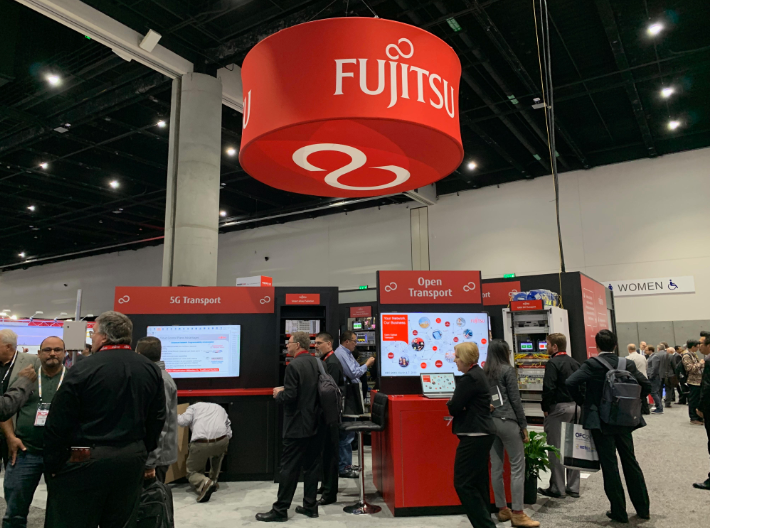
Verizon picks Fujitsu or CPRI, eCPRI and Ethernet Multiplexing Fronthaul

Verizon selected Fujitsu Network Communications as a preferred supplier of CPRI, eCPRI and Ethernet multiplexing fronthaul technology.

In partnership with HFR Networks, Inc. , the Fujitsu solution works across Verizon’s existing network infrastructure to reduce deployment and operational costs while simultaneously supporting 4G LTE and 5G services.

The Time Sensitive Networking (TSN) solution provided by Fujitsu and HFR Networks facilitates a more efficient and lower cost centralized (CRAN) Hubbing of 4G/LTE CPRI traffic using standards based RoE (Radio Over Ethernet) along with eCPRI and Ethernet services.

“Fujitsu is a proven supplier of Smart xHaul transport solutions to Verizon, and we share a history of innovation and success,” said Paul Havala, head of the optical business unit at Fujitsu Network Communications. “Our open Ethernet Fronthaul solution provides Verizon with a reduced total cost of ownership and contributes to a smooth evolution to 5G.”

https://www.fujitsu.com/us/about/resources/news/press-releases/2020/fnc-20200225.html

Fujitsu expands its Smart xHaul for 5G transport

Fujitsu Network Communications is expanding its Smart xHaul transport solution for 5G transport networks in collaboration with HFR Networks and Volta Networks.

The solution enables 5G transport networks to leverage legacy 4G Centralized Radio Access Network (C-RAN) fiber transport and cell sites using an open, disaggregated, pay-as-you-go architecture.

The Fujitsu Smart xHaul solution consists of several key elements:

Intelligent Fronthaul -- now includes new intelligent fronthaul platforms for centralized and cloud-based RAN architectures leveraging next-generation Packet RAN access technology by HFR Networks. The M6424 Time-Sensitive Networking (TSN) aggregation and transport switch series supports interfaces for CPRI, eCPRI and Ethernet services. This temperature-hardened, one rack unit solution supports 24x multi-rate client ports at up to 25G operation for 4G, 5G and Ethernet service coexistence, along with 4x 100GbE network ports offering multiple topologies. With high-precision timing, TSN offers synchronization to the cell site remote radio, while maintaining low latency variation for aggregated 4G and 5G traffic by preempting Ethernet and Internet services. In addition, the M6424-R O-RAN compliant Fronthaul Gateway platform includes a PHY-LOW networking interface that significantly improves bandwidth efficiency and enables multi-vendor interoperability between legacy and new base station equipment.  With this solution, a 5G overlay is not needed on existing 4G transport networks, helping to reduce total costs and speed time to market of lucrative new 5G services.

Disaggregated Cloud Control Plane -- a cloud-based control plane architecture provided by Volta Networks is integral to the new Smart xHaul solution. The virtual routing engine in the cloud combined with agent software on the 1FINITY S100 Switch platform, enables service providers to realize full routing capabilities optimized to their specific application without the limitations and excessive cost structures of legacy, monolithic routers and transport elements. Disaggregating the control and user planes allow scale out via linear resource scaling versus scaling up to a limit with integrated control and user planes. As a result, the solution provides pay-as-you-go efficient scaling to address initial migration from 4G to 5G, as well as diverse 5G multiservice operation using network slicing, for greater intelligence, scalability and cost-efficiency without network overlays.

Network Slicing -- Fujitsu enables network slicing operation via its 1FINITY S100 transport switches for midhaul and backhaul transport, providing enhanced network slicing and cloud control segment routing to reduce operational complexity, increase scalability and deliver better infrastructure utilization versus traditional routers.

Verizon hits 4.2 Gbps over 5G mmWave with 8-channel carrier aggregation

Verizon demonstrated speeds up to 4.2 Gbps over its live 5G network.

The trial, which took place using a commercial network cell site in Texas, aggregated 800 MHz of 28 GHz band spectrum using Samsung Network’s 5G NR 28 Ghz Access Unit, which has been commercially deployed by Verizon. Motorola Mobility and Qualcomm were also key technology providers.

“We’re continuing to expand our 5G Ultra Wideband network, built to enable unique and transformational experiences for our customers,” said Adam Koeppe, Senior Vice President of Technology Planning at Verizon. “We are only beginning to scratch the surface of what 5G can do, demonstrated by this latest milestone.

“We continue to innovate and introduce advanced technologies on our 5G network that will help us reach never-before seen mobile capabilities and create new and exciting use cases across the consumer and enterprise landscape. Using 5G carrier aggregation, we are able to achieve unprecedented mobile speeds and bring the massive bandwidth available with mmWave spectrum to life,” said Koeppe.

The companies said eight channel carrier aggregation using mmWave will be widely available on the 5G network in 2020.

Qualcomm cites momentum for its 5G mmWave small cells platform

Qualcomm Technologies cited growing support for its 5G RAN platform (FSM100xx), which was first announced in May 2018 and it has since been adopted by many manufacturers and cellular infrastructure providers.

The platform support mmWave radio access for indoor and outdoor network densification.

“With the continued growth and adoption of our Qualcomm 5G RAN platform, Qualcomm Technologies aims to deliver cutting-edge 5G mmWave infrastructure technology to power 5G small cell and remote radio head infrastructure across the globe,” said Durga Malladi, senior vice president and general manager, 4G/5G, Qualcomm Technologies, Inc. “Combined with the power and flexibility to support virtual RAN and open radio access interfaces, our Qualcomm 5G RAN platform is designed to allow infrastructure providers the ability to solve pressing connectivity issues and give its users increased access to the reliable, robust and powerful mobile experiences enabled by 5G. We are pleased that leading 5G infrastructure innovators are choosing our Qualcomm 5G RAN platform for their network solutions, and we are excited by the opportunity ahead.”

Supporters include Airspan, Altiostar, Baicells, Corning, Radisys, Rakuten, Samsung, Sercomm, the Small Cell Forum, and Verizon.

Qualcomm intros 5G NR for Small Cells and Remote Radio Heads

Qualcomm introduced the first 5G NR solution for small cells and remote radio head deployments. The new device (FSM100xx), which builds on Qualcomm's FSM Platform for 3G and 4G small cells, support 5G NR in both mmWave and sub-6 GHz spectrum.

Qualcomm said its 5G NR solutions allows OEMs to reuse both software and hardware designs across sub-6 and mmWave products, supporting high-bandwidth and robust coverage for mobile subscribers around the globe. Given the propagation characteristics of 5G NR’s higher frequencies (especially mmWave), solutions are needed to support delivery of uniform 5G experiences, especially indoors where most data is consumed.

The FSM100xx solution scales to address outdoor small cell performance requirements such as support for MIMO implementation and multi-gigabit throughput, as well as support indoor requirements such as compact form factor and power over Ethernet (PoE) support. It also includes a software-defined modem, designed to facilitate OEMs to readily upgrade their devices to comply with future 3GPP releases. Additionally, this 5G NR solution supports various options for interface splits between central unit (CU) and remote radio head, providing OEMs and operators with the flexibility to use a 5G radio access network architecture that best fits their needs, such as a virtualized 5G architecture that is designed to deliver scalability through the cloud or a more distributed architecture to ease fronthaul requirements.

O-RAN Alliance and the Telecom Infra Project reach agreement

The O-RAN Alliance (O-RAN) and the Telecom Infra Project (TIP) agreed to collaborate on the development of interoperable open Radio Access Network (RAN) solutions.

The O-RAN Alliance is focused on the development of open, intelligent, virtualized and interoperable RAN specifications. The Alliance has already created 31 specifications, with 37 demonstrations of the technology at past MWC events, global plugfests, and more than 1 000 000 lines of code released in partnership with the Linux Foundation. Operators have begun to announce network implementations.

O-RAN Alliance’s mission and focus complements TIP’s mission of deploying end-to-end disaggregated telecom infrastructure in varying environments. With the liaison agreement O-RAN and TIP are now reaching a new level of collaboration for open RAN. The liaison allows for sharing information, referencing specifications and conducting joint testing and integration efforts.

"This new collaboration framework between O-RAN and TIP, two major initiatives in the area of open networking, will support our mission to re-shape the RAN industry towards open and intelligent mobile network infrastructure," said Alex Jinsung Choi, COO of the O-RAN Alliance and SVP Strategy & Technology Innovation, Deutsche Telekom. "Alignment on O-RAN interoperability efforts will help the industry to speed up the delivery of commercial open RAN solutions. The establishment of the first joint O-RAN Open Test and Integration Center (OTIC) with the TIP Community Lab in Berlin is a concrete step to facilitate this multi-community approach."

"TIP’s OpenRAN solutions are an important element of our work to accelerate innovation across all elements of the network including Access, Transport, Core & Services. Across the TIP community, we are seeing increasing demand and have achieved meaningful progress with OpenRAN deployments around the world," said Attilio Zani, Executive Director, Telecom Infra Project. "With this collaboration framework in place, TIP and O-RAN will work together to develop interoperable 5G RAN solutions. One of our first outputs will be the release of the OpenRAN 5GNR NR Base Station Platform requirements document with normative references to the O-RAN specifications."

http://www.o-ran.org

Rakuten Mobile looks to Nokia to automate operations

Rakuten Mobile, Japan’s newest mobile network operator, has selected Nokia to implement a fully automated operations environment for the 5G era. Nokia will operate Rakuten Mobile’s virtualized core network to manage total cost of ownership (TCO). The agreement will allow Rakuten Mobile to focus on developing its portfolio of disruptive services and expanding its service footprint, while developing operational maturity and automation capabilities.

Nokia said it is enabling groundbreaking levels of automation in network and service lifecycle management within the Rakuten Mobile cloud environment. Specifically, Nokia is supporting over 160 virtual network function instances across two data centers in an industry-leading multivendor cloud environment. As an essential part of Rakuten Mobile’s operations organization, Nokia’s domain expertise and value-add will be incorporated into the core of Rakuten’s business.

Friedrich Trawöger, Head of Operate & Managed Services Unit at Nokia, said: “By managing its telco cloud we can help Rakuten Mobile to focus on its objectives; to launch its mobile LTE network and to rapidly realize its vision as a 5G digital service provider. We support Rakuten Mobile in bringing new services to market quickly by utilizing the latest innovations in automated operations while focusing on the total cost of ownership.”

Tareq Amin, Chief Technology Officer of Rakuten Mobile, Inc., said: “With Nokia supporting the operation of our cloud native network, we can focus on service launch and expansion. Nokia is an integral partner in our network operations, and we look forward to future business opportunities that this partnership brings.”

NTT DOCOMO picks Cisco's segment routing to optimize 5G backhaul

NTT DOCOMO has selected Cisco's Network Convergence System routers and segment routing for network slicing to help optimize its 5G mobile backhaul.

Cisco said its converged SDN transport, with segment routing, and Network Convergence System routers can provide massive scale, full programmability, simpler cloud integration and service level agreements.

“The IP network plays a more important role with 5G than ever before,” said Jonathan Davidson, Senior Vice President and General Manager, Cisco Service Provider Business. “Networks have to be automated, programmable and capable of massive scale. Together, DOCOMO and Cisco mapped out the right path for its 5G transformation with a new intelligent, software-defined network. Converging services over a common, trustworthy architecture will reduce costs, deliver new services that span multiple domains, and prepare them for a profitable 5G future.”


S

Ciena pulls out of OFC 2020

Citing concerns about the COVID-19 coronavirus, Ciena has withdrawn from the upcoming Capacity Middle East 2020 event, scheduled to take place March 2-5 in Dubai, and the upcoming OFC 2020 event, scheduled to take place March 9-11 in San Diego.

“We have made the decision to cancel our participation in all industry events for the next 30 days in order to safeguard the well-being of our employees, customers and partners. Although we are disappointed that we cannot continue with these events as planned, as they are important benchmarks for the industry, we believe this is the right decision under the circumstances and we look forward to participating in future events,” stated Gary Smith, president & chief executive officer, Ciena.

Lumentum withdraws from OFC

Lumentum confirmed that it will not attend the upcoming OFC 2020 conference and tradeshow scheduled for March 8-12 in San Diego due to the continuing spread of the COVID-19 coronavirus globally. This withdrawal includes all investor and industry events scheduled during OFC.

"Every year, we look forward to attending OFC to showcase our latest innovations and advancements in technology," said Alan Lowe, Lumentum President and CEO. "However, our highest priority is the health and safety of our employees, customers, and partners. This year, due to the rapidly evolving coronavirus outbreak, we believe we can better serve all of our stakeholders by exercising an abundance of caution and not attending OFC."

Infinera posts Q4 revenue of $384.6 million

Infinera reported GAAP revenue for Q4 2019 of $384.6 million compared to $325.3 million in the third quarter of 2019 and $332.1 million in the fourth quarter of 2018. GAAP gross margin for the quarter was 29.0% compared to 26.7% in the third quarter of 2019 and 25.4% in the fourth quarter of 2018.  GAAP net loss for the quarter was $(66.6) million, or $(0.37) per share.  Non-GAAP net income for the quarter was $6.4 million, or $0.03 per diluted share.

“In the fourth quarter, we delivered solid results and achieved significant bookings growth. We also completed the most challenging integration tasks, doubled our synergy savings commitments for the year and returned to non-GAAP operating profitability in the fourth quarter of 2019,” said Tom Fallon, Infinera CEO. “Major accomplishments this past year included strengthening our global customer base with 10 Tier 1 scale customer wins, significant growth in backlog, and continued progress in building our innovation pipeline as evidenced by announced DRX wins, the introduction of XR optics, and growing confidence in our plan to deliver 800G products to the market in 2020.”

https://www.infinera.com/press-release/Infinera-Corporation-Reports-Fourth-Quarter-and-Fiscal-Year-2019-Financial-Results

Crowd watch at the RSA Conference in San Francisco


2pm on Tuesday, 25-February-2020. Not bad considering the circumstances.


Monday, February 24, 2020

Conversational AI for Telco Service Providers


Customer support may well be the first really solid business case for AI in Service Provider networks. Imagine the ROI if conversational AI and automation could trim the time needed for millions of customer support calls.

In this video, Umesh Sachdev, CEO of Uniphore, discusses the use case for conversational AI by telcos.

More thought leadership videos on network automation may be found here:
https://nginfrastructure.com/network-automation/


Intel launches 10nm chip for 5G base stations

Intel introduced a 10nm SoC for wireless base stations. The company is predicting that it will be the leading silicon provider in base stations by 2021, a year earlier than it had earlier forecast, after design wins with three leading base station manufacturers.

Notable, the new Atom P5900 processor extends the Intel architecture from the core to access and all the way to the farthest edge of the network. 

The Atom P5900 promises up to a 1.8X boost in integer processing. In terms of load balancing, the Atom P5900 is expected to deliver a 3.7X performance boost over software-based solutions. For encryption processing, the processor will offer a 5.6X boost over software-only alternatives.


Southern Cross Cable carries first 800G wavelength

Southern Cross Cable connected the first single-wavelength 800G across a live production network using Ciena’s WaveLogic 5 Extreme (WL5e) coherent optics.

Specifically, the new 800G channel speed ran error-free on Southern Cross’ live production network between two large, global data centers on the U.S. West Coast and demonstrated record-breaking spectral efficiencies.

Ciena said Southern Cross will begin volume deployment of WL5e in the second calendar quarter of 2020 across various segments of its network, including Trans-Pacific submarine cables and terrestrial cables across U.S. West Coast and New Zealand.

“As many internet service providers are looking to the submarine cable industry to provide reliable connectivity to their customers, leading operators like Southern Cross need networks that can adapt to fluctuating connectivity demands. With WaveLogic 5, we are delivering the industry’s first 800G solution and reinforcing our leadership in providing the highest performance optics in the market,” stated Rick Seeto, Vice President and General Manager of Asia-Pacific and Japan, Ciena.


Construction begins on Southern Cross NEXT Cable

The Southern Cross NEXT project has achieved CIF (Contract in Force) status and has entered the construction project phase.

The Southern Cross NEXT submarine cable is a state-of-the-art 4 fibre pair undersea route utilising an open cable design and enhancing the existing Southern Cross eco-system. The system will also provide full fibre connectivity to Auckland, New Zealand, and will incorporate Branching Units (BU) and OADM technology for connections to Fiji, Tokelau and Kiribati. Given its robust design and route including branches, the 16,148km cable system will provide the lowest latency path from Australia and New Zealand to the United States. Organisers said Southern Cross NEXT represents a network investment of around US$300 million. It is designed to carry 72 terabits per second of traffic. Completion is targetted for the end of 2021 or early 2022.

“The achievement of CIF is a testament to the hard work of the combined Southern Cross and Pioneer Consulting team over many months and is a validation of the technology and expertise behind the new cable,” said Southern Cross President and CEO, Laurie Miller. “The addition of the Southern Cross NEXT route to our platform will provide existing and future customers with further resiliency and connectivity options between Australia, New Zealand and the United States.”

Intel announces network-optimized 2nd Gen Xeon Scalable processors

Intel announced 2nd Gen Intel Xeon Scalable processors, promising an average of 36% more performance and an average of 42% more performance per dollar than the prior generation Intel Xeon Gold.

The new processors — labeled with an “R,” “T” or “U” suffix — are designed for dual- and single-socket mainstream and entry-level server systems. The addition of more cores and increased cache in these processors are targeted at workloads where capacity-per-server is critical, such as virtualized clouds, hyper-converged infrastructure (HCI) and network function virtualization (NFV).

Intel also announced today two new processors (Intel Xeon Gold 6256 and 6250) that feature the industry’s highest server processor frequency, delivering a base and turbo frequency up to 3.9 GHz and 4.5 GHz, respectively. These

Intel said this wave of Xeon Scalable processors are network-optimized and can deliver up to 58% more performance for NFV workloads. The company cited development partnerships with CenturyLink, China Mobile, SK Telecom, and Sprint.

“Intel’s data-centric platforms offer the broadest market coverage of any server processor platform -– from the cloud, through the network, to the intelligent edge,” said Lisa Spelman, corporate vice president and general manager of the Xeon and Memory Group within Intel’s Data Platform Group. “Working closely with our customers, we are delivering these new server processors to address their performance and pricing needs across a broad range of markets and workloads.”


https://newsroom.intel.com/news/xeon-scalable-5g-network-portfolio-launch/#gs.xerm31

Intel unveils Diamond Mesa ASIC for 5G network acceleration

Intel unveiled "Diamond Mesa", its first next-generation structured ASIC for 5G network acceleration. It complements Intel’s portfolio of processors and FPGAs.

Intel said structured ASICs like Diamond Mesa provide a minimum-risk optimization path for workloads that do not require the full programmability of FPGAs, targeting double the performance efficiency versus the prior generation, and uniquely position Intel as the only provider delivering a full silicon platform foundation for network infrastructure.

Diamond Mesa is currently sampling early access customers.

In addition, Intel introduced "Edgewater Channel," a 5G network-optimized Ethernet NIC.

The new Ethernet 700 Series Network Adapter with Hardware-Enhanced Precision Time Protocol is Intel’s first 5G-optimized network adapter, offering GPS-based cross-network service synchronization with Hardware-Enhanced Precision Time Protocol (PTP).

Latency requirements across 5G network implementations have challenged existing Ethernet technology, especially in edge servers.

Intel said maintaining accurate time synchronization across the network at a cost-effective price point is one avenue to help address application latency. The Ethernet 700 series adapter increases the timing precision required for 5G networks through a combination of hardware and software enhancements.

Edgewater Channel is sampling now and will enter production in Q2‘20.

Vertical Systems Group: 2019 U.S. Carrier Ethernet LEADERBOARD

CenturyLink and AT&T retain the top two rankings on Vertical Systems Group's newly published 2019 U.S. Carrier Ethernet LEADERBOARD.

Seven companies achieved a position on the 2019 U.S. Carrier Ethernet LEADERBOARD. The market leading companies are as follows (in rank order based on year-end 2019 retail port share): CenturyLink, AT&T, Spectrum Enterprise, Verizon, Comcast, Windstream and Cox. Service providers must have four percent (4%) or more of the U.S. Ethernet services market to qualify for a LEADERBOARD rank.

Six companies attained a 2019 Challenge Tier citation (in alphabetical order): Altice USA, Cogent, Frontier, GTT, Sprint and Zayo. The Challenge Tier includes providers with between 1% and 4% share of the U.S. retail Ethernet market.

"The base of U.S. Ethernet ports increased by 8.9 percent in 2019, buoyed by healthy demand for higher speed access to cloud, Internet and VPN services," said Rick Malone, principal of Vertical Systems Group. "During the past year, Ethernet providers focused on better monetizing service features to expand their existing business, while introducing streamlined offers to target the needs of the SMB market."

Highlights of Vertical's 2019 U.S. Ethernet Market Share Analysis

  • CenturyLink continues to hold first position on the U.S. Ethernet LEADERBOARD, followed by AT&T in second position.
  • Spectrum Enterprise moves up to the third position from fourth, surpassing Verizon.
  • Comcast had the highest year-over-year market share growth across the 2019 LEADERBOARD providers.
  • Four Incumbent Carriers (CenturyLink, AT&T, Verizon, Windstream) and three Cable MSOs (Spectrum Enterprise, Comcast, Cox) are represented on the 2019 LEADERBOARD. 

Highlights of Vertical's 2019 U.S. Ethernet Market Share Analysis

  • Retail U.S. Ethernet installations increased 8.9% to more than 1.25 million customer ports.
  • Price compression, particularly for high speed services, continues to limit Ethernet revenue growth.
  • Ethernet is the WAN underlay of choice for Carrier Managed SD-WAN solutions requiring secure, dedicated high speed connectivity.
  • Active fiber build-outs across the U.S. are enabling Ethernet footprint expansions to serve a broader base of mid-market customers.
  • Ethernet service enhancements are providing customers with improved performance, faster installations, and more flexible network configurations.

Mellanox ships ConnectX-6 Dx SmartNICs

Mellanox Technologies has begun shipping its ConnectX-6 Dx SmartNICs, in addition to the soon-to-be-released BlueField-2 I/O Processing Units (IPUs)s.

The ConnectX-6 Dx SmartNICs provide up to two ports of 25, 50 or 100Gbps, or a single port of 200Gbps, Ethernet connectivity powered by 50Gbps PAM4 SerDes technology and PCIe 4.0 host connectivity.

Significantly, the new SmartNICs' hardware offload engines include IPsec and inline TLS data-in-motion cryptography, advanced network virtualization, RDMA over Converged Ethernet (RoCE), and NVMe over Fabrics (NVMe-oF) storage accelerations. ConnectX-6 Dx provides IPsec, TLS, and AES-XTS built-in cryptographic acceleration, and Hardware Root of Trust. In addition to the above capabilities, BlueField-2 adds accelerated key management, integrated Regular Expression (RegEx) pattern detection, secure hash computation, etc.

“Networking and security must converge to achieve consistent and predictable application performance, with all the necessary levels of data privacy, integrity and reliability. This vision is the core foundation on which we designed our ConnectX-6 Dx SmartNIC and BlueField-2 IPU products,” said Amit Krig, senior vice president, Ethernet NIC and IPU Product Line at Mellanox Technologies. “Today we are excited to ship production qualified ConnectX-6 Dx SmartNICs to our hyperscale customers, turning our vision into a reality.”

As an IPU, BlueField-2 provides even more in-hardware security capabilities, including agentless micro-segmentation, advanced malware detection, deep packet inspection and application recognition, that far outperform software-only solutions. Mellanox BlueField IPUs enable the best of both worlds – the speed and flexibility of software-defined solutions, with tighter security, accelerated performance and improved efficiency by processing data in the device hardware at the I/O path.


Michael Kagan, CTO and co-founder of Mellanox Technologies, talks about the next step for SmartNICs and the company's newly released ConnectX-6 Dx product driven by its own silicon.


Sierra Wireless samples 5G embedded modules

Sierra Wireless announced an expanded portfolio of mobile broadband embedded modules for mobile computing, routers, gateways, industrial automation, and new IoT applications, such as robotics, drones and private networks.

Sierra Wireless’ 5G EM919x and 4G LTE Cat-20 EM769x embedded modules are sampling now to OEMs and system integrators requiring secure connectivity and the highest possible speeds to deploy cellular on their mobile computing, networking and IoT platforms worldwide. Built on the Qualcomm Snapdragon X55 5G Modem-RF System, the new EM919x standards-based M.2 modules support 5G NR mmWave, 5G NR sub-6 GHz and LTE technologies globally, as defined by the 3GPP Release 15 standard.

Sierra Wireless is also refreshing its 4G LTE products based on the Qualcomm® Snapdragon™ X16 LTE modem, which will allow customers to more cost-effectively utilize all the available high-speed 4G network bands, including those for CBRS in the U.S. and Private LTE applications. All devices are compatible with current Sierra Wireless EM/MC devices, with no changes required to the host design to speed time to market. The new EM/MC74x1 Cat-7 modules are a secure and cost-effective alternative to existing Sierra Wireless EM/MC745x Cat-6 modules. The devices are capable of 150Mb/s uplink, onboard image switching and secure boot. The portfolio includes:

  • EM/MC7411 – M.2 form factor and mPCIe Minicard LTE Cat-7 supporting all North American carriers, CBRS and FirstNet™
  • EM/MC7421 - M.2 form factor and mPCIe Minicard LTE Cat-7 supporting Europe and Asia-PAC carriers and Private LTE networks
  • EM/MC7431 M.2 form factor and mPCIe Minicard LTE Cat-7 supporting all Japan carriers and Private LTE networks


Keysight's Q1 revenue rises 9% to $1.095 billion

Keysight Technologies reported quarterly revenue of $1.095 billion, up 9% when compared with $1.006 billion last year. GAAP net income was $163 million, or $0.86 per share, compared with GAAP net income of $114 million, or $0.60 per share, in the first quarter of 2019. Non-GAAP net income was $240 million, or $1.26 per share, compared with $176 million, or $0.93 per share in the first quarter of 2019.

“Keysight delivered another outstanding quarter and a strong start to the year with both revenue and earnings exceeding the high end of our guidance. Revenue growth in the quarter was driven by ongoing strength in 5G-related investments and increased spending in aerospace defense and semiconductor measurement," said Ron Nersesian, Keysight president and CEO. "Our consistent financial performance illustrates the strength of our differentiated solutions targeting a diverse set of end markets,” said Nersesian.