Monday, December 13, 2021

TIP demos Phoenix open and disaggregated transponder

The Telecom Infra Project (TIP) demonstrated its Phoenix open and disaggregated transponder for the first time at the NTT R&D Forum 2021 last month.

TIP's Phoenix, which a Layer 0/Layer 1 white box transponder supporting 400 Gbps/lambda, is being developed by TIP's Open Optical & Packet Transport’s (OOPT) Disaggregated Optical Systems (DOS) subgroup. This Phoenix prototype is built over a beta version of the Wistron Galileo Flex-T hardware platform and the Goldstone network operating system (NOS), developed as an Open Source Software (OSS) within TIP’s OOPT NOS subgroup, through the open hardware interface Transponder Abstraction Interface (TAI).

In this demonstration, Wistron’s Galileo Flex T, which can be equipped with four 400 Gbps CFP2-DCOs with a maximum throughput of 1.6 Tbps. For the coherent modules, Fujitsu’s Optical Components (FOC) 400G CFP2-DCO and Lumentum’s 400G CFP2-DCO were used. Both modules contain a 400 Gbit/s low power coherent DSP developed by NTT Network Innovation Laboratories and commercialized by NTT Electronics. 

https://telecominfraproject.com/first-demo-tip-phoenix-ntt-rd-forum/

NEC joins TIP's Phoenix initiative for Optical/Packet transport

NEC has joined the Telecom Infra Project’s (TIP) Phoenix initiative under the Open Optical and Packet Transport (OOPT) Project Group. The goal is to develop a 400G transponder for open and disaggregated high-capacity DWDM networks.

NEC will serve as a system integrator within the OOPT Project Group and the Phoenix initiative to realize a fully disaggregated architecture.

The company plans to release its TIP-compliant 400G transponder solution to the market globally along with NEC's ecosystem partners in 2022.

NEC, which has been actively promoting the Open Radio Access Network (Open RAN) field, said that by participating in this project it will also promote openness in the optical transmission area and contribute to the acceleration of innovation in this area.

"Today's network operators need improved speed and agility to provide better connectivity for communities worldwide," said David Hutton, TIP's Chief Engineer. "NEC participating in TIP's OOPT Project Group is welcome support for critical interoperability to prove that Phoenix use cases can be achieved with open disaggregated optical network architectures. We are excited to see NEC products compliant with TIP's Phoenix requirements as well as their capabilities as a system integrator."

Atsuo Kawamura, Executive VP, Network Service Business Unit, NEC, said, "I believe NEC can provide flexible and optimal solutions that support the delivery of a variety of services provided by operators. Through the development of optical transmission systems that conform to open interfaces, we will keep working to enhance and expand optical networks worldwide."

https://www.nec.com/en/press/202111/global_20211117_02.html

ONF and TIP collaborating on Open Optical Transport 

The ONF and the Telecom Infra Project (TIP) agreed to collaborate on optical transport solutions that increase openness, SDN programmability, and disaggregation. The collaboration combines the ONF's Open Disaggregated Transport Network (ODTN) project and TIP’s­­­ Open Optical & Packet Transport(OOPT) group. Both groups are leveraging open software and hardware, common APIs and community collaboration. The groups said their existing work as...


Russia's Rostelecom plans new Transit Europe – Asia backbone

Rostelecom plans to begin construction of a new fiber backbone linking Russia's western and eastern borders with the countries largest cities and connecting the major European traffic exchanges with Mongolia and China. The TEA NEXT (Transit Europe – Asia) system will also link Vladivostok to Busan, Tokyo and Hong Kong via subsea cables.

Rostelecom announced a parity agreement with VEB Ventures (VEB. RF’s venture fund) each invest around RUB 6 billion in Atlas, an operating company formed for the construction. The total investment is expected to reach around USD 650 million in the next few years with a view to finance the project up until 2025.

As noted by Russia’s Deputy Prime Minister, Dmitry Chernyshenko, TEA NEXT will be instrumental in shaping the national digital economy and boosting innovation.

Construction on the first segment TEA NEXT started in the summer of 2020 running from Moscow via Saint-Petersburg through to the Latvian border.

Mikhail Oseevskiy, President of Rostelecom: “TEA NEXT will be instrumental in delivering our ambition to become the leader across all segments of the telecom ecosystem. With its technically advanced new generation features, the project will provide the critical foundation for the national backbone fiber optic infrastructure in the next thirty years. Atlas, in turn, is set to become the leader in fiber optic services for national companies, as well as the largest international operators and OTT players. The main feature of the project is the brand new advantageous route from West to East of Russia with stations in key cities along the way.”

https://www.company.rt.ru/en/ir/news_calendar/d461430/

Ericsson Routes is Waze for connectivity for autonomous vehicles

 Ericsson has begun beta testing a new service in San Francisco that helps autonomous vehicles, drones, and other unmanned vehicles to predict wireless connectivity from multiple operators across a planned route.

The new Ericsson Routes service is described as "Waze" for wireless cellular quality. Ericsson Routes provides a single integration point and a consistent prediction engine for autonomous vehicles across all their wireless service providers.

The beta program is the first step in a journey that will see the Basic Service reaching commercial limited availability in April 2022. During the second half of 2022, Ericsson will launch the Premium Service in partnership with wireless service providers.

The Basic Service provides connectivity awareness along a path from point A to point B with its uplink blind spot detector (available with the beta program) and the uplink throughput prediction (available at the time of commercial limited availability).

The upcoming Ericsson Routes Premium Service, to be launched in partnership with wireless service providers, will provide a finer, real-time granularity that addresses critical connectivity requirements along the trip from point A to point B.

The beta program is first available in San Francisco, California, while the commercial limited availability release will expand the service to Houston, Texas. Additional markets may be added based on customer feedback. The Premium Service is expected to initially cover the same areas as the Basic Service plus Las Vegas, Nevada.

https://www.ericsson.com/en/ericsson-one/routes

AWS Region opens in Jakarta

Amazon Web Services has activated AWS Asia Pacific (Jakarta) Region, providing its cloud services from data centers located in Indonesia. 

AWS estimates spending on the construction and operation of the new AWS Asia Pacific (Jakarta) Region will create 24,700 direct and indirect jobs with an estimated $5 billion (IDR$71 trillion) in planned investment in the local economy. The Region will also add an estimated $10.9 billion (IDR$155 trillion) over the next 15 years to Indonesia’s Gross Domestic Product (GDP).

With the launch of the AWS Asia Pacific (Jakarta) Region, AWS has 84 Availability Zones across 26 geographic regions globally, with announced plans to launch 24 more Availability Zones and eight more AWS Regions in Australia, Canada, India, Israel, New Zealand, Spain, Switzerland, and the United Arab Emirates. AWS Regions are composed of Availability Zones that place infrastructure in separate and distinct geographic locations. Availability Zones are located far enough from each other to support customers’ business continuity but near enough to provide low latency for high availability applications that use multiple Availability Zones. Each Availability Zone has independent power, cooling, and physical security and is connected through redundant, ultra-low latency networks. AWS customers focused on high availability can design their applications to run in multiple Availability Zones to achieve even greater fault tolerance. 

“The cloud provides organizations of all types and sizes—from businesses to educational institutions to government agencies—opportunities to transform their operations and reinvent experiences for their customers and end users,” said Prasad Kalyanaraman, Vice President of Infrastructure Services at AWS. “AWS is excited to announce our new Region in Asia Pacific and help Indonesian institutions, innovative startups, and world-leading companies deliver cloud-powered applications to fuel economic development across the country. Organizations across industries in Indonesia can now take advantage of the AWS Asia Pacific (Jakarta) Region to lower costs, increase agility, and drive innovation.”

“Infrastructure from the world’s leading cloud provider plays a critical role in accelerating our digital economy,” said Perry Warjiyo, Governor of Bank Indonesia, the nation’s central bank. “We expect that AWS’s cloud technology will help us achieve our vision and goals outlined in the Indonesia Payment Systems 2045 blueprint, fully digitalizing the nation’s payment systems and integrating a multitude of stakeholders and economic activities under the guiding principles of security and data protection.”

http://aws.amazon.com/about-aws/global-infrastructure

Australia's NBN Co targets 100% Renewable Electricity

Australia's NBN Co outlined the following initial three-year roadmap Towards-Zero Carbon Ambition:

  • Reducing its annual energy use by 25GWh by December 2025 
  • Purchasing 100 per cent renewable electricity from December 2025 
  • Using electric or hybrid vehicles, where suitably available, by 2030

NBN Co is committed to delivering a more energy-efficient network, with over 8.3 million premises currently connected to the nbn network, and it will seek to maintain more efficient use of energy as data demand and the number of connected premises continues to grow.

In addition NBN Co has recently entered into a renewable power purchasing agreement that is intended to deliver almost 20 per cent renewable energy to the network by FY23. The company has plans to source 100 per cent of its power purchases from renewable energy sources through further power purchase agreements and contracts for renewables.

https://www.nbnco.com.au/corporate-information/media-centre/media-statements/nbn-co-announces-100-percent-renewable-electricity-target-and-towards-zero-carbon-ambition

Fiber Broadband Association elects 2022 Board of Directors

The Fiber Broadband Association (FBA) today announced it has elected its 2022 Board of Directors. Kevin Morgan, Chief Marketing Officer at Clearfield, was elected as the new Chair of the Board for a one-year term beginning January 1, 2022.

“The FBA Board of Directors plays a critical role in our effort to advance fiber deployment so that every community across North America can access high-speed reliable broadband. In 2021, our Board helped guide us through the momentous passing of the Infrastructure Bill that awarded $65 billion for broadband investment,” said Gary Bolton, President and CEO of the FBA. “As we look towards 2022, there is a huge opportunity for our industry to close the digital equity gap for good, and our newly elected Board has the expertise to help our members navigate this opportunity successfully. I congratulate our newest directors and officers, while also extending gratitude to those that served in 2021.”

Elections for the Board of Directors were held at FBA’s 2021 Premier Members Meeting in Washington, D.C. Subsequently, Board officers were elected at the Board meeting. The full 2022 Board of Directors includes:

  • Chair: Kevin Morgan, Chief Marketing Officer, Clearfield
  • Vice Chair: Joseph “JJ” Jones, Executive Vice President, On Trac, Inc.
  • Secretary: Jimmy Todd, CEO and General Manager, Nex-Tech
  • Treasurer: Joe Jensen, Director, Americas Market Development, Corning
  • Immediate Past Chair: Katie Espeseth, Vice President of New Products, EPB
  • Joanne Hovis, President, CTC Technology & Energy
  • Mark Boxer, Technical Manager – Solutions and Applications Engineering, OFS
  • Scott Jackson, National Market Manager – Broadband, Graybar
  • Ben Moncrief, Sr. VP – Strategic Relations and Managing Director - Alabama, C Spire

https://www.fiberbroadband.org

FBA perspective: America's $65 billion broadband investment

https://youtu.be/oevn0oE_e3s

America's new infrastructure package is the single, largest investment in broadband deployment in history and represents a once-in-a-generation opportunity to get fiber out to every American, says Gary Bolton, president and CEO of the Fiber Broadband Association. Here is a one-minute perspective.

Ericsson joins Vodafone 5G Lab

Ericsson has partnered with the new Vodafone 5G Lab in Madrid, Spain.

The Vodafone 5G Lab is powered by the new Ericsson Cloud Native 5G Core. Running independently of the existing 4G network, the latency of Ericsson’s 5G Core enables network slicing, and improves the stability of the network and its performance.

The companies describe the partnership as a fundamental step towards further elevating the quality of 5G in the Spanish market and creating a solid 5G ecosystem that ensures the entire chain of project development – from design to execution – has access to the best connectivity and 5G devices.

Marta de Pablos, Head of Strategic Marketing for 5G, Vodafone Spain, says: “Vodafone 5G Lab aims to become a fundamental co-creation space to develop a new generation of services and applications that our customers will be able to access in the near future. It is a very important step forward in our strategy to continue being pioneers and a reference in the deployment and use of 5G networks and services in Spain.”

https://www.ericsson.com/en/news/3/2021/ericsson-partners-with-vodafone-to-power-new-5g-lab-in-spain

Windstream Wholesale lights new route from LA to Las Vegas

Windstream Wholesale turned up a direct route from Los Angeles to Las Vegas via its Intelligent Converged Optical Network (ICON) architecture.

This new route offers a more direct, lower latency path for the Asia PAC (APAC) subsea cables landing in Los Angeles to access the growing Las Vegas data center ecosystem. With this addition, Windstream now has three routes connecting Los Angeles to data center facilities in the Las Vegas area including Databank, Switch, Cyxtera and Flexential, among others.

“As more subsea cables land into Los Angeles, there is a tremendous need for the kind of diverse, low-latency connections to domestic data centers that Windstream Wholesale’s expanding network is intentionally designed to deliver,” said Joe Scattareggia, executive vice president of Windstream Wholesale. “Windstream is APAC’s gateway to North America and our ICON network is built to meet this burgeoning demand.”

Windstream’s ICON architecture provides open and disaggregated networking infrastructure for wholesale and enterprise technology customers, that features:

  • Flexible design options, alien wave support and multi-vendor interoperability;
  • More bandwidth, customer-centric design options, and multi-vendor interop support;
  • Layer Zero analytics and Layer One analytics that enable Network Health monitoring through Windstream’s carrier portal as a single pane of glass network management tool; and
  • Faster provisioning via SDN orchestration for both design-based and intent-based provisioning of wave and Ethernet solutions.

https://www.windstreamenterprise.com/wholesale/interactive-map

Sunday, December 12, 2021

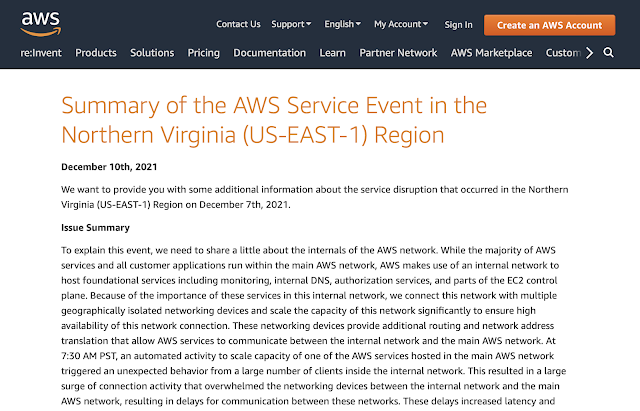
AWS attributes outage to surge from automated scaling of internal network

At 7:30 AM PST on December 7th, 2021, an automated activity at AWS Northern Virginia (US-EAST-1) Region that is used to scale capacity of services hosted in the main AWS network triggered an unexpected behavior from a large number of clients inside the internal network. The unexpected behavior resulted in a large surge of connection activity that overwhelmed the networking devices between the internal network and the main AWS network, resulting in delays for communication between these networks. These delays increased latency and errors for services communicating between these networks, resulting in even more connection attempts and retries. This led to persistent congestion and performance issues on the devices connecting the two networks." The traffic surge impacted the control planes that are used for creating and managing AWS resources.  In particular, API Gateway servers were impacted by their inability to communicate with the internal network during the early part of this event. As a result of these errors, many API Gateway servers eventually got into a state where they needed to be replaced in order to serve requests successfully. 

In a blog posting, Amazon Web Services (AWS) apologized for the incident and said it has already taken several actions to prevent a recurrence of this event, including disabling of the automated scaling process until a remediation method is deployed. 


https://aws.amazon.com/message/12721/

Intel cites advancements in packaging, transistors, quantum physics

Intel outlined its path toward more than 10x interconnect density improvement in packaging with hybrid bonding, 30% to 50% area improvement in transistor scaling, major breakthroughs in new power and memory technologies, and new concepts in physics that may one day revolutionize computing. The announcement was made at this week's IEEE International Electron Devices Meeting (IEDM) 2021 in San Francisco.

Some Intel research highlights:


  • Earlier this year, Intel announced plans for Foveros Direct, which will use sub-10-micron bump pitches to provide an order of magnitude increase in the interconnect density for 3D stacking. 
  • Intel is calling for the establishment of new industry standards and testing procedures to enable a hybrid bonding chiplet ecosystem.
  • Intel is mastering an approach to stacking multiple (CMOS) transistors that aims to achieve a maximized 30% to 50% logic scaling improvement for the continued advancement of Moore’s Law by fitting more transistors per square millimeter.
  • Intel is researching novel materials just a few atoms thick can be used to make transistors that overcome the limitations of conventional silicon channels, potentially enabling millions more transistors per die area.
  • Intel is developing the world’s first integration of GaN-based power switches with silicon-based CMOS on a 300 mm wafer. This sets the stage for low-loss, high-speed power delivery to CPUs while simultaneously reducing motherboard components and space.
  • Intel is exploring novel ferroelectric materials for possible next-generation embedded DRAM technology that can deliver much low-latency read/write capabilities.
  • Intel has demonstrated the world’s first experimental realization of a magnetoelectric spin-orbit (MESO) logic device at room temperature, which showed the potential manufacturability for a new type of transistor based on switching nanoscale magnets.
  • Intel and IMEC are making progress with spintronic materials research to take device integration research close to realizing a fully functional spin-torque device.
  • Intel also showcased full 300 mm qubit process flows for the realization of scalable quantum computing that is compatible with CMOS manufacturing and identifies next steps for future research.

https://www.intel.com/content/www/us/en/newsroom/news/intel-components-research-looks-beyond-2025.html

https://www.ieee-iedm.org

Intel unveils RibbonFET transistor architecture 

Intel unveiled RibbonFET, its first new transistor architecture in more than a decade, and PowerVia, a new backside power delivery method. 

In a webcast presentation highlighting its process and packaging technology roadmaps through 2025, Intel vowed a swift adoption of next-generation extreme ultraviolet lithography (EUV), referred to as High Numerical Aperture (High NA) EUV. The company said it is on-track to received the first High NA EUV production tool in the industry.

Intel's roadmap, with new node names, includes:

  • Intel 7 delivers an approximately 10% to 15% performance-per-watt increase versus Intel 10nm SuperFin, based on FinFET transistor optimizations. Intel 7 will be featured in products such as Alder Lake for client in 2021 and Sapphire Rapids for the data center, which is expected to be in production in the first quarter of 2022.
  • Intel 4 fully embraces EUV lithography to print incredibly small features using ultra-short wavelength light. With an approximately 20% performance-per-watt increase, along with area improvements, Intel 4 will be ready for production in the second half of 2022 for products shipping in 2023, including Meteor Lake for client and Granite Rapids for the data center.
  • Intel 3 leverages further FinFET optimizations and increased EUV to deliver an approximately 18% performance-per-watt increase over Intel 4, along with additional area improvements. Intel 3 will be ready to begin manufacturing products in the second half of 2023.
  • Intel 20A ushers in the angstrom era with two breakthrough technologies, RibbonFET and PowerVia. RibbonFET, Intel’s implementation of a gate-all-around transistor, will be the company’s first new transistor architecture since it pioneered FinFET in 2011. The technology delivers faster transistor switching speeds while achieving the same drive current as multiple fins in a smaller footprint. PowerVia is Intel’s unique industry-first implementation of backside power delivery, optimizing signal transmission by eliminating the need for power routing on the front side of the wafer. Intel 20A is expected to ramp in 2024. The company is also excited about the opportunity to partner with Qualcomm using its Intel 20A process technology.
  • 2025 and Beyond: Beyond Intel 20A, Intel 18A is already in development for early 2025 with refinements to RibbonFET that will deliver another major jump in transistor performance. Intel is also working to define, build and deploy next-generation High NA EUV, and expects to receive the first production tool in the industry. Intel is partnering closely with ASML to assure the success of this industry breakthrough beyond the current generation of EUV.

Regarding its packaging innovations, Intel provided the following updates:

  • Sapphire Rapids will be the first Intel Xeon data center product to ship in volume with EMIB (embedded multi-die interconnect bridge). It will also be the first dual-reticle-sized device in the industry, delivering nearly the same performance as a monolithic design. Beyond Sapphire Rapids, the next generation of EMIB will move from a 55-micron bump pitch to 45 microns.
  • Foveros leverages wafer-level packaging capabilities to provide a first-of-its-kind 3D stacking solution. Meteor Lake will be the second-generation implementation of Foveros in a client product and features a bump pitch of 36 microns, tiles spanning multiple technology nodes and a thermal design power range from 5 to 125W.
  • Foveros Omni ushers in the next generation of Foveros technology by providing unbounded flexibility with performance 3D stacking technology for die-to-die interconnect and modular designs. Foveros Omni allows die disaggregation, mixing multiple top die tiles with multiple base tiles across mixed fab nodes and is expected to be ready for volume manufacturing in 2023.
  • Foveros Direct moves to direct copper-to-copper bonding for low-resistance interconnects and blurs the boundary between where the wafer ends and where the package begins. Foveros Direct enables sub-10-micron bump pitches, providing an order of magnitude increase in the interconnect density for 3D stacking, opening new concepts for functional die partitioning that were previously unachievable. Foveros Direct is complementary to Foveros Omni and is also expected to be ready in 2023.

https://www.intc.com/news-events/press-releases/detail/1486/intel-accelerates-process-and-packaging-innovations


QSAFE delivers blueprint for European Quantum Infrastructure

Earlier this year, the European Commission has selected the “QSAFE” consortium, led by Deutsche Telekom and including Thales, Thales Alenia Space, Telefónica, and the Austrian Institute of Technology, to design the European Quantum Communication Infrastructure (EuroQCI).

QSAFE has now delivered the initial technical design, security analyses, and initial network dimensioning for the EuroQCI network. 

The study, conducted over fifteen months, follows the ‘security-by-design’ approach and elaborates the basis for the deployment of a European quantum infrastructure considering fibre-based terrestrial as well as satellite-based components. It is the follow-up of a first feasibility phase conducted in 2020, with the same consortium led by Thales at that time.

The study is part of the European Union’s efforts to advance the development of independent and secure quantum communication technologies. 

At the end of July 2021, Ireland was the last of the 27 EU Member States to sign the EuroQCI declaration, which is a commitment that the Member States, the European Commission and the European Space Agency together plan to jointly deploy a secure quantum communication infrastructure.

https://www.telekom.com/en/media/media-information/archive/deutsche-telekom-partners-quantum-communication-infrastructure-642332

Video: Radio Access Networks will Never be the Same

https://youtu.be/Pbi0zG7hGPw


As networks become more virtualized, both at the far edge and near edge, Open RAN is drawing more interest and participation from hyperscalers. In this video, Raj Singh, EVP Processor Business Group at Marvell, discusses the opportunities Open RAN offers networks and the emerging trends in the market.

Download the 2021 Open RAN Report here: https://ngi.how/o-ran-2021

Aryaka FlexCore offers “all-in-one” SD-WAN and SASE on L2 or L3

Aryaka announced “all-in-one” SD-WAN and secure access service edge (SASE) offerings for multiple enterprise segments to accelerate cloud adoption and increase business agility.

 Essentially, Aryaka is introducing a global L3 private core to supplement its global L2 private core, all interconnected to the company’s nearly 40 high-performance points of presence (POPs). The Aryaka FlexCore technology allows customers to map their sites to the private core of choice, based on performance or cost considerations, as well as criticality of sites and applications. Using FlexCore as its underlying architecture, Aryaka today also introduced the “EZ” and “Pro” product lines for its new managed SASE and expanded SD-WAN offerings:

  • Aryaka Prime EZ: New managed SASE offering delivered via Aryaka’s cloud-first architecture, initially over the L3 private core. Built with the acquisition of Secucloud, and tailored for small to medium enterprises, the initial capabilities include secure web gateway, firewall as-a-service and web filtering capabilities, all delivered and managed via Aryaka POPs
  • Aryaka SmartConnect Pro: Managed SD-WAN optimized for performance, uses the L2 private core and easy consumption model, geared for mid-to-large enterprises that require high performance networking and global application predictability
  • Aryaka SmartConnect EZ: New managed SD-WAN optimized for cost, uses the L3 private core and easy consumption model, geared for small-to-medium enterprises that are looking for something better than the managed SD-WAN and internet they get from traditional telcos at attractive cost points and the ability to move to the SmartConnect Pro or Prime EZ offering in a graceful manner

Aryaka is also simplifying its pricing, packaging, quoting and deployment of SD-WAN and SASE architectures.  The company will offer “T-shirt” sized pricing models (S,M,L,XL), and the company has standardized the five most requested service tiers globally. 

“CEOs and business leaders rate growth as their highest priority but have to contend with unpredictability and change particularly in today’s environment,” said Matt Carter, CEO of Aryaka. “They are increasingly leaning on ‘cloud-first’ technology to help navigate change and fuel their transformation initiatives. In this scenario, old school telco managed solutions and legacy stacks like MPLS don’t cut it. They are not nimble enough for the new world, and the quality of experience they deliver is poor. This is where Aryaka steps in to deliver something refreshingly different.”

Aryaka SmartConnect EZ and SmartConnect Pro will be generally available in late Q1 CY 2022. Aryaka Prime EZ is available for qualified Beta deployments starting January 2022, with early orderability targeted for April CY 2022.

https://www.aryaka.com/press/aryaka-announces-all-in-one-sd-wan-and-sase/

Aryaka acquires Secucloud GmbH for SASE platform

Aryaka has acquired Secucloud GmbH, a SASE platform provider based in Hamburg, Germany.Secucloud'a platform offers an all-in-one, global, cloud-based firewall-as-a-service, secure web gateway with advanced threat protection capabilities. The platform is engineered to connect all edges including WAN, Cloud, Mobile and IoT securely together.Aryaka said the acquisition complements its existing network security solutions that are provided with other...


Padtec teams up with Airspan and Trópico on 5G Open RAN

Padtec has formed a partnership with Trópico and Airspan Networks to offer 5G network solutions in several spectrum bands, including 700 MHz, 2.3 GHz, 3.5 GHz and 26 GHz.

Padtec said the recent successful auction of 5G spectrum in Brazil will spur a wave of investments in telecom infrastructure to support the next-generation of high-bandwidth applications and services driven by 5G networks. The goal of the three companies is to collaborate to provide end-to-end hardware and software solutions to established telecom operators as well new entrants, providing the tools to support the increasing demand for data traffic on their networks which will result from the widespread adoption of 5G.

“As 5G is deployed and wireless data traffic carried by Airspan’s RAN platform grows exponentially at the edge of the networks, the need for a transport network that can scale and be flexible becomes critical. This strategic collaboration with companies like Padtec and Trópico which have deep market knowledge and are leaders in their fields, along with Airspan’s innovation and expertise, will help accelerate adoption of 5G public and private network solutions”, said Richard Vincent, Airspan SVP of Sales for the Americas.

“The race to deploy 5G in Brazil is on and we are confident that the combination of Airspan extensive RAN portfolio, with Tropico’s in depth expertise in the wireless field in Brazil will complement our capabilities in transport and aggregation of high capacity traffic and enable our alliance to deliver an integrated 5G solution to our customers on the timing they demand”, said Argemiro Sousa, Padtec’s Business Director.

“For us, the partnership with Padtec and Airspan accelerates our plan to offer solutions on connectivity and applications for 5G services”, said Paulo Cabestré, Trópico’s CEO. “As the three companies are leading innovators in our respective spaces with strong customer bases for these portfolios, this powerful collaboration leverages our collective leadership to create good solution for 5G networks”, he added.

https://www.padtec.com.br/en/padtec-airspan-networks-and-tropico-team-up-to-offer-innovative-5g-open-ran-public-and-private-network-solutions/

Colt looks to City Fibre to expand its UK metro networks

Colt Technology Services is extending the reach of its UK metro network through a partnership with City Fibre.  The arrangment enables Colt to connect commercial buildings as on net locations in eight regional cities across the UK; Leeds, Bristol, Slough, Bracknell, Reading, Milton Keynes, Edinburgh and Glasgow. The deal also establishes Edinburgh and Glasgow as the 53rd and 54th Colt Metro Cities.

The intelligent Colt IQ Network comprises of 29,000 on net buildings and over 900 data centres across Europe, Asia and North America’s largest business hubs.

Robin Farnan, Colt’s EVP Operations and Engineering, said: “As a company, we are focused on improving both our reach and costs across the UK. Working with CityFibre to enhance our metro offering, customers can now connect from a building in Edinburgh or Glasgow to New York or Tokyo, entirely on Colt’s IQ Network, drawing on our world class on demand capability. Being able to deliver that kind of global service really puts us in a very strong position to help customers work and grow internationally.”

Andrew Wilson, Head of Wholesale at CityFibre, said: “With CityFibre’s Full Fibre network rapidly scaling to reach 8 million premises by 2025, our city networks unlock the potential for Colt to create its own differentiated value and a world-class network experience. The opportunity for customers within the UK, and Edinburgh and Glasgow particularly, is exciting and we’re thrilled to be working with Colt on driving this global ambition for the UK.”

https://www.colt.net/resources/colt-technology-services-expands-its-national-uk-network-reach/

Thursday, December 9, 2021

Verizon tops 14,000 5G Ultra Wideband cells sites

Verizon exceeded its 2021 year-end target of 14,000 new 5G Ultra Wideband cells sites, providing phone service to parts of 87 U.S. cities, 5G Home to parts of 65 cities and 5G Business Internet to parts of 62 cities.

Verizon said its aggressive expansion has supported an increase in 5G Ultra Wideband data use of more than 750% year to date.

“We’re continuing to see 5G usage accelerate, as our customers experience benefits, like incredible boosts in speed, the ability to stream video and audio in HD and the ability to get console-quality gaming on the go,” said Kyle Malady, CTO of Verizon. “This year our team has nearly doubled its 5G deployment versus the past two years and exceeded the aggressive targets we set at the beginning of the year, even in the face of global supply chain issues, and we’re not stopping. We are on track to deliver our 5G Ultra Wideband service using C-Band spectrum to more than 100 million people in the first quarter of 2022.”

Some additional notes:

  • Verizon now has 5G Home available in five times the number of markets compared to 2020, and 5G Business Internet in nearly three times the number of cities originally projected for 2021. 
  • Verizon’s network team has already deployed 5G Ultra Wideband equipment to thousands of cell sites and will continue aggressive expansion into the new year to meet its market promise of providing 5G Ultra Wideband service to 100 million people by the end of the first quarter of 2022 using C-Band spectrum.
  • The massive 5G Ultra Wideband expansion will initially involve deploying new C-Band equipment on macro cell towers, leveraging Verizon’s LTE network infrastructure. This rapid expansion will also involve deploying the new 5G Ultra Wideband service using small cells, enhancing both access to and the capacity of 5G using C-band spectrum. Just this week, Verizon engineers completed and approved plans for small cell equipment which will be deployed in the network in 2022 after the initial expansion.
  • In addition to rapid expansion using C-Band spectrum, Verizon will continue to expand its 5G Ultra Wideband service with the addition of a significant number of mmWave sites and private network solutions in the coming months.
  • In recent field tests, using 100MHz and 200Mhz of C-band spectrum, the company has seen speeds of 1.5 Gbps and 3 Gbps, respectively. And in a recent lab test using carrier aggregation (800 MHz of mmWave and 100 MHz of C-band) and a test device powered by Snapdragon  X65 5G Modem-RF System, Verizon and Qualcomm reached download speeds of 7.92 Gbps.

https://www.verizon.com/about/news/verizon-5g-ultra-wideband-rapid-c-band-expansion

Video: How TIP's Private Mobile Framework can Transform 5G Use Cases

https://youtu.be/BNNCm7gQaug

In this engineering discussion, David Martín Lambás, Senior Manager – Connectivity Innovation at Telefónica & Chair of TIP’s 5G Private Networks Solution Group and Sriram Subramanian, Global System Integrator Ecosystem Manager at Facebook & Technical Lead of TIP’s 5G Private Networks Solution Group, discuss how TIP’s diverse set of ecosystem partners provide an immersive end-to-end user experience for private network deployments.

ADVA-led 5G DU-Volution project wins funding from UK government

ADVA's UK 5G DU-Volution consortium has won British government funding to promote integration of new technology suppliers for open RAN solutions and develop innovation that enhances spectral efficiency and reduces power, footprint and latency in mobile networks. The ADVA-led consortium includes BT, the University of York, the Scotland 5G Centre and UK-based software companies AccelerComm and CommAgility.

ADVA and its partners were awarded the funding as one of the winning teams in the UK’s Future Radio Access Network Competition (FRANC), which is focused on supporting rapid nationwide rollout of 5G and attracting new home-grown telecommunication vendors to the mobile network supply chain. As well as promoting diversification and interoperability in 5G architectures, the project offers a boost to the UK government’s “levelling up” agenda. Significant investment in the north of England will include ADVA’s new open RAN systems integration center.

“This project will help the UK unlock the true potential of 5G. Together with our partners, we’re solving key challenges for disaggregated, vendor-neutral RAN infrastructure and enabling a new generation of mobile services,” said Christoph Glingener, CTO at ADVA. “As well as supporting interoperability and bolstering supply chains, 5G DU-Volution will create a springboard for British software innovation. By spearheading this project, we’re developing relationships between education institutions and employers and helping to transform the UK into a center of open RAN excellence.”

“We’re proud to be playing a leading role in this project. 5G DU-Volution will provide a platform for a new wave of open RAN software innovators as well as introducing UK-based technology and talent to the global telecoms market,” commented Anthony Magee, senior director of global business development at ADVA. “By working closely together, our consortium will overcome key hurdles to develop and integrate open RAN software and hardware that meet the needs of 5G. We’ll also be testing our early-stage solutions in real-world mobile network settings, including BT’s Adastral Park. What’s more, alongside our research and education partners, we’ll be working towards the next generation of mobile connectivity by evolving the test facilities towards a 6G future.”

https://www.adva.com/en/newsroom/press-releases/20211209-uk-government-awards-future-ran-competition-funding-to-adva-led-consortium

https://ktn-uk.org/news/5g-futureran-competition/

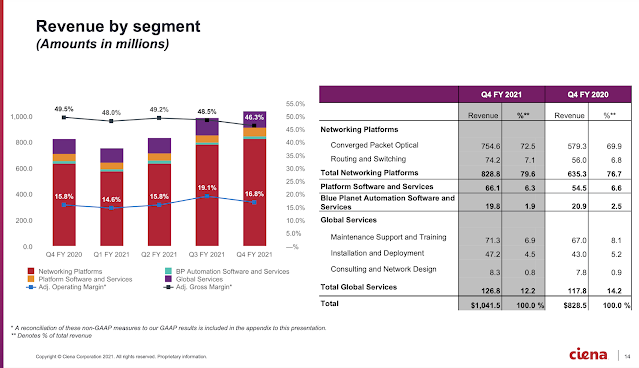
Ciena reports quarterly revenue of $1.04 billion, up 25.7% yoy

Ciena reported revenue of $1.04 billion for its fiscal fourth quarter ended October 30, 2021, an increase of 25.7% year over year. Q4 net income per share was $0.66 GAAP; $0.85 adjusted (non-GAAP), increasing 41.7% year over year.

“Our strong financial results exceeded our expectations in the fourth quarter and for the full fiscal year, driven by continued execution of our strategy and our demonstrated ability to manage supply chain challenges,” said Gary Smith, President and CEO, Ciena. “Looking ahead, we intend to continue driving growth in our business by leveraging our market leadership and investing to capitalize on robust demand dynamics. In addition, our strong balance sheet and cash generation expectations allow us to increase return of capital to our shareholders.”

For fiscal year 2021, Ciena reported revenue of $3.62 billion, as compared to $3.53 billion for fiscal year 2020.

On December 1, 2021, Ciena's Board of Directors authorized the repurchase of up to $1.0 billion of the company's stock, replacing the previous share repurchase authorization. In connection with this new authorization, the company intends to enter into an accelerated share repurchase (ASR) arrangement under which it will repurchase $250 million of its common stock. 

Some highlights:

  • WL5 Extreme (WL5e) total number of customers has reached 140 including 75 in 2021
  • 43 wins in the Routing and Switching portfolio
  • Blue Planet revenue grew 23% YoY
  • Commercially shipped its first 400 ZR pluggables, WL5 Nano
  • Non-telco represented 39% of total revenue
  • Direct web-scale contributed 18% of total revenue
  • APAC contributed 12% of total revenue


https://investor.ciena.com/overview/default.aspx?src=nav

HyperLight demos Hybrid Transmitter with DFB Laser on Thin-Film Lithium Niobate

HyperLight, in collaboration with Harvard University and Freedom Photonics, has demonstrated a breakthrough process of integrating high-power lasers on thin-film lithium niobate platform. 

The hybrid platform enabled the first high optical power transmitter chip consisting of an electrically pumped DFB laser integrated with HyperLight’s high-speed thin-film lithium niobate intensity modulator capable of operating at 60 mW output power and beyond 50 GHz electro-optic bandwidth.

The demonstration used DFB lasers for integration with thin-film lithium niobate because of their low cost, small footprint, and large output powers exceeding 100 mW. Using only passive-alignment and flip-chip thermo-compressive bonding, the DFB lasers emitted approximately 60 mW (17.8 dBm) of optical power into the thin-film lithium niobate waveguides. This will enable new architecture such as large arrays of high-power transmitters as well as unprecedented performance in optical links.

“We are very excited to be a part of this remarkable demonstration of the hybrid integration capability of the thin-film lithium niobate platform with other critical optical components,” said Mian Zhang, co-author, CEO of HyperLight. “The traditional bulk lithium niobate solutions are widely deployed but are limited in performance and applications due to the lack of integration. Our miniaturized thin film integrated solution combines the superior proven material property of lithium niobate with scalable silicon semiconductor processes at low cost. Hybrid integration of key active high-performance components such as DFB lasers with thin film lithium niobate results in best in class performance combined with low cost which opens up a lot of possibilities for those innovators who are looking into lower power consumption and lower cost solutions for optical networks beyond 800G and 1.6Tb/s.”

The results of the above demonstration are described in a manuscript by Amirhassan Shams-Ansari, et. al. entitled, “Electrically pumped high power laser transmitter integrated on thin-film lithium niobate,” (https://arxiv.org/abs/2111.08473). This effort is part of a DARPA funded program Lasers for Universal Microscale Optical Systems (LUMOS) which aims to bring high performance lasers and amplifiers to manufacturable photonics platforms through heterogeneous integration of diverse materials. 

http://www.hyperlightcorp.com

HyperLight and Nokia Bell Labs demonstrate 300 GBd for PAM-4 


HyperLight, a start-up based in Cambridge, MA developing thin-film lithium niobate (LN) photonic integrated circuits (PICs), and Nokia Bell Labs demonstrated a new record-breaking high-speed data transmission using its ultrahigh bandwidth, linear, and low noise thin-film lithium niobate Mach Zehnder (MZM) modulator.Using a HyperLight photonic chip, Nokia Bell Labs demonstrated a low complexity faster than Nyquist scheme without transmitter pre-processing...

HyperLight advances its thin-film lithium niobate PICs

HyperLight, a start-up based in Cambridge, Mass., cited progress in its development of thin-film lithium niobate photonic integrated circuits for next-generation 800 Gbps and beyond 1.6 Tbps optical networking systems.HyperLight claims its thin-film lithium niobate integrated photonics solution combines the proven superior material property of lithium niobate with an established and scalable integration process. The company has developed a thin-film...

HyperLight claims breakthrough with its lithium niobate optical modulator 

HyperLight, a start-up based in Cambridge, MA developing thin-film lithium niobate (LN) photonic integrated circuits (PICs), announced breakthrough voltage-bandwidth performances in integrated electro-optic modulators. HyperLight says its electro-optic PIC could lead to orders of magnitude energy consumption reduction for next generation optical networking.Current electro-optic modulators require extremely high radio-frequency (RF) driving voltages...