Sunday, November 22, 2020

Vantage acquires Hypertec’s Quebec data centers


Vantage Data Centers has acquired the hyperscale data center business from Hypertec in Montreal. Financial terms were not disclosed.

Hypertec’s 49MW campus includes 25MW across two existing facilities and 24MW of expansion capacity. The campus, located less than two miles from Vantage’s existing 11MW campus in Montreal, sits on 10 acres and will consist of 320,000 square feet once fully developed. Vantage will immediately begin construction of a third facility to complete the campus. The Hypertec data center team has joined Vantage.

The acquisition expands Vantage’s total footprint in the Province of Quebec to 81MW of IT capacity across three campuses.

“The acquisition of Hypertec enables Vantage to continue capitalizing on Montreal’s hyperscale growth given its access to scalable renewable energy, attractive power costs, tax incentives and robust fiber connectivity,” said Sureel Choksi, president and CEO, Vantage Data Centers. “Since entering the Canadian market in early 2019, Vantage has invested heavily in the region. We have been very impressed by the Hypertec data center team and are excited to welcome them to Vantage.”

“Vantage continues making significant investments in the Province of Quebec, and the Hypertec acquisition further cements our position as a leading hyperscale provider in Canada,” explained Maxime Guévin, vice president and general manager for Vantage Canada. “This increased capacity positions us to better serve our local and international customers, and we expect Montreal to benefit from the addition of more high-quality jobs and revenue coming into the region.”

This is Vantage’s third acquisition in 2020, including the purchase of Etix Everywhere in February and Next Generation Data (NGD) in July.

http://www.vantage-dc.com

Vantage raises US$1.25 billion in equity funding

Vantage Data Centers raised US$1.25 billion in incremental equity capital from its existing investors, led by Digital Colony. This funding will be used to fuel ongoing expansion and development across North America and Europe.“Hyperscale data center market demand remains strong, and this capital raise will allow Vantage to accelerate its global expansion of sustainable, large-scale campuses,” said Sharif Metwalli, CFO, Vantage Data Centers. “This...

Vantage Data Centers opens data center campus near Frankfurt

Vantage Data Centers inaugurated its first 15MW data center in Germany along with partners Energieversorgung Offenbach (EVO) and DataCenter-Group (DCG). The campus, located in Offenbach, will house three multi-story data centers totaling 55MW of critical IT capacity and 650,000 square feet (60,000 square meters) when fully developed. The opening of the Frankfurt campus is a key milestone in Vantage’s strategy to expand across Europe."The development...


Switch expands its Reno Data Centers

Switch signed a multi-year, multi-million dollar contract with an existing global e-commerce client to significantly grow its footprint at Switch's Citadel Campus in Northern Nevada. 

This transaction follows the previously announced multi-megawatt expansion from a leading developer of advanced semiconductor technologies. Switch says over 80% of its TAHOE RENO 1 facility is committed to clients, including space and power currently sold and future expansion options. The company will now commence construction on its TAHOE RENO 2 data center and begin site preparation work for the TAHOE RENO 3 data center.

"Accelerating development at our Citadel Campus reflects the strong customer demand for our strategically located, differentiated Tier 5® Platinum enterprise class exascale infrastructure," said Switch EVP of Strategy Adam Kramer. "This ongoing development means new job creation and economic investment for Nevada's economy."

At full build-out, the Citadel Campus footprint has the capacity to expand to more than 7 million square feet and over 600 MW of power capacity. The Citadel Campus is one of four exascale PRIME data center campus locations, a regional hub serving the Northwestern U.S., including San Francisco, Silicon Valley and the Pacific Northwest. The Switch PRIME data center campus locations serve North America's four primary latency zones.

The additional Switch PRIME campus locations are the Core Campus (Las Vegas, NV) which serves as a hub for the Southwestern U.S., including Los Angeles and Phoenix. The Pyramid Campus (Grand Rapids, MI) serves as a hub for the Northeastern U.S., including Chicago and New York. The Keep Campus (Atlanta, GA) serves as a hub for the Southeastern U.S., including Northern Virginia and Miami.


Marvell samples Alaska Octal Scalable mGig PHY

 Marvell has begun sampling its second-generation Alaska Octal Scalable mGig PHY family, its first optimized, low power dissipation, low footprint Octal 10M/100M/1G/2.5G/5G/10GBASE-T Ethernet transceivers with IEEE 1588v2 PTP support. 

The Octal mGig-10G 88X3580, a 10G PHY transceiver and the Octal mGig-5G  88E2580, a  2.5/5G PHY transceiver both exceed IEEE cable reach requirements, optimizing the number of access switch deployments and simplifying campus networking. The PHYs are the industry's first Octal 10G and 2.5/5G devices manufactured in 12nm FinFET advanced process technology, providing lower power consumption by up to 10% compared to the previous product generation.

Key features include:

  • Long cable reach performance: Exceeds IEEE standard requirements, 10-20% improvement compared with Marvell's previous generation Octal solution.
  • Low power consumption: The X3580 provides approximately 10% power reduction compared with Marvell's previous generation Octal solution.
  • Enhanced ESD/surge immunity
  • Enhanced EMI protection
  • Full Speed range (10M/100M/1G/2.5G/5G/10G)
  • Small footprint package (17mm x 17mm)
  • Dual media support (Optical and BASE-T)
  • USXGMII and legacy host interfaces (XFI, 5GBASE-R, 2500BASE-X, SGMII)

"Our new Octal mGig PHY family is designed to enable and accelerate emerging mobility and cloud applications by addressing the demand for bandwidth speed flexibility and lower power consumption," said Achyut Shah, vice president and general manager of the PHY BU at Marvell. "Together with our Prestera switches, the new high-density PHY devices offer an optimized performance and BOM cost solution. These make them ideal for mGig switch access use cases such as HD security cameras and Wi-Fi 6 access points including those for remote deployment beyond building structured wiring."

https://www.marvell.com/company/newsroom/marvell-expands-borderless-enterprise-portfolio-octal-scalable-mgig-phy-family.html

Ericsson picked for 5G by CETIN in Czech

Ericsson announced a 5-year contract with CETIN, a wholesale telecom infrastructure company, to bring 5G to the Czech Republic.

Ericsson is set to modernize more than 4,000 cellular sites across the full operational area of CETIN’s mobile network, covering two thirds of the Czech Republic, including the population-dense areas of Prague, Brno and Ostrava. 

CETIN, whose customers include T-Mobile and O2, are powering multiple network providers in Czech to bring 5G powered initiatives like connected utilities and healthcare to life, as well as huge opportunities for consumers such as AR/VR.

Juraj Sedivy, the Chairman of the Board of Directors, CETIN, says: “By partnering with Ericsson, we will build state-of-the-art, secure, and sustainable radio access resources for our clients, largest commercial telecommunication operators in the country. They will in turn use new generation of our network as a platform for unprecedented innovations and offer completely new range of services and functionalities for their end customers in the Czech Republic.”

Arun Bansal, President and Head of Europe and Latin America, Ericsson, says: “With the increasing demand for data and disruptive enterprise opportunities on the horizon, 5G offers amazing opportunities for the Czech Republic, and we’re very proud to be the partner of CETIN to make 5G a reality here. People all over the Czech Republic will benefit from Ericsson’s leading 5G portfolio, bringing the next generation of connectivity to transform everything from manufacturing to healthcare. This partnership will see a modernized mobile network with 5G capabilities that will enable crucial digital transformation for the country and give an economic boost that many need.”


Accenture buys Spanish engineering company for 5G expertise

Accenture has acquired Arca, a Spanish engineering services company with a focus on network operations and business services. 

Arca provides multidisciplinary services for network operations — including activities to engineer, design, deploy, and manage telecom infrastructure — supported by an integrated platform that automates network monitoring, optimizes processes and predicts system anomalies. The combination of these capabilities with Accenture’s SynOps platform will advance Accenture’s ability to help organizations pivot operating models to new sources of growth. Its 640 employees will join Accenture in Spain. Financial terms were not disclosed.

“5G, cloud and edge computing will usher in a new wave of change and innovation for businesses,” said Domingo Mirón, who leads Accenture’s business in Iberia. “To realize their full potential, companies must act now to adopt the right strategy and build new business solutions enabled by network investments. By harnessing Arca’s expertise, this acquisition will strengthen our ability to help clients accelerate their 5G Cloud network transformation from design through to deployment and operation.”

NEC enters strategic pact with AWS


NEC Corporation has entered into a strategic collaboration agreement with AWS, making it the first Japanese company to do so.

With the support of the AWS Professional Services team (new windowProServe), NEC will develop a framework of ready-to-deliver cloud services, including migration, integration, consulting and more, to support the acceleration of digital transformation among government and enterprises.

NEC will provide managed services optimized for multiple industry sectors to support AWS customers that require industry-specific regulations, such as government agencies, the financial sector, and healthcare. 


"NEC is pleased to be the first Japanese company to start a strategic collaboration with AWS. The combination of AWS's global know-how with NEC's experience will enable us to provide safe and secure cloud services to government and enterprise customers who are advancing the digital shift of large-scale mission-critical systems," stated Toshifumi Yoshizaki, Senior Vice President at NEC Corporation.

Claro Colombia conducts 5G trials with Nokia

Claro Colombia has launched an ambitious 5G trial program in four cities in partnership with Nokia.  The tests cover mobile, fixed wireless access (FWA) and corporate 5G services in 3.5GHz spectrum in Bogota, Medellin, Cali, and Barrancabermeja.

Nokia will supply its AirScale portfolio to support both indoor and outdoor coverage, including AirScale Base Stations, AirScale massive MIMO Adaptive Antenna solutions and other radio access network (RAN) solutions. Claro is also using Nokia Software solutions to operationalize the 5G RAN and Core networks, including SON (Self -Organizing Networks), subscriber data management, analytics, and performance monitoring.

The 5G trial is part of Claro’s nationwide 700 MHz spectrum deployment, targeting 1,348 sites in 30 provinces within a period of five years. 


Thursday, November 19, 2020

Nokia intros 25 Gbps symmetrical PON solution

Nokia introduced a 25 Gbps symmetrical PON fiber broadband solution based on its own Quillion chipset and existing next-generation PON access platform and line cards.


Nokia says 25G PON will be a key technology to enable fiber to become the single infrastructure that underpins the entire telecom industry and to deliver any service to any end point. It is also the best next step for PON: it leverages the high volumes and mature eco-system of data center optical technologies to achieve the best cost point, huge capacity, fastest time-to-market, and simplest evolution path compared to 50G PON, which will require a massive technology leap or long time to mature.

All customers with 10 Gbps Quillion boards will also now have 25 Gbps capabilities in their network. Nokia 25G PON can co-exist with GPON and XGS-PON on the same infrastructure, allowing CSPs to add 25 Gbps in overlay without disrupting existing customer services. This will allow them to add 25G PON quickly and efficiently when and where needed to capitalize on new opportunities.

Sandra Motley, President of Fixed Networks at Nokia, said: “Nokia continues to lead the PON evolution. We have a long history of firsts: from the first volume GPON deployments to the first 10G PON and next-generation access platforms. It is vital that we keep pushing and enable our customers to capitalize on new opportunities while fully leveraging their existing investments. By delivering a step-change increase in fiber broadband networks with our 25G PON solution, CSPs will be able to bring better broadband to consumers and businesses, both through fixed fiber and 5G mobile broadband.”


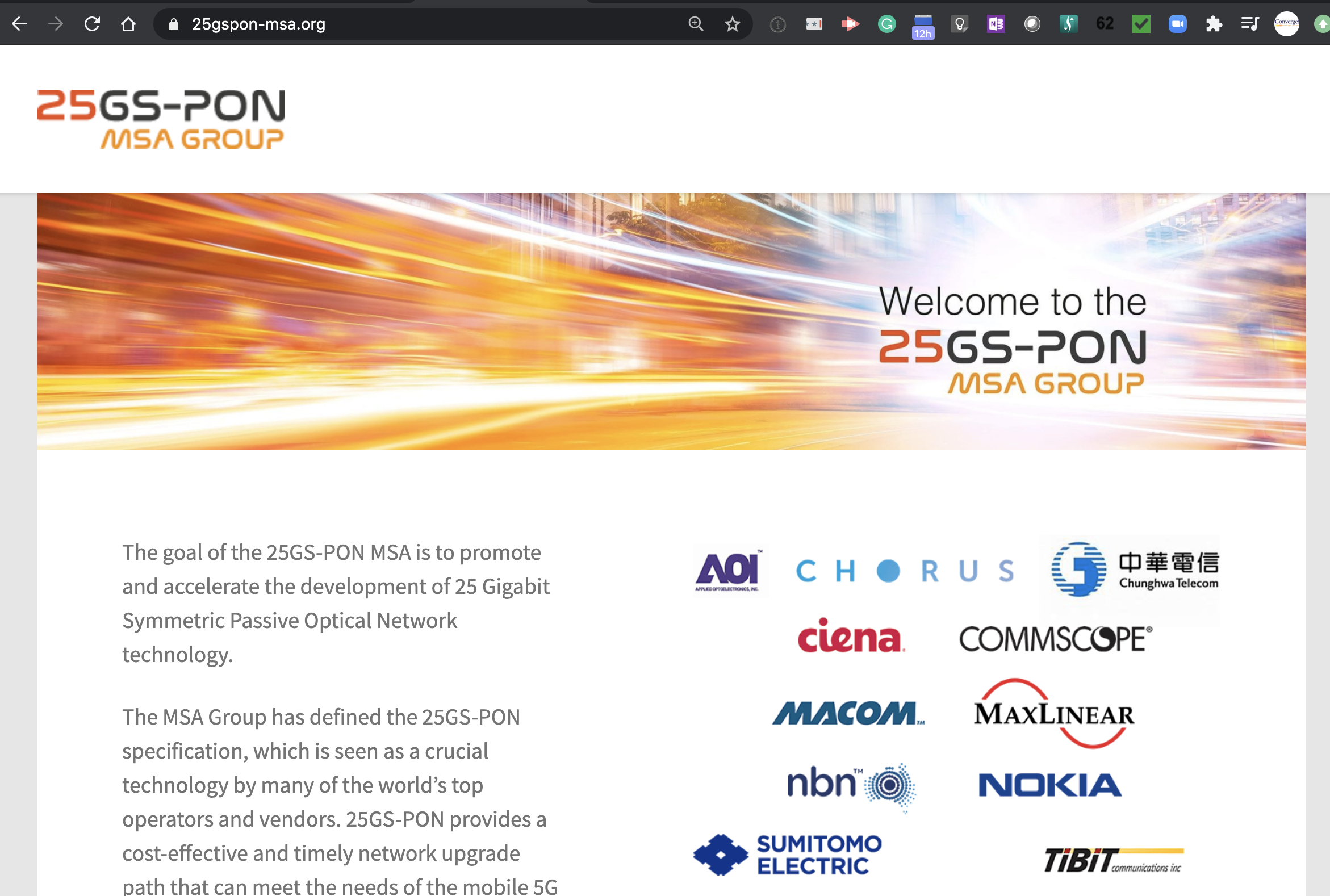
New 25GS-PON multisource agreement gets underway

A new 25G symmetric PON multi-source agreement (25GS-PON MSA) is underway with the goal of promoting and accelerating the development of 25GS-PON. 

The MSA Group has defined the 25GS-PON specification needed to address the gap between 10G XGS-PON and 50G PON in the ITU-T. The MSA was created after the ITU-T SG15/Q2 group did not reach consensus to standardize 25GSPON, which is seen as a crucial technology by many of the world’s top operators and vendors.

As a first step, the 25GS-PON MSA Group created a specification for 25GS-PON which includes optical specifications based on the IEEE 802.3ca 25G EPON standard, along with a Transmission Convergence (TC) layer that is an extension of XGS-PON. 

The MSA Group will also promote and catalyze the market development for 25GS-PON.

The founding members of the 25GS-PON MSA Group include: AOI, Chorus, Chunghwa Telecom, Ciena, MACOM, MaxLinear, NBN Co., Nokia, Sumitomo Electric Industries, Ltd, and Tibit Communications.

http://www.25gspon-msa.org


Cignal AI: EMEA optical and packet transport spending bounces back

European operators resumed purchases of optical and packet transport hardware in 3Q20 as COVID-related supply chain and operational delays eased, according to the most recent Transport Hardware Report from research firm Cignal AI. At the same time, North American spending weakness spread to the optical hardware segment as the region’s operators paused capex after aggressive deployments in the first half of the year.

“EMEA’s packet and optical transport sales growth was bolstered by sales deferred from Q2 and raised the market overall during the third quarter,” said Scott Wilkinson, Transport Hardware lead analyst at Cignal AI. “The outcome was different in North America, where sales were more frontloaded in the first two quarters than in EMEA, especially by the larger operators. NA annual CapEx budgets are largely exhausted, producing declining sales in the second half of the year for this region.”

Highlights:

  • Optical hardware spending grew by double-digits in EMEA, countering expectations of a flat-to-down quarter in optical spending. Nokia led the robust growth with a boost from sales deferred from Q2. Worldwide, optical hardware spending was up slightly.
  • Packet transport hardware spending also rose in EMEA but declined worldwide. EMEA packet transport revenue for both Huawei and Juniper grew by more than 20% YoY as the two companies gained ground on market leaders Cisco and Nokia.
  • North American optical and packet spending declined this quarter, as anticipated by vendors (Ciena, Cisco) with exposure to large network operators. Ciena continues to lead optical market share with slight YoY revenue growth, while Cisco maintains packet transport market leadership despite a sharp YoY revenue decline.

https://cignal.ai/2020/11/emea-optical-and-packet-transport-spending-bounces-back-in-3q20/

Dell'Oro: Optical transport equipment market grew 9% in 3Q 2020

Thanks to higher demand in Asia Pacific, optical transport equipment revenue increased 9 percent year-over-year in 3Q 2020 reaching $3.8 billion, according to a new report from Dell'Oro Group.

“Sales slowed in North America following a strong first half of the year,” said Jimmy Yu, Vice President at Dell’Oro Group. “Whether it was due to network demand caused by people working and studying from home or new projects at the beginning of the year, the demand for optical equipment in the region rose 11 percent in the first half of 2020. But I think there was enough concern surrounding the longevity of the pandemic that service providers grew cautious and refrained from overextending their capital. As a result, optical revenue in North America declined 7 percent in the third quarter,” continued Yu.


Highlights:

  • Growth in Asia Pacific more than offset the lower revenue in North America and Latin America. 
  • Optical revenue grew 22 percent year-over-year in Asia Pacific, driven largely by higher deployments in China and Japan. 
  • With lockdown restrictions easing, some regions such as Middle East and Africa (MEA), significantly rebounded in the quarter following a sharp decline in 1H 2020. 
  • Sales in China, Japan, and MEA each grew over 25 percent.

https://www.delloro.com/news/optical-transport-equipment-market-grew-9-percent-in-3q-2020-to-3-8-billion/

Dell'Oro: Surging demand for 5G accelerates RAN growth

Preliminary readings indicate that the positive momentum that has characterized the radio access network (RAN) market since the upswing began in the second half of 2018 extended into the third quarter, with surging demand for 5G propelling the RAN market to robust year-over-year growth, according to Dell'Oro Group.

“While we correctly identified that the RAN market would appear disconnected from the underlying economy throughout this year, we also underestimated the pace and the magnitude of these 5G rollouts,” said Stefan Pongratz, analyst with the Dell’Oro Group. “This shift from 4G to 5G, including low-band-and mid-band 5G NR, continued to accelerate at a torrid pace in the quarter, underpinned by stronger-than-expected 5G activity in multiple regions.”


Highlights:

  • RAN revenue shares were impacted to some degree by the state of the 5G rollouts in China and North America, resulting in share gains for both Huawei and ZTE over the 1Q20-3Q20 period.
  • The near-term outlook remains favorable for both macro and small cells, with combined 2020 and 2021 2G-4G and 5G base station shipments projected to eclipse 10 M units.
  • We have adjusted the near-term RAN market outlook upward, to reflect stronger than expected activity in China, Europe, and North America, with total RAN projected to approach $70 B to $80 B for the combined 2020 and 2021 period.

IBM to acquire Instana for AIOps application monitoring

IBM will acquire Instana, an application performance monitoring and observability company based in Chicago and with a development center in Germany. Financial terms were not disclosed.

Instana provides businesses with capabilities to manage the performance of complex and modern cloud-native applications no matter where they reside – on mobile devices, public and private clouds and on-premises, including IBM Z.  Instana's enterprise observability platform automatically builds a deep contextual understanding of cloud applications and provides actionable insights to indicate how to best prevent and remedy IT issues that could damage the business or reduce customer satisfaction -- such as slow response times, services that aren't working or infrastructure that is down.

Once Instana's capabilities are integrated into IBM, companies will be able to feed these insights into Watson AIOps. The information could then be compared to a baseline of a normal operating application, with AI triggering alerts to resolve issues quickly before negative impacts to that transaction or activity. This can help eliminate the need for IT staff to manually monitor and manage applications, freeing these employees to focus on innovation and higher value work. 

"With the added responsibility of ensuring the build and run quality of the software they develop, DevOps teams need a new generation of application performance monitoring and observability capabilities to succeed," said Mirko Novakovic, co-founder and CEO, Instana. "Instana's observability capabilities combined with IBM's AI-powered automation capabilities across hybrid cloud environments will give clients a full view of their application performance to best optimize operations."

https://www.ibm.com/cloud/blog/ibm-and-instana

Verizon to install private 5G Ultra Wideband for GM, Honeywell

Verizon will install its 5G Ultra Wideband service inside the corporate offices of General Motors and Honeywell to help drive digital transformation initiatives.

General Motors (GM) and Verizon Business partnered to install 5G Ultra Wideband at GM’s recently announced Detroit-Hamtramck Assembly Center, known as Factory ZERO, an all-electric vehicle (EV) assembly plant. 

Honeywell is installing Verizon’s 5G Ultra Wideband inside their new corporate headquarters in Charlotte. The service will serve their Innovation Center and Executive Leadership floor, where they will showcase different Honeywell products and solutions that benefit from the high bandwidth and low latency provided by Verizon 5G Ultra Wideband.


“If the past few months have taught us anything, it’s that the acceleration to digital will only get faster and our customers must seize this moment to scale quickly, and General Motors and Honeywell are two industry-leading companies that are first movers in this area,” said Tami Erwin, CEO of Verizon Business.“We’ve opened the door to the 5G era and have a once-in-a-lifetime opportunity to completely reimagine the future of enterprise. Foundational to this is the power of Verizon’s 5G network coupled with our expanding portfolio of enterprise cloud applications and devices, including the powerful, new iPhone 12 lineup.”

Apple and Verizon also announced Verizon 5G Fleet Swap, a first-of-its-kind program that allows customers to trade in their entire fleet of smartphones, from Verizon or any carrier, and upgrade to any model in the iPhone 12 lineup for zero upfront cost, with zero to low cost per month.

“The iPhone 12 lineup is the best for business, with an all-new design, advanced 5G experience, industry-leading security and A14 Bionic, the fastest chip ever in a smartphone,” said Susan Prescott, Apple’s vice president of Markets, Apps and Services. “Paired with Verizon’s 5G Ultra Wideband going indoors and 5G Fleet Swap, an all-new device offer for enterprise, it’s now easier than ever for businesses to build transformational mobile apps that take advantage of the powerful iPhone 12 lineup and 5G.”

Vantage raises US$1.25 billion in equity funding

Vantage Data Centers raised US$1.25 billion in incremental equity capital from its existing investors, led by Digital Colony. This funding will be used to fuel ongoing expansion and development across North America and Europe.


“Hyperscale data center market demand remains strong, and this capital raise will allow Vantage to accelerate its global expansion of sustainable, large-scale campuses,” said Sharif Metwalli, CFO, Vantage Data Centers. “This capital raise demonstrates our investors’ continued commitment to Vantage’s strategic growth plan.”

“The Vantage team continues to do an amazing job supporting the growth of their hyperscale customers as they expand in North America and increasingly throughout Europe,” said Marc Ganzi, president and CEO of Colony Capital and Digital Colony. “Supporting the strategic development and financing of our partner companies is a key pillar of Digital Colony’s alpha-creation strategies, so we’re thrilled to be a part of Vantage’s next big step forward.”

Vantage Data Centers opens data center campus near Frankfurt

Vantage Data Centers inaugurated its first 15MW data center in Germany along with partners Energieversorgung Offenbach (EVO) and DataCenter-Group (DCG). 

The campus, located in Offenbach, will house three multi-story data centers totaling 55MW of critical IT capacity and 650,000 square feet (60,000 square meters) when fully developed. The opening of the Frankfurt campus is a key milestone in Vantage’s strategy to expand across Europe.

"The development of this campus in one of the most sought-after markets in Europe is the first milestone in our USD $2 billion European expansion strategy,” said Antoine Boniface, president, Vantage Europe. “Many of our customers need to be in Europe for a variety of reasons, whether it’s to reduce latency or to comply with local privacy laws. Offenbach is an ideal location, located within one kilometer of the main peering points and just 15 minutes from Frankfurt’s international airport."

The Frankfurt campus was part of the acquisition of Etix Everywhere in February 2020, which Vantage announced along with greenfield developments in Berlin, Milan, Warsaw and Zurich.

Vantage Data Centers gains strategic backing from Colony Capital

Vantage Data Centers announced a strategic partnership valued at $3.5 billion to accelerate the expansion of its wholesale data centers throughout North America and Europe.

Specifically, the Colony-led investor group will invest $1.2 billion in Vantage’s diversified portfolio, including 12 stabilized North American data centers, which span more than 1.4 million gross square feet and 150MW of IT capacity across key strategic markets in Santa Clara, California; Quincy, Washington; Montreal and Quebec City, Canada.

Vantage’s management team, led by Sureel Choksi, president and CEO, will continue to manage and operate these assets as part of its global data center footprint. Vantage will maintain the same level of superior service to its valued customers in each market, while simultaneously developing and operating additional data centers throughout North America and Europe. The capital provided by this transaction will support Vantage’s strategy to expand and enhance its global footprint.

http://www.vantage-dc.com

Wednesday, November 18, 2020

FCC opens 5.9 GHz band for Wi-Fi and C-V2X


The FCC adopted new rules for the 5.9 GHz band (5.850-5.925 GHz) to make new spectrum available for unlicensed uses, such as Wi-Fi, and improve automotive safety.  Specifically, the new band plan designates the lower 45 megahertz (5.850-5.895 GHz) for unlicensed uses and the upper 30 megahertz (5.895-5.925 GHz) for enhanced automobile safety using Cellular Vehicle-to-Everything (C-V2X) technology.

The FCC said the spectrum’s impact will be further amplified by the fact that it is adjacent to an existing Wi-Fi band which, when combined with the 45 megahertz made available today, will support cutting-edge broadband applications.  These high-throughput channels—up to 160 megahertz wide—will enable gigabit Wi-Fi connectivity for schools, hospitals, small businesses, and other consumers.  The Report and Order adopts technical rules to enable full-power indoor unlicensed operations in the lower 45 megahertz portion of the band immediately, as well as opportunities for outdoor unlicensed use on a coordinated basis under certain circumstances.  Under the new rules, ITS services will be required to vacate the lower 45 megahertz of the band within one year.  

The new rules also will improve automotive safety by reserving the upper 30 megahertz of the band for Intelligent Transportation System (ITS) services and designating C-V2X as the technology standard for safety-related transportation and vehicular communications.  C-V2X uses cellular protocols to provide direct communications between vehicles and obstacles like other vehicles, cyclists, pedestrians, and road workers, and to receive safety information from roadside transmitters.  

https://www.fcc.gov/document/fcc-modernizes-59-ghz-band-improve-wi-fi-and-automotive-safety


NVIDIA intros Mellanox 400G InfiniBand - the 7th generation

NVIDIA introduced the seventh generation of Mellanox InfiniBand delivering ultra-low latency and double data throughput with NDR 400Gb/s, as well as new NVIDIA In-Network Computing engines to provide additional acceleration.

NVIDIA Mellanox 400G InfiniBand offers 3x the switch port density and boosts AI acceleration power by 32x. In addition, it surges switch system aggregated bi-directional throughput 5x, to 1.64 petabits per second, enabling users to run larger workloads with fewer constraints.


Edge switches, based on the Mellanox InfiniBand architecture, carry an aggregated bi-directional throughput of 51.2Tb/s, with a landmark capacity of more than 66.5 billion packets per second. The modular switches, based on Mellanox InfiniBand, will carry up to an aggregated bi-directional throughput of 1.64 petabits per second, 5x higher than the last generation.

NVIDIA said the world’s leading infrastructure manufacturers — including Atos, Dell Technologies, Fujitsu, GIGABYTE, Inspur, Lenovo and Supermicro — plan to integrate NVIDIA Mellanox 400G InfiniBand into their enterprise solutions and HPC offerings. These commitments are complemented by extensive support from leading storage infrastructure partners including DDN and IBM Storage, among others.

“The most important work of our customers is based on AI and increasingly complex applications that demand faster, smarter, more scalable networks,” said Gilad Shainer, senior vice president of networking at NVIDIA. “The NVIDIA Mellanox 400G InfiniBand’s massive throughput and smart acceleration engines let HPC, AI and hyperscale cloud infrastructures achieve unmatched performance with less cost and complexity.”

“Microsoft Azure’s partnership with NVIDIA Networking stems from our shared passion for helping scientists and researchers drive innovation and creativity through scalable HPC and AI. In HPC, Azure HBv2 VMs are the first to bring HDR InfiniBand to the cloud and achieve supercomputing scale and performance for MPI customer applications with demonstrated scaling to eclipse 80,000 cores for MPI HPC,” said Nidhi Chappell, head of product, Azure HPC and AI at Microsoft Corp. “In AI, to meet the high-ambition needs of AI innovation, the Azure NDv4 VMs also leverage HDR InfiniBand with 200Gb/s per GPU, a massive total of 1.6Tb/s of interconnect bandwidth per VM, and scale to thousands of GPUs under the same low-latency InfiniBand fabric to bring AI supercomputing to the masses. Microsoft applauds the continued innovation in NVIDIA’s Mellanox InfiniBand product line, and we look forward to continuing our strong partnership together.”


“High-performance interconnects are cornerstone technologies required for exascale and beyond. Los Alamos National Laboratory continues to be at the forefront of HPC networking technologies,” said Steve Poole, chief architect for next-generation platforms at Los Alamos National Laboratory. “The Lab will continue their relationship working with NVIDIA in evaluating and analyzing their latest 400Gb/s technology aimed at solving the diverse workload requirements at Los Alamos.”


“Amid the new age of exascale computing, researchers and scientists are pushing the limits of applying mathematical modeling to quantum chemistry, molecular dynamics and civil safety,” said Professor Thomas Lippert, head of the Jülich Supercomputing Centre. “We are committed to leveraging the next generation of Mellanox InfiniBand to further our track record of building Europe’s leading, next-generation supercomputers.”


https://nvidianews.nvidia.com/news/nvidia-announces-mellanox-infiniband-for-exascale-ai-supercomputing

PacketLight debuts 4x400G transponder/muxponder

PacketLight Networks announced the release of its PL-4000T transponder/muxponder supporting any mix of 100GbE, OTU4 or 400GbE services over 400G wavelengths for high capacity DCI, metro, and long-haul applications.  for service providers, enterprise, campus, government, and cloud computing networks.

The PL-4000T modular, standards-based device can serve as either a 4x100GbE muxponder or 1x400GbE transponder per slice using pluggable optical modules. In addition, the PL-4000T strengthens data security by supporting Layer-1 encryption based on GCM-AES-256 standards and Diffie-Hellman (DH) Key Exchange.

The PL-4000T supports standard MSA pluggable modules QSFPDD, CPF2-DCO, and QSFPDD-DCO, and industry standard OFEC and CFEC. The modules reduce power consumption by more than 70 percent and improve port density per 1U compared with existing proprietary, bulky solutions on the market.

The solution integrates EDFA, mux/demux, and an optical switch for fiber protection, delivering the entire DWDM/OTN end-to-end infrastructure solution in a 1U form factor. The PL-4000T provides a full demarcation point between the 100GbE, OTU4, and 400GbE client service and the DWDM and is interoperable with any third-party vendors’ switches and routers.

“We are focused on our customers’ needs to expand their networks faster than ever by providing them with the benefits of our latest technology,” says Koby Reshef, CEO of PacketLight Networks. "Our solution enables migration to 400G networks with optimal cost and performance, while supporting the OIF ZR, OpenZR+, and Open ROADM standards.”

https://www.packetlight.com/about/press-releases/packetlight-400g-transponder-muxponder


ProLabs launches 100G/200G CFP2-DCO transceivers

ProLabs launched its new 100G/200G CFP2-DCO coherent optical transceivers supporting long campus-to-campus ranges.

THE CFP2-DCO transceivers can transmit highly efficient DWDM signals at 100G (or 200G) data rates up to 80 kilometers without the need for amplification. Coherent optics enhance performance in edge and long haul/transport applications, such as edge-to-core or remote-to-metropolitan fiber runs.

"To achieve the data rates and reach needed to meet future data demands, core network infrastructure must evolve despite the cost," said Patrick Beard, Chief Technology Officer at ProLabs. "Migrating from current configurations to new coherent technologies not only provides immediate, cost-effective 100G relief for long haul bottlenecks, but also establishes a reliable foundation for scaling into 200G."

ProLabs says its coherent optical solutions are interoperable in environments with switches and routers from Cisco, Dell, and Edge-core.

https://www.prolabs.com/solutions/coherent-optics-open-the-door-to-100g-200g-over-long-distances

NVIDIA posts record Q3 sales of $4.73, "firing on all cylinders"


NVIDIA reported record Q3 revenue of $4.73 billion, up 57 percent from $3.01 billion a year earlier, and up 22 percent from $3.87 billion in the previous quarter. GAAP earnings per diluted share for the quarter were $2.12, up 46 percent from $1.45 a year ago, and up 114 percent from $0.99 in the previous quarter. Non-GAAP earnings per diluted share were $2.91, up 63 percent from $1.78 a year earlier, and up 33 percent from $2.18 in the previous quarter.

“NVIDIA is firing on all cylinders, achieving record revenues in Gaming, Data Center and overall,” said Jensen Huang, founder and CEO of NVIDIA. “The new NVIDIA GeForce RTX GPU provides our largest-ever generational leap and demand is overwhelming. NVIDIA RTX has made ray tracing the new standard in gaming.

“We are continuing to raise the bar with NVIDIA AI. Our A100 compute platform is ramping fast, with the top cloud companies deploying it globally. We swept the industry AI inference benchmark, and our customers are moving some of the world’s most popular AI services into production, powered by NVIDIA technology.

“We announced the NVIDIA DPU programmable data center processor, and the planned acquisition of Arm, creator of the world’s most popular CPU. We are positioning NVIDIA for the age of AI, when computing will extend from the cloud to trillions of devices.”

Highlights:

  • Data Center - Third-quarter revenue was a record $1.90 billion, up 8 percent from the previous quarter and up 162 percent from a year earlier.
  • Gaming - Third-quarter revenue was a record $2.27 billion, up 37 percent from the previous quarter and up 37 percent from a year earlier.
  • Unveiled the GeForce RTX® 30 Series GPUs, powered by the NVIDIA Ampere architecture and the second generation of RTX, with up to 2x the performance of the previous Turing-based generation.
  • Professional Visualization - Third-quarter revenue was $236 million, up 16 percent from the previous quarter and down 27 percent from a year earlier.
  • Automotive - Third-quarter revenue was $125 million, up 13 percent from the previous quarter and down 23 percent from a year earlier.


Nokia and Qualcomm hit record 8 Gbps on commercial 5G mmWave network

Nokia, Elisa and Qualcomm Technologies achieved a record 8 Gbps from a 5G base station over a commercial network. 

The fast speed, which was showcased at Elisa’s flagship store in Helsinki, Finland, delivered 8 Gbps to two 5G mmWave devices connected simultaneously.  

The milestone was achieved by utilizing Nokia’s 5G mmWave technology and Qualcomm Technologies’ 5G smartphone form factor test devices over Elisa’s commercial 5G network. The base station utilized two Nokia AirScale radios, each using 800 MHz of commercial millimeter wave 5G spectrum at 26 GHz. These provided connectivity to two 5G smartphone form factor test devices powered by a Qualcomm Snapdragon X55 5G Modem-RF System featuring second-generation Qualcomm® QTM525 mmWave antenna modules, with each device reaching 4 Gbps peak speeds from the base station.


Sami Komulainen, executive vice president, production, Elisa, said, “This is an important development and another step in our efforts to bring the fastest speeds and best 5G experiences to our customers. Elisa was the first in Finland and amongst first in the world to deploy 5G. Reaching 8Gbps is a natural step in our 5G development and we want to explore the possibilities 5G offers and push the technology further to benefit our customers.”

Tommi Uitto, president, mobile networks, Nokia, commented, “We are proud to work with our partners on this important and significant achievement that will deliver incredible 5G experiences to people and businesses in Finland. This is another milestone in the development of 5G services and demonstrates the capacity of our commercially deployed 5G solutions.”