Monday, May 27, 2019

NVIDIA unveils EGX Edge Computing Platform

NVIDIA introduced its EGX edge computing platform for performing low-latency AI on continuous streaming data between 5G base stations or other edge locations.

NVIDIA said EGX was created to perform instantaneous, high-throughput AI where data is created – with guaranteed response times, while reducing the amount of data that must be sent to the cloud.

“Enterprises demand more powerful computing at the edge to process their oceans of raw data — streaming in from countless interactions with customers and facilities — to make rapid, AI-enhanced decisions that can drive their business,” said Bob Pette, vice president and general manager of Enterprise and Edge Computing at NVIDIA. “A scalable platform like NVIDIA EGX allows them to easily deploy systems to meet their needs on premises, in the cloud or both.”

EGX begins with the tiny NVIDIA Jetson Nano, which delivers one-half trillion operations per second (TOPS) of processing in only a few watts, and scales all the way to a full rack of NVIDIA T4 servers, delivering more than 10,000 TOPS.

EGX servers are available from global enterprise computing providers ATOS, Cisco, Dell EMC, Fujitsu, Hewlett Packard Enterprise, Inspur and Lenovo. They are also available from major server and IoT system makers Abaco, Acer, ADLINK, Advantech, ASRock Rack, ASUS, AverMedia, Cloudian, Connect Tech, Curtiss-Wright, GIGABYTE, Leetop, MiiVii, Musashi Seimitsu, QCT, Sugon, Supermicro, Tyan, WiBase and Wiwynn.

NVIDIA EGX servers are tuned for NVIDIA Edge Stack and NGC-Ready validated for CUDA-accelerated containers.

NVIDIA has partnered with Red Hat to integrate and optimize NVIDIA Edge Stack with OpenShift. NVIDIA Edge Stack is optimized software that includes NVIDIA drivers, a CUDA Kubernetes plugin, a CUDA container runtime, CUDA-X libraries and containerized AI frameworks and applications, including TensorRT, TensorRT Inference Server and DeepStream.

NVIDIA is also promoting “On-Prem AI Cloud-in-a-Box”, which combines the full range of NVIDIA AI computing technologies with Red Hat OpenShift and NVIDIA Edge Stack together with Mellanox and Cisco security, networking and storage technologies.

“Mellanox Smart NICs and switches provide the ideal I/O connectivity for data access that scale from the edge to hyperscale data centers,” said Michael Kagan, chief technology officer at Mellanox Technologies. “The combination of high-performance, low-latency and accelerated networking provides a new infrastructure tier of computing that is critical to efficiently access and supply the data needed to fuel the next generation of advanced AI solutions on edge platforms such as NVIDIA EGX.”

“Cisco is excited to collaborate with NVIDIA to provide edge-to-core full stack solutions for our customers, leveraging Cisco’s EGX-enabled platforms with Cisco compute, fabric, storage, and management software and our leading Ethernet and IP-based networking technologies,” said Kaustubh Das, vice president of Cisco Computing Systems.

https://nvidianews.nvidia.com/news/nvidia-launches-edge-computing-platform-to-bring-real-time-ai-to-global-industries

Arm unveils next gen Cortex CPU for 5G

Arm unveiled its latest Cortex-A77 CPU, promising a 20% performance improvement over current generation Cortex-A76 devices.

The new Cortex-A77, which targets smartphones, laptops, and other mobile devices, is positioned as Arm's Cortex-A77 5G-ready processor. It will be implemented in 7nm. The company notes that the past two generations of Cortex-A7x series processors (Cortex-A76 and Cortex-A77) have increased overall ML performance by 35x.

Arm is also introducing its Mali-G77 GPU, which leverages its new Valhall architecture to deliver a nearly 40% performance improvement over the previous Mali-G76 devices. Mali-G77 also boasts key microarchitecture enhancements including engine, texture pipes, and load store caches, which achieve 30% better energy efficiency and 30% more performance density. 

In addition, Cadence Design Systems announced that its full-flow digital and signoff tools support the new Arm Cortex-A77 CPU. Cadence delivered a complete 7nm Rapid Adoption Kit (RAK) that utilizes Arm 7nm POP™ IP libraries.

https://www.arm.com/company/news/2019/05/delivering-next-generation-ai-experiences-for-the-5g-world

Vodafone to host mobile gaming over 5G

Vodafone will host a mobile gaming tournament with the final round to be played live over its 5G network.

The Vodafone 5G ESL Mobile Open will commence on 31 May and run until 29 September 2019, and is open to players from 17 countries where Vodafone is present.  The competition features two popular online mobile games: arcade racer Asphalt 9: Legends; and multiplayer battle royale title, PUBG MOBILE.

Vodafone said tThe Grand Finals for both games will be contested live only on Vodafone’s 5G network at Milan Games Week on 28-29 September, providing a major showcase of Vodafone’s high-speed, real-time 5G network for gaming.

There is a total prize fund of €165,000 for all placing Vodafone 5G ESL Mobile One live finalists, including a top prize of €14,000 for the winning Asphalt 9: Legends player and a top prize of €40,000 in total for the victorious PUBG MOBILE team.

https://pro.eslgaming.com/mobileopen/home

Wiwynn offers edge server based on OCP OpenEDGE

Taiwan-based Wiwynn introduced an Edge Platform based on the Nokia-led OCP OpenEDGE specification.

Wiwynn EP100 is a 3U edge system that supports up to five 1U half-width servers and can flexibly configure with 2U half-width and 1U full-width server sleds. Communication service providers can also scale computing power by adding more EP100 systems for applications ranging from base stations to regional central offices.

“We are thrilled to embrace edge cloud opportunities in the 5G era by applying Open Compute Project (OCP) hardware and initiating an open firmware development kit,” said Dr. Sunlai Chang, Senior Vice President and CTO of Wiwynn. “Wiwynn EP100 enables communication service providers to address diverse low-latency data processing demands of Cloud RAN and modern central offices with a flexible and high-efficiency architecture at a balanced cost.”

“Nokia AirFrame open edge launched April 2018 welcomes Wiwynn’s adoption of the Nokia led OCP OpenEDGE specification, with this announcement of a new equipment provider for enclosure and sled designs. Wiwynn’s contribution to OCP OpenEDGE is an important step forward in the creation of a healthy ecosystem and providing Far Edge Data Center Equipment consumers with multi-source procurement options to avoid vendor lock-in,” said Hannu Nikurautio, Head of Cloud RAN Product Management of Nokia.

Innovium showcases switching silicon at Computex Taipei

At this week's Computex 2019 in Taipei, Innovium is showcasing its 12.8Tbps TERALYNX Ethernet switching technology.

Demonstrations will include interoperability with a broad range of 100-400G optics, DAC, ACC, re-timer/gearbox, and comprehensive software and SDK, including integration with latest and highly robust Software for Open Networking in the Cloud (SONiC) software.

https://www.innovium.com

Telstra launches its first 5G device, the HTC 5G Hub

Telstra launched its first commercial 5G mobile device, the HTC 5G Hub.

The HTC 5G Hub is a 5G/4GX media hotspot that can function as a secure mobile corporate solution or a family entertainment hub.

“Our launch of the HTC 5G Hub is the moment 5G becomes a reality for Australian consumers,” Mr Penn said. “Since 2016, we have been working with some of the world’s leading technology brands to ensure Australians are among the first in the world to be able to access 5G. HTC has been a key partner for Telstra, innovating new technologies and driving greater connectivity for our customers. This launch of Australia’s first 5G mobile device is a testament to that partnership" Mr Penn continued “and we are proud to be launching it today,” stated Telstra’s CEO Andrew Penn.

Thomas Dexmier, Country Manager HTC Australia and New Zealand said, “HTC is very proud to partner with Telstra to bring the first 5G media hotspot to Australia. With the HTC 5G Hub, customers will be able to experience the power and speed of Telstra’s 5G network in an innovative device, that combines the advanced capabilities of a mobile hotspot with the versatility of the Android operating system, allowing them to connect at home, at work, and on the go.”

Friday, May 24, 2019

China's Semiconductor Manufacturing International leaves NYSE

Citing low trading volume, Shanghai-based Semiconductor Manufacturing International Corporation (SMIC) notified the New York Stock Exchange of its intend to delist its  American depositary shares (NYSE: SMI).  The delisting of the ADSs from the NYSE is expected to become effective around June 13, 2019.

SMIC provides integrated circuit (IC) foundry and technology services on process nodes from 0.35 micron to 28 nanometer. It is the largest foundry company in mainland China by scale. SMIC has a 300mm wafer fabrication facility (fab) and a 200mm fab in Shanghai; a 300mm fab and a majority-owned 300mm fab for advanced nodes in Beijing; 200mm fabs in Tianjin and Shenzhen; and a majority-owned joint-venture 300mm bumping facility in Jiangyin; additionally, in Italy SMIC has a majority-owned 200mm fab.

Thursday, May 23, 2019

SpaceX launches the first 60 Starlink LEO satellites

SpaceX successfully launched the first 60 satellites of its Starlink LEO constellation.

SpaceX has disclosed plans to deploy as many as 12,000 satellites in three, low earth orbit (LEO) shells. Cost estimates for full deployment approach $10 billion.

The launch used a SpaceX Falcon 9 rocket with a first stage that had previously been used on the Telstar 18 VANTAGE mission in September 2018 and the Iridium-8 mission in January 2019. Following the launch, the booster successfully landed on the “Of Course I Still Love You” droneship, which was stationed in the Atlantic Ocean.

The Starlink satellites were deployed at an altitude of 440km. Onboard propulsion was then used to boost each satellite to an operational altitude of 550km.

The Starlink satellites feature a flat-panel design with multiple high-throughput antennas and a single solar array. Each Starlink satellite weighs approximately 227kg.

SpaceX also said the Starlink satellites are able to track and maneuver around orbiting space debris using thrusters powered by Krypton.

https://www.spacex.com/sites/spacex/files/starlink_mission_press_kit.pdf


Vertical Systems Group: 2018 U.S. Carrier Managed SD-WAN LEADERBOARD

Vertical Systems Group announces that eight companies achieved a position on
AT&T achieved the top position on Vertical Systems Group's 2018 U.S. Carrier Managed SD-WAN Services LEADERBOARD.

The top eight companies (in rank order): AT&T, Hughes, Verizon, Windstream, CenturyLink, Aryaka, Fusion and Comcast. These companies had the highest market shares of installed Carrier Managed SD-WAN customer sites in the U.S. as of year-end 2018.

"Providers in the Carrier Managed segment of the SD-WAN market have emerged as the best choice for delivering large scale, complex and resilient SD-WAN services end-to-end," said Rick Malone, principal of Vertical Systems Group. "We believe that network operators with deep experience in MPLS, Ethernet and IP are most favorably positioned to support enterprise customers as they transition their networks to SDN."

Companies with the next largest market shares in this segment are cited in the Challenge Tier. The following six companies attained a Challenge Tier citation for 2018 (in alphabetical order): Bigleaf, GTT, Masergy, Meriplex, Sprint, and TPx.

Research Highlights

  • SD-WAN is one of the three Managed VPN segments that Vertical tracks, along with MPLS and Site-to-Site VPNs. Service migration analysis shows that the majority of Carrier Managed SD-WAN service installations to date are hybrid configurations that include partial conversions of existing Site-to-Site and MPLS networks.
  • The top five Carrier Managed SD-WAN companies are also the leading providers of Dedicated IP VPN services, including landline and satellite connectivity.
  • A number of SDN-based technologies are utilized to deliver Carrier Managed SD-WAN services. The fourteen LEADERBOARD and Challenge Tier providers use products from the following companies (in alphabetical order): Cisco/Viptela, Silver Peak, Versa, and VMware/VeloCloud, or employ their own internally developed technologies. Several SD-WAN service providers offer multiple solutions.
  • Vertical Systems Group defines a Carrier Managed SD-WAN Service as a carrier-grade offering for business customers that is managed by a network operator, utilizes an SDN architecture, enables dynamic customer edge site connectivity, and provides centralized network control and visibility end-to-end. This definition aligns with MEF terminology for an SD-WAN service.

https://www.verticalsystems.com/2019/05/21/2018-sd-wan-us-leaderboard/

Huawei pitches 5G Deterministic Networking

Huawei is proposing a Deterministic Networking framework to deliver differentiated services in 5G.

In a keynote delivered at the 3rd Future Network Development Conference in Nanjing, Jason (Jisheng) Dai, President of Strategy & Business Development Department of Huawei Cloud Core Network, said cloud-native technology, dynamic intelligent network slicing, and heterogeneous mobile edge computing (MEC) can be leveraged to deliver deterministic performance for latency, packet loss and jitter. These will enable mobile networks to evolve from "best effort" to "guaranteed performance."

Huawei also noted that it is working with industry partners in smart grids, 5G V2X, VR games, 4K/VR live broadcast, and telemedicine to verify 5G deterministic networking and templates for differentiated, deterministic network service capabilities in many vertical applications.

https://www.huawei.com/en/press-events/news/2019/5/huawei-5g-deterministic-networking

Credo announces MACsec device for 400G

Credo introduced a family of PHY devices supporting the IEEE 802.1AE media access controller security (MACsec) and internet protocol security (IPSec) standard for 10G through 400G port interconnects. The MACsec devices integrate 256-bit AES technology.

Credo said its new family of devices addresses security requirements for various Ethernet data link configurations in enterprise, cloud-scale data center, and service provider networks for both commercial and government deployments. This includes links between servers, switches, and routers.

"Adding security functionality to our industry-leading retimer and gearbox devices was a natural step for Credo," said Sandeep Shah, senior director of marketing at Credo. “We are able to deliver these solutions at low power in 28nm CMOS which translates into our customers ability to deploy systems with a competitive edge.”

The first member of the Credo MACsec family, the CMS42550, is available as a pin-compatible upgrade to the production shipping 400G gearbox, the CMX42550KP, which has been deployed in hyperscale data centers. The second member of the family, the CMS50216, doubles the MACsec throughput to 800G.

Highlights:

  • Supports MAC rates of 10G, 25G, 40G, 50G, 100G, 200G and 400G
  • 400G MACsec Gearbox / Retimer (CMS42550)
  • 800G MACsec Retimer (CMS50216)
  • Full MACsec Support
  • 512 Full SecY support
  • IEEE 802.1AE compliant
  • IEEE 802.1AEbn compliant (256-bit key)
  • IEEE 802.1AEbw compliant (extended packet numbering)
  • All cipher suites supported (GCM-AES-128/256, GCM-AES-XPN-128/256)
  • MACsec extensions: passing up to 4 x VLAN tags in clear
  • Full IPsec Support
  • Support for IP/UDP/ESP headers
  • Support for packets with VLAN tags
  • Advanced IPsec features for Enterprise, Data Center and Telecom applications
  • Each port can be configured to MACsec, IPsec or Bypass mode
  • Low power 28nm CMOS


http://www.credosemi.com

IP Infusion qualifies Inphi's 100G for IPoDWDM

IP Infusion has qualified Inphi's COLORZ 100GbE DWDM Pulse Amplitude Modulation (PAM4) platform solution on the IP Infusion OcNOS network operating system. Specifically, Inphi’s COLORZ has been qualified across various white box platforms, allowing for a disaggregated networking solution supporting IPoDWDM data center connectivity.

Inphi’s COLORZ enables 100G DWDM for data center customers to connect their data centers within a metro area. COLORZ, which uses PAM4 and advanced silicon photonics, is available in the industry standard form factor QSFP28 and can be plugged directly into an open slot of a switch or router without the need for a separate transport box. COLORZ delivers up to 4 Tbps of bandwidth over a single fiber.


IP Infusion's OcNOS is a modular extensible network OS for white box open networking solutions offering switching and routing protocol support ranging from Layer2, Layer 3 to Multiprotocol Label Switching (MPLS), and APIs/protocols for SDN. OcNOS features hybrid, centralized or distributed network support; scalable, modular high-performance network; and a robust data plane built on merchant silicon.

“Having native COLORZ support available on the IP Infusion OcNOS operating system, will allow customers to deploy cost effective 100G DWDM connectivity using white box platforms and meet their desire for building low cost flexible disaggregated optical network infrastructure,” said Dr. Loi Nguyen, founder, senior vice president, Optical Interconnect at Inphi. “Customers can now de-couple hardware and software in their DWDM network.”

“The qualification of Inphi’s COLORZ will extend the acceptance of white box solutions based OcNOS to a greater customer base allowing multiplexing of high-speed data stream over single fiber and enabling easy scaling of network capacity for DCI,” said Atsushi Ogata, CEO and President of IP Infusion. “Inphi will continue to be a vital partner for us as we continue to expand the NOS functions and support for current and future Inphi and IP Infusion white box solution customers.”

https://www.inphi.com/
https://www.ipinfusion.com/

First Colo GmbH picks Smartoptics for DCI

First Colo GmbH, which offers data center and managed services to companies across Germany and central Europe, has chosen Smartoptics’ DCI open line system to connect their data centers. The new solution is based on Smartoptics’ flexible DCP-M open line system for smart, flexible 100G DWDM connectivity.

Smartoptics said that by combining PAM4 transceivers embedded directly in Juniper Networks switches with Smartoptics’ flexible DCP-M open line system, First Colo gets a highly-automated 100G DWDM solution.

Xantaro is the service integrator Xantaro for the project. The DCI solution was chosen while First Colo was upgrading its data center infrastructure with new high-capacity Juniper Networks switches and routers to support 100G traffic.

“Our new DCP-M family of products is designed to meet the needs for flexible, cost-efficient data connectivity for DCI and Metro applications. We’re very happy that First Colo trusts our open optical networking solution to connect their data centers. It proves that we are on the right track developing products that really meet the needs for high-speed data connectivity in demanding environments,” says Magnus Grenfeldt, CEO of Smartoptics.

Smartoptics is based in Oslo, Norway.

https://www.smartoptics.com/

5G Americas adds Ciena to Board

5G Americas, the industry trade association and voice of 5G and LTE for the Americas, announced the election of Ciena to its Board of Governors.

5G Americas' Board of Governors members include: AT&T, Cable & Wireless, Cisco, CommScope, Ericsson, Intel, Kathrein, Mavenir, Nokia, Qualcomm, Samsung, Shaw Communications, Sprint, T-Mobile US, Telefónica, WOM and now Ciena.

“Becoming a member of 5G Americas signifies an important step toward enhancing the 5G ecosystem in the region. Working with the other members of this prestigious board will enable us to drive forward the next generations of 4G LTE technology, which will also help to accelerate new 5G deployments,” said Stephen Alexander, Senior Vice President and Chief Technology Officer, Ciena.

http://www.5gamericas.org

LTE accounts for 47% of cellular connections worldwide

Approximately 4 billion connections worldwide are now LTE, representing 47% of all cellular connections, according to the trade group 5G Americas and Ovum.

North America’s market share for LTE at 82 percent exceeds all other world regions at the fourth quarter of 2018; the next highest world regions are Oceania; Eastern and South Eastern Asia with LTE share of 67 percent followed by Western Europe at 52 percent. Latin America and the Caribbean had significant growth of LTE market share to 40 percent, up from 29 percent at the end of 2017. Market share represents the percentage of mobile wireless connections that are LTE technology versus all other mobile cellular technologies.


“While the 5G market reality and innovation are upon us, the number of LTE connections continue to grow on 637 commercial networks worldwide, as well as the evolution to advanced LTE networks for the Internet of Things, Gigabit LTE speeds and new methods for spectrum use and sharing,” stated Chris Pearson, President of 5G Americas.
Additional highlights

4Q 2018 - North America

  • LTE achieved 417 million connections with a market share of 82 percent in the U.S. and Canada.
  • LTE penetration passed 100 percent in 2018. This penetration rate is forecast to rise to 125 percent in 2021 after which time new 5G connections will begin to impact LTE subscriptions and penetration rates. Penetration rates represent the number of connections compared to the population.
  • 417 million LTE connections at 4Q 2018; increase of 63 million year-over-year
  • LTE is forecast to reach 86 percent market share with 473 million connections at the end of 2020 (including M2M) then begin to decline as 5G connections begin to grow; in 2021, LTE market share is forecast to decline to 83 percent and 467 million LTE subscriptions
  • Early launches of 5G in the U.S. will result in the #1 position globally in 2019 with 336,000 connections, 47 percent of all global 5G connections; however, 5G connections will quickly grow in North America to almost 4 million in 2020 (forecast)
  • 5G connections are forecast to pass 100 million in 2022
4Q 2018 - Latin America and the Caribbean

  • LTE’s market share increased from 17 to 29 percent year-over-year at year-end 2017, and grew to 40 percent by the end of 2018. LTE is forecast to be the most widely used cellular technology in the region by the end of 2019.  
  • 700 million total mobile wireless subscriptions
  • 277 million LTE connections; 74 million added year-over-year from 4Q 2017
  • 4Q 2018 was the largest growth quarter for LTE in 2018 with 19.8 million new connections while all other mobile technologies declined; GSM lost 53 million connections and was down to 123 million at the end of 2018
  • LTE is forecast to reach 348 million connections at the end of 2019, 413 million at end of 2020, and peak at 510 million connections by 2022 with 67 percent market share (forecast includes M2M)
  • By 2021, 5G is forecast to achieve nearly 3.5 million connections growing to 17 million in 2022 and 75 million connections in 2023  
4Q 2018 - Global 

  • At the end of 2018, global LTE connections reached nearly 4 billion. Also notable, LTE market share reached 47 percent, up from 37 percent at the end of 2017.

Splunk hits quarterly revenue $425 million, up 36% YoY

Splunk reported revenue of $425 million for its fiscal first quarter ended April 30, 2019, up 36% year-over-year. Software revenues were $265 million, up 54% year-over-year. There was a GAAP operating loss of $145 million and a non-GAAP operating loss of $7.8 million.

During the quarter, Splunk signed more than 400 new enterprise customers, including Brink’s, Cerner Corporation, Chipotle, City University of Hong Kong, El Corte Inglés (Spain), Entertainment One (Canada), LATAM Airlines Group (Chile), PCL Construction, Slack, SumTotal Systems, University of Alabama at Birmingham Health System, Vancouver City Savings Credit Union (Canada) and West Bend Mutual Insurance.

“Our customers are successful because they can unlock value from their growing data landscapes with the unique Splunk platform, and this is what fuels our strong performance,” said Doug Merritt, President and CEO, Splunk. “In Q1, we released Splunk Connected Experiences and Splunk Business Flow, new products that are part of our vision to take Splunk beyond IT and security and to bring our customers closer to their data. These products further differentiate Splunk as we strive to bring data to every question, every decision and every outcome for any organization.”

Wednesday, May 22, 2019

More companies suspend business with Huawei

Arm will suspend business activity with Huawei due to the U.S. blacklisting, according to the the BBC. Arm's core designs and intellectual property are fundamental to many of Huawei's own semiconductor products. Some news reports claim that existing semiconductor designs currently under license and in production may not be affected. ARM is based in the UK and is owned by Softbank, which is based in Japan. The BBC report speculates that Arm uses "U.S. origin technology)" and thus falls under the export ban. EE has announced its intention to replace Huawei equipment in the core of its network.
https://www.bbc.com/news/technology-48363772


Bloomberg reported that operators in Japan, Taiwan, and the UK stopped pre-orders for Huawei's latest smartphones. This includes BT and Vodafone, both of which are preparing to launch initial 5G commercial service in the next 2 weeks.
https://www.bloomberg.com/news/articles/2019-05-22/japan-s-biggest-phone-companies-look-at-pulling-huawei-handsets?srnd=markets-vp

Panasonic also confirmed that it is suspending business with Huawei and its subsidiaries.

CenturyLink adds multipoint-to-multipoint to Ethernet E-Services

CenturyLink has added multipoint-to-multipoint capabilities to its Ethernet E-Services portfolio to help enterprises simplify bandwidth needs and create seamless, multinational WANs.

E-LAN enhances CenturyLink’s E-Services that provide point-to-point, point-to multi-point and multi-point network configurations. The services are MEF CE 2.0-certified and available in nearly 300 markets for on-net and off-net retail and wholesale customers.

CenturyLink’s E-LAN can be used to connect multiple locations across Ethernet-enabled markets globally, regionally or in a single metro location. It leverages SDN capable network components and can be easily configured with CenturyLink Cloud Connect Dynamic Connections, Dynamic Capacity and Enhanced Management solutions, allowing enterprise networks to respond to business-specific connection needs in real time. E-LAN also supports single and multi-Class of Service (CoS) options for flexibility of network design to help support the demands of a customer’s data applications.

“Our global Ethernet Services platform delivers flexibility, simplicity and scalability so customers can design their network to meet their needs today and in the future,” said Chris McReynolds, vice president, core network services, CenturyLink. “The reliability of Ethernet and customization driven by our mature SDN platform provides a strong foundation for adaptive networking, hybrid IT and cloud connectivity.”

CenturyLink's network includes approximately 450,000 global route miles of fiber, with services in more than 60 countries and more than 150,000 on-net buildings, including connectivity to more than 2,200 public and private data centers across the globe.

EE confirms 5G launch, plans 5G fixed broadband

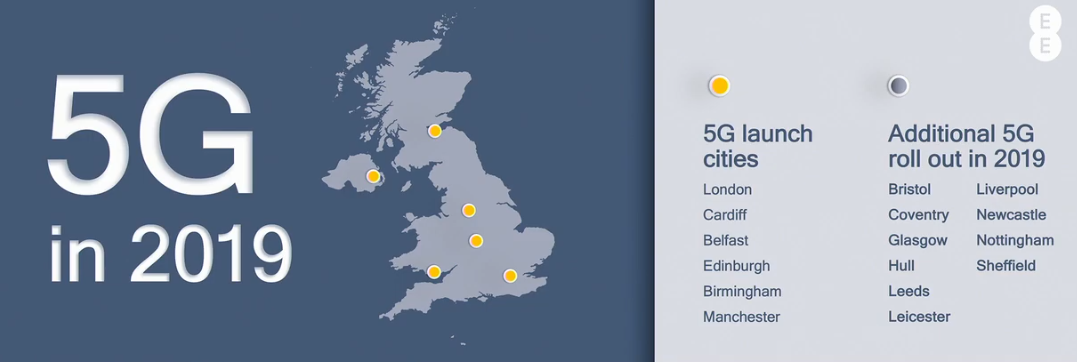
EE will launch commercial 5G in six cities across on 30th May 2019: London, Birmingham, Cardiff, Manchester, Edinburgh and Belfast.

EE says users should experience an increase in speeds of around 100-150Mbps even in the busiest areas. Some customers will break the one gigabit-per-second milestone on their 5G smartphones. The fastest speed possible when EE launched 4G in 2012 was just 50Mbps.

From today, EE customers can pre-order a 5G smartphone on EE’s new 5G Smart Plans. Plans start from 10GB (£54 per month) and extend up to 120GB (£74 per month). EE is also rolling out the UK’s first 5G SIM only plans, offering Swappable benefits, inclusive Service Pack benefits, and a range of great 5G data allowances starting at 20GB per month (£32 per month) and rising to 100GB (£52 per month). EE will offer a 5GEE WiFi plan with the HTC 5G Hub at an upfront cost of £100 and with 50GB of data per month for £50 per month, or for £75 per month with 100GB of data per month.

EE is offering several 5G smartphones including Samsung (Galaxy S10 5G) as well as UK exclusives with Oppo (Reno 5G), LG (V50 ThinQ) and One Plus (7 Pro 5G).

In addition to the six launch cities, in 2019 EE will also be introducing 5G across the busiest parts of Bristol, Coventry, Glasgow, Hull, Leeds, Leicester, Liverpool, Newcastle, Nottingham and Sheffield. And in 2020, even more towns and cities will get 5G sites including: Aberdeen, Cambridge, Derby, Gloucester, Peterborough, Plymouth, Portsmouth, Southampton, Worcester and Wolverhampton.

EE is also preparing to launch a 5GEE WiFi and 5GEE home broadband service month. Pricing has not been disclosed but the company says it will be beat fibre broadband.

Marc Allera, CEO of BT’s Consumer division, said: “This is the start of the UK’s 5G journey and great news for our customers that want and need the best connections. We’ve started with 5G in some of the busiest parts of the UK, the widest range of 5G devices in the UK, and plans that give customers the best mobile connection and great benefits.

EE is launching 5G in the busiest parts of the UK, where 5G can really make a difference by providing a more reliable data connection to businesses and consumers. EE is upgrading more than 100 sites to 5G every month whole continuing to expand 4G coverage into rural areas.

EE 5G rollout


  • Phase 1: a ‘non-standalone’ deployment focused on using the combined power of 4G and 5G to give customers the fastest, most reliable mobile broadband experience they’ve ever had.
  • Phase 2: from 2022, will introduce the full next generation 5G core network, enhanced device chipset capabilities, and increased availability of 5G-ready spectrum. Higher bandwidth and lower latency, coupled with expansive and growing 5G coverage, will enable a more responsive network, enabling truly immersive mobile augmented reality, real-time health monitoring, and mobile cloud gaming. Phase 2 is also a vital step on the journey to the convergence of network technologies.
  • Phase 3: from 2023, will introduce Ultra-Reliable Low Latency Communications (URLLC), Network Slicing and multi-gigabit-per-second speeds. This phase of 5G will enable critical applications like real-time traffic management of fleets of autonomous vehicles, massive sensor networks with millions of devices measuring air quality across the entire country, and the ‘tactile internet’, where a sense of touch can be added to remote real-time interactions.


http://www.ee.co.uk/5G

Mobile data jumped 65% YoY in France in 2018

In 2018, operators in France invested €9.8 billion (excluding spending on frequencies), which is €200 million more than in 2017, according to new metrics published by Arcep, the official telecoms regulator. Total investments have increased by 40% over four years.

Some additional stats for 2018:

  • Voice calls increased 3.7%
  • Mobile data increased by +65% YoY. 
  • There are 47.7 million active 4G customers in France (+6.1 million) who consumed an average 6.7 GB of data a month in 2018. 
  • French customers’ data consumption when travelling abroad doubled in 2018 thanks the European “roam like at home” regulation that was introduced in June 2017.
  • Last year’s spending increase can be attributed almost entirely to the rise in operators’ investments in FTTH: 13.6 additional premises are now eligible to subscribe to a fibre access plan, which represents 7.9 million additional access lines deployed in three years (+3.2 million additional homes passed in 2018). 
  • 4.8 million households have now adopted fibre technology, and at a steadily increasing pace (+1.5 million YoY).

Additional market data for France is posted online.

https://en.arcep.fr/news/press-releases/p/n/the-telecoms-market-in-france.html


Champion ONE intros XGS-PON Optical Transceivers

Champion ONE announced commercial availability of a new line of XGS-PON transceivers for delivering symmetrical 10G service in fiber-to-the-premises (FTTx) networks.

This product line conforms to the ITU standards G.987.2 and G.9807.2. It includes both SFP+ and XFP transceivers for OLT applications, and SFP+ transceivers for ONU applications over 20km rated distances.

Champion ONE notes that XGS-PON deployments will enable telecom network operators to converge services over a common fiber infrastructure, with legacy 1G GPON service and new 10G XGS-PON service over the same fiber.

“Network operators are deploying deeper fiber, copper/coax optimization, and next-generation radio access upgrades to support growing bandwidth demand among end-users,” said Champion ONE CEO John Jutila. “Our network architecture workshops with telecom infrastructure operators highlighted XGS-PON as one of several planned access technology upgrades. We are proud to be an integral partner with our customers to enhance their networks with this new application in our expanding portfolio of open port solutions.”

Champion One is based in Cleveland, Ohio.

https://www.championone.com/