Friday, July 22, 2022

Rakuten Symphony opens lab in Bengaluru

Rakuten Symphony will open a new lab in Bengaluru, India, to focus on the automation of Open RAN-based, cloud native mobile networks. The Global Innovation Lab is expected to open in early 2023 and will be housed inside new engineering development facilities opening simultaneously to bring together Rakuten Symphony’s Bengaluru employee base.

Tareq Amin, Chief Executive Officer of Rakuten Symphony, said, “Our operations around the world are powered by incredible Indian talent and creative innovation, so I am very proud to announce this additional investment with the establishment of our Global Innovation Lab and new engineering development facilities in Bengaluru. I am very confident that as we continue to grow here in India, our ability to provide telco solutions to the world will also grow exponentially.”

Rakuten says its Global Innovation Lab will be a state-of-the art facility that recreates the entire network architecture in a simulated environment, from RAN to Core to transport, enabling function and performance testing. The lab will also act as a showcase for Symworld platform, allowing Rakuten Symphony to demonstrate the capabilities and performance of the platform to customers. It will complement and expand upon Rakuten Symphony’s existing RAN lab in Bengaluru and the Rakuten Cloud Innovation Lab in Tokyo, allowing for global end-to-end testing of apps across the Symworld portfolio. Going forward, there are plans to set up facilities for 6G infrastructure R&D in the lab.

Narendra Narayana, Managing Director of Rakuten Symphony India said, “Rakuten Symphony India represents a key driver of innovation in the telecom space, and we are very excited to further expand our presence. We look forward to fostering local talent and working with local Indian and global partners to promote the adoption of Open RAN technologies and empower global telecom operators to build and operate secure mobile networks.”

Including locations in Bengaluru and Indore, Rakuten Symphony’s employee base in India has grown to over 3,300 in less than one year through acquisitions and organic growth.

https://symphony.rakuten.com/newsroom/rakuten-symphony-to-expand-in-india-with-the-establishment-of-global-innovation-lab-and-new-engineering-development-facilities-in-bengaluru


Xunison secures €3.35 million

Xunison, a start-up based in Dublin, Ireland,  raised seed capital of €3.35 million for its development of software/hardware solutions for telcos and ISPs. 

The funding was secured through Focus Capital Partners.

Xunison cited a business’s partnership rollout with STC, Saudi Arabia.  

Speaking of the super round secured, CEO of Xunison, Ryan O’Donovan commented, “We were humbled by the level of interest that was expressed in this round. It exceeded our expectations and capacity when it closed out on Christmas week. As a result of this funding, 2022 will see Xunison cement our brand presence and effectively communicate the incredible capabilities of the organisation to a global audience.”

https://www.xunison.com

Thursday, July 21, 2022

Ericsson aims for 5G monetization with $6 billion acquisition of Vonage

Ericsson completed its previously-announced acquisition of Vonage Holdings Corp.  

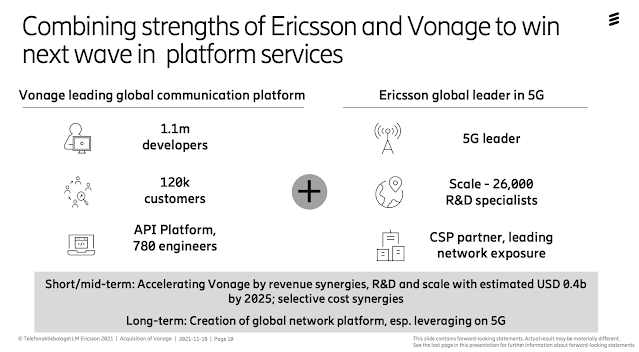
The deal provides Ericsson with a platform for offering a full suite of communications solutions including, Communications Platform as a Service (CPaaS), UCaaS and CCaaS.

Ericsson said it aims to transform the way advanced 5G network capabilities are exposed, consumed and paid for. This will provide the global developer community, including Vonage’s more than one million registered developers, with easy access to 4G and 5G network capabilities via open Application Program Interfaces (APIs).

For communications service providers (CSPs), global network APIs - such as location and quality of service APIs - provide new opportunities to expand their profit pools to monetize 5G network capabilities. For Ericsson, global APIs provide a new material growth opportunity. The existing market for communications APIs – such as video, voice and SMS – is currently growing at 30 percent annually and projected to reach USD 22 billion by 2025.

Ericsson intends to increase R&D investments and offer these solutions to CSPs.

Börje Ekholm, President and CEO, says: “We are excited to welcome Vonage as part of Ericsson. With Vonage’s suite of communications solutions – UCaaS, CCaaS and Communications APIs – Ericsson will further expand its offerings into the enterprise space. In the future, network capabilities will be consumed and paid for through open network APIs, creating the opportunity for unparalleled innovation. We have already launched the first network API, Dynamic End-user Boost, based on existing 4G infrastructure. With Vonage, we will now develop and commercialize these new APIs.  We are already seeing great progress with frontrunner CSPs, and we aim to launch the first 5G network APIs in the coming year. We will continue to create new, enhanced applications and services for enterprises, while driving continued innovation on Vonage’s UCaaS and CCaaS applications, helping businesses create new digital experiences for better communications, connections and engagement.

Rory Read, Vonage CEO, says: “Vonage was born out of innovation and is today a global leader in business cloud communications. This partnership will strengthen our offerings to businesses across the globe by leveraging Ericsson’s leadership in 5G, global market presence and strong R&D capabilities. With the demand for UCaaS, CCaaS and Communications APIs growing rapidly, the combined expertise, talent and innovation is good news for our customers and partners.”

Some additional notes:

  • Ericsson paid for the acquisition with cash on hand.
  • The transaction is expected to be accretive to Ericsson’s EPS (excluding non-cash amortization impacts) and free cash flow before Mergers & Acquisitions (M&As) from 2024 onwards.
  • Vonage will become a separate business area within the Ericsson Group - called Business Area Global Communications Platform (BGCP). Rory Read, current CEO of Vonage, is appointed Senior Vice President and Head of Business Area Global Communications Platform and a member of Ericsson’s Executive Team.
  • Vonage will continue to operate under its existing name and brand being part of the Ericsson Group. 

https://www.ericsson.com/en/press-releases/2022/7/ericsson-completes-acquisition-of-vonage


Ericsson to acquire Vonage for its cloud communications platform

Ericsson agreed to acquire Vonage, one of the earliest developers of a commercial VoIP service, for US$6.2 billion in cash.

Vonage traces its roots to 1998 when Jeff Pulver established Min-X.com as a VoIP exchange. In 2001, the company changed its name to Vonage and launched a commercial VoIP services aimed at consumers. Vonage went public in 2006. Vonage is headquartered in Holmdel, New Jersey and has 2,200 employees throughout the United States, EMEA and APAC.

Currently, the cloud-based Vonage Communications Platform (VCP) serves over 120,000 customers and more than one million registered developers globally. The API platform within VCP allows developers to embed high quality communications - including messaging, voice and video - into applications and products, without back-end infrastructure or interfaces. Vonage also provides Unified Communications as a Service (UCaaS) and Contact Center as a Service (CCaaS) solutions as part of the Vonage Communications Platform.

Sales were US$1.4 billion in the 12-month period to 30 September 2021, and over the same period, Vonage delivered an adjusted EBITDA margin of 14% and free cash flow of US$109 million.

VCP accounts for approximately 80% of Vonage’s current revenues and delivered revenue growth in excess of 20% in the three-year period to 2020, with adjusted EBITDA margins moving from -19% in 2018 to break-even in the 12-month period to 30 September 2021. Vonage’s management team projects annual growth of over 20% for VCP in the coming years.


Ericsson completes Cradlepoint acquisition

Ericsson completed its previously-announced acquisition of Cradlepoint for approximately US$1 billion.Cradlepoint will operate as a stand-alone subsidiary within Ericsson and continue to build on the current market momentum as 5G is speeding up digital transformation and increasing the need for advanced connectivity services for enterprises. Cradlepoint will be part of Ericsson’s Business Area Technologies & New Businesses.Ericsson acquires Cradlepoint...


Cisco intros Webex Wholesale for Service Providers

Cisco launched a new Webex Wholesale Route-to-Market (RTM) for Service Provider. 

The new sales model includes a single commercial agreement with each partner and a self-service platform for Service Providers to deliver managed services for Webex, as well as the agility, scalability and flexibility to create their own co-branded offers.

The Wholesale partner program features consumption-based billing with fixed, predictable per-user/per-month package pricing and equips Service Providers with several invoicing options. The partner onboarding experience includes dedicated Cisco experts, paired with comprehensive online training and a robust set of migration and marketing toolkits to drive market demand and serve SMB customers.

Initial managed services packages for Webex that are available through the Wholesale RTM include:

  • Webex Calling: Enterprise-grade calling and advanced collaboration with features for 1:1 and group messaging, file-sharing, and secure basic video conferencing for up to 100 users, for a complete PBX replacement, including multi-device support, visual voicemail, intelligent call routing and more.
  • Common Area Calling: Calling built for shared use and common area locations and phones.
  • Webex Meetings: A premium meeting and messaging experience with meetings allowing up to 1000 users. Also includes AI-driven intelligence with Webex Assistant, Slido, remote desktop control, moderator controls and more.
  • Webex Suite: Encompasses all the above with premium calling, messaging and meetings, plus advanced features that are engaging and inclusive.

"By tapping into the brand power of respected Service Providers and combining it with our inclusive Webex technology, rapid innovation, and complete collaboration portfolio, we are creating winning partnerships that address the communication needs of small and medium-sized businesses and help them thrive in a hybrid work world," said Jeetu Patel, Cisco EVP and GM, Security & Collaboration.

https://newsroom.cisco.com/c/r/newsroom/en/us/a/y2022/m07/cisco-equips-service-provider-partners-with-new-managed-services-offering-for-webex.html

Nokia's Q2 net sales increased 3% yoy in constant currency

Nokia reported Q2 net sales of EUR 5,873 billion, up 11% year over year in absolute terms and up 3% yoy when accounting for constant currency. Gross margin was 40.2%. EPS was 0.08.

Some highlights:

  • Network Infrastructure net sales grew 12% in constant currency, with growth across all four businesses.
  • Mobile Networks returned to growth despite ongoing supply chain constraints.
  • Cloud and Network Services net sales were flat in constant currency. 
  • Nokia Technologies declined 25% as it continued to be impacted by expired licenses that are in the process of being renewed.

Pekka Lundmark, Nokia's president and CEO, states: "While we recognize the increased global macroeconomic uncertainty and currency fluctuations impacting some emerging markets, I am confident we have the right strategy in place to navigate these challenges along with support from structural technology adoption trends in 5G and fiber. However, we will not become complacent; we remain focused on building technology leadership and improving cost-efficiency to deliver on our strategic goals for the years ahead."

"We have had a strong first half and with our renewed competitiveness, we are well placed to deliver our full year 2022 guidance. There remain risks around timing of Nokia Technologies’ contract renewals, potential COVID-19 lockdowns and the supply chain which remains challenging but is showing signs of improvement. We are currently tracking towards the higher-end of our net sales guidance and towards the mid-point of our operating margin guidance as we manage ongoing inflation and currency headwinds."

https://www.nokia.com/about-us/news/releases/2022/07/21/nokia-corporation-financial-report-for-q2-and-half-year-2022/

AT&T chases growth in 5G and fiber

AT&T reported Q2 revenues from continuing operations of $29.6 billion versus $35.7 billion in the year-ago quarter, down 17.1% reflecting the impact of the U.S. Video separation in Q3 2021 and certain other divested businesses. Excluding the impact of these divestitures, operating revenues for standalone AT&T were up 2.2%, from $29.0 billion in the year-ago quarter.

AT&T said its results were driven by higher Mobility revenues and, to a lesser extent, higher Mexico and Consumer Wireline revenues, partially offset by lower Business Wireline revenues.  

“We’re expanding our customer base at an accelerated pace across our twin engines of growth – 5G and fiber,” said John Stankey, AT&T CEO. “We’re rapidly building out our best-in-class networks on the heels of record-level connectivity investment. We’ve already added nearly 2 million AT&T Fiber locations this year and just reached our target of covering 70 million people with mid-band 5G spectrum two quarters early, with expectations to now approach the 100 million mark by the end of year.”

On the investor conference call, AT&T also disclosed that more customers are falling behind in monthly payments.


Some additional highlights:

Mobility

  • Revenues were up 5.2% year over year, to $19.9 billion due to higher service and equipment revenues. Service revenues were $15.0 billion, up 4.6% year over year, primarily driven by subscriber growth. Equipment revenues were $4.9 billion, up 7.2% year over year, driven by increased sales of higher priced smartphones.
  • Operating expenses were $13.7 billion, up 6.1% year over year due to higher equipment costs, network costs, bad debt expense, amortization of customer acquisition costs, HBO Max content costs, FirstNet 
  • Total net adds were 6.6 million
  • Postpaid churn was 0.93% versus 0.87% in the year-ago quarter.
  • Postpaid phone churn was 0.75% versus 0.69% in the year-ago quarter.
  • Postpaid phone-only ARPU was $54.81, up 1.1% versus the year-ago quarter, due to improved international roaming and a mix shift to higher-priced unlimited plans.
  • FirstNet connections reached approximately 3.7 million across more than 21,800 agencies. 

Business Wireline

  • Revenues were $5.6 billion, down 7.6% year over year due to lower demand for legacy voice and data services, a strategic decision to deemphasize non-core services and lower revenues from the government sector. 
  • Operating expenses were $4.9 billion, down 2.0% year over year due to ongoing operational cost efficiencies and lower amortization of deferred fulfillment costs, partially offset by higher wholesale network access costs and higher depreciation expense. 

Consumer Wireline

  • Revenues were $3.2 billion, up 1.1% year over year due to gains in broadband more than offsetting declines in legacy voice and data services and other services. Broadband revenues increased 5.6% due to fiber growth of nearly 28%, partially offset by non-fiber revenue declines of 9.8%.
  • Total broadband losses, excluding DSL, were 25,000, reflecting AT&T Fiber net adds of 316,000, more than offset by losses in non-fiber services. AT&T Fiber now has the ability to serve 18 million customer locations, and offers symmetrical speeds up to 5-Gigs across parts of its entire footprint of more than 100 metro areas. 

https://about.att.com/story/2022/q2-earnings.html

SK Telecom activates bare-metal 5G Core with Ericsson

SK Telecom has activated a bare-metal cloud-native 5G core network, using Ericsson 5G Core and Cloud Native Infrastructure (CNIS).

SKT's cloud-native 5G core is expected to improve traffic processing significantly compared to existing physical-based cores by applying packet acceleration processing, route optimization, and multi-flow control for ultra-high-speed and large-capacity 5G services.

The companies have been developing and verifying the cloud-native solution in stages since 2019, and since November of last year, they have been testing a full-scale 5G network for commercial service, where the Ericsson’s dual-mode 5G Core is deployed on the Kubernetes over bare metal infrastructure solution Ericsson Cloud Native Infrastructure (CNIS).

Park Jong-kwan, VP, Head of  Infra Tech, says, "Based on the commercialization of the cloud-native-based 5G core, we have laid the foundation to provide cutting-edge ICT services more efficiently and stably. We will continue to develop and apply the next-generation network technology that will become this”.

Monica Zethzon, Head of Solution Area Packet Core at Ericsson says, “With the bare-metal cloud-native 5G Core solution, SKT is reconfirming its ambitions to lead the way in creating a future-focused, versatile 5G network. The efficiency and performance gains to the 5G Core network that comes from this new Cloud Native Infrastructure will be a strong foundation for innovative use cases and new services for enterprises and consumers.  We are proud to continue our long-standing partnership with SKT, together supporting the innovative ecosystem of technology-driven businesses.” 

https://www.ericsson.com/en/press-releases/2/2022/7/skt-live-5g-core


Samsung's 2nd gen SmartSSD computational drive offloads CPU

Samsung Electronics introduced a second generation of its pioneering SmartSSD computational storage drive that uses a Xilinx Versal Adaptive chip to offload certain data processing functionality from the host CPU.

Unlike existing SSDs, Samsung’s SmartSSD can process data directly, thereby minimizing data transfers between the CPU, GPU and RAM. This technology can avoid the bottlenecks that often occur when moving data between storage devices and CPUs, resulting in markedly improved system performance and much higher energy efficiency.

 Samsung says that compared to conventional data center solid-state drives, processing time for scan-heavy database queries can be slashed by over 50%, energy consumption by up to 70% and CPU utilization by up to 97%.

Since its development in 2020 through the joint efforts of Samsung and AMD, the first-generation SmartSSD is being supplied to global IT companies including video communications platform providers. The first-generation SmartSSD was recognized as an Innovation Awards Honoree at CES 2021 for its outstanding performance and energy efficiency.

 “Commercialization of the first-generation SmartSSD, in collaboration with AMD, established that the computational storage market has great potential,” said Jin-Hyeok Choi, Executive Vice President and Head of Memory Solution Product & Development at Samsung Electronics. “With the upgraded processing functionality of the second-generation SmartSSD, Samsung will be able to easily address increasing customer needs in the database and video transcoding sectors, as we expand the boundaries of the next-generation storage market.”

 “Powered by Xilinx Versal Adaptive SoCs from AMD, second-generation Samsung SmartSSDs enable improved CPU efficiency and greatly reduced energy consumption by efficiently integrating the computing and storage functions in data centers,” said Sina Soltani, Corporate Vice President of Sales, AECG, Data Center and Communication Group at AMD. “As data-intensive applications continue to grow, second-generation Samsung SmartSSDs will deliver the superior performance and efficiency required for this expanding market.”

 https://news.samsung.com/global/samsung-electronics-develops-second-generation-smartssd-computational-storage-drive-with-upgraded-processing-functionality

ZEDEDA raises $26 million for edge orchestration

ZEDEDA, a start-up based in San Jose, California, raised $26 million in Series B funding for its edge orchestration solution.

ZEDEDA provides a unified orchestration experience across hardware, software, networks and cloud that delivers visibility, control and security. The company says revenue is up 7x year-over-year, while at the same time, its number of nodes under management has risen by 4x. 

The funding round attracted a range of new and existing investors — including Coast Range Capital, Lux Capital, Energize Ventures, Almaz Capital, Porsche Ventures, Chevron Technology Ventures, Juniper Networks, Rockwell Automation, Samsung Next and EDF North America Ventures. ZEDEDA has now raised more than $55 million since its inception in 2016.

“All aspects of our business — from a growing base of Global 500 customers to major strategic partnerships and growth in deployed edge nodes — are on a terrific path,” said Said Ouissal, founder and CEO of ZEDEDA. “This latest round of investment validates that our open framework and ecosystem approach to the distributed edge is the ideal choice for the future of connected operations.”

http://www.ZEDEDA.com

Quantifi Photonics raises $15M for optical test systems

Quantifi Photonics, a start-up based in Auckland, New Zealand, announced US$15 million in Series C funding for its solutions for the high-density photonic test market.

Quantifi Photonics plans to offer fully integrated test systems for optical transceivers, silicon photonics and co-packaged optical devices that are emerging from R&D labs onto high-volume production lines. At this year's OFC, the company released a 288-channel optical power meter. Quantifi Photonics plans to grow its R&D and manufacturing teams and expand its sales and customer support capabilities in the USA and Europe to capitalize on the significant growth in optical communication networks around the world.

Intel Capital, the venture capital arm of Intel Corporation, led the round which was fully supported by existing investors.

"Intel Capital's investment will help us carry out our strategy and seize the market for the high-value test instruments required to support the rapidly growing transceiver market, which is projected to exceed US $14B by the year 2026," said Dr. Andy Stevens, CEO and co-founder of Quantifi Photonics.

"Silicon photonics is a key technique in the future of the semiconductor and telecommunications industries, especially with the increasing bandwidth requirements for data center and 5G/6G applications," said Sean Doyle, Managing Director at Intel Capital. "The Quantifi Photonics team has the potential to supply critical test and measurement solutions to the market at large."

"By working extremely closely with customers such as Intel, we understand their challenges and can begin to anticipate what they might need in 6, 12 or 24 months' time. As a result, we're rapidly developing a new generation of high-density test solutions that are critical to unlocking the potential of 800G technologies," says Dr. Stevens.

https://www.quantifiphotonics.com

Wednesday, July 20, 2022

NEC selected for Juno transpacific cable

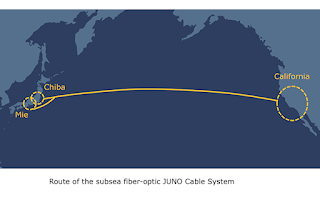
NEC has been contracted to build the JUNO Cable System, which is slated to be the highest capacity transpacific cable when it comes online by the end of 2024.

The project is led by Seren Juno Network Co., Ltd., a company established by NTT Ltd Japan Corporation, PC Landing Corp. Mitsui & Co. and JA Mitsui Leasing.

The JUNO cable will span 10,000 km between Chiba prefecture and Mie prefecture in Japan to California.

NEC plans to deploy its newly developed energy efficient repeaters and leading-edge SDM (Space Division Multiplexing) technology. This system will be able to adapt as many as 20 fiber pairs for the first time in a trans-Pacific subsea fiber-optic cable. The cable is expected to provide a maximum capacity of 350 Tbps.

NEC notes that it has been a leading supplier of submarine cable systems for more than 50 years, and has built more than 300,000 km of cable, spanning the earth nearly 8 times. As a system integrator, it  provides all aspects of submarine cable operations, including the manufacture and installation of optical submarine cables and repeaters, provision of ocean surveys and route designs, training and delivery testing. NEC's subsidiary OCC Corporation manufactures subsea optical cables capable of withstanding water pressures at ocean depths beyond 8,000 meters.

https://www.nec.com/en/press/202207/global_20220721_01.html

Sparkle activates capacity on the Monet subsea cable

Sparkle has activated spectrum capacity on the Monet submarine cable system connecting Brazil to the United States. 

The addition enhances Sparkle's regional backbone for the Americas, which now encompasses five diversified routes between North and South America. Sparkle is also present on the Seabras-1 cable system in the Atlantic and the Curie cable system in the Pacific.

Sparkle now counts 56 Points of Presence across the U.S., Argentina, Brazil, Chile, Colombia, Panama, Peru and Venezuela, a capillary presence in Brazil and a new open landing and connectivity hub in Panama.

https://www.tisparkle.com/PR-Sparkle-Adds-Monet

SkyWater Tech plans a $1.8 billion semiconductor fab at Purdue

SkyWater Technology announced its plans to build a $1.8 billion U.S. semiconductor R&D and production facility in Indiana through a public-private partnership with the state and Purdue University

The partners will pursue funding through the CHIPS (Creating Helpful Incentives to Produce Semiconductors) for America Act.

“This endeavor to bolster our chip fabrication facilities will rely on funding from the CHIPS Act. Federal investment will enable SkyWater to more quickly expand our efforts to address the need for strategic reshoring of semiconductor manufacturing,” said Thomas Sonderman, SkyWater president and CEO. “Through our alliance with the Indiana Economic Development Corporation and Purdue Research Foundation, we have a unique opportunity to increase domestic production, shore up our supply chains and lay the groundwork for manufacturing technologies that will support growing demand for microelectronics.”

“Today’s announcement marks a dramatic advance toward multiple strategic goals of Purdue’s last decade: enriched academic and career opportunities for our students; new research possibilities for our faculty; a transformed, more attractive environment on and adjacent to our campus; and the latest demonstration that Purdue and Greater Lafayette are now the hot new tech hub of a growing, diversifying Indiana economy,” said Purdue President Mitch Daniels. “Even for the place that specializes in them, this constitutes a genuine giant leap.”

https://www.purdue.edu/newsroom/releases/2022/Q3/skywater-technology-chooses-discovery-park-district-at-purdue-for-1.8b-semiconductor-fabrication-facility,-to-create-750-jobs-in-5-years.html


Quantum Loophole builds highest-density fiber route to Ashburn

Quantum Loophole broke ground on its massive QLoop network, a 43-mile fiber ring connecting the company’s 2,100+ acre Quantum Frederick data center development site in Maryland to the Ashburn, Virginia ecosystem. The network ring will offer capacity for more than 200,000 strands of fiber connecting to the Ashburn ecosystem in under one half millisecond Round Trip Time (RTT).

The QLoop fiber optic ring has received all governmental approvals for its two crossings of the Potomac River.

 Quantum Loophole will be constructing a network of conduits to connect Quantum Frederick’s two planned network centers on its Maryland data center campus where automatic, robotic cross connections powered by Telescent are planned to be installed.

 When complete, QLoop will contain in excess of thirty, 2-inch HDPE conduits placed at a depth designed to exceed security standards. When fully deployed, Telescent-enabled network centers will be capable of processing millions of cross connects from the QLoop to the on-campus conduits that deliver fiber to each data center site on the Quantum Frederick campus, thus expediting time-to-market for customers and creating a private metro system on the Quantum Frederick campus.

“We are building the largest medium haul fiber backbone that’s ever been created,” says Josh Snowhorn, Founder and CEO of Quantum Loophole. “And we are bolstering that with some pretty amazing cross-connect capabilities. Each property will have access to conduits and thousands of strands of fiber directly into the QLoop system to enable seamless, private and secure connectivity for all of our campus-wide customers.”

http://www.quantumloophole.com

Dell'Oro: Campus switch sales to exceed $95B over the next 5 years

More than $95 B will be spent on campus switches over the next five years, according to a new report from Dell'Oro Group. Multi-gigabit switches (2.5/5/10 Gbps) are expected to comprise 10 percent of the port shipments by 2026.

“Due to a number of unforeseen headwinds including lingering supply chain challenges, increased macro-economic uncertainties, higher inflation, and regional political conflict, we have lowered our forecast for 2022 and 2023 compared to our prior January report,” said Sameh Boujelbene, Senior Director at Dell’Oro Group. “At the same time, while we made this downward adjustment to our short-term forecast, we have raised the forecast figures for the outer years as we believe spending over the five-year forecast period will not decline compared to our prior forecast, but rather shift from one year to the next, depending on the supply situation and macro environment. Our interviews with system and component vendors, as well as with some of the Value-Added Resellers (VARs) and System Integrators (SIs), revealed that the fundamental growth drivers remain in place and that there is a substantial technology debt urging customers to upgrade their networks in order to support their digital transformation initiatives.

“Nevertheless, while we have maintained our forecast for revenue as well as port shipments, we have changed our port speed mix and shifted some of the volumes from 2.5/5.0 Gbps to the benefit of 1 Gbps. This adjustment is the result of a combination of supply-and-demand-related issues as explained in our report,” added Boujelbene.

Additional highlights from the Ethernet Switch – Campus 5-Year July 2022 Forecast Report:

  • Power-Over-Ethernet (PoE) ports are forecast to comprise nearly half of the total campus port shipments by 2026.
  • China is expected to recover very quickly from the recent lockdown and comprise 25 percent of campus switch sales by 2026.
  • The introduction of new software features and Artificial Intelligence capabilities are expected to increase over our forecast horizon.
  • Interest in Network-As-a-Service (NaaS) offerings is expected to rise but adoption may take time.

https://www.delloro.com/news/campus-switch-sales-to-exceed-95-b-over-the-next-five-years/

Sabey breaks ground on 40-acre data center campus near Austin

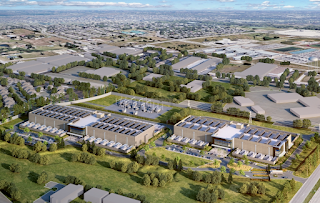
Sabey Data Centers has begun construction on a new, 40-acre data center campus in Round Rock, Texas. 

The new campus will provide up to 72-megawatt (MW) power capacity and will accommodate requirements of all sizes, including hyperscale deployments. When complete, the campus will offer 430,000 square feet of reliable colocation supported by high-density cooling, low cost of power, eight layers of security, carrier-neutral options, etc.

The target Ready for Service date is Q2 2023.

"This new market expansion reinforces the continued demand for digital capacity and is an exciting time for the Sabey organization," said Jeffrey Kanne, President and CEO of National Real Estate Advisors and Vice Chairman of Sabey Data Centers. "We look forward to deploying additional capital to support Sabey's efforts in the booming Austin tech hub."

"Sabey is dedicated to meeting our customers' increased demand for digital infrastructure and thrilled that this market expansion will pave the way for future technology developments in the region," comments Rob Rockwood, President of Sabey Data Centers. " Planning with the City of Round Rock, Round Rock Chamber, and other valued partners has been a welcoming experience. " 

http://www.sabeydatacenters.com

  • Sabey's data center portfolio includes data center campuses in Austin, Ashburn, New York City, Seattle, and Central Washington. 


T-Mobile extends 5G Home Internet across California

T-Mobile has expanded the footprint of its 5G Home Internet across California.

The fixed 5G service is now available to over six million homes throughout the state.

With the expansion, T-Mobile said more than 40 million households – a third of them in rural America – are eligible for 5G Home Internet. 

T-Mobile's 5G Home Internet is priced at $50 a month with AutoPay and no annual contract.

Availability is based on network capacity. 

https://www.t-mobile.com/isp


T-Mobile US pushes 5G Home Internet

One year after launching its fixed 5G Home Internet service, T-Mobile unveiled a number of incentives to accelerate the business under the slogan "Internet Freedom":Free Test Drive. Customers can try Home Internet for 15 days, worry-free. If they like it, great! If not, return the gateway and owe nothing. It’s 100% On Us. Because it’s wireless, they can keep their old provider while testing the T-Mobile service.T-Mobile will cover break-up fees with...

T-Mobile US expands its Fixed Wireless Access service

T-Mobile expanded the footprint of its Mobile Home Internet service to nearly 3 million more homes in 54 cities across four states: Alabama, Louisiana, Mississippi and Tennessee. “We launched T-Mobile Home Internet just a year ago, and already, we’ve disrupted the home broadband industry for good. We’re making fast, reliable, 5G Home Internet available to more than 30 million households across the country. And in Q4 of last year, we were the...


Keysight intros cloud-based Open RAN Architect Test

The Keysight Open Radio Access Network Architect (KORA) test solutions are moving to cloud-based deployment. In addition, the company’s LoadCore software for testing 5G Core (5GC), is now available as a metered, pay-as-you-go (PAYG) solution in AWS Marketplace to allow customers to scale costs with usage.

KORA is Keysight’s suite of test solutions that verify the functionality and performance of end-to-end O-RAN wireless infrastructure. A component of KORA, Keysight's LoadCore 5GC testing software enables customers to perform network capacity tests, measure device data throughput and model a wide variety of end-user behavior and mobility scenarios. A scalable 5GC network performance validation solution, LoadCore can verify that delivered connectivity service remains stable under various demanding conditions such as sudden spikes in network usage caused by disasters or other major events.

“As a cloud-based pay-as-you-go offering, users can purchase and provision KORA test solutions immediately to fit their testing needs,” said Kalyan Sundhar, vice president and general manager of 5G Edge to Core Solutions at Keysight. “This is an exciting new delivery model that offers customers the flexibility and scalability to use Keysight’s test solutions in the environment they want, in the cloud.”

https://www.keysight.com


Tuesday, July 19, 2022

OCP releases Bunch of Wires (BoW) spec for chiplet interconnect

The OCP Foundation released its Bunch of Wires (BoW) specification for Chiplet interconnect, representing a next step in the OCP Open Domain Specific Architecture (ODSA) Project's march towards establishing an open Chiplet ecosystem as a catalyst for a new silicon market place and integrated circuit supply chain model. 

BoW specifies a physical layer (PHY) optimized for System on a Chip (SoC) disaggregation, and complements OCP ODSA Open High Bandwidth Interconnect (OpenHBI) PHY specification targeting High Bandwidth Memory and other parallel bandwidth intensive use cases.

The ODSA BoW PHY specification is optimized for both commodity (organic laminate) and advanced packaging technologies, enabling cost and energy efficient, as well as high-performance designs across a wide range of process nodes. The specification was authored to allow many use cases driving significant economies of scale. Care was taken to impose as few constraints as possible and to avoid including required features in the specification that could increase design complexity when disaggregating an existing SoC.

The OCP Foundation notes that its BoW specification follow an open license model. It is already in use in at least 10 companies, including Samsung and NXP, over a dozen different use cases spanning 5, 6, 12, 16, 22 and 65nm process nodes, and covering Chiplet-based products for networking, specialized AI silicon, FPGAs, and processors. 

"The demand for specialized silicon has been increasing steadily due to workload diversity, such as with the adoption of AI and ML, and we expect this trend to continue for several years. In response to this demand the OCP recognizes that it must be a catalyst to establish open and standardized Chiplet ecosystems and new markets by investing in Chiplet interconnect technology that will enable composable silicon. The release of the BoW specification is an important step in this direction. We expect to increase our efforts on developing supply chain models for composable silicon," said Bill Carter, CTO, OCP Foundation.

"The semiconductor industry continues to innovate in new and exciting directions with multicore application specific SoCs, custom core architectures, deep learning, optical communications, analog processing techniques, RF interfaces, memory architectures and more. The new challenge is how to integrate all of these disparate innovations, several of which are not practical to produce at cutting- edge process nodes. Today's announcement from the OCP ODSA, releasing the Bunch of Wires open-source specification for Chiplet interconnect, supplies a new tool toward expanding innovation in the market. This opens the door to a more competitive landscape and diversity in innovation at varying cadences and is fuel or a healthy industry," said Tom Hackenberg, Principal Analyst, Computing & Software Semiconductor, Memory and Computing Division, Yole Intelligence.

http://www.opencompute.org

OCP 2019: New Open Domain-Specific Architecture sub-project 

The Open Compute Project is launching an Open Domain-Specific Architecture (ODSA) sub-project to define an open interface and architecture that enables the mixing and matching of available silicon die from different suppliers onto a single SoC for data center applications. The goal is to define a process to integrate best-of-breed chiplets onto a SoC. Netronome played a lead role initiating the new project. “The open architecture for domain-specific...


Dell'Oro: DWDM equipment market to surpass $17B by 2026

Demand for optical transport DWDM equipment is forecast to surpass $17 billion by 2026, according to a new report from Dell'Oro Group. Over the next five years, it is expected that DWDM long gaul system sales will grow at a faster pace than WDM Metro system sales. 

"Although there is a ton of market turbulence, we do not see demand for DWDM equipment letting up," said Jimmy Yu, Vice President at Dell'Oro Group. "In fact, the biggest issue is that demand seems to be growing faster than supply. Hence, even if a mild recession were to occur, we think the worst case scenario is that demand will align with supply sooner."

"Hence, we are projecting continuous growth for DWDM system revenues. The only difference over the next five years, compared to previous years, is that we are expecting more growth from DWDM Long Haul since IPoDWDM should lower the use of WDM Metro systems in data center interconnect," added Yu.

Additional highlights from the Optical Transport 5-Year July 2022 Forecast Report:

  • DWDM Long Haul revenue is forecast to grow at a five-year compounded annual growth rate (CAGR) of 5 percent.
  • WDM Metro revenue is forecast to grow at a five-year CAGR of 3 percent.
  • Capacity shipments each year are projected to grow at an average annual rate of 30+ percent.
  • Spectral efficiency is expected to improve at an average annual rate of 9 percent.

https://www.delloro.com/news/optical-transport-dwdm-equipment-market-to-surpass-17-billion-by-2026/