Sunday, March 20, 2022

Dell'Oro: Campus switch sales reach record levels in 2021

The worldwide Campus Switch market revenue reached a record level in the fourth quarter and the full year 2021, according to a new report from Dell'Oro Group. Digital transformation initiatives, combined with government stimulus, propelled most of the growth in 2021. Arista, Extreme, H3C, HPE Aruba, Juniper were able to gain revenue share in 2021.

“What was remarkable is that the 2021 revenue growth was broad-based across all regions, all customer sizes; and all vertical segments, including those that have been hit hard by the pandemic, ” said Sameh Boujelbene, Senior Director at Dell’Oro Group. “However, despite the robust sales performance in 2021, demand continues to outpace supply. Supply challenges continue to limit vendors’ ability to fulfill orders, resulting in wide quarter-to-quarter variations in vendors’ performance. These variations are causing share shifts in the market, which are not necessarily reflective of competitive displacements, but rather the timing of order fulfillment,” added Boujelbene.

Additional highlights from the 4Q 2021 Ethernet Switch – Campus Report:

  • Huawei regained the revenue leading position in China in 4Q 2021, after briefly ceding its place to H3C in the prior quarter.
  • 2.5/5.0 Gbps ports were up 16 percent in 2021 but comprised only 1 percent of the total ports as the price premium over 1 Gbps is still hindering its mass adoption. We expect, however, that the 2.5/5.0 Gbps adoption will accelerate with the ramp of Wi-Fi 6 and the anticipated introduction of Wi-Fi 7 WLAN Access Points.
  • Power-over-Ethernet (PoE) ports up strong double-digits and comprised 30 percent of the total ports in 2021.


Brazil's Raízen picks Juniper + NEC for campus Wi-Fi

Raízen, a global leader in bio-energy solutions, has selected Juniper Networks and NEC to design and deploy anew Wi-Fi network for its headquarters in São Paulo and offices in Piracicaba, Brazil. 

The new network uses the Juniper Mist AI solution to dramatically streamline the IT helpdesk function for Raízen, which is one of Brazil’s largest private business groups.

NEC is providing consultancy and implementation services. 

The new platform provides automated and real-time data insights into exactly what Raízen’s users, devices and sites are experiencing on the network. In addition, by using actionable data from individual users, Mist AI provides tailored feedback and proactive support, as well as correlated, AI-driven insights into the network’s overall ongoing health and performance.

Raízen is assessing further projects based on the capabilities of the Juniper Mist cloud, including Wired Assurance, warehouses becoming Wi-Fi enabled and newly-acquired companies making the move to the Juniper solution.


Thursday, March 17, 2022

Crehan: Amazon and Google deployed >50% of total data center Ethernet switch bandwidth in 2021

The data center Ethernet switch market saw very strong annual bandwidth growth during 2021, with an increase of more than 60%, according to a recent report from Crehan Research Inc. This growth is the largest in four years, despite market bandwidth being five times bigger now. 

A major driver of the strong increase were high-volume 400 gigabit Ethernet (GbE) switch deployments by Amazon and Google, resulting in these two companies accounting for over half of all 2021 bandwidth deployed.

“The insatiable demand for data center networking bandwidth continues," said Seamus Crehan, president of Crehan Research, "with hyperscale cloud service providers at the tip of this spear. Artificial intelligence is one of the latest applications driving robust high-bandwidth growth, as this service-offering from cloud providers gains traction.”

Crehan’s report further shows that it took only about three years for 400GbE to comprise the majority of data center Ethernet switching bandwidth, despite its limited number of early customers. In fact, 400GbE data center switching is just now hitting broad market adoption in terms of number of customers deploying this technology.

"Although the portion of total data center Ethernet networking bandwidth from Amazon and Google has surged over the past couple of years," Crehan said, "it will likely rebalance a bit in 2022 as 400GbE and 200GbE see broader market deployments, starting with Meta and Microsoft early this year."

https://crehanresearch.com

Keysight delivers 800G test solution for 112 Gbps Serial data interfaces

Keysight Technologies introduced an 800G compliance test solution for validating 112 gigabit per second (Gbps) serial data center interfaces. The new 112 Gbps conformance test solution leverages Keysight’s M8040A 64 GBaud high performance bit error ratio tester (BERT) with a N1060A Digital Communication Analyzer (DCA) for receiver testing and Keysight’s Infiniium UXR-Series real-time oscilloscope for transmitter testing. 

Interfaces capable of supporting speeds of at least 100 Gbps and per lane are critical to realizing the benefits of 800G deployments. Keysight’s 112 Gbps conformance test platform enables optical transceiver manufacturers to accurately verify both the transmitter (TX) and receiver (RX) of designs that support connectivity speeds of 100 Gbps or greater.

Keysight said its fully automated 112 Gbps conformance test solution enables users to:

  • perform flexible, precise and repeatable testing across a variety of implementation scenarios, to minimize development schedules.
  • leverage a wide range of test cases for validating compliance to the latest specifications defined by both the Institute of Electrical and Electronics Engineers (IEEE) and the Optical Internetworking Forum (OIF).
  • simplify and accelerate testing of multiple interfaces, including chip-to-chip, chip-to-module, cabled and backplane.

The solution includes automated test software for verifying the following:

  • receiver in conformance to IEEE 802.3ck specifications (M8091CKPA)
  • transmitter in conformance to IEEE 802.3ck specifications (N1091CKCA and D90103CKC)
  • transmitter in conformance to OIF-CEI-112G PAM4 specifications (N109212CA and D9050CEIC)

Keysight expands 800G test solutions with multimode interfaces

Keysight Technologies expanded its portfolio of 800G test solutions for the optical transceiver ecosystem. The latest addition to Keysight’s existing portfolio of 800G test solutions are new design and validation solutions that support multimode interfaces, which are critical for an energy efficient data center infrastructure. The 800G multimode test solutions uniquely support high-speed data interconnect speeds of up to 100 Gbps.

In December 2020, Keysight launched industry-first 800G test solutions to help speed development of next generation data center technologies. The 800G multimode test solutions enable users to verify the performance of a wide range of optical transceiver modules and components, including vertical-cavity surface-emitting lasers (VCSELs), photodiodes, modulator drivers, transimpedance amplifiers (TIAs) and physical layer (PHY) chips.

The extended portfolio supports 400G and 800G design validation, in accordance with standards defined by the Institute of Electrical and Electronics Engineers (IEEE), across the entire product lifecycle, from early research and development to manufacturing. Industry-leading test capabilities from Keysight include:

  • Multimode component characterization using Keysight’s N4373E lightwave component analyzer
  • Conformance and interoperability validation using Keysight’s N1077B 64Gbaud multimode optical and electrical clock recovery solutions
  • Transceiver module performance evaluation using Keysight’s A400GE-QDD and G800GE layer 1 multiport test solutions.

Broadband Forum completes Phase 2 of its 5G work.

The Broadband Forum released three new specifications for providing operators with new 5G deployment options, including 5G hybrid access using wireline and LTE or NR:

  • TR-456 Issue 2 ‘Access Gateway Function Functional Requirements’ - the capabilities introduced by TR-456 Issue 2 include ensuring operators have the capacity to multiplex multiple sessions between the 5G-Residential Gateway and Access Gateway Function on top of the customer VLAN. This enables each session to be unique in terms of User Plane Functions (UPFs) selection, and operators can place video traffic, business traffic or community Wi-Fi all on their own wireline connection with different policies for each. The specification also expands support for legacy CPE in the form of multi-session support and expanded legacy authentication models. It also addressed other operational aspects such as maximum transmission unit handling, improved NAS transport reliability and Quality of Service enhancements.
  • TR-470 Issue 2 ‘5G Wireless Wireline Convergence Architecture’ - Hybrid-access with the functionality of ATSSS (Access Traffic Steering, Switching, Splitting) supports multiple traffic distribution mechanisms and policies, and is another key enabler from TR-470 Issue 2. This is based on the Residential Gateway with dual access: PON or DSL on the wireline side and 5G or LTE on the wireless side. The LTE support is critical as the operator can create and manage logical sessions that leverage existing network coverage and therefore can offer services with seamless availability for connectivity, bandwidth aggregation and policy-based forwarding, even if the 5G radio deployment is not complete yet.
  • TR-124 Issue 7 ‘Functional Requirements for Broadband Residential Gateway Devices’ - adds Multi-Access support and specifies requirements for the Residential Gateways connected to the 5G System which allow operators to maximize throughput, redundancy, and reliability. This provides the ability to not only run isolated sessions on each access, but to run multiple sessions that use multiple access either as active-standby or simultaneously.

“The Phase 2 work has delivered multi-session and enhanced authentication support for legacy Residential Gateways that do not have any 5G capability. Multi-session will enable the same user to connect to multiple service networks, while previously the user was limited to a single data network. This additional improvement can be considered a foretaste of what will be possible with 5G-Residential Gateways,” said Rosaria Persico, Principal Broadband Forum Delegate, TIM. “Operators are able to leverage innovation and common procedures specified by Broadband Forum that result in enhanced customer experience across available access network assets, and this specification development will ensure a smooth evolution path to a standardized 5G hybrid model.”

https://www.broadband-forum.org

Lawrence Berkeley National Lab develops board-in-board interconnects

Lawrence Berkeley National Laboratory (Berkeley Lab) introduced a compact, robust, and low-cost method for interconnecting printed circuit boards (PCBs) without requiring soldering or additional components. 

Berkeley Lab says its narrow board-in-board connectors can handle higher voltages and mechanical stresses compared to currently available miniature connector technologies. Multiple boards can be connected into a variety of shapes, including 3D shapes. Potential uses are broad–ranging, from vital aviation electronics to thin sensor probes. This technology is now available for licensing.

“This new type of PCB interconnects opens up a world of design opportunities for electronics,” said Stijn Wielandt, a researcher in Berkeley Lab’s Earth and Environmental Sciences Area. “The strong locking mechanism means simple assembly and less breakage in applications that produce mechanical stress or vibrations on circuit boards. The compact format also allows for use in 3D components.”

Because the contacts are spaced out along the length of the board, the connector can also handle higher voltages, which opens opportunities in the field of power electronics, for example in the domain of solar power, battery packs, and motor control.


What's hot at OFC22? SENKO on dense fiber connectors for CPO

 Co-packaged optics (CPO) was one of the hottest topics at OFC, as evidenced by the many visitors at SENKO's booth who stopped by to discuss the latest requirements for high-density fiber interconnects, says  Emmanuel Kolczynski, Application Engineering Manager, SENKO.

At OFC, SENKO showcased its SN-MT connector for CPO applications.  Here is an overview.


https://youtu.be/ZEwioqGbrfg

What's hot at OFC22? Cudoform stamping for Co-Packaged Optics

Many companies are looking for new solution for integrating optics with electronics in a single package to shorten electrical link lengths and reduce power, says R. Ryan Vallance, CEO and CTO, Cudoform.

Cudoform specializes in high-accuracy stamping of metallic components, proving an innovative way to bring light into co-packaged optics.


https://youtu.be/eqj9jiazEJ0

AT&T leads 2021 U.S. Carrier Managed SD-WAN LEADERBOARD

Vertical Systems Group announced today that the following seven companies achieved a position on the year-end 2021 U.S. Carrier Managed SD-WAN Services LEADERBOARD (in rank order based on site share): AT&T, Comcast Business, Hughes, Verizon, Windstream, Lumen, and Aryaka. These service providers each have two percent (2%) or more of the installed and billable Carrier Managed SD-WAN customer sites in the U.S. as of December 31, 2021.

“The U.S. Managed SD-WAN services market emerged from the pandemic in 2021 with solid growth in new site installations, driven by accelerated network transformations and more flexible solutions for customers,” said Rick Malone, principal of Vertical Systems Group. “Competition is heating up as evidenced by the shake up in top provider rankings on our year-end 2021 U.S. LEADERBOARD benchmark.”

Three companies attained a Challenge Tier citation for 2021 (in alphabetical order): Fusion Connect, MetTel and TPx. This tier includes service providers with between one percent (1%) and two percent (2%) share of U.S. Carrier Managed SD-WAN sites.

Some additional highlights:

  • Rankings changed for five of the seven market leading providers on Vertical’s 2021 U.S. Carrier Managed SD-WAN LEADERBOARD based on latest site share results as compared to the previous year.
  • AT&T retains first position overall for the fourth consecutive year.
  • Comcast Business rises to second position, up from fourth in 2020 based on site share that includes organic growth plus sites added from its Masergy acquisition.
  • Hughes moves to third position, from second overall in 2020. Verizon moves into fourth position, a change from third in the previous year.
  • Lumen advances to rank fifth, up from sixth position. Windstream drops to sixth position from fifth in 2020. Aryaka retains seventh position and rounds out the roster of top providers for 2021.
  • Additionally, TPx drops into the 2021 Challenge Tier from the LEADERBOARD.
  • MEF 3.0 SD-WAN Service Certification has been attained by five of the 2021 U.S. LEADERBOARD companies: AT&T, Comcast Business, Verizon, Lumen and Windstream. Each of these providers also has employees with MEF SD-WAN Certified Professional training certification.
  • Primary technology suppliers to the service providers ranked on the 2021 Carrier Managed SD-WAN LEADERBOARD include Cisco, Fortinet, Versa and VMware. Additionally, SD-WAN providers Aryaka and Hughes utilize internally developed technologies.

https://www.verticalsystems.com/2022/03/16/2021-us-sdwan-leaderboard/

Dell'Oro: PON equipment spending up 32% yoy

Total global revenue for the Broadband Access equipment market increased to $16.3B in 2021, up 12 percent year-over-year (Y/Y), according to a new report from Dell'Oro Group. Growth came once again from spending on both PON infrastructure and fixed wireless CPE.

"2021 was a record year for PON equipment spending, with some of the highest growth coming from the North American market, where expansion projects and fiber overbuilds are picking up considerably," said Jeff Heynen, Vice President, Broadband Access and Home Networking at Dell'Oro Group. "These fiber expansion projects show no signs of slowing heading into 2022."

Additional highlights from the 4Q 2021 Broadband Access and Home Networking quarterly report:

  • Total cable access concentrator revenue increased 4 percent Y/Y to just over $1B. Steady growth in Distributed Access Architecture (DAA) deployments helps offset declines in traditional CCAP licenses.
  • Total PON ONT unit shipments reached a record 140 M units for the year, bucking the supply chain constraints that have dogged the cable CPE market.


Lightpath expands fiber footprint west of Boston

 Lightpath announced a 75-mile expansion of its all-fiber network west of its Boston metro footprint, bringing the total size of the Lightpath network in the Boston metropolitan area to more than 200 route miles.

The Boston West expansion includes over 75 miles of new, high-count fiber along the I-90 corridor between Boston and Marlborough, planned in two phases. Phase 1 of the build (in yellow on map) will be completed later in 2022, while the additional proposed routes (in red on map) are targeted for completion in 2023. 


Wednesday, March 16, 2022

OIF advances 224G CEI

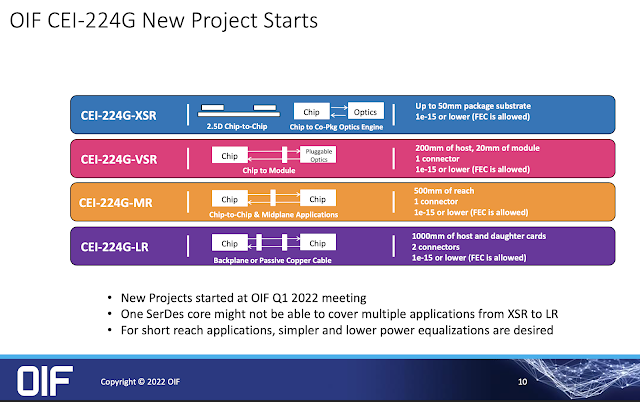
OIF launched four new CEI projects during its recent Q122 Technical and MA&E Committees meeting, which was held virtually in mid-February. These include:

  • CEI-224G-Extra Short Reach (XSR) Common Electrical On-Package Interface Project, 
  • CEI-224G-Very Short Reach (VSR) Common Electrical Chip-to-Module Interface Project, 
  • CEI-224G-Medium Reach (MR) Common Electrical Chip-to-Chip Interface Project, 
  • CEI-224G-Long Reach (LR) Common Electrical Backplane and Copper Cable Interface Project.

 These projects are the first set to target the 224G generation of electrical interfaces.

In addition to these 224G project launches, OIF membership approved publishing the 224G Framework Project white paper that was kicked off in August 2020. 

“OIF’s CEI-224G framework project white paper provides a roadmap for the applications, challenges and projects needed to support new specifications and technologies – these four new projects will develop the Implementation Agreements (IAs) to address that roadmap,” said Dave Stauffer, Kandou Bus and Chair, OIF Physical and Link Layer (PLL) Working Group.

The OIF also launched two new Common Management Interface Specification projects: 

  • CMIS: Form-Factor Specific Hardware Management -- OIF initiated a new project to create supplemental specifications to CMIS for Form-factor Specific Hardware Management (FSHM). CMIS has been adopted to manage future generation of small form-factor pluggable (SFP) 112, SFP-DD/SFP-DD112, and quad small form-factor pluggable (QSFP) 112. Currently, CMIS does not provide hardware management control for these form-factors. FSHM will define form-factor specific module hardware management registers in CMIS.
  • CMIS Support for Host-Module Link Training -- OIF started another new project that will add CMIS Support for Host-Module Link Training. This project will provide an optional out-of-band, protocol agnostic, management mechanism for optimizing link tuning and training.

 http://www.oiforum.com


Zayo carries 800G wavelength over 1,044km

Zayo has deployed the world’s longest known terrestrial 800G optical wavelength in a commercial network — 1,044.51 km along a fiber route stretching from Springville, Utah to Reno, Nevada. The transmission is powered by Infinera’s ICE6 800G coherent technology.

In recent months, Zayo has been making major investments in the company’s fiber network throughout North America and Western Europe, including 31 high-capacity, 400G-enabled long-haul routes and its first production interstate 800G wave in the United States. 

“Zayo continues to achieve what wasn’t previously possible as part of our efforts to provide best-in-class connectivity services and enable our customers’ growth,” said Aaron Werley, Vice President of Lit Networks at Zayo. “We look to the goals of our customers to inform our evolution, and the demand for 800G is being driven by a need for more bandwidth at higher line rates, all while leveraging the cost-effectiveness of high-capacity wavelengths covering longer distances. We are grateful to both our partners at Infinera, whose hardware solutions pushed the limits, and our outstanding Zayo team members who helped make this accomplishment possible.”

“At Infinera, our vision is a connected world with unlimited bandwidth for everyone — everywhere, always, and instantly,” said Tom Burns, General Manager of Infinera’s Optical Modules & Coherent Solutions Group. “We have built our company on a history of challenging conventional thinking and reimagining the telecommunications industry to power the modern enterprise. There’s no better way to demonstrate a commitment to innovation than chasing and breaking world records in network connectivity. This is a groundbreaking moment and we are proud to have partnered with Zayo to make history.”

http://www.zayo.com

Zayo lays out its 400G upgrade plan

Zayo announced the planned deployment of thirty-one high capacity, 400G-enabled long haul routes across North America and Western Europe. The significant network update is expected through Q1 of 2022. Up to 800G transmission will be available in select areas as Zayo deploys significant speed enhancements in anticipation of future network needs.“400G is rapidly becoming the prevailing requirement for networks and Zayo is breaking new ground with its...


OE Solutions announces 100G digital coherent optical modules

OE Solutions announced new 100G Digital Coherent Optical (DCO) transceiver modules targeted at access network applications. The C-band tunable DWDM modules, which will be available in both QSFP-DD and QSFP28 form factors to match typical slot configurations for high-capacity access network equipment, support both unamplified applications as well as amplified network applications.

The current transition to next generation edge network technology with 5G for wireless networks and Distributed Access Architectures (DAA) for multi-system operator networks has created an urgency for introducing coherent transceiver solutions in access networks for connecting hubs with distribution locations across both large metropolitan areas as well as less densely populated suburban and rural areas. DCO transceivers are attractive as they allow longer reach and are more accommodating of fiber characteristics than intensity modulated transceivers, such as those using NRZ and PAM4. Ease of network engineering and deployment are also desired features of DCO modules in access network applications.

“We are excited to announce our first pluggable coherent modules”, said Per Hansen, Vice President Marketing and Sales, and continued “OE Solutions has been a trusted supplier of transceivers to access network application both in the wireless and cable networks segments. We are happy to be able to support our customers worldwide as they embark of leveraging coherent technology for such applications as well”.

Variants of the pluggable 100G DCO transceiver products will be come available from Q3 of this year.

https://www.oesolutions.com

Verizon wins nearly $1 billion in new DoD contracts

The U.S. Department of Defense (DOD)  awarded Verizon Public Sector three Enterprise Infrastructure Solutions (EIS) task order awards worth $966.5 million. 

  • Under the Pentagon task order valued at $515.3 million, Verizon will partner with the DOD to transition the entire Pentagon military and civilian population from copper-based telephony to IP-based services, providing a converged-enterprise environment for the Pentagon’s voice and data services. This includes converting more than 52,000 voice lines to an integrated IP environment with optimized voice and video services. Verizon professional services will provide the DOD with a dedicated support team to help plan, design and implement network upgrades and new equipment at the Pentagon.
  • The second award with DOD-NCR is a $432.9 million task order. Verizon will deliver core voice, transport, internet and professional services to over 370 locations within the DOD-NCR. DOD-NCR leads an interagency group responsible for the homeland security and defense of the Washington, D.C. area and surrounding counties in Virginia and Maryland.
  • Finally, Verizon has been awarded an $18.3 million task order to provide communications technology infrastructure including core voice, transport, internet and managed services at Fort Belvoir. The U.S. Army garrison provides logistical, intelligence and administrative support to a diverse mix of commands, activities and agencies in the Washington, D.C. area.

“The U.S. Dept. of Defense is at the forefront of technology modernization, and we are proud that Verizon has been selected to grow our existing partnership and continue to serve as its digital transformation partner,” said Maggie Hallbach, Senior Vice President, Public Sector at Verizon. “Building on 5G and other professional services awards Verizon secured in 2021, our team of professional and managed services experts are in lock step with DOD’s strategic priorities and we stand ready to help their leadership adapt to the increasingly sophisticated requirements and growing network infrastructure demands.”


FCC revokes licenses of China-based Pacific Networks

 The FCC revoked the license of Pacific Networks Corp. and its wholly-owned subsidiary, ComNet (USA) LLC, to provide domestic interstate and international telecommunications services within the United States.  

The FCC order directs the companies to discontinue any domestic or international services that they provide pursuant to their section 214 authority within sixty days following the release of the Order.  

The FCC said the comaphies are U.S. subsidiaries of a Chinese state-owned entity, and therefore they are subject to exploitation, influence, and control by the Chinese government and are highly likely to be forced to comply with Chinese government requests without sufficient legal procedures subject to independent judicial oversight.  

  • In March 2021, the Commission found that Pacific Networks and ComNet had failed to dispel serious concerns regarding their retention of their authority to provide telecommunications services in the United States.  


Türkiye Wealth Fund acquires 55% stake in Türk Telekom

Türk Telekom announced the sale of the 55% stake owned by LYY Telekomünikasyon to Türkiye Wealth Fund (TVF), was signed between the parties (TVF and LYY). The deal was valued at US$1.65 billion.

In a statement on the subject, Arda Ermut, CEO and Member of the Board of Directors of TWF stated: “As TWF we focus on creating value in line with our mission as an asset-based development fund. Our primary goals include maximizing the value of our assets and supporting the emergence of regional and global leading companies from Türkiye. Türk Telekom is such a company that aligns with our strategies and objectives with its potential and brand value. In this regard, we have signed a SPA to acquire 55% of the total capital of Türk Telekom, a brand not only renowned in Türkiye but also globally.”

March 2022 presentation:


http://www.ttyatirimciiliskileri.com.tr/RaporlarEN/2021/Investor%20Presentation%20Q4'21.pdf

NTT and Schneider Electric partner on private 5G

NTT is collaborating with Schneider Electric on Private 5G (P5G) solutions for manufacturing applications.

In early 2022, the P5G platform will be piloted at Schneider’s Lexington Smart Factory, the first of Schneider Electric’s U.S. plants to become a Smart Factory showcase site leveraging IoT connectivity, Edge analytics, and predictive analytics to drive energy efficiency and further sustainability goals. The P5G will power key use-cases that solve challenges around equipment availability, machine performance, and product quality. For example, the companies will integrate ‘machine vision’ capabilities (industrial cameras with specialized optics) into existing factory and warehouse automation systems, that identify faults as well as wear and tear for incident root cause in near real-time.

“With this strategic partnership, we are confident that NTT's P5G solution will support Schneider Electric business and service level objectives with a powerful machine vision solution that solves for operational continuity and performance throughout the Lexington and Lincoln plant facilities,” said Shahid Ahmed, EVP New Ventures and Innovation at NTT. “Our P5G platform brings full-stack managed services, process workflow and IoT application integration capabilities that both addresses strategic objectives towards factory high performance and net zero carbon emission goals.”

“In partnering with NTT, Schneider Electric further extends its manufacturing expertise along with data center and network solutions to drive innovations for self-contained Edge Private 5G use-cases,” said Luc Rémont, Executive Vice President International Operations at Schneider Electric.

NTT launches Private 5G Network-as-a-Service

NTT is launching a Private 5G platform (P5G) Network-as-a-Service on a globally-available basis.NTT P5G helps enterprises supplement their Wi-Fi connectivity with an integrated, private 5G network running on a cloud-native architecture. The platform can be delivered via cloud, on-premises, or at the edge. The platform is pre-integrated with leading network and software partners, allowing enterprises to secure, scale and segment their network flexibly....


What's hot at OFC22? Flexi Circuit Fiber Shuffle

Tom Mitcheltree, Manager, Application Engineering, US Conec, provides an overview of a new white paper with Optec describing a next gen, flexi circuit fiber shuffle for high-density switches.


https://youtu.be/p-V3COt78LU

What's hot at OFC22? US Conec on Optical Interconnects

Different options for optical connecting from the faceplate of a switch are now available. Tom Mitcheltree, Manager, Application Engineering, US Conec, provides a look.