Tuesday, August 24, 2021

Arista expands its R3-Series routers for next-gen edge

 Arista Networks introduced new routers and enhancements to its EOS (Extensible Operating System) for next-generation network edge roles in the multi-cloud era. 

The new capabilities for virtual private networking and traffic engineering enable three additional edge use cases for multi cloud, metro and 5G RAN based on Arista’s cloud-grade routing principles.

  • Multi Cloud Edge: Demand for public cloud services is creating the new cloud edge, created by the cloud footprint at the network edge to deliver services closer to the end customer. Cloud edges are being built globally, with 100G/400G directly connecting to the cloud, based on a repeatable Layer 3 architecture, common software-driven provisioning and programmatic traffic steering, to deliver uninterrupted service that scales globally.
  • Metro Edge: Legacy router designs are degrading quality and end-user experiences for service providers. To meet the new bandwidth demand and faster connectivity for E-LINE and E-LAN services, service providers are upgrading their metro ethernet edge with Capex efficient, high density merchant silicon-based 100G/400G routing platforms. Additionally, to achieve Opex efficiency, service providers are simplifying protocol complexity by adopting a single protocol for multiple edge VPN services and driving consistent automation for the metro fabric - the combination for faster and scalable service delivery.
  • 5G RAN Edge: 5G architecture is disaggregating traditional mobile backhaul, bringing the public cloud footprint in the RAN (Radio Access Network) for real-time localized service updates. To address bandwidth demand from distributed nodes and a radically scaled user/device and traffic profiles, 5G edge requires scale-out repeatable routing design with high speed, high-performance connectivity, a single OS for open standards-based protocols, and consistent automation framework across the mobile backhaul and Multi-access Edge Compute (MEC) deployments, enabling Opex efficiency and faster time to market for new services.

The features for the new routing use cases are available now in the latest EOS release.

Additions and updates to the Arista R3-Series include:

7800R3 and 7500R3 modular systems scaling to 460Tbps of capacity

  • New 7500R3 and 7800R3 line cards with native 25G SFP ports for flexible scaleout of edge routing applications
  • Expanded 7800R3 range with 16-slots for up to 576 400G or 768 100G ports

7280R3 Series of 1U and 2U systems scales up to 9.6Tbps with 24 ports of 400G in 1U and with newly released options expanding the solutions for network edge

  • 7280CR3MK-32P4S and 7280CR3MK-32D4S with 32 100G ports and four 400G ports providing both routing scale and integrated MACsec encryption at 100G
  • 7280CR3-36S and 7280CR3K-36S, offering 36 100G ports and flexible port modes for all network edge roles from 10G to 400G
  • 7280SR3M-48YC8, offering 48 25G ports plus 8 100G ports with MACsec encryption
  • 7280SR3-40YC6, offering 40 25G ports plus 6 100G ports for aggregation and access deployment
https://www.arista.com/en/company/news/press-release/12922-pr-20210824

Mavenir demos first 2G containerized architecture

Mavenir announced the commercial readiness of a containerized GSM 2G architecture using an enhanced fronthaul (FH) interface between the Multi Radio Access Technology (MRAT), Remote Radiohead Unit (RRU) and the Distributed Unit (DU) and demonstrating full frequency hopping, multiple TRX’s, multiple codecs, ciphering and handovers in readiness for commercial deployments.

Mavenir combined the 2G technology from its ip.access acquisition and containerized the GSM layer 1, 2 and 3 protocols of 2G in the DU microservices architecture that can be run in parallel and on the same platform with the 4G/5G network architecture.

In addition, Mavenir has developed an enhanced 2G interface MRAT protocol on top of the O-RAN Alliance-based enhanced Common Public Radio Interfaces (eCPRI) interface with minimal adaptation and will make this combined interface openly available by standardizing the interface in the O-RAN Alliance. This containerized solution is scalable with the feature rich and industry leading Mavenir Webscale Platform as well as other 3rd party webscale platforms.

“Mavenir is excited to have developed and demonstrated a world’s first, viability of an Open vRAN containerized architecture for 2G with the addition of multiple air interface protocols using an O-RAN based architecture,” said Pardeep Kohli, president and CEO of Mavenir. “This milestone enables us to readily support operators in making a complete swap from proprietary Radio Access Network (RAN) solutions to open interfaces, and virtualized Web-Scale architectures.”

Mavenir will contribute to O-RAN Alliance in the standardization of the fronthaul interface for 2G. The Mavenir solution also brings the advantages of Open RAN lower layer split (LLS) mode to the DU Architecture allowing CSPs to centralize the 2G DUs as well freeing up space and complexity at the tower site. This also enables pooling of the Central Processing Unit (CPU) resources across several sites.

https://www.mavenir.com/press-releases/mavenir-demonstrates-worlds-first-2g-containerized-architecture/


Palo Alto Networks sees rapid growth in SASE

Palo Alto Networks reported revenue of $1.2 billion for its fiscal fourth quarter 2021, ended July 31, 2021, compared with total revenue of $950.4 million for the fiscal fourth quarter 2020. GAAP net loss for the fiscal fourth quarter 2021 was $119.3 million, or $1.23 loss per diluted share, compared with GAAP net loss of $58.9 million, or $0.61 per diluted share, for the fiscal fourth quarter 2020.

Non-GAAP net income for the fiscal fourth quarter 2021 was $161.9 million, or $1.60 per diluted share, compared with non-GAAP net income of $144.9 million, or $1.48 per diluted share, for the fiscal fourth quarter 2020. A reconciliation between GAAP and non-GAAP information is contained in the tables below.

"Our strong Q4 performance was the culmination of executing on our strategy throughout the year, including product innovation, platform integration, business model transformation and investments in our go-to-market organization," said Nikesh Arora, chairman and CEO of Palo Alto Networks. "In particular, we saw notable strength in large customer transactions with strategic commitments across our Strata, Prisma and Cortex platforms."  


https://www.paloaltonetworks.com/company/press/2021/palo-alto-networks-reports-fiscal-fourth-quarter-2021-financial-results

Cerebras advances its "Brain-scale AI"

Cerebras Systems disclosed progress in its mission to deliver a "brain-scale" AI solution capable of supporting neural network models of over 120 trillion parameters in size. 

Cerebras’ new technology portfolio contains four innovations: Cerebras Weight Streaming, a new software execution architecture; Cerebras MemoryX, a memory extension technology; Cerebras SwarmX, a high-performance interconnect fabric technology; and Selectable Sparsity, a dynamic sparsity harvesting technology.

  • Cerebras Weight Streaming enables the ability to store model parameters off-chip while delivering the same training and inference performance as if they were on chip. This new execution model disaggregates compute and parameter storage – allowing researchers to flexibly scale size and speed independently – and eliminates the latency and memory bandwidth issues that challenge large clusters of small processors. It is designed to scale from 1 to up to 192 CS-2s with no software changes.
  • Cerebras MemoryX is a memory extension technology. MemoryX will provide the second-generation Cerebras Wafer Scale Engine (WSE-2) up to 2.4 Petabytes of high performance memory, all of which behaves as if it were on-chip. With MemoryX, CS-2 can support models with up to 120 trillion parameters.
  • Cerebras SwarmX is a high-performance, AI-optimized communication fabric that extends the Cerebras Swarm on-chip fabric to off-chip. SwarmX is designed to enable Cerebras to connect up to 163 million AI optimized cores across up to 192 CS-2s, working in concert to train a single neural network.
  • Selectable Sparsity enables users to select the level of weight sparsity in their model and provides a direct reduction in FLOPs and time-to-solution. Weight sparsity is an exciting area of ML research that has been challenging to study as it is extremely inefficient on graphics processing units. Selectable sparsity enables the CS-2 to accelerate work and use every available type of sparsity—including unstructured and dynamic weight sparsity—to produce answers in less time.

“Today, Cerebras moved the industry forward by increasing the size of the largest networks possible by 100 times,” said Andrew Feldman, CEO and co-founder of Cerebras. “Larger networks, such as GPT-3, have already transformed the natural language processing (NLP) landscape, making possible what was previously unimaginable. The industry is moving past 1 trillion parameter models, and we are extending that boundary by two orders of magnitude, enabling brain-scale neural networks with 120 trillion parameters.”

https://cerebras.net/news/cerebras-systems-announces-worlds-first-brain-scale-artificial-intelligence-solution/


Cerebras unveils 2nd-gen, 7nm Wafer Scale Engine chip

Cerebras Systems introduced its Wafer Scale Engine 2 (WSE-2) AI processor, boasting 2.6 trillion transistors and 850,000 AI optimized cores.

The wafer-sized processor, which is manufactured by TSMC on its 7nm-node, more than doubles all performance characteristics on the chip - the transistor count, core count, memory, memory bandwidth and fabric bandwidth - over the first generation WSE. 

“Less than two years ago, Cerebras revolutionized the industry with the introduction of WSE, the world’s first wafer scale processor,” said Dhiraj Mallik, Vice President Hardware Engineering, Cerebras Systems. “In AI compute, big chips are king, as they process information more quickly, producing answers in less time – and time is the enemy of progress in AI. The WSE-2 solves this major challenge as the industry’s fastest and largest AI processor ever made.”


The processors powers the Cerebras CS-2 system, which the company says delivers hundreds or thousands of times more performance than legacy alternatives, replacing clusters of hundreds or thousands of graphics processing units (GPUs) that consume dozens of racks, use hundreds of kilowatts of power, and take months to configure and program. The CS-2 fits in one-third of a standard data center rack.

Early deployment sites for the first generation Cerebras WSE and CS-1 included Argonne National Laboratory, Lawrence Livermore National Laboratory, Pittsburgh Supercomputing Center (PSC) for its groundbreaking Neocortex AI supercomputer, EPCC, the supercomputing centre at the University of Edinburgh, pharmaceutical leader GlaxoSmithKline, and Tokyo Electron Devices, amongst others.

“At GSK we are applying machine learning to make better predictions in drug discovery, so we are amassing data – faster than ever before – to help better understand disease and increase success rates,” said Kim Branson, SVP, AI/ML, GlaxoSmithKline. “Last year we generated more data in three months than in our entire 300-year history. With the Cerebras CS-1, we have been able to increase the complexity of the encoder models that we can generate, while decreasing their training time by 80x. We eagerly await the delivery of the CS-2 with its improved capabilities so we can further accelerate our AI efforts and, ultimately, help more patients.”

“As an early customer of Cerebras solutions, we have experienced performance gains that have greatly accelerated our scientific and medical AI research,” said Rick Stevens, Argonne National Laboratory Associate Laboratory Director for Computing, Environment and Life Sciences. “The CS-1 allowed us to reduce the experiment turnaround time on our cancer prediction models by 300x over initial estimates, ultimately enabling us to explore questions that previously would have taken years, in mere months. We look forward to seeing what the CS-2 will be able to do with more than double that performance.”

https://cerebras.net/product

Keysight joins Google Cloud Partner Initiative

 Keysight Technologies has joined Google Cloud’s partner initiative to support agile orchestration of 5G services at the network edge.

Keysight offers a wide range of solutions for validating early designs, system interoperability and performance, network and end-point security, as well as compliance to 3GPP and O-RAN specifications. Keysight’s end-to-end solution portfolio, built on common hardware and software platforms, enables a cloud-centric ecosystem to speed deployment of multi-access edge computing (MEC), network function virtualization (NFV) and artificial intelligence (AI) technology. This allows mobile operators to confidently orchestrate innovative wireless connectivity services at the edge of the network.

“As a Google Cloud partner, Keysight will support service providers transitioning to cloud and edge computing, which are needed for delivering advanced applications and use cases such as streaming media, cloud gaming, connected vehicles, private wireless networks and immersive experiences,” said Scott Bryden, vice president of Keysight’s operator industry solutions group. “Keysight’s solutions across wireless and wireline technologies enable hyperscalers and mobile operators to create unified, heterogenous networks that support a wide range of use cases, requirements and applications.”


KGPCo to re-sell Ribbon's Cloud & Edge and IP Optical solutions

KGPCo, a leading communications network services and supply chain provider, will re-sell Ribbon's entire portfolio of Cloud & Edge and IP Optical solutions.

Ribbon and KGPCo, which already have a number of customers in the IP Optical market including joint wins at CL Tel, Eastern Slope Rural Telephone and Tombigbee Electric Cooperative, said the expanded partnership enables both organizations to leverage their respective expertise and further extend their offerings to help service providers and utilities modernize, enhance and improve their communications networks.

"We have enjoyed a number of strategic customer wins with KGPCo for our IP Optical business and are excited to broaden our relationship to now cover our Cloud & Edge solutions," said David Hogan, Vice President of Enterprise & Channel Sales for Ribbon. "Our expanded partnership allows both organizations to leverage our individual strengths to help service providers transform their legacy networks. Additionally, having the ability to now extend KGPCo's world-class services capabilities to our customers and prospects will be a critical component of our joint successes moving forward."


Monday, August 23, 2021

Zayo lays out its 400G upgrade plan

Zayo announced the planned deployment of thirty-one high capacity, 400G-enabled long haul routes across North America and Western Europe. The significant network update is expected through Q1 of 2022. Up to 800G transmission will be available in select areas as Zayo deploys significant speed enhancements in anticipation of future network needs.

“400G is rapidly becoming the prevailing requirement for networks and Zayo is breaking new ground with its 800G capabilities,” said Brian Lillie, Chief Product and Technology Officer. “This deployment underscores Zayo’s commitment to maintaining the leading edge of communications infrastructure and providing state-of-the art network solutions critical to our customers’ digital transformation journeys.”

Zayo said its optimized wavelength network is designed to provide a direct route for multi-cloud and multi-market connectivity, ideal for content providers, hyperscalers, carriers and data centers. The upgrade will also enable reduced physical space requirements as well as reduced operation and maintenance costs resulting from a 40% reduction in power consumption.

http://wwww.zayo.is/400G

Zayo appoints Steve Smith as its new CEO

Zayo Group named Steve Smith as Chief Executive Officer, replacing Dan Caruso.. Smith was recently a Managing Director of the Private Equity firm GI Partners. Before that, he was CEO of Equinix for over 10 years, growing revenues from $400 million to $4.4 billion across 200 data centers, in 52 markets. He is a West Point graduate and an 8-year Army veteran.“Steve’s track record successfully managing growing digital infrastructure businesses...

Seaborn appoints Steve Orlando as CEO

Seaborn Networks appointed Steve Orlando as its new Chief Executive Officer.Orlando brings 27 years of experience across senior leadership positions at Zayo Group, Orlando joins Seaborn from Zayo Group, where he served as the Senior Vice President of Fiber and Network Solutions. In this role, he led product, operations and network development to support indirect and direct sales for the organization across 18 states in the Central Region. He...

Citing increased demand to 100G ports, Zayo announced a significant boost to its IP Transit capacity in key metro markets across the United States. Zayo recently completed upgrades to support 100G IP Transit in Phoenix, San Jose and Denver. These three metro areas join Atlanta, Boston, New York, Miami, San Francisco and Seattle in benefiting from Zayo’s 100G enabled services. “We're also meeting requests from higher bandwidth consumers as they...

Zayo adds U.S. wavelength routes

Zayo announced four new long-haul optical wavelength routes in the U.S: Miami to New Orleans features a high-capacity DWDM network, an architecture used to increase bandwidth. This route, which provides a diverse route out of Miami, provides an option for Latin American carriers that require backhaul from cable landing stations in the area. With completion expected in the third calendar quarter, the route will expand Zayo’s growing presence in...


Djibouti Telecom doubles capacity of DARE1 cable with Ciena

Djibouti Telecom is deploying Ciena’s GeoMesh Extreme submarine network solution to upgrade its DARE1 (Djibouti Africa Regional Express1) network serving the East Africa region. The upgrade utilizes Ciena's 6500 Packet-Optical Platform powered by the WaveLogic family, allowing a doubling of line rates to 400 Gbps. Spectrum Sharing capabilities enable the partitioning of submarine optical spectrum to different end users for more efficient use of undersea assets. The network is managed via Ciena’s Manage, Control and Plan (MCP) domain controller.

Located on the northeast coast of the Horn of Africa, Djibouti is situated on the Bab el-Mandeb Strait—one of the world’s busiest shipping routes serving the Indian Ocean and Red Sea. The nation is a connectivity hub for East Africa, made possible by state-owned network provider Djibouti Telecom.


As part of a consortium of telecoms operators, Djibouti Telecom operates eight submarine cable systems, including DARE1, which crosses Djibouti, Kenya, and Somalia. The 5,000 km network, which connects the countries to data centers and content providers around the world, offers businesses and citizens access to internet, mobile, and global cloud services. 

http://www.ciena.com

DARE-1 subsea cable enters service to East Africa

The Djibouti Africa Regional Express (DARE) submarine cable system has entered service in East Africa and the Horn of Africa. 

The 4,900 km cable links Djibouti, Somalia and Kenya. The project was funded by Djibouti Telecom, Somtel, Hormuud Telecom and Telkom Kenya. Total investment was US$81 million.

DARE-1 has a design capacity of 36 Tbps, making it the largest in the region.

https://international.djiboutitelecom.dj/dare1/internet-le-cable-dare-1-mis-en-service/

IBM Telum Processor features interconnect to link up to 32 chips

IBM unveiled its upcoming Telum Processor for artificial intelligence applications. A Telum-based system is planned for the first half of 2022.

Telum is IBM's first processor that contains on-chip acceleration for AI inferencing while a transaction is taking place. The chip contains 8 processor cores with a deep super-scalar out-of-order instruction pipeline, running with more than 5GHz clock frequency, optimized for the demands of heterogenous enterprise class workloads. The completely redesigned cache and chip-interconnection infrastructure provides 32MB cache per core, and can scale to 32 Telum chips. The dual-chip module design contains 22 billion transistors and 19 miles of wire on 17 metal layers.

The chip is developed in Samsung's 7nm EUV technology node.

IBM said its Telum processor excels in AI-specific workloads, such financial services workloads like fraud detection, loan processing, clearing and settlement of trades, anti-money laundering and risk analysis. 

https://newsroom.ibm.com/2021-08-23-IBM-Unveils-On-Chip-Accelerated-Artificial-Intelligence-Processor

Intel secures foundry contract in Pentagon's RAMP-C program

The U.S. Department of Defense awarded Intel an agreement to provide commercial foundry services in the first phase of its multi-phase Rapid Assured Microelectronics Prototypes - Commercial (RAMP-C) program. 

The RAMP-C program was created to facilitate the use of a U.S.-based commercial semiconductor foundry ecosystem to fabricate the assured leading-edge custom and integrated circuits and commercial products required for critical Department of Defense systems. In October 2020, DOD launched the RAMP program using the Advanced Commercial Capabilities Project Phase 1 Other Transaction Authority. 

The contract was awarded to the newly established Intel Foundry Services business through the NSTXL consortium-based S2MARTS OTA. Financial terms were not disclosed.

“One of the most profound lessons of the past year is the strategic importance of semiconductors, and the value to the United States of having a strong domestic semiconductor industry. Intel is the sole American company both designing and manufacturing logic semiconductors at the leading edge of technology. When we launched Intel Foundry Services earlier this year, we were excited to have the opportunity to make our capabilities available to a wider range of partners, including in the U.S. government, and it is great to see that potential being fulfilled through programs like RAMP-C,” stated Pat Gelsinger, Intel CEO

Under RAMP-C Intel Foundry Services will partner with industry leaders, including IBM, Cadence, Synopsys and others, to support the U.S. government’s needs for designing and manufacturing assured integrated circuits by establishing and demonstrating a semiconductor IP ecosystem to develop and fabricate test chips on Intel 18A, Intel’s most advanced process technology.

“The RAMP-C program will enable both commercial foundry customers and the Department of Defense to take advantage of Intel’s significant investments in leading-edge process technologies,” said Randhir Thakur, Intel Foundry Services president. “Along with our customers and ecosystem partners, including IBM, Cadence, Synopsys and others, we will help bolster the domestic semiconductor supply chain and ensure the United States maintains leadership in both R&D and advanced manufacturing. We look forward to a long-term collaboration with the U.S. government as we deliver RAMP-C program milestones.”

https://www.intel.com/content/www/us/en/newsroom/news/intel-wins-us-project-develop-foundry-ecosystem.html 

U.S. DoD backs Intel for semiconductor packaging tech

The U.S. Department of Defense awarded a contract to Intel to enable the U.S. government to access Intel’s state-of-the-art semiconductor packaging capabilities in Arizona and Oregon.

The project, which is supported by the DoD's State-of-the-Art Heterogeneous Integration Prototype (SHIP) program,  is executed by the Naval Surface Warfare Center, Crane Division, and administered by the National Security Technology Accelerator.

The second phase of SHIP will develop prototypes of multichip packages and accelerate advancement of interface standards, protocols and security for heterogeneous systems. SHIP prototypes will integrate special-purpose government chips with Intel’s advanced, commercially available silicon products, including field programmable gate arrays, application-specific integrated circuits and CPUs. This combination of technologies provides new paths for the U.S. government’s industry partners to develop and modernize the government’s mission-critical systems while taking advantage of Intel’s U.S. manufacturing capabilities.

Heterogeneous packaging allows the assembly of multiple, separately manufactured integrated circuit dies (chips) onto a single package to increase performance while reducing power, size and weight. SHIP provides the U.S. government access to Intel’s advanced heterogeneous packaging technologies, including embedded multi-die interconnect bridge (EMIB), 3D Foveros and Co-EMIB (combining both EMIB and Foveros).

“Intel and the U.S. government share a priority to advance domestic semiconductor manufacturing technology. The SHIP program will enable the Department of Defense to take advantage of Intel’s advanced semiconductor packaging capabilities, diversifying their supply chain and protecting their intellectual property while also supporting ongoing semiconductor R&D in the U.S. and preserving critical capabilities onshore,” stated Jim Brinker, president and general manager of Intel Federal LLC.

“To ensure that the U.S. defense industry base can continue to deliver state-of-the-art electronics for national security, it is imperative that the Department of Defense (DoD) partners with leading U.S. semiconductor companies," Nicole Petta, principal director of microelectronics, Office of the Under Secretary of Defense for Research and Engineering. "The DoD microelectronics roadmap recognizes the importance of strategic partnerships with industry. The roadmap also prioritizes and recognizes that as process scaling slows, heterogeneous assembly technology is a critical investment for both the DoD and our nation. SHIP directly contributes to advancing the objectives outlined in the DoD roadmap and the DoD looks forward to working with Intel, a world leader in this technology.”

http://www.intel.com


In 2018, Intel demonstrated a new 3D packaging technology, called "Foveros," which for the first time brings 3D stacking to logic-on-logic integration. Foveros will will allow products to be broken up into smaller “chiplets,” where I/O, SRAM and power delivery circuits can be fabricated in a base die and high-performance logic chiplets are stacked on top. The first Foveros product will combine a high-performance 10nm compute-stacked chiplet with a low-power 22FFL base die. 

IDC forecasts Managed Edge Services market to reach $2.8B in 2025

Worldwide revenues for managed edge services will reach $445.3 million in 2021, an increase of 43.5% over 2020, according to a new forecast from International Data Corporation (IDC). Over the 2021-2025 forecast period, the compound annual growth rate (CAGR) for managed edge services is expected to be 55.1%.

IDC said it believes public cloud providers, or hyperscalers, will be key enablers of edge services through the partnerships they are establishing with 5G service providers. 


"Managed edge services represent a significant monetization opportunity for service providers to capitalize on their investment in edge compute," says Ghassan Abdo, research vice president, Worldwide Telecom, Virtualization, and CDN, IDC. "At the same time, service providers are keenly aware of the potential impact of the edge on their current market position and are watching closely for unforeseen competition from adjacent markets and new disruptors. Technology vendors including network equipment providers (NEPs) and software, datacenter, and networking vendors are vying to shape this market and play a significant role in delivering innovative edge services."

IDC identified three primary deployment models for managed edge services.

  • On-premises deployment: This represents managed edge use cases where the edge compute infrastructure is deployed at the enterprises' premises, also referred to as private deployment. This deployment model is intended to address the need for extra low latency and is applicable to industrial use cases, healthcare, and AR/VR applications.
  • Service provider edge deployment: This represents managed edge services provided by edge compute deployed at the provider edge, both fixed and mobile. IDC expects this deployment model to spur development of a wide range of vertical use cases.
  • CDN edge deployment: This represents managed edge services provided by edge compute deployed at the CDN POPs or edge locations. These use cases will enhance content delivery with personalized, high-fidelity, and interactive rich media customer experience.

IDC projects the on-premises edge to be the fastest-growing segment with a five-year CAGR of 74.5%. The service provider edge will be the second-fastest growing segment with a CAGR of 59.2%, which will enable it to become the largest market segment by 2022. The CDN edge segment is expected to have a five-year CAGR of 41.9%.

https://www.idc.com/getdoc.jsp?containerId=prUS48179321


Prysmian to invest $85M to expand fiber manufacturing in North America

Prysmian Group is investing $85 million in major equipment and technology upgrades at plants in North America.

The company said most of these investments and upgrades will take place at the Prysmian Group Claremont, N.C. facility to expand production of optical products. Additionally, the Claremont facility is expected to grow to 620 employees in the next 18 months, adding up to 70 new jobs.

“Prysmian Group is committed to support the growth necessary to expand access to high-speed broadband in North America,” said Andrea Pirondini, Chief Executive Officer of Prysmian Group North America “The U.S. Rural Digital Opportunity Fund and the Canadian Universal Broadband Fund will also help build local economies and provide access to healthcare services and education opportunities. Prysmian Group continues to experience strong demand in North America for optical fiber in the telecom sector, and is proud to play a lead role as an enabler of the digital transformation across the Country. With these investments, we can continue to meet customer needs in support of 5G development in the U.S. and Canada.” ended Pirondini.

With a strong legacy in manufacturing optical fiber and cable for a broad range of applications, the Group has four telecom production sites in the United States. In particular, the Claremont R&D center is the only one of its kind, co-located in a joint optical fiber and optical fiber cable manufacturing facility. 

https://www.prysmiangroup.com/en/press-releases/prysmian-group-investing-to-support-broadband-development-and-5g-in-north-america

Nokia expands 5G radio and core deal with A1 Telekom Austria Group

A1 Telekom Austria Group (A1) selected Nokia to extend its 5G footprint outside of Austria into Bulgaria, Serbia, and Slovenia. The multi-country single vendor deal will see Nokia provide 5G RAN solutions from its  AirScale portfolio to all three markets and 5G Standalone core network to Serbia and Slovenia. Financial terms were not disclosed. 


Nokia, which is already providing comprehensive 5G coverage across Austria, is a long-standing partner of A1 and had worked collaboratively to introduce 3G and 4G mobile networks as well as Austria's largest fiber-optic network and multiple private wireless campus installations.

Tommi Uitto, President of Mobile Networks, Nokia, said: “We are delighted to have been selected by A1 Telekom Austria Group to support their rollout of our AirScale 5G RAN and core technology across Bulgaria, Serbia and Slovenia. They continue to place their trust in our technology and are committed to delivering best-in-class services to their subscribers around the world. We look forward to working collaboratively with them moving forward.”


Cambodia's SINET upgrades with Juniper

SINET, one of Cambodia’s largest internet and telecommunication service providers, has selected Juniper Networks to upgrade its network infrastructure., accelerating time-to-value for customers in Cambodia. 

SINET currently operates over 200 active network points of presence (POPs) in main cities, provincial towns, remote districts and villages across Cambodia. SINET will upgrade its Ethernet Virtual Private Network – Virtual Extensible LAN (EPVN-VxLAN) IP Fabric and Metro-Ethernet transport networks. The network upgrades includes:

  • Juniper's QFX Series Switches, which provide the building blocks for SINET EVPN-VxLAN IP Fabric.
  • Juniper's ACX Series Universal Metro Routers supporting SINET’s latest 200G Metro-Ethernet expansion project, bolstering its nationwide fiber network and maintaining its competitiveness with one of Cambodia’s most advanced networks.


“It is an honor to be chosen by one of Cambodia’s largest network providers, and we are excited to empower SINET in connecting millions of users through simple, fast and reliable network systems. By providing flexible and easily scalable network solutions, I am confident that we will be able to support SINET’s continued growth and to help deliver high-performance connectivity to the digitally vibrant communities across urban and rural Cambodia," stated Perry Sui, Senior Director, ASEAN/Taiwan, Juniper Networks.


Thursday, August 19, 2021

Vocus plans Darwin-Jakarta-Singapore cable

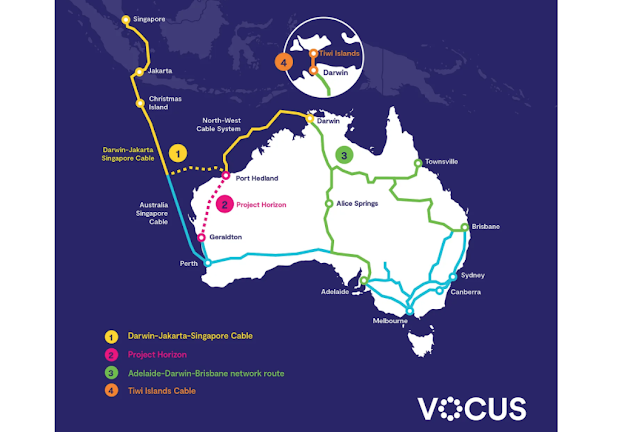
Vocus unveiled plans for the Darwin-Jakarta-Singapore Cable (DJSC), the first international submarine cable connection into Darwin, establishing the Northern Territory capital as Australia’s newest entry point for international data connectivity.

Vocus has now signed construction contracts for a new $100 million, 1,000km cable linking the Australia Singapore Cable (ASC) to the North West Cable System (NWCS) in Port Hedland – providing the final piece of the Darwin-Jakarta-Singapore Cable (DJSC), a $500 million system of high-capacity cables connecting Perth, Darwin, Port Hedland, Christmas Island, Indonesia, and Singapore.

The DJSC will deliver 40Tbps of internet capacity between Australia and Asia – unlocking Darwin as a major new data hub for the Asia-Pacific and opening up the Pilbara mining region for low-latency connectivity into Singapore.

The DJSC has been years in planning and marks the final stage in a sequence of major infrastructure builds by Vocus in Australia’s North and West. The DJSC will interconnect with the 4,600km ASC between Perth and Singapore and the 2,100km NWCS between Port Hedland and Darwin, with the completed system expected to be online by mid-2023.

Minister for Communications, Urban Infrastructure, Cities and the Arts, the Hon Paul Fletcher MP said: “Submarine cables are vital infrastructure, connecting Australia to the rest of the world. This new international cable landing in Darwin will provide more capacity and additional redundancy for Australia, and I welcome this investment from Vocus.”

The announcement coincides with the completion of the ‘Terabit Territory’ project with the Northern Territory Government, which has seen Vocus deploy 200 Gbps (Gigabits per second, per wavelength) technology on its domestic fibre network into Darwin. Vocus’ Darwin fibre routes now have 20Tbps of capacity, scalable to deliver up to 480Tbps of total capacity – with a future upgrade path in place to deliver 400Gbps technology as it becomes commercially available. 

https://www.vocus.com.au/news/vocus-announces-the-darwin-cable

AT&T to provide 5G for millions on new GM vehicles

General Motors has selected AT&T to provide 5G to millions of new vehicles over the next decade in the United States. 

GM said 5G connectivity will first be available in select model year 2024 vehicles. Additionally, through GM’s fifth-generation network, current 4G LTE-equipped model year 2019 and newer vehicles will experience faster connectivity speeds and many of the same performance benefits of future 5G-equipped vehicles. Current Chevrolet, Buick, GMC and Cadillac owners in the U.S. with 4G LTE-capable model year 2019 and newer vehicles will migrate to the new network infrastructure once available. 

To support GM’s next generation connected vehicles , AT&T is working with Microsoft to integrate secure cloud services.

“Together with AT&T, we’ve brought unprecedented experiences to the daily commute, family road trips and everything in between,” said Santiago Chamorro, GM vice president of Global Connected Services. “As an in-vehicle connectivity leader, this rollout demonstrates our commitment to growth through software-enabled services and reimagining every customer touchpoint by enabling faster connectivity speeds to power in-vehicle voice-enabled services, navigation, and apps that our customers have grown to love.”

“By connecting millions of GM vehicles to our nationwide 5G network, we will improve the customer experience for existing services while laying the groundwork for the next wave of innovation including autonomous driving,” said Gregory Wieboldt, senior vice president, Global Business, Industry Solutions, AT&T. “We now connect more vehicles than any other carrier and GM has played a critical role in our success. We’re honored to work alongside GM to usher the next chapter of connected driving.”


Lumen launches Edge Private Cloud

Lumen Technologies introduced a fully-managed Lumen Edge Private Cloud service that provides pre-built infrastructure for high-performance private computing connected to a global fiber network. 

Lumen Edge Private Cloud is a completely managed Infrastructure-as-a-Service that brings together a private cloud platform with the Lumen global fiber network, edge facilities, security, and managed services to help bridge clouds, IT infrastructure, and storage that allow applications to run at peak performance.  

"Lumen has decades of experience helping our customers implement private cloud solutions for critical workloads, and now we are extending our private cloud capabilities onto our low latency edge platform," said Chris McReynolds, vice president of cloud edge product management for Lumen. "We can help our customers enhance experiences, enhance application performance, and improve security and control — with speed and at scale by empowering them to deploy workloads closer to digital interactions on pre-built hardware and managed infrastructure. With Lumen Edge Private Cloud our customers can have a customized private cloud environment running within days, with Lumen assisting with design, implementation, managed services, and security consulting."

https://www.lumen.com/edge


Polaris Wireless and Qualcomm team on z-axis location for E911

Polaris Wireless' vertical (z-axis) location will be delivered through the Qualcomm Location Suite. 

The companies said their collaboration will facilitate the adoption of a fully integrated solution for feature phones and other cellular devices not served by iOS and Android operating systems. The effort takes advantage of Polaris Wireless proven z-axis location technology which is designed to exceed the FCC’s 3-meter z-axis accuracy requirement. Qualcomm Technologies has enhanced the capabilities of the Qualcomm Location Suite to provide z-axis location information via a standards-based interface, known as LPPe, which is the delivery method favored by mobile service providers.

“We are very enthusiastic about our collaboration with a world-class company like Qualcomm Technologies,” said Manlio Allegra, CEO and Founder of Polaris Wireless.  “By combining Polaris Wireless’ deep experience in 3D location with Qualcomm Technologies’ unparalleled position in the mobile ecosystem, we will support currently unserved wireless subscribers who deserve to be located with the best possible accuracy in emergency situations.” 

“The addition of vertical location is poised to help first responders to better determine the floor of an emergency caller within a multi-story building,” said Francesco Grilli, Vice President, Product Management, Qualcomm Technologies, Inc. “We continue to work with mobile operators, component manufacturers, and location innovators to support FCC regulations in a seamless manner for OEMs and users. We are proud of this work with Polaris Wireless to make it possible.”

https://www.polariswireless.com/


Lanner's uCPE verified for ADVA Ensemble Connector

The Lanner NCA-4025 is now verified with Intel Select Solution for uCPE with ADVA Ensemble Connector. In addition, ADVA’s Ensemble Connector is available preinstalled on a variety of Lanner’s leading network appliances.


The companies said their solution gives businesses and CSPs an open and flexible solution guaranteed to meet the performance needs of the most demanding uCPE applications. It delivers improved networking through the Ensemble Connector operating system and virtual network function hosting environment. This features advanced applications at Layer 2 and 3, including LTE access and Carrier Ethernet 2.0 functionality, as well as zero-touch provisioning for ultimate simplicity and scale. The uCPE offering also enables access to the Ensemble Harmony Ecosystem, the industry’s largest set of onboarded virtualized applications and supported servers.

“We’re excited that Lanner’s NCA-4025 is now a certified Intel Select Solution for uCPE preinstalled with Ensemble Connector. The new plug-and-play offering delivers the highest levels of performance while running multiple virtual network functions. It reduces the effort and complexity of testing and validation and accelerates time-to-market for new services,” said Mike Heffner, GM, Edge Cloud, ADVA. “The carrier-class capabilities of our Ensemble Connector combined with Lanner’s high-performance network appliances provide customers with a choice of highly scalable and secure hardware-software solutions that are pre-integrated and ready to deploy.”

http://www.adva.com

Telekom Romania picks Mavenir for cloud-native IMS

Telekom Romania Mobile Communications selected Mavenir to deploy a cloud-native IMS (vIMS) platform together with VoLTE and VoWi-Fi microservices. In combination with Mavenir’s cloud-native IMS platform, VoLTE and VoWi-Fi microservices will provide continuity of voice services for Telekom Romania while helping the company to strengthen its 4G/LTE network and facilitate the transition to 5G.

Mavenir notes that its network software solutions are running on Deutsche Telekom’s pan-European cross-border PAN-NET telco cloud network.

Brandon Larson, SVP, GM, Multimedia Business Unit at Mavenir, said, “By deploying on Deutsche Telekom’s PAN-NET, this project is another great example of how Mavenir’s market-leading network software solutions can run on any cloud. We’re very proud to provide Telekom Romania with tools to help it compete successfully in the future.”