Monday, October 8, 2018

CyrusOne invests in Brazilian data center

CyrusOne is making a $12 million investment in ODATA Brasil S.A. and ODATA Colombia  in exchange for a 10% equity interest in S.A.S. (collectively “ODATA”).

“CyrusOne is a leader and innovator in the data center industry, and their design and construction expertise will be valuable in delivering timely, cost-efficient builds to hyperscale companies.”

ODATA is focused on hyperscale cloud companies. The company currently has over 12 MW of capacity with plans to develop over 100 MW in Brazil, and will soon be launching construction in Colombia. ODATA is majority owned by Patria Infrastructure Fund III, managed by Patria Investments (“Patria”), a leading private equity firm in Brazil.

In connection with this investment, CyrusOne and ODATA entered a commercial agreement covering leasing activity with CyrusOne customers in the ODATA portfolio. In addition, Kevin Timmons, CyrusOne’s chief technology officer, will join the ODATA board of directors.

“We are excited to partner with Patria and the ODATA team as they scale their business throughout Latin America. To date, Brazil and other LATAM markets have largely been served by a limited number of providers, leading to few options and high costs for our customers. The combination of our collective resources will form the basis of a powerful platform from which we can better serve these customers’ increasingly global needs,” said Gary Wojtaszek, president and chief executive officer of CyrusOne. “Through Patria, which holds a number of investments across the communications infrastructure space, customers in ODATA’s facilities will have access to both dark fiber and lit services via Vogel Telecom, another portfolio company. At the same time, we will work with ODATA, helping the company build a scalable platform that can deliver high quality facilities at the lowest cost.”

Rancher's new release targets improved Kubernetes cluster ops

Rancher Labs released version 2.1 of its container management software, introducing next generation automatic cluster operations and application management, as well as a migration path for users moving from Rancher’s Cattle orchestrator to Rancher Kubernetes.

“Rancher continues to be the de facto choice for enterprises looking to run containers and Kubernetes in production,” said Sheng Liang, CEO and co-founder of Rancher Labs. “With Rancher 2.1, we’re providing key upgrades to the product that further enables any enterprise to embrace Kubernetes and accelerate development, reduce infrastructure costs and improve application reliability.”

Rancher 2.1 brings scalability improvements, as well as the ability to define and manage Kubernetes Clusters as code with Rancher. Additionally, Rancher is now enabling users to snapshot and export the complete configuration of Kubernetes clusters managed by Rancher, and later on restore Kubernetes clusters by importing the same configuration file.

http://www.rancher.com

Facebook's Portal offers video calling. built-in Alexa

Facebook introduced two consumer video conferencing devices featuring smart camera and microphones as well as built-in Amazon Alexa capabilities. The service provides video conferenced between Facebook and Messenger contacts.

The smart cameras use AI to track the users as they move about within view.

Connectivity is provided via Wi‑Fi (802.11a/b/g/n/ac) with dual band MIMO (2.4GHz and 5GHz), and Bluetooth 4.2.

Facebook said it has striven to provide the highest level of security and that its Portal service does not have Facebook ads at this time, although third-party services using the platform may have embedded ads.

Sunday, October 7, 2018

U.S bank signs Zayo for dark fiber, wavelengths, colo

Zayo announced a contract to provide a U.S.-based multinational bank with dark fiber, colocation and wavelengths.

Zayo said the colocation solution at a zColo data center in the western U.S. will serve as an interconnection hub for the customer. Dark fiber routes from the data center, over existing Zayo network, will connect to the bank’s core data centers in the area. In addition, a high-capacity wavelength solution will also be deployed, providing long-haul connectivity between nine markets across the U.S.

“Zayo’s unique ability to bring together all aspects of a North American infrastructure solution, including dark fiber, data centers and high-capacity, diverse wavelengths, was a deciding factor in this win,” said Randy Dunbar, president of Transport at Zayo. “The solution delivers all the baseline components providing the ability for the bank to continue to scale their network across a broad geography.”

Thursday, October 4, 2018

Sandvine: Netflix is 15% of all downstream Internet traffic

Netflix represents 15% of all downstream traffic across the entire Internet, according to Sandvine's newly released 1H 2018 Global Internet Phenomena Report.

Some highlights:

  • Video is ~58% of downstream traffic on the Internet
  • BitTorrent is ~22% of all upstream traffic on the Internet
  • Google is 40.2% of all connections in APAC
  • League of Legends has 51.53% of gaming connections among the Top 100 games
  • More than 50% of internet traffic is encrypted, and TLS 1.3 adoption is growing.
  • Gaming is becoming a significant force in traffic volume as gaming downloads, Twitch streaming, and professional gaming go mainstream.

Sandvine's Global Internet Phenomena Report is based on the company's policy and traffic control solutions, which are deployed across over 150 Tier 1 and Tier 2 fixed, mobile, WiFi, and satellite networks serving a combined 2.1 billion subscribers worldwide.

“Our business model is based on being ‘the best’ telco network data analytics company and providing our customers with use cases to understand, optimize, and manage subscriber quality of experience. Our goal with this report is to inform the global community on the ‘Internet Phenomena’ we live in every day, and to expose challenges and opportunities to build a more collaborative eco-system, improving the connected experiences for subscribers,” stated Lyn Cantor, President and CEO at Sandvine.


Procera rebrands as Sandvine now that the merger is complete

Procera Networks completed its previously announced acquisition of Sandvine. The combined company will operate under the Sandvine name.

Sandvine, headquartered in Waterloo, Ontario, was founded in 2001 by a team that had worked together on a previous start-up called PixStream, a video networking start-up that Cisco acquired that same year for C$554 million. Sandvine's core expertise is in network policy management, including the control of spam, usage-based billing, quality of service, and P2P throttling over any type of access network, including cable/DOCSIS, DSL/FTTx, Satellite, 3G, LTE, WiFi, and fixed wireless.

Procera Networks, based in Fremont, California, was founded in 2002 and includes significant operations in Sweden. Its PacketLogic platforms use deep packet inspection (DPI) to deliver analytics, traffic management, and enforcement use cases for broadband network operators, mobile operators and academic institutions. In 2007, Procera completed an IPO and in 2013 bought Vineyard Networks, a Canadian DPI company, for C$28 million. In 2015, private funds managed by Francisco Partners Management, a technology-focused private equity firm, acquired Procera Networks in an all-cash transaction valued at approximately $240 million.


The new company will serve over 400 communications service provider customers, with over 1 billion subscribers in more than 100 countries, as well as over 500 enterprise customers and more than 100 OEM and channel partners. It will be led by Procera's CEO Lyndon Cantor, and Procera CFO Richard Deggs.

Epsilon deploys Juniper's Metro Fabric for 100GbE global expansion

Epsilon, a privately-held global communications service provider based in London and Singapore, has deployed Juniper’s Metro Fabric solutions to support its global network upgrades to power future IoT applications and robust enterprise services.

Epsilon combines on-demand infrastructure, automation, web-based portals and APIs to deliver "friction-free access to global connectivity for resolving complex networking challenges." Its "Infiny by Epsilon" connectivity is based on a self-service SDN platform.  The current network is a terabit optical global backbone, which is deployed across over 90 Points of Presence (PoP) globally and connects over 600 network operators, communication and cloud service providers.

For this upgrade project, Epsilon required seamless integration with their existing network for optimized network management and the ability to quickly scale for service expansion and speed of delivery. These requirements will also enable end-to-end service level agreement (SLA) visibility, a key differentiator that will support web-based on-demand provisioning.

Juniper said its solution was chosen after an extensive evaluation process. Some highlights:

  • 100GbE-readiness with flexibility in the underlay: uses a combination of the MX10003 5G Universal Routing Platform as the MPLS transport core, and Metro Fabric solutions from Juniper consisting of the ACX5048 Universal Metro Router and BTI Packet Optical Transport Platforms. This enables a variety of connectivity options across 1GbE/10GbE/100GbE, tailored to individual market requirements.
  • Interoperability, automation and a single-pane-of-management: Across the stack, network management is now significantly streamlined, while offering end-to-end visibility and increased automation capabilities. Leverages interoperability of Juniper’s solutions and the open APIs provided by the Junos operating system.
  • Forward-looking scalability to support IoT and big data applications: leverages continued upgrades of the MX Series 5G Universal Routing Platform and ACX Series Universal Metro Routers, offering the current and long-term scalability and investment protection required to service more than 100 points-of-presence across the United States, Europe, Middle East and Asia-Pacific.
“We have been evolving our infrastructure gradually over the last decade in anticipation for the massive traffic growth driven by innovations in cloud, big data and IoT. By upgrading our network to offer 100GbE on-demand around the world, we are helping not only our existing partners but also new customers to benefit from hyper-scalable connectivity that is designed to support services of the future. We are pleased to partner with Juniper to realize our vision for flexible, fluid and intelligent global networking,” stated Jerzy Szlosarek, chief executive officer, Epsilon.

“The exponentially growing demands of today’s and tomorrow’s networking traffic is a continuously-evolving challenge for our customers. As we continue to address these and other networking complexities, we are proud to have found an outstanding long-term partner in Epsilon. Their rapidly growing global platforms demand a stellar foundation of powerful and reliable network infrastructure solutions that are adaptable to future requirements – and we are delighted to continue providing them with the critical technology differentiators crucial for their continued growth and success in the long-term,” said Sally Bament, vice president, service provider marketing, Juniper Networks.

Juniper refreshes MX edge routers powered by its Penta silicon

Juniper Networks introduced its new MX Series 5G Universal Routing Platform powered by a new generation of its custom ASICs promising extensive programmability and performance improvements for supporting resource-intensive applications like 5G and secure SD-WAN-based managed services.

The new "Penta" silicon, which leverages 16nm geometry, functions as the packet forwarding engine for the MX series. It delivers a 50 percent power efficiency gain (0.5 watts per gigabit) over the existing Junos Trio chipset, which leads to a 3x bandwidth increase for the MX960, MX480 and MX240. Juniper designed the Penta silicon with native support of both MACsec and an IPsec crypto engine – an industry-first – that can originate and terminate thousands of IPSec sessions without sacrificing performance. Additionally, Juniper Penta supports flexible native Ethernet support (FlexE).

Juniper Penta silicon features:

  • 16nm with Integrated 3D HBM Memory reducing packaging by 83% over the 4th Generation Trio silicon 
  • 500G Full Duplex / 1T Half Duplex 
  • 50Gbps SERDES 
  • Fully Programmable Packet Pipeline 
  • Fully Fungible Integrated Databases for FIB, ACLs, Tunnels, Telemetry, and more… 
  • Built-in FlexEthernet Support 
  • Built-in MACSec & IPSec Tunnel Encryption Engine (Industry First)
A second major innovation with the platform is open hardware-accelerated 5G Control and User Plane Separation (CUPS), which enables operators to separate the evolved packet core user plane (GTP-U) and control plane (GTP-C) with a standardized Sx interface. This allows service providers to scale the control plane and the user plane independently as needed for added flexibility and investment protection.

Juniper said its MX Series 5G platform is the first networking platform to support a standard-based hardware accelerated 5G user-plane in both existing and future MX routers to enable converged services (wireless and wireline) on the same platform while also allowing integration with third-party 5G control planes. Juniper expects this will lower total cost of ownership by as much as three to four times over software-based user plane implementations for MXs deployed in the field.

In addition, the rollout expands Juniper Universal Chassis system. The previously announced PTX and QFX Universal Chassis gains two new MX variants: MX10008 and MX10016. The 13-RU MX10008 and 21-RU MX10016 Universal Chassis bring industry-leading and space-saving scale for edge routers at 19.2Tbps and 38.4Tbps, respectively.

The MX10008 and MX100016 will be available during the second half of 2018. Juniper Penta Silicon-powered line cards for the MX960, MX480 and MX240 will be available in Q1 2019. New CUPS support will be available in the first half of 2019.

Bloomberg: The Big Hack

Bloomberg Businessweek published a bombshell article alleging that a malicious microchip smaller than a grain of rice was secretly embedded into server motherboards designed and sold by SuperMicro and installed by 30 U.S. companies, including Amazon Web Services and Apple. The article, which cites unnamed U.S. government officials and insiders at AWS and Apple, claims that Chinese government agents led the operation, which amounts to "the most serious" attack on the hardware supply chain of the IT industry. Bloomberg said the case dates back to 2014 - 2015 and concerns servers supplied by Elemental Technologies of Portland, Oregon, a supplier of specialized video caching servers based on SuperMicro servers. AWS

Apple, AWS and SuperMicro all issued statements strongly refuting the article.

Super Micro:  "Supermicro has never found any malicious chips, nor been informed by any customer that such chips have been found... Supermicro has never been contacted by any government agencies either domestic or foreign regarding the alleged claims."

AWS, Steve Schmidt, Chief Information Security Officer: "As we shared with Bloomberg BusinessWeek multiple times over the last couple months, at no time, past or present, have we ever found any issues relating to modified hardware or malicious chips in Supermicro motherboards in any Elemental or Amazon systems.‎"

Bloomberg said it was confident in its reporting and had multiple sources to verify the attack.

https://www.bloomberg.com/news/articles/2018-10-04/the-big-hack-amazon-apple-supermicro-and-beijing-respond


FirstNet builds fleet of deployable network assets for disasters

FirstNet is building a fleet of network assets, including Satellite Cell on Light Trucks (SatCOLTs), that public safety agencies subscribing to FirstNet can call upon during emergencies to help first responders stay connected.

The fleet now includes 72 dedicated deployable network assets that are stationed across the country. In addition to the FirstNet-dedicated fleet, public safety subscribers will be able to tap into assets, as available, from the AT&T fleet – which is one of the nation’s largest and most advanced disaster response programs.

In 2018 alone, the AT&T FirstNet team has already supported nearly 100 emergency and event response efforts via asset deployments and other solutions. This includes active shooter situations, tornadoes in the east, wildfires across the western states, and most recently, deployments for the Merrimack Valley gas explosions and Hurricane Florence.

“Hurricane Florence devastated several South Carolina communities, leaving behind dangerous flooding and an aftermath we’ll be dealing with long after the water recedes,” said Pickens County Emergency Management Deputy Director Pierce Womack. “Throughout it all, FirstNet has been with us every step of the way to provide our first responders with reliable connectivity and 24/7 support. The service has been aiding in our rescue and recovery from the storm, giving us a leg up to provide the best possible service to the citizens in need. It’s critical situations like these which show FirstNet’s dedication in supporting Emergency Services.”

NTT Com delivers SDx for McLaren at Formula 1 Japanese Grand Prix

NTT Communications is delivering a software-defined-everything (SDx) connectivity on a temporary basis for the McLaren Formula 1 (F1) Team during the F1 Japanese Grand Prix 2018. The McLaren garage at Suzuka Circuit will have high-speed, route-optimized connection to the cloud. In addition, the NFV infrastructure and uCPE will benefit from high-speed connection to a multi-cloud, including NTT Com's Enterprise Cloud, a hybrid cloud environment supporting traditional and cloud-native ICT for highly secure and stable operations with designed-in flexibility and agility.

NTT Com said its "Suzuka Special" network will speed up trackside communication for faster, more flexible in-race strategizing, including cloud-based telemetry data analysis, a key to successful F1 racing. The network will be deployed at Suzuka Circuit, Japan and the McLaren Technology Centre in Woking, UK as well as in the team's cloud infrastructure network in Europe. The new NFV infrastructure will comprise a software-defined wide area network (SD-WAN), WAN accelerator, unified threat management (UTM) and web proxy. NTT Com will deploy universal customer premises equipment (uCPE) at both Suzuka Circuit and the McLaren Technology Centre by utilizing a white-box CPE base, which will facilitate flexible installation of required software. NFV infrastructure, namely UTM, web proxy and uCPE, including SD-WAN and WAN accelerator software installed in the white-box CPE, will be used to establish an Internet gateway and SD-WAN at the F1 race track for an extra-fast network for solving network latency.

Tatsuya Yamashita, Head of NTT Com's Technology Development Division, said: "McLaren has been using NTT Com's SD-WAN service with zero downtime for the entire 2018 season, beginning at the Australian Grand Prix. We are now delighted to introduce our new NFV infrastructure for the Japanese Grand Prix. The superior ICT solutions NTT Com is providing as a trusted technology partner are not only giving McLaren a competitive edge in F1 racing, but also are providing us with invaluable insight into potential solutions for our general enterprise customers' digital transformations."


Optech intros 400G QSFP-DD

Taiwan-based Optech is introducing its line of 400G QSFP-DD transceivers, cables and loopback devices

The QSFP-DD transceivers can reach 100 meters for the QSFP-DD SR8 up to 10km for the QSFP-DD LR4.

Earlier this year, Optech launched a 100G QSFP28 ER4 Lite transceiver rate for up to 30km.

http://www.optech.com.tw

IDC: Security spending to reach $133.7 billion in 2022

Worldwide spending on security-related hardware, software, and services is forecast to reach $133.7 billion in 2022, according to an new update to IDC's Worldwide Semiannual Security Spending Guide, amounting to a compound annual growth rate (CAGR) of 9.9%. Security spending is forecasted to be $92.1 billion for 2018.

"Security remains an investment priority in every industry as companies seek to protect themselves from large-scale cyber attacks and to meet expanding regulatory requirements," said Eileen Smith, program director, Customer Insights and Analysis. "While security services are an important part of this investment strategy, companies are also investing in the infrastructure and applications needed to meet the challenges of a steadily evolving threat environment."

Some highlights:

  • Security-related services will be both the largest ($40.2 billion in 2018) and the fastest growing (11.9% CAGR) category of worldwide security spending. 
  • Managed security services will be the largest segment within the services category, delivering nearly 50% of the category total in 2022. 
  • Integration services and consulting services will be responsible for most of the remainder. 
  • Security software is the second-largest category with spending expected to total $34.4 billion in 2018. 
  • Endpoint security software will be the largest software segment throughout the forecast period, followed by identity and access management software and security and vulnerability management software. The latter will be the fastest growing software segment with a CAGR of 10.7%. Hardware spending will be led by unified threat management solutions, followed by firewall and content management.
  • Banking will be the industry making the largest investment in security solutions, growing from $10.5 billion in 2018 to $16.0 billion in 2022. 
  • Security-related services, led by managed security services, will account for more than half of the industry's spend throughout the forecast. The second and third largest industries, discrete manufacturing and federal/central government ($8.9 billion and $7.8 billion in 2018, respectively), will follow a similar pattern with services representing roughly half of each industry's total spending. The industries that will see the fastest growth in security spending will be telecommunications (13.1% CAGR), state/local government (12.3% CAGR), and the resource industry (11.8% CAGR).
  • The United States will be largest geographic market for security solutions with total spending of $39.3 billion this year. 
  • The United Kingdom will be the second largest geographic market in 2018 at $6.1 billion followed by China ($5.6 billion), Japan ($5.1 billion), and Germany ($4.6 billion). 


https://www.idc.com/getdoc.jsp?containerId=prUS44370418


Vodafone Italy comments on 5G plans

Vodafone Italy announced that the 3700 MHz spectrum it acquired this week in the national auction can be used immediately to enhance coverage, improve capacity, and for the rapid development of 5G services.

In the spectrum action, Vodafone Italy agreed to pay for the following licenses:

  • 3700 MHz – 80 MHz for €1,685 million, available from 1 January 2019 with a licence duration of 19 years.
  • 700 MHz – 2 x 10 MHz FDD (Frequency Division Duplexing) for €683 million, available from July 2022 with a licence duration of 15.5 years.
  • 26 GHz – 200 MHz for €33 million, available from 1 January 2019 with a licence duration of 19 years.

When it is available from 2022, the 700 MHz spectrum will be used to deploy enhanced 5G services, providing nationwide coverage at very high speed and very low latency. Vodafone can also use the 26 GHz spectrum acquired to deliver high capacity services in densely populated locations such as city centres, sports stadiums or industrial plants.

Vodafone currently has 5G trials underway in Milan and its metropolitan area, with the aim of transforming Milan into the 5G capital of Europe. Vodafone expects to have already achieved coverage of 80% of Milan and its metropolitan area by December 2018.

Vodafone Group CEO Nick Read said: “Auctions should be designed to balance fiscal requirements with the need for investment to enable economic development. Telecoms is the sector that enables all other sectors to participate in the Gigabit society. It is critical that European governments avoid artificial auction constructs which fail to strike a healthy balance for the industry.”

Wednesday, October 3, 2018

Fujitsu demos 600G single wavelength optical transmission

Fujitsu Network Communications announced the first demonstration of flexible 600 Gbps single wavelength optical transmission using its 1FINITY T600 Transport platform. Software-provisioned data rates up to 600 Gbps per wavelength were achieved by a combination of high-performance components and electronics on the T600, maximizing spectral efficiency and reach for optimized network performance.

Specifically, Fujitsu publicly demonstrated error-free 600 Gbps transmission using 64QAM modulation at 69 Gbaud and 75GHz grid spacing in a point-to-point configuration. Service turn-up and onsite reprovisioning of signal rates and modulation formats were achieved among 300 Gbps, 400 Gbps and 600 Gbps. Fujitsu’s FSS2 system software provided OpenConfig over gRPC Network Management Interface (gNMI) for system configuration, streaming telemetry for network monitoring, and enhanced diagnostics. The demonstration showcased a 600G 64QAM live constellation shown on a Fujitsu-built vector signal analyzer.

The 1FINITY T600 is powered by third-generation digital signal processor (DSP) technology developed by NTT Electronics (NEL) in partnership with Fujitsu. The plaform delivers sophisticated and flexible modulation schemes and variable forward error correction (FEC). The advanced modulation flexibility provides optimum reach, capacity and power consumption, thereby enabling network operators to reduce cost per bit per kilometer for data center interconnect (DCI), metro, long-haul and submarine applications.

“At OFC 2018, Fujitsu was the first optical vendor to exhibit 500G per lambda,” said Rod Naphan, Deputy Head of the Network Products Business Unit at Fujitsu. “This week’s public demonstration of 600G further validates our leadership in next-generation coherent technology and positions us to bring the 1FINITY T600 to market in 1Q19.”

The Fujitsu 600 Gbps single wavelength optical transmission demonstration occurred during the NANOG 74 conference in Vancouver, British Columbia, on October 1-3, 2018.

http://us.fujitsu.com/telecom

Cloudera and Hortonworks to merge, promising a single enterprise cloud platform

Cloudera (NYSE:CLDR) and Hortonworks (Nasdaq:HDP) agreed to a merger of equals with the goal of becoming "the world’s leading next-generation data platform provider, spanning multi-cloud, on-premises and the Edge."

The combination establishes the industry standard for hybrid cloud data management, accelerating customer adoption, community development, and partner engagement.

Cloudera, which is based in Palo Alto, California, began operations in 2008 as a hybrid open-source Apache Hadoop distribution. The company completed its IPO in April 2017. Cloudera has partnerships with AWS and Microsoft Azure.

Hortonworks, which is based in Santa Clara, California, was formed in June 2011 to supply open source software for enterprises. Hortonworks has partnerships with Google Cloud, Microsoft Azure, and IBM Cloud.


Tom Reilly, chief executive officer at Cloudera, stated, “Our businesses are highly complementary and strategic. By bringing together Hortonworks’ investments in end-to-end data management with Cloudera’s investments in data warehousing and machine learning, we will deliver the industry’s first enterprise data cloud from the Edge to AI. This vision will enable our companies to advance our shared commitment to customer success in their pursuit of digital transformation.”

“This compelling merger will create value for our respective stockholders and allow customers, partners, employees and the open source community to benefit from the enhanced offerings, larger scale and improved cost competitiveness inherent in this combination,” said Rob Bearden, chief executive officer of Hortonworks. “Together, we are well positioned to continue growing and competing in the streaming and IoT, data management, data warehousing, machine learning/AI and hybrid cloud markets. Importantly, we will be able to offer a broader set of offerings that will enable our customers to capitalize on the value of their data.”

The all-stock transaction, which has been unanimously approved by the Boards of Directors of both companies. Cloudera stockholders will own approximately 60% of the equity of the combined company and Hortonworks stockholders will own approximately 40%.

The combined company will have approximately $720 million in annual revenue, more than 2,500 customers, more than 800 customers over $100,000 ARR, and more than 120 customers over $1 million ARR.

The two companies have over $500 million in cash and no debt.


New numbering system differentiates Wi-Fi technologies

The Wi-Fi Alliance is rolling out a new numbering system to differentiate between generations of Wi-Fi technology.

Under the naming convention:

  • Wi-Fi 6 identifies devices that support 802.11ax technology
  • Wi-Fi 5 identifies devices that support 802.11ac technology
  • Wi-Fi 4 identifies devices that support 802.11n technology

The Wi-Fi Alliance says the change is needed because these waves of technology introduce new features – faster speeds, increased throughput, and better experiences - that benefit consumers.  Industry adoption of the new is expected to help in this regard.

https://www.wi-fi.org/discover-wi-fi/wi-fi-6


Palo Alto Networks to acquire RedLock for $173M

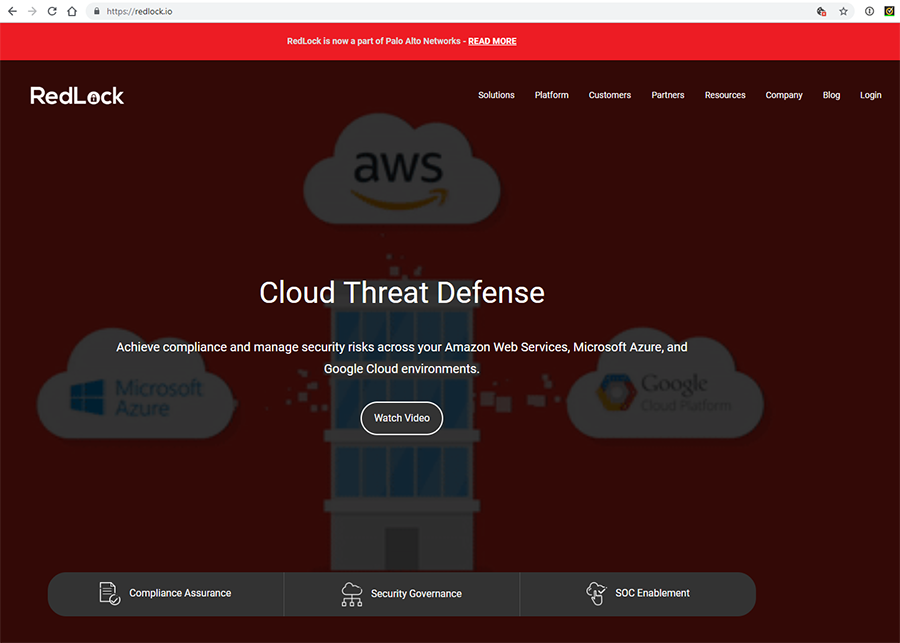
Palo Alto Networks agreed to acquire RedLock, a cloud threat defense company, for approximately $173 million in cash.

RedLock's Cloud 360 platform takes an AI-driven approach that correlates disparate security data sets to provide visibility, detect threats, and enable rapid response across an organization’s public cloud environment, including  Microsoft Azure, Google Cloud Platform, and AWS.  RedLock is based in Menlo Park, California. RedLock co-founders Varun Badhwar (previously co-founded CipherCloud) and Gaurav Kumar (previously Software Architect at CipherCloud), will join Palo Alto Networks.

Palo Alto Networks notes that it already provides a broad security offering for multi-cloud environments with inline, host-based, and API-based security, which was bolstered by the acquisition of Evident.io in March 2018. The company currently serves more than 6,000 cloud customers globally with its cloud security portfolio that includes VM-Series next-generation firewall, Aperture, Evident, and GlobalProtect cloud service. Palo Alto Networks now plans to combine the Evident and RedLock technologies to provide customers with cloud security analytics, advanced threat detection, continuous security, and compliance monitoring in a single offering anticipated early next year.

"We are thrilled to add RedLock’s technology to our cloud security offerings. The addition of their technologies allows us to offer the most comprehensive security for multi-cloud environments, including Amazon Web Services, Google Cloud Platform and Microsoft Azure, and significantly strengthens our cloud strategy going forward," stated Nikesh Arora, chairman and CEO of Palo Alto Networks.

https://redlock.io/

Orange Business delivers IoT across Europe for Octo Telematics

Orange Business Services has been awarded a 3-year contract renewal to provide global IoT services to Octo Telematics, the leading provider of telematics and data analytics for the auto insurance industry.

Under the contract, Orange Business will help Octo to manage, monitor and diagnose a large fleet of IoT devices autonomously. Octo develops and markets a complete range of vehicle telematics solutions, such as automatic crash alerts, on-call assistance, and car accident liability analysis. The solutions also range from personal insurance models, such as Usage Based Insurance to shared mobility, fleet management, and eco-driving management. Octo has more than 5.6 million connected users across the world and has a commercial relationship with more than 100 partners.

The Orange IoT Managed Global Connectivity includes SIM coverage across Europe to personalize Octo services, carry out remote analysis and reduce overall running costs. They will be able to collect information and conduct analytics using behavioral, contextual and other telematics data. This will help insurance companies assess risk and enhance the accuracy of crash notification and claims management while improving customer relationships. Using this technology, insurance companies will also be able to make critical business decisions, evaluating the price risk while looking after their customers.

“Octo Telematics was facing a business transformation and needed an IT partner able to support its growing business throughout Europe, while also providing a personalized service, analysis and remote management. We were able to meet their needs with a solution to manage their connected users in full autonomy, offering them more operational efficiency and flexibility,” said Fabrice de Windt, senior vice president, Europe, Orange Business Services.

Telstra delivers SD-WAN to Ruralco, an Australian agribusiness

Telstra will deliver SD-WAN to more than 500 locations for Ruralco, one of Australia’s leading agribusinesses.  Under the multi-million dollar deal, Telstra's SD-WAN connectivity will improve Ruralco’s operational agility, application performance and increase overall bandwidth to its outlets. It will also enable the roll out of an updated point of sales and customer relationship management solution.

The partnership, which also includes 2,200 mobile devices, will improve access to technology services for Ruralco’s vast communities of customers across rural and regional Australia. The agreement will see all Ruralco’s technology services brought together under one partnership with Telstra simplifying its operations, which were previously managed by different providers as separate bespoke solutions.

John Ieraci, Chief Customer Officer, Enterprise Australia, Telstra said, “Telstra has a long and proud history supporting customers and businesses in rural and regional Australia. By partnering with Ruralco we are helping to provide innovative technology services to the communities that provide critical services to the rest of the country."

Google Cloud builds deeper integrations for SAP

Google Cloud Platform announced new capabilities and integrations for SAP workloads.

The new functionality includes SAP workload sizing, and SAP HANA dynamic tiering, which provides disk-based, large-volume extended storage for SAP HANA warm data.

https://cloud.google.com/blog/topics/partners/google-cloud-platform-your-cloud-destination-for-mission-critical-sap-workloads

Tata Communications acquires Teleena, an IoT specialist

Tata Communications has agreed to acquire Teleena, a Netherlands-based Internet of Things (IoT) connectivity specialist and mobile virtual network enabler (MVNE). Financial terms were not disclosed.

Tata Communications bought a 35% equity stake in Teleena in January 2017.

Teleena’s solution is a key part of the Tata Communications’ MOVE platform, which enables enterprises and device manufacturers to capture, move and manage information worldwide through borderless, secure and scalable connectivity. The acquisition gives Tata full access to Teleena’s technology portfolio, including its MVNE platform, its Operational Support System / Business Support System (OSS/BSS) solution, and the expertise of Teleena’s mobility and IoT industry specialists.

“The growth rate in the global mobility and IoT market is phenomenal: by 2021, enterprises’ spending on mobility alone is set to surpass USD 1.7 trillion,” said Anthony Bartolo, Chief Product Officer, Tata Communications. “Our vision is to create an environment where anything can be ‘born connected’. Providing everyone and everything in the world with seamless connectivity globally will support businesses’ digital transformation. The combination of the Tata Communications MOVE™ platform, and Teleena’s technology and talent, will help us fulfil this vision, and accelerate our growth in the mobility and IoT market.”