Friday, September 9, 2022

Keysight and IBM target Open RAN in Europe

Keysight Technologies and IBM signed a memorandum of understanding (MoU) to pursue open radio access network (RAN) deployments in Europe.

IBM endeavors to use Keysight Open Radio Architect (KORA) solutions in the company’s Open RAN center of excellence (CoE), established in 2021, to help mobile operators drive innovation to meet the standards defined by the O-RAN ALLIANCE. IBM intends to integrate Keysight’s software-centric open RAN test, measurement and emulation tools with IBM’s Cloud Pak for Network Automation, an AI-powered telco cloud platform that enables the automation of network operations.

Based in Madrid, Spain, IBM’s CoE enables communications service providers (CSPs) to deploy IBM solutions in their laboratory environments or live networks to support private and industrial applications. IBM’s CoE aims to advance digital transformation in the telco industry and is supported by IBM Consulting.

“Keysight’s collaboration with IBM will help enable mobile operators to speed deployments of digital transformation tools that are critical in supporting industrial competitiveness in Europe,” said Kalyan Sundhar, vice president and general manager for Keysight’s wireless network access business. “The integration of Keysight’s open RAN test solutions with IBM’s Cloud Pak for Network Automation will help service providers in automating applications that are critical to delivering a wide range of connectivity services.”




FCC Chair proposes 5-year rule to de-orbit nonfunctioning LEO sats

FCC Chairwoman Jessica Rosenworcel put forward new rules that would require satellite operators in low-Earth orbit to dispose of their satellites within 5 years of completing their missions. If adopted by a vote of the full Commission at its September monthly meeting, the new rules will shorten the existing 25-year guideline for deorbiting satellites after they cease to function.

“Since 1957 humanity has put thousands of satellites into the sky, often with the understanding that they were cheaper to abandon than take out of orbit. These satellites can stay in orbit for decades, careening around our increasingly crowded skies as space junk and raising the risk of collisions that can ruin satellites we count on,” said Chairwoman Rosenworcel.

“Today it is the recommended practice for satellite operators to deorbit their spacecraft within 25 years of completing their missions. But there is no reason to wait that long anymore. Our space economy is moving fast. For it to continue to grow, we need to do more to clean up after ourselves so space innovation can continue to expand. That is why I am proposing to shorten the 25-year guideline to no more than 5 years. It will mean more accountability and less risk of collisions that increase debris. I hope my colleagues will join me in supporting this effort.”

https://www.fcc.gov/news-events/events/2022/09/september-2022-open-commission-meeting

Intel breaks ground on its new fab in Ohio

Intel held a groundbreaking ceremony attended by President Biden to mark the beginning of construction on two advanced chipmaking facilities in Ohio. 

Intel also announced the first phase of funding for its Ohio Semiconductor Education and Research Program. During this first phase, Intel is providing $17.7 million for eight proposals from leading institutions and collaborators in Ohio to develop semiconductor-focused education and workforce programs.

“Today marks a pivotal moment in the journey to build a more geographically balanced and resilient semiconductor supply chain. The establishment of the Silicon Heartland is testament to the power of government incentives to unlock private investment, create thousands of high-paying jobs, and benefit U.S. economic and national security. We would not be here today without the support of leaders in the administration, Congress and the state of Ohio, who share a vision to help restore the United States to its rightful place as a leader in advanced chipmaking,” stated Pat Gelsinger, Intel CEO.

https://www.intel.com/content/www/us/en/newsroom/news/intel-announces-next-us-site-landmark-investment-ohio.html#gs.c25ibm

Intel expands its manufacturing plans

Intel will invest more than $20 billion in the construction of two new fabs in Ohio. The initial phase of the project is expected to create 3,000 Intel jobs and 7,000 construction jobs over the course of the build. Air Products, Applied Materials, LAM Research and Ultra Clean Technology will establish a physical presence in the region. Initial production is targetted for 2025.Today’s investment marks another significant way Intel is leading the effort...


Thursday, September 8, 2022

Graphiant shakes up routing with its network edge service

Graphiant, a start-up based in San Jose, California, emerged from stealth to unveil a new network edge service that promises to shake up the established framework of VPNs, including MPLS and SDWAN.

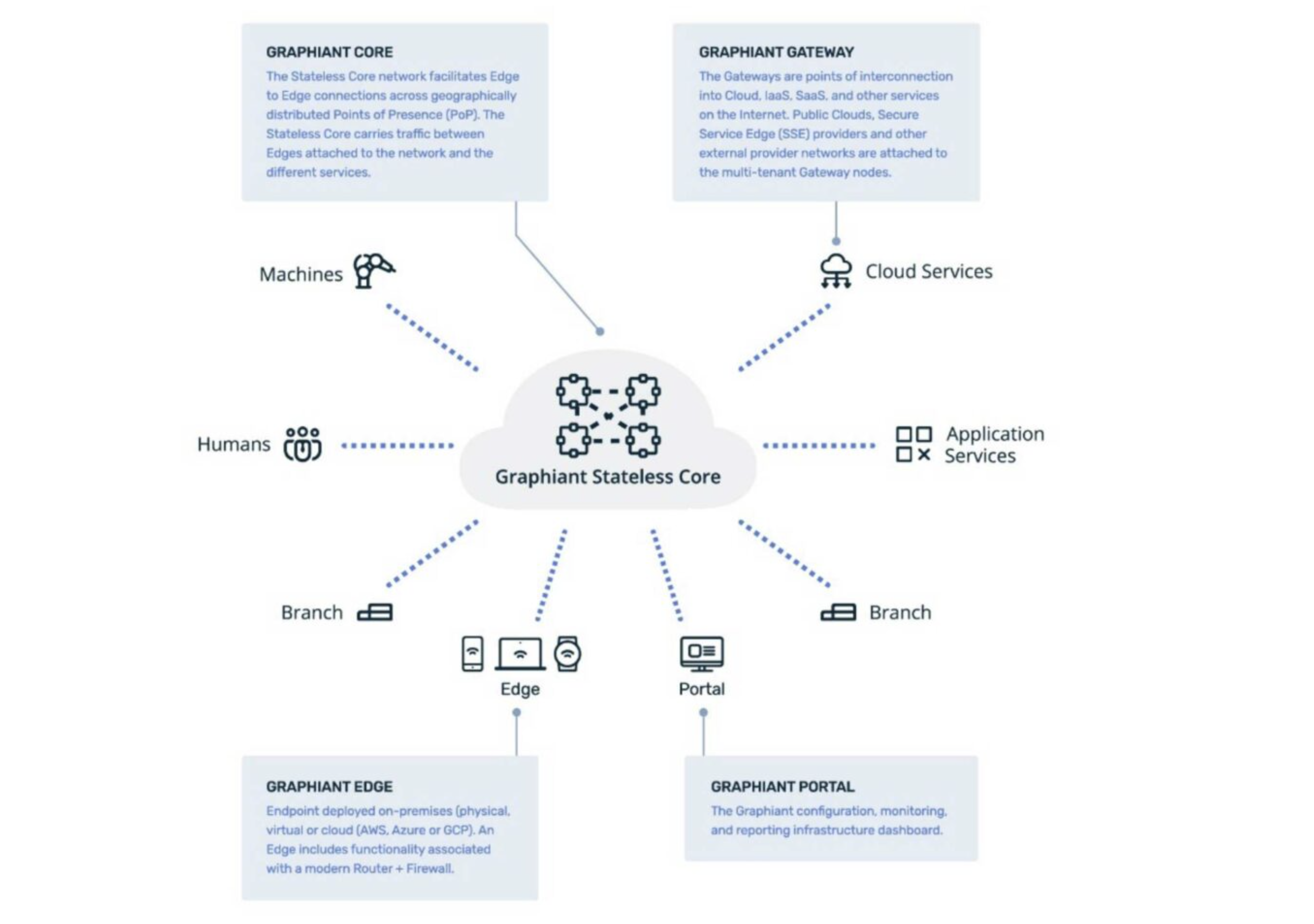
The Graphiant Network Edge provides connectivity between the enterprise WAN, hybrid cloud, network edge, customers and partners. The service promises MPLS-like performance (guaranteed delivery, security and privacy) and Internet-class agility. 


All routing is handled by the Graphiant Stateless Core, which leverages a proprietary routing label system to provision protected paths across an underlay network that is managed by Graphiant. From the enterprise customer perspective, traffic remains encrypted from edge to edge, and SLA-grade performance is guaranteed. The company has its network core deployed in key Equinix data centers serving as its PoPs.

Graphiant's idea is to remove the need for network architects to build bespoke networks between every resource, hybrid cloud, edge network, customer and partner. Instead, they simply connect each resource to the Graphiant Stateless Core. 

“Network architects have to provide connectivity for an impossibly complex world,” says Khalid Raza, CEO of Graphiant. “Connecting business resources, hybrid cloud, edge networks and remote workers, is time-consuming, error-prone and full of security challenges.  We’ve delivered a solution that removes this complexity.”


Video: What's next for enterprise connectivity? (after MPLS and SDWAN)

What's next for enterprise connectivity?

Graphiant, a start-up based in Silicon Valley, has just unveiled a new network edge service that promises to shake up the established framework of VPNs, including MPLS and SDWAN.

In this video, we hear from Khalid Raza, founder and CEO of Graphiant, and who is widely regarded as a visionary in routing protocols and large-scale network architectures. Raza previously was founder & CTO of Viptela, an SDWAN pioneer that was eventually acquired by Cisco for $610 million in 2017. 

https://youtu.be/iVtnsTlnKfs

Comcast to offer symmetrical multi-gig speeds in 2023

Comcast  has begun a nationwide rollout of multi-gig Internet speeds with the goal of reaching more than 50 million homes and businesses before the end of 2025.

As part of this initiative, Comcast is accelerating the transformation of its network to a virtualized cloud-based architecture that is fully prepared for 10G and DOCSIS 4.0.

Under this initiative Comcast is:

  • Immediately rolling out download speeds up to 2 Gigs – combined with up to 5x-to-10x faster upload speeds – to millions of homes and businesses; available in 34 cities and towns before the end of 2022; more than 50 million homes and businesses by the end of 2025; and continuing throughout the entire network. Initial rollouts are already underway in Colorado Springs, CO; Augusta, GA; and Panama City Beach, FL, with more launched at a regular cadence through the end of the year
  • For Xfinity customers: extending new multi-gigabit network speeds throughout the home with the multi-gig-capable Wi-Fi 6E Gateway, xFi connected home platform, and xFi Pod Wi-Fi extenders
  • For Comcast Business customers: Delivering ultra-fast Wi-Fi speeds for businesses with a new multi-gig capable gateway
  • Completing the core technical foundation for 10G, which will deliver multi-gig symmetrical speeds over the connections already installed in tens of millions of homes and businesses
  • Finalizing transition to a cloud-based, virtualized network that enables faster speeds, greater reliability for customers, while also implementing a network architectural update that enables greater upload and download capacity
  • Building multi-gig capabilities that can reach everyone connected to Comcast’s network, not just select neighborhoods and customers, just as Comcast has done with previous network improvements
  • Improving energy efficiency, helping Comcast become carbon neutral by 2035

“We’re making our network even smarter and faster, which allows us to quickly deliver true multi-gig Wi-Fi to tens of millions of businesses and residential consumers at an unprecedented pace,” said Charlie Herrin, President of Technology, Product, Experience at Comcast Cable. “Whatever the application, whatever the future holds, our network and world-class, whole-home Wi-Fi experience will be there and ready to power all of our customers’ connected experiences.”

Comcast demos 10G technologies

Comcast reached download speeds faster than 8 Gbps and upload speeds faster than 5 Gbps during a 10G event at CableLabs headquarters.For the demo, Comcast connected a 10G-enabled Virtualized Cable Modem Termination System (vCMTS) linked by more than 80 kilometers of fiber to the demonstration site. The fiber terminated into a production switch, which connected to what is believed to be the world’s first fully functional 10G-enabled Full Duplex DOCSIS...

Comcast tests Lumenisity's hollowcore fiber

Comcast confirmed its first deployment of advanced hollowcore fiber optics.Comcast connected two locations in Philadelphia, which enables network engineers to continue to test and observe the performance and physical compatibility of hollowcore fiber in a real-world deployment. Comcast successfully tested bidirectional transmission (upstream and downstream traffic traveling on a single fiber), used coherent and direct-detect systems (allowing for...

CableLabs cites 10G milestones

CableLabs cited a number of 10G milestones achieved in 2021:CableLabs recently published its first set of specifications for a new device, called the Coherent Termination Device, that enables operators to take advantage of coherent optics technologies in fiber-limited access networks. Typically used for long-haul, metro and submarine networks, coherent optics technologies enable operators to use their existing fiber assets more efficiently when teamed...

Comcast tests 10G modem based on full Duplex DOCSIS 4.0

Comcast achieved a top downlink performace of over 4 Gbps using a prototype 10G modem.  The lab test used a full duplex DOCSIS 4.0 system-on-chip (SoC) from Broadcom.The modem test utilized the DOCSIS 4.0 FDX SoC device, which Comcast demonstrated in April 2021, to pair with two cable modem chips. These were connected over a lab-based hybrid fiber-coaxial network to the vCMTS operating in DOCSIS 4.0 mode. Comcast said this represents the...


ADVA introduces new 10G edge device

ADVA introduced an outdoor 10G Carrier Ethernet edge demarcation device that complies with MEF 3.0 specifications

The ADVA FSP 150-XO106 is compact and temperature-hardened, making it ideal for deployment in space-restricted locations and harsh outdoor conditions. Requiring no cabinet or cooling, it can be easily deployed on walls, poles and cell towers. The feature-rich solution includes advanced OAM capabilities, supports precise synchronization and fully integrates with ADVA’s Ensemble Controller and Packet Director for simple network management.

“The emergence of more connected devices and the boom in video streaming create a new set of demands at the network edge. So too does the rapid digital transformation across all industries, from healthcare to education to agriculture. Our compact and ruggedized FSP 150-XO106 is specifically designed to address this need by enabling 10Gbit/s demarcation technology in any outdoor space,” said Mike Heffner, GM of Edge Cloud, ADVA. “The versatility and ease of deployment of our new device will bring reliable, high-speed connectivity to more places than ever before.”

https://www.adva.com/en/newsroom/press-releases/20220908-adva-introduces-new-10g-edge-device-for-outdoor-environments

Intel and Broadcom host cross-vendor Wi-Fi 7 demo topping 5 Gbps

Intel and Broadcom hosted a cross-vendor Wi-Fi 7 demonstration that showed over-the-air speeds greater than 5 Gbps. The trial used an Intel Core processor-based laptop with a Wi-Fi 7 solution connected to a Broadcom Wi-Fi 7 access point.

Wi-Fi 7 leverages new features including wider 320 MHz channels in unlicensed 6GHz spectrum, higher order 4K QAM data modulation, simultaneous connections across multiple bands with multi-link operation and improved channel utilization efficiency with multi-resource unit puncturing.

“We are proud to highlight how next-generation Wi-Fi 7 can make new mobile PC experiences possible. Industry collaboration is essential to ensure we deliver on the promises of this new wireless technology. We would like to thank our colleagues at Broadcom for their great technical cooperation, which helped enable this unprecedented, first-of-its-kind demonstration of ultra-high speed and ultra-low latency Wi-Fi 7,” said Carlos Cordeiro, Intel Fellow and Wireless CTO, Client Computing Group, Intel.

Vijay Nagarajan, vice president, Wireless Connectivity Division, Broadcom, said, “Today’s milestone sends a clear message: the ecosystem is ready and Wi-Fi 7 is here to deliver extraordinary capacity and blazing fast speeds to extend gigabit broadband. The reliable, low latency communication provided by Wi-Fi 7 is a key element of Broadcom's vision for connecting everything as the Internet evolves to its next iteration replete with immersive experiences. Industry collaboration is key to making this unprecedented connectivity a reality and we were delighted to work with Intel to achieve another industry first.”

https://www.intel.com/content/www/us/en/products/docs/wireless/wi-fi-7.html


II-VI changes name to Coherent

II-VI  (Nasdaq: IIVI) announced a corporate name change to Coherent Corp. (Nasdaq: COHR) and a new brand identity, following the successful completion of II-VI’s acquisition of Coherent, Inc., on July 1, 2022.

“We chose the name Coherent because it has the universal meaning of ‘bringing things together,’ and an appeal that we believe will expand our brand recognition and ultimately lead to value creation,” said Dr. Vincent D. Mattera, Jr., Chair and CEO of Coherent Corp. “The broader meaning of the word coherent represents our diversity in thinking distilled into our clarity of purpose, our unity in action, and our broader sense of engagement by connection to our mission, vision, and values.”

The company says its new logo represents the atom, which is foundational to what makes our products possible. The new name and brand identity reflect the combined company’s strong heritage and long history while signaling a broadened scope and vision for the future. The organization will maintain II-VI’s founding date of 1971 and its founding place and corporate headquarters as Saxonburg, Pennsylvania.

https://ii-vi.com/

Wednesday, September 7, 2022

Apple's Emergency SOS via satellite uses Globalstar

Apple's newest iPhone 14 models feature a new "Emergency SOS via satellite" capability delivered via Globalstar's constellation of LEO satellites, which cover approximately 80% of the Earth's surface.

Designed for emergency communications when out of cellular or Wi-Fi range, the iPhone 14 user must have a clear view of the sky. Texting can take from seconds to several minutes. Messages are relayed from earth-to-ground stations to the nearest emergency service providers. Messages are sent in encrypted form, and decrypted by Apple before being passed along to the relevant emergency services dispatcher, or the emergency relay center. Apple will set up emergency relay specialists to communicate verbally with emergency service providers not receiving texts. In addition, Apple's Find My feature can be used via satellite to share off-grid locations with friends or relatives.

Apple says the service isfree for two years with the activation of any iPhone 14 model. Connection and response times vary based on location, site conditions, and other factors. 

Emergency SOS via satellite will be available with an iOS 16 software update coming in November 2022.

Separately, Globalstar confirmed via an SEC filing that it has won a contract to provide satellite service to Apple for the new iPhone 14 capability. Globalstar said the companies have completed feasibility testing, material upgrades to Globalstar's ground network, construction of 10 new gateways around the world. Globalstar has also launched a ground spare satellite and finished in-field system testing. Apple has agreed to pay Globalstar a recurring service fee, as well as payments for operating expenses, certain capital expenditures, bonus payments, etc.


https://www.apple.com/iphone-14-pro/specs/

https://investors.globalstar.com/node/14431/html

  • In December 2016, the FCC adopted rules permitting Globalstar to deploy a terrestrial low-power broadband network using 11.5 MHz of the Company's 2.4 GHz spectrum. 

Molex intros optical-electrical interconnects for Co-Packaged Optics

Molex introduced its pluggable module solution for co-packaged optics (CPO), which moves optical connections from the front panel to within the host system—right next to high-speed ICs.

The new External Laser Source Interconnect System (ELSIS) is a complete system of cage, optical and electrical connectors with a pluggable module.

"From high-speed networking chips to graphics processing units (GPUs) and AI engines, the demand for I/O bandwidth continues to escalate," said Tom Marrapode, director of advanced technology development, Molex Optical Solutions. "By placing the optics closer to these ASICs, CPO will address the growing complexities associated with high-speed electrical traces, including signal integrity, density and power consumption."

Molex notes that traditional pluggable modules have their optical connections at the user side of the module, creating concerns about eye safety when used with high-power laser sources, such as those planned for CPO. As a blind-mating solution, ELSIS eliminates user access to optical fiber ports and cables, providing a complete external laser source system for safe, easy implementation and maintenance. The use of external laser sources also means a major heat source is moved away from the optoelectronics and IC package. Plus, the design eliminates high-speed electrical I/O drivers on the IC and in pluggable modules, further reducing thermal loads and power consumption within the equipment.

Molex is currently sampling the ELSIS hybrid optical electrical connector and cage system. Supporting design and development materials for the fully pluggable module system, including 3D models, technical drawings and detailed specifications, are available now. Molex is targeting Q3 2023 for release of the fully integrated solution.

https://www.molex.com

Mavenir and NEC deliver massive MIMO on Orange’s 5G SA test

Mavenir and NEC  (NEC) have deployed massive MIMO (mMIMO) on Orange’s 5G standalone (SA) experimental network in Chatillon near Paris. The deployment is part of the extension of project Pikeo – Orange’s cloud-based and fully automated 5G SA experimental network, also called Pikeo at this site.

Mavenir’s cloud-native Open virtualised Radio Access Network (Open vRAN) software has been deployed on Orange’s cloud infrastructure with NEC’s 32T32R mMIMO active antenna unit (AAU) to deliver high capacity and enhanced coverage. Interoperability between radios and virtualised Distributed Units (vDUs) over the O-RAN Alliance Open Fronthaul Interface is key to Open RAN’s ability to simplify the deployment of multi-vendor networks and eliminate vendor lock-in.

“Mavenir and NEC’s successful Open RAN deployment of mMIMO on Orange’s Innovation 5G SA experimental network is a major stepping stone on the road towards Open RAN deployments and illustrates Orange’s commitment to support the development of multi-vendor Open RAN solutions with innovative partners. Our Open RAN Integration Centre, open to our partners worldwide, contributes to the development of a strong Open RAN ecosystem in Europe,” said Arnaud Vamparys, SVP Radio Access Networks and Microwaves at Orange.

“Deploying 5G SA mMIMO is a significant milestone in developing Open RAN and transitioning from virtualised to cloudified networks. We are very proud of our continuing collaboration with Orange, NEC and other companies that are proving the potential of the multi-vendor, cloud-native, standards-based approach,” said Hubert de Pesquidoux, Executive Chairman of Mavenir.

“The latest deployment of Open RAN mMIMO in Europe is another milestone for Open RAN and one that required close collaboration and tight integration between multiple vendors. This synergy is exactly what Open RAN needs to successfully deliver on its promise of a truly open multi-vendor ecosystem,” said Naohisa Matsuda, General Manager of NEC’s 5G Strategy and Business.

https://www.mavenir.com

Orange names its 5G Stand Alone vendors 

Orange has chosen the following industrial partners for its 5G Stand Alone networks across Europe:Ericsson’s 5G SA core network for Belgium, Spain, Luxembourg and PolandNokia’s 5G SA core network for France and Slovakia, and Nokia’s Subscriber Data Management for all countriesOracle Communications for 5G core signaling and routing in all countriesFor other network functions, in particular the radio, a software update of the existing equipment will...

O-RAN Alliance demos at MWC Barcelona

 O-RAN ALLIANCE will host 22 demos at the upcoming MWC Barcelona 2022 as well as 24 additional demos online at the O-RAN Virtual Exhibition. Here are highlights.Intelligent RAN control demosEricsson presents its approach to SMO as an enabler of automation and value creation in the context of open innovation with rApps. Ericsson Intelligent Automation Platform provides multi-vendor and multi-technology support for RAN and empowers CSPs to accelerate...


Cogent to acquire T-Mobile Wireline assets, including legacy Sprint LH

Cogent Communications agreed to acquire T-Mobile's Wireline Business. 

In addition to the fiber network and related assets and customers, Cogent will acquire certain liabilities associated with the business. In addition, at the closing of the acquisition, the parties will enter into a separate agreement pursuant to which Cogent will offer IP transit services to T-Mobile for 54 months following the closing date and T-Mobile will pay Cogent $700 million for such services, with $350 million due in equal payments over the first 12 months after closing and $350 million due in equal payments over the remaining 42 months.

Cogent described the acquisition as an ideal strategic fit with its existing business. The Wireline Business offers the legacy Sprint U.S. long-haul network that provides an owned network asset to complement and eventually replace Cogent's current leased network and provides the ability to expand its product set, including the sales of optical wave transport services to new and existing customers. It also has a current customer base who are a fit for Cogent's products and services, and a group of experienced employees with the knowledge and capabilities to execute the company's strategy.

Cogent expects to offer customers the ability to migrate from their legacy MPLS VPN solutions to modern Ethernet / VPLS or SD-WAN / DIA solutions for their corporate needs. Cogent also expects to facilitate the migration of netcentric internet access customers from the T-Mobile Wireline Business (legacy Sprint) AS1239 to Cogent's AS174.

https://www.cogentco.com/en/about-cogent/press-releases/3566-cogent-announces-definitive-agreement-to-acquire-t-mobile-s-wireline-business

Intelsat to provide secure global communications for FBI

Intelsat General Communications LLC (IGC), a wholly owned subsidiary of Intelsat, has been selected by the U.S. Federal Bureau of Investigation (FBI) for resilient, secure, on-demand communications in clear and contested environments across the globe.

The service will leverage Intelsat's GEO satellite fleet, combining multi-layered, Ku-band HTS coverage with wide and spot beams to bring broadband connectivity around the globe - including the most trafficked flight routes. This solution delivers preflight, in-route transit, and on-station data, voice, and video communication capabilities anywhere in the world. 

https://Intelsat.com

Intel appoints Weiss as co-GM of the Design Engineering Group

Intel named Shlomit Weiss as senior vice president and co-general manager (GM) of the Design Engineering Group (DEG), replacing senior vice president Sunil Shenoy, who will retire at the end of the year. Weiss will lead the company’s design, development, validation and manufacturing support of intellectual properties (IPs) and system-on-chips (SoCs), reporting directly to Intel CEO Pat Gelsinger and joining the company’s executive leadership team.

Weiss returned to Intel last year as co-GM of DEG with Shenoy, specifically leading client product design engineering and the Intel architecture core portfolio used across client, data center and other segments. Before rejoining Intel, Weiss was senior vice president of silicon engineering at Mellanox, now part of Nvidia. She has more than 30 years of experience in the semiconductor industry. Weiss has spent 28 years at Intel in engineering and leadership roles, including as leader of cross-site teams responsible for IP and discrete data center products, and general manager of data center group silicon development.

“The design engineering organization plays a central role in our ability to deliver leadership products in every category in which we compete. It requires a leader with deep technical expertise and passion for engineering excellence, and Shlomit has that in spades,” Gelsinger said. “With more than three decades of experience in semiconductor and SoC design engineering and management, Shlomit is known for her focus on quality and predictable execution, which are critical focus areas as we advance our IDM 2.0 strategy.”

“I returned to Intel last year because I was inspired and excited by Pat’s bold IDM 2.0 strategy and vision for the company and I saw an opportunity to help accelerate the company’s path to product leadership,” Weiss said. “I’m honored to join Pat’s leadership team and help re-energize and re-establish a culture of execution and innovation while leading our engineering teams to drive consistent and predictable cadence of quality product innovation.”

Tuesday, September 6, 2022

CHIPS for America strategy released

The U.S. Department of Commerce released its strategy for implementing the $50 billion CHIPS Act of 2022 program, which was signed by President Biden last month.  Here are the highlights,

The CHIPS Act of 2022 program has four primary goals :

  • Establish and expand domestic production of leading edge semiconductors in the US, of which the US currently makes 0% of the world’s supply
  • Build a sufficient and stable supply of mature node semiconductors
  • Invest in R&D to ensure the next generation semiconductor technology is developed and produced in the US.
  • Create tens of thousands of good-paying manufacturing jobs and more than hundred thousand construction jobs. This effort will ensure the pipeline for these jobs expands to include people who have historically not had a chance to participate in this industry, including women, people of color, veterans and people who live in rural areas

The program supports three distinct initiatives:

  • Large scale investments in leading edge manufacturing: The CHIPS incentives program will target approximately three quarters of the incentives funding, around $28 billion, to establish domestic production of leading-edge logic and memory chips that require the most sophisticated manufacturing processes available today. Those amounts may be available for grants or cooperative agreements, or to subsidize loans or loan guarantees. The Department is still assessing the impact of the newly enacted advanced manufacturing facility investment tax credit on capital expenditures, which will generate significant additional project investment from participants and will reduce the required share of CHIPS incentives funding allocated for leading edge projects. The Department will seek proposals for the construction or expansion of manufacturing facilities to fabricate, package, assemble and test these critical components, particularly focusing on projects that involve multiple high-cost production lines and associated supplier ecosystems.
  • New manufacturing capacity for mature and current-generation chips, new and specialty technologies, and for semiconductor industry suppliers: The CHIPS incentives program will increase domestic production of semiconductors across a range of nodes including chips used in defense and in critical commercial sectors such as automobiles, information and communications technology, and medical devices. This initiative is broad and flexible, encouraging industry participants to craft creative proposals. For this initiative, the Department expects dozens of awards with the total value expected to be at least a quarter of the available CHIPS incentives funding, or approximately $10 billion. Those amounts may be available for grants or cooperative agreements, or to subsidize loans or loan guarantees.

  • Initiatives to strengthen US leadership in R&D: The CHIPS R&D program will invest $11 billion in a National Semiconductor Technology Center, a National Advanced Packaging Manufacturing Program, up to three new Manufacturing USA Institutes, and in NIST metrology research and development programs. This constellation of programs is intended to create a dynamic new network of innovation for the semiconductor ecosystem in the United States. Executing this vision will require collaboration with academia, industry, and allied countries, and will require sustained investment over many years.

Funding documents, which will provide specific application guidance for the CHIPS for America program, will be released by early February 2023.

“Rebuilding America’s leadership in the semiconductor industry is a down payment on our future as a global leader,” said U.S. Secretary of Commerce Gina Raimondo. “CHIPS for America, will ensure continued US leadership in the industries that underpin our national security and economic competitiveness. Under President Biden’s leadership, we are once again making things in America, revitalizing our manufacturing industry after decades of disinvestment and making the investments we need to lead the world in technology and innovation.”

https://www.commerce.gov/news/press-releases/2022/09/biden-administration-releases-implementation-strategy-50-billion-chips

An 18-page strategy document is published here: https://www.nist.gov/system/files/documents/2022/09/06/CHIPS_Strategic_Plan_Sept_6_2022.pdf

CHIPS and Science Act funding processes get underway

 President Biden signed an Executive Order to implement the semiconductor funding in the bipartisan CHIPS and Science Act of 2022.The order establishes an interagency CHIPS Implementation Steering Council, which will be  co-chaired by National Economic Director Brian Deese, National Security Advisor Jake Sullivan, and the Acting Director of the Office of Science and Technology Policy, Alondra Nelson. The order also  establishes...

Key provisions of the CHIPS and Science Act of 2022

The U.S. House of Representatives voted 243-187 to pass the CHIPS and Science Act of 2022. The legislation was approved by the U.S. Senate last week. President Biden is now expected to sign it into law.The principal aim of the CHIPS Act is to onshore domestic manufacturing of semiconductors. It will also substantially increase government funding for science and technology development programs impacting the networking and telecommunications fields. The...


Broadcom's new Trident 4C offers 2.8 Tbps flow anomaly detection

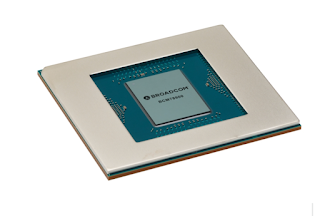
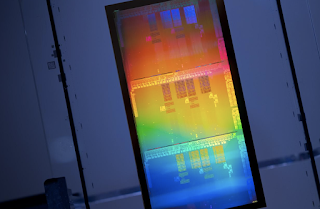
Broadcom announced shipment of its Trident 4C Ethernet switch ASIC, a 12.8 terabits/second security switch capable of analyzing all traffic at line rate. 

Broadcom said its new switching ASIC is able to inspect 100 percent of the traffic, even at the extreme bandwidths found in network cores. Trident 4C integrates a purpose-built analytics engine capable of 170 billion operations per second with the ability to detect suspicious flow anomalies at line rate. This engine, enabled by default, has no impact on switch operation or performance.

  • “Sampling-based approaches to security are inherently flawed. We decided to eliminate the tradeoff between security and performance,” said Ram Velaga, senior vice president and general manager, Core Switching Group, Broadcom. “Trident 4C is a natural extension of our innovative portfolio. We started with Layer-2 switching, progressed to Layer-3 routing, and now are adding Layer 4-7 security as we climb the network OSI stack.”

Trident 4C highlights

  • Connection-aware monitoring of 500k+ active flows at 5.4 billion packets/second
  • 170 billion ALU operations per second for advanced connection fingerprinting
  • 4M state flow metrics counters set by a programmable arithmetic engine
  • 1M exact-match policy ACLs
  • Suitable for fixed-configuration and chassis-based designs
  • SONiC and SAI readiness for rapid integration into high-capacity networks

https://www.broadcom.com/company/news/product-releases/60491

Broadcom advances its co-packaged optics network switch

Broadcom will provide its new 25.6-Tbps Humboldt co-packaged optics (CPO) network switch to Tencent.Humboldt features Broadcom’s StrataXGS Tomahawk 4 switch chip directly coupled and co-packaged with four 3.2-Tbps Silicon Photonics Chiplets In Package (SCIP) optical engines. Tencent has defined the system architecture and worked closely with Broadcom to develop hardware and software for field deployment of the 25.6-Tbps CPO switch system. Ruijie...

Broadcom delivers 51.2 Tbps Tomahawk 5

Broadcom has begun customer shipments of its StrataXG Tomahawk 5 switch series, providing 51.2 Tbps of Ethernet switching capacity in a single, monolithic chip.“Delivering the world’s first 51.2 Tbps switch two years after we released Tomahawk 4, the industry’s first 25 Tbps switch, is a testament to the outstanding execution and innovation by the Broadcom team,” said Ram Velaga, senior vice president and general manager, Core Switching Group, Broadcom....

Broadcom ships 7nm Trident 4 programmable Ethernet switching silicon 

Broadcom is now shipping its StrataXGS Trident 4 BCM56880 switch silicon with capacity scaling from 2.0 to 12.8 terabits per second (Tb/s). The new silicon, which boasts the industry’s highest Ethernet switching performance, also brings compiler-programmable packet processing and telemetry capabilities as well as compatibility with earlier generation Trident chips. This enables enterprises to utilize merchant silicon-based systems throughout their...


Keysight implements Credo's retimer/gearbox for 800G test

Keysight has selected Credo's retimer/gearbox devices for its Layer 1-3 800GE network device and Ethernet protocol test solutions for network infrastructure. 

Keysight provides 800GE Layer 1-3 test coverage with an extensive set of use cases and break-out Ethernet port speeds from 800GE to 100GE, while leading the industry with the highest port density per rackmount unit in test solutions.

Credo said its devices were for two strategic test capabilities: First,  the chip-to-module, high performance SERDES with 112 Gb/s electrical lanes with PAM4 signaling for 1x800GE and related slower port speed support. Most importantly, the ability to provide auto negotiation and link training (AN/LT) – which are needed for support of passive and active direct attached copper (DAC) cabling required for switch and server interconnections within equipment racks that are deployed in high volume within data centers.

Keysight delivers 800G test solution for 112 Gbps Serial data interfaces 

Keysight Technologies introduced an 800G compliance test solution for validating 112 gigabit per second (Gbps) serial data center interfaces. The new 112 Gbps conformance test solution leverages Keysight’s M8040A 64 GBaud high performance bit error ratio tester (BERT) with a N1060A Digital Communication Analyzer (DCA) for receiver testing and Keysight’s Infiniium UXR-Series real-time oscilloscope for transmitter testing. Interfaces capable of...

Credo Technology Group introduced its new Sparrow 800G gearbox and Heron 1.6T retimer/gearbox devices.The new Sparrow and Heron devices are built around Credo’s core low-power, high-performance DSP technology to offer improved line card functionality. The devices deliver the increased bandwidth, improved power, and cost efficiency required to support the large, growing data infrastructure market.“Credo’s core value in developing products is to deliver...

Keysight expands 800G test solutions with multimode interfaces

Keysight Technologies expanded its portfolio of 800G test solutions for the optical transceiver ecosystem. The latest addition to Keysight’s existing portfolio of 800G test solutions are new design and validation solutions that support multimode interfaces, which are critical for an energy efficient data center infrastructure. The 800G multimode test solutions uniquely support high-speed data interconnect speeds of up to 100 Gbps.In December 2020,...


Credo intros Black Hawk PAM4 retimer and gearbox DSP

Credo introduced its Black Hawk (CRT55321), a PAM4 retimer and gearbox for providing guaranteed, end-to-end signal integrity in backplane, front panel and copper applications. The new device, which leverages the company’s unique PAM4 DSP architecture, is a 32-lane device that supports 16 lanes on the host side and 16 lanes on the line side. The extended reach performance provides robust signal integrity for PAM4 across the most difficult channels,...