Showing posts with label CHIPs. Show all posts

Tuesday, September 6, 2022

CHIPS for America strategy released

The U.S. Department of Commerce released its strategy for implementing the $50 billion CHIPS Act of 2022 program, which was signed by President Biden last month.  Here are the highlights,

The CHIPS Act of 2022 program has four primary goals :

  • Establish and expand domestic production of leading edge semiconductors in the US, of which the US currently makes 0% of the world’s supply
  • Build a sufficient and stable supply of mature node semiconductors
  • Invest in R&D to ensure the next generation semiconductor technology is developed and produced in the US.
  • Create tens of thousands of good-paying manufacturing jobs and more than hundred thousand construction jobs. This effort will ensure the pipeline for these jobs expands to include people who have historically not had a chance to participate in this industry, including women, people of color, veterans and people who live in rural areas

The program supports three distinct initiatives:

  • Large scale investments in leading edge manufacturing: The CHIPS incentives program will target approximately three quarters of the incentives funding, around $28 billion, to establish domestic production of leading-edge logic and memory chips that require the most sophisticated manufacturing processes available today. Those amounts may be available for grants or cooperative agreements, or to subsidize loans or loan guarantees. The Department is still assessing the impact of the newly enacted advanced manufacturing facility investment tax credit on capital expenditures, which will generate significant additional project investment from participants and will reduce the required share of CHIPS incentives funding allocated for leading edge projects. The Department will seek proposals for the construction or expansion of manufacturing facilities to fabricate, package, assemble and test these critical components, particularly focusing on projects that involve multiple high-cost production lines and associated supplier ecosystems.
  • New manufacturing capacity for mature and current-generation chips, new and specialty technologies, and for semiconductor industry suppliers: The CHIPS incentives program will increase domestic production of semiconductors across a range of nodes including chips used in defense and in critical commercial sectors such as automobiles, information and communications technology, and medical devices. This initiative is broad and flexible, encouraging industry participants to craft creative proposals. For this initiative, the Department expects dozens of awards with the total value expected to be at least a quarter of the available CHIPS incentives funding, or approximately $10 billion. Those amounts may be available for grants or cooperative agreements, or to subsidize loans or loan guarantees.

  • Initiatives to strengthen US leadership in R&D: The CHIPS R&D program will invest $11 billion in a National Semiconductor Technology Center, a National Advanced Packaging Manufacturing Program, up to three new Manufacturing USA Institutes, and in NIST metrology research and development programs. This constellation of programs is intended to create a dynamic new network of innovation for the semiconductor ecosystem in the United States. Executing this vision will require collaboration with academia, industry, and allied countries, and will require sustained investment over many years.

Funding documents, which will provide specific application guidance for the CHIPS for America program, will be released by early February 2023.

“Rebuilding America’s leadership in the semiconductor industry is a down payment on our future as a global leader,” said U.S. Secretary of Commerce Gina Raimondo. “CHIPS for America, will ensure continued US leadership in the industries that underpin our national security and economic competitiveness. Under President Biden’s leadership, we are once again making things in America, revitalizing our manufacturing industry after decades of disinvestment and making the investments we need to lead the world in technology and innovation.”

https://www.commerce.gov/news/press-releases/2022/09/biden-administration-releases-implementation-strategy-50-billion-chips

An 18-page strategy document is published here: https://www.nist.gov/system/files/documents/2022/09/06/CHIPS_Strategic_Plan_Sept_6_2022.pdf

CHIPS and Science Act funding processes get underway
 President Biden signed an Executive Order to implement the semiconductor funding in the bipartisan CHIPS and Science Act of 2022.The order establishes an interagency CHIPS Implementation Steering Council, which will be  co-chaired by National Economic Director Brian Deese, National Security Advisor Jake Sullivan, and the Acting Director of the Office of Science and Technology Policy, Alondra Nelson. The order also  establishes...

Key provisions of the CHIPS and Science Act of 2022

The U.S. House of Representatives voted 243-187 to pass the CHIPS and Science Act of 2022. The legislation was approved by the U.S. Senate last week. President Biden is now expected to sign it into law.The principal aim of the CHIPS Act is to onshore domestic manufacturing of semiconductors. It will also substantially increase government funding for science and technology development programs impacting the networking and telecommunications fields. The...


Thursday, July 28, 2022

Key provisions of the CHIPS and Science Act of 2022

The U.S. House of Representatives voted 243-187 to pass the CHIPS and Science Act of 2022. The legislation was approved by the U.S. Senate last week. President Biden is now expected to sign it into law.

The principal aim of the CHIPS Act is to onshore domestic manufacturing of semiconductors. It will also substantially increase government funding for science and technology development programs impacting the networking and telecommunications fields. 

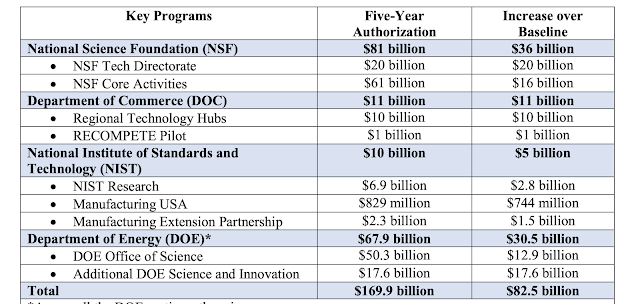
The legislation provides $54.2 billion in total appropriations for CHIPS and Public Wireless Supply Chain Innovation (also known as ORAN), and $82.5 billion in additional appropriations for research programs through the National Science Foundation, the Department of Commerce, NIST, NASA, and the Department of Energy.

Here is a summary

CHIPS for America Fund:

  • Manufacturing Incentives: $39 billion in financial assistance to build, expand, or modernize domestic facilities and equipment for semiconductor fabrication, assembly, testing, advanced packaging, or research and development, including $2 billion specifically for mature semiconductors. Within the incentive program, up to $6 billion may be used for the cost of direct loans and loan guarantees.
  • Research and Development (R&D): $11 billion for Department of Commerce (DOC) research and development.
  • National Semiconductor Technology Center (NSTC): A public-private partnership to conduct advanced semiconductor manufacturing R&D and prototyping; invest in new technologies; and expand workforce training and development opportunities.
  • National Advanced Packaging Manufacturing Program: A Federal R&D program to strengthen advanced assembly, test, and packaging (ATP) capabilities, in coordination with the NSTC.
  • Manufacturing USA Semiconductor Institute: A partnership between government, industry, and academia to research virtualization of semiconductor machinery, develop ATP capabilities, and design and disseminate training.
  • Microelectronics Metrology R&D: A National Institute of Standards and

CHIPS for America Workforce and Education Fund: $200 million to kick start development of the domestic semiconductor workforce, which faces near-term labor shortages, by leveraging activities of the National Science Foundation.

CHIPS for America Defense Fund: $2 billion for the DoD to implement the Microelectronics Commons, a national network for onshore, university-based prototyping, lab-to-fab transition of semiconductor technologies—including DoD-unique applications—and semiconductor workforce training.

CHIPS for America International Technology Security and Innovation Fund: $500 million for the DOS, in coordination with the U.S. Agency for International Development, the Export-Import Bank, and the U.S. International Development Finance Corporation, to support international information and communications technology security and semiconductor supply chain activities, including supporting the development and adoption of secure and trusted telecommunications technologies, semiconductors, and other emerging technologies.

Public Wireless Supply Chain Innovation Fund: $1.5 billion through the DOC National Telecommunications and Information Administration (NTIA), in coordination with NIST, the Department of Homeland Security, and the Director of National Intelligence, among others, to spur movement towards open-architecture, software-based wireless technologies, and funding innovative, ‘leap-ahead’ technologies in the U.S. mobile broadband market.Technology (NIST) research program to advance measurement science, standards, material characterization, instrumentation, testing, and manufacturing capabilities.

O-RAN: The CHIPS & Innovation Act of 2022 would also provide $1.5 billion to implement the USA Telecom Act that was enacted in the William M. (Mac) Thornberry National Defense Authorization Act for Fiscal Year 2021. This program would help shore up the global telecommunications supply chain and limit the scope of involvement globally of telecommunication companies with close ties to the Communist Party of China, like Huawei. Funds would be used to capitalize on U.S. software advantages, accelerating development of an open-architecture model (known as OpenRAN) that would allow for alternative vendors to enter the market for specific network components, rather than having to compete with Huawei end-to-end.

Basic R&D: Expanded funding for Research and Innovation (National Science Foundation, Department of Commerce, National Institute of Standards and Technology, NASA, and Department of Energy). Representing the largest five-year investment in public R&D in the nation’s history, the expanded funding aims to "grow both curiosity-driven and translational research, ensuring both the creation of new ideas and the ability of those ideas to create new innovations, products, companies, and jobs in the United States."

https://www.commerce.senate.gov/2022/7/view-the-chips-legislation

Read the bill's text:  https://www.commerce.senate.gov/services/files/CFC99CC6-CE84-4B1A-8BBF-8D2E84BD7965

EU Chips Act promises €43 billion in semiconductor investments

The European Commission is calling for €43 billion euros of public and private investments to spur the design, manufacturing and packaging of advanced semiconductors in Europe.The EU Chips Act aims to bring about a thriving semiconductor sector from research to production and a resilient supply chain. The ambition is for the EU to double its current market share in semiconductors to 20% in 2030. Key elements of the proposal:The main components are:The...