Showing posts with label ECOC. Show all posts

Wednesday, September 7, 2022

Molex intros optical-electrical interconnects for Co-Packaged Optics

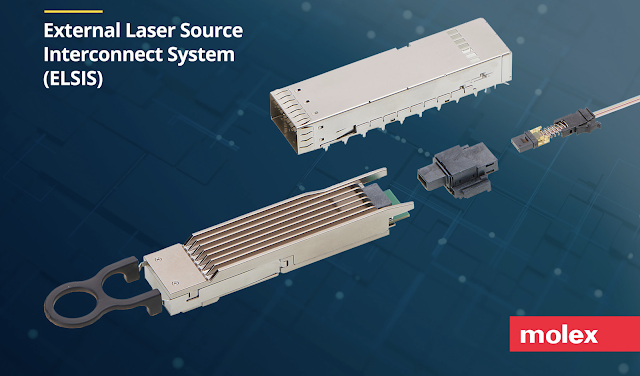
Molex introduced its pluggable module solution for co-packaged optics (CPO), which moves optical connections from the front panel to within the host system—right next to high-speed ICs.

The new External Laser Source Interconnect System (ELSIS) is a complete system of cage, optical and electrical connectors with a pluggable module.
"From high-speed networking chips to graphics processing units (GPUs) and AI engines, the demand for I/O bandwidth continues to escalate," said Tom Marrapode, director of advanced technology development, Molex Optical Solutions. "By placing the optics closer to these ASICs, CPO will address the growing complexities associated with high-speed electrical traces, including signal integrity, density and power consumption."

Molex notes that traditional pluggable modules have their optical connections at the user side of the module, creating concerns about eye safety when used with high-power laser sources, such as those planned for CPO. As a blind-mating solution, ELSIS eliminates user access to optical fiber ports and cables, providing a complete external laser source system for safe, easy implementation and maintenance. The use of external laser sources also means a major heat source is moved away from the optoelectronics and IC package. Plus, the design eliminates high-speed electrical I/O drivers on the IC and in pluggable modules, further reducing thermal loads and power consumption within the equipment.

Molex is currently sampling the ELSIS hybrid optical electrical connector and cage system. Supporting design and development materials for the fully pluggable module system, including 3D models, technical drawings and detailed specifications, are available now. Molex is targeting Q3 2023 for release of the fully integrated solution.

https://www.molex.com

Tuesday, September 14, 2021

L-com intros Erbium-Doped Fiber Amplifiers

L-com, an Infinite Electronics brand and a preferred manufacturer of wired and wireless connectivity products, announced today that it has launched a new series of Erbium-Doped Fiber Amplifiers (EDFA) and directly modulated fiber transmitters.

The new EDFA fiber amplifiers feature high-performance erbium-doped fiber with a low noise pump laser, embedded automatic monitoring system, AC power, 78 channels and an FC port. They operate on the 1550nm wavelength.

L-com's new directly modulated fiber transmitters are available in both 1310nm and 1550nm wavelength versions and feature AC Power, one SC/APC connector and a wide automatic gain control (AGC) range in the 1.2 GHz band.

"Our new EDFA amplifiers and fiber transmitters are critical components for distributing and extending optical signals in CATV network applications. By using an erbium-doped design, these new products offer the highest levels of output power, gain and very low insertion loss, resulting in the highest quality output signals," said Paul Hospodar, Product Line Manager.


Monday, September 13, 2021

II‐VI and Lumentum form SmartTuning Optics MSA

II‐VI and Lumentum are founding members of a new SmartTuning Multi-Source Agreement (MSA) that aims to standardize an interoperable self-tuning feature for full-band tunable dense wavelength division multiplexing (DWDM) pluggable optical transceivers. 

The companies say that incorporating a plug-and-play, self-tunable feature adds an extra layer of automation which further simplifies network installation and operation practices. Self-tunable DWDM pluggables eliminate the need for labeling or tracking fibers, reducing the overall operational cost for service providers. Additionally, the self-tuning functionality does not require new integration–within systems, the function can be enabled or disabled. 

"With the SmartTuning MSA, 5G mobile service providers will be able to better optimize their network architectures with easy-to-integrate, cost-effective, and automated optical networking solutions," said Justin Abbott, Lumentum Director of Product Line Management, Telecom Transmission. "This development should also accelerate the expansion of 5G network infrastructure by enabling more network automation, which results in less technician time in the field and lower ongoing network operating costs."

"The algorithms developed by the SmartTunable MSA will improve OpEx and CapEx for our end users by simplifying the deployment of their systems, reducing technician time in the field, and eliminating the need for tuning equipment,” said Dr. Lee Xu, Sr. Vice President, Transceivers Business Unit. “Our customers will greatly appreciate the efficiency and streamlined operations achieved through this standardization effort, as they ramp-up DWDM system deployments to support high speed wireline and 5G wireless broadband services.”

http://www.smarttunable-msa.org/

Monday, September 23, 2019

Lumentum demos coherent modules, WSS, PAM4-optimized EMLs

Lumentum is presenting its full-spectrum of optical communications solutions at ECOC 2019 in Dublin, including:

Coherent Network Transmission Products

  • Line-side coherent CFP2 Modules for 100G/200G+ transmission: Lumentum will exhibit both 100G/200G CFP2-ACO and CFP2-DCO coherent pluggable transceiver modules that leverage Lumentum's high-speed InP PIC devices.
  • Coherent building blocks: High-speed coherent components for 100G and beyond including integrated coherent TROSAs with up to 64 GBaud symbol rates, high-bandwidth integrated driver modulators, and micro and dual ITLAs.
  • Line-side direct-detect modules for 10G/25G tunable transmission: With more than 10 years of deployments and billions of device hours in the field, Lumentum is an established leader in tunable transmission for 10G and beyond. A broad range of tunable transmission products will be on display.

TrueFlex ROADM Portfolio

  • Next-generation TrueFlex contentionless twin 8x24 wavelength selective switch (WSS): the newest addition to Lumentum's ROADM portfolio, enables simplified add/drop port scaling to support capacity growth in CDC networks and eliminates the need for EDFA arrays in many network designs. In addition, Lumentum will feature the TrueFlex monitoring portfolio and the TrueFlex Micro WSS platform including the high-port count Micro Twin 1x20 and 1x35, the Micro 1x9, the Micro Twin 1x9, and the Nano 1x9.

High-Speed Datacom Laser Chips

  • DMLs: Lumentum DMLs offer high-reliability and use a pioneering cavity design to operate over the wide temperature ranges demanded by the latest 5G wireless systems.
  • EMLs: Lumentum PAM4-optimized EMLs enable next-generation 400G and single-lambda 100G solutions that reduce the cost per bit. Lumentum laser chips enable a wide variety of standards-compliant modules for high-speed networking.
  • VCSELs: Lumentum VCSELs for short-reach applications utilize Lumentum's experience in high-volume 3D sensing applications to deliver high-performance and cost-effective solutions to data centers and can be supplied as a single bare die, or 1x4 arrays.

Telecom Pump Lasers

  • Next-generation high-power and high-reliability 980 nm pump lasers: The next-generation family of 980 nm pumps offer a range of maximum output powers from 800 mW to 1000 mW in a variety of form factors.

SDN Open Networking Platform

The Open Networking Foundation (ONF) will perform a live open and disaggregated transport network (ODTN) demonstration using Lumentum's optical network elements at Demo 2. The live demo will showcase the use of the ONOS SDN controller for disaggregated transport networks, covering the provisioning of data connectivity services and demonstrating advanced automatic failure recovery and resiliency, at both the data and control plane level.

https://www.lumentum.com

Jabil Photonics demos coherent SiP-based 100G/200G CFP2-DCO

Jabil Photonics (formerly Jabil AOC Technologies) is demonstrating its coherent 100G/200G CFP2-DCO module this week at ECOC 2019 in Dublin.

Jabil’s CFP2-DCO is a hot-pluggable module designed to support single-wavelength data coherent transmission at 100Gbps using DP-QPSK and 200Gbps using DP-16QAM modulations. The CFP2-DCO is designed for DWDM networks ranging from metro and data-center interconnect (DCI) to long-haul applications, as well as 100Gbps point-to-point (P2P) coherent solutions for unamplified links in 5G and cable access networks up to 80km.

Jabil’s CFP2-DCO is powered by Elenion Technologies’ next generation Silicon Photonics (SiP) coherent engine. The module incorporates an ultra-narrow linewidth external cavity micro-ITLA laser with gridless DWDM wavelength capability for tuning across the extended C-Band, and a low power coherent Digital Signal Processor (DSPs) using advanced 16-nm CMOS technology.

“As the pace of optical networking innovation and the surge of bandwidth demand in communication networks continues to accelerate, the ecosystem needs players that can quickly enable volume manufacturing and simplify sourcing models,” said Stefano Schiavoni, vice president and GM of Jabil’s Photonics business unit. “The release of our CFP2-DCO product represents a significant industry milestone by delivering a vertically integrated solution at the lowest cost structure. Unlike traditional build-to-print contract manufacturers, Jabil leverages its advanced design capabilities, operational excellence and world-class supply chain to meet the increasingly competitive requirements of our customers.”

“We are pleased with the opportunity to partner with Jabil Photonics to manufacture our sophisticated SiP coherent optical engines together with the CFP2-DCO in Jabil’s precision optical manufacturing line,” said Larry Schwerin, president and CEO of Elenion Technologies.

The CFP2-DCO will be Jabil’s first product launched under the “Jabil Photonics” brand which replaces the former “Jabil AOC Technologies” brand.  The new branding reflects Jabil’s end-to-end manufacturing and supply chain capabilities in the area of photonics.  In addition to the product line expansion with the Jabil Photonics CFP2-DCO, Jabil is growing its investment in the optical segment with the expansion of its Penang, Malaysia, production facility with a focus on Optical Manufacturing Services (OMS) as well as Jabil Photonics components. 

HUBER+SUHNER debuts cross-connect fiber management system

HUBER+SUHNER introduced its LISA Double Access solution -- a high-density, modular cross-connect fiber management system solution that provides a maximum of 3600 ports per rack. Alongside the LISA Double Access is the IANOS fiber management system, which provides flexibility for managing high volumes of cables and data rates.

“We realise that the LISA Double Access has long been the technology of choice and is an important aspect of network design for our customers,” said Eduardo Lopes, Head of Product Management Fiber Management Systems (FMS) at HUBER+SUHNER.“ As pioneers in cost-effective cross-connect connectivity solutions, we are convinced that the use of a comprehensive, but simply structured fiber optic management system is crucial for the successful operation of a data center due to the vulnerability of fiber optic cabling.”

Also joining HUBER+SUHNER’s line-up at ECOC 2019, is its novel Wavelength Division Multiplexer Coupling Module (WCM) for chip on-board low-cost transceivers assemblies. Featuring between two and eight lambdas based on TFF filters and CUBO’s direct beam bouncing polymer optical bench technology, the WCM provides ultra-low loss performance to couple and (de)mux two-to-eight laser diodes or photo detectors from a PCB board into a fiber receptacle. It enables transceiver or optical board manufacturers to assemble the non-hermetic optical bench in a very low-cost passive way directly on top of the photo detectors or lasers integrated in their PCB board.

Adding to the extensive Fiber Connectivity range already presented, HUBER+SUHNER Cube Optics (CUBO) will also debut its new 400G PAM4 Receiver Optical Sub-Assembly (ROSA) at the event. Designed for use in 400GBase-FR transceivers, the four-channel demultiplexer – which contains four integrated photo detectors with linear transimpedance amplifiers – operates at 56GBaud lane speed and features an optical LC receptacle input and electrical flex foil output. The high sensitivity of -4.6dBm eliminates the need to use additional expensive and power-hungry DSP chips in the transceiver, while still meeting IEEE specifications.

https://www.hubersuhner.com/en

Centera and Credo partner on Single-Lambda 100G PAM4

Centera Photonics and Credo, which specializes in Serializer-Deserializer (SerDes) technology, are partnering on a low power, cost and performance optimized 100G-DR/FR QSFP28 optical module.

Centera and Credo are showcasing the 100G-DR modules at ECOC 2019 in Dublin.

“Credo’s purpose built mixed signal optical DSP solutions provide the precise balance between performance, power, and price to enable mass deployments of 100Gbps Single-Lambda optical modules,” said Jeff Twombly, Vice President of Marketing and Business Development at Credo. “Combined with Centera’s optical engine technology and transceiver-level expertise, we are able to deliver world class solutions to our mutual customers that achieve the best overall system performance, signal integrity, and power efficiency.”

“Centera’s proprietary silicon optical engine sets a new frontier for next-generation of single-wave 100G optical interconnects in datacenter applications,” said Dr. Brian Lan, Centera’s R&D Director. “Credo’s power optimized optical DSP allowed us to quickly develop and deliver best in class 100G production modules for our data center customers.”

http://www.credosemi.com

Infinera's XR Optics delivers coherent optical subcarrier aggregation

Infinera introduced a point-to-multipoint coherent optical subcarrier aggregation technology with the potential to significantly reduce the number of transceivers required in an access network while eliminating intermediate aggregation.

Infinera's XR optics technology, which is optimized for hub-and-spoke traffic patterns, is powered by independently routable Nyquist subcarriers and coherent optical aggregation capabilities. With coherent subcarrier aggregation (CSA) capabilities, XR optics technology enables a single high-speed transceiver to simultaneously send and receive independent data streams to/from numerous low-speed transceivers.


Subcarriers can be flexibly sized. For example, 4 X 25G subcarriers defined in a 100G QSFP-28 transcrivers; or 16 X 25G subcarriers defined in a 400G QSFP-DD transceiver.

The company says that by leveraging these capabilities, network operators will be positioned to significantly reduce the number of transceivers in the network, eliminate the need for costly intermediate aggregation devices, and more efficiently optimize transport infrastructure for hub-and-spoke end-user traffic flows.

Initial areas of focus include DAA fiber deep networks, 5G X-haul, DSL/PON backhaul, and fiber-enabled business services.

XR optics is designed to be integrated into a variety of form factors, including industry-standard pluggables, from low-speed interfaces with a single subcarrier to high-speed (400G+) interfaces with numerous subcarriers.

“We’re excited to introduce the revolutionary concept of coherent subcarrier aggregation, one that will redefine the cost structure of next-generation transport networks,” said Dr. Dave Welch, Founder and Chief Innovation Officer. “XR optics addresses a fundamental deficiency in optical communications technology and is expected to have a significant impact on any network that implements an aggregation function.”

“Developing 400ZR solutions demands a large investment, and companies are looking for ways to leverage these investments by broadening their addressable market. Infinera has gone a step further in a big, bold move: it is combining its unique expertise in photonics, silicon, and network
management to yet again create a truly differentiated approach to solve the engineering challenges faced by network operators,” said Andrew Schmitt, Directing Analyst, Cignal AI.

“We are excited about XR optics and its potential to make optical networks more efficient,” said Beck Mason, SVP and General Manager Telecom Transmission, Lumentum. “Our market leading coherent transmission products, based on high-performance indium phosphide photonic integrated circuits, are well proven and deployed in volume in coherent transmission applications, including those employing digital subcarriers, the innovative technology upon which XR optics is based.”

“Optical aggregation with XR optics is a compelling new architecture for aggregating edge nodes such as 5G radios into high-speed 400G router ports without requiring active aggregation devices in the field. We welcome this multi-vendor effort to fundamentally reduce the complexity
and operational cost of aggregation networks,” said Christophe Metivier, VP of Manufacturing and Platform Engineering, Arista Networks.

ECOC 2019 -- a panel discussion, “XR Optics: Point-to-Multipoint Coherent Connectivity and the Future of Transport Network Architectures,” is scheduled for Wednesday, September 25 at 10:30 a.m. in Room Dodder B.

https://www.infinera.com/innovation/xr-optics

Sunday, September 22, 2019

Source Photonics showcases 400G at ECOC 2019

At ECOC 2019 this week in Dublin, Source Photonics is demonstrating its complete 400G portfolio with industry partners

Source Photonics’ portfolio of Datacenter and Routing products includes:

  • 400G-DR4 supporting 400GE links over 500m as well as an enhanced reach of up to 2 km (4x100G-FR) with support for breakout into 100G-DR/FR
  • 400G-LR8 supporting 400GE links up to 10 km
  • 400G-ER8 supporting 400GE links up to 40km as technology demonstration

“Successful interoperability between optical transceivers and hosts is crucial to rolling out the next higher data rate connectivity,” said Ed Ulrichs, Director of PLM at Source Photonics. “Together with our partners in the industry, we aim to bring next-generation solutions to our customers and provide the high-speed connectivity they require.”

Source Photonics will show error-free traffic through a link involving Viavi’s ONT 603 unit and QCT’s QuantaMesh BMS T9032-IX9 switch connected with various Source Photonics 400G optical transceivers.

“We take pride as a company in being a part of the faster and more connected cloud scale networks because of our leading-edge portfolio of compute, storage, and networking products,” said Mike Yang, Senior Vice President of Quanta Computer and President of Quanta Cloud Technology (QCT). “QCT is the ideal solutions provider to harness the innovative capabilities of this new switch technology and deliver state-of-the-art 32x400GbE platforms for our web-scale customers worldwide, with best-in-class quality, economics, and time-to-market."

http://www.sourcephotonics.com

OE Solutions announces 50G Bidirectional optical transceiver for 5G

OE Solutions announced a 50G bidirectional SFP28 ER ST optical transceiver.

The new 50G BIDI ER ST transceiver, which is aimed especially at wireless mid-haul applications, operates in the O-band with a standard-temperature (ST) rating in a QSFP28 form factor. It supports a transmission distance of 40km.

The new device joins OE Solutions’ extensive portfolio of 10G, 25G and now 50G optical transceivers for wireless access networks, including front-, mid- and backhaul.

OE Solutions said the ambitious goals of the wide range of performance metrics in the 3GPP release-16 standard, which is expected to be ratified in 2020, will impact the optical access network supporting 5G wireless services dramatically. Much higher capacities need to be delivered to a much larger number of antennas. In addition, compute and storage resources will be required closer to the antennas than was the case for LTE and previous-generation wireless services. As the network architectures evolve to support these changes, new optical transceiver requirements have emerged.

The 50G PAM4 BIDI ER optical transceiver leverages PAM4 encoding to enable 50G duplex connectivity over a single fiber. When considered in conjunction with OE Solutions’ 10G and 25G NRZ BIDI transceivers, service providers can size a single-fiber connection cost-efficiently to match the
bandwidth demand. The 50G PAM4 transceiver employs dual-25G electrical interfaces of a QSFP28 standards-compliant module design. As such, the module offers a simple way to double the bandwidth over a single-fiber link without having to install filters for wavelength multiplexing.

“We are very excited to launch our first 50G transceiver product for wireless access network applications”, said Per Hansen, VP of Marketing and Sales at OE Solutions, and continued “We have a long history of working closely with the leading equipment manufacturers and service providers to
deploy new generations of wireless infrastructure. As 5G increases the bandwidth requirements for the optical part of the access network and new network architectures are being deployed, the industry demands new optical transceivers solutions such as this 50G device, which leverages PAM4
modulation to provide the needed bandwidth, reach and cost-efficiency.”

Visit OE Solutions at ECOC, Booth 226.

https://oesolutions.com/

CIG announces 400G, 200G and 100G optical mModules

Cambridge Industries Group (CIG) announced a full line-up of 400G, 200G and 100G optical modules for datacenter applications at ECOC 2019, Dublin, Ireland. The line of products consists of the following:

  • 400G QSFP56-DD FR4/LR4 and DR4
  • 200G QSFP56-FR4, both digital (DSP) and analog (CDR) versions
  • Next generation 100G QSFP28-DR1/FR1/LR1, CWDM4, LR4


“Adding a full line of 400G, 200G and 100G optical modules into our product offering reaffirms our commitment to bring innovative high-quality, low-cost and low-power technologies into the industry,” said Gerry Wong, CEO of CIG. “Specifically, CIG was one of the first companies to introduce 400G QSFP56-DD FR4 module into the market. Earlier this year, CIG announced the world’s first 200G analog CDR based optical module for datacenter interconnect application which, together with our large scale, high quality automated manufacturing capabilities, allows CIG to quickly meet the needs of the telecom and datacom markets.”

Vladimir Kozlov, Ph.D., Founder and CEO of LightCounting Market Research, added, “Sales of next generation Ethernet transceivers are on track to exceed $200 million in 2019 and reach $4 billion by 2024. Our market forecast report assumes that suppliers will be able to scale up production volumes and reduce cost to enable rapid adoption of next generation Ethernet transceivers.”

CIG’s 400G FR4, 100G single wavelength (100G DR1 and FR1), and legacy 100G (100G LR4 and CWDM4) modules are generally available (GA). 400G DR4 modules will be available in 4Q 2019. 200G FR4 modules based on analog CDR or DSP are under development and expected to sample in early 4Q 2019. GA is expected in late 4Q 2019.

Lumentum to divest certain transceiver product lines to CIG

Lumentum announced plans to sell certain optical transceiver product lines developed and manufactured by its subsidiary Oclaro Japan to Cambridge Industries Group (CIG). The sale is not expected to impact the guidance ranges provided on February 5, 2019 for Lumentum's third fiscal quarter, ending March 30, 2019. Revenue attributable to the products to be sold in the proposed transaction is approximately $20 million of the $50 million to $55 million of datacom revenues previously included in Lumentum's guidance for the third fiscal quarter of 2019.

CIG also entered into a long-term strategic supply agreement for Lumentum's photonic chips.

Wednesday, September 18, 2019

MaxLinear announces PAM4 DSPs optimized for 100G

MaxLinear announced the extension of its Telluride 100G per wavelength PAM4 DSP family with the availability of the MxL93515 and MxL93516, optimized for 100G applications.

MaxLinear said its second-generation DSPs offer significantly lower power and smaller footprint, comfortably enabling sub-3.5W QSFP28 designs while also meeting the form factor needs of the smaller SFP-DD/DSFP optical modules. Like its first-generation DSPs, the MxL93516 includes a monolithically integrated EA-EML laser driver.

The new MxL93515 and MxL93516 also feature a comprehensive digital pre-distortion (DPD) engine in the transmit direction to compensate for laser non-linearity and to cancel packaging limitations that cause reflections and bandwidth degradation at these extremely high signal frequencies. This DPD engine combined with the integrated EA-EML laser driver make these DSPs ideally suited for uncooled EA-EML lasers offering a substantially lower cost model to compete against existing 100G PSM4/CWDM4/LR4.

All Telluride DSPs include an auto-adaptive signal enhancement engine that enables robust SNR and BER performance. The engine integrates a continuous time linear equalizer (CTLE), automatic gain control (AGC), a feed forward equalizer (FFE), and a decision feedback equalizer (DFE).

The MxL93515 and MxL93516 are available in a tiny 7mm x 8.5mm package that supports both 4x25Gbps NRZ (QSFP28) and 2x50Gbps (SFP-DD/DSFP) PAM4 signals on the electrical interface. The package includes either an integrated 1.8Vpp EA-EML laser driver or a differential output that supports an external silicon photonics driver.

“Following the spectacular success of our first-generation Telluride products, we optimized the power and cost of our second-generation devices to enable a new generation of 100G single lambda QSFP and SFP modules,” said Will Torgerson, Vice President and General Manager of MaxLinear’s High-Speed Interconnect Group. "Our second-generation Telluride DSPs combined with the need for fewer optical components will drive the cost per bit down across the industry and we anticipate single lambda 100G solutions to become a majority of the data center and front-haul deployments over the next 2-3 years.”

http://www.maxlinear.com/MxL93515

Tuesday, September 17, 2019

ECOC 2019: Renesas to show full 64 Gbaud receiver

At next week's European Conference on Optical Communication (ECOC) in Dublin, Ireland, Renesas Electronics will show:

  • Telecom Applications: Renesas combines a 64 Gbaud linear trans-impedance amplifier (TIA) with a photo diode to provide a full 64 Gbaud receiver solution, suitable for µICR and IC-TROSA designs. Along with the Renesas linear driver family, these solutions showcase the full spectrum of products ideal for next-generation 400G/600G coherent optical transceivers.
  • Datacom and 5G Applications: The Renesas 50G PAM4 DML driver is designed for low-cost, low-power data center applications targeting 200 Gbps, as well as 1-channel applications in emerging 5G base station communication systems. Renesas will demonstrate combining the driver with a DML mounted in an industry-standard TOSA to enable a low-cost, easy-to-use solution for 5G mid-haul and back-haul applications.

Thursday, September 27, 2018

ECOC 2018: Synopsys and SMART Photonics announce InP kit

At ECOC 2018, Synopsys and SMART Photonics, which is a European manufacturer of InP Photonics components with production and research facilities located in Eindhoven, The Netherlands, introduced a production-ready process design kit (PDK) based on SMART Photonics' Indium Phosphide (InP) process.

Synopsys said its PIC Design Suite, which comprises OptSim Circuit and OptoDesigner tools, provides a seamless PIC design flow from idea to manufacturing from a single solutions provider. The addition of the SMART PDK to OptSim Circuit, combined with the PDK's availability in OptoDesigner, enables users to use the PIC Design Suite to schematically capture and simulate InP-based PIC designs with the SMART PDK building blocks, and then synthesize and verify a SMART-foundry-compatible layout.

"This is another example of a world-class PIC foundry taking advantage of the new opportunities offered by rapid advances in photonic integration," said Tom Walker, group director of R&D for Synopsys' Photonic Solutions. "We are excited to be working with SMART Photonics and to be able to give our mutual customers the ability to design advanced custom photonic applications using the SMART Photonics InP semiconductor process."

http://www.synopsys.com

ECOC 2018: Inphi highlights 100G and 400G Single Lambda PAM4

At ECOC 2018, Inphi highlighted its ecosystem collaboration with multiple optical solution industry leaders, including AOI, Delta Electronics and Source Photonics, showing readiness in delivering 100Gbps and 400Gbps PAM4 based module solutions for hyperscale cloud data center networks.

“As the pioneer of PAM based solutions with a proven history in the data center, Inphi is excited to be demonstrating single lambda PAM4 based solutions in conjunction with multiple industry leaders at ECOC 2018,” said Siddharth Sheth, SVP, Networking Interconnects at Inphi. “Multi-vendor interoperability coupled with adhering to strict compliant standards, allows this ecosystem of vendors to successful advance the adoption of PAM4 based solutions quickly and efficiently.”

“In order for 100Gbps and 400Gbps PAM4 based optical solutions to become a reality, strong collaboration across the industry is critical,” said Seamus Crehan, president and founder of Crehan Research Inc. “This ecosystem of industry leaders will help to advance the quick adoption and interoperability of PAM4 based systems and make single lambda optical solutions for 12.8T switch platforms a reality.”

“As the industry continues to move to higher data rates, it becomes vital to build a healthy ecosystem through value-driven partnerships. Inphi Corporation has been an important partner in the development of our 100G and 400G solutions,” said Robinson Tsai, VP of R&D of AOI Taiwan and AOI China. “We are excited to work together with this collaboration of leaders to build the next generation high-speed transmission technology.”

“We work closely with Inphi on 100Gbps and 400Gbps PAM4 based solutions. We see the emergence of 100Gbps and 400Gbps PAM4 solutions for next generation of hyperscale cloud data center networks and Inphi is one of the leading companies providing advance technologies,” said Ted Kuo, CBU BU Head at Delta Electronics Inc.

“Many successful demonstrations at this years’ ECOC show that the single lambda 100G ecosystem is coming together and will be ready for deployment in the field in 2019,” said Ed Ulrichs, director of PLM at Source Photonics. “Inphi is a trusted industry partner that is enabling us to productize both 100G and 400G solutions using a variety of solutions at both 28Gbaud and 53Gbaud per lane. We are excited to partner with Inphi to meet both performance and time-to-market needs for advanced transceiver solutions.”

ECOC 2018: Tektronix shows PAM4 test and debug solutions

At ECOC 2018, Tektronix showcased its optical test solutions, including:
  • PAM 4 Testing - DSA8300 sampling oscilloscope with an 80GHz optical sampling module showing support for IEEE 802.3bs based 400G optical testing for TDECQ, including new advances in high-sensitivity single-mode/multi-mode optical measurements for NRZ and PAM-4.
  • PAM 4 design and debug- DPO70000SX 70GHz ATI performance oscilloscope analyze single shot PAM-4 signals with live triggering and post-equalized error detection for 400G standards.
  • Complex Coherent testing - an end-to-end demonstration of optical modulation analysis software supporting multi-OMA systems, featuring the AWG70000 Series Arbitrary Waveform Generator and the DPO70000SX oscilloscope for applications such as spatial division multiplexing and more.
  • Support for new emerging standards - 400G ZR Receiver Testing - featuring the Tektronix DPO70000SX 70GHz ATI performance oscilloscope


Wednesday, September 26, 2018

ECOC 2018: Cisco shows 400 Gigabit Ethernet Nexus switch

At ECOC 2018. as part of the 100G Lambda multisource agreement (MSA) interoperability demonstration, Cisco demonstrated Nexus 32-port 100 GbE & 400 GbE 1RU switches populated with modules from various manufacturers.

In a blog post, Cisco's Mark Nowell writes "It is very exciting that 400 GbE is now becoming available for testing, deployment, and adoption by network operators, paving the way for Terabit Scale Ethernet being a mainstream technology. There will be many more announcements in the future but it is important to mark this key milestone!"

https://blogs.cisco.com/datacenter/cisco-makes-terabit-scale-ethernet-networking-a-reality-with-400-gbe-technology


ECOC 2018: ColorChip shows 40-400G optical transceivers

At ECOC 2018, ColorChip showcased its portfolion of optical transceivers ranging from 40 to 400G.

During the exhibition, ColorChip demonstrated a new family of 100G-400G PAM4 optical transceivers, including 100G Single-Lambda PAM4 QSFP28, 200G FR4 (2km) and LR4 (10km) QSFP56 and 400G QSFP56-DD DR4/FR4 transceivers, built with power efficient uncooled DML/EML-based CWDM4 optical engines.

ColorChip's CEO, Yigal Ezra, commented: "Today we are proud to announce the availability of 200G QSFP56 FR4 beta samples and expect to have 400G DR4/FR4 samples available in Q4, proving once again our commitment to spearhead innovative optical interconnect solutions that will further advance a truly connected world".

ECOC 2018: MaxLinear intros 400 Gbps DR4 Optical Modules, 100G transceiver/driver

At ECOC 2018, MaxLinear introduced a 100 Gbps transceiver with integrated driver.

MaxLinear’s new MxL93512 is part of the Telluride family of devices, which are DSP SoCs with integrated electro-absorption modulated laser (EA-EML) drivers for 100 Gbps/400 Gbps optical interconnects. The new device allows optical module vendors to develop a 100 Gbps optical interconnect module in a compact form factor for intra-datacenter applications with a transmission distance up to 2 Kilometers.


The MxL9351x SoCs are suitable for use within QSFP28 module form factors. Two options are currently available: the MxL93512 that integrates an EA-EML driver with 1.8V PP SE swing, and the MxL93513 that offers differential 800mV peak-to-peak swing for non EA-EML-based optics.

Maxlinear said its Telluride family features several operating modes that can connect to multiple generations of switch ASICs (128x25G NRZ, 256x25G NRZ or 256x50G PAM4) enabling 3.2Tbps, 6.4Tbps or 12.8Tbps front panel capacity per data center rack unit. These different operating modes span a variety of optical module form factors such as QSFP28, SFP-DD, QSFP-DD, OSFP and COBO.

MaxLinear also announced support for 400 Gbps breakout mode clocking in its MxL9354x products. The functionality will be on display at the company’s stand (#684) at the European Conference on Optical Communication (ECOC) in Rome taking place from Sept. 24-26, 2018. MaxLinear’s Telluride 400 Gbps PAM4 DSP (MxL9354x), based on 100 Gbps single lambda technology, is enabling development of DR4 and FR4 optical modules for the upcoming hyperscale datacenter transition to 400 Gbps. The initial use case in this transition is expected to be dominated by use of 400 Gbps DR4 modules used in a breakout application. The breakout mode of a 400 Gbps DR4 module requires certain clocking considerations that allow for the four 100 Gbps lanes to be treated as independent 100 Gbps ports and connect to a 100 Gbps DR1 or FR1 module on the other side. The unique clocking architecture of the MxL9354x makes it possible to achieve this requirement seamlessly.

http://www.maxlinear.com

Tuesday, September 25, 2018

ECOC 2018: DSFP form factor doubles data rate and density of SFP

A rev 1.0 hardware specification has been released for new DSFP (Dual Small Form-Factor Pluggable) modules -- doubling the data rate and port density of SFP modules in the same footprint.

Whereas SFP has a single electrical lane pair operating at bit and data rates up to 28 Gbps using NRZ and 56 Gbps using PAM4, the new DSFP has two electrical lane pairs, each operating at bit rates up to 26 Gbps using NRZ and 56 Gbps using PAM4, supporting aggregate date rates up to 56 Gbps and 112 Gbps, respectively. DSFP will potentially scale to a per lane bit rate of 112 Gbps using PAM4, supporting aggregate data rate up to 224 Gbps. SFP modules can be plugged into DSFP ports for backwards compatibility.

The spec was developed by the DSFP MSA (Multi-Source Agreement) Group, whose founding members are Amphenol, Finisar, Huawei, Lumentum, Molex, NEC, TE Connectivity, and Yamaichi.

The DSFP Hardware Specification Rev. 1.0 includes complete electrical, mechanical and thermal specifications for module and host card, including connector, cage, power, and hardware I/O. Also included are operating parameters, data rates, protocols, and supported applications.

Work is now underway on the DSFP MIS (Management Interface Specification), which is an abridged version of the CMIS (Common MIS) being developed by the QSFP-DD, OSFP and COBO Advisors Group.

“We are very excited about the introduction of a highly competitive new form factor by the DSFP MSA, which will double interface bandwidth and port density while maintaining compatibility with the existing SFP family of optics,” said Zhoujian Li, President of Research and Development, Wireless Networks, Huawei. “The DSFP form factor is low cost, has excellent high-speed signal integrity, reduces PCB area and is easy to design and manufacture.  It is a great platform that enables 5G deployment and evolution, while fully protecting our customers’ investment.”

“Publication of the DSFP Hardware Specification is part of an industry trend of quickly developing solutions optimized for specific applications. Stringent cost, power and size constraints in demanding market segments, like Mobile infrastructure, leads to solutions focused strictly on required functionality,” commented Chris Cole, Chair of the DSFP MSA Group, and Vice President of Advanced Development, Finisar.

http://www.dsfpmsa.org