Tuesday, April 19, 2022

JPNAP tests 400 GigE interconnects

JPNAP, one of Asia's largest internet exchanges (IX1), in partnership with Internet Initiative Japan (IIJ) an NTT Communications, conducted its first IX interconnection using 400-gigabit Ethernet.

The demonstration, which used 400-gigabit routers and switches from Arista, Cisco, and Juniper, tested interoperability at the physical and network levels, including optical switches, routing control, and 400-gigabit traffic flow using 400-gigabit interfaces (400G-FR4 and 400G-LR4) in the IX.

INTERNET MULTIFEED CO. (Multifeed), which operates JPNAP, provided the test environment and verified the interoperability of the 400-gigabit interface. IIJ and NTT Com verified the interoperability of the 400-gigabit interface from the standpoint of IX service users.

Multifeed said it will continue to study the introduction of a 400-gigabit service for JPNAP, targeting a commercial launch within the fiscal year ending next March, aiming to further enhance and expand its IX services with advanced technologies and services. IIJ and NTT Com also aim to introduce the technology to cope with increasing traffic and thereby enhance the mobile Internet as a key social infrastructure.

JPNAP has been providing a 100-gigabit interface since July 2012. With the continuing rise in Internet traffic, however, multiple 100-gigabit interfaces have been increasingly bundled out of necessity, pointing to the need for a wider bandwidth interface.

https://www.ntt.com/en/about-us/press-releases/news/article/2022/0419.html

Arista tunes its EOS and CloudVision for media/entertainment networks

Arista Networks is extending its Arista EOS and CloudVision software to support high-performance switched networks for media and entertainment customers. 

Arista Media Control Service (MCS), which is supported on all of Arista’s EOS-based platforms including the full range of Arista 7000-series 10/25/40/50/100/400G Ethernet switches, tunes the Arista network fabric for faster establishment of audio and video streams. 

Arista MCS is a licensed software service that provides APIs to dynamically program bandwidth-protected multicast flows across an Arista IP topology while also providing integrated event notification and tally in a highly efficient and deterministic manner. 

https://www.arista.com/en/company/news/press-release/15276-pr-20220419

India's HFCL Limited teams with IP Infusion for 5G RAN portfolio

HFCL Limited, which operates optical fiber Cable manufacturing plants at Hyderabad and Goa, is working with IP Infusion on a new portfolio of 5G products for the Radio Access Network (RAN) and Transport. Ghe 5G Transport products include Cell Site Router, DU (Distributed Unit) Aggregation Router, and CU (Centralized Unit) Aggregation Router. 

The companies say that IP Infusion’s OcNOS integrated with HFCL-designed high-performance 5G Transport routers will improve network efficiencies and optimize telecom infrastructure as 5G rollout accelerates. The 5G Transport router portfolio with IP Infusion’s network OS showcasesinnovations in multiple areas, including segment routing protocol for significantly increased scalability, closed loop automation for continuous analytics optimizing the end user experience, and increased power efficiencies. To detect and prevent security threats, a simplified configuration interface delivers the benefits of maximum server hardening. HFCL managed the full cycle from concept to design to implementation, tailoring the solution for the specific needs of market use cases both for India and global customers.

HFCL’s 5G Transport products are based on merchant silicon, network dis-aggregated architecture, and on open standards like TIP (Telecom Infra Project), and OCP (Open Compute Project).

“This strategic partnership signals a huge step forward in our goal to help operators modernize their 5G transport network which is critical for the successful rollout of 5G services,” said Mahendra Nahata, HFCL Managing Director. “We are pleased to partner with IP Infusion, and trust their exemplary record of flexibility, reliability and collaboration will equip us to bring a highly efficient and future-proof solution to our market and to the rest of the world.”

“OcNOS combined with HFCL’s proven hardware will revolutionize India’s telecom industry, allowing for the deployment of new services quickly based on tested, and validated open networking,” said Atsushi Ogata, President and CEO of IP Infusion. “This strategic partnership will also comply with the Make in India initiative and is a major milestone in bringing open architecture, broad access and innovation as 5G becomes a reality in India and global markets.”


POET Technologies joins Singapore's Hybrid-Integrated Micro-Electronics center

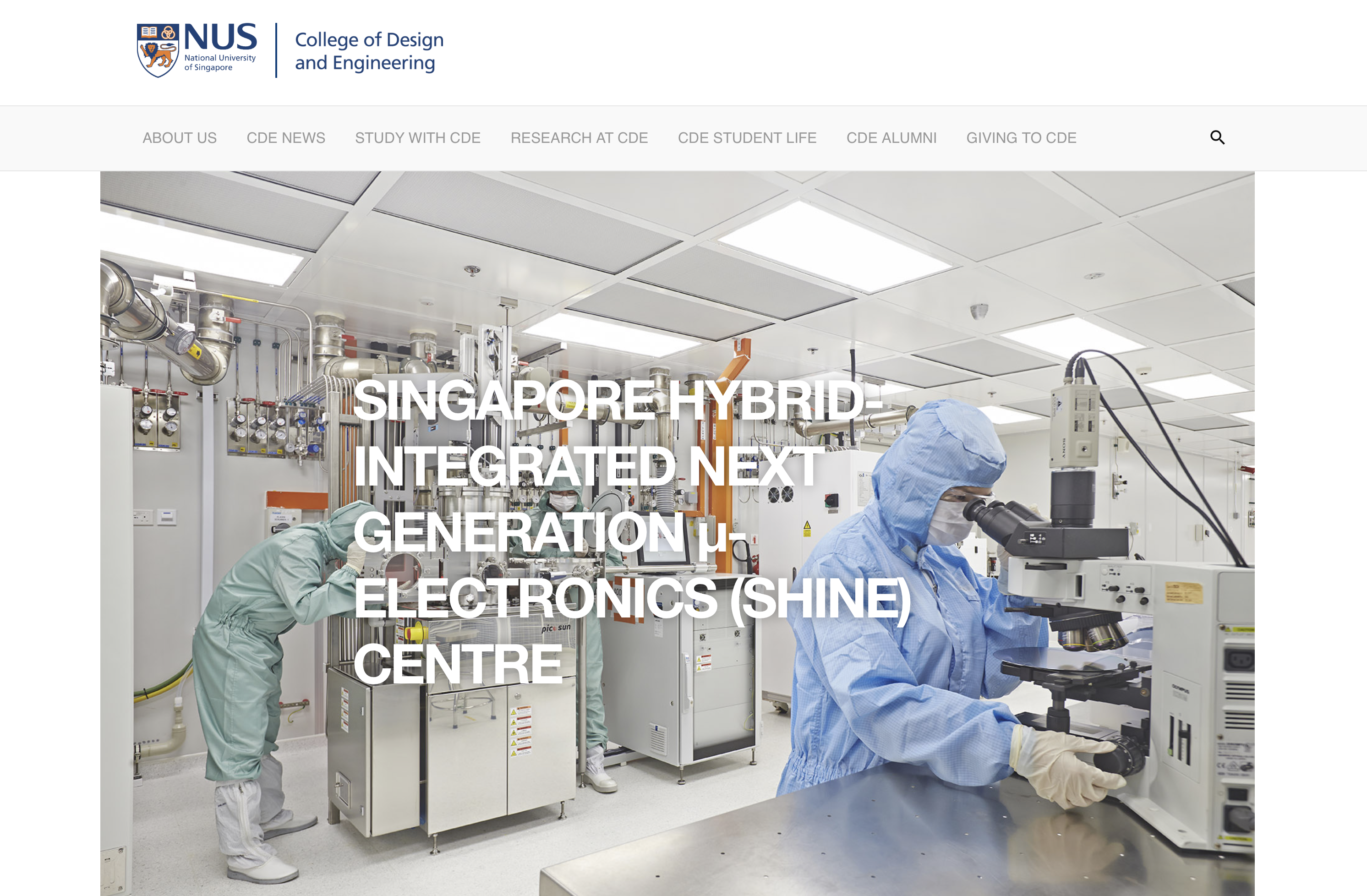
POET Technologies has joined the Singapore Hybrid-Integrated Next Generation micro-Electronics (SHINE) Center located in the College of Design and Engineering at the National University of Singapore (NUS).

The mission of the SHINE Center is to address fundamental issues arising in IoT microelectronics and to engage industry players during the development cycle, to eventually translate the technology to industry. A strong team formed by top-notch professors across the world from NUS, NTU, University of California Berkeley and Northeastern University, A*STAR Institute of Microelectronics (IME) and DSO National Laboratories (DSO) will be actively involved as research participants. Other members of the Consortium currently include Advanced Micro Foundry (AMF), Applied Materials, Cadence Design System, Continental Automotive and SOITEC. James Lee, Vice President and General Manager of POET’s Singapore subsidiary, has played a key role in the conception of the Consortium and will lead several projects on behalf of the company. SHINE is expected to have a partnership launch and inaugural technical workshop in June.

“The vision for SHINE comes from Professor Aaron Thean, Dean of the College of Design and Engineering, with whom POET has worked for a number of years on certain engineering challenges, and more recently Professor Lim Yeow Kheng, who joined the faculty about two years ago from STATS ChipPAC Pte. Ltd.,” said Dr. Suresh Venkatesan, Chairman & CEO of POET Technologies. “We are delighted to be a founding member of SHINE, as it brings together equipment and expertise that NUS and companies in the consortium may use, independently and confidentially, to develop advanced processes and manufacturing techniques for hybrid integration of photonics devices. The systems, scientific instruments and engineering staff at NUS complements well our existing operation in Singapore, especially in the area of 2.5D and 3D semiconductor manufacturing. We plan to use the SHINE Center to design and manufacture Optical Interposer-based solutions for several new vertical markets, consistent with the mission of SHINE, including applications in sensing and the Internet of Things (IoT).”

https://cde.nus.edu.sg/research/research-centres/singapore-hybrid-integrated-next-generation-electronics-shine-centre-shine

http://www.poet-technologies.com

Fungible launches a partner program

Fungible is launching a partnership program for its composable data center solutions.

The Fungible Partner Exchange (FunPX) partner program allows resellers, distributors, and technology providers worldwide to connect, collaborate, and grow their composable infrastructure capabilities to cloudify the world’s data centers.

“It’s my pleasure to announce the FunPX partner program. We recognize the importance of the channel. Our partners have been instrumental in fueling Fungible’s success and are a critical component in reaching our growth targets,” said Brian McCloskey, Chief Revenue Officer at Fungible. “We are investing in the tools, people, and processes to enable our partners to grow with us by providing immediate access to the essential information they need to win and help our mutual customers realize the benefits that the Fungible portfolio can bring to their infrastructure.”

https://www.fungible.com/partners

Fungible leverages DPU to DPU to centralize GPUs across Ethernet

Fungible introduced a means by which data centers could centralize their existing GPU assets into a single resource pool to be attached to servers on demand.The Fungible GPU-Connect (FGC) solution leverages the company's DPU to dynamically compose GPU and CPU resources across an Ethernet network.Instead of dedicated GPUs sitting idle most of the time, data centers can provide new users with access to the GPU pool, making greater use of existing assets....


Windstream's Kinetic broadband boosts to 2 Gig

Windstream's fiber-based residential broadband service announced the availability of 2 Gig service in select residential markets. 

“While many of our competitors are overlooking these markets, we’re optimizing them,” said Mark Lederman, vice president of product for Kinetic. “As more homes have more devices connected to the internet, from gaming systems to streaming movies to refrigerators, families need faster speed to accommodate the demand.”

Kinetic is involved in a multi-year $2 billion capital investment strategy across its 18-state footprint. Last year, the company laid nearly 81,000 miles of next-generation fiber across the communities it serves, many of them small towns and rural areas. Additionally, the company is creating unique partnerships with cities, counties and other groups to drive fiber deeper into the network faster.

https://www.windstream.com/fiber-internet

Parallel Wireless conducts Open RAN field trial in Brazil

Parallel Wireless is partnering with Inatel, Telecom Infra Project (TIP), Brisanet, Claro, TIM, and Vivo to conduct an Open RAN field trial throughout Brazil and other LATAM countries.   

Inatel - National Institute of Telecommunications is an education, research, and technology development center created in 1965 and located in Santa Rita do Sapucaí, southern Minas Gerais, also known as the Electronics Valley. It was the first institution of higher education in Telecommunications Engineering in Brazil.

Parallel Wireless will provide an Open RAN network enabling All Gs (2G, 3G, 4G and 5G) utilizing Band 7 for the trial. The setup in test has Comba and Dell Technologies solutions. Mobile Network Operators Brisanet, Claro, TIM and Vivo are partners in the Open Field program. 

Russell Ribeiro, Regional VP LATAM Sales at Parallel Wireless said, "We are excited to partner with Inatel and TIP to showcase our leading-edge cloud-native, O-RAN compliant, Open RAN solutions enabling 4G and 5G broadband connectivity, providing leading edge applications for the citizens of Brazil and other LATAM countries. We are starting this Open Field program with 4G and will evolve to 5G later this year. We believe this program is a very good showroom for MNOs throughout Latin America to come and see our platform in operation in a real field environment."

Gleyson A. dos Santos, Business Development Specialist at Inatel said, "I am thrilled to participate in this field trial with Parallel Wireless and TIP where we will showcase how Open RAN technology enables robust wireless telecommunications products with improved software quality, less maintenance, faster adoption of new technologies and better user experiences." 

http://www.parallelwireless.com

Monday, April 18, 2022

Windstream Wholesale completes 400G ZR+ trials

Windstream Wholesale completed interoperability testing of QSFP-DD form factor ZR+ pluggable modules from II-VI and Acacia, now part of Cisco. 

The tests established 400 Gigabit links in a production environment over a 1,027-kilometer link. The team also leveraged the Marvell Deneb Coherent DSP within a native 0 dBm II-VI pluggable and the Acacia module using the Greylock DSP. Industry standard oFEC algorithms were also used in the trials.

“These successful trials demonstrate that Windstream Wholesale remains the optical technology leader in making 400G wavelengths the default deployment for large wholesale and hyperscale customers,” said Buddy Bayer, president of Enterprise and Wholesale at Windstream. “Interoperability is key to simplifying high-performance networks in a cost and energy-efficient manner, and no other service provider has done more than Windstream toward making it a reality in the marketplace. This significant achievement validates Windstream’s strategy of open, disaggregated optical networking.”

Windstream also announced it has become the first service provider member of the OpenZR+ MSA. 

“We see the OpenZR+ community as well-positioned to make progress around standardization and interoperability in the high-performance transceiver arena,” said Art Nichols, vice president of network architecture and technology at Windstream. “Our goal is not simply to take advantage of our interop and optimization learnings internally, but to also contribute to the industry as a whole in driving open networking forward.”

“We would like to thank Windstream for their industry leadership in driving the technology and hosting the multivendor interoperability trials,” said Matthias Berger, vice president, coherent technology, II-VI Incorporated. “The success of these trials validates the level of maturity of the 400G ZR+ ecosystem which is essential to enable open systems and network architectures such as IP-over-DWDM.”

“As one of the founding members of the OpenZR+ MSA, we are excited to see the industry embracing interoperability and moving towards open networking architectures,” said Tom Williams, senior director of marketing for Acacia, now part of Cisco, and co-chair of the OpenZR+ MSA. “Interoperability and the introduction of new modules, such as our recently announced Bright 400ZR+ QSFP-DD pluggable, will be key to accelerating the adoption of router-based optics in transport networks.”

https://news.windstream.com/news/news-details/2022/Windstream-Wholesale-Successfully-Completes-Industrys-First-400G-ZR-Interoperability-Trials/default.aspx

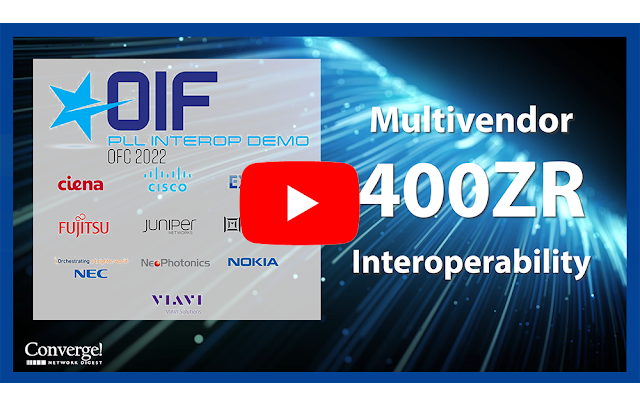
Karl Gass provides an overview of the OIF's 400ZR multivendor interoperability demonstration at OFC22 in San Diego, California.

Two set-ups are tested:

  • 400GE to Transport DWDM link - from an EXFO traffic generator/analyze via NeoPhotonics OSFP traversing a Cisco Open Line System to a Ciena Open Line system to a Cisco CFP-DCO in a Viavi traffic generator/analyzer
  • Round robin path consisting of 14 QSFP-DD modules, including modules from Cisco, Juniper, Ciena, Marvell, NeoPhotonics, and Fujitsu

Windstream Wholesale completes 1000 km 400G ZR+ field trials

Windstream Wholesale completed 1000 km 400G field trials leveraging pluggable modules from II-VI with QSFP-DD-DCO optics that achieve a high transmit power of 0dBm. The trials demonstrated unprecedented performance with strong working margins over a production network route and traversing up to 24 ROADMs in a lab environment.During the field trial, Windstream Wholesale closed established a 400G link on a 1,000+ kilometer link between Phoenix and...

Marvell intros low power, multi-mode 400G DSP

Marvell announced sampling of is new Deneb ultra-low power, multi-mode 400G DSP for disaggregated optical platforms. The new 7nm CDSP for 400G pluggable, which is compatible with its predecessor (Canopus), provides a seamless upgrade to interoperable pluggables across multiple platforms. Deneb can be used to enable standards based ITU, Open ROADM and OpenZR+ compliant 100G/200G/300G/400G pluggable transceivers."Standards-based interoperable...


The Netherlands aims for photonic integrated circuit leadership with €1.1B fund

PhotonDelta, a cross-border ecosystem of photonic chip technology organizations,secured €1.1 billion in public and private investment. This includes €470 million from the National Growth Fund of the Netherlands, while the rest is co-invested by various partners and stakeholders. 

The aim is to transform the Netherlands into the leader of the next generation of semiconductors and photonic integrated circuits (PICs).

The programme will run for six years and will enable PhotonDelta and its partners to further invest in photonic startups and scaleups, expand production and research facilities, attract and train talent, drive adoption, and develop a world-class design library. Currently, the PhotonDelta ecosystem currently consists of 26 companies, 11 technology partners and 12 R&D partners. The organization has jointly invested €171 million in promising photonics companies including Smart Photonics, PhotonsFirst, Surfix, MicroAlign, Solmates and Effect Photonics.

By 2030, PhotonDelta aims to have created an ecosystem with hundreds of companies, serving customers worldwide and a wafer production capacity of 100,000+ per year. 

Ewit Roos, CEO at PhotonDelta, said: "This investment is a game-changer. It will make the Netherlands the home of the next generation of semiconductors which will have a profound impact. The ongoing chip shortage highlights the pressing need to create its own production capabilities for strategic technologies. We will now be able to support hundreds of startups, researchers, producers and innovators to boost this industry that will be as impactful as the introduction of microelectronics a few decades ago."

"The Netherlands is considered a pioneer in the development of PIC technology, and thanks to the continuous support from the Dutch government, we have been able to build a full supply-chain around it that is globally recognised as a hotspot for photonic integration."

"Photonic chips are one of the most important technological breakthroughs of the last decade. Not only do they allow for the creation of devices that are faster, cheaper, more powerful and greener - they also enable radical new innovations like affordable point-of-care diagnostics or quantum computing to become a reality."

The PhotonDelta proposal has been submitted by the Dutch Ministry of Economic Affairs & Climate Policy in close collaboration with Eindhoven University of Technology (TU/e), University of Twente (UT), Delft University of Technology (TUD), Holst Centre, TNO, IMEC, PITC, CITC, Holst Centre, OnePlanet, Smart Photonics,Lionix International, Effect Photonics, MantiSpectra, PhotonFirst, Phix, and Bright Photonics.

https://www.photondelta.com

CompoundTek demos hybrid Si O+C+L-Band wavelength-tunable laser

Singapore-based CompoundTek, a global foundry in emerging Silicon Photonics (SiPh), has demonstrated a hybrid Silicon O+C+L-band wavelength-tunable laser module in collaboration with a stealth-mode product company.

The company said the laser modules operated simultaneously in the O-, C-, and L-wavebands. The laser engines have a wavelength tuning range of 175 nm across the three wavebands, with an output power and side-mode suppression ratio as high as 40 mW and 50 dB, respectively.

While distributed feedback (DFB) laser arrays and microelectromechanical systems (MEMS) vertical cavity surface emitting lasers (VCSEL) have been shown to demonstrate wavelength-tuning functionality, there are limitations in terms of DFB array coupler loss and mechanical instability, respectively. Littman/Littrow-configured external cavity lasers (ECL) have also indicated wide operating wavelength range; however, the application-space of these class of lasers are limited by their bulk, as well as higher vulnerability to environmental vibrations.

CompoundTek’s Chief Operating Officer, KS Ang, said, “The challenge is for the development of a solid state-based laser diode with compact footprint, good performance that can be manufactured in a scalable, high-yield, and low-cost process. CompoundTek’s silicon photonics platform poses an attractive proposition for the realisation of the technology.”

“While there are many ways to build a tunable laser, what sets CompoundTek’s technology apart is our ability to integrate with Silicon Photonics devices which offer low propagation loss and high integration densities. Kudos to Dr. Brian Sia and the team, we are indeed very proud of this latest achievement,” he added.

https://compoundtek.com/compoundtek-successfully-demonstrates-one-of-the-worlds-first-hybrid-si-ocl-band-wavelength-tunable-laser-module-for-stealth-mode-product-company/

STACK Infrastructure plans new 84MW data center in northern Virginia

STACK Infrastructure unveiled plans for a new 84MW data center campus on 34 acres in Prince William County in Northern Virginia. 

The project will comprise a minimum of two buildings spanning 602,000 square feet. 

STACK anticipates the data centers will be ready in Q3 of 2023.

In the last four months, STACK has announced a total of 300MW of additional capacity planned in Northern Virginia. In aggregate, STACK’s current and under-development capacity is 600+MW in the region.

“STACK has again capitalized on its industry-leading expertise and deep local relationships to deliver capacity in the world’s most coveted power and land-constrained market,” said Brian Cox, Chief Executive Officer of STACK. “This new campus adds to STACK’s already significant presence in Prince William County and is STACK’s latest demonstration of our commitment to continuously delivering scalable solutions for our clients in strategic locations across the globe.”

“It is not by chance that we have shown this level of growth in Northern Virginia,” said Cox. “We are focused on building and delivering critical capacity for our clients where they have the greatest needs. Our continued expansion in the markets that matter most to our clients, like Northern Virginia, combined with our focus on sustainability initiatives, position STACK as the trusted development and operational partner to hyperscalers.”

https://www.stackinfra.com/about/news-events/press-releases/stack-infrastructure-adds-to-its-robust-northern-virginia-presence-with-new-84mw-campus/

  • Previously this year, STACK announced three new data center campus projects, including a 216MW flagship Ashburn campus, a 56MW campus in Toronto, a 36MW Inzai campus in Japan, and a flagship Portland campus with 200MW of current and expansion capacity. In March, STACK announced its global expansion into the EMEA region, establishing itself as one of the largest global private data center operators worldwide. STACK’s offerings comprise numerous concurrent projects in key regions throughout the Americas, Asia Pacific, and EMEA. 

Sabey announces 72mw data center campus in Austin

Sabey Data Centers unveiled plans for a new 72MW data center campus on 40 acres in Round Rock, Texas. 

The two-building data center campus willfeature the company’s latest innovations that maximize available data center space while shrinking its construction footprint. Site preparation has commenced, and Sabey will break ground on the new data center campus in June of 2022 with a target Ready for Service Date of Q1 2023.

“This is an exciting time for the entire Sabey organization,” said Tim Mirick, Chief Revenue Officer of Sabey Data Centers. “The Austin region has everything our customers are looking for: a vibrant and growing technology hub, a thriving, diversified economy, and a high quality of life. We are eager to offer our award-winning service, lowest-cost power, and market-leading total cost of ownership to companies considering Texas for data center expansion.”

Sabey also opereates data center campuses in Seattle, WA, Quincy, WA, East Wenatchee, WA, Ashburn, VA, and New York City, NY.

www.sabeydatacenters.com

Investment firm acquires Unitas Global's connectivity business

Digital Alpha Advisors, a leading digital infrastructure investment firm, has acquired Unitas Global's Connectivity Business. Financial terms were not disclosed.

Unitas Global is a network service provider offering automated ubiquitous edge access to cloud everywhere with an automated design and pricing platform, Unitas Nexus.

The company will continue to operate under the name Unitas Global and the current management team will continue.

"The acquisition of Unitas Global's Connectivity Business assets is a further demonstration of Digital Alpha's commitment to digital infrastructure and the next generation of networking," Digital Alpha Managing Partner, Rick Shrotri, shares. "The global data networking marketplace offers a significant opportunity for companies with the vision and the capability to enable critical end-to-everywhere services. We look forward to adding Unitas Global’s Connectivity Business assets to our portfolio and building on its already strong foundation."

"The disruptive nature of Unitas' twin-pillar strategy has become increasingly self-evident in the market. The team is ready to take on the next chapter, partnering with Digital Alpha and its portfolio companies, to become the market leader redefining agile connectivity solutions for the enterprise," states Patrick Shutt, CEO of Unitas Global. Grant Kirkwood, Co-founder and CTO of Unitas Global, adds, "We are extremely excited to invest in the further development of our proprietary Unitas Global technologies, including Unitas Nexus™ and Unitas Reach™, to support our customers globally."

http://www.unitasglobal.com

Gigamon names Shane Buckley as president and CEO

Gigamon named Shane Buckley as its next president and CEO, replacing Paul Hooper who is stepping down after 10 years as CEO role but who will remain an active member of the Gigamon Board of Directors.

Buckley has served as the President and COO at Gigamon for four years where he has expanded the company’s business and markets worldwide. Prior to joining Gigamon in 2018, Buckley served as the CEO at Xirrus and President and CEO of Rohati Systems.

“As President and Chief Operating Officer (COO), Shane demonstrated his abilities as a world-class executive by co-leading the company through both highly successful quarters in parallel with navigating the challenges of the global pandemic,” said Paul Hooper, outgoing CEO at Gigamon. “I am confident in passing the torch to Shane as I believe this marks an appropriate time for a transition in leadership as the company embarks on its next growth phase. I am leaving the company in good hands with a trusted, proven leader and friend.”

“Enterprises are quickly shifting toward hybrid and multi-cloud deployments to accelerate digital transformation initiatives but, unfortunately, they must contend with an ever-more dangerous threat landscape,” said Buckley. “I look forward to entering this new phase of growth focused on addressing the evolving requirements of our customers by investing in the deep observability solutions required to achieve the full agility of a resilient digital infrastructure without risk.”


Thursday, April 14, 2022

Project Nephio leverages Kubernetes to scale 5G across edge locations

A new open source project called Nephio has been launched by the Linux Foundation and Google Cloud aimed at simplifying the deployment and management of scalable 5G networks across multiple edge locations.

Project Nephio aims to deliver carrier-grade, simple, open, Kubernetes-based cloud native intent automation and common automation templates that materially simplify the deployment and management of multi-vendor cloud infrastructure and network functions across large scale edge deployments. 

Additionally, Nephio will enable faster onboarding of network functions to production including provisioning of underlying cloud infrastructure with a true cloud native approach, and reduce costs of adoption of cloud and network infrastructure.

Nephio has support from several founding organizations including Service providers: Airtel, Bell Canada, Elisa, Equinix, Jio, Orange, Rakuten Mobile, TIM, TELUS, Vapor IO, Virgin Media O2, WINDTRE as well as Network Function, Service and Infrastructure Vendors: Aarna Networks, ARM, Casa-systems, DZS, Ericsson, F5, Intel, Juniper, Mavenir, Nokia, Parallel Wireless, VMware. 

“Telecommunication companies are looking for new solutions for managing their cloud ready and cloud native infrastructures as well as their 5G networks to achieve the scale, efficiency, and high reliability needed to operate more cost effectively,” said Amol Phadke, managing director, Telecom Industry Products & Solutions, Google Cloud. “We look forward to working alongside The Linux Foundation, and our partners, in the creation of Nephio to set an industry open standard for Kubernetes-based intent automation that will result in faster and better connected cloud-native networks of the future.” 

“Collaboration across Telecom and Cloud Service Providers is accelerating and we are excited to bring Nephio to the open source community,” said Arpit Joshipura, GM Networking, Edge & IOT, The Linux Foundation, “As end users demand end to end open source solutions, projects like Nephio complement the innovation across LFN, CNCF, LF Edge for faster deployment of telecom network functions in a cloud-native world.” 

https://nephio.org

SONiC moves under the Linux Foundation umbrella

The Software for Open Networking in the Cloud (SONiC, an open source networking operating system), is now part of the Linux Foundation. 

Created by Microsoft for its Azure data centers, SONiC is an open source network operating system (NOS) based on Linux that runs on over 100 different switches from multiple vendors and ASICs. It offers a full-suite of network functionality, like BGP and RDMA, that has been production-hardened in the data centers of some of the largest cloud-service providers. It offers teams the flexibility to create the network solutions they need while leveraging the collective strength of a large ecosystem and community.

“We are pleased to welcome SONiC to the Linux Foundation family of open networking projects,” said Arpit Joshipura, general manager, Networking, Edge, and IoT, the Linux Foundation. “SONiC is a leader in open source data center NOS deployments, and we’re looking forward to growing its developer community.”

The Linux Foundation will primarily focus on the software component of SONiC, and continue to partner with Open Compute Platform(OCP) on aligning hardware and specifications like SAI.

“Microsoft founded SONiC to bring high reliability and fast innovation to the routers in Azure cloud data centers. We created it as open source so the entire networking ecosystem would grow stronger. SONiC already runs on millions of ports in the networks of cloud scalers, enterprises, and fintechs. The SONiC project is thrilled to be joining the Linux Foundation to take the community to its next jump in scale, participation, and usage," said Dave Maltz, Technical Fellow and Corporate Vice President, Microsoft Azure Networking.

SONiC brings a strong existing ecosystem, with premier members including Alibaba, Broadcom, Dell, Google, Intel, Microsoft, NVIDIA and 50+ global partners.

“Large hyperscalers agree that merchant silicon, hardware independence, and open source protocol and management stack are essential for running their data center networks. Broadcom has wholeheartedly supported this vision with leading-edge, predictable silicon execution and contributions to the SONiC project. We are excited to see the SONiC initiative join the Linux Foundation and look forward to working with the streamlined ecosystem to drive the data center and hyperscale needs of the future,” said Mohammad Hanif, senior director of engineering, Core Switching Group, Broadcom.

“The Open Compute Project Foundation is pleased to continue its collaboration with SONIC as part of the OCP’s new hardware – software co-design strategy. The open source SONiC Network Operating System is enabling rapid innovation across the network ecosystem, and it began with the definition of the Switch Abstraction Interface (SAI) at OCP. Hardware – software co-design focuses on software that requires intimate knowledge of the hardware to drive maximum hardware performance, and speed time-to-market for hardware where system performance and ecological footprint can be highly dependent on software -hardware interactions," said George Tchaparian, CEO, Open Compute Project Foundation.

https://azure.github.io

LF Networking cites carrier momentum with ONAP and OpenDaylight

In a blog post, LF Networking cites ongoing deployments by leading global carriers for its  ONAP (Open Network Automation Platform) and OpenDaylight, including:

  • Spark New Zealand is using ONAP as an  automation suite to support future use cases that 5G could enable, such as network slicing, and closed loop automation.  In partnership with Infosys, Spark took a relatively short six months to go from kickoff to implementation of ONAP. 
  • Verizon leverages OpenDaylight as its directional SDN controller. After initial work exploring OpenDaylight (ODL), Verizon decided to pull the testing, packaging, support in-house and create their own optimized ODL distribution. ODL now serves as Verizon’s foundational and directional SDN controller with two use cases in production across the network. Currently, Verizon is using Yang model driven platform solutions and wants to integrate different types of data modeling technology, Open APIs, rest platforms, and more. 
  • Deutsche Telekom deploys ONAP in O-RAN Town. In its O-RAN Town project, DT deployed in the city of Neubrandenburg a multi-vendor Open RAN trial network for 4G and 5G services with massive MIMO integrated into the live network — the first in Europe. To automate services on all network domains, DT introduced a vendor-independent Service Management and Orchestration (SMO) component based on ONAP open source. The SMO is to be at the heart of complete lifecycle management of all O-RAN components in this deployment. 
  • Orange deploys automation framework powered by ONAP. Realizing a long-pursued goal of using ONAP, Orange has deployed and trialed an automation framework powered by ONAP. The current use case, in production in Orange Egypt, includes automating network services, network connectivity and resource management inside IP/MPLS, and configuration changes such as provisioning virtual private networks. 
  • Bell Canada automates a significant amount of manual configuration, recovery, and provision work by using ONAP in production across multiple use cases. Since 2017, the use of ONAP at Bell Canada has expanded to automating numerous key network services across all business units. Moving forward, ONAP is playing a major role in 5G and multi-access edge computing (MEC) rollouts. The key metric Bell uses to measure the success of ONAP is the number of recurring manual task hours saved per month

https://www.lfnetworking.org/blog/2022/04/08/open-source-networks-in-action-how-leading-telcos-are-harnessing-the-power-of-lf-networking/

ONAP Honolulu adds cloud-native functionality, O-RAN integrations

LF Networking (LFN) announced the ONAP Honolulu release -- the eighth distribution of the Open Network Automation PlatformONAP Honolulu highlights:More Cloud Native Functionality. Honolulu brings cloud native functionality with seamless configuration of Helm based CNFs and K8s resources. This new functionality includes health checks and is implemented in the Controller Design Studio (CDS) and MutliCloud projects. An ONAP cloud native task force meets...

Cignal AI: Total optical component revenue by company

Cloud operator capex for hyperscale datacenter expansion drove Datacom optical component revenue growth by 27% to reach $4.7B in 2021, as reported in Cignal AI’s new Optical Components Report. This growth outstripped component revenue growth from Telecom, Consumer, and Industrial optical component applications. Total revenue for optical components across all four segments grew 15% to reach $14.5B in 2021.

The Optical Components Report also tracks detailed unit shipments of Datacom and Telecom transceivers across multiple module types and reaches. Shipments of 400GbE Datacom modules doubled and reached record levels in 2021, as large cloud operators and select enterprise customers transitioned from 100G to this new speed.

“The transition to 400GbE is well underway, and pluggable coherent 400Gbps technology is revolutionizing the design of the optical networks that connect datacenters,” said Scott Wilkinson, Lead Optical Component Analyst at Cignal AI. “400Gbps speeds will drive spending and bandwidth growth both inside and outside the datacenter in 2022.”

More Key Findings from the 4Q21 Optical Components Report:

  • Supply chain difficulties limited Telecom optical components market growth the most in 2021. However, the segment is forecast to grow more than 8% in 2022.
  • Consumer component revenue for 3D sensing applications was flat YoY as lower-cost components offset higher unit shipments.
  • Industrial optical components used for welding and medical applications grew 18% in 2021, following a weak 2020. Following the acquisition of Coherent, II-VI is poised to control over 50% of this market.
  • 1.8M QSFP-DD Datacom modules shipped during 2021, most of which were DR4 format. The report also tracks SR4, FR4, and LR4 Datacom transceivers.
  • Over 60k 400Gbps pluggable coherent modules shipped last year, the majority of which were QSFP-DD ZR. The report captures the shipment details of all the emerging derivatives of this format, including ZR, ZR+, 0dB ZR+, and CFP2 based ZR+.
  • Shipments of 200Gbps coherent CFP2 modules grew 17% to just over 200k units during 2021 as Chinese OEMs ramp this speed (which is less dependent on western technology) for longer distance metro and long haul applications.

https://cignal.ai/2022/04/datacom-optical-component-revenue-nearly-5b-in-2021/

2Africa makes first landing in Genoa

The first landing of the 2Africa cable was completed in Genoa, Italy.  Vodafone, the 2Africa landing party in Genoa, has partnered with Equinix to land the cable directly into the Equinix Carrier Neutral Data Center (CNDC), with Retelit delivering the fronthaul. As with all 2Africa cable landings, capacity will be available to service providers in Genoa on a fair and equitable basis, encouraging and supporting the development of a healthy internet ecosystem.

Working with a local Italian operator, 2Africa has also developed a new terrestrial route connecting the Genoa cable landing station (CLS) directly to major CNDCs in Milan.

At 45,000km, 2Africa is expected to be the longest subsea cable ever deployed. A total of 46 cable landing locations are envisioned for the project before completion in 2024.

The 2Africa consortium, comprised of China Mobile International, Meta, MTN GlobalConnect, Orange, stc, Telecom Egypt, Vodafone and WIOCC

Equinix and Vodafone to build subsea hub in Genoa for 2Africa cable

Equinix and Vodafone announced a plan to build a new subsea hub in Genoa, called GN1, to serve as a strategic interconnection point for the 2Africa cable system.2Africa is a consortium cable project backed by China Mobile International, Facebook, MTN GlobalConnect, Orange, stc, Telecom Egypt, Vodafone and WIOCC. At 37,000km long, 2Africa will be one of the world’s largest subsea cable projects and will interconnect Europe (eastward via Egypt), the...

2Africa subsea cable boasts design capacity up to 180 Tbps

2Africa, a new subsea cable to serve the African continent and Middle East region, promises to deliver  more than the total combined capacity of all subsea cables serving Africa today, with a design capacity of up to 180Tbps on key parts of the system. Consortium partners include China Mobile International, Facebook, MTN GlobalConnect, Orange, stc, Telecom Egypt, Vodafone and WIOCC. Alcatel Submarine Networks (ASN) has been selected to build...


Ericsson's Q1 sales grew by 3% YoY -- builds buffer of vital components

Ericsson reported Q1 2022 sales of SEK 55.1 (49.8) billion, up 3% compared to a year earlier. The company said sales were driven by Networks in North America and in Europe and Latin America. 

Reported gross margin was 42.3% (42.8%) impacted by proactive investments in supply chain resilience in Networks. Rolling four quarter gross margin was 43.2%.

Ericsson cited a provision for impairment of assets and other extraordinary costs due to its indefinite suspension of affected business in Russia, ongoing discussions with the U.S. Department of Justice regarding bribes in Iraq, and its efforts to build a buffer of critical components to handle supply chain problems. 

Comments from Börje Ekholm, President and CEO of Ericsson:

We continue to execute on our strategy to be a leading mobile infrastructure provider and to establish a focused enterprise business. We see strong business momentum and our investments in technology and a resilient supply chain have allowed us to continue to win market share and deliver on customer commitments in spite of global supply chain challenges. In the quarter, we saw organic sales[1] growth of 3%. Gross margin at 42.3% (42.8%) indicates underlying stability while absorbing cost increases in the supply chain. Our EBITA margin was 11.0%, adjusted for revaluation of holdings and provision related to Russia.

Russia’s invasion of Ukraine and the resulting humanitarian disaster is a major setback for the world. While mobile infrastructure is essential for communications in Russia, it has been clear from the start of the invasion that business in Russia would have to be reconsidered. Following current sanctions, we have announced an indefinite suspension of our affected business in Russia and recorded a provision for impairment of assets and other extraordinary costs of SEK -0.9 b. in Q1. We will continue to monitor and respond to the situation day by day, with priority on the safety and well-being of our people.

In our core mobile infrastructure business, we foresee a longer investment cycle compared with previous mobile generations as 5G’s broad application usage will drive a continued need to increase capacity. Technology leadership is driving our competitiveness, and in the quarter, we invested SEK -10.7 (-9.6) b. in R&D.

Networks sales grew organically by 4% in Q1 reflecting our continually strengthened market position. Gross margin was 44.7% (46.1%). Software sales vary between quarters, and a certain SEK 1 b. annual software contract that is normally recorded in Q1, is this year delayed into Q2. Gross margin was also negatively impacted by proactive investments in supply chain resilience. Hard work throughout the organization enabled us to deliver on customer commitments despite global supply chain challenges. We also continue to increase our R&D investments to extend our leadership. R&D increased by SEK -1 b. YoY and was primarily related to our Cloud RAN portfolio, which gives customers more flexible deployment options, and to next generation ASICs that provide industry-leading radio performance, energy savings and footprint reduction. We foresee long-term attractive return on our investments similar to the last few years.

Digital Services organic sales were down by -2% YoY in the quarter and EBIT was SEK -1.4 b. We are building a strong platform for Digital Services and sales development in the cloud native 5G core portfolio is encouraging with double digit growth, albeit from a low base. However, the overall result in the quarter is not satisfactory. The target of a limited loss for 2022 is challenging especially in light of the increased investments in R&D in service orchestration and 5G portfolio. We now increase focus on accelerating sales growth and addressing efficiency to improve profitability.

To capture opportunities in the rapidly growing enterprise space, we are focusing on two specific areas. The first focus area is wireless networks for enterprise where we already offer easy-to-use pre-packaged solutions, with Cradlepoint showing strong growth in the first quarter as 5G coverage increases on the US C-band. We also see growing momentum for our 5G portfolio in Dedicated Networks. In addition, we are increasing investments in our enterprise go-to-market organization.

The other focus area is a Global Network Platform, which will be built on global unified interfaces, so called APIs. Developers and enterprises will be able to create new use cases and experiences, like high quality video or XR on top of the 5G network, which enable operators and the industry to monetize the network investment in new ways. Ericsson intends to play a major role in building the API platform. With our previously announced intention to acquire Vonage – more than 1 million developers, 120,000 enterprise customers and a proven scaled API infrastructure – we will have a strong position to deliver on this ambition.           

Ericsson’s IPR licensing revenues in Q1 were affected by several expiring patent license agreements pending renewal and by 5G license negotiations. We are confident in our strong 5G position and leading patent portfolio, positioning us well to conclude pending and future license renewals. Revenues from current IPR licensing contracts are estimated to SEK 1.0–1.5 b. in Q2. The actual revenue impact will depend on timing as well as terms and conditions of new agreements.

We are currently engaging with the Department of Justice (DOJ) regarding the breach notices it issued relating to the Deferred Prosecution Agreement. The resolution of these matters could result in a range of actions by DOJ, and may likely include additional monetary payments, the magnitude of which cannot at this time be reliably estimated. As this process is ongoing, we remain limited in what we can say about the historical events covered in the Iraq investigation and our ongoing engagement on the matter. We are fully committed to co-operating with the DOJ and our work to further strengthen our Ethics and Compliance program, controls and our culture remains a top priority. It was actually our improved compliance program that allowed us to identify the misconduct in Iraq that started at least back in 2011.

In light of the global supply chain challenges, we decided to create a buffer of vital components in order to secure that we meet customer delivery commitments. In the quarter this had a material impact on inventory levels and therefore Free cash flow before M&A amounted to -1.7 (+1.6) b. We expect elevated inventory levels to remain in the next few quarters.

https://www.ericsson.com/en/press-releases/2022/4/ericsson-reports-first-quarter-results-2022