Sunday, February 27, 2022

Rakuten Symphony and Qualcomm target Massive MIMO RU and DU

Rakuten Mobile and Qualcomm Technologies agreed to collaborate to develop a next-generation 5G Radio Unit (RU) with Massive MIMO capabilities and distributed units (DUs).

The new products, which will leverage the Qualcomm X100 5G RAN Accelerator Card and high-performance Massive MIMO Qualcomm QRU100 5G RAN Platform, are designed to enhance Rakuten Symphony’s Symware product portfolio of Open RAN solutions.
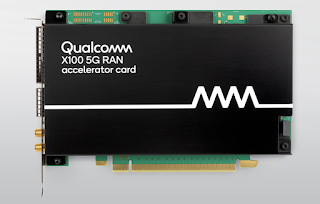
Rakuten Mobile, Rakuten Symphony and Qualcomm Technologies aim to deliver a high-performance Open RAN Massive MIMO solution that supports configurations of up to 64T64R, which will enhance coverage, improve cell-edge data speeds, as well as increase the overall capacity of the network. This will also enable enhanced speed in the rollout of 5G networks with high performance O-RAN compliant infrastructure products.

"Rakuten Symphony is passionately committed to enabling the transformation of mobile networks for the digital-centric future and we are honored to have our group’s opportunity to collaborate with global technology leaders such as Qualcomm Technologies to achieve this goal," said Tareq Amin, chief executive officer, Rakuten Symphony, Inc. "The new RUs and DUs developed with the support of Qualcomm Technologies aim to offer mobile operators and other organizations a dynamic and cost-effective way to deploy high-performance, virtualized 5G networks through the adoption of O-RAN-compliant software and infrastructure."

“Qualcomm Technologies is pleased to collaborate with Rakuten Mobile, the parent company of Rakuten Symphony on the development of comprehensive solutions from Open RAN 5G Radio Units with Massive MIMO capabilities to high-performance Distributed Units platforms. Through this collaboration, our collective aim is to accelerate next generation 5G mobile infrastructure global adoption, and this milestone will help operators meet performance demands at the edge and provide enhanced user experiences,” said Durga Malladi, senior vice president and general manager, 5G, mobile broadband and infrastructure, Qualcomm Technologies, Inc. 

#MWC22: Accelerating Virtual 5G Distributed Unit Processing

 What's hot at #MWC22? In the drive toward O-RAN and v-RAN, silicon vendors are racing toward smaller geometries, and Marvell is on the leading edge with portfolio optimized for the RU, DU and now the virtualized DU, says Joel Brand, Senior Director, Product Marketing, Marvell. 

https://youtu.be/upKd1yp6YOM

The idea with the virtualized DU is to process some of the functionality in a host server leveraging cloud technologies and a new generation of accelerator cards powered by dedicated silicon.


GSMA Foundry Telco Edge Cloud trial interconnects two MEC platforms

Bridge Alliance, MobiledgeX, Singtel and Telefonica achieved an interconnection between two heterogenous multi-access edge computing (MEC) platforms as part of a GSMA Foundry Telco Edge Cloud trial. 

Bridge Alliance is a group of mobile operators in Asia Pacific, Middle East and Africa.

The hub-to-hub interconnection between the Bridge Alliance Federated Edge Hub (FEH) and MobiledgeX Edge-Cloud platform could allow edge applications to be deployed across different edge platforms and regions served by each hub. 

Singtel’s MEC and Telefonica’s MEC are connected by FEH and MobiledgeX Edge-Cloud platform respectively. With the interconnection, Singtel’s customers will be able to deploy edge applications on Telefonica’s MEC and vice versa, enabling multi-market services delivery across an extended geographical footprint, including Asia and Europe. Customers, developers, and partners can discover, as well as order cross-regional edge resources and deploy applications through a unified interface, ensuring a uniform experience across different networks and markets in these regions. Previously, interconnections were performed between operators on a one-on-one basis, making it difficult to scale the edge coverage.

Dr Ong Geok Chwee, CEO of Bridge Alliance, said, “We’re delighted to achieve this industry-first milestone with MobiledgeX and Telefonica. The implication of such hub-to-hub interconnections is that our member operators’ enterprise customers will be able to offer exciting data-intensive and low latency services in markets beyond our Asian footprint. We believe that this is only the beginning of more cross-regional edge deployments in the industry, which will occur as more of our member operators come on board our FEH, and as more trials between different edge hubs/aggregators are established. We welcome more edge hub partners on board.”

Michael Lochead, SVP of product for MobiledgeX said, “The true promise of edge computing hinges on seamless developer access for high-performance applications that can take advantage of global reach. Today’s announcement represents another major leap toward this goal, demonstrating that operators in disparate regions can choose the edge computing platform that best fits individual market needs while still easily achieving worldwide reach. We are proud to continue advancing edge compute possibilities with our operator partners as meaningful edge service rollouts are prepped for 2022 and beyond.”

https://www.telefonica.com/en/communication-room/bridge-alliance-mobiledgex-singtel-and-telefonica-achieve-world-first-interconnection-of-heterogenous-multi-access-edge-computing-mec-platforms-utilising-hub-to-hub-architecture/

Taiwan's ITRI and Pegatron show private 5G base station

Taiwan's Industrial Technology Research Institute (ITRI) and Pegatron are showcasing a 5G energy-saving private network solution at this year's Mobile World Congress (MWC).

The debut of the 5G Open RAN (O-RAN) energy-saving private network solution demonstrates how smart algorithms in conjunction with network traffic monitoring and traffic steering technology allow 5G base stations to provide smart, energy-saving, and uninterrupted services. 


https://www.itri.org/eng.

Deutsche Telekom's revenues grew 7.7% in 2021

Deutsche Telekom exceeded its financial guidance for 2021, with total revenue growing by 7.7 percent to 108.8 billion euros.

Service revenues rose by 6.5 percent to 84.1 billion euros. Adjusted EBITDA AL rose by 6.6 percent year-on-year to 37.3 billion euros. 

“We won’t let up,” said Tim Höttges, CEO of Deutsche Telekom. “Profits are growing in all areas. The Group’s successful course continues.”

In 2021, Deutsche Telekom invested 18.0 billion euros worldwide, excluding expenses for mobile spectrum. 5.9 percent more than in the previous year. Adjusted net profit increased by 2.6 percent to 5.9 billion euros; on an unadjusted basis, it increased by 0.4 percent to 4.2 billion euros.

Some highlights:

  • In its home market, Deutsche Telekom can look back on a year of substantial growth in customer numbers and of strong earnings. In the broadband business, the Company recorded 360,000 customer additions, thus significantly increasing its market share in 2021. At year-end, 17.2 million (retail and wholesale) customers were using a fiber-optic based line (FTTH, VDSL/vectoring), 1.2 million more than a year earlier.
  • In mobile communications, Telekom recorded growth in branded contract customers of 666,000 for the full year. The clear market leadership in terms of mobile service revenues was reinforced. In the fourth quarter, this figure was up 2.3 percent against the prior-year period.
  • The Germany operating segment increased total revenue by 1.6 percent year-on-year in the 2021 financial year to 24.2 billion euros. Growth in adjusted EBITDA AL was even stronger: up 3.6 percent to 9.5 billion euros.
  • T-Mobile US ended the year with 108.7 million customers, an increase of 6.7 million within 12 months. More than 2.9 million of these additions related to the particularly profitable postpaid phone segment. Total revenue increased by 15.2 percent to 80.8 billion U.S. dollars. At the same time, adjusted EBITDA AL increased by 11.8 percent to 26.9 billion U.S. dollars. The business combination with Sprint is paying off. Last year, synergies leveraged in shared functions, sales, and networks amounted to 3.8 billion U.S. dollars. In 2022, this figure is expected to rise to between 5.0 and 5.3 billion U.S. dollars, thereby exceeding the integration costs of the merger on a full-year basis for the first time since the business combination with Sprint as of April 1, 2020.
  • The Europe operating segment generated adjusted EBITDA AL of more than 4.0 billion euros within a year for the first time. In organic terms, i.e., adjusted for exchange rate effects and changes in the composition of the Group, this was 5.4 percent more than in the prior year. This indicator for earnings performance had increased organically year-on-year in every quarter of the last four years. Service revenues grew by 2.0 percent in organic terms in 2021 to 9.6 billion euros.
  • Customer numbers increased in all areas in 2021. The European national companies won 770,000 new mobile contract customers in total. The number of broadband customers went up by 350,000. The number of users of convergent fixed-mobile product bundles increased by 842,000.

North American MWC moves to Las Vegas

 The North American edition of MWC has been scheduled for 28 – 30 September in Las Vegas. 

The will be delivered in partnership between GSMA and the CTIA. The event is part of the GSMA’s annual series of MWC events that includes editions in Barcelona, Africa, and Shanghai.

“We are excited to bring the MWC experience to Las Vegas, bringing Connectivity Unleashed to a proud center of business and technology in the US. Our North American event has always brought the mobile ecosystem face-to-face to build strong relationships and harness innovation, and this year will be no different.” John Hoffman, CEO GSMA Ltd said.

Friday, February 25, 2022

SpaceX launched 50 more Starlink satellites from Vandenberg

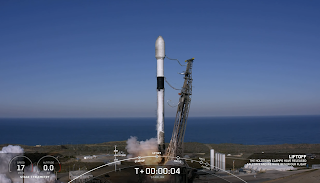
On Friday, February 25, SpaceX launched 50 Starlink satellites from Space Launch Complex 4 East (SLC-4E) at Vandenberg Space Force Base in California. The first stage was recovered on a drone ship in the Pacific.

This was the eight launch of 2022 and the fourth flight for the Falcon 9 first stage booster supporting this mission, which previously supported Sentinel-6 Michael Freilich, DART and one Starlink mission.

Starlink service is now available in Brazil and Bulgaria, bring the number of countries with Starlink service to 29.

Thursday, February 24, 2022

AT&T and Intel co-develop advanced RAN pooling

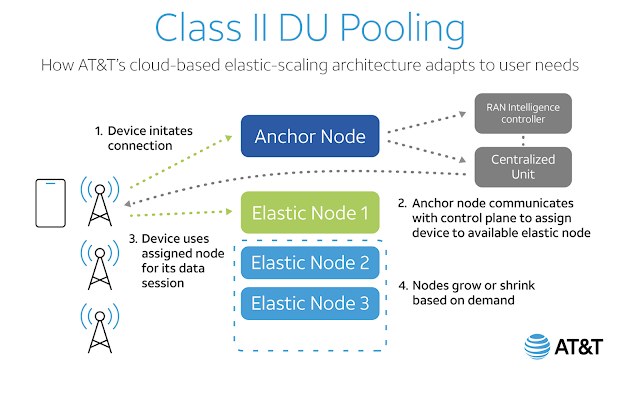
AT&T is collaborating with Intel on an Advanced  base station distributed unit (DU) pooling technology designed to deliver unprecedented levels of elasticity in the RAN. 

AT&T says DU pooling provides the greatest value in C-RAN or Centralized RAN network deployments where RAN baseband equipment from many cell sites are “pooled together” into a “cloud” of general purpose processors in far edge data centers or central offices. Furthermore, through an advanced form of DU pooling called Class II pooling, a single 5G radio can now distribute the baseband processing for each user device in the cell across multiple servers.

DU pooling technology was made possible by combining AT&T’s Open RAN technologies as one of the co-founders of the O-RAN Alliance with Intel’s expertise in general purpose processors and software-based RAN through its FlexRAN software stack running on Intel 3rd generation Intel Xeon Scalable processors. The open standards for communications between radios and DUs that were published by O-RAN enabled its development, and the result is a technology demonstrator implemented on FlexRAN software.


https://about.att.com/innovationblog/2022/cloudifying-5g-with-elastic-ran.html

#MWC22: Proactive Service Assurance for 5G

What's hot at MWC22? 

Proactive Service Assurance for 5G says Rohit Batra, Head of Telecommunications, Media and Technology product for ServiceNow. Two key partnerships are highlighted: NTT and DISH.


https://youtu.be/NswG3yVyz70

Telefonica validates O-RAN xHaul transport link with Keysight

Telefonica accomplished the first validation of an open radio access network (RAN) xHaul transport link using Keysight's test tools.

xHaul is a unified fronthaul and backhaul networking infrastructure. It creates a common packet-based transport network for flexible and software-defined reconfiguration of networking elements in a service-oriented unified management framework. Mobile operators, such as Telefonica, are implementing O-RAN compliant xHaul transport architectures to reconfigure and share the network quickly and cost-effectively, to streamline delivery of 5G services.

“Keysight’s 5G test tools enable Telefonica Open Testing and Integration Centre (OTIC) to characterize xHaul transport links in accordance with O-RAN WG9 test specifications and advance its O-RAN xHaul interoperability test plans,” said Scott Bryden, vice president and general manager at Keysight. “Keysight’s solutions for emulating real-life Ethernet traffic conditions enable verification of the functionality and reliability of O-RAN xHaul transport architecture.” 

NETGEAR intros triband WiFi 6E for SMBs

NETGEAR introduced a tri-band, business-grade WiFi 6E product with cloud management for small and medium businesses (SMBs).

Key Features of WAX630E:

  • New 6GHz Band –– WAX630E offers many features and capabilities of WiFi 6 access points, including higher performance, lower latency, and faster data rates and supports WiFi 6E on the new wider 6GHz WiFi band
  • Ultra-Low Latency — Extends into the new 6 GHz band bringing 14 additional 80 MHZ channels for expanded spectrum capacity and less congestion thereby lower latency
  • WiFi Speed of up to 7.8Gbps ––Tri-Band WiFi with combined wireless speeds of up to 7.8Gbps (0.6+4.8+2.4 Gbps)
  • 8-Streams Tri-Band WiFi — 8 WiFi streams (two streams of 6GHz, four streams of 5GHz, and two streams of 2.4GHz) means more available bandwidth and less congestion for all devices on WiFi
  • Multi-Gigabit Speed with PoE — Includes a 2.5 Gbps Ethernet port with PoE++ for high speed and easy wiring. An additional 1 Gbps Ethernet port is included for wired extension to a WiFi access point. Ideal switches to power WAX630E are GSM4210P, MS510TXPP, MS510TXUP and MS108EUP.
  • Remote Management — Remote Cloud monitoring and management with NETGEAR Insight for single pane of glass management. Insight Pro is available for multi instance network management for managed service providers.
  • 8 Secure Wireless Networks (SSIDs) — Separate VLANs and WPA3 makes WAX630E the ideal network configuration for SMBs for security and manageability
  • Separate VLANs — Separate networks to keep admin, employee, visitor, HR, Finance department networks securely separated from each other

Pricing begins at $350.

"ISPs are now offering multi-gig speeds to their business customers. Simultaneously, client devices such as the latest Samsung Galaxy, Google Pixel smart phones and several new personal computer systems from leading manufacturers are supporting WiFi 6E. This combination makes it an imperative for businesses to at least double the connection speeds for their underlying WiFi systems,” said Doug Cheung, Director of Product Line Management, SMB Wireless at NETGEAR. “The WAX630E will enable businesses to improve the bandwidth of their WiFi network by up to 2.5 times.”


ADVA reports revenue of EUR 157.7 million, growth in demand from CSPs

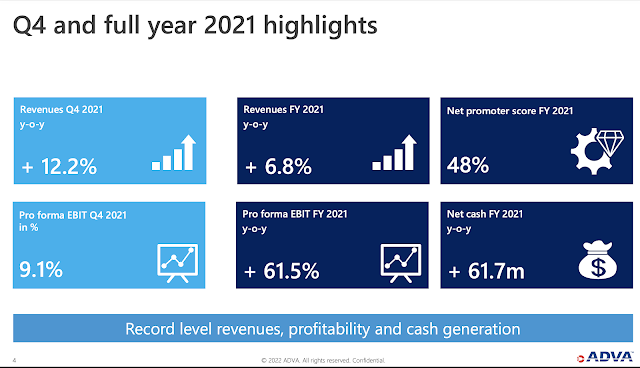
Citing growth in demand from communication service providers (CSPs), particularly in the cloud access solution area, ADVA reported Q4 revenue of EUR 157.7 million, up by 3.9% from EUR 151.8 million in Q3 2021, also considerably up by 12.2% compared to EUR 140.6 million in Q4 2020. Net income reached EUR 17.5 million in Q4 2021 and decreased by 5.2% from EUR 18.5 million in Q3 2021, but increased significantly by 32.2% from EUR 13.2 million in Q4 2020. 

“Our business transformation strategy will remain our focus in 2022. Profitability, liquidity and expanding our sales in new industries are top priorities,” said Brian Protiva, CEO of ADVA. “Technologically, our solutions are extremely well aligned to the transformation of networks with cloud, mobility, 5G, automation and security. In addition to the high-value performance features of our optical data transmission, precise network synchronization technology and programmable cloud access solutions, our service portfolio also delivers increasing value. Furthermore, our strategic move to join forces with ADTRAN will create a global leader in a quickly expanding market opportunity around the network edge. Together, we can offer a comprehensive portfolio of solutions from the access part of the network, through the network edge, to the metro core, which goes well beyond the offerings of most other Western manufacturers.”

“Today, we report on a great financial year with solid growth and a significant increase in profitability. The consistent implementation of our business transformation strategy enables us to compensate for higher procurement costs due to the global shortage of components and still expand our margins. High cash flow generation combined with consistent debt reduction has led to a significant increase in our net cash position, which we were able to expand by more than EUR 60 million compared to 2020,” commented Uli Dopfer, CFO of ADVA. However, global inflationary tendencies and the resulting higher material costs, as well as the global shortage of materials, pose challenges for us in 2022. We start the year again with an order-backlog at record levels and are confident that we will once again overcome the ongoing challenges and grow profitably in 2022.”


VMware posts revenue of $3.53 billion, up 7% yoy

VMware reported Q4 revenue of $3.53 billion, an increase of 7% from the fourth quarter of fiscal 2021.  Non-GAAP net income for the fourth quarter was $855 million, or $2.02 per diluted share, down 9% per diluted share compared to $936 million, or $2.21 per diluted share, for the fourth quarter of fiscal 2021.

Revenue for fiscal year 2022 was $12.85 billion, an increase of 9% from fiscal 2021.

  • The combination of subscription and SaaS and license revenue was $1.90 billion, an increase of 11% from the fourth quarter of fiscal 2021.
  • Subscription and SaaS revenue for the fourth quarter was $868 million, an increase of 23% year-over-year.

“The growth in customer demand for our multi-cloud solutions was reflected in our Q4 results. We are at an exciting time in our industry, as enterprises large and small transform and modernize to become software-based, digital enterprises,” said Raghu Raghuram, CEO, VMware. “We are well-positioned to help our customers build, run and secure their applications in this multi-cloud environment.”

“Q4 was a strong finish to a transformational year in which we became a standalone company and surpassed $12B in revenue,” said Zane Rowe, executive vice president and CFO, VMware. “As we look to our next fiscal year, we remain focused on accelerating growth of our Subscription & SaaS portfolio and scaling our multi-cloud platform enabling us to deliver long-term revenue and profit growth.”


NeoPhotonics reports revenue of $80.6 million, growth in 400G

Citing supply chain impacts, especially for analog and power semiconductors, NeoPhotonics reported revenue of $80.6 million, up 18% year-over-year on growth in 400G and above capable products and down 3.7% quarter-over-quarter. Supply chain shortages negatively impacted revenue by $15 million in the fourth quarter. Non-GAAP net loss per share was $0.06, compared to a Non-GAAP loss per share of $0.14 a year ago and a Non-GAAP net earnings per share of $0.01 in the prior quarter.

“Our business remains on a strong growth path, as demand continues to increase and our backlog has expanded to record levels with nearly a year of visibility. Our fourth quarter revenue trend reflected the operational challenges as the full force of industry-wide IC chip supply shortages impacted our topline revenue by more than $15 million. Our products for 400G and above applications grew 9% sequentially, comprising 56% of total revenue, despite this product group being the most impacted by supply chain chip shortages,” said Tim Jenks, Chairman and CEO of NeoPhotonics. “Moreover, we now have three Cloud and data center switch customer design wins in place for our 400ZR coherent DCO modules products.”

Mr. Jenks continued, “The Lumentum transaction announced last November remains on track, having been approved by our stockholders at our special meeting on the first of February and the expiration of the waiting period under U.S. anti-trust regulations, as previously announced. We believe Lumentum is an ideal partner to serve our customers on a larger scale and look forward to securing regulatory approval from China and closing the transaction. I would like to thank all NeoPhotonics employees for their hard work and dedication for our strong performance in 2021, and for building the company’s strong technology leadership for high speed over distance applications.”

Year-over-year growth of products for 400G and above applications exceeded 70% to $148 million

Growth of 18% over the same quarter last year despite supply chain shortages.


DISH posts revenue of $4.45B, dip in pay-TV and wireless subscribers

DISH Network reported revenue totaling $4.45 billion for the quarter ending December 31, 2021, compared to $4.56 billion for the corresponding period in 2020. 

Net income attributable to DISH Network totaled $552 million for the fourth quarter 2021, compared to $733 million from the year-ago quarter. Diluted earnings per share were $0.87 for the fourth quarter, compared to $1.24 per share during the same period in 2020. 

Some highlights: 

  • Net pay-TV subscribers decreased approximately 273,000 in the fourth quarter, compared to a decrease of approximately 133,000 in the year-ago quarter. 
  • The company closed the quarter with 10.71 million pay-TV subscribers, including 8.22 million DISH TV subscribers and 2.49 million SLING TV subscribers. 
  • Retail wireless net subscribers decreased by approximately 245,000 in the fourth quarter, compared to a net decrease of 363,000 in the year-ago quarter. 
  • The company closed the quarter with 8.55 million retail wireless subscribers. 
  • Wireless CapEx for 2022 is expected to be $2.5 billion, compared to $1.0 billion for 2021.


Keysight names Satish Dhanasekaran as next CEO

Keysight Technologies named Satish Dhanasekaran as its next President and CEO, effective May 1, placing Ron Nersesian, who is retiring but who will continue as Executive Chairman of the Board.

Chief Executive Officer of Keysight when Agilent Technologies decided to spin-out the business in 2013. Under Nersesian’s leadership, Keysight’s revenues have increased at a ten percent compound annual growth rate, while generating annualized earnings and free cash flow growth of eighteen percent and twenty-five percent, respectively. At the same time and as of the end of fiscal year 2021, Keysight’s market capitalization has increased six-fold, while delivering shareholder returns nearly four times that of the S&P 500 Index.

Dhanasekaran began his career at Keysight in 2006. He has been Chief Operating Officer since 2020, focused on growing orders, increasing annual recurring revenue and driving the company’s growth initiatives. He oversees the Keysight functions that contribute to these objectives, including market and technology research; development of new technologies, products, and solutions; services; marketing; and sales.

“Keysight has a very bright future ahead, and I look forward to working with the team to execute our software-centric solutions strategy and apply the Keysight Leadership Model to deliver greater value for our customers, shareholders and employees.”

“I am incredibly proud of the exceptional results that the Keysight team has achieved for customers and shareholders,” said Nersesian. “Looking ahead, I am even more confident in Keysight’s future prospects and ability to drive further value creation given the strength of the company’s differentiated solutions, R&D investments, sales and marketing engines, leadership team, balance sheet, and culture.”


Wednesday, February 23, 2022

Arista embeds network detection and response into switches

Arista Networks is adding embedded security and packet analysis capabilities to its 720XP series of switches. 

By embedding NDR (Network Detection and Response) capabilities into the Arista EOS-based switches themselves, Arista says it can deliver broader visibility and threat hunting across the modern cognitive campus. 

The new capabilities build on Arista's Autonomous Virtual Assist (AVA) platforms with two key components: AVA Sensors and the AVA Nucleus. AVA Sensors support a variety of form factors from stand-alone appliances and virtual to cloud workloads and now, within campus power over ethernet (PoE) switches. The AVA Sensors analyze the full packet, including application layer data which sets the stage for automated and manual threat hunting. The sensors then transfer the “just right” deep-packet data to the AVA Nucleus, which is offered as both on-premises and SaaS. 

Arista will deliver the capabilities via a switch software upgrade . The company cites minimal impact on switch performance or reliability.

“Network security has been an ongoing challenge for most organizations due to hardware deployments and configuration changes needed at the network infrastructure level. While organizations acknowledge that the network presents a unique vantage point, security teams have been forced to trade off network visibility and ongoing operational costs,” said Rahul Kashyap, Vice President and General Manager of Cybersecurity and CISO at Arista Networks. “By building NDR capabilities into the switching infrastructure itself, Arista enables a built-in, secure network that reduces organizational risk by speeding up both time to detection and time to remediation.”

The new capabilities are expected to be generally available in Q2, 2022, with early trials in March 2022.


Mavenir showcases portfolio of O-RAN-compliant radio units

Mavenir is introducing a portfolio of O-RAN compliant Radio Units (RUs) spanning micro, macro, millimeter wave (mmWave) and massive MIMO (mMIMO) deployments. The products will be showcased at the upcoming Mobile World Congress.

The Mavenir OpenBeam radio portfolio covers a wide range of spectrum, both licensed and unlicensed. Mavenir is offering open interfaces and O-RAN 7.2 compliance.

“We have engaged with customers globally to curate a comprehensive O-RAN portfolio that addresses the needs of both private enterprises as well as traditional communication providers” says Rajesh Srinivasa, Senior Vice President of Radio Business Unit at Mavenir. “OpenBeam portfolio covers a wide range of deployment scenarios starting from micro-RUs to 64TR Massive MIMO Radios. OpenBeam radios deliver industry-leading performance and energy efficiency packed in a small footprint.”

Pardeep Kohli, Chief Executive Officer at Mavenir, said “With the incredible growth of virtualization and Open RAN, we always believed that the ecosystem had to be accelerated as this is fundamental for the success of the future of networks. Mavenir has been working with many partners in the ecosystem, and we have also injected more direct contributions when it comes to innovative design.

https://www.mavenir.com/press-releases/expanding-the-open-ran-ecosystem-with-a-wide-portfolio-of-high-performance-o-ran-compliant-radios/

Viavi builds up its Open RAN test suite

Viavi Solutions announced extensions to its Open RAN test suite, including:

  • RIC Test. TeraVM RIC Test validates the performance of the RAN Intelligent Controller (RIC) when presented with a wide range of RAN scenarios, tests the functionality of rApps and xApps, and provides the means to generate the data needed to train AI models.
  • Test in the Cloud. VIAVI allows any node – O-RU, O-DU, O-CU, RIC and Core – and complete end-to-end testing to be performed in public, private and edge cloud environments.
  • Test as a Service. VIAVI now provides a Test as a Service (TaaS), offering the support to maximize your engineering productivity and provide access to the right tools and expertise to enable the rapid delivery of high performance and ultra-reliable cellular communications products.
  • TMLite. The capabilities of the flagship TM500 Network Tester are now available in a streamlined version on a commercial-off-the-shelf (COTS) server, enabling vendors to deploy focused functional test tools earlier in the development cycle, and allow smaller vendors to gain access to the TM500 family with a more compact package. The TMLite is built around the latest third-generation AMD EPYC processors which offer high compute and input/output flexibility per server, enabling multiple carriers of 4G and 5G at RF and Open Fronthaul.

VIAVI also highlighted the following partnerships:

  • Capgemini. VIAVI has collaborated with Capgemini, through Capgemini Engineering in Portugal, to deliver an industry-leading 5G and O-RAN lab test capability, powered by VIAVI's O-RAN Lab as a Service (LaaS) to ensure successful network integration of 5G networks and accelerate Lab-to-Live trials for Open RAN.
  • Ericsson. VIAVI will be delivering geolocation capabilities as a Non Real-time RIC Application (rApp) on the Ericsson Intelligent Automation Platform, a service management and orchestration product which enables any mobile network, purpose-built or Cloud RAN / Open RAN, to be intelligently automated.
  • Rohde & Schwarz. VIAVI and Rohde & Schwarz are partnering to offer an integrated solution for conformance testing of O-RAN Radio Units (O-RUs), including the O-RU Test Manager which provides a seamless user experience.

"Open RAN is moving out of the lab into the real world, facing the messy complexities of mapping theoretically sound technologies and architectures to a wide diversity of implementation scenarios," said Sameh Yamany, Chief Technology Officer, VIAVI. "VIAVI has harnessed its decades of leadership in test tools for cellular and virtual networks, our critical role in industry organizations such as the O-RAN ALLIANCE, and our relationships with other major vendors to ensure our customers have access to tailored and best-of-breed solutions."


MaxLinear debuts single-chip for 5G Open RAN Radio Units

MaxLinear introduced a fully integrated System on Chip (SoC) for 4G/5G Open RAN (Radio Access Network) radio units (RU) including in Macro, Massive MIMO, and Small Cell applications.

MaxLinear's Sierra integrates the following sub-systems into a single chip:

  • RF Transceiver supporting up to 8 transmitters, 8 receivers, and 2 feedback receivers
  • Digital Front End (DFE), powered by MaxLIN™ the industry’s leading digital pre-distortion (DPD) and crest factor reduction (CFR) solution, and supporting digital up-conversion (DUC) and digital down-conversion (DDC) of component carriers
  • Low PHY Baseband Processor supporting 5G, 4G, and NB-IoT air interfaces
  • Fronthaul Interface compliant with O-RAN Alliance Split 7.2x

“Sierra is an ultimate integration of MaxLinear’s highest performance RF and system technologies. It empowers radio vendors to rapidly and cost effectively develop new platforms with best-in-class size, weight, and power consumption for Open RAN applications,” said Brendan Walsh, Vice President of MaxLinear’s Wireless Infrastructure Group. “In this way Sierra represents a game-changing innovation that will level the playing field for wireless infrastructure vendors and can dramatically accelerate the global rollout of Open RAN without compromise on network performance or cost.”