Showing posts with label Service Assurance. Show all posts

Sunday, December 11, 2022

Blueprint: Why CSPs need to shift to support root-cause analyses

by Stephanie Sculley, Head of Analytics Practice, Advanced Consulting Services West at Nokia

Today’s networks are complex to say the least. Because of that, it can be difficult to determine the underlying cause of an issue that’s hindering the customer experience. 

For some communications service providers (CSPs), chasing the wrong suspect can result in wasted time and effort while the true criminal runs free continuing to frustrate customers. 

This unproductive cycle is prevented with root-cause analysis, which identifies the actions that are needed to solve problems, minimizes churn and keeps customers happy, or at least happier. Not only does this save time, but it also helps CSPs keep their decisions customer-focused.

Nonetheless, there are three areas where CSPs often get stuck when trying to conduct root-cause analysis to address these problems, but fortunately, switching up one’s mindset can help to mitigate these common errors. Let’s find out how.

You Don’t Know If You Don’t Ask…a Lot: How to Solve the Problem with Meaningful Questions 

A cold has similar symptoms as an allergy, the flu or even a more serious diagnosis. So, if someone says they have a cough or a runny nose, the doctor needs to ask the right questions to come to an accurate diagnosis. This may even involve doing research or even consulting other professionals, who may have experience in other areas.  

While not the exact same scenario, this is a similar situation to what CSPs face when trying to determine the cause of network issues. Performance and service-related issues can originate from various sources from device manufacturers, content or app providers, user behavior, device manufacturers, or even the network itself, making it near impossible to figure out the cause of problems on one’s own.

Thus, it’s critical that CSPs ask the right questions to determine the cause of lagging key performance indicators (KPIs), growing customer complaints and churn.

Finding a true root cause can be like peeling an onion; there are many layers of investigation. With each new layer exposed, it’s vital to analyze and inspect the relevant details as moving too quickly with a possible solution could result in breaking KPIs in other areas. 

To assist in the root-cause analysis process, many turn to artificial intelligence and machine learning (AI/ML). However, while excellent and essential, these tools also require deep, hands-on experience and the correct data to generate conclusive solutions — ultimately bringing back up the importance of asking the right questions. 

Finding a Needle in a Needle Stack: How to Work with Data

Aside from asking the right questions, CSPs looking for the root cause of customer experience issues can also get hung up on vast amounts of data. 

Most CSPs have invested significant time, resources and energy into integrating sensors and devices throughout their operations with the aim to collect meaningful data. But instead, the data often has the opposite effect as CSPs are left with massive amounts of information that area struggle to sort through and generate value and actionable insights off of. 

To truly capitalize on their data and the findings it uncovers, CSPs need specialized tools along with industry expertise and advanced domain insight. Fortunately, telco data consultants who have worked with various CSPs in different industries can utilize the best practices and lessons learned from these experiences to truly investigate the large pool of data and uncover the most meaningful insights to determine the correct root cause and best course of action. 

The Customer Really Comes First: How to Start Making Customer-Centric Decisions

The last area where CSPs get stuck is with their decision-making process. Commonly, CSPs focus on a performance-driven approach to decision-making. This puts additional emphasis on areas such as the quality and capabilities of segments of their network. However, this narrow focus on just the radio access network (RAN) or the core can have a net negative impact on the business’s operations when it does not simultaneously better customer experience.

By focusing on the customer end-to-end in the decision-making process, CSPs can ultimately keep customers happy instead of causing their eyes to wander to competitors. But doing so requires a deep understanding and knowledge of the true cause of service complaints to properly address issues affecting the customer experience.

Take the example of customers complaining about dropped calls. At a surface level, it may seem like a solution to invest in optimizing network performance in their area, even if it may risk increasing consumer costs. However, the customer may still be affected by the end-to-end service path, which means that the isolated optimizations might not even improve their experience. Even worse, these increased costs, which may be portrayed as higher service fees as a result of the optimization, could cause the customer to ultimately choose a different provider. 

As a general principle of end-to-end customer-focused decision-making, an investment isn’t effective if it doesn’t better the customer experience. And as a part of that, it’s crucial to uncover and act on true root causes. 

And if issues continue to be unclear or complicated, it may be worthwhile to collaborate with an external partner, who can provide expertise and perspective when investigating root causes. 

Not only would an external provider supply broad industry insight based on ongoing work with various global CSPs, but they also have the domain knowledge and AI/ML expertise needed to ask the right questions, analyze data and uncover the true root cause of any issue – improving end-to-end customer experience by ensuring the customers’ needs are addressed head-on.


Sunday, November 27, 2022

Blueprint: To unleash the 5G opportunity, we need to tackle 5G operational challenges

by Charles Thompson, Vice President, Service Assurance, Spirent Communications

5G brings incredible opportunity for communication service providers (CSPs), enterprises, and the broader digital ecosystem. By 2022, there were already 700 million 5G subscriptions across more than 70 countries—an explosion of devices that can take advantage of 5G density and performance. Even more exciting, the industry is gearing up to unleash a new generation of enterprise use cases across manufacturing, healthcare, retail, and other verticals. 

Operators and their customers are banking on new 5G capabilities like ultra-low latencies, native cloud/edge connectivity, and network slicing to fuel transformative new business models. Before that can happen, however, we need to be confident that CSPs can actually operate next-generation networks and services. And so far, that’s not a given. 

5G introduces a radically different network than CSPs have worked with before, requiring new strategies for monitoring, troubleshooting, and other basic network operations. It’s tempting to focus on the amazing 5G possibilities. But for most CSPs, just assuring 5G networks and services remains a work in progress. 

Navigating 5G Complexity

Why does 5G present so many challenges? Because it changes pretty much everything about telecom networks, from deployments to updates to the basic definition of “network infrastructure.” Most current operations strategies were designed for yesterday’s networks. They’re built to assure mostly hardware-based network functions from one or two vendors, and services with fixed, predictable traffic patterns. In a 5G world, however, the network mimics a living, breathing organism, composed of virtualized and disaggregated software running as a dynamic hybrid cloud. 

It’s a huge change, and for CSP assurance teams, it brings: 

  • New technologies: 5G network functions are more flexible and adaptable, scaling in and out dynamically as conditions change. But for teams trying to monitor network services, this means service paths constantly change too—including traversing clouds and infrastructure segments outside the CSP’s control. 
  • Cloud software models: By running open, disaggregated network architectures, CSPs can work with new vendors and more quickly tap into new innovations. But these architectures also bring many more network layers and interfaces that assurance teams now have to observe. Additionally, instead of receiving software updates two to three times per year and implementing them in fixed maintenance windows, operators now receive continuous updates from many more vendors, each releasing on its own cadence.  
  • Cloud-centric architectures: The passive assurance tools used to monitor 4G networks assumed a more centralized topology, with the “network edge” located in a few large regional data centers. To enable new 5G use cases with ultra-low latencies and advanced edge intelligence, CSPs are embracing highly distributed architectures. Large operators might maintain 50 edge data centers—and potentially hundreds more “far edge” sites hosting network functions closer to customers. When monitoring is designed to observe a few fixed points in the network, that’s no longer enough. 
  • New security concerns: The traditional enterprise network perimeter has eroded, with most applications and users now operating outside the firewall. As a result, almost all data is now encrypted. How can operators measure end-user experience in an always-encrypted world? 

If you’re wondering how current assurance strategies will adapt to this new reality, CSP operations teams are, too. Traditional approaches rely on passive monitoring infrastructures that collect real user data from live services. This type of monitoring can’t keep up with dynamic cloudified networks and service paths that continually change. Even if it could, it would still only detect problems after they’d affected customers. By then, the stringent service-level agreements (SLAs) on which operators are depending to monetize their 5G investments may already be violated. 

Introducing Active Assurance

Traditional static probes may not scale with 5G networks, but another monitoring strategy seems tailor-made for them: active assurance. Active assurance agents function like a virtual device, injecting synthetic traffic into the network to measure performance from a user’s point of view. They can plug into any part of the network, running the same applications and emulating the same behavior as real users. And since they use the same authentication and trust framework, they provide a firsthand view of what real users experience. 

Active assurance can continuously monitor the performance of complex 5G networks, applications, and services. By emulating real application traffic, CSPs can maintain SLAs for the most demanding 5G use cases. And unlike traditional monitoring, which only measures real user traffic, active assurance can address the full network lifecycle: validating new network functions and slices before activation, monitoring and troubleshooting live services, and re-validating after any change. 

It adds up to an assurance strategy perfectly suited for 5G networks and services. CSPs can:

  • Detect problems before users: Active assurance uses artificial intelligence and machine learning (AI/ML) to spot emerging issues in highly dynamic, distributed environments. Combined with automated activation testing and post-change validation, CSPs can spot many problems before they affect live services—essential for supporting more stringent SLAs. 
  • Scale with dynamic 5G networks: There’s no way to instrument static monitoring infrastructure for service paths that are constantly in flux, or that traverse third-party networks and clouds. But active agents work like any other endpoint, sending traffic through the network and observing how the network performs. As a result, they capture the end-to-end service experience—including those parts outside the operator’s control. 
  • Accelerate root cause analysis: Since active assurance follows the same path through the network as real users, it provides true end-to-end visibility. Supported by AI analysis tools, operations teams can quickly segment any problem, even when it originates in someone else’s network. 
  • Support encrypted traffic in motion: Traditional static monitoring must decrypt packets to analyze the service experience—limiting where it can be used and potentially increasing risk. Since active assurance uses the same security, following the same paths as real users, no decryption is needed. 
  • Automate testing: Active assurance plugs right into the automated, AI-enabled operational models that accompany modern cloud-native, software-driven networks. Service providers can automatically invoke active testing as part of Continuous Integration/Continuous Delivery (CI/CD) toolchains and change management procedures. And they can use automated triage test scripts to quickly isolate issues.

Looking Ahead

5G networks hold enormous potential for CSPs and their customers—provided we can overcome the daunting operational challenges that come with them. CSPs are still refining the monitoring strategies they’ll need to deliver on 5G’s potential. But with active assurance, they have a powerful toolset for assuring 5G services—and a clear roadmap to operationalize them. 


Wednesday, June 15, 2022

EXFO and Intel intro 5G service assurance

EXFO has collaborated with Intel on a service assurance solution for 5G network operators. This solution supports automation for cloud specific assurance regardless of whether faults originate in the network, service layers, or in the cloud-native network infrastructure.

EXFO’s full-stack assurance solution utilizes platform observability by Intel alongside EXFO’s existing adaptive service assurance (ASA) platform to close the visibility gap among cloud-native infrastructure and the network and service layers. In doing so, it provides complete visibility across the entire operational span of operator networks. The solution enables operators to assess the operational state of the underpinning cloud-native infrastructure from the chip-level up, allowing faults to be isolated or correlated across all network domains. Together, the EXFO and Intel technology speeds up the time to resolution and eliminates domain-specific fault denial.

Intel Xeon Scalable Processors, with built-in AI and NFV accelerators, provide the foundation to propel 5G experiences and Intel® Platform Telemetry Insights provide a granular view into the cloud-native infrastructure operations. It enables operators to “see” right into the heart of the foundational platform infrastructure and assess operational metrics, including health, utilization, congestion, power consumption and configuration checks. By adopting CNCF’s OpenTelemetry project, Intel provides a standard implementation for the industry to benefit from infrastructure observability.

“Network virtualization is an evolutionary path that began in 4G and is now firmly established in 5G. But managing service level agreements across virtual and physical domains is significantly more challenging, especially when the infrastructure is not always owned by the operator. As part of our adaptive service assurance platform, EXFO’s full-stack assurance solution ensures that operators can detect, correlate and resolve faults wherever they originate, significantly reducing time to resolution,” said Philippe Morin, EXFO’s CEO.

“While service assurance in mobile networks is relatively well understood, the added dimension of cloud-native infrastructure provides a new challenge for most operators. Given the ubiquitous adoption of solutions fueled by Intel Xeon processors in the core network, Intel Platform Telemetry Insights with Open Telemetry and EXFO’s ASA platform provides the lens operators need to help deliver full service assurance across their network infrastructure,” said Alex Quach, VP and GM, Intel’s Wireline & Core Network Division.

https://www.exfo.com/en/corporate/news-events/press-releases/?listall=1

Tuesday, May 31, 2022

Orange Business Services debuts Service Manage-Watch

Orange Business Services introduced Service Manage-Watch, a global supervision solution for network services and applications for both Orange-provided and third-party services. Service Manage-Watch covers the entire enterprise’s IT ecosystem and is designed to ensure that connectivity and security at the edge, applications, equipment, and user experience are all performing at optimal levels.

Service Manage-Watch delivers end-to-end real-time visibility via a single dashboard. In addition, the service is bolstered by a team of dedicated experts at Orange Business Services to fine-tune the correlation rules and work closely with service desk agents for advanced troubleshooting adapted to the specific customer requirements. This continuously improves global IT performance supervision. Metrics from monitoring tools are harvested into the Orange Data Lake and correlated for analysis using Artificial Intelligence (AI) to generate proactive and predictive alerts.

"Service Manage-Watch adds genuine predictive AI power to Orange’s performance monitoring portfolio. Orange’s proven consultative capabilities will help businesses ensure that they are getting the best out of Service Manage-Watch’s capabilities. This launch strengthens Orange’s position as an independent cloud access aggregator and gives it differentiation versus hyperscalers," said Gary Barton, Principal Analyst, Enterprise Technology and Services, GlobalData.

“As both a telco-native company and an integrator, we provide the interface and manage the services, so we understand just how important performance can be to take a business from merely functioning to being outstanding when it comes to supporting business initiatives. Service Manage-Watch is a game-changer for enterprises focused on optimal performance, guaranteeing the availability of applications and networks, while enhancing decision making to increase productivity and user satisfaction. It is a key asset for our Multisourcing Service Integration (MSI) approach,” explained Daniel Bigagli, vice president, Enterprise Services at Orange Business Services.

https://www.orange-business.com/en/press/orange-business-services-unveils-service-manage-watch-supervise-performance-enterprise-it

Thursday, February 24, 2022

#MWC22: Proactive Service Assurance for 5G

What's hot at MWC22? 

Proactive Service Assurance for 5G says Rohit Batra, Head of Telecommunications, Media and Technology product for ServiceNow. Two key partnerships are highlighted: NTT and DISH.


https://youtu.be/NswG3yVyz70

Sunday, December 5, 2021

Blueprint: To Unlock the 5G Future, Service Providers Need to Get Active

by Steve Douglas, Head of Market Strategy, Spirent Communications

Imagine a big storm just passed through your neighborhood, and you’re worried it might have damaged your roof. Do you:

a. Go investigate how the roof is holding up 

b. Wait until the next storm to see if water starts dripping into your bedroom

Most of us would choose option A. It just makes sense to try to determine if something is broken ahead of time, before it fails and creates a bigger, more expensive problem. And yet, that’s not the approach most service providers use today when monitoring their networks.

Modern active monitoring technologies let operators poke and prod their networks in a variety of ways to spot potential problems before they affect customers. But only a fraction of service providers actually use them across the end-to-end network. Instead, most rely on the same techniques they’ve used for years: passively collecting telemetry data, analyzing it over time, detecting many problems only when someone calls to complain. 

This has never been an ideal situation, but in the near future, it will be an impossible one. As service providers progress with 5G rollouts, passive monitoring strategies fall apart. Which means, active testing and assurance is no longer optional. It’s becoming a mission-critical requirement. 

 Problems with Traditional Testing

Historically, most operators have relied on passive monitoring to assess network health, isolate faults, and ensure they live up to their service-level agreements (SLAs). That is, they deploy passive probes throughout their environment to capture network traffic data, dump that data into huge data lakes, and run analytics on it to identify anomalies. Active monitoring takes a more proactive approach. Instead of waiting for statistical analysis to reveal issues over weeks or months, it continually injects synthetic traffic into the network to measure performance in real time. 

Active monitoring is not a new concept. Many operators use it today in transport networks, where they’ve been seeking to introduce self-healing and automation capabilities. In the heart of most networks though, the passive approach still dominates. Now, that’s starting to change in response to five big trends:

  • Cloudification: To enable more agility and automation, operators are implementing more of the network as software, hosted in cloud environments. As a result, network elements are no longer static, rigid functions. They’re dynamic pieces of software that can be continually spun up and moved across cloud environments.  
  • Openness: The 5G specification mandates open interfaces. This allows operators to work with new vendors and open-source technologies in ways that weren’t possible before. But it also means that, instead of getting software updates a couple times a year from one or two well-known suppliers, you can now expect constant updates from dozens of vendors. 
  • Automation: Legacy manual approaches can’t keep up with the volume and velocity of change in cloudified networks. As complexity and costs grow, operators need to automate more of their operations and enable self-healing, self-optimizing networks. 
  • Artificial intelligence (AI): To enable true “self-driving networks,” you can’t stop and wait for human beings to make decisions. So, AI is playing play a larger role in network operations. 
  • Shift to work from home: Businesses were already seeing their workforces get more distributed, but COVID-19 kicked this trend into overdrive. Suddenly, operators need to deliver business-quality network experiences anywhere and everywhere.
As these trends converge, network traffic patterns become incredibly dynamic, elastic, and hard to predict. Just understanding what’s happening out there, much less isolating the source of issues, gets enormously difficult—especially if you’re relying on passive probes in static locations. 

Getting Active 

To navigate these issues and position themselves to succeed in the 5G marketplace, service providers are now extending active testing and assurance across more of their networks. Active monitoring involves three basic components: 

  • Active test agents—lightweight software probes that can run on any cloud compute platform and be spun up anywhere in the network, even on end-user devices
  • Large testing libraries to cover a variety of simulations—voice calls, video sessions, web browsing, low-latency services, and more
  • Intelligent automation, so the environment can not only run tests in the background continuously but can make smart decisions about which tests to run and where, without human input 

By adopting active testing and assurance, you can:

  • Monitor more proactively: With active testing always working in the background, you can continually probe your environment and spot most problems before they affect customers or SLAs. 
  • Accelerate change management: Active testing can become a default step when provisioning new services or network functions (NFs), immediately validating their performance as soon as they’re deployed. But it’s also valuable for contending with nonstop multivendor software updates. Now, you can rapidly test and validate updates in the live network, instead of having to wait weeks or months for lab testing. 
  • Assure SLAs: A growing number of services use hybrid environments, where parts of the service depend on cloud providers or other third parties. How do you guarantee that enterprise customers get the performance they’re paying for when you don’t fully own the service delivery infrastructure? The only way is to continually test the end-to-end service. 
  • Reduce mean time to repair (MTTR): If you’re relying on passive monitoring, you have to capture enough statistical data to feel confident that an anomaly signifies a real problem. Getting to that point takes time—especially if you’re waiting for organic traffic to recreate the conditions that caused the issue. Too often, while you’re waiting, customers are already calling to complain. With active monitoring, you can recreate any network conditions synthetically. And when you identify issues, you can isolate their source more quickly. 

In early active testing deployments, we’ve seen operators reduce MTTR by close to 75% through rapid fault isolation. Just as important, they’re seeing trouble tickets fall by nearly 90% through proactive monitoring—meaning they’re fixing most issues before they ever impact customers.

Preparing for the Future

Active testing can be enormously useful in today’s telecommunications networks. But if you want to achieve your business objectives in the coming years for 5G, it’s absolutely essential. Whether you’re embracing DevOps software methodologies to accelerate innovation, offering low-latency enterprise services under SLAs, or driving down costs and complexity with self-driving networks, you can’t do any of it with passive monitoring. It’s time for active assurance. 


Tuesday, November 16, 2021

Why Service Assurance is Vital to our Multi-Cloud Future


Going forward, service assurance is vital for personal and business communications, says Chet Patel, BT's Chief Commercial Officer and President, BT Americas.  Continuous investment is needed, especially in AI, automation, and analytics, to ensure the best customer experience.  Here is a 1-minute perspective from San Francisco.

Download the 2021 Service Assurance Report here: https://ngi.how/sa-2021

Thursday, October 7, 2021

Nokia's first deployment of Digital Operations software on AWS globally

Lightstorm, India’s first carrier-neutral network infrastructure platform, will deploy Nokia's Digital Operations software to automate service fulfilment and service assurance processes, enabling the company to create new revenue streams by offering Network-as-a-Service (NaaS) solutions to their enterprise customers.

The deployment represents the first publically-announced implementation of Nokia's Digital Operations software on Amazon Web Services (AWS) globally. Specifically, Nokia’s Digital Operations software is being deployed on AWS by Cloud Kinetics, a Singapore-based AWS Premier Consulting Partner and AWS Managed Service provider for AWS globally. 

Amajit Gupta, Chief Executive Officer, at Lightstorm, said: "Lightstorm is building a resilient and future-ready telecom network designed to support the ever-growing demand for data and low-latency applications in India. We are confident that Nokia's Digital Operations software on AWS will help us realize our vision of building a software-defined programmable and automated network. We look forward to working with Nokia in our journey to provide a world-class digital experience through our platform."

Vinish Bawa, Head of Emerging Markets, India at Nokia, said: “This deployment builds on Nokia’s relationship with AWS, which supports the development and deployment of telecom-specific cloud-native solutions for communication service providers. With Nokia’s Digital Operations software and the reliability and scalability of AWS, Lightstorm is positioning itself as a next-generation service provider capable of delivering NaaS services rapidly and efficiently.”

https://www.nokia.com/about-us/news/releases/2021/10/07/lightstorm-opts-for-nokias-digital-operations-software-for-faster-service-rollout/


Tuesday, September 28, 2021

Colt implements Ciena's Blue Planet for Service Assurance

Colt Technology Services' IQ Network is using Ciena's Blue Planet fault management software to proactively anticipate – and even act upon – potential network issues before they occur. Blue Planet Route Optimization and Analysis (ROA) provides visibility and control of Colt's multi-layer network to correct service delivery issues, accelerating time to market for new services. 

Colt's 100Gbps-optimised, high-bandwidth and low-latency IQ Network connects over 900 data centres and more than 29,000 on-net buildings globally. 


“Deploying UAA for fault management enables us to leverage automation and AI to rapidly analyse and resolve network issues, as well as to proactively identify opportunities to enhance the reliability of our network,” said Shane Sura, Colt’s Vice President of Network Operations. “This is a key enabler in providing the fastest detection and resolution of network issues for exceptional customer service.”

“Networks today are incredibly complex and require automation so network providers can deliver the best digital experiences possible,” said Rick Hamilton, Senior Vice President, Blue Planet. “With Blue Planet, Colt is creating a network that can adapt to support the next wave of connectivity demands while further reinforcing its goal of putting customers first.” 

https://www.ciena.com/about/newsroom/press-releases/colt-technology-services-enriches-customer-digital-experiences-with-blue-planet.html

Saturday, August 28, 2021

Service Assurance: Why is my Network Performance Inconsistent?

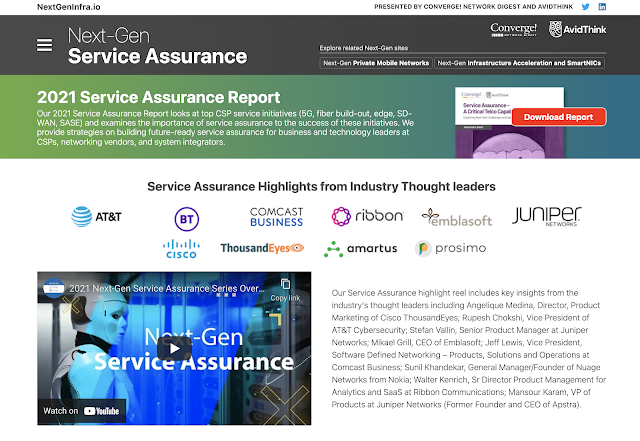
Our 2021 Service Assurance Report, which looks at top CSP service initiatives (5G, fiber build-out, edge, SD-WAN, SASE) and examines the importance of service assurance to the success of these initiatives. We provide strategies on building future-ready service assurance for business and technology leaders at CSPs, networking vendors, and system integrators.

In this video, Jim Carroll and Roy Chua discuss highlights of the report.

https://youtu.be/i6VTokSwPVs


Download the 2021 Service Assurance Report here: https://ngi.how/sa-2021

Sunday, July 11, 2021

Video: The Importance of Application Experience

It’s all about the application experience. 

In this video, Mehul Patel, Head of Marketing at Prosimo, discusses the important factors in delivering application experience with today’s infrastructure, including application security, speed, and the overall cost.

https://youtu.be/H8cuTyjI6KQ 

Prosimo targets secure app delivery with multi-cloud networking

Prosimo, a start-up based in Santa Clara, California, emerged from stealth to unveil its Application eXperience Infrastructure (AXI) platform for secure application delivery in multi-cloud environments. The platform is positioned for multi-cloud networking, Zero Trust with Identity Aware Proxy, app micro-segmentation, access to lift-and-shift VMware on AWS, Azure or GCP, app-infrastructure modernization for Kubernetes and service mesh apps, and etc.  Promiso,...

Who is Prosimo? CTO presentation

https://youtu.be/58YMebmBJwMProsimo, a start-up based in Santa Clara, California,  has launched its Application eXperience Infrastructure (AXI) platform for ensuring secure application experiences across multi-cloud environments.In this 40-minute presentation, Nehal Bhau, Co-founder & CTO, Prosimo, shares his insights on the SD-WAN market, Prosimo's vertically integrated stack and its method to leverage the global infrastructure of the top...


Video: Service Assurance Must Evolve to Observability


Service assurance must evolve to expand visibility, understand context, and encompass SD-WAN and SASE. 

In this video, Angelique Medina, Director, Product Marketing of Cisco ThousandEyes, discusses how service assurance is evolving and why it needs to progress from monitoring to observability.

https://youtu.be/p5na3yxy_2o

Cisco to acquire ThousandEyes for real-time Internet visibility

Cisco agreed to acquire privately-held ThousandEyes, a provider of real-time visibility tools for the delivery of applications and services over the Internet. Financial terms were not disclosed. ThousandEyes, which is headquartered in San Francisco, was founded in 2010 by Mohit Lad and Ricardo Oliveira who had worked together during grad school in the UCLA Internet Research Lab to visualize Autonomous System topologies. T ThousandEyes vantage points...


Wednesday, July 7, 2021

How Service Providers are addressing Service Assurance

What’s the boundary of where managed service providers and carriers start and stop with respect to cloud services? In this video, Jeff Lewis, Vice President, Software Defined Networking – Products, Solutions and Operations at Comcast Business, discusses the complexity of interacting with services in the cloud.

https://youtu.be/7zH8SgY-sCc


Download the 2021 Service Assurance Report here: https://ngi.how/sa-2021


Active vs Passive Monitoring for Service Assurance

5G is changing the landscape for service assurance. Historically, the telco industry has relied on passive monitoring to fulfill service assurance needs. In this video, Mikael Grill, CEO of Emblasoft, talks about the advantages of introducing active monitoring for more precise measurement of network service KPIs and QoS.

https://youtu.be/ozqCaEaKvTA

Announcement: Emblasoft provides end-to-end validation for world’s first cloud-native 5G SA Core deployment with Telenor - https://ngi.how/2V3fDgx

T-Mobile Case Study: Validating migration to virtual EPC - https://ngi.how/3ycSR3L 

Tuesday, July 6, 2021

Video: Service Assurance for Cybersecurity

With large amounts of data, endpoints and interactions taking place on a network, the focus on service assurance becomes even more important. In this video, Rupesh Chokshi, Vice President of AT&T Cybersecurity, discusses why service assurance and cybersecurity are critical in the ongoing management of the network.

https://youtu.be/dpiseggRc7Y


Video: Deliver End-to-end Network Quality with Active Assurance

The requirements around network quality are drastically increasing for both business and home use cases. SLAs are promising network quality with network KPIs, but how can we measure this? Meet active assurance. In this video, Stefan Vallin, Senior Product Manager at Juniper Networks, discusses how active assurance manages SLAs to ensure network quality.

https://youtu.be/C0q9Gr-jzrw