Thursday, June 2, 2022

Arista intros 7130 Series of low latency programmable switches

Arista Networks introduced ultra low latency, highly programmable 7130 Series switching systems designed for demanding in-network applications, such as financial trading. 

The Arista 7130 Series of low latency programmable switchesare powered by full-featured, programmable switching silicon and ultra low latency Layer 1 and highly scalable FPGAs. The expanded 7130 Series includes two new models that integrate full-featured L2/3 switching and open programmability with high performance L1 connectivity. They both run Arista EOS and integrate with CloudVision, supporting the broad range of switching, routing, DANZ monitoring and programmability across Arista’s extensive portfolio.

  • The 7130LBR Series are 96 port systems combining the ultra low latency Layer 1 X-Point with two high performance FPGAs, Broadcom Jericho2 switching silicon, a powerful CPU and precision timing hardware, enabling consolidation of network, server and custom FPGA applications into a highly compact form factor. Compared to traditional multi-box approaches, the 7130LBR reduces device and network hop count, cabling, power and cost while providing orders of magnitude density and latency improvements through co-location of these key components.
  • Supporting dynamic reconfigurability, the robust features of Arista’s R series, a portfolio of 7130 FPGA applications from Arista and its partners and a comprehensive FPGA Development Kit, customers can mix and match Arista applications with their bespoke processing without resorting to slow connections to external devices. In addition, two high-grade AMD/Xilinx FPGAs can be combined to perform complex data processing tasks or deployed in parallel enabling independent functions and live prestaging of new applications with seamless switch-over.
  • The 7130B Series provides high density Layer 1 fabric combined with a full-featured, high-radix Intel Tofino L2/3 switch. Providing over 2.5x the Layer 1 connectivity of existing solutions with 256 interfaces using high-density QSFP-DD connectors, hundreds of devices can be interconnected to provide thousands of edge ports and hundreds of FPGAs with minimal latency impact. In addition, the 7130B sophisticated P4 programmable packet processing enables customized packet handling, filtering and statistics as well as Arista’s advanced pipeline profiles for scalable address translation, tunneling and load balancing.

“Cboe is one of the world’s largest global market infrastructure providers and delivers leading-edge technology that powers markets and serves investors around the globe,” said Curt Schumacher, Senior Vice President, Infrastructure at Cboe Global Markets. “As we continue to invest in our infrastructure to drive our ongoing expansion into new markets and regions globally, we expect Arista’s solutions will provide new ways to further enhance application performance and scale, without compromising on efficiency, in our business.”

Customer testing is currently in progress, with general availability in Q4 2022.

https://www.arista.com/en/company/news/press-release/15648-pr-20220601


OIF advances Common Management Interface Spec (CMIS)

The OIF has released a Common Management Interface Specification (CMIS) Implementation Agreement (IA). 

CMIS provides a well-defined mechanism to initialize and manage optical and copper modules in a standard way, while still providing the capability to provide custom functionality. This commonality makes integration into different host platforms easier for both the host and module vendors.

IA—CMIS 5.2:The importance of CMIS continues to expand as higher-speed systems require more complex modules demanding more sophisticated management interfaces. This IA marks the first OIF-approved CMIS IA and the completion of the transition of the work to OIF.

“One of the reasons OIF adopted the CMIS work is its close coupling and application to ongoing OIF projects,” said Ian Alderdice, Ciena and OIF Physical & Link Layer Working Group – Management Co-Vice Chair. “This IA includes new features supporting a wide variety of form factors, most importantly fiber channel enhancements which expands the range of end-user applications.”

At its Q2 2022 Technical and MA&E Committees Meeting, which was held last month, a new CMIS project was also intiated. CMIS addresses commonality in managing pluggable modules and is a critical interface working hand-in-hand with other OIF areas, including co-packaging and electrical. The project work to create the next version of CMIS will add the necessary support for co-packaging/External Laser Small Form Factor Pluggable (ELSFP) projects and link training.

“This new project work represents the next steps in the evolution of CMIS and its alignment with other OIF PLL Working Groups tracks to enable an interoperable ecosystem,” said Gary Nicholl, Cisco and OIF PLL Working Group – Management Co-Vice Chair and Secretary/Treasurer. 

https://www.oiforum.com/oif-releases-new-common-management-interface-specification-cmis-implementation-agreement-and-launches-new-cmis-project-at-q2-technical-and-mae-committees-meeting/

OIF adopts Common Management Interface Specification (CMIS) 

OIF has adopted the Common Management Interface Specification (CMIS) work initiated by the Quad Small Form Factor Pluggable Double Density (QSFP-DD) Multi Source Agreement (MSA).  

CMIS may be used by pluggable or on-board modules, such as QSFP Double Density (QSFP-DD), OSFP, COBO, QSFP, and future module developments like co-packaged optics with host to module management communication based on a two-wire interface. This specification is targeted to systems manufacturers, system integrators and suppliers of CMIS compliant optical and copper modules. 

“The QSFP-DD MSA initiated the CMIS effort to address an industry need for commonality in managing pluggable modules, and it has been broadly and successfully adopted across the industry,” said Mark Nowell, Cisco, QSFP-DD MSA Group founding member and MSA co-chair. “OIF is very well suited to maintain and extend the development of this effort and I look forward to seeing their progress.”

“Adopting CMIS from the QSFP-DD MSA, with the goal to build on and extend the specification is an ideal expansion of OIF’s work,” said Nathan Tracy, OIF VP of Marketing and TE Connectivity. “OIF is where the cloud gets its work done and extending CMIS is a giant step forward and an integral linkage to the other work that OIF members are doing to enable an interoperable ecosystem.” 

In August, OIF announced the new Physical & Link Layer (PLL) Working Group Management track to include the transition of ownership and maintenance of CMIS from the QSFP-DD MSA to OIF and a project to focus on CMIS extensions for co-packaging implementations. OIF will take over the ongoing CMIS revisions and further enhancements and CMIS extensions under this track. This track is co-vice-chaired by Gary Nicholl, Cisco and Ian Alderdice, Ciena.

https://www.oiforum.com/

OIF's Coherent Common Management Interface Spec supports 400ZR

OIF has completed the Coherent Common Management Interface Specification (C-CMIS) Implementation Agreement (IA), which serves as an extension to the CMIS (QSFP-DD/OSFP/COBO) management specification, specifically targeting DCO modules. “The C-CMIS IA is an important part of the developing 400ZR ecosystem,” said Ian Betty, Ciena and OIF Board Member. “It defines additional management registers, and monitors, together with new functionality, mechanisms,...

OIF launches Optical Module Management Interface Survey

The OIF is conducting a survey to determine how the Common Management Interface Specification is viewed by the industry and the level of industry alignment on and support for further standardization of optical module management. The subject of module management encompasses physical interfaces, communication protocols and management applications layers. The survey is intended to gather industry opinion regarding evolution of optical module management...


Telefónica Hispam picks Mavenir for cloud-native IMS core

Telefónica Hispam (Hispanoamérica) has selected Mavenir's cloud-native IMS Core for fixed and mobile networks across Mexico, Colombia, and Chile.

Mavenir said the transition to its cloud-native IMS platform will allow Telefónica Hispam to evolve all fixed and mobile voice services and modernize operations. The solution will be deployed on TCloud, Telefónica’s private telco cloud infrastructure.

Alejandro Ghianni, Planification and Engineering Director at Telefónica Hispam said, “At Telefónica, we appreciate that core network functions must be modernized to support network evolution, and virtualized architectures will need software that supports both VoLTE and 5G Voice. We are very excited to embark on this network transformation journey with Mavenir.”

Javier Gavilan, Mavenir’s Chief Technical Officer CALA region said, “Only a cloud-native network, evolved into a fully web-scale platform, can meet the requirements for a successful 5G transformation. Mavenir’s cloud-native IMS Core can be deployed on any cloud eliminating legacy hardware platforms. This mobile-first architecture has been deployed in a variety of large multivendor environments including O2 Telefónica in Germany and Virgin Mobile O2 in the UK. We are very pleased to have been awarded this important project by Telefónica Hispam.

https://www.mavenir.com/press-releases/telefonica-selects-mavenir-for-cloud-native-ims-core/

Telefónica builds cloud native IoT with Mavenir packet core and AWS

Telefónica is preparing to launch a managed IoT connectivity service based Mavenir’s packet core solution and AWS’s cloud infrastructure. Mavenir's cloud native functions will be hosted in AWS. Mavenir said the use of the cloud enables advanced, new functionalities for end users that were not previously possible: local data processing/storage, direct connectivity to other cloud services, and global low latency. The new service is managed...


Credo ships 40G PAM3 SerDes

Credo Technology Group announced availability of its Ostrich 40G, PAM3 Serializer/Deserializer (SerDes) PHY/PMA Intellectual Property (IP). 

Ostrich is a multi-protocol high-speed SerDes supporting data rates up to 25.6Gbps NRZ and 40Gbps PAM3. A single bi-directional lane supports channel insertion loss up to 30dB bump-to-bump at 40Gbps with spread-spectrum clocking (SSC) enabled while achieving very low power to address all key application use cases. Credo's unique SerDes technology enables silicon solution providers and OEMs to manufacture custom chip solutions which address new market opportunities, while delivering on critical performance and low- power system level requirements.

Credo says unique mixed signal approach was first applied with the move from NRZ to PAM modulation when Ethernet connectivity jumped from 25G to 50G. With new applications demanding two times the throughput, and current single-lane data rates maxing out in the 20G to 32G NRZ performance range, the move to advanced modulation schemes enables higher performance at the lowest possible power. To enable 40Gbps performance the company determined that PAM3 offered the best overall balance of performance and power.

Bill Brennan, Credo’s President and Chief Executive Officer stated: “The data infrastructure market is experiencing an exponential increase in bandwidth demand. There is a revolution happening as new markets and standards, including those for applications such as consumer devices, small-to-medium sized business, automotive and others demand higher-speed connectivity at lower power. Credo is addressing the expansion of the connectivity ecosystem by delivering industry-leading performance with advanced IP solutions like our Ostrich 40G PAM3 SerDes, while in parallel providing complementary IC product solutions."

https://www.credosemi.com

Sony establishes a Space Communications company

Sony Corporation of America has formed a new company, Sony Space Communications Corporation (SSC), to offer small optical communications devices for connecing micro satellites in LEO via a laser beam. 

By using optical communications, SSC aims to realize high-speed communications with small devices, which are physically difficult to achieve with conventional radio communications because conventional communications require large antenna and high power output. In addition, by constructing an optical communications network not only between satellites and the ground, but also between satellites in orbit, SSC aims to enable real-time communications from anywhere on the ground to any satellite in space. 

"Currently there are approximately 12,000 satellites in space, and the number is expected to increase in the future. The amount of data used in orbit is also increasing year by year, but the amount of available radio waves is limited," said Kyohei Iwamoto, President, Sony Space Communications Corporation. "Low Earth Orbit (LEO) satellites need to communicate with the ground, so a large number of communications facilities are required for real-time communications, which is problematic because these satellites must pass directly over a ground station to communicate with it. Additionally, the need for frequency licenses for radio waves and the requirement for lower power consumption of communication equipment needed by smaller satellites, like micro satellites, are also issues to be addressed."

https://www.sony.com/content/sony/en/en_us/SCA/company-news/press-releases/sony-corporation-of-america/2022/new-company-established-sony-space-communications-corporation.html


Zayo acquires Education Networks of America

Zayo Group has acquired Education Networks of America (ENA), a leader in providing managed network connectivity, communications and cybersecurity services to K-12 school districts participating in the federally-funded E-Rate program, as well as other public sector customers. The acquisition is being funded by Zayo’s recent sustainability-linked first lien term loan (“ESG term loan”)

ENA was previously owned by ZMC, a leading investor in and operator of media, communications and entertainment businesses. The acquisition marks another significant milestone in a momentous first half of the year for Zayo, which has included the acquisition of QOS Networks, the addition of Lisa Hook to the board of directors and Zayo’s largest organic network expansion to date.

“We are proud of Zayo’s history serving the public sector and see tremendous opportunity with the addition of ENA, which is known for being a trusted provider of managed network and cybersecurity solutions,” said Andrés Irlando, president of Zayo. “ENA’s mission, particularly serving K-12 and healthcare customers, will enable us to have a positive impact on communities while furthering our commitment to leading in Environmental, Social and Governance initiatives. Together, we look forward to driving digital transformation across the public sector while delivering an exceptional customer experience.”

https://www.zayo.com


Wednesday, June 1, 2022

Novva Data Centers raises $355 million for continued expansion

Novva Data Centers, which operates data center campuses in Colorado Springs, Colorado, and West Jordan, Utah, raised $355 million in capital from CIM Group, bringing the company's total equity commitment to Novva to $450 million in just over two years.

The funding will support Novva's plans to expand across the United States in order to offer 1,000 MW of designed data center capacity by 2027 at several strategic, yet-to-be-named locations. 

It also supports CIM Group and Novva's ongoing partnership to create a world-class product, as well as a unique, bespoke "wholocation" experience to customers. Wholocation refers to a combination of wholesale scale and retail colocation, which provides the ability to serve clients of any size and scalability needs — from those requiring 1 cabinet to 1,000+ cabinets. 

"This equity investment from CIM Group will allow Novva to continue delivering on our company vision of providing the best wholesale and multi-tenant colocation infrastructure services to clients at the lowest possible cost," said Novva CEO Wes Swenson. "We're thrilled to have a partner like CIM Group that shares the same vision of delivering a bespoke, premium data center experience to each and every client."

"CIM Group is excited to continue to invest in Novva Data Centers' growth strategy as Novva demonstrates it is among one of the most innovative data center developers and operators in the industry." said Avi Shemesh, Co-Founder of CIM Group.

http://www.novva.com


Dell'Oro: Strong growth for optical transport solutions in the Americas

The worldwide Optical Transport equipment market grew 2 percent year-over-year in 1Q 2022, according to a new report from Dell'Oro Group.  The market was driven by the stellar growth in the American regions, comprising North America and Latin America.

"Growth in Americas more than offset declines in other regions," said Jimmy Yu, Vice President at Dell'Oro Group. "There was definitely strong demand for optical equipment in North America and Latin America, and vendors were able to deliver products even with component shortages and supply issues hampering them. Unfortunately, due to reasons that included the war in Ukraine, COVID lockdowns, supply problems, and weaker currency, optical revenue declined year-over-year in all of the other regions, including Europe, Asia Pacific, and China," added Yu.

Additional highlights from the 1Q 2022 Quarterly Report:

  • Optical Transport revenue in North America and Latin America grew 25 percent and 19 percent year-over-year, respectively. The other regions declined at a mid-single-digit rate in the same period.
  • The vendors with the highest market share in the American regions include Ciena, Fujitsu, Infinera, and Cisco. Together, these companies have nearly 80 percent share of the regional revenue.
  • Component shortage and supply problems lowered the year-over-year worldwide optical market growth rate in the quarter from an estimated 6 percent to 3 percent.

https://www.delloro.com/news/north-america-optical-transport-equipment-market-grew-25-percent-in-1q-2022/


Tech Update: Market Traction for MEF LSO APIs

https://youtu.be/evRXR5HLXPs

MEF Lifecycle Service Orchestration (LSO) is a reference architecture and framework for enabling end-to-end automation and orchestration, across multiple provider networks.  LSO defines the reference points between key functions within the service provider and extending out to the enterprise and the cloud. MEF standardizes these reference points, developing information models, business requirements and use cases, and data schemas, packaged within SDKs that enable developers to build open APIs to support each reference point. 

Here is an update from Michael Kearns, Co-founder and Chief Strategy Officer for Amartus and Co-Chair of MEF LSO Subcommittee, covering:

  • What primary use cases are emerging for MEF LSO APIs by global Service Providers? 
  • How are Service Providers leveraging LSO APIs to meet enterprise demand?
  • Are we reaching a market inflection point for MEF LSO APIs?

More info on MEF LSO is here: https://www.mef.net/service-automation/lso-apis/

Get up to speed on SmartNICs by downloading our 2022 SmartNICs and Infrastructure Acceleration Report: https://ngi.how/ia-2022


ADVA launches GPS-backup-as-a-service

ADVA introduced a GPS/GNSS-backup-as-a-service (GBaaS) that employs a combination of multi-layer detection, multi-source backup and fault-tolerant mitigation to render timing networks more secure. Embedded in all timing devices, ADVA’s Syncjack technology provides comprehensive and precise synchronization performance monitoring and analytics, enabling the Ensemble Sync Director network management suite to intelligently operate and prioritize multi-source timing feeds across the network. Onboard multi-band GNSS receivers boost timing accuracy and also protect against attacks like jamming and spoofing. But for those times when GNSS is either unavailable or compromised, a dispersed network of autonomous cesium atomic clocks and network backup timing feeds is always sitting on standby, ready to deliver highly accurate network timing over long periods of GNSS unavailability.

ADVA says its solution addresses new guidelines and standards for redundant positioning, navigation, and timing (PNT) architectures. 

“GBaaS is a completely new way for service providers to sell critical PNT infrastructure as a service without the burden of investment and maintenance. For the first time, they can offer their customers SLAs at a range of levels that ensure the resilient and assured timing needed across time-sensitive networks and applications,” commented Nino De Falcis, senior director of business development at Oscilloquartz, ADVA. “The flexibility and protection that GBaaS affords is bad news for any malicious actors looking to attack PNT services. Service providers can now offer their customers a guarantee: When GNSS is compromised or goes offline, ADVA’s robust network of defense-in-depth PTP timing devices will be there to provide the accuracy and backup they urgently need.”

“Threats to hamper PNT capabilities are growing, and much of the world’s critical infrastructure is still without adequate protection from GNSS vulnerabilities. All of that can change when service providers are able to offer GBaaS. It’s based on our aPNT+ platform, which leverages a suite of technologies, including multi-band GNSS receivers and AI- and ML-based management software. As well as making networks more resilient against cyberattacks, our aPNT+ platform also delivers highly accurate backup when GNSS fails,” said Gil Biran, GM of Oscilloquartz, ADVA. “Now service providers can offer ADVA’s aPNT+™ protection as a subscription-based service as part of their SLAs. This will enable many more timing networks to achieve very high levels of resilience and assurance. Across a wide range of industries, this will be the easiest and most flexible way to guarantee robust PNT services.”

https://adva.li/gbaas-slides

https://www.adva.com

HPE reports Q2 sales of $6.7B, strong demand, supply chain issues

Citing strong customer and growth in subscription sales, Hewlett Packard Enterprise reported Q2 revenueof $6.7 billion, up 0.2% and 1.5% adjusted for currency from the prior-year period and in line with Q2 outlook. Diluted net earnings per share (GAAP) were $0.19, flat from the prior-year period primarily due to $126 million of Russia-related charges. Non-GAAP earnings amounted to $0.44, down 4% from the prior-year period due to impact from Russia-related operations and currency.

“Persistent demand led to another quarter of significant order growth and higher revenue for HPE, underscoring the accelerating interest customers have in our unique edge-to-cloud portfolio and our HPE GreenLake platform,” said Antonio Neri, president, and CEO of Hewlett Packard Enterprise. “I am optimistic that demand will continue to be strong, given our customers’ needs to accelerate their business resilience and competitiveness. We remain focused on innovating for our customers and on executing with discipline so that we translate that demand into profitable growth for HPE.”

“We are particularly pleased with the resiliency of our gross margins despite the inflationary environment and ongoing supply chain disruptions,” said Tarek Robbiati, EVP and CFO of Hewlett Packard Enterprise. “With record levels of high-quality backlog, we are well positioned for growth in FY22 and beyond, and confident in realizing the financial commitments we set at our Securities Analyst Meeting last October.”

Segment Results

  • Intelligent Edge revenue was $867 million, up 8% from the prior-year period in actual dollars and 9% when adjusted for currency, with 12.6% operating profit margin, compared to 15.7% in the prior-year period. Aruba Services revenue was up double-digits from the prior-year period and Intelligent Edge as-a-Service ARR4 was up 50%+ from the prior-year period.
  • High Performance Computing & Artificial Intelligence (“HPC & AI”) revenue was $710 million, up 4% from the prior-year period in actual dollars and 5% when adjusted for currency, with (5.6%) operating profit margin, compared to 2.6% from the prior-year period. The operating loss was driven by supply constraints and delayed customer acceptances. We remain on track to exceed the expected 11% market CAGR from FY21-24.
  • Compute revenue was $3.0 billion, flat from the prior-year period in actual dollars and up 1% when adjusted for currency, with 13.9% operating profit margin, compared to 11.2% from the prior-year period. Margin expansion was driven by strategic pricing actions more than offsetting input cost increases.
  • Storage revenue was $1.1 billion, down 3% from the prior-year period in actual dollars and 2% when adjusted for currency, with 12.6% operating profit margin, compared to 16.8% from the prior-year period reflecting higher supply chain costs and unfavorable mix shift.
  • Financial Services revenue was $823 million, down 2% from the prior-year period in actual dollars and flat when adjusted for currency, with 12.6% operating profit margin, compared to 10.8% from the prior-year period. Net portfolio assets of approximately $12.6 billion, down 4% from the prior-year period or up 1% when adjusted for currency. The business delivered return on equity of 20.4%, up 2.1 points from the prior-year period, well above pre-pandemic levels.

Ligado picks Sony for IoT chips for its 5G satellite service

Ligado Networks has selected Sony Semiconductor Israel  to develop chipsets for Ligado's 5G mobile satellite network for the Internet of Things (IoT).

As a leading provider of cellular IoT chipsets, Sony will build on extensive design efforts and standards coordination to adapt 5G IoT technology and manufacture IoT chipsets that are compatible with Ligado's L-band MSS spectrum, which 3GPP has standardized as Band 255 for Non-Terrestrial Networks. Ligado plans to deploy a 5G satellite IoT network to support mainstream devices using low-cost chipsets for both satellite and terrestrial connectivity. 

Ligado says its 3GPP standards-based 5G satellite IoT network will support tens of millions of mobile devices powering critical machine-to-machine communications in the transportation, agriculture, utilities, and energy sectors. The partnership with Sony brings Ligado one step closer to providing standalone satellite and combined satellite and terrestrial connections to enterprise customers.

"As a leader in developing IoT standards for mobile satellite networks, we are excited to work with Sony to advance new capabilities and serve the growing market for 5G mobile satellite connectivity anywhere in the U.S. and across North America," said Sachin Chhibber, Ligado Chief Technology Officer. "This satellite capability will also support our 5G mobile private network solution by enabling ubiquitous coverage and reliability, which are essential for critical infrastructure enterprises as they modernize operations."

"We are excited to support Ligado's 5G mobile satellite network," said Dima Feldman, Vice President of Product Management and Marketing at Sony Semiconductor Israel. "The addition of satellite connectivity to our market-leading 5G IoT chipsets improves utility for critical communications customers and expands our market reach."

https://ligado.com

Kajeet picks ONF’s Aether Private 5G open source platform

Kajeet has selected Open Networking Foundation's (ONF's) Aether platform to build their own private 5G Networks-as-a-Service offering. The Kajeet solution provides a cloud-based platform providing enterprises Private LTE and 5G, both indoor and outdoor, with seamless mobility between public and private cellular networks, as a turnkey cloud-managed Network-as-a-Service.

Kajeet’s Private 5G platform provides cloud-based SIM management, device and network management, and end-to-end smart network slicing with QoS SLA assurance for addressing the challenges of mission-critical enterprise applications. It enables customers to manage their private wireless networks with 24/7/365 Tier-1 support from Kajeet. 

ONF has deployed and demonstrated the capabilities of Aether at multiple global sites in concert with its leading vendor and carrier partners. Since its introduction in 2020, Aether has achieved a number of significant milestones, including:

“We are excited to work with the ONF to offer an innovative, open, carrier-grade Private 5G Platform that is purpose-built for enterprises. It seamlessly combines Kajeet’s public and private wireless solutions and expertise," states Derrick Frost, SVP and GM of Private Wireless Networks at Kajeet. 

https://opennetworking.org/category/news-and-events/latest-news/

Telia sells 49% stake in its Swedish tower business to Brookfield and Alecta


Telia sold 49 percent of its tower business in Sweden to Brookfield and Alecta at a price corresponding to an enterprise value (EV) for 100 percent of SEK 11,224 million (US$1,140 billion) on a cash and debt free basis. The valuation of the Swedish tower business equals 28.2x normalized EBITDA 2021.

Allison Kirkby, Telia Company President and CEO, says: “We are delivering on our strategy to both develop and crystalize the value of our digital infrastructure, and I am delighted that we have Brookfield and Alecta as our Tower partners in Norway, Finland and now in Sweden. Having created the Nordic region's leading Tower company with an EV of EUR 2.6 billion, we aim to be an even stronger foundation to the continued digitalization of the Nordics."

With the completion of the transaction of the minority stake in the Swedish tower business, and the previous completion of the sale of 49 percent of Telia’s Norwegian and Finnish tower business to Brookfield and Alecta, as announced on December 29, 2021, the tower assets are placed in Telia Towers AB which is 51 percent owned by Telia with the remaining 49 percent owned by Brookfield and Alecta.

 https://www.teliacompany.com/en/news/press-releases/2022/6/telia-company-completes-the-sale-of-a-minority-stake-in-its-swedish-tower-business-to-brookfield-and-alecta/

TIM and Open Fiber contemplate merger

TIM and Open Fiber and major investors reached a preliminay integration agreement aimed at accelerating the rollout of fiber broadband across Italy.

The deal would create a single, non-vertically integrated telecommunications network operator, controlled by CDPE and invested in by Macquarie Asset Management and Kohlberg Kravis Roberts (KKR). The transaction may be structured by separating TIM's fixed network infrastructure activities from its commercial activities - through a corporate transaction or combination of corporate transactions to be defined - and the integration of the former with the network controlled by Open Fiber in a manner to be defined.

At this stage, the parties have signed a non-binding MoU and negotiations are expected to continue in the coming months.

https://www.gruppotim.it/en/press-archive/corporate/2022/PR-MoU.html

EFFECT Photonics opens regional HQ in Maynard, MA

EFFECT Photonics, which is a developer of integrated coherent optics solutions and a spin-off from the Eindhoven University of Technology in the Netherlands,  opened its Americas Headquarters in Maynard, Massachusetts. The new facility provides further support for North and South American customers and partners as well as for global customers with operations in the region.

EFFECT Photonics aims to democratize photonics technology by making complex high-performance optical systems simpler and more affordable for a variety of industries including telecommunications, aerospace, lidar and quantum technology. The company recently acquired ViaSat’s coherent digital signal processing business. In addition, EFFECT Photonics is working on subcomponents such as DSP, tunable lasers (iTLAs) as well as full modules for direct detect solutions. 

“Photonics represents one of the fastest-growing industries as it provides an ideal solution to respond to the soaring demand of higher bandwidth and enable increased interconnectivity to make people’s lives better and easier,” said James Regan, CEO, EFFECT Photonics. “With the opening of our new Americas headquarters, EFFECT Photonics is well-suited to meet worldwide demand and able to realize our goal of becoming a global company.”

https://effectphotonics.com

EFFECT Photonics acquires Viasat's Coherent Optical DSP business

 EFFECT Photonics agreed to acquire coherent optical digital signal processing (DSP) and forward error correction (FEC) technology as well as a highly experienced engineering team, from Viasat. Financial terms were not disclosed.Viasat is a long-established player in DSP and FEC technology with eight generations of design IP.From this acquisition, EFFECT Photonics said it will now own the entire coherent technology stack of all optical functions,...

EFFECT Photonics and Jabil Photonics target QSFP-DD

EFFECT Photonics and Jabil Photonics agreed to co-develop a next generation of coherent QSFP-DD  optical modules. EFFECT Photonics will make available its System-on-Chip optical technology and Jabil will leverage its track record of manufacturing coherent modules in very large quantities with extensive sourcing capabilities.“One of the ambitions we have as an organization is to build strong partnerships to increase our ability to develop...

EFFECT Photonics raises $43 million for system-on-chip

EFFECT Photonics, a leading developer of DWDM components based on its optical System-on-Chip technology, announced $43 million in Series-C funding.EFFECT Photonics, which is a spin-off from the Eindhoven University of Technology in the Netherlands, has developed a photonic chip in which light signals can be generated, modulated, filtered, and detected. The first close of the investment round, was co-led by Smile Invest together with existing...


Tuesday, May 31, 2022

Intel unveils data center GPU with open source management software

Intel announced Rialto Bridge, a data center graphics processing unit (GPU) offering up to 160 Xe cores, more FLOPs, more I/O bandwidth and higher TDP limits for significantly increased density, performance and efficiency. It uses the same architecture as the Intel data center GPU Ponte Vecchio and adds enhanced tiles with Intel's next process node.

Intel said the next major architecture innovation on its roadmap will be Falcon Shores, bringing x86 CPU and Xe GPU architectures together into a single socket. This architecture is targeted for 2024 and projected to deliver benefits of more than 5x performance-per-watt, 5x compute density, 5x memory capacity and bandwidth improvements.

Jeff McVeigh, vice president and general manager of the Super Compute Group at Intel Corporation, writes: 

"As the data center and HPC workloads increasingly move toward disaggregated architectures and heterogeneous computing, we will need tools that can help us effectively manage these complex and diverse computing environments."

Today, we are introducing Intel XPU Manager, an open-source solution for monitoring and managing Intel data center GPUs locally and remotely. It was designed to simplify administration, to maximize reliability and uptime by running comprehensive diagnostics, to improve utilization and to perform firmware updates."


https://www.intel.com/content/www/us/en/newsroom/opinion/accelerated-innovations-sustainable-open-hpc.html

Marvell samples Ethernet switch for next gen automobiles

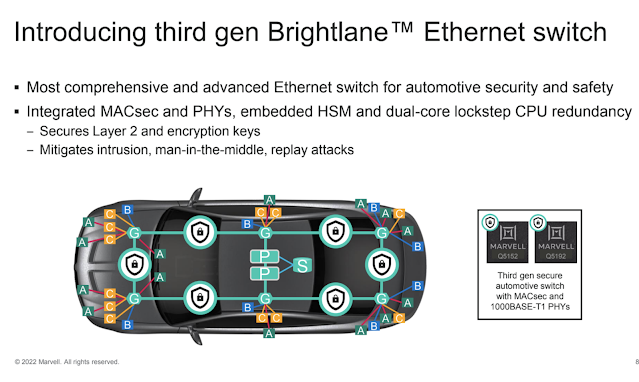
Marvell is sampling its third generation Brightlane Ethernet Switch for automobiles.

The latest Marvell Brightlane family, which includes 9-port and 16-port versions, is designed for Ethernet-based zonal architectures in next generation car designs. 

The new switch features IEEE 802.1AE-2018-compliant Media Access Control security (MACsec) protocols and an embedded Hardware Security Module (eHSM) for software authentication and data encryption. It also integrates 10Base-T1S capabilities, along with 100/1000Base-T1 PHYs, 2.5G/10G SerDes and PCIe Gen3 ports.


In addition, the Brightlane Ethernet Switch supports the latest Time-Sensitive Networking (TSN) standards to reduce latency and ensure quality of service (QoS) for essential vehicular connectivity, including the IEEE 802.1CB standard for data redundancy.

“The move to software-defined vehicles (SDVs) is a rapidly emerging megatrend in the automotive industry because software-centric architectures not only will enable over-the-air software updates for existing in-vehicle systems, but they will make possible entirely new aftermarket services and applications to continuously improve safety and driving experiences over time,” said Ian Riches, vice president for the Global Automotive Practice, Strategy Analytics. “As a result, security and safety is foundational to these networks, and Marvell’s new secure managed Ethernet switch integrates all the essential elements to drive the SDV revolution forward.”

“As the newest Brightlane Ethernet switch in our portfolio, this innovative design is targeted at the core need to ensure the security of next-generation in-vehicle networks and the data they carry,” said Mike Yeager, vice president and general manager, Automotive Business Unit, Marvell. “Our end-to-end optimization for software-defined, zonal architectures, advanced security, increased bandwidth and PHY integration is driving design win momentum for Marvell’s Ethernet products among top auto manufacturers and OEM partners.”

https://www.marvell.com/company/newsroom/marvell-introduces-industry-first-automotive-ethernet-switch-with-wockstep-dual-core-reliability-for-safer-vehicles.html

AMD completes its $1.9 billion acquisition of Pensando

AMD completed its previously-acquisition of Pensando Systems in a transaction valued at approximately $1.9 billion. 

Pensando’s distributed services platform will expand AMD’s data center product portfolio with a high-performance data processing unit (DPU) and software stack that are already deployed at scale across cloud and enterprise customers including Goldman Sachs, IBM Cloud, Microsoft Azure and Oracle Cloud.  The Pensando team will join the AMD Data Center Solutions Group, led by AMD Senior Vice President and General Manager Forrest Norrod. 

“The data center remains one of the largest growth opportunities for AMD. The addition of the Pensando Systems team with their hardware and software portfolio will enables us to offer cloud, enterprise and edge customers a broader portfolio of leadership compute engines that can be optimized for their specific workloads,” said AMD Chair and CEO Dr. Lisa Su. “Pensando’s leadership DPU complements our data center product portfolio, enabling AMD to offer solutions that can significantly accelerate data transfer speeds while providing additional levels of security and analytics that will play a larger role in defining the performance of next-generation data centers.”

https://www.amd.com/en/corporate/pensando-acquisition


AMD to acquire Pensando for its DPU + software stack

AMD agreed to acquire Pensando, a Silicon Valley start-up offering a software-defined edge services platform powered by a custom packet processor, for approximately $1.9 billion before working capital and other adjustments. 

Pensando ("thinking" in Spanish) is led by Cisco’s legendary “MPLS” team — Mario Mazzola, Prem Jain, Luca Cafiero, Soni Jiandani and Randy Pond. Its platform is designed to accelerate networking, security, storage and other services for cloud, enterprise and edge applications. Its architecture leverages the programmable packet processor distributed throughout a network to efficiently accelerate multiple infrastructure services simultaneously, offloading workloads from the CPU and increasing overall system performance. The company says it can achieve between 8x and 13x greater performance compared to competitive solutions.

Pensando claims multiple deployments at scale across cloud and enterprise customers, including Goldman Sachs, IBM Cloud, Microsoft Azure and Oracle Cloud. 

CEO Prem Jain and the Pensando team will join AMD as part of the Data Center Solutions Group, led by AMD Senior Vice President and General Manager Forrest Norrod. Pensando will remain focused on executing their product and technology roadmaps, now with additional scale to accelerate their business and address growing market opportunities across a broader number of customers.

http://pensando.io

Pensado emerges from stealth, led by "MPLS" team from Cisco

Pensando Systems, a start-up based in San Jose, California, emerged from stealth to unveil its first product -- a software-defined edge services platform that was developed in collaboration with the world’s largest cloud, enterprise, storage, and telecommunications companies.

Pensando ("thinking" in Spanish) is led by Cisco’s legendary “MPLS” team — Mario Mazzola, Prem Jain, Luca Cafiero, Soni Jiandani and Randy Pond. Hewlett Packard Enterprise and Lightspeed Venture Partners led a Series C round to raise up to $145 million in funding. This will bring the total amount raised to $278 million after an earlier founder-led series A round of $71 million, and a customer-led series B round of $62 million. Cited customers, investors, and partners including HPE, Goldman Sachs, NetApp, and Equinix.

The Pensando platform is a custom programmable processor optimized to execute a software stack delivering cloud, compute, networking, storage and security services wherever data is located, all managed via its Venice Centralized Policy and Services Controller. The platform delivers highly programmable software-defined cloud, compute, networking, storage, and security services wherever data is located.

The platform promises an improved security posture through distributed network protection and east-west security. It offloads networking and security functions at wire speed to dedicated accelerators, and it is designed to scale to > 1000 tenants per server and >1M routes.

The company claims its capability means that cloud providers can now gain a technological advantage over the current market leader, Amazon Web Services Nitro, delivering 5-9x improvements in productivity, performance, and scale when compared to current architectures with no risk of lock-in.

The portfolio includes:

  • Naples 100 and Naples 25 cards for installation in standard servers. The Naples Distributed Services Card (DSC) delivers high-performance cloud, compute, networking, storage and security functions. 
  • Venice Centralized Policy and Services Controller - Centrally-managed enterprise-grade security and visibility at every level of the stack enables seamless distribution of all infrastructure services policies to active Naples nodes. In addition, Venice handles lifecycle management such as deploying in-service software upgrades to Naples nodes and delivers always-on telemetry, deep end-to-end observability, and operational simplicity across the environment. 
Pensando also announced that Mark Potter, chief technology officer of Hewlett Packard Enterprise (HPE), and Barry Eggers, a partner of Lightspeed Venture Partners, joined the board of directors, with John Chambers, CEO of JC2 Ventures, leading as chairman.
http://pensando.io


Orange Business Services debuts Service Manage-Watch

Orange Business Services introduced Service Manage-Watch, a global supervision solution for network services and applications for both Orange-provided and third-party services. Service Manage-Watch covers the entire enterprise’s IT ecosystem and is designed to ensure that connectivity and security at the edge, applications, equipment, and user experience are all performing at optimal levels.

Service Manage-Watch delivers end-to-end real-time visibility via a single dashboard. In addition, the service is bolstered by a team of dedicated experts at Orange Business Services to fine-tune the correlation rules and work closely with service desk agents for advanced troubleshooting adapted to the specific customer requirements. This continuously improves global IT performance supervision. Metrics from monitoring tools are harvested into the Orange Data Lake and correlated for analysis using Artificial Intelligence (AI) to generate proactive and predictive alerts.

"Service Manage-Watch adds genuine predictive AI power to Orange’s performance monitoring portfolio. Orange’s proven consultative capabilities will help businesses ensure that they are getting the best out of Service Manage-Watch’s capabilities. This launch strengthens Orange’s position as an independent cloud access aggregator and gives it differentiation versus hyperscalers," said Gary Barton, Principal Analyst, Enterprise Technology and Services, GlobalData.

“As both a telco-native company and an integrator, we provide the interface and manage the services, so we understand just how important performance can be to take a business from merely functioning to being outstanding when it comes to supporting business initiatives. Service Manage-Watch is a game-changer for enterprises focused on optimal performance, guaranteeing the availability of applications and networks, while enhancing decision making to increase productivity and user satisfaction. It is a key asset for our Multisourcing Service Integration (MSI) approach,” explained Daniel Bigagli, vice president, Enterprise Services at Orange Business Services.

https://www.orange-business.com/en/press/orange-business-services-unveils-service-manage-watch-supervise-performance-enterprise-it