Thursday, April 28, 2022

Dell'Oro: Increased investment in 5G NR mmWave

Preliminary findings from Dell'Oro Group suggest 5G NR mmWave investments improved in the fourth quarter but this was not enough to change the full-year growth momentum.

Following two years of exponential growth, mmWave revenues increased 15% to 20% in 2021, propelling 5G NR mmWave to account for 1% to 2% of total sub 6 GHz plus mmWave RAN revenues.

Additional mmWave highlights from the 4Q 2021 and 5-Year RAN reports:

  • Ericsson leads the mmWave RAN market.
  • The mismatch between capex and data consumption when comparing the sub-6 GHz and mmWave spectrum will evolve gradually over time – global 5G NR mmWave revenues are projected to reach $1 B to $2 B by 2026.
  • Mobile remains the primary focus, however, gNB and repeater technology advancements are expected to improve the FWA business case.

Huawei reports Q1 sales of CNY131 billion, down 13.8% yoy

Huawei reported Q1 2022 revenue of CNY131 billion in revenue (approx US$19.80 billion), with a net profit margin of 4.3%.

"In Q1, our overall business results were in line with forecasts. Our consumer business was heavily impacted, and our ICT infrastructure business experienced steady growth," said Ken Hu, Huawei's Rotating Chairman. "We have yet again increased our investment in R&D to harness the momentum of our innovation and create new value for customers."

"As always, we want to thank our customers and partners for their ongoing trust and support," Hu added. "In 2022, we still face a challenging and complicated business environment. Despite considerable operational challenges, we will work more closely with our customers and partners around the world to overcome adversity."

Huawei's Q1 revenue drops 16.5% year-on-year

Huawei reported Q1 2021 revenue of CNY152.2 billion (US$23.17 billio) in revenue, a 16.5% decrease year-on-year. The company said its network business maintained steady growth, while its consumer business revenue declined, in part as a result of selling the Honor smart device brand in November 2020. Huawei's net profit margin was up 3.8 percentage points year-on-year at 11.1% – the result of the company's ongoing efforts to improve quality of...


Wednesday, April 27, 2022

Disaggregation across the Network Stack is Here to Stay

In this video, Arpit Joshipura, GM/SVP Networking + Edge/IOT at The Linux Foundation, looks at the role disaggregation plays across the network stack and the importance of a network operating system that is independent of hardware.

Download the 2022 SmartNICs and Infrastructure Acceleration Report: https://ngi.how/ia-2022


Do customers want to program their SmartNICs?

https://youtu.be/0XlSXN1r5Lk

In this video, Mike Bushong, Group Vice President, Cloud-Ready Data Center at Juniper Networks, looks at the bifurcation between the hyperscalers and the rest of the market around programmable SmartNICs and the challenges that need to be solved.

Download the 2022 SmartNICs and Infrastructure Acceleration Report: https://ngi.how/ia-2022


Comcast Business adds Cisco SD-WAN powered by Viptela

Comcast Business has begun offering Cisco SD-WAN powered by Viptela under its managed SD-WAN solutions portfolio. The collaboration expands Comcast Business’s ability to provide enterprise customers with comprehensive, global secure networking solutions with Ethernet, SD-WAN and security solutions – regardless of their existing infrastructure or vendor relationships.

Cisco SD-WAN powered by Viptela integrates cloud optimization, security, and advanced analytics. The solution enables micro-segmentation and identity-based policy management, extended end-to-end visibility into network health and performance, and integrated 4G LTE and 5G connectivity functionality.

“The expansion of our strategic partnership with Cisco to include Cisco SD-WAN allows us to offer our enterprise customers a broad portfolio of secure network solutions aligned to their unique needs and infrastructure requirements,” said Amit Verma, Vice President, Solutions Engineering and Technology, Comcast Business. “Our open, vendor-agnostic strategy combined with our access to affordable, reliable broadband technology, allows us to craft a solution that leverages the right mix of access technologies to help enterprises meet their objectives and simplify network management operations.”

“As businesses evolve their hybrid work models, IT leaders are being asked to extend the enterprise network to employees anywhere and ensure delivery of consistent application experiences to any location,” said JL Valente, Vice President, Product Management, Enterprise Routing and SD-WAN at Cisco. “Working with Comcast Business to offer advanced managed SD-WAN services based on Cisco technology demonstrates our continued commitment to help customers simplify their goal of providing secure access and the best user experience when connecting to cloud applications.”

In addition, the Comcast Business and Cisco managed services portfolio includes Cisco SD-WAN powered by Meraki and Comcast Business Teleworker VPN with Cisco Meraki.


Redefining the Perimeter with SD-WAN and SASE

 https://youtu.be/Zi1WGo58_xoWith the hybrid work environment, the convergence of security and networking has never been more present. In this video, Jeff Lewis, Vice President, Software Defined Networking – Products, Solutions and Operations at Comcast Business, discusses the evolution in the SD-WAN space and how the edge perimeter is being redefined with SA...


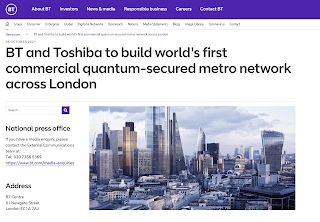
BT and Toshiba test quantum secured communication services

BT and Toshiba, along with EY launched the trial of a world first commercial quantum secured metro network. The infrastructure will be able to connect numerous customers across London, helping them to secure the transmission of valuable data and information between multiple physical locations over standard fibre optic links using quantum key distribution (QKD). 

The network’s first commercial customer, EY, will use the network to connect two of its sites in London, one in Canary Wharf, and one near London Bridge. 


BT will operate the network, providing a range of quantum-secured services including dedicated high bandwidth end-to-end encrypted links, delivered over Openreach’s private fibre networks, while Toshiba will provide quantum key distribution hardware and key management software. 

In the network, QKD keys will be combined with the in-built ethernet security, based on public-key based encryption, which will enable the resultant keys to be used to encrypt the data.

 George Freeman, Minister for Science, Research and Innovation, HM Government, commented: “I am very pleased to see the first trial by BT and Toshiba of a commercial quantum secured metro network, which represents significant progress towards achieving our ambition to make the UK a quantum-enabled economy. This is the kind of innovation that helps cement the UK as a global innovation economy in the vanguard of discovering, developing and commercially adopting transformational technology with real societal benefits.”

BT and Toshiba to build quantum-secured metro network across London

BT and Toshiba are to build a quantum-secured metro network linking sites in London’s Docklands, the City and the M4 Corridor.  The two companies’ initial focus will be to provide trials for enterprise customers who are carrying sensitive traffic (such as database backups) between sites, and to explore potential future offerings such as encrypted links and “quantum keys-as-a-service."  A timeline has not been disclosed.BT will provide data...

BT tests Quantum Key Distribution over hollow core fibre 

 BT has conducted a trial of Quantum Key Distribution (QKD) over hollow core fibre cable developed by Lumenisity, a spin out from Southampton University.Testing of Nested Anti-Resonant Nodeless Fibre (NANF) hollow core fibre kicked off this summer at the BT Labs in Ipswich.BT researchers operated a state-of-the-art QKD system using commercial equipment over a 6-kilometre-long Lumenisity CoreSmart cable with a hollow, air-filled centre, revealing...

ADVA supports Quantum-Secure VPN (QuaSiModO) project

ADVA is playing a key role in a unique research initiative extending post-quantum security to VPN networks. The company has supplied its ADVA FSP 150 with ConnectGuard Ethernet encryption for the Quantum-Secure VPN Modules and Operation Modes (QuaSiModO) project, which is being conducted by the Fraunhofer Institute of Applied and Integrated Security, the Ludwig Maximilian University of Munich and genua GmbH. Funding is provided by the German Federal...

Orange Business links Siemens in 94 countries with SD-WAN

Orange Business Services has successfully migrated 1,168 of Siemen's locations in 94 countries to a secure SD-WAN infrastructure. 

Overcoming potential implementation challenges during the pandemic, Orange Business Services, with its technology partner Cisco, has been able to now fully deliver one of the biggest SD-WAN deployments in the world across 94 countries.

“Siemens is a global company with offices and production sites all over the world, and we need a reliable and future-proof communications network. It’s a critical business enabler that has to be agile enough to evolve with our business,” emphasized Hanna Hennig, CIO, Siemens AG. “As a pioneer in innovation and technology, we set the highest standards for our transformation project. With the global capabilities, expertise and orchestration of Orange Business Services, we were able to successfully complete the massive deployment of Flexible SD-WAN, which delivers decisive advantages for our business and users alike, including a streamlined user experience with dynamic traffic routing for applications as well as dynamic bandwidth allocation.”

The seamless and secure SD-WAN coverage provides the foundation for a flexible Siemens security framework. This approach further increased Siemens’ abilities to effectively mitigate, detect and respond to risks.

"We are so pleased that Siemens chose Orange Business Services to be its trusted partner. Deploying, migrating and implementing this huge digital transformation project for Siemens and managing their critical global communications infrastructure underlines our end-to-end integrator expertise in delivering large-scale global projects. We have delivered on Siemens' objectives by combining SD-WAN technology with cloud-based services and solutions,” commented Aliette Mousnier-Lompre, Interim CEO at Orange Business Services.

VMware targets Sovereign Cloud opportunity

VMware has established a Sovereign Cloud initiative to help governments and regulated industries to identify and engage with trusted national or regional cloud service providers to meet their unique sovereign cloud requirements. 

The newest VMware Sovereign Cloud designated partners are IONOS SE, Saudi Telecom Company (STC), Sopra Steria AS, and TDRA. This brings the total to 14 participants in the VMware Sovereign Cloud initiative in distinct sovereign regions covering Canada, Mexico, Sweden, Norway, United Kingdom, Germany, Spain, Italy, New Zealand, Australia, Saudi Arabia, UAE, India, and the United States.

“We are pleased to welcome new partners to our Sovereign Cloud initiative and see existing partners demonstrate momentum in meeting the sovereign cloud requirements of customers around the world,” said Rajeev Bhardwaj, vice president of product management, cloud infrastructure business group, VMware. “New data services from Tanzu will enable all our VMware Cloud Provider partners, particularly, sovereign cloud-focused partners, to expand their data and application transformation portfolios and accelerate cloud adoption. This will allow customers to remain within sovereign regions and jurisdictional control while achieving cutting edge transformation at scale.”

Through VMware Cloud Director and its technology ecosystem, VMware said it helps ensure that sovereign cloud providers have a wealth of solutions to augment their offerings. Some key capabilities:

  • Integrated Self-Service Sovereign Object Storage: Sovereign clouds require local Object Storage capabilities to meet the needs of data residency, a key pillar in sovereign clouds. Cloudian provides an integrated Object storage service that meets growing data volumes of national data and innovation in application development.
  • Ransomware protection, backup, and recovery: Data protection is another critical aspect of Sovereign cloud as all applications and workloads can be targets for cybercrime. Ransomware protection from Veeam and Cloudian uses immutable storage and instant workload recovery to help protect sovereign environments and critical national data from being changed or encrypted.
  • Key management services: Sovereign cloud environments require the highest levels of protection, with a core requirement for encryption and key management. Fortanix delivers an integrated data security platform that provides VMware Cloud providers’ customers more control over their security-sensitive workloads and simplifies partner key services with encryption, tokenization, and secrets management.
  •  Additionally, Fortanix provides VMware Sovereign Cloud customers full control and ownership of the keys within the VMware Sovereign cloud boundary. Fortanix DSM complements this with FIPS 140-2 level 3 certified hardware security modules and key management with regional level isolation and enables full compliance with specific data privacy/transfer regulations including Shrems II and GDPR.


NETGEAR cites COVID-induced lockdowns in China for sales dip

NETGEAR reported Q1 net revenue of $210.6 million, a decrease of 33.8% from the comparable prior year quarter.

First quarter 2022 GAAP operating loss of $58.5 million impacted by non-cash impairment charges of $44.4 million, or (27.8)% of net revenue, as compared to operating income of $31.3 million, or 9.9% of net revenue, in the comparable prior year quarter. First quarter 2022 non-GAAP net loss per diluted share was $0.28, as compared to net income per diluted share of $0.99 in the comparable prior year quarter.

Patrick Lo, Chairman and Chief Executive Officer of NETGEAR, commented, “We ended the first quarter with net revenue of $210.6 million and non-GAAP operating margin of (4.4)%, within the range of our recently revised guidance. We continued to experience strong demand for our SMB products, especially on our ProAV switches; however, our ability to deliver meaningfully higher revenue was constrained by COVID-induced lockdowns in China which impacted supply of components to our supply chain partners. On the CHP side, we saw the continued year over year and sequential growth in end user sales of our super-premium mesh products represented by our Orbi 8 and Orbi 9. Meanwhile overall CHP sales were negatively impacted by the U.S. consumer WiFi market contracting from approximately 15% above 2019 levels entering the first quarter to roughly flat to 2019 exiting the first quarter. The lower top line performance negatively impacted our operating leverage and resulting margin performance in the quarter.”

Mr. Lo continued, “In spite of these challenges, it’s clear that our core long-term strategy of focusing on the premium, higher-margin segments of the WiFi mesh market and the ProAV revolution remains intact. As the pioneer of the Tri and Quad band WiFi segment we are seeing great reception of our $1,500 Quadband WiFi 6E Orbi. Buoyed by the success of our premium WiFi products, we ended the quarter with 627,000 paid subscribers for our services business and remain encouraged by this progress towards our full year target of 750,000 subscribers.”

https://investor.netgear.com/events-and-presentations/events-calendar/default.aspx

MaxLinear posts record net revenue of $263.9m, up 26% year-over-year

MaxLinear reported Q1 net revenue of $263.9 million, up 6% sequentially and up 26% year-over-year. GAAP diluted earnings per share was $0.42, compared to diluted earnings per share of $0.35 in the prior quarter, and diluted earnings per share of $0.05 in the year-ago quarter. Non-GAAP diluted earnings per share was $1.00, compared to diluted earnings per share of $0.86 in the prior quarter, and diluted earnings per share of $0.55 in the year-ago quarter.

“In the first quarter, revenue was up 6% sequentially and up 26% year-over-year, driven by strong growth across all our markets, and in particular, our connectivity market, which grew 14% sequentially. Our Wi-Fi growth has continued to be robust as we continue to win market share based on our leading differentiated feature set. We are confident in our ability to more than double this business in 2022, and are on a firm trajectory to deliver at least $200 million of Wi-Fi revenue in 2023. Along with the market share wins, we are also making tremendous progress in continued innovation for next generation Wi-Fi 7, which will drive future growth opportunities. Cash flow from operations was approximately $134.2 million, and non-GAAP gross margin for Q1 improved to 62.8%. We are excited about our prospects for continued future growth driven by our comprehensive product portfolio, and the accelerating pace of new product launches particularly in connectivity, fiber-to-the home broadband, optical, and wireless infrastructure markets,” commented Kishore Seendripu, Ph.D., Chairman and CEO.

https://investors.maxlinear.com

Ribbon posts Q1 sales dip to $173 million due to supply chain issues

Ribbon Communications reported Q1 revenue of $173 million, compared to $193 million for the first quarter of 2021. Product and service bookings-to-revenue was 1.20x in the first quarter of 2022, with IP Optical Networks at 1.27x.

"The Ribbon team delivered financial results directly in-line with our guidance for the quarter despite continued supply chain constraints. Our continued growth in IP Optical sales in North America, strong RFP activity, and new product pipeline provide confidence that our financial performance will continue to improve throughout the year," noted Bruce McClelland, President and Chief Executive Officer of Ribbon Communications. 

McClelland continued, "The increased investment we are making in product development is accelerating the pace of new product and service introductions in order to deliver on our strategy to generate both near-term and longer-term revenue growth. Partnerships such as our recent Cloud & Edge announcement with Microsoft to accelerate deployment of Teams further differentiate our solutions and expand our market reach."


Tuesday, April 26, 2022

SmartNIC Offload for 5G User Plane Function


Optimizing the utilization of servers is important to carriers as they look to maximize the ROI for their network infrastructure. In this video, Charlie Ashton, Senior Director of Business Development at Napatech, discusses the business benefits of offloading the 5G user plane function (UPF) to dedicated accelerators like SmartNICs and details Napatech’s UPF offload solution.

Download the 2022 SmartNICs and Infrastructure Acceleration Report: https://ngi.how/ia-2022

Article: Time to start saving power, money and real estate in your 5G packet core

https://www.napatech.com/time-to-start-saving-power-money-and-real-estate-in-your-5g-packet-core/

Solution Brief: SmartNIC offload solution for 5G User Plane Function

https://www.napatech.com/support/resources/solution-descriptions/smartnic-offload-solution-for-5g-user-plane-function/

Can SONiC become the Linux of Network Operating Systems?

In this video, David Maltz, Technical Fellow and Corporate Vice President at Azure Networking, details the features and benefits of SONiC, an open source network operating system based on Linux that runs on switches from multiple vendors and ASICs.

First, what is SONiC and where is it deployed?

What are the use cases for telcos, mobile operators, edge-cloud providers and enterprises?

Can SoNIC benefit from the new generation of DPU-powered SmartNICs?

What's next for SONiC?  Will it become the Linux of Network Operating Systems?


Download the 2022 SmartNICs and Infrastructure Acceleration Report: https://ngi.how/ia-2022


Ayar Labs lands $130m for In-Package Optical I/O

Ayar Labs, a start-up based in Santa Clara, California, secured $130 million in additional financing for its optical I/O solution. 

With the new investment, Ayar Labs said it is ramping production and securing supply chain partners, as signaled by previously announced multi-year strategic collaborations with Lumentum and Macom, both leaders in optical and photonic products, as well as GlobalFoundries on its new GF Fotonix platform. The company also confirmed that it made its first volume commercial shipments under contract and expects to ship thousands of units of its in-package optical interconnect by end of year.

The new funding was led by Boardman Bay Capital Management. Hewlett Packard Enterprise (HPE) and NVIDIA entered this investment round, joining existing strategic investors Applied Ventures LLC, GlobalFoundries, Intel Capital, and Lockheed Martin Ventures. Other new strategic and financial investors participating in the round include Agave SPV, Atreides Capital, Berkeley Frontier Fund, IAG Capital Partners, Infinitum Capital, Nautilus Venture Partners, and Tyche Partners. They join existing investors such as BlueSky Capital, Founders Fund, Playground Global, and TechU Venture Partners.
 
“As a successful technology-focused crossover fund operating for over a decade, Ayar Labs represents our largest private investment to date," said Will Graves, Chief Investment Officer at Boardman Bay Capital Management. "We believe that silicon photonics-based optical interconnects in the data center and telecommunications markets represent a massive new opportunity and that Ayar Labs is the leader in this emerging space with proven technology, a fantastic team, and the right ecosystem partners and strategy.”
 
“Optical connectivity will be important to scale accelerated computing clusters to meet the fast-growing demands of AI and HPC workloads,” said Bill Dally, Chief Scientist and Senior Vice President of Research at NVIDIA. “Ayar Labs has unique optical I/O technology that meets the needs of scaling next-generation silicon photonics-based architectures for AI.”
                                                                                                                                                                                        
“Ayar Labs’ highly differentiated technology is crucial to supporting the high-performance computing architectures of the future,” said Paul Glaser, Vice President and Head of Hewlett Packard Pathfinder, HPE’s venture arm. “Ayar Labs represents a strategic investment opportunity for HPE to help our customers more efficiently derive greater insights and value from their data.”
 
“The overall financing is much larger than we originally targeted, underscoring the market opportunity for optical I/O and Ayar Labs’ leadership position in silicon photonics-based interconnect solutions,” said Charles Wuischpard, CEO of Ayar Labs. “This financing allows us to fully qualify our solution against industry standards for quality and reliability and scale production starting this year.” 
 
http://www.ayarlabs.com
 

What's hot at OFC22? Ayar Labs on Optical I/O

There is a lot of discussion about optical I/O and the challenge of getting photonics integrated much closer to compute units, says Mark Wade, co-founder and CTO, Ayar Labs.Last year, Ayar Labs demonstrated its end-to-end, DWDM micro-ring solution for optical I/O. This year, it's clear that big parts of the industry are heading in this direction.  Some highlights for the ecosystem include GlobalFoundries newly announced photonics platform, a...

What's hot at OFC22? GlobalFoundries on Co-packaged optics

The proof-point for co-packaged optics are here, says Anthony Yu, VP of Computing and Wired Infrastructure, GlobalFoundries. Yu discusses GlobalFoundries' newly unveiled next generation silicon photonics platform and active design wins with major customers, including collaborations with Broadcom, Cisco Systems, Marvell, NVIDIA, Ayar Labs, Lightmatter, PsiQuantum, Ranovus and Xanadu.The Consortium for Onboard Optics (COBO) has been instrumental...

Lumentum and Ayar Labs target external light sources for CPO

Lumentum and Ayar Labs announced a strategic collaboration agreement to deliver CW-WDM MSA compliant external laser sources in high volume. “Co-packaged optics to replace traditional copper interconnects is a massive new market opportunity broadly recognized by the industry and one that Lumentum is well-positioned to address with our proven laser technologies and manufacturing scale,” said Walter Jankovic, Senior Vice President and General Manager...

GlobalFoundries unveils next gen silicon photonics platform

GlobalFoundries unveiled its next generation silicon photonics platform and active design wins with major customers, including collaborations with Broadcom, Cisco Systems, Marvell, NVIDIA, Ayar Labs, Lightmatter, PsiQuantum, Ranovus and Xanadu. The platform enables a high level of integration onto a photonics integrated circuit (PIC). It also supports innovative packaging solutions, such as the passive attachment for larger fiber arrays, support...


Arelion activates new Southwest U.S. route

Arelion activtated its latest US East-to-West coast network project: a new Southwest route provides long-haul connectivity at multi-terabit scale for Dallas and El Paso to the West coast through Phoenix, Arizona; San Diego, California; and Los Angeles, California.

This expansion completes the high-capacity system across the United States connecting previously announced deployments eastward from Dallas, Texas, via Nashville, Tennessee to Ashburn, Virginia.

The new route utilizes the latest generation of high-capacity enhanced-reach coherent DWDM technology and an open photonic layer to increase the local availability of high-speed IP Transit, Cloud Connect, DDoS Mitigation, Ethernet and IPX services for operators, content providers and enterprises alike. 

"This deployment is an ongoing execution of Arelion's initiative to address customer demand and connect tier one markets and growing edge markets across the country," said Art Kazmierczak, Director of Business and Network Development at Arelion. "By building an open system we are committed to providing a network that is flexible, automated and scales efficiently. Our new routes add diversity in metro regions to connect cloud availability zones with direct access into hyperscale datacenter campuses in addition to legacy carrier interconnection points."

The completion of this route provides customers access to previously announced expansions in:

Dallas – New enhanced metro access options offer three different diverse routes that feed into downtown Dallas serving legacy carrier hotels downtown but also directly into the new developing hyperscale campuses located in the suburban parts of the market.

El Paso – A fourth and fifth route going into El Paso access a new metro gateway site and serve demand from the El Paso-Juarez cross-border market and adjacent regions in the State of Chihuahua.

Phoenix – A new enhanced metro gateway in Phoenix can now seamlessly connect to five data center campuses and serve additional diversity and capacity out of Phoenix.

San Diego – A new market for Arelion, the EdgeConneX gateway serves as an access point for local customers and to connect into Tijuana and Mexicali and serve the western areas of Mexico and the Baja peninsula.

Los Angeles – One of the faster routes at 31.6 milliseconds from LA to Dallas, the connection is a new, diverse route with competitive latency between the two points and completes the cross-country route into this major international destination and content hub.


Microsoft shows strong Azure growth, up 46% yoy

Driven by surging cloud sales, Microsoft reported quarterly revenue of $49.4 billion, up 18% yoy, and net income of $16.7 billion, up 8% GAAP (up 13% non-GAAP).

“Going forward, digital technology will be the key input that powers the world’s economic output,” said Satya Nadella, chairman and chief executive officer of Microsoft. “Across the tech stack, we are expanding our opportunity and taking share as we help customers differentiate, build resilience, and do more with less.”

“Continued customer commitment to our cloud platform and strong sales execution drove better than expected commercial bookings growth of 28% and Microsoft Cloud revenue of $23.4 billion, up 32% year over year,” said Amy Hood, executive vice president and chief financial officer of Microsoft. 

Business Highlights

Revenue in Productivity and Business Processes was $15.8 billion and increased 17%, with the following business highlights:

  • Office Commercial products and cloud services revenue increased 12% (up 14% CC) driven by Office 365 Commercial revenue growth of 17% (up 20% CC)
  • Office Consumer products and cloud services revenue increased 11% (up 12% CC) and Microsoft 365 Consumer subscribers grew to 58.4 million
  • LinkedIn revenue increased 34% (up 35% CC)
  • Dynamics products and cloud services revenue increased 22% (up 25% CC) driven by Dynamics 365 revenue growth of 35% (up 38% CC)

Revenue in Intelligent Cloud was $19.1 billion and increased 26%, with the following business highlights:

  • Server products and cloud services revenue increased 29% (up 32% CC) driven by Azure and other cloud services revenue growth of 46% (up 49% CC)

Revenue in More Personal Computing was $14.5 billion and increased 11%, with the following business highlights:

  • Windows OEM revenue increased 11%
  • Windows Commercial products and cloud services revenue increased 14% (up 19% CC)
  • Xbox content and services revenue increased 4% (up 6% CC)
  • Search and news advertising revenue excluding traffic acquisition costs increased 23% (up 25% CC)
  • Surface revenue increased 13% (up 18% CC)


https://www.microsoft.com/en-us/Investor/earnings/FY-2022-Q3/press-release-webcast

Juniper reports revenue of $1.168 billion, supply chain pressure

 Juniper Networks reported net revenues of $1,168.2 million, an increase of 9% year-over-year and a decrease of 10% sequentially. GAAP operating margin was 5.0%, an increase from 2.6% in the first quarter of 2021, and a decrease from 11.8% in the fourth quarter of 2021.

“Business momentum remained strong and exceeded our expectations during the March quarter, with solid double-digit order growth across all customer verticals and all customer solutions,” said Juniper’s CEO, Rami Rahim. “While some of this strength speaks to the health of our markets, much of this demand can be attributed to strong execution across our product management, engineering and go-to-market organizations. We believe the technical differentiation of our customer solutions should position us to benefit from the various industry tailwinds that are likely to increase demand for network infrastructure in the years to come.”

“We delivered strong financial results during Q1, as revenue came in above the mid-point of our guidance and we met the mid-point of our non-GAAP earnings per share outlook, despite continued challenges from a supply chain perspective,” said Juniper’s CFO, Ken Miller. “Our global teams are executing extremely well and we continue to take actions to further strengthen our supply chain resilience. Based on our recent momentum, the strong backlog we’ve built and our efforts to further strengthen our supply, I remain confident in our ability to accelerate growth and improve profitability on a full-year basis.”

Juniper also noted ongoing supply chain issues. "There is a worldwide shortage of semiconductors and other components impacting many industries, caused in part by the COVID-19 pandemic. Similar to others, we are experiencing ongoing supply chain challenges, which have resulted in extended lead times, as well as elevated logistics and component costs. We continue to work to resolve supply chain challenges and have increased inventory levels and purchase commitments. We are working closely with our suppliers to further enhance our resiliency and mitigate the effects of disruptions outside of our control. We believe that even with these actions, extended lead times and elevated costs will likely persist for at least the remainder of the year. While the situation is dynamic, at this point in time we believe we will have access to sufficient supplies of semiconductors and other components to meet our financial forecast."

https://investor.juniper.net/investor-relations/press-releases/press-release-details/2022/Juniper-Networks-Reports-Preliminary-First-Quarter-2022-Financial-Results/default.aspx

Aviz Networks raises seed funding for SONiC

Aviz Networks, a start-up based in San Jose, California, announced a $4 million seed funding round to support its development of SONiC software solutions for hybrid cloud and edge networks.

Aviz is enabling a unified and consistent user experience across multi-vendor environments with its Aviz Certified SONiC program and a high quality application-driven support model, backed by 24/7 availability of SONiC experts. Aviz has signed partnerships with all major Switch and ASIC vendors to enable customers for interoperable multi-vendor networks. Furthermore, Aviz is accelerating SONiC adoption by making the NOS application aware and bringing Cloud-Native and AI capabilities to hybrid networks.

“We are living in a world of disaggregated, platform independent applications running in the cloud, which are increasingly AI enabled. SONiC is the first-ever multi-vendor standards-based NOS and is a perfect environment to drive innovation in networking," said Vishal Shukla, CEO, of Aviz Networks. “We are solving problems of orchestration, monitoring, and support across a multi-vendor ecosystem at scale. A leading web-scale enterprise customer that uses tens of thousands of devices sourced from multiple vendors is using Aviz’s SONiC Enterprise Suite to manage their SONiC fabric."

The Aviz founding team, with backgrounds from companies including Nvidia (Mellanox), AWS and F5 (Shape Security), has a proven track record of nurturing developer communities and delivering technology platforms that transform enterprise infrastructure. Vishal Shukla, Co-founder & CEO is leading the team, Chidambaram B, Co-founder & CTO is leading research and development, and Gautam Agrawal, Co-founder & CPO is leading product and marketing.

http://www.aviznetworks.com

Google promises planet-scale Media CDN

Google announced general availability of Media CDN, a new service to help media and entertainment customers to efficiently and intelligently deliver streaming experiences to viewers anywhere in the world. 

In a blog post, Shailesh Shukla, Vice President and General Manager, Networking, Google Cloud, writes "Media CDN builds on the success of the existing Cloud CDN portfolio for web and API acceleration and complements it by enabling delivery of immersive media experiences."

"In addition to running on planet-scale infrastructure, Media CDN tailors delivery protocols to individual users and network conditions. Media CDN includes out-of-the-box support for QUIC (HTTP/3), TLS 1.3, and BBR, optimizing for last-mile delivery . When the Chrome team rolled out widespread support for QUIC, video rebuffer time decreased by more than 9% and mobile throughput increased by over 7%."

Media CDN also promises capabilities including ad insertion, ecosystem integrations and platform extensibility, and powerful AI/ML analytics. The platform includes deep integration with Google Cloud Armor for planet-scale DDoS protection and a rich set of capabilities to detect and mitigate attacks, prevent abuse, manage risk, and comply with regulatory or licensing requirements.  

https://cloud.google.com/blog/products/networking/introducing-media-cdn


Monday, April 25, 2022

NTT and SKY Perfect to build space computing network

NTT Corporation and SKY Perfect JSAT Corporation agreed to establish a 50-50 joint venture company that will launch a novel integrated space computing network for optical data relay service.

The new company, called Space Compass, will build stratospheric and near-Earth space for ICT infrastructures to support a number of fields, including energy, environment and climate change, disaster prevention, marine infrastructure, and security

In FY2024, Space Compass will launch an optical data relay service for high-speed transmission to the ground via a geostationary orbit (GEO) satellite. This will carry a vast amount of diverse data collected in space by observation satellites. Existing services, which transmit data directly to ground stations, have communication capacity limits imposed by the use of radio waves as well as limits on the time at which ground stations can communicate with observation satellites. In contrast, optical transmission via a GEO will enable high-capacity, quasi-real-time data transmission.

https://group.ntt/en/newsrelease/2022/04/26/220426a.html