Thursday, April 21, 2022

LuminWave raises $20 million for solid-state LiDAR

LuminWave, a start-up based in Hangzhou, China, raised more than $20 million in Series B financing for its Si-photonics 4D LiDAR.

LuminWave develops unique Si photonics-based frequency-modulated continuous wave (FMCW) coherent detection and solid-state scanning technologies and highly integrated LiDAR solutions. It currently has two product families: a solid-state large FOV (up to 120⁰x90⁰) Diversity Series (D-Series) and a FMCW 4D Foresight Series (F-Series).

The D-Series aims at collision avoidance and blind area detection applications for ADAS and autonomous driving as well as applications in industrial automation and smart infrastructures. Its large FOV, high resolution, compact size, and appealing price make it a perfect choice for a large variety of use cases. D1, the first product in this family, was released early last year and is currently in volume production. A next generation higher performance model is on its way.

The F-Series takes advantage of Si photonics-based solid-state FMCW to provide unique high accuracy, 

 "As more LiDARs are being deployed on the road, immunity from LiDAR crosstalk will become crucial to safety. Our FMCW LiDAR perfectly addresses this issue ," said Dr. Feng, CEO of LuminWave Technology.

http://www.LuminWave.com

Hurricane Electric deploys POP at CoreSite Boston

Hurricane Electric deployed a new Point of Presence (PoP) at CoreSite BO1 data center in Boston. It is Hurricane Electric’s second PoP in Boston. The facility is located at 70 Inner Belt Rd, Somerville, MA.

CoreSite BO1 serves a wide variety of sectors, offering access to leading network, cloud and IT providers. The facility has over 253,000 square feet of data center space and can support high-density, computer-intensive requirements, and can scale from cabinets and cages to private suites. The facility offers a 100% uptime SLA, supported by an operations team and 24x7x365 security.

“We’re excited to launch our second Point of Presence in Boston,” said Mike Leber, President, Hurricane Electric. “Hurricane Electric looks forward to offering Greater Boston’s bustling economy increased connectivity options to meet their demanding network requirements.”


Kyocera expands manufacturing in Sendai, Japan

Kyocera unveiled plans to build the largest manufacturing facility it has ever operated in Japan, expanding production capacity for components including organic semiconductor packages and crystal device packages. 

The new facility, which will open in October 2023, will provide a 4.5-fold increase in production capacity for organic packages at the Sendai Plant Campus, as well as a substantial increase in capacity for crystal device packages.

Kyocera cites rising demand for its organic semiconductor packages and crystal device packages from 5G applications as well as automotive cameras and high-performance processors used in Advanced Driver-Assistance Systems (ADAS) and autonomous driving. 


Wednesday, April 20, 2022

NASA's Communications Services Project issues $278M in contracts

NASA selected six American satellite communications (SATCOM) providersto begin developing and demonstrating near-Earth space communication services that ultimately will replace the agency's near-Earth satellite fleet. 

The combined value of NASA's Communications Services Project (CSP) funded agreements is $278.5 million. The funded companies are:

  • Inmarsat Government Inc. of Reston, Virginia, has been awarded $28.6 million. Inmarsat's proposed approach demonstrates a commercial radio frequency geostationary orbiting L-band relay network for low-rate SATCOM services to spacecraft and launch vehicles for routine missions, contingency operations, launch and ascent, and early operations phase communications.
  • Kuiper Government Solutions (KGS) LLC of Arlington, Virginia, has been awarded $67 million. Kuiper's proposed approach demonstrates a commercial optical low-Earth orbiting relay network for high- and- low-rate SATCOM services to spacecraft in low-Earth orbit for routine missions, contingency operations, and early operations phase communications.
  • SES Government Solutions of Reston, Virginia, has been awarded $28.96 million. SES's proposed approach demonstrates commercial radio frequency geostationary orbiting C-band and medium-Earth orbiting Ka-band relay networks for high- and- low-rate SATCOM services to spacecraft in low-Earth orbit for routine missions, contingency operations, launch and ascent, and early operations phase communications.
  • Space Exploration Technologies (SpaceX) of Hawthorne, California, has been awarded $69.95 million. SpaceX's proposed approach demonstrates a commercial optical low-Earth orbiting relay network for high-rate SATCOM services to spacecraft in low-Earth orbit for routine missions, contingency operations, launch and ascent, and early operations phase communications.
  • Telesat U.S. Services LLC of Arlington, Virginia, has been awarded $30.65 million. Telesat's proposed approach demonstrates commercial radio frequency geostationary orbiting C-band and low-Earth orbiting Ka-band relay networks for high- and- low-rate communications services to spacecraft in low-Earth orbit for routine missions.
  • Viasat Incorporated of Carlsbad, California, has been awarded $53.3 million. Viasat's proposed approach demonstrates a commercial radio frequency geostationary orbiting Ka-band relay network for high- and low-rate communications services to spacecraft in low-Earth orbit for routine launch and missions.

"We are following the agency's proven approach developed through commercial cargo and commercial crew services. By using funded Space Act Agreements, we're able to stimulate industry to demonstrate end-to-end capability leading to operational service," said Eli Naffah, CSP project manager at NASA's Glenn Research Center. "The flight demonstrations are risk reduction activities that will develop multiple capabilities and will provide operational concepts, performance validation, and acquisition models needed to plan the future acquisition of commercial services for each class of NASA missions."

https://www.nasa.gov/press-release/nasa-industry-to-collaborate-on-space-communications-by-2025

https://www1.grc.nasa.gov/space/communications-services-program/#learn-more

Comcast tests Lumenisity's hollowcore fiber

Comcast confirmed its first deployment of advanced hollowcore fiber optics.

Comcast connected two locations in Philadelphia, which enables network engineers to continue to test and observe the performance and physical compatibility of hollowcore fiber in a real-world deployment. Comcast successfully tested bidirectional transmission (upstream and downstream traffic traveling on a single fiber), used coherent and direct-detect systems (allowing for forward and backward technology compatibility), and produced traffic rates ranging from 10 gigabits per second (Gbps) to 400 Gbps all simultaneously on a single strand of hollowcore fiber.

Comcast believes its 40-kilometer hybrid deployment of hollowcore and traditional fiber to be the longest in the world by an Internet provider. 

“Hollowcore fiber is a leap forward in how we deliver ultra-fast, ultra-low latency and ultra-reliable services to customers,” said Elad Nafshi, EVP & Chief Network Officer at Comcast Cable. “As we continue to develop and deploy technology to deliver 10G, multigigabit performance to tens of millions of homes, hollowcore fiber will help to ensure that the network powering those experiences is among the most advanced and highest performing in the world.”

“We are proud to be working with Comcast on the next generation hollowcore fiber, which we believe unlocks exciting new potential for connectivity around the world,” said David Parker, Executive Chairman of Lumenisity.

http://www.comcastcorporation.com

Lumenisity unveils Hollow Core Double Nested Antiresonant Nodeless Fiber

Lumenisity Limited, a start-up based in Romsey, United Kingdom, announced a new generation of hollowcore fibre with the lowest attenuation of any hollowcore fibre reported to date. The company says its new product surpasses the attenuation of conventional germanium-doped single-mode fibre (SMF) in the O and C bands. Specifically, Lumenisity’s new Hollow Core Double Nested Antiresonant Nodeless Fiber (DNANF) achieves attenuations of <0.22...

BT begins testing hollow core fibre

BT kicked off trials of hollow core fibre at the BT Labs in Adastral Park, Ipswich, in a collaborative project with Lumenisity, a Southampton University spin out company, and Mavenir.BT researchers are conducting the trials at BT’s research and engineering campus, using a 10-kilometre-long hollow core fibre cable provided by Lumenisity. The new fibre has a hollow, air filled centre that runs the entire length of the cable. It will be used to test...

euNetworks connects LSE with hollowcore fibre from Lumenisity

Lumenisity Limited, a start-up based in Romsey, United Kingdom, supplied its ultra low latency CoreSmart cable solution based on "NANF" hollowcore fibres, to euNetworks Fiber UK. The fibre route connects an Interxion data center with the London Stock Exchange.Lumenisity Limited, which was formed in early 2017 as a spin out from the University of Southampton, said data travels 50% faster in hollowcore cable, reducing latency by 1/3, and providing...


MIT's novel photolithography targets thin mirrors and silicon wafers

Researchers at MIT have developed a novel photolithography technique that could significantly improve the fabrication of thin mirrors and silicon wafers.

The new approach to reshaping thin plate materials enables precise and complex shapes typically used for high-level, complex systems, like deformable mirrors or wafer-flattening processes during semiconductor manufacturing. By printing stress patterns lithographically to deform optical or semiconductor surfaces, the researchers believe future production will be more precise, scalable, and cheap.

The research is published in the April 20 issue of Optica.

https://news.mit.edu/2022/mit-scientists-develop-low-cost-high-precision-fabrication-method-thin-mirrors-and-silicon-0420

Lightwave Logic cites hybrid polymer-silicon photonics innovation

Lightwave Logic announced the publication of a U.S. patent application on a new invention that will simplify polymer modulator fabrication when integrated with silicon photonics for high-volume foundry manufacturing applications.

The company said its patent application - entitled "TFP (thin film polymer) optical transition device and method," - illustrates the design of a simpler to fabricate, lower cost hybrid integrated photonics chip using electro-optic polymers which are more advantageous for high-volume production. The essence of the invention is a hybrid polymer-silicon photonics engine that fits into fiber optic transceivers (either pluggable or co-packaged) that are used in the routers, servers and network equipment that are proliferating with the growth of data centers, cloud computing and optical communications capacity.

Dr. Michael Lebby, Chief Executive Officer of Lightwave Logic commented, "This patent application is core to our drive to provide a hybrid integrated photonics platform to boost the performance of silicon photonics technologies using our proprietary electro-optic polymers. The patent application teaches the simplicity of fabricating the design in standard large volume silicon foundries, further simplifying manufacturing for our foundry partners.

https://www.lightwavelogic.com/news/

Lightwave Logic announces $33M for electro-optic polymers

Lightwave Logic announced that Lincoln Park Capital Fund purchased $3 million of common stock at closing, which was sold at $9.16/share. Under the purchase agreement, Lightwave Logic will have the right, but not the obligation, to sell up to an additional $30.0 million of its common stock to Lincoln Park over a 36-month period.  Lightwave Logic will control the timing and amount of any sales to Lincoln Park with no upper limits to the price...

Lightwave Logic develops photo-stable organic polymer for optical modulators

Lightwave Logic announced photo-stable organic polymer material for use in the company's next-generation modulators. The technology will be trialed with potential customers under NDA.Lightwave Logic said its materials have shown high tolerance to high-intensity infrared light, common in a fiber optic communications environment and increasingly important as higher density of devices access the network, directly resulting in higher intensity infrared...


Comcast Business mitigated 24,845 DDoS attacks in 2021

In 2021, Comcast Business DDoS Mitigation Services successfully identified and helped defend 24,845 multi-vector attacks targeting Layers 3,4, and 7 simultaneously. Overall, 69 percent of Comcast Business customers experienced DDoS attacks, a 41 percent increase over 2020, while 55 percent were targets of mulit-vector attacks, as opposed to in 2020 where most customers experienced single vector attacks.

The statistics were reported in the newly released 2021 Comcast Business DDoS Threat Report, which found that mulit-vector DDoS attacks targeting Layers 3, 4, and 7 simultaneously represent a 47 percent increase from the record number set in 2020.

“DDoS attacks, when they occur, can be costly and difficult to defend. The risk of losing network, server and application availability is higher than ever,” said Shena Seneca Tharnish, Vice President, Cybersecurity Products, Comcast Business. “With threat actors constantly innovating, organizations must stay vigilant to help protect their infrastructure from bad actors determined to cause financial and reputational damage."

  • Other key findings from the 2021 Comcast Business DDoS Threat report include:
  • Attacks on information technology customers grew steadily, ending the year at 10X the January numbers.
  • 98 percent of all multi-vector attacks were under 5 Gbps, as bad actors often strike at low volumes to avoid detection, degrade site performance and map out network vulnerabilities for reconnaissance.
  • 69 percent of all multi-vector attacks lasted under 10 minutes, as short duration attacks are harder to detect and give IT organizations less time to respond, quickly overwhelming defenses.
  • The number of vectors deployed in a single multi-vector attack increased from five to 15, while the number of amplification protocols used in multi-vector attacks increased from three to nine.
  • 99 percent of customers experienced repeat attacks, while the largest and most severe attack was delivered at a rate of 242 Gbps.

The 2021 Comcast Business DDoS threat report focuses on multi-vector attacks that target Layers 3, 4, and 7 simultaneously. 

https://business.comcast.com/community/browse-all/details/2021-comcast-business-ddos-threat-report

EE tests carrier aggregation across 7 bands

 EE, in collaboration with Qualcomm, aggregated a 5G signal using seven different spectrum carriers, including its existing 3.4GHz and new 3.6GHz 5G channels, for a total of 170 MHz of spectrum.

The companies report 2.2 Gbps downlinks in lab testing. EE expects to see real-world speeds of over 1.7 Gbps on its network. 

Working in collaboration with Qualcomm Technologies at BT’s Borehamwood lab, the EE network can now deliver a 5G signal using seven radio carriers, including some spectrum EE acquired in Ofcom’s spectrum auction last year. Using five 4G (LTE) carriers and two 5G (New Radio), it is the first time any European network has achieved this feat. A mobile test device featuring the Snapdragon 8 Gen 1 Mobile Platform with Snapdragon X65 5G Modem-RF System was used to achieve the milestone.

David Salam, Director of Mobile at EE, said: “Our commitment to technology investment and innovation, coupled with our leading 5G footprint, continues to see the EE network offer and sustain the best overall 5G experience in the UK. By pooling our research expertise with Qualcomm Technologies, we have been able to further enhance the EE network and will start to deliver some of Europe’s fastest 5G speeds in our major cities.”  

Vikrant Jain, Director, Business Development at Qualcomm Technologies International, Ltd., said: “We’re proud to have worked with EE to achieve such a notable milestone in the evolution of 5G technology. Aggregating seven (5LTE +2NR) different spectrum bands for 5G is a significant achievement and will provide enhanced customer experience. Qualcomm Technologies would like to congratulate EE as it remains at the forefront of 5G technology innovation.”

https://newsroom.ee.co.uk/ee-collaborates-with-qualcomm-to--achieve-a-european-first-in-5g-speeds/

Singtel and Indonesia's Telkomsel partner on data centers

Singtel and its Indonesian partner Telkom, the parent company of Singtel's regional associate Telkomsel, agree dto collaborate on data centre strategy. 

Singtel has carved out its data center business into a separate Singtel-owned entity with approximately 60 MW of capacity. In addition to securing a site in Tuas for a new integrated cable landing and data centre facility which will be ready in three to four years and add 30-40 MW in capacity, Singtel will continue to explore adding further capacity.

Telkom has an existing data centre portfolio of 27 data centres in Indonesia and the region. It is also building a hyperscale data centre with 75 MW capacity to serve local and foreign companies and hyperscalers. Selected data centre assets from Telkom will be placed in the data centre platform. The companies will also collaborate on development opportunities and explore bringing third-party investors or partners into the platform.

Besides Indonesia, Singtel has set its sights on the Thai data centre market. In February, Singtel signed a joint development agreement with Gulf Energy and Singtel's regional associate AIS to start developing data centres in Thailand, and the new joint venture will be launched soon.

"This partnership with Telkom is an important step for our data centre strategy, bringing together the prime assets, expertise and networks of two market leaders in data centre operations in Indonesia and Singapore. As the largest digital economy in ASEAN, Indonesia is a strategic data centre market which expands our platform’s footprint to cover the three fastest-growing locations in the region – Indonesia, Singapore and Thailand," states Yuen Kuan Moon, Singtel Group CEO.

Telkom CEO Mr Ririek Adriansyah said, “Telkom Group is currently consolidating our data centre business to answer the challenges of digital transformation. The regional data centre platform is a continuation of this data centre consolidation strategy and demonstrates our commitment to respond to customer needs and capture opportunities that will pave the way for our company to become a data centre player on a global level. These efforts require strategic partnerships with operators who have proven capabilities and track records. With its strengths and experience, Singtel is one of the strategic partners for Telkom in developing this regional data centre business."

Singtel also announced a collaboration to support Telkomsel’s transformation into Indonesia’s leading consumer fixed broadband and mobile operator through a fixed mobile convergence strategy with Telkom.

https://www.singtel.com/about-us/media-centre/news-releases/singtel-deepens-collaboration-with-telkom-in-regional-data-centr


CommScope intros active-passive antenna platform

CommScope introduced an active-passive antenna platform for accelerating 5G-related tower deployments.

CommScope said its new Mosaic platform allows operators to combine active and passive antenna capabilities in a way that simplifies tower top complexity, reduces occupied tower top space and wind loading, while preserving the performance of all technologies. Mosaic reduces the required footprint at the top of the tower by providing the capability to mount massive MIMO AAS equipment on the back of a conventional passive antenna using advanced technology and modular design practices. The range of available port counts and lengths in the passive antenna module makes it easy to upgrade to 5G mMIMO while supporting all legacy sub-6 GHz bands.

“Operators are globally estimated to spend approximately $1 trillion (2019 – 2025) in network deployment CAPEX as they capture emerging growth in 5G. The clever engineering behind Mosaic offers a pragmatic way to add both capacity and capability while maximizing previous spectrum and 4G cell site investments,” said Farid Firouzbakht, SVP and segment president, Outdoor Wireless Networks, CommScope. “CommScope is removing a significant 5G deployment challenge so operators can prioritize ways to monetize their networks with superfast 5G connectivity.”

https://www.commscope.com/press-releases/2022/commscopes-mosaic-speeds-5g-deployments/

Frontier hires Vishal Dixit to head its fiber-first strategy

Frontier Communications named Vishal Dixit as its Chief Strategy Officer to drive its fiber-first strategy. He reports directly to Frontier CEO Nick Jeffery. 

Dixit joins the team from Vodafone, where he oversaw strategy and business development as it transformed into a tech company. He helped spearhead the turnaround for Vodafone in the UK, expanding fiber network access and restoring the business to above-market revenue growth.


Marvell adds Sara Andrews to Board

Marvell announced the appointment of Sara Andrews, Chief Information Security Officer at Experian, to its board of directors.

In addition, incumbent director Bethany Mayer, who joined the Marvell Board in 2018, has chosen to not stand for reelection at the upcoming Annual Meeting of Stockholders which is currently scheduled for June 23, 2022.


Tuesday, April 19, 2022

JPNAP tests 400 GigE interconnects

JPNAP, one of Asia's largest internet exchanges (IX1), in partnership with Internet Initiative Japan (IIJ) an NTT Communications, conducted its first IX interconnection using 400-gigabit Ethernet.

The demonstration, which used 400-gigabit routers and switches from Arista, Cisco, and Juniper, tested interoperability at the physical and network levels, including optical switches, routing control, and 400-gigabit traffic flow using 400-gigabit interfaces (400G-FR4 and 400G-LR4) in the IX.

INTERNET MULTIFEED CO. (Multifeed), which operates JPNAP, provided the test environment and verified the interoperability of the 400-gigabit interface. IIJ and NTT Com verified the interoperability of the 400-gigabit interface from the standpoint of IX service users.

Multifeed said it will continue to study the introduction of a 400-gigabit service for JPNAP, targeting a commercial launch within the fiscal year ending next March, aiming to further enhance and expand its IX services with advanced technologies and services. IIJ and NTT Com also aim to introduce the technology to cope with increasing traffic and thereby enhance the mobile Internet as a key social infrastructure.

JPNAP has been providing a 100-gigabit interface since July 2012. With the continuing rise in Internet traffic, however, multiple 100-gigabit interfaces have been increasingly bundled out of necessity, pointing to the need for a wider bandwidth interface.

https://www.ntt.com/en/about-us/press-releases/news/article/2022/0419.html

Arista tunes its EOS and CloudVision for media/entertainment networks

Arista Networks is extending its Arista EOS and CloudVision software to support high-performance switched networks for media and entertainment customers. 

Arista Media Control Service (MCS), which is supported on all of Arista’s EOS-based platforms including the full range of Arista 7000-series 10/25/40/50/100/400G Ethernet switches, tunes the Arista network fabric for faster establishment of audio and video streams. 

Arista MCS is a licensed software service that provides APIs to dynamically program bandwidth-protected multicast flows across an Arista IP topology while also providing integrated event notification and tally in a highly efficient and deterministic manner. 

https://www.arista.com/en/company/news/press-release/15276-pr-20220419

India's HFCL Limited teams with IP Infusion for 5G RAN portfolio

HFCL Limited, which operates optical fiber Cable manufacturing plants at Hyderabad and Goa, is working with IP Infusion on a new portfolio of 5G products for the Radio Access Network (RAN) and Transport. Ghe 5G Transport products include Cell Site Router, DU (Distributed Unit) Aggregation Router, and CU (Centralized Unit) Aggregation Router. 

The companies say that IP Infusion’s OcNOS integrated with HFCL-designed high-performance 5G Transport routers will improve network efficiencies and optimize telecom infrastructure as 5G rollout accelerates. The 5G Transport router portfolio with IP Infusion’s network OS showcasesinnovations in multiple areas, including segment routing protocol for significantly increased scalability, closed loop automation for continuous analytics optimizing the end user experience, and increased power efficiencies. To detect and prevent security threats, a simplified configuration interface delivers the benefits of maximum server hardening. HFCL managed the full cycle from concept to design to implementation, tailoring the solution for the specific needs of market use cases both for India and global customers.

HFCL’s 5G Transport products are based on merchant silicon, network dis-aggregated architecture, and on open standards like TIP (Telecom Infra Project), and OCP (Open Compute Project).

“This strategic partnership signals a huge step forward in our goal to help operators modernize their 5G transport network which is critical for the successful rollout of 5G services,” said Mahendra Nahata, HFCL Managing Director. “We are pleased to partner with IP Infusion, and trust their exemplary record of flexibility, reliability and collaboration will equip us to bring a highly efficient and future-proof solution to our market and to the rest of the world.”

“OcNOS combined with HFCL’s proven hardware will revolutionize India’s telecom industry, allowing for the deployment of new services quickly based on tested, and validated open networking,” said Atsushi Ogata, President and CEO of IP Infusion. “This strategic partnership will also comply with the Make in India initiative and is a major milestone in bringing open architecture, broad access and innovation as 5G becomes a reality in India and global markets.”


POET Technologies joins Singapore's Hybrid-Integrated Micro-Electronics center

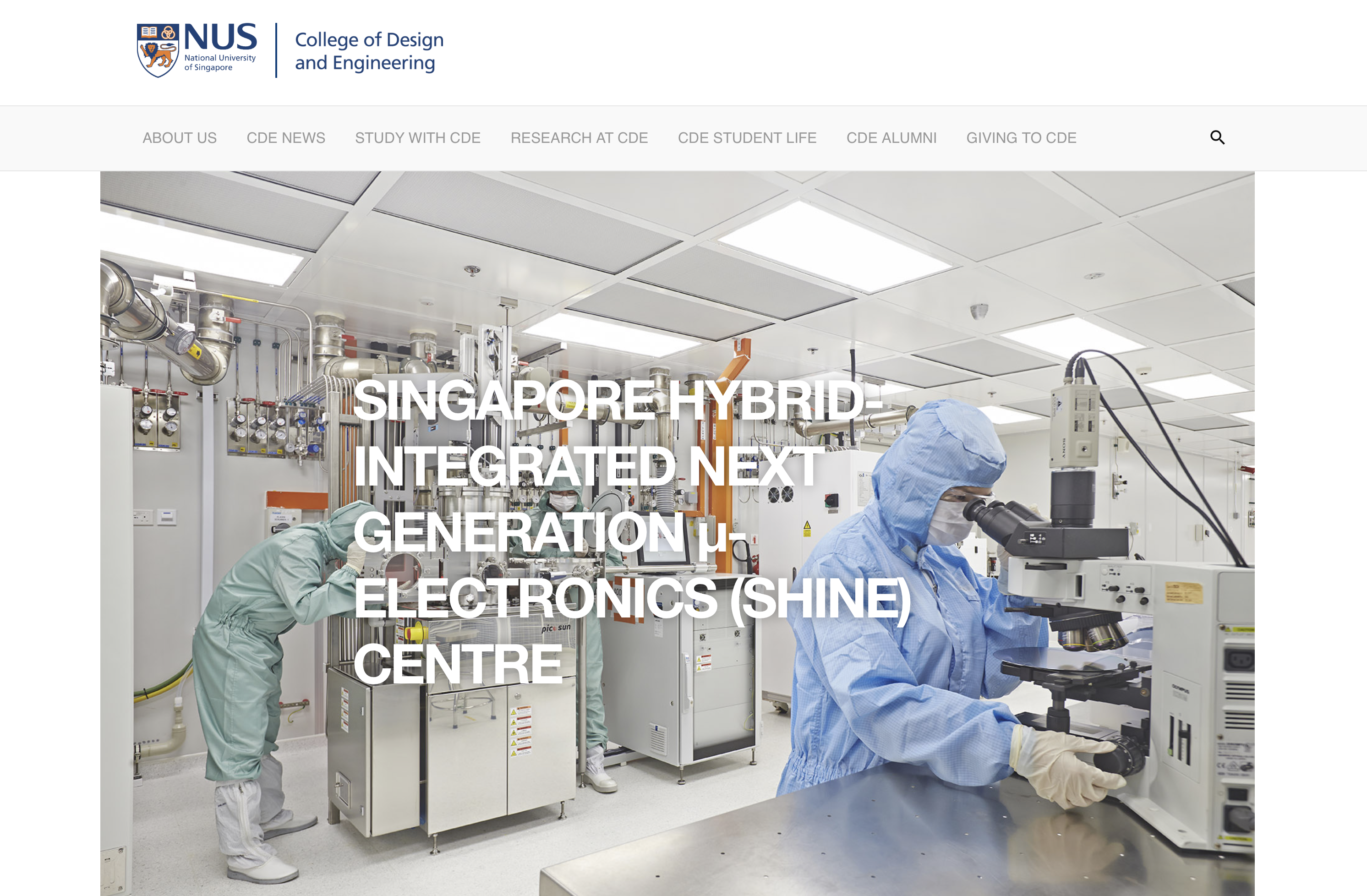
POET Technologies has joined the Singapore Hybrid-Integrated Next Generation micro-Electronics (SHINE) Center located in the College of Design and Engineering at the National University of Singapore (NUS).

The mission of the SHINE Center is to address fundamental issues arising in IoT microelectronics and to engage industry players during the development cycle, to eventually translate the technology to industry. A strong team formed by top-notch professors across the world from NUS, NTU, University of California Berkeley and Northeastern University, A*STAR Institute of Microelectronics (IME) and DSO National Laboratories (DSO) will be actively involved as research participants. Other members of the Consortium currently include Advanced Micro Foundry (AMF), Applied Materials, Cadence Design System, Continental Automotive and SOITEC. James Lee, Vice President and General Manager of POET’s Singapore subsidiary, has played a key role in the conception of the Consortium and will lead several projects on behalf of the company. SHINE is expected to have a partnership launch and inaugural technical workshop in June.

“The vision for SHINE comes from Professor Aaron Thean, Dean of the College of Design and Engineering, with whom POET has worked for a number of years on certain engineering challenges, and more recently Professor Lim Yeow Kheng, who joined the faculty about two years ago from STATS ChipPAC Pte. Ltd.,” said Dr. Suresh Venkatesan, Chairman & CEO of POET Technologies. “We are delighted to be a founding member of SHINE, as it brings together equipment and expertise that NUS and companies in the consortium may use, independently and confidentially, to develop advanced processes and manufacturing techniques for hybrid integration of photonics devices. The systems, scientific instruments and engineering staff at NUS complements well our existing operation in Singapore, especially in the area of 2.5D and 3D semiconductor manufacturing. We plan to use the SHINE Center to design and manufacture Optical Interposer-based solutions for several new vertical markets, consistent with the mission of SHINE, including applications in sensing and the Internet of Things (IoT).”

https://cde.nus.edu.sg/research/research-centres/singapore-hybrid-integrated-next-generation-electronics-shine-centre-shine

http://www.poet-technologies.com

Fungible launches a partner program

Fungible is launching a partnership program for its composable data center solutions.

The Fungible Partner Exchange (FunPX) partner program allows resellers, distributors, and technology providers worldwide to connect, collaborate, and grow their composable infrastructure capabilities to cloudify the world’s data centers.

“It’s my pleasure to announce the FunPX partner program. We recognize the importance of the channel. Our partners have been instrumental in fueling Fungible’s success and are a critical component in reaching our growth targets,” said Brian McCloskey, Chief Revenue Officer at Fungible. “We are investing in the tools, people, and processes to enable our partners to grow with us by providing immediate access to the essential information they need to win and help our mutual customers realize the benefits that the Fungible portfolio can bring to their infrastructure.”

https://www.fungible.com/partners

Fungible leverages DPU to DPU to centralize GPUs across Ethernet

Fungible introduced a means by which data centers could centralize their existing GPU assets into a single resource pool to be attached to servers on demand.The Fungible GPU-Connect (FGC) solution leverages the company's DPU to dynamically compose GPU and CPU resources across an Ethernet network.Instead of dedicated GPUs sitting idle most of the time, data centers can provide new users with access to the GPU pool, making greater use of existing assets....


Windstream's Kinetic broadband boosts to 2 Gig

Windstream's fiber-based residential broadband service announced the availability of 2 Gig service in select residential markets. 

“While many of our competitors are overlooking these markets, we’re optimizing them,” said Mark Lederman, vice president of product for Kinetic. “As more homes have more devices connected to the internet, from gaming systems to streaming movies to refrigerators, families need faster speed to accommodate the demand.”

Kinetic is involved in a multi-year $2 billion capital investment strategy across its 18-state footprint. Last year, the company laid nearly 81,000 miles of next-generation fiber across the communities it serves, many of them small towns and rural areas. Additionally, the company is creating unique partnerships with cities, counties and other groups to drive fiber deeper into the network faster.

https://www.windstream.com/fiber-internet

Parallel Wireless conducts Open RAN field trial in Brazil

Parallel Wireless is partnering with Inatel, Telecom Infra Project (TIP), Brisanet, Claro, TIM, and Vivo to conduct an Open RAN field trial throughout Brazil and other LATAM countries.   

Inatel - National Institute of Telecommunications is an education, research, and technology development center created in 1965 and located in Santa Rita do Sapucaí, southern Minas Gerais, also known as the Electronics Valley. It was the first institution of higher education in Telecommunications Engineering in Brazil.

Parallel Wireless will provide an Open RAN network enabling All Gs (2G, 3G, 4G and 5G) utilizing Band 7 for the trial. The setup in test has Comba and Dell Technologies solutions. Mobile Network Operators Brisanet, Claro, TIM and Vivo are partners in the Open Field program. 

Russell Ribeiro, Regional VP LATAM Sales at Parallel Wireless said, "We are excited to partner with Inatel and TIP to showcase our leading-edge cloud-native, O-RAN compliant, Open RAN solutions enabling 4G and 5G broadband connectivity, providing leading edge applications for the citizens of Brazil and other LATAM countries. We are starting this Open Field program with 4G and will evolve to 5G later this year. We believe this program is a very good showroom for MNOs throughout Latin America to come and see our platform in operation in a real field environment."

Gleyson A. dos Santos, Business Development Specialist at Inatel said, "I am thrilled to participate in this field trial with Parallel Wireless and TIP where we will showcase how Open RAN technology enables robust wireless telecommunications products with improved software quality, less maintenance, faster adoption of new technologies and better user experiences." 

http://www.parallelwireless.com