Wednesday, November 17, 2021

Ekinops delivers optical backbone upgrade for France's IKOULA

IKOULA, a French Infrastructure-as-a-Service (IaaS) provider of dedicated servers, outsourced cloud computing, web and cloud hosting services, has selected Ekinops to upgrade its backbone network between data centers.

Ekinops is delivering the PM 200FRS02 200G FlexRate coherent line card for IKOULA to upgrade its existing Ekinops chassis that are already transporting traffic on multiple 10G cards. The line card is used in 100G mode, de facto instantly multiplying the capacity of this line by a factor of ten to handle the current traffic load. 

IKOULA has been using Ekinops equipment for its core network for over ten years, connecting data centers in Reims and Eppes and an Internet point-of-presence (PoP) in Paris. Having grown since the initial installation to 25,000 active customers in over 60 countries on 4 continents, IKOULA recognized the need to upgrade its backbone network in order to maintain its customers’ high quality of experience despite the increased demand. The PM 200FRS02 FlexRate card can be installed in the same chassis used by 10G saving IKOULA both the cost of new shelves as well as the time and cost of deploying and commissioning the new hardware. A long record of performance, simplicity of deployment, short lead times and exemplary execution were all factors in IKOULA’s decision to upgrade with Ekinops.

“Our optical transport solutions enable service providers to radically transform the speed of their networks,” says Thierry Varona, Sales Director France at Ekinops. “The FlexRate technology will allow IKOULA to more easily adapt to continued service growth without compromising on quality of service.”

https://www.ekinops.com/news/customers/ekinops-upgrades-ikoula-data-center-interconnection-links-enabling-cloud-services-on-french-network

Padtec's Q3 revenue rises 42% yoy

Brazil-based Padtec Holding reported Q3 2021 gross operating revenue of approximately R$ 120 million, up 42.1% compared to the same quarter in 2020. Operating revenue reached R$ 326 million in the 9-month period of 2021 – an increase of 55% compared to the same period last year and 2.6% in relation to the revenue registered in 2020 (R$ 317.9 million). It was the best quarterly result in the company's recent history.

In the period from January to September 2021, Padtec also recorded an improvement in EBTIDA, with earnings before interest, taxes, depreciation and amortization of R$49 million. Adjusted EBTIDA (which excludes non-recurring events) reached R$ 34 million, with a margin of 13.8% – growth of 27% when compared to the amount registered in 2020. The gross margin in the 3rd quarter of 2021 was 36.3%, maintaining the same level as the 2nd quarter of 2020 (above 35%) and reinforcing the profitability of the company's businesses.

In the quarter that celebrates its 20th anniversary, Padtec obtained an important recognition of its positive financial performance and the sustainable growth registered in recent years. The company won third place in the Telecommunications category of the Best and Biggest 2021 award, given by Exame magazine. In this year's edition, in addition to operating and financial results, the publication also analyzed companies' ESG (Environmental, Social and Governance) practices.

In the research and development area, between January and September 2021, Padtec invested R$ 30.6 million in the creation of new products for high-performance optical communication systems, maintaining the same percentage of R&D investments in relation to net revenue of recent years. “The investment in technology is the differential that allows Padtec to remain competitive and at the frontier of knowledge in its area of expertise”, emphasizes Roberto Nakamura, the company's Technology director. “Our focus is on providing networks capable of adapting to constant changes in demand, so that people and companies can stay connected”, he adds.

https://www.padtec.com.br/en/

Bell Canada tests Nokia's 25G PON

Bell Canada has tested Nokia's  25G PON fiber broadband technology at Bell’s Advanced Technical Lab in Montréal, Québec. The trial validated that current GPON and XGS-PON broadband technology and future 25G PON can work seamlessly together on the same fiber hardware, which is being deployed.

Stephen Howe, EVP & Chief Technology Officer, Bell, said: “As part of Bell’s purpose to advance how Canadians connect with each other and the world, we embrace next-generation technologies such as 25G PON to ensure we remain at the forefront of broadband innovation. Our successful work with Nokia to deliver the first 25G PON trial in North America will help ensure we maximize the Bell fiber advantage for our customers in the years to come.”

https://www.nokia.com/about-us/news/releases/2021/11/16/nokia-and-bell-canada-test-25g-pon-fiber-broadband-technology/

Nokia supplies private LTE for Bahrain’s Electricity and Water Authority

Nokia will build a secure, private LTE network (pLTE) for Bahrain’s Electricity and Water Authority (EWA). In the first phase of deployment, Nokia will cover Al Muharraq area in Bahrain. After the successful completion of the first phase, the network will connect thousands of secondary substations and hundreds of primary substations spread across the entire country.

In the first phase, Nokia's solution will connect 500 secondary substations and six primary substations to the central location. Its solution including Nokia IP/MPLS wireless router 7705 SAR-Hmc, Nokia Compact Mobility Unit (CMU), Nokia Network Services Platform (NSP) and Nokia LTE radio equipment will be used to build advanced private LTE networks. The solution will be based on 3GPP standardization on 410 MHz Band B87 which is specifically for industrial use for private LTE connectivity.

Kamal Ballout, Head of Nokia Enterprise, Middle East, Africa, China and India at Nokia, said: “Private LTE is enabling utility organizations around the world to simplify networks management and use automation to bring down costs. We are committed to modernizing and upgrading EWA’s distribution systems for better performance and reliability. Our end-to-end portfolio allows us to provide reliable and ultra-high-speed broadband wireless networking to our utility customers.”

Tuesday, November 16, 2021

Why Service Assurance is Vital to our Multi-Cloud Future


Going forward, service assurance is vital for personal and business communications, says Chet Patel, BT's Chief Commercial Officer and President, BT Americas.  Continuous investment is needed, especially in AI, automation, and analytics, to ensure the best customer experience.  Here is a 1-minute perspective from San Francisco.

Download the 2021 Service Assurance Report here: https://ngi.how/sa-2021

DISH Wireless and Cisco target 5G enterprise services

DISH Wireless and Cisco announced a strategic agreement focused on enterprise 5G services in the United States. Some highlights:

  • Go-to-market strategy: DISH will participate in Cisco’s Reseller and Managed Services Program
  • Deployment of an intelligent transport network: Cisco is helping to plan, design and deliver an open, cloud-based network that will predict, self-heal and self-optimize with closed-loop automation for transport network slicing. 
  • Co-innovation on virtual routing:  DISH’s 5G network will be powered with fully automated Cisco XRv9K virtualized routers running on AWS, along with virtual Cell Site Routers (vCSR) at the tower. 
  • New operational models: Cisco is helping DISH build out a lean, world-class DevOps organization that drives automation and improves operational efficiency leading to faster time-to-market with new services, speed to revenue and return on investments. Key outcomes are CI/CD testing and zero-touch onboarding to enable DISH to quickly go from development to pre-production, as well as staging and testing directly to production. 
  • Technology:  Cisco will support DISH with the following: IOS-XR operating system for 5G, backhaul and fronthaul transport via Cisco NCS series routers, segment routing for automated traffic management and network slicing, Nexus 9000 series with an Application Centric Infrastructure (ACI) fabric for data center switching, and Cisco Crosswork Network Controller as the transport domain controller including automated service provisioning and assurance.  

“Cisco and DISH are disrupting the mobile and enterprise markets by launching cloud-powered 5G services in record time through innovative technologies, fostering new application development and improving the overall customer experience,” said Chuck Robbins, Chairman and CEO, Cisco. “Together, we look forward to helping businesses across industries transform their networks to support the evolution of hybrid work models, the transition to Network as a Service (NaaS) offers, and the expansion into new markets including IoT.”

“DISH has compiled an outstanding roster of partners in the wireless industry, and Cisco is a key player helping us launch a customizable, automated, 5G network optimized for enterprise performance,” said Charlie Ergen, Chairman, DISH. “Working with Cisco is central to achieving our goal of delivering a best-in-class experience for enterprises. Our ability to continually drive value and enhance capabilities for our customers is a key differentiator for DISH and positions us to disrupt the industry with more innovation, speed, agility and security.”


Ericsson's Intelligent Automation Platform runs rApps

Ericsson launched its Intelligent Automation Platform and a suite of rApps as its next natural step for existing 4G and 5G radio access networks (RAN). 

The Ericsson Intelligent Automation Platform is a service management and orchestration product that builds on the company's cloud native dual-mode 5G Core and the Cloud RAN portfolio, while also supporting multivendor RANs including purpose-built and Open RANs. The solution facilitates AI and automation, which improves network performance, operational efficiency and customer experience to help create smarter networks.

Ericsson said its new platform automates the radio access network using AI and radio network applications (rApps) with different functionalities. In a similar way to an operating system that automates operations, resources and identifies improvements to be made across the network, Ericsson Intelligent Automation Platform includes a non-real-time RAN intelligent controller (Non-RT-RIC) that operates rApps. Ericsson is introducing a suite of rApps across four domains: efficient automated deployment; network healing; network evolution; and network optimization. The company is also introducing a software-development toolkit (SDK) to help operators and integrators to build their on rApps.

Jan Karlsson, Senior Vice President and Head of Business Area Digital Services, Ericsson, says: “We embrace the principle of openness and the evolution to open network architectures. Building upon our Cloud RAN offering, we are taking another major step towards building the network for the digital future with the launch of Ericsson Intelligent Automation Platform, which fundamentally enables smarter mobile networks. We look forward to providing our customers with an open platform that enables operational efficiency, enhances customer experience and drives service innovation. I am happy to hear the reactions from our customers already being positive towards our new product and we look forward to future development and innovation.”

Neil McRae, MD Architecture & Strategy, BT Group Chief Architect, says: “At BT we connect for good and continuously innovate to provide the best services for our customers. As we expand and modernize building more reliable networks in more places, managing network complexity via automation is critical to ensure our customers best quality of experience.  I’m pleased to see that Ericsson is launching the Intelligent Automation Platform for automating networks, based on the O-RAN Alliance Service Management and Orchestration (SMO) concept. Ericsson’s vision to extend that SMO concept to support both Open RAN and existing 4G and 5G networks, using a single operational pane-of-glass is an innovative approach.”

https://www.ericsson.com/en/ran/intelligent-ran-automation/intelligent-automation-platform

FCC attracts $21.8 billion in bids for mid-band spectrum

The FCC announced the conclusion of bidding in the first phase of Auction 110 for licenses in the 3.45 to 3.55 GHz band. Winning bidders will now have the opportunity to bid for frequency-specific licenses in the assignment phase of Auction 110.  

In the clock phase, bidders won 4,041 of the 4,060 available generic blocks, and gross proceeds in the clock phase reached over $21.8 billion, which places Auction 110 among the highest grossing auctions in FCC history.  

Auction 110 makes available 100 megahertz of mid-band spectrum for commercial use across the contiguous United States.  The spectrum licenses are divided into ten 10-megahertz blocks licensed by geographic areas known as Partial Economic Areas (PEAs).  License winners will operate within a cooperative sharing framework that will enable commercial use by an array of service providers, while also ensuring coexistence with federal incumbents where and when they require continued access to the band.  

http://www.fcc.gov/auction/110


Bloomberg: Secretive Chinese Committee Draws Up List

China has formed a secretive Information Technology Application Innovation Working Committee with the goal of replacing foreign technology suppliers and boosting local competitors, according to Bloomberg. 

The report says the committee has developed an “IT Application Innovation” plan, known as Xinchuang in Chinese, that serves as a whitelist of approved vendors for government and private sector projects in the areas of telecom equipment, data center servers and switches, computing silicon, cloud servicesm and network security. 

The list is seen as a direct response to the Entity list developed by the U.S. government of non-trusted Chinese vendors.

https://www.bloomberg.com/news/articles/2021-11-16/secretive-chinese-committee-draws-up-list-to-replace-u-s-tech

Lumentum introduces multi-junction VCSEL arrays

Lumentum introduced high-performance 1D and 2D addressable arrays for advanced automotive, consumer, and industrial LiDAR and 3D sensing applications.

VCSEL arrays have become the preferred laser illumination source for short-range 3D sensing applications such as biometric security and world-facing LiDAR in consumer mobile devices due to their proven reliability and ability to be manufactured at scale. 

Lumentum said its multi-junction VCSEL arrays can deliver significantly higher peak optical power densities and efficiencies  for longer-range applications by decreasing the electrical current needed and simplifying electrical driver and package design. Specifically, Lumentum's high-power multi-junction addressable VCSEL arrays emit at 905 nm and 940 nm and are built upon the manufacturing foundation developed over the past several years of high-volume VCSEL array shipments serving the consumer electronics market. The higher peak power, addressability, thermal stability, and narrow wavelength range of these sources open new potential for all-solid-state short-, medium- and long-range LiDAR systems.

"We're excited to build on our industry-leading multi-junction VCSEL technology with this breakthrough and bring addressable array illumination sources to longer-range depth-sensing applications like LiDAR," said Matt Everett, Product Line Director of 3D Sensing at Lumentum. "On-chip array addressability can eliminate the need for mechanical beam scanning, which opens a new world of possibilities for autonomous vehicles and emerging 3D sensing systems and will help accelerate LiDAR adoption across a wide range of customer applications."

Lumentum high-performance multi-junction addressable VCSEL array products are expected to be available starting in calendar Q4 of 2022. 

http://www.lumentum.com

Keysight and Credo collaborate on 800 GigE testing

Keysight Technologies has collaborated with Credo to enable data center operators  and the respective supply chain to validate the readiness of data center equipment in complex 800 Gigabit Ethernet (GE) environments.

The 800GE testing equipment is comprised of Keysight's G800GE Forward Error Correction- (FEC) Aware and Compliance test system using Credo’s Active Electrical Cable (AEC) connectivity solution. The AECs are key to ensuring signal integrity for copper cabling lengths greater than two meters. Long reach capabilities are essential to connect the data center servers to a top of rack (ToR) switch.

"The move to 800GE presents DCOs and vendors in the supply chain with new challenges to validate chips, optical transceivers, or networking equipment port electronics,” said Ram Periakaruppan, vice president and general manager, Keysight's Network Test and Security Solutions group. "The unique combination of the Keysight G800GE test system and Credo's 800GE AEC technology addresses the interoperability challenges and enables the data center community to accelerate validation of 800GE devices and network infrastructure.”

"Keysight's G800GE test system with 400GE/200GE/100GE per port fan-outs meets the performance and verification needs of 800GE interconnect and infrastructure," said Don Barnetson, vice president of product at Credo. "It is very exciting to see Keysight leverage our HiWire LP CLOS AEC 800 in their 800GE test and validation platform. The performance of this AEC is not only enabling next generation hypsercale data center implementations, but is also a valued component of the infrastructure making those implementations possible.”

http://www.keysight.com

PacketFabric offers hourly billing for 100G data center interconnection

PacketFabric is now offering hourly billing for data center interconnect (DCI) backbone virtual circuits (VCs), at speeds up to 100Gbps across nearly 200 global points of presence (PoPs).

PacketFabric customers can now create hourly backbone VCs on demand via the PacketFabric portal and API. In addition, customers can dynamically provision burstable bandwidth on an hourly basis, above term-based backbone VCs.

"The cloud is what happens to traditional infrastructure when you automate and make it hyper-consumable," said Anna Claiborne, PacketFabric Chief Technology Officer and Chief Product Officer. "At PacketFabric, our mission is to turn the inflexible slog of getting premium-grade network connections into a rocket-fueled network multi-tool, just like interaction you expect from cloud providers. Hourly backbone VCs up to 100Gbps, deployed in minutes, are a first. This new capability is a significant step forward in pushing the networking industry towards the vision of true bandwidth on demand."

http://www.packetfabric.com

Zayo Expands in Indianapolis and Fort Wayne

Zayo announced an expansion of network infrastructure in Indianapolis and Fort Wayne, Indiana. 

Expansion plans include adding more than 200 route miles throughout Indiana over the next two years, including a new fiber route from South Bend, Indiana, to Grand Rapids, Michigan. By year’s end, a long haul dark fiber route from Indianapolis to St. Louis, Missouri will be available to new and existing customers, adding network protection on a key route between two emerging tech hubs. Additionally, starting in Q1 2022, Zayo will offer wave bandwidth up to 400Gbps from Indianapolis to Columbus, Ohio, and Chicago, Illinois.

Zayo is also rolling out a new Shielded Internet Access product offer to new and existing customers in the region. 

https://go.zayo.com/indianapolis-fort-wayne-dedicated-network

Monday, November 15, 2021

American Tower to buy CoreSite for $10B

American Tower agreed to acquire CoreSite for $170.00 per share in cash, an enterprise value of $10.1 billion when including the assumption and/or repayment of CoreSite’s existing debt.

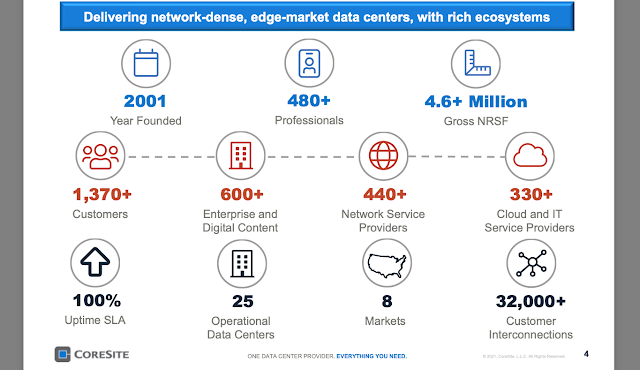
CoreSite, which as of Q3 2021 consisted of 25 data centers, 21 cloud on-ramps and over 32,000 interconnections in eight major U.S. markets, generated annualized revenue and Adjusted EBITDA of $655 million and $343 million, respectively, in Q3 2021. CoreSite has averaged double-digit annual revenue growth over the past five years.

American Tower said it expects to leverage its strong financial position to further accelerate CoreSite’s attractive development pipeline in the U.S., while also evaluating the potential for international expansion in the data center space. The acquisition is also expected to be transformative for American Tower’s mobile edge compute business in advance of the proliferation of 5G low-latency applications throughout the cloud, enterprise and network ecosystems, establishing a converged communications and computing infrastructure offering with distributed points of presence across multiple edge layers. 

Tom Bartlett, American Tower’s Chief Executive Officer stated, “We are in the early stages of a cloud-based, connected and globally distributed digital transformation that will evolve over the next decade and beyond. We expect the combination of our leading global distributed real estate portfolio and CoreSite’s high quality, interconnection-focused data center business to help position American Tower to lead in the 5G world. As the convergence of wireless and wireline networks accelerates and classes of communications infrastructure further align, we anticipate the emergence of attractive value creation opportunities within the digital infrastructure ecosystem. We look forward to welcoming CoreSite’s talented team to American Tower and working together to capitalize on those opportunities to drive enhanced long-term value creation for our customers and shareholders as we continue to connect billions of people across the globe.”

CoreSite’s Chief Executive Officer, Paul Szurek, stated, “We are excited to partner with American Tower to expand its communications infrastructure ecosystem and accelerate its edge computing strategy through the addition of CoreSite’s differentiated portfolio of U.S. metro data center campuses. The combined company will be ideally positioned to address the growing need for convergence between mobile network providers, cloud service providers, and other digital platforms as 5G deployments emerge and evolve. In addition, we expect the enhanced scale and further geographic reach to provide a platform for the combined company to accelerate its growth trajectory and expand into additional U.S. metro areas, as well as internationally, leveraging American Tower’s extensive presence across the globe. CoreSite’s outstanding team, interconnection platform and data center campus portfolio are a highly complementary fit with American Tower’s existing communications sites, and we believe this partnership delivers significant value to CoreSite’s stockholders and will create an exciting new chapter for our customers, employees and partners.”

American Tower intends to finance the transaction in a manner consistent with maintaining its investment grade credit rating and has obtained committed financing from J.P. Morgan. 


KKR and Global Infrastructure Partners to acquire CyrusOne for $15B

KKR, a leading global investment firm, and Global Infrastructure Partners agreed to acquire CyrusOne for $90.50 per share in an all-cash transaction valued at approximately $15 billion, including the assumption of debt.

The $90.50 per share purchase price reflects a premium of approximately 25% to CyrusOne’s unaffected closing stock price on September 27, 2021, the last full trading day prior to published market speculation regarding a potential sale of the Company.

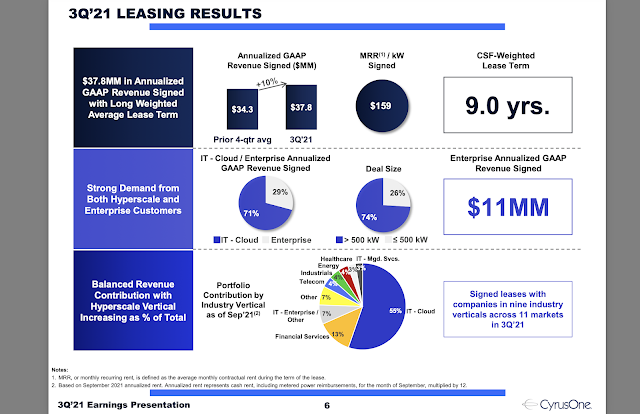
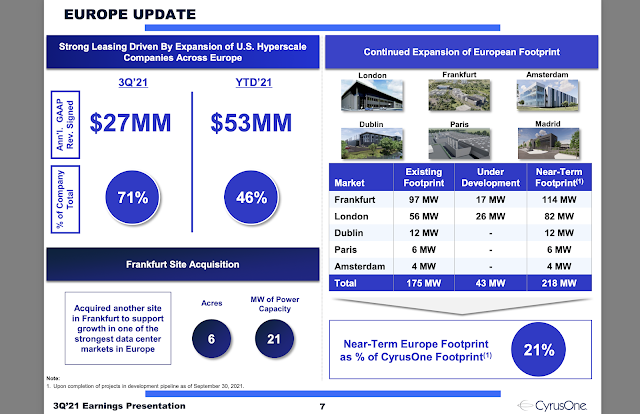
CyrusOne operates more than 50 data centers worldwide providing mission-critical facilities for approximately 1,000 customers, including approximately 200 Fortune 1000 companies. Services include colocation, hyperscale, and build-to-suit environments.

“This transaction is a testament to the tremendous work by the entire CyrusOne team. We have built one of the world’s leading data center companies with a presence across key U.S. and international markets supporting our customers’ mission-critical digital infrastructure requirements while creating significant value for our stockholders,” said Dave Ferdman, Co-Founder and interim President and Chief Executive Officer of CyrusOne. “KKR and GIP will provide substantial additional resources and expertise to accelerate our global expansion and help us deliver the timely and reliable solutions at scale that our customers value.”

“Today’s announcement is the culmination of a robust strategic review process conducted by the CyrusOne Board of Directors to determine the best path forward for the Company and maximize stockholder value,” said Lynn Wentworth, Chair of the CyrusOne Board of Directors. “This transaction provides CyrusOne stockholders with significant value and simultaneously positions the Company to even better serve its customers to meet their needs in key markets around the world.”

https://cyrusone.com


Xilinx intros FPGA data center accelerator card for HPC

Xilinx introduced a data center accelerator card and a new standards-based, API-driven clustering solution for deploying FPGAs at massive scale for high performance computing (HPC) and database workloads. 

The new Alveo U55C accelerator, which is Xilinx’s most powerful Alveo accelerator card to date, delivers more parallelism of data pipelines, superior memory management, optimized data movement throughout the pipeline, and the highest performance-per-watt in the Alveo portfolio. The Alveo U55C card is a single-slot full height, half length (FHHL) form factor with a low 150W max power. 

The company says the new card offers superior compute density and doubles the HBM2 to 16GB compared to its predecessor, the dual-slot Alveo U280 card. The U55C provides more compute in a smaller form factor for creating dense Alveo accelerator-based clusters. It’s built for high-density streaming data, high IO math, and big compute problems that require scale-out like big data analytics and AI applications. Leveraging RoCE v2 and data center bridging, coupled with 200 Gbps bandwidth, the API-driven clustering solution enables an Alveo network that competes with InfiniBand networks in performance and latency, with no vendor lock-in. MPI integration allows for HPC developers to scale out Alveo data pipelining from the Xilinx Vitis unified software platform. 

“Scaling out Alveo compute capabilities to target HPC workloads is now easier, more efficient and more powerful than ever,” said Salil Raje, executive vice president and general manager, Data Center Group at Xilinx. “Architecturally, FPGA-based accelerators like Alveo cards provide the highest performance at the lowest cost for many compute-intensive workloads. By introducing a standards-based methodology that enables the creation of Alveo HPC clusters using a customer’s existing infrastructure and network, we’re delivering those key advantages at massive scale to any data center. This is a major leap forward for even broader adoption of Alveo and adaptive computing throughout the data center.”

CSIRO, Australia’s national research organization along with the world’s largest radio astronomy antenna array, is utilizing Alveo U55C cards for signal processing in the Square Kilometer Array radio telescope. Deploying the Alveo cards as network-attached accelerators with HBM allows for massive throughput at scale across the HPC signal processing cluster. The Alveo accelerator-based cluster allows CSIRO to tackle the massive compute task of aggregating, filtering, preparing and processing data from 131,000 antennas in real time. The 460Gbps of HBM2 bandwidth across the signal processing cluster is served by 420 Alveo U55C cards fully networked together across P4-enabled 100Gbps switches. The Alveo U55C cluster delivers processing performance with overall throughput at 15Tb/s in a compact power and cost efficient footprint. CSIRO is now completing an example Alveo reference design in order to help other radio astronomy or adjacent industries achieve the same success.


Astera Labs' module enables copper-based Smart Electrical Cables at up to 800 GbE

Astera Labs introduced its new Taurus Smart Cable Module portfolio to overcome performance bottlenecks in data center Switch-to-Switch and Switch-to-Server interconnects running up to 100G/Lane for 200/400/800 GbE. 

The Taurus SCM enables cloud system integrators and cable assembly vendors to rapidly develop and deploy cost-effective, copper-based Smart Electrical Cables (SEC) with purpose-built intelligence capabilities to reliably address reach, signal integrity, security, fleet management, and bandwidth utilization issues in hyperscale data centers.

“Our new Taurus Smart Cable Module solution tackles hyperscalers’ emerging 50G and 100G/Lane Ethernet design challenges, which impact reach, signal integrity, physical constraints, power budgets and bandwidth utilization,” said Sanjay Gajendra, CBO, Astera Labs.

  • Taurus Smart Cable Module Portfolio – key features:
  • Supports 100G PAM4 (106.25 Gbps), 50G PAM4 (53.125 Gbps), 25G NRZ (26.5625 Gbps and 25.78125 Gbps), and other Ethernet line rates.
  • Resolves rate mismatch between NICs and Switches with 50G-to-100G PAM4 & 25G-NRZ-to-50G-PAM4 Aggregation and Disaggregation with gearbox capabilities.
  • Enables 36-dB reach extension for 3-meter reach over thin (up to 34AWG) copper cables, ensuring sufficient cable length and flexibility.
  • Ultra-Low-Latency.
  • Advanced fleet management capabilities with full CMIS features, security, and deep diagnostics.
  • Qualified with leading cable vendors to enable Smart Electrical Cables (SECs) in QSFP-DD and OSFP form factors.

“Advanced PAM-4 100G/Lane Ethernet connectivity solutions must overcome complex design challenges such as reach, latency and power efficiency while keeping the cost per bit low to accelerate 400GbE and 800GbE deployments in data centers,” said Alan Weckel, Founder and Technology Analyst at the 650 Group. “Astera Labs Taurus Smart Cables™ play an important role in enabling intra rack connectivity based on active copper cables for the 800GbE interconnect ecosystem.”

Furthermore, Taurus SCMs enable a flexible supply chain of Smart Electrical Cables by qualifying with leading cable vendors to support SECs in QSFP-DD and OSFP form factors, allowing any cable OEM to integrate intelligent Taurus capabilities into their 200/400/800GbE solutions.

http://www.AsteraLabs.com

Megaport offers Aruba EdgeConnect SD-WAN

Megaport is now offering the Aruba EdgeConnect SD-WAN Platform on Megaport Virtual Edge (MVE) for enabling  branch-to-cloud connectivity via Megaport’s global SDN.

Aruba EdgeConnect customers can now leverage Megaport’s worldwide ecosystem of more than 700 data centres and over 360 service providers, with 230+ cloud on-ramps including Alibaba Cloud, AWS, Google Cloud, Microsoft Azure, IBM Cloud, Oracle Cloud, and Salesforce. 

MVE is a globally distributed compute and network service, and customers can host Network Function Virtualisation instances on-demand at the point of use, managing them globally from a single pane of glass. A built-in transit gateway provides highly scalable access for connecting networks, via the public internet, to Megaport’s private SDN. Virtualized devices hosted on MVE can create connections between the Megaport SDN and their distributed sites via the transit gateway.

“Integrating the Aruba EdgeConnect SD-WAN platform with Megaport’s SDN will enable joint customers to achieve better network and application performance while reducing cloud costs,” said Vincent English, CEO of Megaport. “Since MVE is available in 22 metro areas across North America, Asia-Pacific, and Europe, traffic can be localized allowing data termination to be optimised for performance.“

https://www.megaport.com/services/megaport-virtual-edge/

Netography raises $45M for cloud-native network detection and response

Netography, a start-up based in Annapolis, Maryland, raised $45 million in Series A funding for its SAAS network security offering.

Netography’s cloud-native SaaS NDR ingests network metadata from on-premise as well as multicloud infrastructure to provide visibility and attack detection in a much simpler and easier to manage package than traditional network detection and response (NDR) solutions. The company’s technology deploys, runs, and scales using the full power of the cloud, without introducing additional physical or virtual sensors or appliances to manage, and without the challenges of unwieldy full packet capture and deep packet inspection solutions.

The new funding was led by Bessemer Venture Partners and SYN Ventures, with participation from existing investors Andreessen Horowitz, Mango Capital, Harpoon Ventures, and Wing Venture Capital. 

The company reports strong traction signing customers in the federal government and defense, aerospace and travel, financial services, utilities, and manufacturing verticals.

In September, Netography announced the appointment of Martin Roesch as CEO, and co-founder Barrett Lyon, network security pioneer, moved into the role of Chief Architect. Roesch is the creator of the open-source project Snort and the former Founder, CEO, and CTO of network security firm Sourcefire, which Cisco acquired. 

“The adoption of the Zero Trust model of security with its concomitant utilization of pervasive network encryption requires rethinking how the capabilities of network security can be delivered in the atomized networks of today. The appliance model and deep packet inspection will provide less and less utility as we move forward, and it’s time for a new architecture that addresses the needs of modern network environments,” said Roesch. “By upending this model and approaching security with the mindset of securing atomized networks, Netography provides security teams the protection they actually need for the way their networks look today and going forward as they embrace a distributed, Web 3.0 world.”

https://netography.com/overview/


Santec acquires JGR Optics and OptoTest for optical test

Japan-based Santec Corporation has acquired JGR Optics Inc. (Headquarters: Ottawa, Canada), and OptoTest Corp. (Headquarters: Camarillo, CA). Both companies will continue to operate under their existing brands as subsidiaries of Santec. Financial terms were not disclosed.

Both JGR Optics and OptoTest are recognized leaders in fiber optic test solutions for measuring insertion and return loss of cable assemblies and components. 

Santec is a leading manufacturer of advanced optical components, tunable lasers, optical test equipment and OCT systems.

“We’re excited to enter the fiber testing market with the acquisitions of JGR Optics and OptoTest. Both companies have a proven track record of delivering high performance return loss, insertion loss and polarity measurement systems as well as optical switches to fiber optic cable assemblies and components productions" said Mototaka Tei, Chief Executive Officer of Santec Corp. "Santec is a leading supplier of test and measurement systems for Optical Telecom and Datacom and with this acquisition we widen our footprint the growing market for fiber optics production equipment. JGR and OptoTest both have complementary technology to Santec. The acquisitions will not only allow us to operate in adjacent markets, but will enable us to expand our product offering by integrating their technology into Santec's products and solutions.”