Sunday, October 24, 2021

Telstra and Australian government to acquire Digicel Pacific

Telstra, in partnership with the Australian government, reached a deal to acquire the Digicel business in the South Pacific region for US$1.6 billion, plus up to an additional US$250 million subject to business performance over the next three years.

The Digicel business will be owned and operated by Telstra. Telstra is contributing US$270 million of equity to the US$1.6 billion purchase price and the Australian Government, through Export Finance Australia, is providing the remaining US$1.33 billion through a combination of non-recourse debt facilities and equity like securities. Telstra will own 100 per cent of the ordinary equity.

Digicel currently operates in six markets in the South Pacific including Papua New Guinea, Fiji, Samoa, Vanuatu, Tonga and Nauru. It recorded sales of approximately US$450 million and adjusted EBITDA of approximately US$222 million in the year ended March 31, 2021. Following the sale, Digicel, which is privately owned by Irish businessman Denis O’Brien, will focus on the 26 Caribbean & Latin American markets where it also operates.


“Digicel Pacific is a commercially attractive asset and critical to telecommunications in the region. The Australian Government is strongly committed to supporting quality private sector investment infrastructure in the Pacific region. We previously said that if Telstra were to proceed with a transaction it would be with financial and strategic risk management support from the Government. We also said that in addition to a Government funding and support package, any investment would also have to be within certain financial parameters with Telstra’s equity investment being the minor portion of the overall transaction. I am pleased that we have been able to achieve both of those outcomes,” said Andrew Penn, CEO of Telstra.

“Digicel enjoys a strong market position in the South Pacific region holding a strong number one position in all markets other than Fiji where it is the number two. The combined business generated EBITDA of US$233 million for the financial year ended 31 March 2021, with a strong margin. Digicel Pacific has already invested significant capital in PNG, which is its largest market, to achieve extensive network coverage including 4G to 55 per cent of the population. The medium to long-term capex to sales is expected to be around 15 per cent,” said Mr Penn.

Commenting, Denis O’Brien, Digicel Founder and Chairman said: “Today’s announcement is a tremendous testament to our colleagues across Digicel Group and in particular, our 1,700 staff in the Pacific. In 2006, we established a business in the South Pacific region that has helped democratise mobile communications and transform local economies and societies by making affordable best-in-class communications available to more than 10 million people across six of the most exciting markets in the South Pacific region. I am very pleased that today’s agreement with Telstra, our very near neighbour in the Pacific, will further enhance DPL’s infrastructure, data and call termination links with one of the largest and most reliable networks in Australia. I thank all of our colleagues in the South Pacific and beyond who have made today possible and I remain committed to ensuring a successful transition in my ongoing role as a director of the newly formed holding company for DPL.

https://www.digicelgroup.com/en/news.html

https://www.telstra.com.au/aboutus/investors/announcements

Anello raises $28M for silicon photonic optical gyroscope

Anello Photonics, a start-up based in Santa Clara, California, announced $28 million in Series A funding for its Silicon Photonic Optical Gyroscope (SiPhOG) sensor technology.

Anello says its novel SiPhOG replaces the discrete optical components of a traditional Fiber Optic Gyroscope (FOG) and combines high precision with greatly reduced size, weight, power and cost. The technology combines an Anello-developed on-chip waveguide manufacturing process integrated with a patented silicon photonic chip-scale gyroscope. 

Applications for the SiPhOG sensor technology could include automotive, trucking, construction, drone, aerospace, defense and consumer electronics.   

The Series A funding was led by New Legacy Ventures and included investments from Lockheed Martin Ventures, Catapult Ventures, JS Capital, Hardware Club, and individual investments from several Silicon Valley luminaries.

"With the development of the SiPhOG we are going to change the Navigation industry," says Mario Paniccia, Chief Executive Officer and co-founder of Anello. "We are bringing all the benefits of optical gyro performance onto an integrated silicon photonic circuit platform."

"By providing an independent and accurate ground truth of vehicle position, Anello's sensor and IMU system improves the reliability of Autonomous Vehicle localization while reducing the vulnerability to cyber-security threats and environmental interference common to other localization sensors," says Mike Horton, Chief Strategy Officer and co-founder of Anello.

http://www.anellophotonics.com

Taiwan Mobile deploys 5G standalone core with Nokia

Taiwan Mobile Co. has deployed Nokia's 5G standalone core. The installation includes Nokia’s voice core, cloud packet core, subscriber data management, signaling, network exposure, policy controller, cloud infrastructure, and security management for radio transport. 

The 5G standalone core network enables Taiwan Mobile to provide advanced 5G services such as network slicing and smart city solutions that require ultra-low latency and reliability.

Nokia is already the sole supplier of Taiwan Mobile’s 5G network.


Tom Koh, Senior Vice President and Chief Technology Officer, Technology Group, Taiwan Mobile, said: “Introducing SA to unleash the full potential of 5G beyond high-speed to further realize innovative use cases enabled by ultra-low latency and massive IoT is our strategic mission in the 5G era. We are delighted to reach this milestone with Nokia to bring the first true 5G network into Taiwan. Owning the agility of network slicing to swiftly customize the network for accommodating different use cases, Taiwan Mobile will be able to accelerate time-to-market to provide a wide variety of services for everyone and everything and to free enterprises to embrace Industry 4.0.”


Swiss operator Sunrise UPC consolidates OSS with Nokia

Sunrise UPC Communications AG has deployed Nokia’s Digital Operations software to modernize and consolidate its Operations Support Systems (OSS) for existing services and new IoT and 5G-era services, like network slicing.

Nokia claims Digital Operations software provides Sunrise UPC with an Open API catalog-driven fulfillment solution that eliminates silo-based network management and enables agile product launches by leveraging 5G and IoT technology to reduce time-to-market by up to 50 percent.


Working in tandem with Nokia’s Converged Charging software, Sunrise UPC and Nokia are utilizing joint continuous integration or continuous delivery (CICD) deployment and testing framework to further increase productivity and prepare for future IoT and 5G services.

Nokia’s fulfillment solution modernizes OSS catalog, inventory, order management and provisioning, with pre-integrated processes for end-to-end automation. 

Fabio Pellegrino, VP, IT Platform Delivery at Sunrise UPC, said: “Nokia’s OSS solution eliminates silos within our network to greatly increase the speed at which we can deploy new IoT and 5G services. We look forward to the increased flexibility this solution provides as we move into the 5G-era.”

Lumentum offers 10W illuminator based on VCSEL array

Lumentum announced a 10 W flood illuminator module that incorporates a high-performance three-junction vertical-cavity surface-emitting laser (VCSEL) array for consumer and industrial 3D sensing applications.

VCSEL illuminators are increasingly being used in a variety of high-performance 3D sensing applications ranging from biometric security in mobile phones to emerging industrial and consumer AIoT (artificial intelligence of things). AIoT, the convergence of artificial intelligence and the internet of things, benefits from 3D sensing since it is dependent on capturing vast amounts of high-quality data to enable efficient artificial intelligence processing. 

Lumentum's new 10 W flood illuminator leverages the company's decades of experience in providing high performance and field-proven VCSELs to the market in high-volumes, including shipping more than one billion VCSEL arrays into 3D sensing applications. The flood illuminator is available in a compact standard surface-mount package with a built-in eye safety function. It integrates a three-junction VCSEL array, an optical diffuser, a ceramic substrate, and a photodiode, which enables closed loop control.

www.lumentum.com

SES-17 Ka-band satellite successfully launched

The SES-17 satellite was successfully launched onboard an Ariane 5 launcher operated by Arianespace from the Europe’s Spaceport in Kourou, French Guiana.

From its orbital slot of 67.1 degrees West orbital slot, the very high throughput geostationary (GEO) SES-17 Ka-band satellite offers nearly 200 user beams that can be connected to any other beam at any time across the Americas, the Caribbean and the Atlantic Ocean. The satellite is capable of dynamically changing the power and frequency allocation of any beam. It is also the first GEO satellite to use Adaptive Resource Control (ARC), an industry-first software system that leverages the full flexibility of totally digital payloads to autonomously adapt space and ground resources on the fly to meet customer needs.

Equipped with an all-electric propulsion system, the satellite will reach orbit as of mid-2022. When operational, anchor customer Thales InFlyt Experience will use SES-17’s connectivity to power its next-generation aviation connectivity solution, FlytLIVE. 

“Today’s launch of SES-17 is an exciting milestone for our FlytLIVE Connectivity Solution currently flying within the United States,” said Craig Olson, Vice President at Thales InFlyt Experience. “The network and satellite architecture was specifically developed for the unique connectivity requirements of our commercial aviation customers and their passengers. With SES-17, FlytLIVE will provide full coverage for the entire Americas and North Atlantic Corridor delivering an unmatched connectivity experience in the air.”

“We are immensely excited to have SES-17 join our GEO fleet and medium earth orbit (MEO) constellation. SES-17 is the fruit of a successful collaboration between the Thales Group, Thales Alenia Space and SES, and will enable us to address the exponential connectivity demands in aviation and maritime, and to accelerate digital inclusion initiatives across the Americas,” said Steve Collar, CEO of SES. “Thanks to Arianespace, SES-17 is now on its way to orbit. We are looking forward to SES customers being able to leverage the high throughput, global reach and low-latency of SES’s multi-orbit, interoperable Ka-band satellite network comprising SES-17 and our upcoming O3b mPOWER constellation.”

https://www.ses.com/

China Telecom chalks up 12.5% revenue growth over last year

 For the first three quarters of 2021, China Telecom reported operating revenues of RMB329,241 million, representing an increase of 12.5% over the same period of last year, of which service revenue were RMB304,271 million, representing an increase of 8.3% over the sameperiod of last year. The profit attributable to equity holders of the company wascRMB23,327 million, representing an increase of 24.7% over the same period of last year and an increase of 17.1% over the same period of last year excluding the one-off after-tax gain from the disposals of E-surfing Pay Co. Ltd and China Telecom Leasing Corporation Limited of RMB1,416 million.

As of September 2021, China Telecom was serving approximately 370 million mobile subscribers, a net addition of 18.64 million. The number of 5G package subscribers reached approximately 156 million with a net addition of 69.04 million, while the penetration rate reached 42.1%. The total handset data traffic increased by 39.3% year-on-year, and mobile ARPU amounted to RMB45.4, which continued to increase over the same period of last year.

https://doc.irasia.com/listco/hk/chinatelecom/interim/2021/int3q.pdf

Thursday, October 21, 2021

Toshiba shrinks quantum key distribution onto a chip

 Researchers at Toshiba Europe have developed the world’s first chip-based quantum key distribution (QKD) system, potentially paving the way for much more secure networks.

QKD systems typically comprise a complex fibre-optic circuit, integrating discrete components, such as lasers, electro-optic modulators, beam-splitters and fibre couplers. This project aimed to develop a QKD system on a single chip. Random bits for preparing and measuring the qubits are produced in quantum random number generator (QRNG) chips and converted in real-time into high-speed modulation patterns for the chip-based QKD transmitter (QTx) and receiver (QRx) using field-programmable gate arrays (FPGAs). Photons are detected using fast-gated single photon detectors. Sifting, photon statistics evaluation, time synchronisation and phase stabilisation are done via a 10 Gbps optical link between the FPGA cores, enabling autonomous operation over extended periods of time. As part of the demonstration, the chip QKD system was interfaced with a commercial encryptor, allowing secure data transfer with a bit rate up to 100 Gbps.
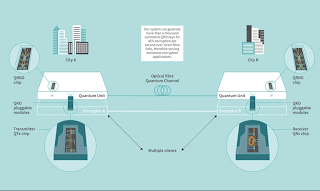
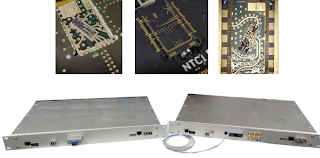
To promote integration into conventional communication infrastructures, the QKD units are assembled in compact 1U rackmount cases. The QRx and QTx chips are packaged into C-form-factor-pluggable-2 (CFP2) modules, a widespread form-factor in coherent optical communications, to ensure forward compatibility of the system with successive QKD chip generations, making it easily upgradeable. Off-the-shelf 10 Gbps small-form-factor pluggable (SFP) modules are used for the public communication channels.


Taofiq Paraiso, lead author of the Nature Photonics paper describing the chip-scale QKD system, says: “We are witnessing with photonic integrated circuits a similar revolution to that which occurred with electronic circuits. PICs are continuously serving more and more diverse applications. Of course, the requirements for quantum PICs are more stringent than for conventional applications, but this work shows that a fully deployable chip-based QKD system is now attainable, marking the end of an important challenge for quantum technologies. This opens a wide-range of perspectives for the deployment of compact, plug-and-play quantum devices that will certainly strongly impact our society.”
Andrew Shields, Head of Quantum Technology at Toshiba Europe, remarked, “Photonic integration will allow us to manufacture quantum security devices in volume in a highly repeatable fashion. It will enable the production of quantum products in a smaller form factor, and subsequently allow the roll out of QKD into a larger fraction of the telecom and datacom network.”

Taro Shimada, Corporate Senior Vice President and Chief Digital Officer of Toshiba Corporation comments, “Toshiba has invested in quantum technology R&D in the UK for over two decades. This latest advancement is highly significant, as it will allow us to manufacture and deliver QKD in much larger quantities. It is an important milestone towards our vision of building a platform for quantum-safe communications based upon ubiquitous quantum security devices.”

http://www.quantum.toshiba.co.uk

BT and Toshiba to build quantum-secured metro network across London

BT and Toshiba are to build a quantum-secured metro network linking sites in London’s Docklands, the City and the M4 Corridor.  The two companies’ initial focus will be to provide trials for enterprise customers who are carrying sensitive traffic (such as database backups) between sites, and to explore potential future offerings such as encrypted links and “quantum keys-as-a-service."  A timeline has not been disclosed.

BT will provide data services secured using Quantum Key Distribution (QKD) and Post-Quantum Cryptography (PQC) over Openreach’s Optical Spectrum Access Filter Connect (OSA FC) solution for private fibre networks. The QKD links will be provided using a quantum network that includes both core and access components, and will be integrated into BT’s existing network management operations. 

Toshiba will provide quantum key distribution hardware and key management software. The company launched commercial products for QKD, manufactured at its Cambridge site, in the latter half of 2020. Toshiba says it has achieved the highest key rates (1,000’s of keys per second) and longest range of any commercially available fibre QKD system.

While BT and Toshiba have previously installed a point-to-point quantum-secure link between two commercial sites, deploying a full quantum-secured metro network environment with multiple endpoints requires new approaches to integration and management. 

Building on the BT and Toshiba point-to-point solution for the Bristol-based NCC (National Composites Centre) and Centre for Modelling and Simulation (CFMS), this new network will extend the solution to serve multiple customers across the London metropolitan area.  

Howard Watson, CTO of BT, said: “BT and Toshiba have established a global lead in the development of quantum-secure networks. We’re excited to be taking this collaboration to the next level by building the world’s first commercially operational quantum-secured metro network in London. Secure, robust and trusted data transfer is increasingly crucial to our customers across the globe, so we’re proud of the role our Quantum R&D programme is playing in making the world’s networks safer as we enter the dawn of a new age of quantum computing.”

Taro Shimada, Corporate Senior Vice President and Chief Digital Officer at Toshiba Corporation, said: “Our partnership with BT will allow us to offer organisations quantum-secured network services which protect their data from retrospective attacks with a quantum computer. We are delighted to work with BT, with its long heritage of delivering secure, trusted networks. This network paves the way for commercial QKD services in the UK and eventually beyond.”


ADVA FSP 3000 powers UK’s first quantum network

ADVA's FSP 3000 platform is powering a metro transport system in the city of Cambridge that is being used for the UK's first quantum network. The project, which is conducted by the UK National Quantum Technologies Programme, super-encrypts data using quantum key distribution (QKD) for complete and long-term cryptographic data security. ADVA said the openness of its ADVA FSP 3000 platform, which can accept keys from third-party systems utilizing...

Toshiba Research, BT and ADVA Test ‘Quantum Leap’ Encryption

Toshiba Research Europe, BT, ADVA Optical Networking and the National Physical Laboratory (NPL), the UK’s National Measurement Institute, have tested Quantum Key Distribution (QKD) technology over a live fibre network. BT said the idea behind the trial is to leverage the principles of quantum mechanics in transmitting encryption key information. Any attempt to intercept the key can be identified, as it introduces anomalies which can be detected....


Windstream and II-VI to develop 400G QSFP-DD pluggables

Windstream Wholesale is working with II-VI to co-develop next-generation, 400G transceivers. The companies said their joint work will:
  • Deliver the world’s first high-performance 0 dBm, 400G QSFP-DD coherent pluggable module—making these transceivers compatible with existing and emerging modern ROADM based photonic layers supporting multi-service, multi-layer architectures;
  • Significantly increase 400G transceiver density by drastically reducing the size and power demands of 400G pluggables relative to sled-based and even CFP2-based solutions;
  • Reduce capex and opex by allowing for direct insertion of high-performance coherent optics into current 400G enabled routers, based on the smaller form factor; and
  • Open up a direct technical path for the further evolution IP-over-DWDM with ROADM-based photonic layers, extending the application space beyond simple point-to-point DCI style networks.
“This game-changing partnership is a vital step toward making 400G wavelengths the default deployment service for large wholesale and hyperscale customers,” said Buddy Bayer, chief network officer at Windstream. “II-VI’s high transmit power 0dBm 400G QSFP-DD DCO transceivers will enable Windstream to deploy greatly simplified network architectures, by optically connecting routers directly to access, metro, and regional transport networks without additional intermediary interfaces, eliminating an entire layer of optical equipment. This revolution in IP-over-DWDM network architecture achieves significant savings in upfront costs and ongoing expenses, affording Windstream a highly competitive operational model.”

“Our partnership with Windstream will fast-track the development of a disruptive 400G transmission technology that builds on our award-winning integrated coherent transmitter and receiver optical subassembly, or IC-TROSA, which itself is based on our advanced and proprietary indium phosphide technology along with our industry leading opto-electronic integration platform,” said Matthias Berger, vice president, coherent technology, II-VI Incorporated. “Indium phosphide is the intrinsic enabler of the 400G transceiver’s high 0 dBm output power yet with low enough power consumption to be uniquely suitable for QSFP-DD.”

An archived webinar panel called “Beyond 400ZR-Expanding the Reach of Pluggable Coherent” is available here:

https://cignal.ai/2021/10/beyond-400zr-expanding-the-reach-of-pluggable-coherent/?utm_campaign=xxxx&utm_source=yyyy&utm_medium=zzzz

https://news.windstream.com/news/default.aspx

Intel sees 10% rise in Data Center Group sales, except cloud

 Citing strong revenue for its Internet of Things Group (IOTG) and record third-quarter revenue in the Data Center Group (DCG) and Mobileye businesses, Intel reported Q3 GAAP revenue of $19.2 billion, up 5% year over year (YoY), and non-GAAP revenue of $18.1 billion, up 5% YoY. 

While topline revenue missed market estimates by $170 million, non-GAAP EPS surpassed expectations. Third-quarter GAAP earnings-per-share (EPS) was $1.67; non-GAAP EPS was $1.71, which exceeded July guidance by $0.61. As a result, Intel raised its full-year 2021 EPS and gross margin guidance and is now expecting GAAP EPS of $4.50 and non-GAAP EPS of $5.28 and GAAP gross margin of 55% and non-GAAP gross margin of 57%.

“Q3 shone an even greater spotlight on the global demand for semiconductors, where Intel has the unique breadth and scale to lead. Our focus on execution continued as we started delivering on our IDM 2.0 commitments. We broke ground on new fabs, shared our accelerated path to regain process performance leadership, and unveiled our most dramatic architectural innovations in a decade. We also announced major customer wins across every part of our business,” said Pat Gelsinger, Intel CEO. “We are still in the early stages of our journey, but I see the enormous opportunity ahead, and I couldn’t be prouder of the progress we are making towards that opportunity.”


AT&T's fiber broadband net adds continue to rise

Citing customer growth in wireless, fiber and HBO Max, AT&T reported Q3 consolidated revenues of $39.9 billion versus $42.3 billion in the year-ago quarter. The 5.7% drop was attributed to separation of the U.S. video business, other divested businesses, and lower Business Wireline revenues. Excluding these items, consolidated revenues totaled $38.1 billion compared to $36.4 billion in the year-ago quarter.

Third-quarter net income attributable to common stock was $5.9 billion, or $0.82 per diluted common share, versus $2.8 billion, or $0.39 per diluted common share in the year-ago quarter. 

“We continue to execute well in growing customer relationships, and we’re on track to meet our guidance for the year,” said John Stankey, AT&T CEO. “We had our best postpaid phone net add quarter in more than 10 years, our fiber broadband net adds increased sequentially, and HBO Max global subscribers neared 70 million. We also have clear line of sight on reaching the halfway mark by the end of the year of our $6 billion cost-savings goal.”

Some Communications highlights

Mobility:

  • 928,000 postpaid phone net adds
  • 1,218,000 postpaid net adds
  • 249,000 prepaid phone net adds
  • Postpaid phone churn of 0.72%
  • Revenues up 7.0%; service revenues up 4.6%; equipment revenues up 15.0%
  • Operating income of $6.0 billion, up 4.6% year over year; EBITDA up 3.6%
  • Operating income margin of 31.1%; EBITDA service margin 55.0%

Consumer Wireline:

  • 289,000 AT&T Fiber net adds; penetration about 37%
  • Revenues up 3.4%; broadband revenues up 7.6% with ARPU growth of 5.2%

https://about.att.com/story/2021/q3_earnings.html

ProLabs offers 100G EDFAMUX & QSFP28 PAM4 DWDM transceivers

ProLabs introduced a new long range 80km DWDM solution by pairing its 100G erbium-doped fiber amplified multiplexer (EDFAMUX) with QSFP28 PAM4 DWDM 2x50G transceivers.

The EDFAMUX is an all-in-one solution that includes the multiplexer, EDFA, and dispersion compensator in a 1 rack unit (1RU) 19" package, reducing space and patch complexity while adding the ability to reconfigure as needed.When paired with the DWDM PAM4 transceivers that require dispersion compensation for reaches beyond 5km, the system is capable of DWDM signals up to 80km across channels 29 to 59.

"By including the EDFA and dispersion compensator in the multiplexer, network operators can optimize rack space and simplify PAM4 DWDM deployments," said Ray Hagen, Global Product Line Manager at ProLabs. "The saved rack space can be used for additional bandwidth-increasing components, while the EDFAMUX simplifies the DWDM run via its web- and console-configuration and network agnostic physical layer package."

ProLabs' new 80km DWDM long range solutions are coded for full feature compatibility in environments with systems from Cisco, Juniper, Arista, etc.

http://www.prolabs.com

Wednesday, October 20, 2021

DT runs with Cisco 8000 Series routers

One year after introducing its 8000 Series routers, Cisco confirmed that Deutsche Telekom (DT) has now deployed the new platforms, which feature Cisco Silicon One Q200 series chips, to boost its network performance and reach – now supporting 246M mobile customers, more than 27 million fixed-network lines and 22 million broadband lines. 

Deutsche Telekom worked closely with Cisco to move from redesign to full provisioning in under four months

The companies also note that the deployment helps DT make a significant contribution towards achieving its CO2 neutralization goals. The Cisco 8000 series routers reduce power consumption by up to 92% per 100 Gbps compared to the previous Cisco CRS-X multi-chassis system.


“Providing our customers with fast, reliable broadband to stay connected to the people and things that matter most is our top priority,” said Walter Goldenits, CTO of Telekom Deutschland GmbH. “The cooperation with Cisco provides us with a secure and stable network with supreme availability and security which benefits our customers.”

“We have seen the world transform over the last year and a half and the internet had to transform with it,” said Jonathan Davidson, Executive Vice President and General Manager, Mass-Scale Infrastructure Group, Cisco. “Working together with leading service providers like Deutsche Telekom, we are showcasing how the latest in networking, routing and silicon technology can deliver the internet experience we need to stay connected – and bring more people online.”

https://newsroom.cisco.com/press-release-content?type=webcontent&articleId=2203691

Cisco unveils Routed Optical Networking

Cisco announced a number of  Internet infrastructure products and technologies including a new Routed Optical Networking solution featuring Acacia pluggable optics and Cisco’s full mass-scale routing portfolio. The company claims its integration of routing and optics will lead to savings of up to 46% over traditional, layered IP + optical product architecture.

At its virtual Cisco Live! event, the company said Acacia’s pluggable coherent optics, advancements in Segment Routing and Ethernet VPN, and new Cisco Crosswork Cloud capabilities will lead to greater efficiency for service providers and web scale companies such as Airtel, Altibox, Eolo, Facebook, Google Cloud, Rakuten Mobile, SFR, Telenor, Telia Carrier, Telstra, Websprix, etc.

Here are some highlights of the announcements

Cisco Silicon One - Cisco first introduced its programmable networking silicon architecture in 2019. The company has now expanded the Cisco Silicon One platform from a routing-focused solution to one which also addresses the web-scale switching market, offering ten networking chips (devices) ranging from 3.2 Tbps to 25.6 Tbps.

Subscriber Management - Cisco is introducing its new Cisco Cloud Native Broadband Network Gateway for telco customers (wireline), joining the Cisco family of existing cloud native broadband routers for cable and mobile. It paves the way for convergence to a unified subscriber management solution, bringing further simplification and efficiency while enabling service providers to offer truly access-agnostic services independent from where people use these services.  

Routing for the Access, Aggregation, Edge, and Core 

  • Cisco’s latest 8000 family of routers now features Cisco Silicon One Q200 series chips offering up to 14.4 Tbps total capacity, enabling 32 and 64 x 100G web-scale switches.
  • Introducing powerful new line cards and chassis for the Cisco Aggregated Service Router (ASR) 9000 series and Network Convergence System (NCS) 500 and 5500 series routers providing increased capacity with capital and operational cost savings
  • New Crosswork Network Controller (CNC) features help customers operate the Cisco Routed Optical Networking solution

Cisco Crosswork Cloud - new application called Traffic Analysis offers a comprehensive view across network peering points. With this insight

Cisco Business Critical Services - design and consulting services to help customers adopt Cisco's Routed Optical Networking and Cloud Native Broadband solutions. 

Cisco boosts high-performance SD-WAN with Catalyst 8000 Series

 Cisco introduced its  Catalyst 8000 Series Edge Platform, a new high-performance routing platform to help customers accelerate cloud adoption and deliver secure and automated connectivity to applications across cloud, data center, and edge.Cisco says its new platform allows customers to adopt cloud solutions at their own pace. It adopts a Secure Access Service Edge (SASE) architecture. Three versions are available.The Catalyst 8500 Series...


Ericsson debuts Network Data Analytics Function for cloud-native 5G Core

Ericsson introduced a Network Data Analytics Function (NWDAF) to help drive smarter data-driven policies in cloud-native 5G cores. NWDAF is a reusable set of microservices integrated into Ericsson’s cloud-native dual-mode 5G Core and in Ericsson Expert Analytics . Flexible deployment scenarios and model portability enable the NWDAF to be located both centrally and as a built-in NWDAF in the 5G Core products. NWDAF is based on 3GPP Release 17, defining a distributed network analytics architecture where inference and training, and data repository are separated.

NWDAF enhances network operability by providing insight that helps the service provider identify and solve network problems on different levels as well as input for taking valued business decisions. One example is automated closed loops (data retrieval, analytics processing, insights generation and action enforcement) on different network and application levels.

Ericsson says its NWDAF can drive up to 45 percent reduction in OPEX and CAPEX compared with typical third-party NWDAF implementation with event exposure. Smart data acquisition allows more efficient integration and testing, simpler orchestration and optimal footprint.

Neil McRae, MD Architecture & Strategy, BT Group Chief Architect says: “At BT we connect for good and our customers increasing reliance on the network requires us to think differently. With Ericsson we are working on cloud native solutions for 5G Core architecture to support multiple generations of technologies and we see the need for greater automation and analytics to manage complex networks and ensuring the best quality experience for our customers. I’m pleased to see that Ericsson is launching NWDAF building upon Ericsson’s built-in software probes and Expert Analytics (EEA), a natural next step development to enhance closed loop automation and service assurance that could benefit BT’s Customer Network Experience (CNE) platform.”

Monica Zethzon, Head of Solution Area Packet Core, Ericsson, says: “Everything 5G, especially 5G Core networks, must be automated. Automation will improve operational efficiency, reduce time to market for new services and is required to handle the magnitude of tailor-made services that will be introduced with 5G. With the launch of NWDAF we build the automated closed loop and assurance, enabled by AI and machine learning, to leverage data-driven operation based on network data.”

https://www.ericsson.com/en/press-releases/2021/10/ericsson-enables-smarter-networks-that-learn-and-improve


Qualcomm's ultraBAW filters extend RF for 5G and Wi-Fi up to 7 GHz

Qualcomm introduced ultraBAW RF filter technology for 5G and Wi-Fi bands up to 7 GHz. Radio frequency (RF) filters isolate radio signals from the different spectrum bands that phones use to receive and transmit information.

Qualcomm said the new ultraBAW RF filters, which extends and expands the company's existing ultraSAW portfolio, will be especially useful for providing access to sub-7 GHz spectrum in next-generation mobile devices, laptops, as well as numerous solutions for Automotive, IoT, and industrial applications to benefit from 5G and Wi-Fi co-existence, leading to enhanced performance and power efficiency indoors and outdoors. While Qualcomm ultraSAW covers low-band frequencies from 600 MHz to 2.7 GHz, the Qualcomm ultraBAW covers the range from 2.7 to 7.2 GHz, expanding mid-band connectivity up to sub-7 GHz. Qualcomm ultraBAW also supports ultra-wide channels of up to 300 MHz, and co-existence for 5G and/or Wi-Fi networks, enabling faster downloads and uploads.

“Our new generation RF filter solutions are crucial in the expansion of 5G beyond mobile. We’ve seen tremendous success with our Qualcomm ultraSAW technology for sub-3 GHz, and now with Qualcomm ultraBAW we’re able to offer superior performance up to 7 GHz,” says Christian Block, senior vice president and general manager, RFFE, QUALCOMM Germany RFFE GmbH. “Qualcomm Technologies is working with industry-leading OEMs to develop the next generation of connected devices, allowing consumers to seamlessly enjoy peak performance from 5G NR and Wi-Fi networks, wherever they’re streaming videos, downloading files, or enjoying extended reality experiences.” 

https://www.qualcomm.com/news/releases/2021/10/20/qualcomm-announces-new-rf-filter-technology-enable-next-generation-5g-and

ProLabs intros SFP+ 10G narrowband 9 channel tunable 40km transceivers

ProLabs introduced new SFP+ 10G DWDM narrowband 9 channel tunable 40km fiber transceivers for data centers and enterprise networks. The solution contains five tunable optics with the capability to tune to channels 20-28, 28-36, 36-44, 45-52, or 52-60, covering from 1561.42nm to 1531.12nm.

Network operators can tune these 10G DWDM 40km optics using the ProTune Coding & Tuning System or in-field autonomously. This reduces the need for 40 discrete part numbers and fixed wavelength specifications down to only 5 different 10G DWDM tunable transceivers.

"The flexibility offered by a tunable 10G DWDM transceiver addresses many operational challenges," said Ray Hagen, Global Product Line Manager at ProLabs. "A 10G tunable in the access network reduces sparing & inventory complexities, allowing for greater quantities of fewer parts on hand. This simplification of parts allows fix agents to fit as needed into any network segment and wavelength, improving performance in mean-time-to-repair."

Verizon reports accelerated 5G adoption

Citing accelerated 5G adoption and continued expansion of its FWA, mmWave and FiOS footprints, Verizon reported revenue of $32.9 billion, up 4.3 percent from third-quarter 2020. This includes two months of Verizon Media revenue of approximately $1.4 billion on a segment basis. Excluding Verizon Media, operating revenues increased 5.5 percent. Net income amounted to $6.6 billion, an increase of 45.5 percent from third-quarter 2020, and adjusted EBITDA of $12.3 billion, an increase of 3.3 percent from third-quarter 2020.

Capital expenditures year-to-date were $13.9 billion. 

"We had a strong third quarter, delivering on our strategy and growing in multiple areas," said Verizon Chairman and CEO Hans Vestberg. "Our disciplined strategy execution demonstrated growth in 5G adoption, broadband subscribers and business applications. We are increasing our 2021 guidance, and we continue to expand our 4G LTE and 5G network leadership. We fully expect to have a strong finish to the year as we accelerate deployment of 5G to our customers across the country."


Some highlights:

  • Total Verizon Consumer revenues were $23.3 billion, an increase of 7.3 percent year over year. 
  • Consumer wireless service revenues were $14.0 billion in third-quarter 2021, a 4.0 percent increase year over year. Consumer grew phone net additions and continued to execute on its unlimited and premium unlimited migration strategy.
  • Consumer wireless retail postpaid churn was 0.84 percent in third-quarter 2021, and wireless retail postpaid phone churn was 0.67 percent. 
  • In third-quarter 2021, Consumer reported 423,000 wireless retail postpaid net additions. This consisted of 267,000 phone net additions and 223,000 other connected device net additions, offset by 67,000 tablet net losses. Consumer's phone net additions in third-quarter 2021 were more than Consumer's phone net additions in both third-quarter 2020 and third-quarter 2019.
  • There were 98,000 Fios Internet net additions in third-quarter 2021. Consumer Fios revenues were $2.9 billion in third-quarter 2021, an increase of 4.3 percent year over year. Consumer reported 68,000 Fios Video net losses in third-quarter 2021.
  • In third-quarter 2021, Business continued to see strong demand for wireless services across multiple verticals. Strong Small and Medium Business momentum, the best performing quarter year-to-date for wireless subscriber growth in Global Enterprise and an increase in activity with enterprises in the private wireless and MEC space led the quarter.
  • Total Verizon Business revenues were $7.7 billion, down 0.8 percent year over year. Wireless revenue growth continues to offset ongoing legacy wireline declines.
  • Business wireless service revenues were $3.1 billion in third-quarter 2021, a 3.6 percent increase year over year.
  • Business wireless retail postpaid churn was 1.29 percent in third-quarter 2021, and wireless retail postpaid phone churn was 1.04 percent.
  • Business reported 276,000 wireless retail postpaid net additions in third-quarter 2021, including 162,000 phone net additions.


Cisco announces its strategic product categories


Cisco confirmed its plans report its product and service revenue in the following categories effective Q1 FY 2022: 

  • Secure, Agile Networks
  • Hybrid Work
  • End-to-End Security
  • Internet for the Future
  • Optimized Application Experiences
  • Other Products
  • Services

The change was first noted in Cisco's Investor Day presentations. Cisco plans to report its Q1 FY 2022 in a conference call scheduled for Wednesday, November 17, 2021.


ADVA's Q3 revenues up 3.5% year-over-year to EUR 151.8 million


Citing growth in demand from communication service providers (CSPs), ADVA reported quarterly revenues of EUR 151.8 million, up 3.5% year-over-year to EUR 146.7 million in Q3 2020. 

Pro forma gross profit in Q3 2021 decreased by 8.9%, reaching EUR 52.2 million (34.4% of revenues) compared to EUR 57.3 million (38.3% of revenues) in Q2 2021 and increased by 0.4% compared to EUR 51.9 million (35.4% of revenues) reported in Q3 2020. The reduction in gross profit compared to the previous quarter is mainly attributable to the semiconductor crisis, which led to increased purchasing costs.

Pro forma operating income for Q3 2021 was EUR 13.0 million (8.6% of revenues) and decreased by 9.7% compared to EUR 14.4 million (9.7% of revenues) reported in Q2 2021. Compared to Q3 2020, pro forma operating income improved substantially by 17.7% from EUR 11.1 million (7.5% of revenues).

Operating income for Q3 2021 of EUR 9.5 million decreased substantially by 27.2% from EUR 13.0 million reported for Q2 2021 and slightly decreased by 2.8% from EUR 9.8 million in Q3 2020. Operating income for Q3 2021 was impacted by extraordinary expenses in connection with the announced merger with ADTRAN amounting to EUR 2.1 million.

Net income reached EUR 18.5 million in Q3 2021, substantially up by 54.0% from EUR 12.0 million in Q2 2021, and significantly up by 177.0% from EUR 6.7 million in Q3 2020. The significant increase in net income is mainly due to a tax benefit of EUR 8.8 million resulting from increased deferred tax assets.

The company’s cash and cash equivalents totaled EUR 100.5 million, representing an increase of EUR 15.5 million compared to EUR 85.0 million at the end of Q2 2021. Year-over-year cash and cash equivalents substantially increased by EUR 32.2 million from EUR 68.3 million at the end of Q3 2020.

Net cash at the end of Q3 2021 stood at EUR 20.6 million compared to a net cash position of EUR 3.9 million at the end of Q2 2021 or a net debt position of EUR 35.0 million at the end of Q3 2020.

“Customer demand for our solutions remains strong and we’re fighting hard to overcome the current supply chain challenges,” said Brian Protiva, CEO, ADVA. “We’re also looking forward to the planned business combination with ADTRAN. Our industry is in the early stages of an unprecedented investment cycle in fiber expansion propelled by the goal of delivering high-speed connectivity to all homes, businesses and the future 5G infrastructure. This expansion of the digital infrastructure requires new, innovative solutions and drives convergence at the network edge. Together with ADTRAN, we’re creating a market and innovation leader in this space that offers the industry’s most comprehensive and unique portfolio of solutions based on openness, scalability, security and software-controlled automation.”

“In view of the global semiconductor crisis, the third quarter was definitely challenging. Nevertheless, we managed to grow and generate solid margins. In addition, we were able to generate cash, and with more than EUR 100 million cash and a net cash position of around EUR 21 million, we further improved our level of financial flexibility,” said Uli Dopfer, CFO, ADVA. “The semiconductor crisis will last longer than we originally assumed, and the coming weeks and months will certainly be demanding again. Nevertheless, we are confident that with these strong numbers and order books at a record level, we will be able to overcome these supply challenges and close the year with good results within our outlook.”

https://www.adva.com/en/newsroom/press-releases/20211021-adva-manages-supply-constraints-and-grows-revenues-and-profitability-in-q-3-2021

ADTRAN + ADVA merger targets fiber broadband opportunities

ADTRAN and ADVA announced a merger focused on end-to-end fiber networking solutions for communications service providers, enterprise and government customers. The deal combines ADTRAN’s market presence in fiber access, fiber extension and subscriber connectivity solutions with ADVA’s position in metro wavelength division multiplexing, data center interconnect, business ethernet and network synchronization solutions. The new company, which will...


Telenor deploys 5G xHaul transport with Cisco and NEC

Telenor has selected NEC and Cisco to deploy 5G xHaul transport networks in Norway and Denmark.

Cisco will supply its NCS 540 series as the cell site router and NEC will provide value added services to implement an architecture that enables flexible and highly scalable end-to-end IP/MPLS networks with bandwidth that can support the high-capacity and low-latency communication required by 5G. 

“As a One-stop Network Integrator, NEC takes a customer-first approach, providing optimal solutions that match individual requirements based on our best-of-breed ecosystem, consisting of NEC's own products and those from industry-leading partners such as Cisco. We are excited to contribute to the advancement of Telenor's 5G network evolution,” said Mayuko Tatewaki, General Manager, Service Provider Solutions Division, NEC Corporation.

NEC and Cisco partner on 5G IP transport

NEC and Cisco announced a Global System Integrator Agreement (GSIA) to expand their partnership for accelerating the deployment of innovative 5G IP transport network solutions worldwide.

NEC has been a Cisco Gold Partner for over two decades.

Under the agreement, the companies will jointly drive new business opportunities for 5G. NEC group companies will work closely with Cisco to complement NEC’s ecosystem with optimized IP metro/access transport and edge cloud computing solutions. Cisco will support NEC’s customer engagements by offering best-in-class products, proposals and execution support.

The companies said they will strive to further enhance their joint solution portfolio and to optimize regional activities for advancing the digital transformation of customers across the globe.

"We believe 5G is fueling the internet for the future, and accelerating our customers’ digital transformations," said Jonathan Davidson, Senior Vice President and General Manager, Mass-Scale Infrastructure Group, Cisco. "Together with NEC, we are creating a powerful force to drive the critical changes needed in networking infrastructure to carry the internet into the next decade."