Wednesday, July 22, 2020

India's Airtel renews managed services contract with Ericsson

Bharti Airtel =has renewed its agreement with Ericsson (NASDAQ: ERIC) to provide pan-India managed network operations through Ericsson Operations Engine.

The three-year deal will see Airtel launching Ericsson Operation Engine during 2020. Ericsson will deploy the latest automation, machine learning and artificial intelligence (AI) technologies to enhance Airtel’s mobile network performance and customer experience. Ericsson will also manage Airtel’s network operations center and field maintenance activities across India. Ericsson will also provide Network Optimization Services, combining multi-vendor networks expertise with its state-of-the-art machine learning/AI-enabled Cognitive Software Suite. This will deliver a better customer experience and ensure a superior return from Airtel’s deployed network assets.

The agreement builds on the 25-year collaboration between Ericsson and Airtel in India.

Randeep Sekhon, Chief Technology Officer, Bharti Airtel, says: “We are pleased to strengthen our deep partnership with Ericsson as part of our vision to build a future ready network that enables world-class experience for our customers. We are confident these new technologies will enable us to serve the emerging data requirements of customers in a digitally connected India.”

Deutsche Telekom launches LTE-M in Germany

Deutsche Telekom LTE-M is now commercially available across Germany in both post-paid and pre-paid IoT offerings, including its Business Smart Connect LPWA and M2M tariffs.

Deutsche Telekom already completed first certifications of a handful of LTE-M chipsets and modules, thereby enabling faster user time-to-market and connectivity quality.

“LTE-M gives our customers the opportunity to develop new solutions where previous technologies had their limitations,” says Rami Avidan, CEO of Deutsche Telekom IoT GmbH. “The technology is a firm part of our overall IoT network portfolio. It is 5G-ready and therefore future-proof – ideally positioned to drive innovation for the Internet of Things even further.”

In comparison to NB-IoT, LTE-M offers higher data rates (up to 350 Kbps), lower latency, connected mobility (i.e. the ability of a technology to do handover between cells), and SMS support.

https://www.telekom.com/en/media/media-information/archive/deutsche-telekom-launches-lte-m-in-germany-604370

Deutsche Telekom launches NB-IoT in Germany

Deutsche Telekom launched its NarrowBand IoT (NB-IoT) service in Germany. The network currently covers 90 percent of the nation's territory and 90% of its population. The rollout will be completed by the end of 2019.

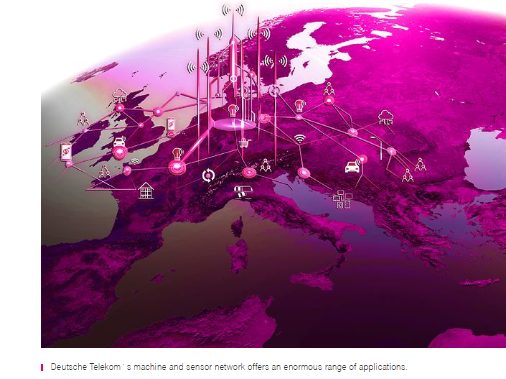
"Our machine and sensor network offers an enormous range of applications," says Kai-Ulrich Deissner, Head of International Technology & Services Delivery, Deutsche Telekom. "Mobility, security or waste management are just a few areas that the new network revolutionizes. It is an important prerequisite for the development of mobile IoT in the years to come."

Deutsche Telekom is also introducing NB-IoT roaming in Europe. As a first step, the national companies in Germany, Austria, the Netherlands, Hungary, Slovakia and the Czech Republic support roaming among each other. Other countries will follow.
Nine European subsidiaries and the USA have introduced NB-IoT so far. The Netherlands completed their nationwide rollout in mid-2017. Austria and Slovakia have been covered nationwide since 2018.

Quintillion adds former NORAD commander as strategic advisor

Quintillion, which built a submarine and terrestrial high-speed fiber optic cable system that spans the Alaskan Arctic, named General (Ret.) Charles H. Jacoby Jr. as a Senior Strategic Advisor.  Jacoby previously served as the first Army officer to command North American Aerospace Defense Command (NORAD) and the United States Northern Command.

Quintillion has already deployed over 1,600 miles of fiber optic cable off the Alaskan coast. The company says it three-phase subsea cable system will ultimately connect Asia to the American Pacific Northwest, and to Western Europe via the Northwest Passage through the Alaskan and Canadian Arctic.

http://qexpressnet.com/

T-Mobile cuts pricing for post-paid with unlimited data

T-Mobile announced an aggressive new price point for its postpaid service: four lines of unlimited data for $25 each/month. Four 5G phones can be included for $5 more each/month, and all with 5G access included. The offer is for a limited time.

On August 2, the newly merged company begins operations under the flagship T-Mobile brand in retail nationwide, bringing the network of Sprint and T-Mobile stores together and beginning to roll out new  policies nationwide.

Huawei and partners establish 4G/5G FWA Technology Forum

Huawei and 20 industrial partners jointly announced the establishment of the 4G/5G FWA Technology Forum as a platform that convenes industrial and ecosystem partners to jointly promote the rapid development of 4G and 5G FWA technologies.

Participating companies include ASR, Atel, Esound, Fibocom, FROG, GOSUNCN, HAIOT, Lintron, MaxComm, MobiWire, MOBOT, Neoway, NOTION, QUECTEL, Sequans, Tigercel, Tozed Kangwei, UNISOC, and Zmtel.

According to the joint declaration, the forum will serve to help:

  • Share trends in the industry, identify directions in technical development, accumulate successful experiences, and overcome business challenges.
  • Improve the 4G and 5G FWA technologies required to provide wireless broadband connection solutions with increased performance and cost-effectiveness.
  • Enhance the collaboration between FWA solution providers and mobile network operators to improve the industry's ecosystem and ensure business success.
  • Promote the success of the FWA industry to accelerate the provisioning of broadband access to anyone, anywhere, with the goal of "connecting the other half" of the world's population.


Zhang Yiqu, General Manager of WTTx Product Line, said in his speech: "Almost 50% of the world's population is still outside the scope of Internet coverage. This represents both enormous challenges and huge market potentials that require the entire industry to come together to develop solutions. Through the 4G/5G FWA Technology Forum, Huawei is excited to collaborate with partners to accelerate the deployment of 4G and 5G FWA and contribute to "connecting the other half" of the world's population. This will be a great achievement for the FWA industry in the new era of wireless home broadband."

Tuesday, July 21, 2020

Verizon tests 800G long-haul with Infinera

Verizon successfully carried an 800 Gbps wavelength over its live, long-haul fiber network using equipment from Infinera.

The trial was conducted over Verizon’s live production network with a combination of industry standard fibers. The trial used Infinera’s fifth-generation coherent optical technology, ICE6 (Infinite Capacity Engine), equipped in a GX Series platform and marked the following significant industry achievements:

  • 800 Gbps single-wavelength transmission over 667 km between Nashville and Atlanta
  • 600 Gbps single-wavelength transmission over 2,283 km from Atlanta to Memphis with a loop back in Memphis
  • 400 Gbps single-wavelength transmission over 4,091 km from Atlanta to Dallas with a loop back in Dallas

“Verizon continually pursues the latest technology to provide high-speed, reliable transport solutions while meeting demanding network requirements,” said Parthiban Kandappan, chief technology officer at Infinera. “With Infinera’s ICE6 technology, Verizon successfully transmitted high-speed optical signals across substantial distances over all network fiber types. This industry-leading optical innovation coupled with flexible configurations provides a single transmission solution that enables both 800 Gbps over large portions of the network and cross-continental transmission at 400 Gbps.”

“With the evolution into more robust 5G applications and solutions, the ability to move massive amounts of data across long distances becomes even more crucial,” said Kevin Smith, Vice President of Technology Planning and Development for Verizon. “Continuing to advance the capabilities of our extensive fiber network alongside advancements in 5G technology, the Radio Access Network, and the network core will result in an unparalleled network experience for our consumer and enterprise customers.”

https://www.verizon.com/about/news/verizon-long-haul-data-session


Verizon carries 800 Gbps wavelength

Verizon reported the transmission of 800 Gbps of data on a single wavelength over its live network.

The test showed equipment interoperability from two different suppliers and the capability to quadruple the typical capacity carried on a wavelength. The test traffic was transmitted between two Juniper Networks QFX 5220 packet platforms across two Ciena 6500 platforms powered by WaveLogic 5 Extreme (WL5e) coherent optics.

Verizon said the use of this new coherent optics and equipment from Ciena and Juniper demonstrates the evolution to a more software-driven and automated network with tunable capacity from 200Gbps to 800Gbps per wavelength.\

“In the past, we needed to combine multiple wavelengths to achieve 800 Gbps capacity,” said Kevin N. Smith, Vice President of Technology and Planning for Verizon. “Now, with the new optics configuration from Ciena and Juniper Networks on our fiber network, we are advancing our connecting layer of fiber to prepare for the explosion of data we know will come along with 5G’s transformational impact on industries and consumers. And being the only provider in the industry with that capacity on a single wavelength allows us to deliver the service at a much lower cost per bit.”

Innovium raises $170 million for its switching silicon

Innovium, a start-up based in San Jose, California, raised $170 million for its switching silicon solutions cloud and edge data centers.

The new funding round included investments from Premji Invest, DFJ Growth, funds and accounts managed by BlackRock, and multiple strategic investors, along with existing investors including Greylock, Capricorn, WRVI, Qualcomm Ventures, Redline, S-Cubed Capital and DAG

. Innovium said this latest funding makes it the first network silicon company to achieve billion-dollar valuation "unicorn" status.

Earlier this year, Innovium unveiled its TERALYNX 8 silicon boasting 25.6Tbps switch with 112G SerDes

In addition, Innovium noted the following milestones during 1H 2020:

  • Continued volume production ramp of TERALYNX 7
  • Ramping TERALYNX 5 shipments for ToR, Edge & 5G customer designs
  • Revenue growth of over 5x in 1H 2020 vs 1H 2019
  • Achieved over 20% market share in 50G WW SerDes shipments and emerged as the only credible silicon diversity option [1]
  • Wins, deployments and trials at majority of top 25 Cloud customers in the world

“We are delighted at the strong adoption at leading OEM, Cloud and ODM customers for our TERALYNX® family, which resulted in over 20% market share for 50G SerDes switch silicon in our first year of shipments. This additional funding, achieved despite ongoing macroeconomic uncertainty, validates our vision, execution and momentum in a multi-billion secular high-growth market,” said Rajiv Khemani, Co-founder and CEO of Innovium.

“Data centers are expected to see secular long-term expansion from Cloud, 5G, AI and remote-work applications. Innovative TERALYNX switch silicon products from Innovium have already been adopted by world’s leading hyperscale Cloud providers and leading OEMs including Cisco. We are excited to partner with Innovium for its roadmap innovation and help accelerate go-to-market ramp up,” said TK Kurien, Managing Partner and Chief Investment Officer at Premji Invest.

https://www.innovium.com/

Innovium pushes switching silicon to 25.6 Tbps with support for 112G PAM4

Innovium unveiled its TERALYNX 8 networking switch silicon featuring a massive 25.6 Tbps capacity and support for 112G PAM4 SerDes I/O. This next-generation TERALYNX 8 design features deep programmability, the largest on-chip buffers, and advanced telemetry capabilities.

Innovium's TERALYNX 8 switch, which is aimed at hyperscale data centers and which is expected to sample in the second half of 2020, could be used for highly compact, highest port-density single-chip switches for 100G to 800G configurations, including 1RU, 32 x 800G switch. The silicon will be delivered in a single 7nm die fabricated by TSMC.

Innovium confirmed that its current generation, 12.7 Tbps switching silicon is already being used by numerous commercial customers, including some of the biggest cloud provider networks.

Some TERALYNX 8 highlights

  • 112G SerDes IO with best economics for next-generation switches
  • Up to 256 long-reach (LR) 112G PAM4 SerDes to enable switch configurations such as 32 x 800G, 64 x 400G, 128 x 200 and 256 x 100G
  • Enables industry’s most compact 32 x 800G (25.6 Tbps) switch in 1RU form factor
  • Enables a range of connectivity options, including 10/25/50/100/200/400 GbE
  • Range of pin-compatible SKU options, including 25.6 Tbps, 12.8 Tbps and 8Tbps
  • Largest on-chip buffer of 170 MB for a data-center switch
  • Highest radix with 256 ports to help flatten network tiers
  • INNOFLEX programmable forwarding pipeline offers unmatched flexibility and feature-set
  • Enhanced forwarding and ACL table scales
  • Robust RoCE, PFC and rich QoS necessary for distributed storage, HPC and AI applications
  • FLASHLIGHT™ v3 telemetry and analytics solves toughest troubleshooting problems
  • Hardware driven in-band and streaming telemetry available at line-rate
  • Additional innovations for deep analytics correlated to applications
  • Unique predictive and actionable information versus reactive data overload seen in alternative switch providers
  • Industry’s most scalable and fully compatible product line from 1 to 25.6T
  • Full SW and architecture compatibility with TERALYNX 5 & TERALYNX 7

New Zealand's Spark builds OTN 2 with Ciena

Spark has completed the first stage of its next generation Optical Transport Network (OTN 2) using equipment, software and services from Ciena.

The OTN 2 rollout is a two-year project, which has started in Auckland, and will expand towards Hamilton, Wellington and Christchurch. Initially, the new OTN equipment will be an express overlay to the existing core network, then will eventually replace the existing OTN.

The network, which features ‘self healing’ capabilities to automatically restore services after things like natural disasters, is now live and operating at 800 Gbps. Spark’s previous links operated at 100 or 200 Gbps. The rollout includes Ciena’s 6500 flexible grid colorless, directionless and contentionless (CDC) photonic line system with advanced control plane capabilities, WaveLogic 5 Extreme coherent optics, and Manage, Control and Plan domain controller with Liquid Spectrum analytics.

Campbell Fraser, Spark’s Technology Tribe Lead said that the roll out of OTN 2 will deliver increased resiliency enabling Spark to respond and restore service much faster after events such as the Kaikoura earthquakes.

“The ‘self-healing’ technology, which we believe is a first for New Zealand, will minimise the impact of network outages. These are caused by cuts in the fibre cable from earthquakes, floods, landslips, construction works or rodents damaging cables. Currently, restoring service is a manual process but the sharp growth in network traffic means manual restoration is becoming unmanageable. The optical restoration ‘self-healing’ technology allows the light signals that carry the data to automatically change their path after a fibre cut, so this is a big step forward. We expect to be able to restore services much more quickly so we can get customers back up and running.”

“A self-healing and resilient network that can automatically fine tune capacity and dynamically adapt to evolving user demands and unexpected fibre cuts or natural disasters is critical in today’s digital-first environment,” said Rick Seeto, Vice President and General Manager of Asia-Pacific and Japan, Ciena.

Dell'Oro: Sustained growth for the Optical Transport Market

The Dell'Oro Group is forecasting the Optical Transport market, largely comprised of DWDM systems, to expand in 2020 and for the next five years, reaching nearly $18 billion.

Some highlights from Dell'Oro's Optical Transport five-year forecast:

  • By 2024, nearly 30 percent of wavelength shipments will be from an 800 Gbps-capable line card. More than half of these line cards are expected to be used at 400 Gbps.
  • The next wavelength speed following 800 Gbps will be 1200 Gbps (1.2 Tbps). Based on the timing of past coherent DSP introductions and first-line card shipments, we anticipate 1.2 Tbps-capable line cards to enter the market in the 2023-2024 time period (but more likely in 2024).
  • Demand for Optical Transport gear for data center interconnect (DCI) is expected to take a turn in the near future.
  • Disaggregated WDM transponder unit sales are a bright spot of growth, annually growing at a double-digit percentage rate.
  • 400ZR will moderate the market’s growth.

https://www.delloro.com/news/optical-transport-market-to-expand-for-many-more-years-reaching-nearly-18-billion/

Equinix builds flagship data center in Milan

Equinix is building a new state-of-the-art colocation data center in Milan, Italy.

Known as ML5 and due to open in Q1 2021, the International Business Exchange (IBX) data center will host advanced interconnection services, including Equinix Cloud Exchange Fabric (ECX Fabric) and Equinix Internet Exchange.

The facility is situated in North-West Milan, which will provide customers with direct access to Equinix's industry-leading software-defined networking service, ECX Fabric, enabling virtual interconnections to some of the largest cloud providers in the world, such as: Amazon Web Services, Microsoft Azure, Oracle Cloud Infrastructure and Google Cloud.

The $51 million first phase of ML5 is expected to provide a capacity of 500 cabinet equivalents and colocation space of approximately 15,000 square feet (1,400 square meters). Upon completion of the planned future phases, ML5 is expected to provide total capacity of more than 1,450 cabinet equivalents and colocation space of more than 45,000 square feet (4,200 square meters).

The ML5 IBX is the fourth data center for Equinix in Italy.


Windstream reports Q2 revenue of $1.2 billion

Windstream reported Q2 preliminary total revenues and sales of $1.185 billion, operating income of $24.8 million and Adjusted OIBDAR of $424 million, representing the third consecutive quarter of sequential growth in Adjusted OIBDAR as total cash operating costs fell by 9 percent year-over-year. Adjusted OIBDAR margin was 35.8 percent, an increase of 80 basis points year-over-year and an increase of 60 basis points sequentially.

Adjusted OIBDAR excludes approximately $4.5 million in COVID-19 related costs, which primarily consisted of pay premiums for its field technicians.

For the first six months of the year, the company's Kinetic division added over 40,000 net new broadband subscribers, surpassing the company’s previous full-year guidance of 40,000 new broadband subscribers. As a result, the company is increasing its 2020 full-year guidance to 60,000 net broadband subscribers.

Kinetic high-speed data revenues have now grown for two consecutive quarters. As a result, Kinetic’s total consumer revenues also grew sequentially and Kinetic service revenues reached $502 million during the quarter. Kinetic segment contribution margin of $291 million in the quarter includes the COVID-19 costs incurred.

Enterprise service revenues were $577 million in the quarter as strategic revenues reached 15 percent of total Enterprise service revenues during the quarter, an increase of 24 percent year-over-year. Enterprise segment contribution margin was 20.4 percent, essentially flat year-over-year and up 150 basis points sequentially.

Wholesale service revenues totaled $86 million in the quarter and segment contribution margin was $62 million, essentially unchanged from the first quarter of 2020.

Monday, July 20, 2020

Debunking the Top 10 Myths of DPDK

The Data Plane Development Kit (DPDK) software is a set of Linux user-space libraries and drivers that accelerate packet-processing workloads running on all major CPU architectures.

In this video, Jim St. Leger, Director, Open Source Strategy and Marketing, Intel, dispels popular myths and misconceptions around DPDK.

Myth #10 (1:10): DPDK is code complete
with Wang Yong, Hardware Engineer, ZTE

Myth #9 (1:51): DPDK is just for hardware
with Edwin Verplanke, Solution Architect, Intel

Myth #8 (2:40): DPDK is a closed community
with Harini Ramakrishnan, Program Manager II, Microsoft

Myth #7 (3:21): SmartNICS will kill DPDK
with Georgii Tkachuk, Performance Engineer, Intel

Myth #6 (4:04): Intel controls DPDK
with Honnappa Nagarahalli, Principal Software Engineer, Arm

Myth #5 (5:05): DPDK is only for telcos
with Yasufumi Ogawa, Research Engineer, NTT Service System Lab

Myth #4 (5:47): DPDK is not green
with Jingjing Wu, Software Engineer, Intel

Myth #3 (6:32): DPDK is Linux
Jill Lovato, Senior Manager, Communications, the Linux Foundation

Myth #2 (7:35): DPDK is not for containers
with Muthurajan Jayakumar “M Jay,” Technical Marketing Engineer, Intel

Myth #1 (8:40): DPDK is software dataplane only
with Trishan de Lanerolle, Technical Program Manager, the Linux Foundation, and Thomas Monjalon, Engineer, Mellanox (NVIDIA).

https://youtu.be/eh_lqzRDJho

Also available is a Myth-busting DPDK in 2020 Report, which may be downloaded here: https://ngi.how/dpdk-myths-20

Fortinet acquires OPAQ Networks for SASE

Fortinet has acquired OPAQ Networks, a Secure Access Service Edge (SASE) cloud provider based in Herndon, Virginia. Financial terms were not disclosed.

OPAQ’s Zero Trust Network Access (ZTNA) cloud solution protects organizations’ distributed networks – from data centers, to branch offices, to remote users, and Internet of Things (IoT) devices.

Fortinet said OPAQ’s patented ZTNA solution enhances its own SASE offering to form the best-in-class SASE cloud security platform with the industry’s only true Zero Trust access and security by providing industry-leading next-generation firewall and SD-WAN capabilities, web security, sandboxing, advanced endpoint, identity/multi factor authentication, multi-cloud workload protection, cloud application security broker (CASB), browser isolation, and web application firewalling capabilities.

Ken Xie, Founder, Chairman of the Board, and CEO, states: "The recent SASE market momentum further validates our Security-driven Networking approach and underscores what we’ve been saying for years. In the era of hyperconnectivity and expanding networks, with the network edge stretching across the entire digital infrastructure, networking and security must converge. In fact the acquisition of OPAQ actually further enhances our existing SASE offering. Now, we will deliver the most complete SASE platform on the market with the broadest security and industry-leading SD-WAN and networking offerings that can all be delivered to customers and partners through a flexible, cost efficient and patented zero-trust cloud architecture."

SoftBank picks Ericsson for cloud native dual-mode 5G Core

SoftBank has selected Ericsson for its 5G Standalone Network, including Ericsson Cloud Packet Core, Ericsson Cloud Unified Data Management and Policy, as well as Ericsson NFVI.

Ericsson said it will deliver zero-touch operation, including continuous delivery and integration processes (CI/CD), by leveraging container-based microservice architecture and automation capabilities.

Ericsson’s dual-mode 5G Core provides SoftBank with capabilities that enable the development of new 5G use cases for mobile broadband users, as well as for enterprises and industry partners. Ericsson and SoftBank have been continuously collaborating in developing and deploying 5G technologies throughout the Japanese market including 5G RAN and 5G EPC. In May 2019, Ericsson was selected by SoftBank as its primary 5G radio access network (RAN) vendor.

Keiichi Makizono, Senior Vice President, CIO of SoftBank, says: “Japan is a leading 5G telecom market and together with Ericsson we are building a new platform of innovation for the country. Under our new agreement, we will extend our long-term partnership and provide a high quality and future-proof platform enabling a new wave of innovation for Japanese society.”

Luca Orsini, Head of Ericsson Japan, says: “Ericsson’s cloud native dual-mode 5G Core provides the cutting-edge container-based microservice architecture that will help SoftBank to both develop new business models towards consumers, enterprise and industry partners as well as to move onto the next level of network operational efficiency.”

Ericsson currently has 99 commercial 5G agreements or contracts with unique operators and supports 54 live 5G networks worldwide.

Softbank picks Ericsson and Nokia for 5G

SoftBank Corp. awarded major 5G contracts to Ericsson and Nokia, marking a significant change in its preferred vendors. Huawei has been a supplier of 4G infrastructure for Softbank.

Ericsson was selected by SoftBank as a primary 5G vendor for the deployment of a multi-band 5G network in Japan following a series of successful joint proof-of-concept activities that began in 2015. Under a new agreement, Ericsson will provide SoftBank with radio access network equipment, including products from the Ericsson Radio System portfolio. This will enable SoftBank to launch 5G services on their newly granted 3.9-4.0 GHz and 29.1-29.5 GHz bands for 5G New Radio (NR).

Nokia also confirmed that it was selected to supply its 5G AirScale solution to Softbank for deployment across Japan. Nokia's 5G AirScale supports multiple frequencies, in both distributed and centralized architectures, giving SoftBank tremendous flexibility in its network evolution. Nokia has also been a long term supplier to Softbank. Nokia also noted that it now has 38 5G commercial contracts, including 20 with named customers.

Nokia deploys Self-Organizing Network software for Telstra

Telstra will deploy Nokia’s EdenNet SON solution to automate its radio access network (RAN) configuration management, improving network performance and efficiency to support the increased demands of 5G. The agreement will see Telstra roll out Nokia’s SON solution on its multi-vendor, nationwide 3G, 4G and 5G RAN. It will be delivered across model, staging, and production environments. Financial terms were not disclosed.

Nokia’s EdenNet SON is an open, 3GPP standards-based platform that enables mobile operators to efficiently realize the full potential of their existing networks, as well as drive transformation to 5G. As a centralized solution, the cognitive EdenNet SON platform eliminates complexities from multi-vendor, multi-technology and multi-layered networks.

Ashley Hunter, Network Engineering Executive, Telstra, said: “Telstra is a world leader in adopting new radio and platform technologies, and Nokia’s EdenNet SON solution will help enable us to automate our network configuration and operations to improve cycle time, repeatability, reliability and cost. Nokia’s Open SON framework APIs hide the complexity of the underlying network, allowing Telstra to focus on automating the configuration of our network to help provide greater reliability, faster speeds and peace of mind for our customers.”

FCC to support infrastructure rules protecting historic properties

The FCC announced an agreement with the Advisory Council on Historic Preservation (ACHP) and the National Conference of State Historic Preservation Officers (NCSHPO) to support wireless infrastructure builds while continuing to protect historic properties.

The agreement amends the Nationwide Programmatic Agreement for the Collocation of Wireless Antennas (Collocation NPA) that the FCC, ACHP, and NCSHPO entered into in 2001.  The Collocation NPA establishes streamlined reviews for infrastructure projects covered by that agreement.

The amendment updates the review process for collocation (or adding wireless equipment at existing tower sites).  Previously, a collocation project that involved any excavation outside of the current tower site would not qualify for the streamlined review process established by the Collocation NPA.  That conflicted with the streamlined review process that applies when providers are taking down and replacing a wireless structure—a process that allows for deployment and excavation up to 30 feet outside of the existing site.  Today’s amendment resolves that inconsistency by bringing the Collocation NPA into conformance with the tower replacement review.

“This is a vitally important agreement to ensure our infrastructure policies can meet the challenges and opportunities of 5G,” said Commissioner Brendan Carr, who has led the Commission’s wireless infrastructure modernization efforts.  “It represents a commonsense approach to encouraging collocations where tower replacements are not necessary.  The FCC team and our partners at ACHP and NCSHPO worked closely, and I want to extend my thanks and appreciation for the time and good-faith efforts that enabled us to reach this agreement.”

South Africa's rain launches Stand Alone 5G with Huawei

rain, South Africa’s data-only mobile network, launched the first Standalone 5G (SA 5G) network in the country using equipment from Huawei.

rain's Standalone 5G is currently available in Cape Town covering areas including Sea Point in Cape Town, Claremont, Goodwood, Bellville, Durbanville, and Cape Town City Centre.

"Standalone 5G will further improve 5G network performance with increased the uplink rate, lower latency, and improved reliability, ushering in high-end cloud VR and cloud gaming services, more diversified enterprise and home broadband services, " said rain Chief Marketing Officer Khaya Dlanga.

"SA 5G will demonstrate how 5G is powerful in realizing South Africa’s 4IR future. Powered by Huawei’s world’s leading 5G solutions, our SA 5G will enable the industries ‘digital transformation in the future, such as smart healthcare, smart ports, smart mining and smart manufacturing in South Africa. We will work with the trustworthy strategic partner to further expand our 5G networks and bring the best service and experience to our customers," Khaya added.

WSJ: China May Retaliate Against Nokia and Ericsson

Chinese Commerce Ministry is considering imposing export controls on Nokia and Ericsson China-made products if the EU decides to ban Huawei from participating in 5G deployments, according to The Wall Street Journal. This follows the new restrictions on Huawei imposed by the UK. The U.S. government is increasing its campaign to get other European countries to restrict Huawei.


https://www.wsj.com/articles/china-may-retaliate-against-nokia-and-ericsson-if-eu-countries-move-to-ban-huawei-11595250557

IBM's Q2 revenue drops 5.4%

IBM reported Q2 revenue of $18.1 billion, down 5.4 percent (down 1.9 percent adjusting for divested businesses and currency). GAAP EPS from continuing operations was $1.52.

“Our clients see the value of IBM’s hybrid cloud platform, based on open technologies, at a time of unprecedented business disruption," said Arvind Krishna, IBM chief executive officer. "We are committed to building, with a growing ecosystem of partners, an enduring hybrid cloud platform that will serve as a powerful catalyst for innovation for our clients and the world.”

“Our prudent financial management in these turbulent times enabled us to expand our gross profit margin, generate strong free cash flow and improve our liquidity position," said James Kavanaugh, IBM senior vice president and chief financial officer. "We have the financial flexibility to continue to invest in our business and return value to our shareholders through our dividend policy.”

Some highlights:

  • Cloud & Cognitive Software (includes Cloud & Data Platforms which includes Red Hat, Cognitive Applications and Transaction Processing Platforms) — revenues of $5.7 billion, up 3 percent (up 5 percent adjusting for currency), with growth in Cloud & Data Platforms, up 29 percent (up 30 percent adjusting for currency) led by Red Hat. Cognitive Applications and Transaction Processing Platforms declined. Cloud revenue more than doubled.
  • Global Business Services (includes Consulting, Application Management and Global Process Services) — revenues of $3.9 billion, down 7 percent (down 6 percent adjusting for currency), driven by declines in Application Management and Consulting. Cloud revenue up 12 percent (up 13 percent adjusting for currency). Gross profit margin up 240 basis points.
  • Global Technology Services (includes Infrastructure & Cloud Services and Technology Support Services) — revenues of $6.3 billion, down 8 percent (down 5 percent adjusting for currency). Cloud revenue up 18 percent (up 20 percent adjusting for currency).
  • Systems (includes Systems Hardware and Operating Systems Software) — revenues of $1.9 billion, up 6 percent, led by IBM Z, up 69 percent (up 68 percent adjusting for currency). Storage Systems revenue up 2 percent (up 3 percent adjusting for currency); Power declined. Cloud revenue up 22 percent. Gross profit margin up 430 basis points.
  • Global Financing (includes financing and used equipment sales) — revenues of $265 million, down 25 percent (down 23 percent adjusting for currency), reflecting the wind-down of OEM commercial financing. Gross profit margin up 360 basis points. 

2021 SPIE Photonics West rescheduled for March in San Francisco

SPIE, the international society for optics and photonics, has rescheduled its 2021 Photonics West conference and exhibition. The event will take place 6-11 March 2021, in San Francisco’s Moscone Center. The co-located SPIE AR | VR | MR event has been rescheduled for the same week.

“For the photonics community, the conference and tradeshow calendar begins with Photonics West,” said SPIE Senior Director of Technical Programs Marilyn Gorsuch. “This year, that excitement and buzz will be bottled up until March. SPIE knows that in-person conferences are critical opportunities to reconnect with colleagues, share research, and find new solutions. We are working to create the best Photonics West possible with all the exciting events the photonics community has come to expect from us, from BiOS Hot Topics, the Prism Awards and our industry exhibitors, to plenaries from our high-profile LASE and OPTO researchers. We are looking forward to showcasing the best in photonics science and engineering as we welcome our community to San Francisco in March.”