Thursday, April 12, 2018

ZTE gains Chair of new IEEE Next Gen V2X Study Group

ZTE has been designated as the chair of newly formed IEEE 802.11 NGV SG (Next Generation V2X Study Group), which will look at the requirements for adopting recent 802.11 technologies for new V2X applications, specifically for higher throughput applications, better reliability/efficiency, and extended range as well.

The goal of the NGV SG is to define the scope and develop the PAR and CSD for an IEEE 802.11 standard on Next -Generation V2X while maintaining backward compatibility with 802.11p. Sun Bo, a ZTE standard expert, was designated as the chair of the IEEE 802.11 NGV SG.

ZTE noted that two of its researchers have also taken on key leadership roles in international standards developments. Zhou Jingyi was designated as the chair of the Numbering Adhoc under IEEE-SA NewCom. Sun Bo was elected as the chair of WPAN WG under China NIST recently.

ZTE also holds the vice chair of 3GPP RAN2, the vice chair of IEEE P1934 WG, rapporteurs of two important ETSI MEC ISG projects, and is a board member of OpenFog Consortium.

Wednesday, April 11, 2018

Intel ships FPGA-powered accelerator cards for Xeon servers

Intel's FPGA-powered accelerator cards are featured in a new range of Xeon processor-based servers coming from major OEM customers, including Dell EMC and Fujitsu.

Both Dell EMC and Fujitsu will incorporate a complete Intel hardware and software stack in their individual offerings, consisting of Intel Programmable Acceleration Cards with Arria 10 GX FPGA and the Intel Acceleration Stack for Intel Xeon Scalable processor with FPGAs.

“We are beginning our adoption of Intel Programmable Acceleration Card with Arria 10 GX FPGA with PRIMERGY server and engaging our priority customers. The FPGA acceleration benefits enable operators to tackle the opex constraints while still achieving scale, performance and adaptability,” said Kenichi Sakai, corporate executive officer and head of Data Center Platform Business Unit of Fujitsu.

Dell EMC PowerEdge R640, R740 and R740XD servers incorporating Intel FPGA acceleration are now available for volume deployment with more to come.

“We are at the horizon of a new era of data center computing as Dell EMC and Fujitsu put the power and flexibility of Intel FPGAs in mainstream server products,” said Reynette Au, vice president of marketing for the Intel Programmable Solutions Group. “We’re enabling our customers and partners to create a rich set of high-performance solutions at scale by delivering the benefits of hardware performance, all in a software development environment.”

Intel first announced sampling of the card in October 2017 with the promise to make it commercially available in 1H 2018.

AT&T and Crown Castle expand strategic relationship

AT&T and Crown Castle announced a new and expanded long-term leasing deal for wireless network infrastructure.

Under the new agreement, leasing management and operations are streamlined to improve the efficiency and flexibility under which AT&T can deploy new technologies and increase network capacity. In addition to macro sites, the new agreement covers small cell deployments. Financial terms were not disclosed.

The companies said the new agreement will enable AT&T to speed up the deployment of 5G technologies and the execution of our FirstNet build.

"This agreement marks a significant milestone in our relationship with Crown Castle," said Susan Johnson, executive vice president – Global Connections and Supply Chain, AT&T. "It establishes a market-based framework and simplifies the lease management and administration process. This will allow us to streamline network projects to better serve our customers."

"We are pleased to expand our longstanding strategic relationship with AT&T," said Mike Kavanagh, Chief Commercial Officer, Crown Castle. "We look forward to continuing to support AT&T's growth by providing our infrastructure assets to meet their network needs for years to come."

Xtera in conversation with Verizon - part 1


The evolution of optical transport technology in terrestrial and subsea networks as we approach Shannon's limit is the topic of discussion in this conversation with Glenn Wellbrock, Director, Backbone Network Design, Verizon, Stuart Barnes, Chairman and CSO, Xtera, and Vijay Rudravajjala, VP Engineering, Xtera.


See video:
https://youtu.be/H3zt-Nd-xQ8


Xtera in conversation with Verizon - part 2


In this segment, the conversation turns to network disaggregation trends. A key question that is raised by network operators is "what value am I going to get out of disaggregation if I am not interested in becoming an equipment manufacturer or system integrator?"  The value may be in standardizing APIs and driving network agility.

On the issue of standards, the topic of how to accurately quantify the capacity of open lines is raised, especially when spectral sharing is employed.

Glenn Wellbrock, Director, Backbone Network Design, Verizon
Stuart Barnes, Chairman and CSO, Xtera
Vijay Rudravajjala, VP Engineering, Xtera

See video: https://youtu.be/Bpvb7ACLxbk


Anova claims wireless network delivers lowest latency from Chicago to Wash DC at 3.4ms

Anova Technologies, which specializes in connectivity for the financial sectors, announced the activation of a long haul wireless network between Aurora, IL and 1275 K St., Washington D.C.

The Aurora facility is a data center for the Chicago Mercantile Exchange (CME) and the Washington address is used by the Department of Labor and is where important macro-economic releases are delivered.

Anova's network has the capability to bi-directionally transmit 150Mbps, with client port-to-client port latencies measured at 3.4ms one-way from Aurora, IL to Washington D.C. The company says this path is the fastest commercial network between these locations.

“We have always been active in providing capacity out of Washington, D.C. for this type of data; our path from New Jersey to D.C. has been up for over four years. And when you add our recently acquired CME to NY4 route to this network – Anova now owns and operates a triangle of long haul wireless connectivity between all three major U.S. financial centers: the CME in Aurora, the New Jersey equities & FX exchanges and the news epicenter of Washington D.C. No other provider has this,” stated Mike Persico, founder and CEO of Anova Technologies.

Anova now has almost 3000 total kilometers of active RF network across long haul and metro regions.

  • Anovva is developing two proprietary networking platforms:
    The Relay - an FPGA-based endpoint termination device that optimizes layer 1 for latency while democratizes queuing & fail-over. The company claims zero queuing cross customers at the bit level. 
  •  Laser Transport System (LTS) - a data transmission platform that simulcasts across two frequencies (MMW and laser) and selects the best packet in real time using Dynamic Packet Resourcing (DPR) thus enabling fiber-like availability at wireless speed.

Keysight delivers 5G tester to NTT DOCOMO

Keysight Technologies has provided a 28 GHz Channel Sounding Solution to NTT DOCOMO to characterize the air interface.

5G channel sounding measures parameters such as path loss, power delay profile, reflection, and various fading profiles including Doppler shift. It is required to design efficient and robust 5G channel models.

Keysight said its 5G 28 GHz Channel Sounding Solution with wideband MIMO data capture techniques enables engineers to measure angular spread with fewer measurements and improve resolution of the multi-path parameters. Keysight and NTT DOCOMO recently cooperated on a similar project at a 60 GHz fixed use case.

“We knew that we needed a cooperative relationship with a test and measurement provider who specialized in high-frequency applications to develop and verify underlying technologies for 5G,” said Yukihiko Okumura, Group leader of 5G Radio Access Network Research Group, Research Laboratories of NTT DOCOMO. “The technical support and expertise from Keysight in 5G channel sounding techniques for mobility helped us understand the channel behavior at mmWave frequencies, especially travelling at high speeds.”

“Keysight is enabling the 5G industry by providing a combination of technical expertise and solutions in mmWave frequencies,” said Garret Lees, Director of Operator Solution Group, Keysight Technologies. “By partnering with NTT DOCOMO on 5G we’re able to accelerate key testing capabilities, allowing the wider mobile ecosystem to gain insights and innovate early.”

Zayo to provide dark fiber ring in the Montreal for cloud company

Zayo will build a high-capacity dark fiber ring in the Montreal metro area to a global cloud provider. The project involves the extension of Zayo's existing dense network in Montreal and building a 60-kilometer ring for the anchor tenant along the South Shore, the city’s growing technology and data center hub. The name of the anchor tenant was not disclosed.

“This project enables us to further expand our Canadian footprint and deliver the high-performance communications infrastructure that this long-standing customer merits,” said Jack Waters, CTO and president of Fiber Solutions at Zayo. “We expect to capture the benefits of scale leveraging our dense Montreal footprint and these new success-based routes.”

Telia Carrier connects Sabey Data Centers Seattle

Telia Carrier is now providing its 100G-enabled IP backbone and transmission network to Sabey Data Center Properties in Seattle.

Intergate.Seattle is Sabey Data Center’s flagship property and is the largest privately owned multi-tenant campus on the west coast. It is composed of two campuses, eight buildings and more than 1,373,000 square feet of data-center space.

“We are proud to partner with Sabey Data Center’s Intergate.Seattle campus. Our reliable network services enable Sabey to deliver the flexibility and capacity its customers need,” said Stephen Hartman, head of Telia Carrier’s North American Region.

Sabey Data Centers pulls in $675m in financing

Seattle-based Sabey Data Centers, which owns and operates data center campuses in Seattle, Ashburn (VA), Quincy (WA) and Wenatchee (WA), closed a $675 million financing package led by TD Securities, including a $425 million 5-year term loan and a $250 million 5-year revolver. 

The company said proceeds of the term loan will be used to refinance existing property-level debt into a corporate facility, while the revolver will be used to fund capital expenditures for data center development and strategic initiatives.  Sabey plans to expand its data center campuses in Northern Virginia as well as in Central Washington, which benefits from low power rates and a mild climate ideal for efficient cooling.

EXFO's quarterly sales rise 7.8% to US$64.7 million

EXFO reported sales of US$64.7 million in the second quarter of fiscal 2018, up 7.8% year-over-year. Sales were up 5.2% to US$128.1 million at the halfway mark of the company's fiscal year. 

In January 2018, EXFO assumed full control of Astellia, a global leader in the performance analysis of mobile networks and subscriber experience.

Sales, excluding the one-month contribution of Astellia, attained US$62.9 million in the second quarter of 2018 compared to US$60.0 million in the second quarter of 2017. Astellia contributed US$1.8 million in sales in the second quarter and first half of 2018. Astellia's sales were reduced by US$0.3 million to account for acquisition-related fair value adjustment of deferred revenue.

IFRS net loss attributable to the parent interest totaled US$4.7 million, or US$0.08 per share, in the second quarter of fiscal 2018 and US$2.0 million, or US$0.04 per share, at the halfway mark of the fiscal year. In comparison, net earnings attributable to the parent interest totaled US$1.0 million, or US$0.02 per diluted share, in the second quarter of 2017 and US$4.3 million, or US$0.08 per diluted share, in the first half of 2017.

Adjusted EBITDA totaled US$2.5 million, or 3.9% of sales, in the second quarter of 2018 and US$8.6 million, or 6.7% of sales, in the first half of the fiscal year.

"I am thrilled with the closing of the Astellia acquisition as it positions EXFO among the top five providers worldwide of service assurance solutions," said Philippe Morin, EXFO's Chief Executive Officer. "Together, we have created a strong critical mass with solutions deployed at more than 250 network operators, while our global sales organizations have been merged to maximize cross-selling opportunities. Similarly, our unique portfolio of complementary technologies will be combined to deliver unmatched capabilities in high-growth markets like NFV/SDN, IoT and 5G. Although this transformative acquisition involves a short-term financial impact, we expect the additional sales volume, cross-selling opportunities, efficiencies as well as complementary technology and service offerings will contribute to earnings growth in fiscal 2019."

"In addition, I am pleased with the strong performance from our Physical-layer product line in the second quarter of 2018," Mr. Morin added.


EXFO to acquire Astellia for mobile subscriber awareness

EXFO has launched an all-cash voluntary tender offer to acquire all of the outstanding shares of Astellia, a provider of network and subscriber intelligence solutions for mobile operators. EXFO already holds 33.1% of Astellia's equity.

The offer is proposed at a price of EUR 10 per Astellia share, valuing the entirety of Astellia's equity (on a fully diluted basis) at approximately €25.9 million.

Astellia's real-time monitoring and troubleshooting solution optimizes networks end-to-end, from radio to core.  The company is based in France with significant operations in Spain and a strong presence in Canada, Lebanon, Morocco and South Africa.

"We aim to combine the two companies and create a global leader in the service assurance and analytics industry", said Germain Lamonde, EXFO's founder and Executive Chairman of the Board. "Combining our complementary base of customers, technologies and competencies, as well as our similar corporate cultures, will enable the development of game-changing solutions and services within a large market in rapid transition—all this in the best interests of our customers, employees and shareholders."

OPAQ Networks raises $22.5 million for its Security-as-a-Service

OPAQ Networks, a start-up based in Herndon, Virginia, OPAQ Networks announced a $22.5 million Series B round of financing for its Security-as-a-Service.

OPAQ provides service providers with a single integrated/automated portal to deliver and manage network security for midsize enterprises. The OPAQ cloud platform combines a fully encrypted private network backbone with continuous monitoring, compliance analytics/reporting, next-generation firewall, web application firewall, DDoS mitigation, micro-segmentation and automated security management capabilities.

The company cited several recent milestones: a strategic partnership with Palo Alto Networks, the introduction of its micro-segmentation technology for endpoints, and its acquisition of business intelligence/reporting automation specialists FourV Systems.

The funding round was led by new investor Greenspring Associates, with continuing participation from Columbia Capital and Harmony Partners.

“OPAQ Networks has built and delivered the most advanced high-performance platform for providing Fortune 100-grade network security to midsize enterprises, a capability that has been missing in this segment of the market due to deployment complexity, lack of resources and affordability,” said Glenn C. Hazard, Chairman and CEO of OPAQ Networks. “This latest round of financing provides the necessary resources to accelerate our go-to-market plan, continue to expand our focus on channel partners and overall market adoption.”

http://www.opaqnetworks.com

Tuesday, April 10, 2018

MEF advances its LSO architecture with 2 new specifications

MEF published two new specifications advancing the orchestration of MEF 3.0 connectivity services over multiple network layers, including the optical domain. Both standards were developed within MEF’s LSO (Lifecycle Service Orchestration) Reference Architecture.

Network Resource Management (NRM) – Information Model (MEF 59) -- defines the information model to facilitate the orchestration of Carrier Ethernet connectivity services through WAN SDN controllers, OTN subnetwork managers, and legacy network management systems. The MEF NRM model is specified in Papyrus UML and is based on current and developing best network management solutions by ITU-T, ONF, and TM Forum to allow for wider interoperability across multi-vendor and multi-technology platforms. This approach also facilitates upcoming work on OAM and OTN.
Along with the LSO RA, the MEF NRM serves as a basis for the new MEF 60 specification and thus supports the LSO Presto interface.

“MEF is playing a leading role to deliver the seamless management of services and resources in a multi-carrier, multi-vendor, multi-technology environment,” said Andrea Mazzini, editor of MEF 59 and Senior Systems Engineer, Nokia. “Interoperable network management models are a fundamental part of the picture and play a key role in the standardization of agile, assured, and orchestrated end-to-end connectivity.”

CenturyLink, Ciena, Cisco, Coriant, Ericsson, Huawei, Infinera, NEC, and RAD joined Nokia in contributing to MEF 59.

Network Resource Provisioning – Interface Profile Specification (MEF 60) -- provides an abstracted, intent-based solution for activation of – as well as topology retrieval of – network resources in support of MEF-defined services. The specification is complemented by an enhanced LSO Presto SDK (software development kit) that has been made available to the MEF Developer Community on the MEF GitHub.

"The CenturyLink-led MEF 60 provides an essential solution in the overall development of the MEF LSO portfolio of APIs,” said Jack Pugaczewski, editor of MEF 60 and Distinguished Architect, CenturyLink. “This development effort is a great example of a traditional standards development and open source hybrid, which resulted in a quality, expedited specification alongside the release of a corresponding API and SDK."

“MEF 60 is an excellent illustration of standards collaboration between industry organizations,” said Pascal Menezes, CTO, MEF. “Specifically, MEF 60 leverages ONF’s TAPI model for network resource activation and topology. The LSO Presto NRP API already is integrated into an OpenDaylight SDN controller plug-in, created by the MEF Developer Community working alongside the ODL UNI Manager project. And LSO Presto NRP service provisioning scenarios will be tested as part of the OIF 2018 SDN Transport API Interop Demo.”

CenturyLink, Amartus, Ciena, Cisco, Coriant, Ericsson, Huawei, Infinera, Iometrix, NEC, Nokia, and RAD contributed to MEF 60.

“MEF members have been working diligently to develop and demonstrate model-driven ‘North-South’ intra-provider LSO APIs and ‘East-West’ inter-provider LSO APIs that are required to orchestrate MEF 3.0 services,” said Nan Chen, President, MEF. “The new specifications enable us to define the critical LSO Presto NRP (Network Resource Provisioning) API for orchestrating services over a mix of underlying network technologies. We thank the LSO project teams for their diligent work and look forward to also sharing more good news related to inter-provider orchestration in the coming months.”

AT&T shares some 5G field trial results

AT&T is collecting large data sets from 5G field trials with real people and so far the results are encouraging, writes Melissa Arnoldi is president, AT&T Technology & Operations, in a blog posting this week.

Citing her posted results:

Waco, Texas
Participants: Small and mid-sized businesses

  • Provided 5G mmWave service to a retail location more than 150 meters away from the cell site and observed wireless speeds of approximately 1.2 Gbps in a 400 MHz channel.
  • Observed latency rates at 9-12 milliseconds.
  • Latency impacts things like the time between pressing play and seeing a video start to stream or hitting a web link and seeing a webpage begin to load. For context, MIT researchers discovered the human brain “latency” is 13 milliseconds.
  • Supported hundreds of simultaneously connected users using the 5G network.

Kalamazoo, Michigan
Participants: Small businesses

  • Observed no impacts on 5G mmWave signal performance due to rain, snow or other weather events.
  • Learned mmWave signals can penetrate materials such as significant foliage, glass and even walls better than initially anticipated.
  • Observed more than 1 Gbps speeds under line of sight conditions up to 900 feet. That’s equal to the length of 3 football fields.

South Bend, Indiana 
Participants: Small business and residential customers

  • Observed a full end-to-end 5G network architecture, including the 5G radio system and core, demonstrating extremely low latency.
  • Successfully provided gigabit wireless speeds on mmWave spectrum in both line of sight and some non-line of sight conditions.


http://about.att.com/innovationblog/two_years_of_5g_tria

AT&T updates its 5G and FTT rollout plans

AT&T confirmed plans to roll out mobile 5G service in a dozen U.S. markets by late 2018, making it the first U.S. carrier to do so. The initial launch is aimed at consumers. Trials of 5G business applications are also planned this year.

The company also updated its plans in the following areas:

  • LTE-LAA - AT&T, which deployed its first commercial LTE-Licensed Assisted Access (LTE-LAA) site in downtown Indianapolis in November 2017, now says it intends to launch the technology in at least 2 dozen additional metros this year. LAA offers theoretical peak speeds of up to 1 Gbps. In previous field tests, AT&T observed actual peak wireless speeds of 979 Mbps. 
  • AT&T 5G Evolution - this series of upgrades based on LTE-Advanced technologies launched in 23 major metros in 2017. Further rollouts are underway. 
  • LTE-M - AT&T's nationwide, low-power, wide-area LTE-M network went live in 2017. LTE-M supports large-scale IoT applications, like smart city services, smart metering, asset tracking, supply chain management, security and alarm monitoring, and personal wearables. 
  • Fixed Wireless Internet - in 2017, AT& launched high-speed internet access to over 440,000 locations across 18 states in mostly rural areas through technologies like Fixed Wireless Internet, as part of the FCC Connect America Fund. In 2018, AT&T plans to reach over 660,000 total locations in 2018 and 1.1 million locations by the end of 2020 in those 18 states.
  • Fixed 5G and AirGig - AT&T has pre-standard 5G fixed wireless trials underway in Austin, Texas; Waco, Texas; Kalamazoo, Michigan and South Bend, Indiana with residential, small business, and education customers. The company has also announced 2 trials of its AirGig technology, which targets transport for ultra-fast low latency internet over power lines. 
  • Fiber for Consumers and Businesses - AT&T Fiber currently reaches more than 7 million locations across 67 metros nationwide. This year, AT&T plans to add 3 million more locations on. By mid-2019, AT&T Fiber should reach at least 12.5 million locations across at least 82 metro area/ 
  • G.fast - In 2017, AT&T launched G.fast service supporting Internet speeds up to 500 Mbps for multifamily properties across 8 metro areas outside of its 21-state traditional service area. AT&T now to extend G.fast to apartment communities.

MEF to offer SDN/NFV professional certification

MEF is introducing an SDN/NFV professional certification developed in collaboration with the Linux Foundation and ETSI.

The certification validates a professional's knowledge, skills, and abilities in the domains of software-defined networking and network functions virtualization.

MEF now offers three certifications as part of a comprehensive Professional Certification Framework. These include the MEF-SDN/NFV, MEF Carrier Ethernet Certified Professional (MEF-CECP), and MEF Network Foundations (MEF-NF) certifications. Individuals who obtain all three of these certifications qualify for the coveted MEF Network Expert certification.

“The MEF-SDN/NFV certification is the newest in a planned family of essential, professional, expert, and master level certifications that comprise the MEF Professional Certification Framework,” said Nan Chen, President, MEF. “Together, these certifications – and the training that programs that underpin them – aim to help service providers and technology companies develop and maintain highly skilled professional workforces in an era of rapid innovation.”

“The MEF-SDN/NFV certification exam builds upon our experience in certifying more than 5,700 professionals from 440 companies worldwide and incorporates input from top SDN and NFV experts from the Linux Foundation, ETSI, and other organizations,” said Rick Bauer, Director of Certification, MEF. “We appreciate the support we have received from our industry partners in developing this highly requested professional certification.”

ADVA brings zero touch provisioning to network edge devices

ADVA introduced its new line of FSP 150 ProNID network edge devices featuring zero touch provisioning.

ADVA said its automated deployment capability removes the need for all manual intervention in the provisioning, testing and activation of demarcation equipment. Zero touch provisioning avoids the expense and effort caused by human error and significantly improves scalability. The technology utilizes cryptographic methods to safely authenticate devices and ensure the integrity of software and configuration data.

Automated device configuration and service provisioning was already supported by ADVA’s NFVI software solution (Ensemble Connector).

“Make no mistake, zero touch automation is set to transform the communication service industry. This one disruptive innovation will instantly reduce complexity and cost like nothing we’ve seen before. That’s why we’ve injected zero touch provisioning into our edge devices and why we’re committed to automation across our full technology range. And, as automation mustn’t come at the expense of security, we’re also combining it with strong security controls,” said Christoph Glingener, CTO, COO, ADVA.

Video: MACOM in conversation with Verizon


MACOM, which has a long history in telecommunications, has moved quickly in recent years to expand its presence in photonics and advanced semiconductors, says Vivek Rajgarthia, SVP, and GM, Lightwave for MACOM.

This conversation with Glenn Wellbrock, Director, Backbone Network Design, Verizon, explores innovation and volume production at the component level, and how this impacts the overall network. 

See video: https://youtu.be/-DOCjW9FHMQ


Cisco offers Tetration as SaaS and as virtual appliance

Cisco announced two new consumption models for its Tetration solution for the data center and cloud: Tetration-SaaS, the cloud-based solution for cloud-first and cloud-only organizations, and Tetration-V, a software-only version using a virtual appliance for smaller deployments.

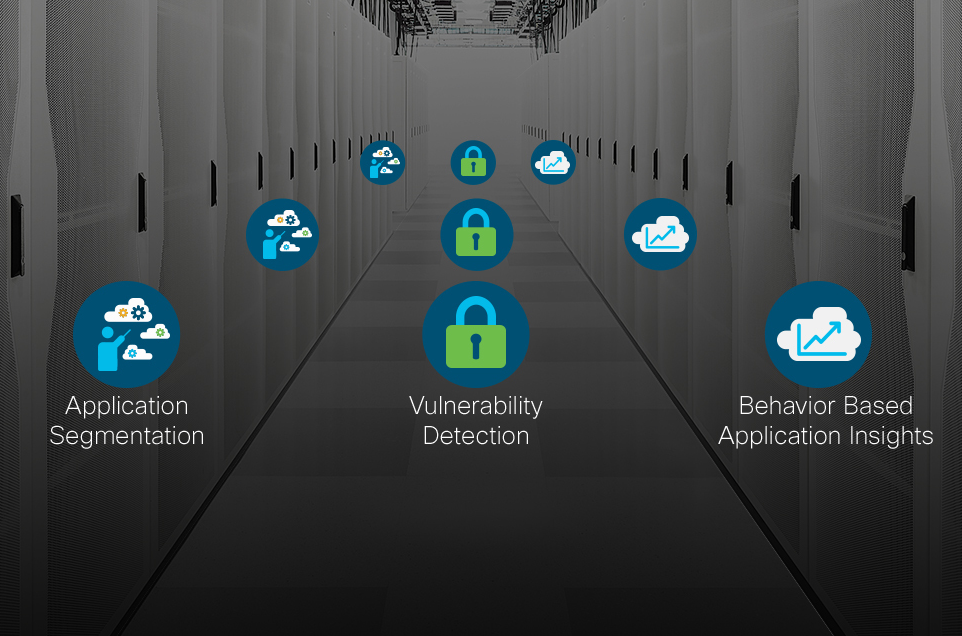
Both Tetration models can identify data center applications, their detailed dependencies, and the underlying policies between different application tiers. Cisco said its Tetration enables network perators to implement a zero-trust model using whitelist policy and segmentation, monitor the behavior of server processes, and identify software-related vulnerabilities.

Previously, Cisco Tetration was only offered as in on-premises form factors. Tetration works with Cisco ACI and Cisco's security portfolio, including Cisco Firepower Next-Generation Firewall (NGFW), Next-Generation IPS (NGIPS), Advanced Malware Protection (AMP), and Stealthwatch.

“Cisco Tetration helps Xentaurs manage successful cloud and data center deployments for our clients by ensuring every single connection and flow to an application is visible,” said Anoj Willy, CEO, Xentaurs. “Without this critical information, app, cloud, and data center migrations would be impossible to precisely guarantee nothing is missed and everything is as it is intended. Tetration goes further in establishing and enforcing a zero-trust environment that is the foundation for microsegmentation, down to containers and next-generation services development.”

Palo Alto Networks to acquire Secd for Endpoint security

Palo Alto Networks agreed to acquire Israel-based Secdo, a supplier of endpoint security solutions. Financial terms were not disclosed.

Secdo's patented technology uses assisted learning combined with the only thread-level visibility to automatically investigate and respond to every alert from any security technology.

Palo Alto Networks said the acquisition brings sophisticated endpoint detection and response, or EDR, capabilities – including unique data collection and visualization – to its own "Traps" advanced endpoint protection and the Application Framework in order to enhance their ability to rapidly detect and stop even the stealthiest attacks.

"We believe security operations teams need the most advanced and consistent approach to endpoint security. With Secdo's EDR capabilities as part of our platform, we will accelerate our ability to detect and prevent successful cyberattacks across the cloud, endpoint, and network," stated Mark McLaughlin, chairman and CEO of Palo Alto Networks.

"We are delighted to join the Palo Alto Networks team. We founded Secdo to dramatically increase visibility for security operations teams to reduce the time it takes to detect and respond to an alert. The combined capabilities of Secdo and Palo Alto Networks will provide customers the capabilities they need to swiftly and accurately detect and respond to cyberattacks," said Shai Morag, co-founder and CEO of Secdo.
om.

RAD announces vAccess, Service Delivery and Assurance VNF for vCPE

RAD introduced a new capability called vAccess that allows deployment of VNFs over any access.

The new vAccess capability, which is already in use by a Tier 1 operator in North America, is part of RAD’s Service Assured Access solutions and is designed to help service providers quickly roll out vCPE services.

RAD said vAccess upgrades any white box operating system to carrier-grade level by adding VNF assurance capabilities and, when combined with ots pluggable physical network functions (P-PNFs), adds missing network capabilities such as CE2.0 demarcation and interfaces such as xDSL, PON, and legacy TDM.

“vAccess allows operators to get on the SDN/NFV bandwagon today. They can benefit from white boxes’ cost savings while providing any virtualized service, such as vSD-WAN, vRouter, and vEncryption over whatever access infrastructure they have installed,” said Ilan Tevet, VP Marketing and Business Development at RAD.

Liquid Telecom South Africa names Reshaad Sha as CEO

Liquid Telecom has appointed Reshaad Sha as CEO of Liquid Telecom South Africa, effective June 1, 2018.

Reshaad, a South African national, will oversee the growth of digital services and the rollout of enhanced network services for enterprises and consumers across the country.

Reshaad most recently served as CEO of SqwidNet, an open access Internet of Things (IoT) network operator, and has for the last five years served as Chief Strategy Officer and Executive Director of the open access fibre optic company Dark Fibre Africa. He also has extensive international management experience having worked for a variety of global tech and telecoms companies, including Cisco and LogicaCMG.