Tuesday, November 22, 2016

Baidu Opens Chinese language APIs for Key Speech Technologies

Baidu, , China's leading search engine, is making available Chinese language APIs for its four key speech technologies: Long Utterance Speech Recognition, Far-Field Speech Recognition, Expressive Speech Synthesis and Wake Word.

Baidu said its intent is to provide developers with access to its AI-based technologies. Baidu has also released API for facial recognition, optical character recognition, natural language processing and others. In September, the company also open sourced its deep learning framework PaddlePaddle, an easy-to-use platform allowing developers to apply deep learning to their products and services.

"We are at the dawn of the AI era. By opening our AI technologies, we will make it easier for everyone to create AI-enabled applications," says Andrew Ng, chief scientist of Baidu.

In just three years, the daily requests for speech recognition grew from 5 million in 2013 to 140 million this year, and the number of daily requests for speech synthesis stands today at 200 million. In the meantime, the number of developers using Baidu's speech system has also grown from 10,000 in 2014 to 140,000 this year.

http://www.baidu.com/

NZ Breaks Ground for Hawaiki Landing Station

New Zealand Prime Minister, Rt Hon John Key, and Minister of Communications, Hon Amy Adams, participated in a ground breaking ceremony for the Hawaiki Submarine Cable landing station at Bream Tail, Mangawhai Heads, Northland, New Zealand.

The 14,000 km Hawaiki submarine cable will link New Zealand to Australia, Hawaii and mainland United States, with options to expand to several South Pacific islands.

“The Hawaiki cable brings huge benefits to New Zealand in terms of greater capacity, competition in Internet pricing, resilience and security of supply, and increased opportunities for our technology and IT industries,” said Hawaiki Chairman Sir Eion Edgar.

Hawaiki Transpacific Cable Project is On Track

Pre-deployment work on Hawaiki, the 14,000 km transpacific cable system scheduled for completion in mid-2018, is on track. Hawaiki will link Australia and New Zealand to the mainland United States, as well as Hawaii, with options to expand to several South Pacific islands.

Hawaiki Submarine Cable LP and TE SubCom announced that system manufacturing has commenced. Some updates:

  • More than 1,000 kilometers of lightweight cable has been manufactured to date for Hawaiki at TE SubCom’s facility in Newington, N.H., USA.
  • Manufacturing of Hawaiki repeaters is underway.
  • Detailed landing surveys have been completed for sites in Pacific City, Oregon and Kapolei, Hawaii.
  • Completion of deep sea survey from Oregon to Hawaii.
  • Survey has covered all of U.S. Exclusive Economic Zone (EEZ), with the completion of the branch to American Samoa
  • In September 2016, Hawaiki Submarine Cable LP officially submitted for a submarine cable landing license from the U.S. Federal Communications Commission (FCC).
  • Demonstrating its commitment to the connectivity of Pacific Islands, Hawaiki has added three additional branching units to enable the future connection of New Caledonia, Fiji and Tonga. 

http://www.hawaikicable.co.nz
http://www.te.com

Monday, November 21, 2016

CableLabs: Thinking about the Implications of 5G


In this 2-minute video, Pete Smythe, VP, Core Innovation, CableLabs, discusses some of the implications of 5G, including the impact of ultra-low latency on fixed mobile convergence.

Another area of interest is unlicensed spectrum for LTE and WiFi, where we can anticipate an intersection of mobile networks and fixed-line networks, as well as an overlapping of public and private networks in hospitals, factories, etc.

See video: https://youtu.be/CnSjp-v1kFs


Momentum Builds for Citizens' Band LTE (3.5 GHz)


The Citizens Broadband Radio Service (CBRS) Alliance, which was formed in February 2016 with the goal of making LTE-based solutions in the 3.5 GHz CBRS band widely available, announced the addition of Accelleran, Airspan Networks, American Tower Corp., AT&T, Baicells, CableLabs, Ericsson, ExteNet Systems, Nsight, Ranzure Networks, Rise Broadband, and ZTE as members. Founding members of the alliance include Access Technologies (Alphabet), Federated...

Liberty Global and CableLabs Join the MulteFire Alliance


Liberty Global and CableLabs have joined the MulteFire Alliance, an independent, diverse and international member-driven consortium dedicated to developing next-generation wireless technology. customers.” The main focus of the MulteFire Alliance is to ensure that next-generation LTE mobile standards are compatible with shared and unlicensed spectrum. This compatibility ensures that the next generation 

Oracle to Acquire for DNS Operations

Oracle has agreed to acquire Dyn, a leading cloud-based Internet Performance and Domain Name System (DNS) provider that monitors, controls, and optimizes Internet applications and cloud services. Financial terms were not disclosed, although media reports valued the deal at over $600 million.

Dyn said its DNS platform drives 40 billion traffic optimization decisions daily for more than 3,500 enterprise customers, including preeminent digital brands such as Netflix, Twitter, Pfizer and CNBC.

Oracle said Dyn’s DNS solution extends the Oracle cloud computing platform and provides enterprise customers with a one-stop shop for Infrastructure-as-a-Service (IaaS) and Platform-as-a-Service (PaaS).

“Oracle already offers enterprise-class IaaS and PaaS for companies building and running Internet applications and cloud services,” said Thomas Kurian, President, Product Development, Oracle. “Dyn’s immensely scalable and global DNS is a critical core component and a natural extension to our cloud computing platform.”

“Oracle cloud customers will have unique access to Internet performance information that will help them optimize infrastructure costs, maximize application and website-driven revenue, and manage risk,” said Kyle York, Chief Strategy Officer, Dyn. “We are excited to join Oracle and bring even more value to our customers as part of Oracle’s cloud computing platform.”

https://www.oracle.com/corporate/acquisitions/dyn/index.html

Dyn Managed DNS Hit by Major DDoS Attack


Dyn, which provides cloud-based Internet Performance Management and traffic steering to major websites, including Twitter, Zappos, Red Hat, BT, CNBC and Zillow, experienced a major DDoS was impacting its Managed DNS customers in its US East region. On its status update site, Dyn noted that it began monitoring and mitigating a DDoS attack starting at 11:10 UTC on October 21st-Friday 2016 against its Dyn Managed DNS infrastructure. Impacted web

Hibernia Offers BGP Flowspec for Global IP Traffic

Hibernia Networks introduced Border Gateway Protocol Flow Specification (BGP Flowspec) for its global IP Transit services. This new security capability is available immediately for all Hibernia Networks IP Transit customers.

The company said BGP Flowspec provides network operators and enterprise customers a tool to address DDoS threats. The enhanced DDoS mitigation solution allows customers to save valuable time between the identification of an attack and the implementation of remediation schemes. BGP Flowspec’s ability to take a surgical approach to traffic filtering, through the Network Layer Reachability Information (NLRI) functionality, enables the identification of specific traffic flows that should be discarded as a component of a DDoS attack.

“Given the number of threat vectors on the Internet, it’s absolutely essential that carriers and enterprise customers have the latest in DDoS mitigation capabilities in today’s environment,” states Al DiGabriele, Senior Vice President of Product Management and Marketing at Hibernia Networks. “Hibernia Networks’ IP Transit customers gain a more effective and precise security response tool with BGP Flowspec.”

http://www.hibernianetworks.com


Palo Alto Networks Trims Outlook

Palo Alto Networks reported sales of $398.1 million for its first quarter of fiscal 2017, up 34% compared with total revenue of $297.2 million for the fiscal first quarter 2016. GAAP net loss for the fiscal first quarter 2017 was $61.8 million, or $0.69 per diluted share, compared with GAAP net loss of $39.9 million, or $0.47 per diluted share, for the fiscal first quarter 2016.

The company trimmed its outlook for Q2, saying it now expects total revenue in the range of $426 to $432 million, representing year-over-year growth between 27 percent and 29 percent. Diluted non-GAAP net income per share are expected in the range of $0.61 to $0.63 using 93.5 to 95.5 million shares.

"Our first quarter 2017 results underscore that our Next-Generation Security Platform uniquely solves customers' most complex security challenges," said Mark McLaughlin, chief executive officer of Palo Alto Networks. "Our platform's ability to provide high degrees of prevention, automation, leverage and consistent security, regardless of wherever data may be, is becoming increasingly important in the face of today's important macro technology changes. As a result, customers and prospects globally are adopting our platform at high rates."

https://www.paloaltonetworks.com

Brocade reported fourth quarter revenue of $657 million, an increase of 12% year-over-year and 11% quarter-over-quarter. Revenue for fiscal year 2016 was $2,346 million, up 4% year-over-year. GAAP diluted earnings per share (EPS) was $0.16 for the fourth quarter and $0.51 for fiscal year 2016, down 19% and down 35% year-over-year, respectively.

"Fiscal 2016 was a year of significant accomplishment," said Lloyd Carney, CEO. "We delivered record revenue and expanded our market reach to address critical requirements at the network edge through our acquisition of Ruckus Wireless. In addition, we provided our customers with significant innovations across our product portfolio, including Gen 6 Fibre Channel, data center automation, Ruckus Cloud Wi-Fi, and next-generation data center routing. With a range of new IP Networking solutions expected to launch in the first quarter of fiscal 2017, we continue to advance our roadmap and help our customers transform their networks for digital business."

Q4 2016 SAN product revenue was $303 million, down 7% year-over-year and up 8% quarter-over-quarter. The Q4 year-over-year revenue decline was due to an 18% decrease in director sales and a 13% decrease in embedded switch sales, partially offset by a 7% increase in fixed-configuration switch sales. For fiscal year 2016, SAN product revenue was $1,229 million, down 6% year-over-year, primarily due to certain partner business transitions and a challenging storage spending environment, leading to lower director and embedded switch sales.
Q4 2016 IP Networking product revenue was $256 million, up 51% year-over-year and up 22% quarter-over-quarter. The Q4 year-over-year increase was primarily driven by the inclusion of $96 million of Ruckus Wireless product revenue, following the acquisition in fiscal Q3 2016. This was partially offset by lower service provider sales and lower sales into the education market. For fiscal year 2016, IP Networking product revenue was $730 million, up 21% year-over-year, primarily due to the inclusion of five months of revenue from Ruckus Wireless, partially offset by lower service provider and U.S. federal sales.

http://newsroom.brocade.com/press-releases/brocade-reports-fourth-quarter-and-fiscal-2016-earnings-nasdaq-brcd-1287070#.WDPe-_krJEY

NTT Launches New Submarine Cable-Laying Ship

NTT officially launched the "Kizuna", new submarine cable-laying vessel, from the Kanrei shipyard in Tokushima, Japan.

The 8,500 ton ship, which measures 109 meters in length and 20 meters in width, and which will have a planned average cruising speed of 13 knots and a capacity of up to 60 crew, will be completed by the end of fiscal year 2016.

Kizuna will be owned by NTT FINANCE and leased to NTT World Engineering Marine Corporation (NTTWEM). The ship is configured with its main working space in the stern. Its design incorporates azimuth propellers, an electric propulsion system and a dynamic positioning system. These allow it to navigate quickly to selected locations and once in position, to withstand wind velocities of up to 14 meters per second, wave heights of up to 3 meters and ocean currents of up to 3 knots.

http://www.ntt.co.jp

IBM to Add Four New Data Center in UK

IBM is adding four new cloud data centers in the UK to keep pace with growing client demand. This investment expands IBM Cloud data centers to six in UK and 16 total across Europe. The company now has 50 data centers worldwide.

"By adding four new Cloud data centers in the UK, IBM is giving local businesses an easy route to the cloud, helping them quickly innovate and respond to market demands,” said Robert LeBlanc, senior vice president of IBM Cloud. "IBM is continuing to invest in high growth areas, offering clients higher-value cloud data services such as Watson and Blockchain running on our cloud infrastructure that delivers world-class scalability, performance and security."

http://www.ibm.com

Sunday, November 20, 2016

Panasonic Avionics Picks Ericsson for 5G-ready core

Panasonic Avionics, which is a leading supplier of inflight entertainment systems, has selected Ericsson to enable the next generation of connectivity services to the aviation and additional multiple markets.

Ericsson will implement its 5G-ready core solution through Panasonic Avionics' subsidiary AeroMobile, a global inflight connectivity provider and registered mobile network operator. The solution will enable crew and passengers on aircraft, cruise ships and yachts, and employees in the and mining sectors, to enjoy 2G, 3G, LTE and Wi-Fi connectivity.

Paul Margis, President and Chief Executive Officer, Panasonic Avionics Corporation says: "This innovative collaboration with Ericsson is an integral part of our strategy to address the global communications needs of consumers and businesses in the future, and it demonstrates our commitment to enabling connected devices through the Internet of Things.

"Using this new global communications platform, we will help our customers - across all of our vertical markets - leverage ubiquitous connectivity to improve their operations with real time data across all of their connected platforms."
Anders Lindblad, Head of Business Unit IT and Cloud, Ericsson, says: "NFV is an important technology for the 5G-ready core, and industry-leading operators around the world are already using our solution in live commercial service. We are extremely happy
that Panasonic Avionics selects Ericsson as the sole supplier for their 5G-ready core."

https://www.ericsson.com/us/news/2057178

Vapor Develops Optimized Data Center for Edge Locations

Vapor IO introduced a new data center platform for building out IoT and edge environments. The solution combines an optimized rack architecture with software based on Open Data Center Runtime Environment (OpenDCRE), an open source protocol created by Vapor IO for monitoring and responding to data center hardware, software and environmental characteristics in hybrid and edge environments.


“The cloud as we know it is changing,” said Cole Crawford, co-founder and CEO of Vapor IO.  “For the last decade, it’s been dominated by large, centralized data centers. But there is an emerging class of applications—including IoT, virtual and augmented reality, and mobile apps—where centralized data centers simply won’t work because compute, storage and network capacity must be near the application or device. With Vapor Edge, we’re paving the way for a truly decentralized data center and enabling cloud computing at the edge.”

Vapor Edge consists of specialized software  for remote operation and workload management, as well as patented hardware designs which are optimized for edge environments and manufactured by partners under license. Included are:

  • Vapor CORE: Operators use Vapor CORE software to remotely monitor and administer their Vapor Edge environments. Vapor CORE spans all of the centralized data center and edge machines, ingests hardware telemetry in real time, and provides operators with a way to remotely view and manage their edge capabilities.
  • Vapor Compass: Operators use Vapor Compass software to build highly-automated command-and-control policies for managing workloads in distributed edge environments. Vapor Compass makes real-time optimization decisions, including rescheduling workloads onto edge nodes or centralized data centers, based on policies, including latency and cost.
  • Vapor Chamber: Optionally, operators use Vapor Chamber designs to build out the physical environment for Vapor Edge. The Vapor Chamber is a revolutionary circular racking system for servers, designed by Vapor IO, which is licensed to manufacturers who sell and distribute the system. The Vapor Chamber is tightly integrated with Vapor Edge software, and is ideal for use in more hostile edge environments, such as in cell towers and on rooftops. It is self-contained, extremely energy efficient and well-suited for remote operation. Customers can also retrofit existing equipment into a Vapor Edge environment, with or without Vapor Chambers.

http://www.vapor.io

NTT Docomo Cites 5G Progress with Samsung, Huawei

In a test conducted with Samsung Electronics earlier this month at Fuji Speedway, a motorsport racing circuit in Shizuoka Prefecture, Japan, NTT DOCOMO achieved a data speed of more than 2.5Gbps with a mobile device that was in a vehicle travelling 150km/h. The company said this trial verified the feasibility of stable connectivity for 5G mobile devices in fast-moving trains. Transmissions were conducted using the 28GHz high-frequency band, one of the candidate bands that the Ministry of Internal Affairs and Communications is considering to designate for commercial 5G networks in Japan.

DOCOMO said the problem of large path-loss of high-frequency radio signals was overcome with massive multiple-input multiple-output (MIMO) technologies that incorporate beamforming, which concentrates radio waves in a specific direction, and beam tracking, which adjusts the beam according to the fast-moving mobile device's location.

In a separate undertaking, DOCOMO conducted an outdoor data-transmission trial with Huawei from October 3 to 26. It was carried out in a field measuring 100,000 square meters, equivalent to 12 soccer pitches, in the Minato Mirai 21 waterfront of Yokohama. The trial involved 23 simultaneously connected mobile devices and achieved a cumulative 11.29Gbps of data throughput and latency below 0.5 milliseconds using the 4.5GHz frequency band.

The trial combined multi-user MIMO (MU-MIMO) technology for simultaneous multiple access and a precoding algorithm that optimizes signals for maximized performance and also limits inter-user interference. It achieved a MU-MIMO transmission of a maximum 79.82bps/Hz/cell, which was 1.8 times more efficient than an outdoor trial conducted in China in November 2015.
The successful outcomes of these trials will be exhibited at DOCOMO R&D Open House 2016 at the DOCOMO R&D Center in the Yokosuka Research Park near Yokohama, Japan on November 17 and 18.

https://www.nttdocomo.co.jp/english/info/media_center/pr/2016/1116_00.html

Nokia Brings Machine Learning to its Motive Customer Care

Nokia is adding advanced machine learning capabilities to its Motive Customer eXperience Solutions (CXS) software portfolio, providing communications service providers with smarter tools to reduce costs and improve customer experiences.

Specifically, Nokia Motive Service Management Platform (SMP) 7.0 and Motive Care Analytics (CAL) 2.0 use machine-learning algorithms developed by Nokia Bell labs - advanced capabilities that give computers the ability to learn without being explicitly programmed.

Nokia said it aims to set a new standard for proactive care in the industry, dramatically improving the detection, troubleshooting and resolution of subscriber issues.

"Service disruptions are often hard to identify because they happen in the access network, on customer equipment or on customers' devices. Traditional customer care may only address a small part of a larger problem and the time-consuming, step-by-step troubleshooting process can lead to customer frustration and the risk of lost business. By providing the earliest possible detection of network issues and streamlining help desk and self-care interactions, these new Nokia solutions reduce IT and care costs, and result in happier, more loyal customers," stated Bhaskar Gorti, president of Applications & Analytics at Nokia

https://networks.nokia.com/solutions/motive-cxs

5G-ConnectedMobility Consortium Gets Underway in Germany

A new “5G-ConnectedMobility” consortium has been formed to strengthen 5G research and development in Germany. A dedicated 5G test network in the 700-MHz band has been established along the A9 motorway and the high speed rail track between Nuremberg and Greding.

Founders of the group include Ericsson, BMW Group, Deutsche Bahn, all three German mobile network operators -Deutsche Telekom, Telefónica Deutschland and Vodafone, the TU Dresden 5G Lab Germany, the Federal Highway Research Institute (BASt) and the Federal Regulatory Agency (BNetzA). The Federal Ministry of Transport and Digital Infrastructure and the Bavarian Road Construction Administration support the project
.
“5G-ConnectedMobility” creates an infrastructure and a real application environment on a “Digital Test Field Motorway”, above all to carry out tests in the area of vehicle-to-vehicle, vehicle-to-infrastructure, digitalization of the railway infrastructure and other applications using 5G technology.

https://eth.org.hu/5G-ConnectedMobility/en

Thursday, November 17, 2016

Intel Nervana Aims for AI

Intel introduced its "Nervana" platform and outlined its broad for artificial intelligence (AI), encompassing a range of new products, technologies and investments from the edge to the data center.

Intel currently powers 97 percent of data center servers running AI workloads on its existing Intel Xeon processors and Intel Xeon Phi processors, along with more workload-optimized accelerators, including FPGAs (field-programmable gate arrays).

Intel said the breakthrough technology acquired from Nervana earlier this summer will be integrated into its product roadmap. Intel will test first silicon (code-named “Lake Crest”) in the first half of 2017 and will make it available to key customers later in the year. In addition, Intel announced a new product (code-named “Knights Crest”) on the roadmap that tightly integrates best-in-class Intel Xeon processors with the technology from Nervana. Lake Crest is optimized specifically for neural networks to deliver the highest performance for deep learning and offers unprecedented compute density with a high-bandwidth interconnect.

“We expect the Intel Nervana platform to produce breakthrough performance and dramatic reductions in the time to train complex neural networks,” said Diane Bryant, executive vice president and general manager of the Data Center Group at Intel. “Before the end of the decade, Intel will deliver a 100-fold increase in performance that will turbocharge the pace of innovation in the emerging deep learning space.”

Bryant also announced that Intel expects the next generation of Intel Xeon Phi processors (code-named “Knights Mill”) will deliver up to 4x better performance1 than the previous generation for deep learning and will be available in 2017.

In addition, Intel announced it is shipping a preliminary version of the next generation of Intel Xeon processors (code-named “Skylake”) to select cloud service providers. With AVX-512, an integrated acceleration advancement, these Intel Xeon processors will significantly boost the performance of inference for machine learning workloads. Additional capabilities and configurations will be available when the platform family launches in mid-2017 to meet the full breadth of customer segments and requirements.

Intel also highlighted its Saffron Technology, which leverages memory-based reasoning techniques and transparent analysis of heterogeneous data.

https://newsroom.intel.com/editorials/krzanich-ai-day/

Intel to Acquire Nervana for AI

Intel agreed to acquire Nervana Systems, a start-up based in San Diego, California, for their work in machine learning. Financial terms were not disclosed.

Nervana, which was founded in 2014, developed a software and hardware stack for deep learning.

Intel said the Nervana technology would help optimize the Intel Math Kernel Library and its integration into industry standard frameworks, advancing the deep learning performance and TCO of the Intel Xeon and Intel Xeon Phi processors.

http://www.intel.com

Infinera Upgrades and Expands DTN-X with Infinite Capacity Engine

Infinera introduced a number of new platforms within its DTN-X Family designed to power cloud scale networks.  The rollout include two new platforms, the XT-3300 and the XT-3600 meshponders, as well as significant upgrades to the XTC-4 and XTC-10 Packet Optical Transport Node (P-OTN) platforms.

Infinera also announced the MTC-6 FlexILS chassis and 20-port super-channel Flexible Grid Reconfigurable Optical Add-Drop Multiplexer (FlexROADM), a key element within one of the most widely deployed flexible grid open line systems.

Infinera said cloud scale networks must be designed to efficiently address both large N x 100 gigabit Ethernet (GbE) linear connectivity requirements driven by web scale operators as well as the diverse mesh connectivity requirements driven by more traditional telco enterprise and residential customers.
Key attributes of cloud scale networks include:

  • Scalable and sliceable – multi-carrier super-channel technology delivering massive bandwidth per optical engine along with the ability to use software defined networking (SDN) control to independently tune, modulate and route each wavelength
  • Integrated and disaggregated – integrated dense wavelength division multiplexing (DWDM) and switching platforms working in harmony with disaggregated server-like platforms to build the most cost effective networks possible
  • Secure and open – completely open and programmable solutions while featuring in-flight line-rate encryption and other critical security features
  • The DTN-X Family platforms now integrate the ground-breaking Infinera Infinite Capacity Engine featuring the Advanced Coherent Toolkit. The new server-like DTN-X XT-3300 and XT-3600 are the industry’s first meshponder platforms, which combine sliceable photonics and muxponder functionality to deliver hyper-scalability up to 2.4 terabits per second (Tb/s) along with fine-grained granularity for optical mesh networks. The server-like small form factor meshponder platforms, developed from experiences in the web scale market, seamlessly interoperate with the chassis-based DTN-X XTC switching platforms.
Some highlights of the announcement:

  • The Infinera DTN-X XTC-4 and XTC-10 platforms have been upgraded to support 1.2 Tbps per slot and more than double the switching and transmission capacity through non-disruptive, in-service upgrades. The new DWDM modules, powered by the Infinera Infinite Capacity Engine, co-exist with the deployed modules thereby offering complete investment protection. The DTN-X XTC now offers up to 12 Tb/s of non-blocking switching capacity and unlike competitive systems, have no tradeoffs between client side tributary capacity and line side capacity.
  • The Infinera FlexILS open line system, which supports over 50 Tbps of fiber capacity, takes super-channels from the DTN-X platforms and routes wavelengths to the appropriate destination for flexible optical mesh networking. The new 20-port super-channel FlexROADM supports flexible grid super-channels with single-channel granularity and full CDC (colorless, directionless, contentionless) functionality while using six times fewer fibers than conventional ROADMs. FlexILS now includes the new compact MTC-6 chassis and is fully open and interoperable with Infinera and third-party terminals.
  • All of the new capabilities in the FlexILS and DTN-X Family are controlled by the Xceed Software Suite and managed by Infinera’s Digital Network Administrator (DNA). This comprehensive software portfolio enables service providers to simply and easily optimize the network including keeping traffic at the optical layer longer and only grooming and switching when necessary.
“Infinera is transforming transport networks to be open and cloud scale,” said Dr. Dave Welch, Infinera Co-founder and President. “We are bringing the power of web scale to service provider networking with the unified architecture of meshponders and multi-terabit switches managed by a common, open control layer. The upgraded DTN-X Family and the new CDC FlexROADM deliver a new architecture that enables network operators to cost effectively provide scalable and secure end-user services. This architecture demonstrates Infinera’s commitment to innovation to enable our customers to build the next generation cloud scale infrastructure.”

The MTC-6 FlexILS open line system chassis is shipping now. The XT-3300 platform is planned for availability in the first quarter of 2017 with the other platforms to follow starting in the second quarter of 2017.

https://www.infinera.com/infinera-powers-cloud-scale-networks-with-new-dtn-x-platforms/

Infinera's Infinite Capacity Engine Revs to 2.4 Tbps Capacity


Infinera unveiled its Infinite Capacity Engine, a multi-terabit optical subsystem combining the company's next generation FlexCoherent Processor and the photonics of its fourth generation photonic integrated circuit (PIC). The Infinite Capacity Engine, which will be integrated into the Infinera portfolio of long-haul terrestrial, subsea, metro and data center interconnect platforms, breaks new ground for optical transport by being the first in the...


LinkedIn Inaugurates Hyperscale Data Center in Oregon

LinkedIn opened a massively scalable, next-generation data center in Oregon.

The facility, which is hosted by Infomart, is now fully live and ramped. The location benefits from a direct access contract for 100% renewable energy, network diversity, expansion capabilities, and talent opportunities. LinkedIn expects to achieve a PUE (Power Usage Effectiveness) of 1.06 during full economization mode.

The network in the new data center uses LinkedIn's own programmable switch design (Pigeon) based on Broadcom's Tomahawk silicon and its own software stack.

https://engineering.linkedin.com/blog/2016/11/linkedin_s-oregon-data-center-goes-live

LinkedIn Develops its Own Data Center Switch

LinkedIn's engineering team has developed its own data center switch to keep up with the rapidly growing traffic demands of its professional, social network.

The new switch, dubbed "Pigeon", is a 3.2 Tbps switching platform that can be used as a leaf or spine switch. It uses Broadcom's latest Tomahawk silicon (32X100G) and switch software developed in house.

In a blog post, Zaid Ali Kahn describes why the company decided to take on the difficult task of switching software code development rather than relying on an existing network equipment supplier. Key reason include ongoing bugs, unneeded features, lack of a Linux-based platform support tools such as Chef/Puppet/CFEngine, out-of-date monitoring capabilities, and the high-cost of scaling the software license.

The Pigeon switch will be deployed in LinkedIn's upcoming data center in Oregon.

https://engineering.linkedin.com/blog/2016/02/falco-decoupling-switching-hardware-and-software-pigeon

Intel and Google Alliance Looks to Multi-Cloud Enterprise IT

Intel and Google announced a strategic alliance to help enterprise IT deliver an open, flexible and secure multi-cloud infrastructure for their businesses. The companies agreed to collaborate on Kubernetes (containers), machine learning, security and IoT.

One area of focus is the optimization of the open source TensorFlowOpens in a new window library to benefit from the performance of Intel architecture. The companies said their "joint work will provide software developers an optimized machine learning library to drive the next wave of AI innovation across a range of models including convolutional and recurrent neural networks."

Intel and Google are also working on the Kubernetes open source container management platform in multicloud environments. The goal is to drive optimizations to Kubernetes to take full advantage of Intel architecture including performance optimizations, improved infrastructure management, and further enhanced security for enterprise workloads.

http://itpeernetwork.intel.com/intel-announces-strategic-alliance-google-accelerate-multi-cloud-adoption-democratize-ai/

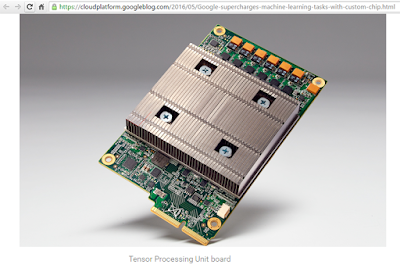
Google Builds a Custom ASIC for Machine Learning


Google has developed a custom ASIC for machine learning and artificial intelligence. The Tensor Processing Unit (TPU) is tailored for TensorFlow, which is an open source software library for machine learning that was developed at Google. In a blog posting,  Norm Jouppi, Distinguished Hardware Engineer at Google, discloses that the TPUs have already been in deployment in Google data centers for over a year, where they "deliver an order of magnitud

Versa Networks Hires Kelly Ahuja and Pankaj Patel

Versa Networks named Kelly Ahuja as its new CEO, replacing company co-founder Kumar Mehta, who now takes on the role of Chief Development Officer. Kelly is an eighteen-year veteran of Cisco, serving most recently as senior vice president (SVP) of the Service Provider Business.  He held multiple leadership roles during his tenure at Cisco, including SVP/GM of the Mobility Business Group and SVP/GM of the Service Provider Routing Technology Group.

Versa also announced that Pankaj Patel has joined the company as lead director on Versa’s board of directors. Most recently, Pankaj was Executive Vice President and Chief Development Officer at Cisco and drove the business and technology strategy across Cisco’s $38 billion Routing, Switching, Wireless, Security, Mobility, Video, Collaboration, Data Center and Cloud offerings.

“With Versa Networks experiencing immense demand for its platform for SD-WAN and SD-Security, and the wide-area network market now entering the next phase of explosive growth, there are no better people to lead our company than Kelly Ahuja and Pankaj Patel. They are the right leaders at the right time,” said Versa Networks founder, Kumar Mehta. “Over the last four years, I’ve had the privilege of working with the most talented team in the industry at Versa, and I know their passion and hunger for greatness will only grow under Kelly and Pankaj’s direction.”

Versa Networks offers a carrier-grade software-defined WAN (SD-WAN) and security (SD-Security) solution that is purely software- and NFV-based, and fully multi-tenant. The solution provides a wide range of virtualized networking and security functions that can be used to create highly scalable and high-value managed services that run on low-cost white box and x86 hardware.

http://www.versa-networks.com

OIF Commences Work on Four New Project

Following its Q4 meeting this month in Auckland, New Zealand, The Optical Internetworking Forum announced four new projects:

  • 400ZR Interoperability Project -- will develop an implementation agreement for 400G ZR and short-reach DWDM multi-vendor interoperability.  It is relevant for router-to-router interconnect use cases and is targeted at (passive) single channel and amplified DWDM applications with distances up to 120 km. This project should ensure a cost-effective and long-term relevant implementation using single-carrier 400G, coherent detection and advanced DSP/FEC algorithms.  
  • Common ACO Electrical I/O Project -- will define the ACO electrical I/O independent of the choice of form factor and optical carrier count for 45 Gbaud and 64 Gbaud per-carrier applications. This project would build upon the success of the CFP2-ACO but is form factor agnostic so that it could be applied to multiple applications such as  CFP4, CFP8, QSFP, micro QSFP and OFSP.
  • Coherent Modem Management Interface Project -- members have requested that the industry combine the coherent modem management interface specifications [4"x5" LH MSA, CFP2-ACO, CFP2-DCO, Flex-Coherent, etc.] into a standalone document.  OIF leadership, working in conjunction with the CFP MSA group, is inviting companies to participate in creating a complementary Normative document.
  • High Baud Rate Coherent Modulation Function Project -- will define a small form factor component implementation agreement that combines the high baud-rate PMQ (HB-PMQ) modulator plus the RF drive functions into a single component. This new component will be used in conjunction with a high baud Integrated Coherent Receiver (ICR), a micro Integrable Tunable Laser Assembly (ITLA) and a coherent DSP, to implement a high performance coherent modem.

“The OIF continues to work with other standards bodies and the industry to identify a wide range of technology needs that cross the entire optical and electrical ecosystem,” said Karl Gass of Qorvo and the OIF’s Physical Link Layer working group optical vice-chair.  “The OIF remains committed to providing technology direction that provides a path to interoperability in a pre-competitive environment. The projects started during the Q4 meeting demonstrate the OIF’s  commitment to work with other standards bodies in the industry.”

In addition, OIF announced the following election results: Dave Brown of Nokia was re-elected to the Board for a two-year term and appointed as president.  Re-elected to one-year terms were Junjie Li of China Telecom and Dave Stauffer of Kandou Bus. Stauffer will continue to serve as secretary/treasurer. Jonathan Sadler of Coriant and Nathan Tracy of TE Connectivity were elected to the board for two-year terms.  Tracy was appointed as vice president of marketing. Tom Issenhuth of Microsoft was appointed as vice president and Ian Betty of Ciena continues to serve on the Board.

Newly elected were Klaus-Holger Otto of Nokia as Technical Committee chair, Ed Frlan of Semtech as Technical Committee vice chair and Jeffery Maki of Juniper Networks as chair of Physical Layer User Group Working Group.

Brian Holden of Kandou Bus, Market Awareness and Education Committee co-chair, Physical and Link Layer; and Lyndon Ong of Ciena, MA&E Committee co-chair, Networking were both re-elected.

http://www.oiforum.com/