Showing posts with label DT. Show all posts

Monday, February 26, 2024

DT and Sony test live TV production via network API

Deutsche Telekom and Sony are testing the use of 5G network Application Programming Interfaces (APIs) to manage Nevion’s VideoIPath media orchestration platform. Nevion is a subsidiary of Sony.

The solution uses Deutsche Telekom’s network APIs to make optimum use of the 5G network and offer low latency and reliable bandwidth, which is essential for live, professional video production.

The tests successfully combined Nevion’s smart bandwidth management capabilities and Sony’s ultra-low latency video compression technology with seamless access to Deutsche Telekom’s 5G SA network and optimized via network APIs. The tests were carried out on a 5G standalone (SA) testbed in a Deutsche Telekom lab environment in Krakow, Poland. As part of this test, Sony used its recently-launched CBK-RPU7 HEVC 4K/HD remote production unit for the video compression, and its new 5G Portable Data Transmitter PDT-FP1 – both attached to a camera.  These devices complement the solution by enabling cameras in the field to connect to the broadcast production center over the 5G network. The network APIs used in the tests follow the standards set by CAMARA, the open-source network API project within the Linux Foundation, of which Deutsche Telekom is an active member.

https://www.telekom.com/en/media/media-information/archive/successful-test-of-live-tv-production-via-network-api-1060876

false

Monday, December 12, 2022

Deutsche Telekom selects Juniper for Magenta Business SD-X

Deutsche Telekom has selected Juniper Networks as the first network technology partner for Magenta Business Networks SD-X. 

SD-X is a cloud-based, virtualized and automated platform that will provide a rapid, simplified and cost-effective transition from MPLS to software-defined network services.

Juniper is providing DT with advanced technologies to create a secure, software-driven network fabric that uses AI to provide actionable insights on real-time performance coupled with automated mitigation. 

The Juniper solution provides client-to-cloud service levels with AI-driven intelligence to optimize and maintain the best user experiences. With AI-driven insight, problems are proactively discovered and addressed via recommended actions and/or self-driving network operations. 

“DT has fully embraced the powerful value of intelligent networks with SD-X. This highly-scalable business model is more cost-effective than traditional approaches, while providing the agility and ease of use customers demand. In turn, these customers can use SD-X as the foundation for an experience-driven digital business for their own customers and employees. We look forward to working with DT to roll out more managed services across SD-X to deliver a game-changing networking experience,” states Manoj Leelanivas, Chief Operating Officer, Juniper Networks.

Wednesday, November 16, 2022

O-RAN Alliance elects DT's Alex Jinsung Choi as chairman

Members of the O-RAN Alliance elected Dr. Alex Jinsung Choi, SVP Group Technology at Deutsche Telekom, as the new chairman of the Board. Dr. Choi had previously served as COO of O-RAN ALLIANCE since its founding in 2018. In the chairmanship he replaces Andre Fuetsch, who served as chairman from 2018 until his retirement from AT&T in August 2022.

“The recently elected O-RAN ALLIANCE leadership stays fully committed to O-RAN’s mission to transform Radio Access Networks towards open, intelligent, virtualized and fully interoperable RAN,” said Dr. Alex Jinsung Choi, Chairman of the O-RAN ALLIANCE and SVP Group Technology, Deutsche Telekom. “Building on its foundation of specifications, open software development and testing and integration efforts, O-RAN will continue seeking ways to facilitate the open RAN ecosystem towards rapid progress of commercial deployments.”

Stefan Engel-Flechsig was appointed by the Board as O-RAN ALLIANCE’s COO. Stefan has a long professional career in the mobile industry and has supported O-RAN as legal counsel since the launch of the association.

O-RAN ALLIANCE Work Groups and Focus Groups recently published 53 new technical documents completing its Release 002. It includes two new specification titles:

  • A1 interface: Use Cases and Requirements – the first dedicated A1 interface use case specification with stage-2 level flow chart
  • The specification on a new E2 Service Model (E2SM), Cell Configuration and Control – covering Cell and slice-level resource configuration and control for network slicing use case

On October 25, 2022 during the Open RAN Summit at Fyuz in Madrid, O-RAN and TIP announced a further alignment of their value propositions and deliverables to complement each other seamlessly. Alignment between O-RAN and TIP enables the ecosystem to streamline the development of O-RAN based products, verify interfaces and interoperability of components, and demonstrate the functionality and operational performance of the open RAN solutions that are commercially available.

https://www.o-ran.org

Andre Fuetsch steps down from AT&T and the O-RAN Board

Andre Fuetsch, Network Chief Technology Officer of AT&T, is retiring, effective August 30, 2022. He is also stepping down from his Chairman position at the O-RAN ALLIANCE. AT&T will remain on the O-RAN Board as a founding member.“Under Andre’s leadership, O-RAN has grown to a well-respected body changing the paradigm of Radio Access Networks towards openness, intelligence and innovation,” said Alex Jinsung Choi, Chief Operating Officer and...

O-RAN Alliance publishes 52 new specifications

The O-RAN ALLIANCE released a new set of 52 specifications for open and intelligent RAN, as the first batch of the O-RAN Release 003 specifications. Among them there are 12 new titles including use cases for Massive MIMO and the R1 interface, E2 interface testing, O2dms interface, Acceleration Abstraction Layer, outdoor macro cell HW, and security specification of 3 different parts of the O-RAN Architecture.“The O-RAN ALLIANCE has always taken security...


Monday, January 31, 2022

DT and Google expand partnership for RCS messaging, cloud and TV

Deutsche Telekom and Google are expanding their partnership in three key areas: enhanced mobile messaging services for businesses through Telekom RCS Business Messaging powered by Google and Jibe Cloud; the new Sovereign Cloud for Germany will be available to German cloud customers ahead of schedule; and Telekom’s premium TV experience, MagentaTV One, powered by Android TV OS available now in Germany and expanding to additional European markets. 

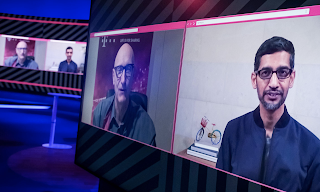
CEO Tim Höttges and Google CEO Sundar Pichai discussed this expanded partnership as part of Telekom's internal digital kick-off event attended by around 1,000 top managers. 

"Deutsche Telekom is a longstanding and important partner for us, going back to the launch of the G1, the first smartphone powered by Android, in 2008,” says Sundar Pichai, CEO of Google and Alphabet. “Today’s announcements will expand the range of helpful and trusted products and services that we can provide to businesses and consumers across business messaging, cloud computing, and TV experiences.”

Some highlights:

RCS messaging: Telekom and Google currently offer enhanced mobile messaging services for millions of Android users across Austria, Croatia, Czech Republic, Greece, Hungary, Netherlands, North Macedonia, Poland, Romania and Slovakia. This new expanded partnership extends Rich Communication Service (RCS) to customers of Telekom in Germany. In addition, Telekom announces for its entire European footprint the availability of Telekom RCS Business Messaging, provided by Google. The service enables secure, efficient and highly engaging exchanges between customers and companies via messaging. Consumers can order products, make reservations, purchase tickets and more through a seamless digital experience within their messaging app, while companies can create and manage messages to reach target groups more effectively and increase brand loyalty. 

German Sovereign Cloud: the launch of the new Sovereign Cloud for Germany will take place ahead of schedule. Telekom's business customer arm T-Systems and Google Cloud are launching their new sovereign cloud service in spring 2022. It will be available for all clients, initially out of the Frankfurt Google Cloud Region. Telekom and Google confirmed that they will jointly drive innovation for the cloud, closely aligned with the new German government's digital plans which aims to build a public administration cloud based on a multi-cloud strategy and open interfaces, as well as meeting strict sovereignty and transparency requirements. To this end, the partners are setting up a Co-Innovation Center in Munich as announced in November 2021. In addition, executive briefing facilities in Munich and one in Berlin will be established for close collaboration with customers. 

T-Systems will manage a set of sovereignty controls and measures, including encryption and identity management. In addition, T-Systems will exercise a control function over relevant parts of the German Google Cloud infrastructure. Any physical or virtual access to facilities in Germany (such as routine maintenance and upgrades) will be under the supervision of T-Systems and Google Cloud.

MagentaTV One launches in Germany: the new service is powered by Android TV OS.  MagentaTV One combines classic TV with a wide variety of streaming services, media libraries, and numerous apps via the Google Play Store. MagentaTV One is Deutsche Telekom’s second device powered by Android TV OS in Germany, following the successful launch of the MagentaTV Stick in 2020.

https://telekom.com/en/media/media-information/archive/telekom-and-google-expand-partnership-645356

T-Systems teams with Google Cloud on sovereign cloud for Germany

T-Systems announced a strategic, long-term partnership with Google Cloud to provide a sovereign cloud for German enterprises, the public sector, and healthcare organizations. 

The companies agreed to develop a large spectrum of next-generation sovereign cloud solutions and infrastructure where customers can host their sensitive workloads whilst continuing to leverage the scalability, elasticity and reliability of public cloud services. Service management and operation of the sovereign cloud will be supervised by T-Systems.

The new joint offering that will be available as of mid 2022 and then upgraded over the following months. In addition, T Systems will exercise a control function over relevant parts of the German Google Cloud infrastructure. 

"Our joint strategic goal is to support the digitalization of European companies and the public sector as they move operations to the cloud," explained Adel Al-Saleh, member of the Telekom Board of Management and CEO of T-Systems. "Together with Google Cloud, we will build a sovereign cloud services portfolio that provides clients with full control over their data, software and operations whilst leveraging the full power of Google Cloud. Even stricter compliance requirements for public sector institutions will be addressed. We are happy that we’ll be able to offer customers a cloud solution that is secure and sovereign, but also gives access to the innovation and scalability of Google Cloud in Germany. We are also considering Austria and Switzerland as a next step," he added.

"We’re committed to helping enable Germany’s digital transformation,” said Thomas Kurian, CEO of Google Cloud. “Data privacy, security and control are vital to European and German organizations as they digitize their operations. The sovereign cloud solution we are partnering with T-Systems to create will provide public and private-sector organizations with an additional layer of technical and operational measures and controls that ensure German customers can meet their data, operational, and software sovereignty requirements." 

https://www.telekom.com/en/media/media-information/archive/sovereign-cloud-from-t-systems-and-google-cloud-635314

T-Systems enters strategic collaboration agreement with AWS

T-Systems and Amazon Web Services (AWS) announced a multi-year Strategic Collaboration Agreement to manage the digital transformation of companies more quickly, efficiently and securely. 

T-Systems said the agreement will spur it to build out capacity in both solutions and people through a strong training and enablement program. The ICT service provider intends to train 3,000 additional AWS experts as part of the new collaboration.

Regarding security, AWS and T-Systems agreed to closely collaborate to achieve the targets recently set by the European regulation.

“Since the beginning of our relationship with AWS, we have built up expertise in AWS technology and combined it with our extensive experience from major transformation projects. Our customers appreciate this,” explained Adel Al-Saleh, member of the Deutsche Telekom Board of Management and CEO T-Systems.

https://www.t-systems.com/us/en/about-t-systems/news/t-systems-and-aws-expand-collaboration-365120

Deutsche Telekom aligns with Microsoft Azure

Deutsche Telekom and Microsoft announced a seven-year strategic agreement to help customers of all sizes accelerate their cloud transformation initiatives. 

"We have agreed on the framework for joint strategic growth with our long-term partner Microsoft. We are delighted," said Adel Al-Saleh, member of the Deutsche Telekom Board of Management and CEO of T-Systems. "This partnership will enable us to enhance services for our customers. We will also be supporting each other with digitalization and network build-out." 

Highlights

  • Telekom plans to migrate the majority of its internal IT workloads to the public cloud by 2025 and Azure is a central part of that strategy. Through a companywide training program, thousands of Telekom employees will learn how to maximize the benefits of Azure. 
  • Telekom will also offer its customers direct access to the Microsoft cloud through Azure ExpressRoute. 
  • Telekom will offer Microsoft 365, including Microsoft Teams. As part of this, the companies have started a project for German schools to reimagine traditional approaches to education, enabling remote learning through cloud-based IT infrastructure, modern devices and the cloud productivity and collaboration applications within Microsoft 365. 
  • Telekom will help its customers with moving their SAP environments to Azure. SAP solutions on Azure offer enterprise-grade security, and business continuity and reduce hardware expenses, making it easier for start-ups and smaller organizations to get started. 

Wednesday, April 29, 2020

Deutsche Telekom selects ADTRAN's OLT for Access 4.0 network

Deutsche Telekom has selected ADTRAN’s SDX OLT solutions for deployment as part of its new Access 4.0 network, as well as to be deployed in its existing architectures along with ADTRAN’s SDN-enabled management system, Mosaic Cloud Platform.

As part of this partnership, Deutsche Telekom and ADTRAN have aligned joint developments for the Access 4.0 project, based on principles defined by the Open Networking Foundation’s SDN-Enabled Broadband Access (SEBA) reference architecture.

DT's Access 4.0 network is integrating SDN, disaggregated hardware components and network functions virtualization (NFV) technologies in an open ecosystem to gain flexibility while lowering overall deployment costs. In the first phase, Access 4.0 will focus on DT’s fiber access network that can scale to support a mix of residential, enterprise and backhaul services.


ADTRAN’s SDX OLT solutions integrate into Access 4.0’s SEBA-based architecture to provide carrier-grade GPON and XGS-PON service delivery in an open ecosystem.

“The Access 4.0 program constitutes a true paradigm shift, not only in terms of technology, but also ecosystem, collaboration and agility, through its ability to break vendor lock-in and reduce time-to-market,” said Robert Soukup, Deutsche Telekom Senior Program Manager. “A key to our success will be ADTRAN’s domain experience, their history of working with DT on its large-scale access initiatives and their commitment to delivering an open, scalable and disaggregated solution.”

“DT’s Access 4.0 network is changing the way access networks and services will be designed, developed and deployed for the next several decades,” said Dr. Eduard Scheiterer, ADTRAN Senior Vice President, Research and Development. “ADTRAN shares DT’s vision for creating more advanced fiber access architectures that provide the network economies of data centers and the service agility of cloud providers. We believe this is how networks should be built and look forward to helping DT achieve its network and market goals today, as well as support future planned network expansion.”

https://www.adtran.com/sd-access

ADTRAN adds ONTs to 10G PON Portfolio


ADTRAN introduced its new 600-Series of 10G PON ONTs, which serve all business and residential broadband applications. The line-up now includes the: SDX 602x 10G SME ONU Delivers high-bandwidth SLA-based, enterprise-grade services by integrating Carrier Ethernet network interface device functionality. The SDX 620s & 640s XGS-PON and 10G EPON SFP+ ONUs Simplifies service delivery and enables flexible WAN technology options for SFP-based...


ONF publishes SEBA, Trellis and ODTN reference designs


The Open Networking Foundation (ONF) released its first three Reference Designs (RD’s): SEBA, Trellis and ODTN. Each of these reference designs are backed by network operators and supported by supply chain partners. The reference designs are paired with an open source Exemplar Platform (EP).  Both the RD and EP proceed in parallel, and RDs are not released unless a paired EP is available to prove out the architecture and accelerate adoption.  Virtualized...

Deutsche Telekom's Access 4.0 rethinks broadband access


Deutsche Telekom's Access 4.0 program rethinks broadband access in the context of the ONF's SEBA project, edge clouds, and FTTH/B. Presented by Robert Soukup, Program Manager. The project aims to lower OPEX by reaping the benefits of automation, breaking vendor lock-in, and accelerating time to market. 2019 will be decisive for Access 4.0, as the company plans limited field trials. https://youtu.be/9HpWuPg_...


Sunday, April 19, 2020

DT, Swisscom, Telia and Vodafone enable NB-IoT roaming

Deutsche Telekom, Swisscom, Telia, and Vodafone signed NarrowBand IoT (NB-IoT) roaming agreements.

NB-IoT roaming will shortly be available across 18 European countries. These include Deutsche Telekom’s networks in Germany, The Netherlands, Austria, Czech Republic, Slovakia, Hungary, Greece, Poland and Croatia; Swisscom’s network in Switzerland and Liechtenstein; Telia Company’s networks in Denmark, Finland, Norway and Sweden; as well as Vodafone’s networks in Spain, Italy, Germany, The Netherlands and the United Kingdom.

“Our customers need a sustainable roaming environment for their Mobile IoT deployments to deliver a consistent service across international borders. This allows them to benefit from economies of scale as they continue to expand their business,” says Rami Avidan, responsible for IoT at Deutsche Telekom. “We are working hard to help accelerate the adoption of NB-IoT roaming in Europe and beyond. It is great to see the interoperability of our and our first partners’ networks now in place.”

https://www.telekom.com/en/media/media-information/archive/mobile-iot-roaming-goes-live-across-europe-598700

Wednesday, April 8, 2020

DT offers managed networking services for Azure

Deutsche Telekom is now offering managed network services for Microsoft Azure and has joined the Azure Networking Managed Service Provider (MSP) partner program.

Managed networking includes

  • Virtual WAN (to connect various locations)
  • ExpressRoute (for private connections with Azure data centers)
  • Security measures (firewall, combating DDOS attacks)
  • In Europe, Deutsche Telekom covers managed services in the areas of Cloud Connectivity and Cloud Security. Being an Azure MSP member, Deutsche Telekom experts are able to provide customers with even more support when migrating to Azure and operating Microsoft services. They are also involved in the further technical development of network elements. 

“Deutsche Telekom is Europe’s leading telco. We are proud that we can leverage our proven network know-how together with our partner Microsoft to provide enterprise customers with excellent cloud services,” said Frank Strecker, SVP Cloud Managed Services and responsible for DT’s public cloud business.
Sunil Kishen, Principal Program Manager, Azure Networking, Microsoft said, “Microsoft’s collaboration with Deutsche Telekom is part of our commitment to the region, bringing digital innovation to everyone. By combining the Microsoft Azure ecosystem and DT’s network capabilities, we support the creative power and growth opportunities of our customers.”

Tuesday, October 8, 2019

Deutsche Telekom picks Netcracker's Network Domain Orchestration

Deutsche Telekom has selected Netcracker’s Network Domain Orchestration solution to automate multidomain network discovery and visualization; multi-layer traffic optimization; IP and optical backbone provisioning; and multi-vendor network orchestration.

The deployment aims to help DT gain end-to-end network insight; automate complex service provisioning processes; and massively reduce cost and effort.

Delivered in phases, this program will begin by automating network discovery and visualization to gain end-to-end network insights. That will pave the way to automate IP and Optical trunk provisioning. In the network, Netcracker’s Network Domain Orchestration solution will integrate dozens of IP devices and SDN controllers from more than 5 different major hardware vendors. This degree of automation is expected to reduce provisioning time and effort by more than half. Future plans for this program include adding intelligent network planning and simulation as well as enhancing service assurance with AI.

“It is an honor to be chosen by Deutsche Telekom from more than a dozen competitors and to have an opportunity to deliver end-to-end network automation that will play a catalyzing role in one of the most ambitious network automation projects in the industry,” said Bob Titus, Chief Technology Officer at Netcracker Technology.

Wednesday, July 17, 2019

Deutsche Telekom kicks off 5G rollout

Deutsche Telekom has kicked off its 5G rollout in Germany and expects to have 300 5G antennas in more than 100 locations online by the end of the year.

The first six German cities with 5G include Berlin, Bonn, Darmstadt, Hamburg, Leipzig, and Munich. In the upcoming 18 months, the 20 largest cities in Germany will all be connected with 5G.

"We punched our ticket for a 5G future with the spectrum auction. Our goal now is to get 5G to the streets, to our customers, as quickly as possible. Nearly three-quarters of our antenna locations in Germany are connected with optical fiber – we're now building on that," says Dirk Wössner, Member of the Board of Management, Deutsche Telekom, and Managing Director, Telekom Deutschland GmbH. "Our teams are working hard in every area. Whether we're talking about the network, rate plans, or devices and applications – we're speeding up to get 5G started this year. At the same time, we need a clear regulatory framework and pragmatism from the authorities – particularly when it comes to questions regarding regional spectrum, local roaming, allocation of the auction proceeds, and the approval procedures – which takes far too long in Germany."

In parallel, Deutsche Telekom is working on 5G campus networks, together with industrial users. In this approach, the network build-out follows the specific needs of business customers. "We're already working on the 5G network with Osram and automotive supplier ZF," says Claudia Nemat, Deutsche Telekom Board Member, Technology and Innovation. "Whether mobility concepts in cities, manufacturing in the industry of tomorrow, or virtual reality in the entertainment sector is involved: 5G is the key. And the industry can count on us as a partner in the 5G rollout."

Deutsche Telekom begins pilot 5G rollout in Berlin

Deutsche Telekom has activated its first six cells with commercial 5G antennas in the heart of Berlin and thereby achieved the first 5G data connection in a live network in Europe.

The Deutsche Telekom 5G cluster covers an area of up to five kilometers wide in Berlin's Mitte and Schöneberg districts for test operations. The antennas, in three cells located in Leipziger Straße and three in Winterfeldtstraße, are based on the 5G New Radio (5G NR) specs. The antennas are using frequencies in the 3.7 GHz spectrum band under a testing license. The 5G equipment is integrated into the live network infrastructure, meaning it is interacting with Deutsche Telekom's 4G spectrum in Germany.

DT's plan is to install an additional 70 cells by the summer across a total of more than 20 sites.

DT is using commercial 5G equipment from Huawei, as well as software and terminals, based on the 3rd-Generation Partnership Project (3GPP) standard for 5G New Radio (in the non-standalone version).

"We're continuing on our strong preparation course for the rollout of 5G in 2020," noted Claudia Nemat, Deutsche Telekom Board member for Technology and Innovation. "Today, right in the heart of Berlin, we're taking the next decisive step – with the successful integration of commercial 5G technology into our network. We want to ensure that 5G is going to deliver on its promise of enhanced mobility, high speed and low latency."

Thursday, July 11, 2019

Deutsche Telekom and Software AG to create global Cloud of Things

Deutsche Telekom and Software AG formed a strategic partnership to deliver IoT services on a global scale.

Specifically, Deutsche Telekom and its enterprise customer unit T-Systems will expand their Cloud of Things offering, using Software AG’s Cumulocity IoT platform.

The companies are targeting an “IoT made in Germany” with plans to provide coverage in Germany, other European markets, and the United States.

Adel Al-Saleh, CEO of T-Systems and Board Member of Deutsche Telekom, said: “We’re delighted to be extending the reach and capabilities of our Cloud of Things IoT platform alongside our partner. Software AG’s technology is critical in enabling us to scale an already successful service and introduce new functionality, giving us the confidence to move into new sectors. Our strategic partnership will help us continue to drive innovation and provide the best possible platform and services for clients, both from the enterprise sector and Germany’s world-leading Mittelstand.”

Tuesday, June 11, 2019

Deutsche Telekom commits to 100% renewable power as of 2021

Deutsche Telekom aims to use only electricity from renewable sources by 2021 and, by 2030, to reduce its CO2 emissions by 90 percent compared with 2017.

Also by 2030, Deutsche Telekom wants to lower the emissions from the production and utilization phases of its products and customer solutions by 25 percent.

“As one of the biggest DAX-listed companies, we take climate protection very seriously. We want to build the future for the generations to come, not rob them of it. Climate protection is an integral part of any future-proof business model,” says Tim Höttges, CEO of Deutsche Telekom AG, explaining the company’s climate protection targets.

Deutsche Telekom is the third DAX-listed company officially recognized by SBTi as contributing toward the target of limiting global warming to 2° C.
Only just over 200 companies worldwide have climate protection targets that have been certified as science-based and will thus contribute toward implementing the Paris Agreement of 2016. Deutsche Telekom is the third DAX-listed company alongside SAP and HeidelbergCement to have received a positive evaluation.

Sunday, March 31, 2019

Deutsche Telekom vows 100% renewable energy by 2021

Deutsche Telekom announced a new, ambitious climate target: the Group is aiming to achieve a 100 percent use of electricity from renewable energy sources as early as 2021.

Deutsche Telekom also vowed to reduce other emissions from gas, oil, and other sources of energy. By 2030, the Group aims to reduce CO2 emissions by 90 percent compared to 2017.

“We want to build the future, not obstruct it”, says Tim Höttges, CEO Deutsche Telekom. “Climate protection is one of the key challenges of our age. With the new targets for the period 2021-2030, we are taking our responsibility seriously and are acting decisively, quickly and, at the same time, in a sustainable manner. Furthermore, this sends an important signal to our customers because sustainability is becoming increasingly important as a purchasing criterion,” stated Tim Höttges, CEO Deutsche Telekom.

https://www.telekom.com/en/media/media-information/archive/deutsche-telekom-to-switch-to-electricity-from-renewable-sources-of-energy-567218

Tuesday, October 23, 2018

Deutsche Telekom revamps its International Wholesale Business

Deutsche Telekom is rebranding and refocusing its International Wholesale Business.

The carrier's international wholesale arm will now be known as Deutsche Telekom Global Carrier. The company said it is implementing a fresh strategy to more quickly provide innovative solutions that will in turn result in a superior customer experience. Deutsche Telekom Global Carrier will leverage big data, AI and digitization to centralize processes and enable a more transparent overview. The result will reduce the time needed for procurement, ordering and delivery.

Rolf Nafziger, Senior Vice President Deutsche Telekom Global Carrier, explained the rationale behind the new name. “Technological transformations are happening at amazing speed, opening up a new era of global connectivity. To help our customers prepare for an uncertain tomorrow, we saw the need to make changes to how we conduct our international wholesale business. We will now tighten our focus on fostering innovation, initiating partnerships and exceeding customer expectations – with future-proof solutions and higher flexibility. These actions will secure our place as a driving force shaping the future of telecommunications.”

https://globalcarrier.telekom.com/

Sunday, October 21, 2018

DT adds 400 base stations pushing LTE coverage to 97.6%

Deutsche Telekom commissioned over 400 new mobile base stations across its home market in Q3, pushing LTE coverage in Germany to 97.6% of the population.  The company says it is on track to raise the number of mobile base stations in Germany from 27,000 in 2017 to 36,000 in 2021. Population coverage is set to increase to 98 percent by 2019.

“Focusing solely on fixed-network expansion when it comes to the gigabit society is a short-sighted approach,” says Walter Goldenits, Chief Technology Officer at Telekom Deutschland. “With respect to 5G we cannot afford to ease up with mobile communications expansion. We must continue to drive infrastructure expansion forward. Deutsche Telekom is the leader in Germany when it comes to expanding networks. We do not talk. We build.”


Tuesday, August 7, 2018

Deutsche Telekom expands 100Mbps in rural areas

Deutsche Telekom reported progress in its network modernization especially in development areas as 405,000 additional households across Germany recently become eligible for 100 Mbps service. Upload speeds have also increased from 10 Mbps to 40 Mbps. The speed boast is attained by installing vectoring line cards in its street cabinets.

"We are making great progress on expanding broadband in Germany", said Walter Goldenits, Chief Technology Officer at Telekom Deutschland.

Sunday, June 17, 2018

Deutsche Telekom extends broadband rollout

Deutsche Telekom confirmed plans to lay 60,000 kilometers of optical fiber in 2018. This compares to 40,000 kilometers laid in 2017.

Telekom's full fiber-optic network now measures 455,000 kilometers -- the largest in Europe. It would wrap around the Earth ten times.

Telekom calculates that it costs between 50,000 and 150,000 euros to lay a kilometer of optical fiber cable.

Deutsche Telekom kicked off a fiber-optic build-out in the port area of the Free and Hanseatic City of Hamburg.

The rollout will bring fiber connections to an estimated 1,000 businesses in the area. The effort will involve laying more than 80 kilometers of fiber-optical cabling and installing 28 distribution cabinets.

“Among the federal states, Hamburg is already taking on a leading role in the provision with digital infrastructure. Fiber-optic connectivity is no
longer just a vision for our city: it’s a reality. The on-going expansion needs to make quick progress. Business parks and the Port area are particularly important in this effort to ensure that Hamburg remains an ultra-modern, highly future-ready business and industrial location. We welcome the fact that Deutsche Telekom too is driving on with the fiber-optic build-out in Hamburg,” says Frank Horch, the Hanseatic City’s minister for economy, transport and innovation.

Deutsche Telekom also noted that more than 832,000 households across Germany are now eligible for 100 Mbps service thanks to its expanded use of vectoring technology over its copper network.


Monday, March 5, 2018

Deutsche Telekom prices IoT at 10 Euros for Ten Years

Deutsche Telekom, in partnership with Cologne-based mobile communications provider 1NCE, introduced a very low cost, flat rate data plan for smart devices on the Internet of Things priced. Customers pay a ‘lifetime fee” of ten euros in the prepaid tariff and receive a data flat rate of up to 500 megabytes for the service life of each smart device of ten years.

The offer is initially valid within the European Union as well as in Switzerland and Norway.

“With this tariff, we will make it as easy as possible for our customers to quickly implement new IoT solutions. That means no monthly bills, no additional fees, no tariff jungle", says Alexander P. Sator, founder and CEO of 1NCE. “Deutsche Telekom, as a pioneer in NB-IoT, is effectively pushing ahead with the expansion of the network. We hope that this close cooperation will accelerate growth in the European IoT market.”

“Deutsche Telekom's own service-based NB-IoT offering is optimally complemented by 1NCE's simple, disruptive business model. Together, we are addressing a larger market and creating the best customer experience," says Hagen Rickmann, Managing Director Business Customers at Deutsche Telekom.

Tuesday, February 27, 2018

DT, Intel and Huawei show 5G NR interoperability

Deutsche Telekom, Intel and Huawei have completed 5G interoperability and development testing (IODT) based on the 3GPP R15 Standard with a commercial base station in an operator lab environment.

The test, which was carried out in Bonn, Germany, used  Huawei's 5G commercial base station and Intel's third generation 5G NR Mobile Trial Platform (MTP). The testing included synchronization, coding, frame structure, and numerology components underlying the interconnection of the NR-compliant terminal and network. The configuration was based on the largest C-band cell bandwidth defined by the 5G NR standard. It also incorporates the latest Massive MIMO multi-antenna and beamforming technology enabled by the standard framework.The companies have also verified 5G NR interoperability in Huawei’s Shanghai labs.


Thursday, November 16, 2017

DT opens European Smart Solutions Center in Budapest

Deutsche Telekom company has established a European Smart Solutions Center (ESC), based in Budapest with the goal of consolidating its smart city expertise and activities across the Deutsche Telekom Group.

DT is looking to promote smart city solutions to municipalities in Europe. The new center covers central functions such as marketing, partnering, pre-sales and delivery governance, and works closely with local smart city sales & delivery experts. The center also offers a unique competence in consulting cities to utilize funds for urban development, allocated by the European Union.

DT noted that the European Commission has allocated a budget of 120 million euro to promote free access to wireless connectivity in public places across Europe such as parks, squares public buildings, libraries, health centers and museums. DT is working with Cisco on a package for cities to implement a tailor-made, secure and user-friendly WiFi4EU solution.

Monday, October 16, 2017

DT has four 5G NR antennas running in Berlin

Deutsche Telekom has now activated four antennas in Berlin running pre-standard 5G NR technology.

The network is achieving throughput of more than 2 Gbps to a single customer device, as well as a latency of three milliseconds on commercial sites in Berlin's Schöneberg district. The network is running in the 3.7 gigahertz band. Huawei is the lead supplier.

"5G New Radio in Berlin is the first major step towards 5G for everybody," said Deutsche Telekom CTO Bruno Jacobfeuerborn. "As soon as the standard is defined and is available, we will proceed in 2018 to lay the foundation for large-scale build-out. This is how we are driving the technology development in Europe and demonstrate our innovation power.”